Category Archives: war crimes

More Syrian children die as Assad’s sieges intensify

The Telegraph reports: Fresh evidence has emerged of how starving Syrians are being forced to eat grass to survive as President Bashar al-Assad’s regime defies the UN to tighten sieges across Syria.

International aid agencies say that the regime is using humanitarian aid – which is supposed to be delivered freely under both international law and United Nations resolutions – as a bargaining chip.

Aid workers claim the crisis has now spread well beyond the town of Madaya, north west of Damascus, where photographs of emaciated children caused an international outcry earlier this month.

Omar Hakim, a doctor in Syrian capital, reported similar scenes of horror in the south-west suburb of Moadhamiya last week.
“Twelve people died last week, six of them children,” he told The Sunday Telegraph.

“There are 1,500 patients here suffering chronic diseases which require treatment or medicine which is not available. Six hundred children need breast-feeding but their mothers can’t feed them because they’re malnourished too.

“People are eating grass, and rice if it’s available. The aid which has been sent is not enough to keep people alive.”

Sieges have been used as a weapon since the start of the war, but the situation has worsened in recent weeks. [Continue reading…]

Facebooktwittermail

In Syrian town cut off from the world, glimpses of deprivation

The New York Times reports: Nisrine kept teaching school for months as the siege tightened around the Syrian town of Madaya, but had to give up a few weeks ago when her students got too weak to walk to class. A local medic has been surviving on the rehydration salts he gives patients, while a business school graduate picks grass to make soup for his 70-year-old father, consulting shepherds about which ones their long-since-slaughtered flocks liked best.

A dozen women waited anxiously in their doorways one recent evening as an antigovernment activist named Firas trudged slowly up their street handing out small batches of smuggled bulgur wheat.

Firas, though, was in shock. He had taken a meal to the house of Suleiman Fares, 63 and bone-thin, in hopes of saving his life, only to find him already dead. Frustrated, Firas declared that far to the north, rebels allied with those in Madaya ought to resume shelling two pro-government towns — towns full of civilians who are also suffering, tit for tat, a siege from the other side.

“Better to die fighting,” he said that night in one of a series of recent telephone interviews, “than to starve.”

The people of Madaya and neighboring Zabadani have tried, since the siege by pro-government forces began in July, to keep society functioning and adjust to their surreal new set of dynamics. There is the black market across blockade lines, for instance, and the quiet or unexpected ways this type of warfare can kill: heart attacks, stillbirths, a step on a land mine while foraging for food.

And there is the relentless physical and psychological contraction of their communities, only an hour’s drive from Damascus, Syria, and two from Beirut yet suddenly sealed off from the outside world. [Continue reading…]

Facebooktwittermail

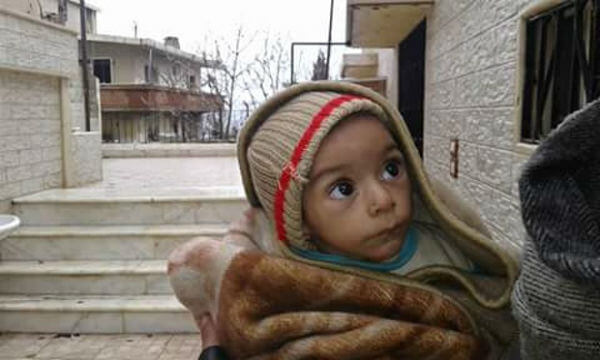
UN war crimes investigators gathering testimony from starving Syrian town

starving-child-madaya

Reuters reports: Residents of a besieged Syrian town have told U.N. investigators how the weakest in their midst, deprived of food and medicines in violation of international law, are suffering starvation and death, the top U.N. war crimes investigator told Reuters on Tuesday.

An aid convoy on Monday brought the first food and medical relief for three months to the western town of Madaya, where 40,000 people are trapped by encircling government forces.

Another United Nations official who oversaw the aid delivery described on Tuesday how he saw malnourished residents, particularly children, some of whom were little more than skeletons and barely moving.

The U.N. commission of inquiry documenting war crimes in Syria has been in direct contact with residents inside Madaya, the commission’s chairman Paulo Pinheiro said in an emailed reply to Reuters questions.

“They have provided detailed information on shortages of food, water, qualified physicians, and medicine. This has led to acute malnutrition and deaths among vulnerable groups in the town.” he said in the email sent from his native Brazil.

The U.N. inquiry, composed of independent experts, has long denounced use of starvation by both sides in the Syrian conflict as a weapon of war, and has a confidential list of suspected war criminals and units from all sides which is kept in a U.N. safe in Geneva. [Continue reading…]

Facebooktwittermail

Russia/Syria: Extensive recent use of cluster munitions

Human Rights Watch reports: The military offensive that the Russian and Syrian government forces opened against armed groups opposed to the government on September 30, 2015, has included extensive use of cluster munitions – inherently indiscriminate and internationally banned weapons.

The use violates United Nations resolution 2139 of February 22, 2014, which demanded that all parties involved in Syria end “indiscriminate employment of weapons in populated areas,” Human Rights Watch said. It also contradicts a statement issued by the Syrian Ministry of Foreign Affairs and Expatriates on November 9, 2015, in which it insisted that the Syrian Arab Armed Forces do not and will not use indiscriminate weapons.

“Syria’s promises on indiscriminate weapons ring hollow when cluster munitions keep hitting civilians in many parts of the country,” said Ole Solvang, deputy emergencies director. “The UN Security Council should get serious about its commitment to protect Syria’s civilians by publicly demanding that all sides stop the use of cluster munitions.” [Continue reading…]

Facebooktwittermail

Saudi Arabia bombs schools in Yemen

Amnesty: Saudi Arabia-led coalition forces have carried out a series of air strikes targeting schools that were still in use, in violation of international humanitarian law, and hampering access to education for thousands of Yemen’s children, said Amnesty International in a new briefing published today. The coalition forces are armed by states including the USA and UK.

The briefing ‘Our kids are bombed’: Schools under attack in Yemen, investigates five air strikes on schools which took place between August and October 2015 killing five civilians and injuring at least 14, including four children, based on field research in Yemen. While students were not present inside the schools during the attacks, the strikes caused serious damage or destruction which will have long-term consequences for students.

“The Saudi Arabia-led coalition launched a series of unlawful air strikes on schools being used for educational – not for military – purposes, a flagrant violation of the laws of war,” said Lama Fakih, Senior Crisis Advisor at Amnesty International who recently returned from Yemen. [Continue reading…]

Facebooktwittermail

Government attacks on Syria’s health care system

In the New England Journal of Medicine, Michele Heisler, M.D., M.P.A., Elise Baker, B.A., and Donna McKay, M.S., write: In July 2015, a 26-year-old pediatrician described to our team of Physicians for Human Rights (PHR) investigators his experiences in Aleppo, Syria’s most populous city. When he was a medical student in 2012, government forces detained and severely beat him. He now works as an emergency medicine physician and surgery resident in a hospital that has twice been bombed by the Syrian government. He lives in fear of being killed by bombs on his way to work or while there. His family wants him to leave Syria as they did, but he explained, “It’s our country, and if we leave, it will fall apart. At times, I think maybe I will leave and specialize and come back with better skills, but then I see how much the people need me. Maybe that’s the biggest thing that’s keeping me inside.”

Media coverage of Syria has focused on the exodus of refugees fleeing the sectarian warfare and the atrocities committed by the Islamic State. Less attention is paid to the Syrian government’s destruction of hundreds of hospitals and clinics in opposition-controlled areas and deaths of doctors, nurses, and other medical personnel. Since the conflict began in 2011, PHR has documented the killings of 679 medical personnel, 95% of them perpetrated by government forces. Some personnel were killed in bombings of their hospitals or clinics; some were shot dead; at least 157 were executed or tortured to death.

In July, a PHR team investigated the state of the health care system in eastern Aleppo.3 Though Aleppo does not reflect the worst of the destruction in Syria today, conditions there illustrate the consequences of these repeated attacks: the city’s medical facilities have been attacked nearly 50 times since opposition groups gained control of eastern Aleppo in 2012. The government has rained rockets, missiles, and since 2013, “barrel bombs” (100-to- 1000-kg barrels filled with explosives, shrapnel, nails, and oil that are dropped from helicopters and break into thousands of fragments on impact) on homes and civilian infrastructure, including hospitals. The number of barrel-bomb attacks reached an all-time high between April and July 2015. These bombs, which obliterate everything they hit and inflict head-to-toe injuries on anyone in their large blast radius, have had a devastating impact on life in eastern Aleppo. Only a quarter of the city’s 1.2 million residents remain, more than two thirds of the hospitals have stopped functioning, and roughly 95% of doctors have been killed or have fled. [Continue reading…]

Facebooktwittermail

Israeli expert: Trump’s call to kill terrorists’ families immoral, ineffective

CNN reports: A leading Israeli counter-terrorism expert says Donald Trump’s call to “take out” the families of terrorists would run afoul of international law and degrade the moral standing of the U.S.

“Any deliberate attacks aimed against civilians is a war crime, regardless if they are family members of terrorists or presidents or presidential candidates,” said Boaz Ganor, a former consultant to Israeli Prime Minister Benjamin Netanyahu.

“Adopting this policy is immoral and against the common liberal democratic values,” added Ganor, the founder and executive director of the International Institute for Counter-Terrorism in Israel. “Deliberate attacks against the terrorist families is blurring the moral differences between the terrorist organizations and the state which is fighting terrorism. This by itself might benefit the terrorists which are trying to claim that they are fighting a moral war against relentless and immoral entity.”

On Wednesday, Trump responded to a question on Fox News about minimizing civilian casualties in the fight against ISIS by saying the U.S. should hit the kin of enemy fighters.

“You have to take out their families, when you get these terrorists, you have to take out their families,” Trump said. “When they say they don’t care about their lives, you have to take out their families.” [Continue reading…]

It’s a shame Ganor wasn’t pressed to provide clarification on Israel’s long-standing policy of destroying the family homes of suspected terrorists. It’s immoral to kill family members but it’s ok to send in bulldozers to flatten their homes? Even Trump might find that confusing.

Facebooktwittermail

MSF hospital in Syria hit by ‘double-tap’ barrel bombing

The Guardian reports: A hospital supported by Médecins Sans Frontières in Homs has been partially destroyed in a “double-tap” barrel bombing, a signature tactic of the Syrian air force.

The strikes on the hospital in Zafarana, a besieged town in northern Homs, killed seven people including a young girl, MSF said in a statement, and prompted the movement to nearby field hospitals of many wounded, some of whom died on the way.

Saturday’s strikes were the latest in an apparent pattern of escalating attacks on medical facilities and doctors in the Syrian civil war, according to human rights organisations.

MSF, which operates and supports a number of health centres and field hospitals in Syria, said the attack bore the hallmark of a double-tap strike, whereby the first bombing is followed by a second one after paramedics have arrived to help the victims. “This double-tap tactic shows a level of calculated destruction that can scarcely be imagined,” said MSF’s director of operations, Brice de le Vingne. [Continue reading…]

Facebooktwittermail

U.S. official says use of chemical weapons is ‘routine’ in Syria

Reuters reports: Recent attacks with chlorine and mustard gas on the battlefield in Syria show that the use chemical weapons in the civil war is becoming routine, a U.S. official said on Monday.

A confidential report by the Organisation for the Prohibition of Chemical Weapons on Oct. 29 provided the first official confirmation of use of sulphur mustard, commonly known as mustard gas, in Syria since it agreed to destroy its chemical weapons stockpile, two years ago.

While the OPCW did not specifically say which of the many sides in the war used the chemical, diplomatic sources said it had been used in clashes between Islamic State and rebel fighters in the town of Marea in August, as well as in rebel-held areas under attack by Syrian government forces.

That raised the possibility, diplomatic sources said, that Islamic State had gained the ability to make it themselves, or that it may have come from an undeclared stockpile.

“The sad reality is that chemical weapons use is becoming routine in the Syrian civil war,” Rafael Foley, representing the United States, told a special session of the OPCW’s Executive Council, in remarks sent to Reuters. [Continue reading…]

Facebooktwittermail

MSF calls for independent and impartial investigation of U.S. attack on Kunduz hospital

BBC News reports: A US aircraft attacked a Medecins Sans Frontieres (MSF) clinic in the Afghan city of Kunduz because of “human error”, a US military inquiry said.

The investigation found the crew of the AC-130 gunship mistook the clinic for a nearby government building that had been seized by Taliban fighters.

At least 30 civilians were killed in the 3 October attack, amid a campaign to retake Kunduz from Taliban forces.

MSF said the report demonstrates “gross negligence” by the US military.

The group said the incident constituted “violations of the rules of war” and reiterated calls for an “independent and impartial investigation into the attack”. [Continue reading…]

Facebooktwittermail

ISIS suspected of using chemical weapons in Syria and Iraq

Reuters reports: Chemical weapons experts have determined that mustard gas was used in a Syrian town where Islamic State insurgents were battling another group, according to a report by an international watchdog seen by Reuters.

A confidential Oct. 29 report by the Organisation for the Prohibition of Chemical Weapons (OPCW), a summary of which was shown to Reuters, concluded “with the utmost confidence that at least two people were exposed to sulphur mustard” in the town of Marea, north of Aleppo, on Aug. 21.

“It is very likely that the effects of sulphur mustard resulted in the death of a baby,” it said.

The findings provide the first official confirmation of use of sulphur mustard, commonly known as mustard gas, in Syria since it agreed to destroy its chemical weapons stockpile, which included sulphur mustard.

The report did not mention Islamic State, as the fact-finding mission was not mandated to assign blame, but diplomatic sources said the chemical had been used in the clashes between Islamic State and another rebel group taking place in the town at the time.

“It raises the major question of where the sulphur mustard came from,” one source said. “Either they (IS) gained the ability to make it themselves, or it may have come from an undeclared stockpile overtaken by IS. Both are worrying options.”

Syria is supposed to have completely surrendered the toxic chemicals 18 months ago. Their use violates U.N. Security Council resolutions and the 1997 Chemical Weapons Convention.

The findings were part of three reports released to members of the OPCW last week. They add to a growing body of evidence that the Islamic State group has obtained, and is using, chemical weapons in both Iraq and Syria. [Continue reading…]

Facebooktwittermail

Médecins Sans Frontières releases internal review of Kunduz hospital attack

Médecins Sans Frontières reports: The international medical humanitarian organization Doctors Without Borders/Médecins Sans Frontières (MSF) today released an internal document reviewing the October 3 airstrikes by US forces on its hospital in northern Afghanistan. The chronological review of the events leading up to, during, and immediately following the airstrikes reveal no reason why the hospital should have come under attack. There were no armed combatants or fighting within or from the hospital grounds.

The document, part of an ongoing review of events undertaken by MSF, is based upon sixty debriefings of MSF national and international employees who worked at the 140-bed trauma center, internal and public information, before and after photographs of the hospital, email correspondence, and telephone call records. At least thirty people were killed in the airstrikes, including 13 staff members, 10 patients and 7 unrecognizable bodies yet to be identified.

“The view from inside the hospital is that this attack was conducted with a purpose to kill and destroy,” said Christopher Stokes, MSF general director. “But we don’t know why. We neither have the view from the cockpit, nor the knowledge of what happened within the US and Afghan military chains of command.”

The initial findings of the MSF review firmly establish the facts from inside the hospital in the days leading up to and during the attack. The review includes the details of the provision of the GPS coordinates and the log of phone calls from MSF to military authorities in attempt to stop the airstrikes. MSF had reached an agreement with all parties to the conflict to respect the neutrality of the hospital, based on international humanitarian law.

“We held up our end of the agreement — the MSF trauma center in Kunduz was fully functioning as a hospital with surgeries ongoing at the time of the US airstrikes,” said Dr. Joanne Liu, international president of MSF. “MSF’s no-weapons policy was respected and hospital staff were in full control of the facility prior to and at the time of the airstrikes.”

Among the 105 patients at the time of the airstrikes, MSF was treating wounded combatants from both sides of the conflict in Kunduz, as well as women and children.

“Some public reports are circulating that the attack on our hospital could be justified because we were treating Taliban,” said Stokes. “Wounded combatants are patients under international law, and must be free from attack and treated without discrimination. Medical staff should never be punished or attacked for providing treatment to wounded combatants.”

The MSF internal review describes patients burning in their beds, medical staff that were decapitated and had lost limbs, and others who were shot from the air while they fled the burning building.

“The attack destroyed our ability to treat patients at a time of their greatest need,” said Dr. Joanne Liu, international president of MSF. “A functioning hospital caring for patients cannot simply lose its protected status and be attacked.”

Facebooktwittermail

Russia dismisses questions about airstrikes on hospitals in Syria

EA Worldview reports: Russia’s Defense Ministry has tried a new line to dampen bad publicity over its airstrikes on hospitals in Syria, saying the medical facilities do not exist.

Major-General Igor Konashenkov said the accusations of several damaged hospitals, with the deaths of staff and patients, were “traditionally made without any proof, without any factual backing”. He claimed that, of six hospitals said to have been struck, only one is real. [Continue reading…]

Médecins Sans Frontières reports: Airstrikes in Syria have killed at least 35 Syrian patients and medical staff in 12 hospitals in northern Syria since an escalation in bombings began in late September, the international medical humanitarian organization Doctors Without Borders/Médecins Sans Frontières (MSF) said today.

According to staff at the hospitals, the attacks, which have also wounded 72 people, targeted medical facilities in Idlib, Aleppo, and Hama governorates, including six supported by MSF. Overall, six hospitals have been forced to close, including three supported by MSF, and four ambulances were destroyed. One hospital has since reopened, yet access to emergency, maternity, pediatric, and primary health care services remains severely disrupted. [Continue reading…]

Facebooktwittermail

At least 70 killed and 550 wounded in horrific market-bombing in Damascus besieged area

Médecins Sans Frontières reports: At least 70 people have been killed and 550 injured in an air strike on a marketplace in the Douma neighbourhood near Damascus, Syria.

As the nearest makeshift hospital had been bombed the previous day, medical workers struggled to cope with the influx of injured people. MSF fears the intensification of bombing that has been seen in northern and central Syria over the course of October could become even more horrific if it spreads to besieged areas around Damascus, where almost a million people are trapped with no way to escape, few medical facilities, and no options for medical evacuations of seriously wounded.

The devastation caused by the initial air strike on the market was exacerbated by further shelling on the rescue teams who were attending to the wounded. Two hundred and fifty patients required surgery, and a further 300 patients have been treated for non-surgical wounds. The multi-trauma wounds are described by medics as being worse than anything they have seen before.

“This was an extremely violent bombing,” says the director of a nearby MSF-supported hospital who assisted in the first wave of mass-casualty response. “The wounds were worse than anything we’ve seen before, and there were large numbers of dead. We had to do many amputations. And a lot of the wounded had massive blood-loss, which means we needed large amounts of IV-fluid and blood bags. We did out best to cope, but the number of critically wounded was far beyond what we could handle with our limited means.”

Because so many hospitals have been destroyed in Syria’s conflict, many facilities have moved services underground or split up services across different locations in a bid to remain operational. The entrance gate of the Douma makeshift hospital had been struck by bombing on Thursday, causing 15 dead and 100 wounded. Because the services had recently been split across several buildings, the hospital was able to respond to part of the mass casualty influx. However, the overwhelming numbers of critically wounded meant that no one single hospital could have coped, and six other makeshift hospitals also launched mass casualty response plans to help treat the wounded from the marketplace bombing. [Continue reading…]

Facebooktwittermail

Russian raids said to deliberately target rebel field hospitals in Syria

RFE/RL reports: Russian air strikes in Syria have deliberately targeted field hospitals in strategic opposition-controlled areas of Syria, killing and injuring staffers, disrupting their work and in some cases disabling hospitals altogether, opposition sources in Syria claim.

The head of the opposition-controlled Free Health Directorate of Aleppo, Yasser Darwish, told RFE/RL’s correspondent in Syria this week that since the Russian air campaign started on September 30, Russian warplanes had carried out over 40 raids on field hospitals in the southern Aleppo countryside, as well as in Hama and Idlib provinces.

The raids have damaged field hospitals in the southern countryside of Aleppo, including in Al-Eis, Al-Hadher, Khan Tuman, and Al-Zirba, Darwish said.

Civilian casualties were reported in Al-Zirba and Al-Hadher in Russian raids on October 15.

Other doctors, including Dr. Muhammad Tennari, the director of Sarmin hospital in Idlib Province, where at least 12 people were killed in an air raid last week, have also claimed that Russia is deliberately targeting medical facilities. [Continue reading…]

Facebooktwittermail

How the U.S. government condemns or ignores indiscriminate bombing

Micah Zenko writes: If you watch U.S. government press conferences, you will occasionally come across a moment of incidental but illuminating honesty. Yesterday, one such moment occurred during a routine press briefing with Col. Steve Warren, spokesman for Operation Inherent Resolve (OIR), the command element for the war against the self-declared Islamic State. Col Warren was asked about the growing number of disturbing allegations of Russia’s indiscriminate use of airpower in Syria. Just the day before, Secretary of Defense Ashton Carter told the Senate Armed Services Committee that, “it appears the vast majority of [Russian] strikes, by some estimates as high as 85 percent to 90 percent, use dumb bombs.” Warren echoed Carter’s assessment, claiming that, “Russians have chosen to use a majority of really, just dumb bombs, just gravity bombs, push them out the back of an airplane, and let them fall where they will.”

Col. Warren went further to castigate Russia for its use of one particular type of ordinance: “You know, there’s been reporting that the Russians are using cluster munitions in Syria, which we also find to be irresponsible. These munitions have a high dud rate, they can cause damage and they can hurt civilians, and they’re just, you know, not good.”

That cluster munitions are “not good,” except as a reliable method for killing noncombatants outside of an intended target field, is a well-known and established fact. According to one UN estimate, the failure rates for cluster munitions vary from between 2 and 5 percent (according to manufacturers) to between 10 and 30 percent (according to mine clearance personnel). They were subsequently banned by the UN Convention on Cluster Munitions, which entered into force in August 2010 and has been endorsed by ninety-eight states parties. Notable states that have refused to sign and ratify the convention include those that consistently uses airpower to achieve their military objectives, such as Russia, the United States, and Saudi Arabia. [Continue reading…]

Facebooktwittermail

Selective anti-imperialism: Why some bombings provoke more outrage than others

Sam Charles Hamad writes: Earlier this month in the Afghan city of Kunduz, the U.S. committed an apparent war crime. At some point in the early hours of Oct. 3, a U.S. gunship fired on a hospital run by Medicins Sans Frontieres, destroying the facility, killing 22 people and injuring over 30. There is no doubt of the criminality of this act — even if, as the U.S. and Afghani governments have suggested, the attack occurred due to Taliban militants having some presence within the hospital compound (a claim vigorously denied by eyewitnesses and victims), it was still a crime.

In the hours following the attack, many people of all political persuasions from around the world rightfully condemned it, but perhaps most vocal were those on the political left. Public outrage over war crimes is of course not just to be welcomed passively, but it can be actively useful in terms of demanding accountability from those who committed the crimes, while giving a voice to its victims. All too often, when it comes to activity against these acts of criminality, it is organizations, political parties, and individuals who identify with the left that lead the charge on these matters — the consequences of this can be impressive.

And the left are no longer marginal. The so-called “alternative media” is catching up with the mainstream media in terms of its reach, while political forces that identify as left-wing are now once again in the mainstream of politics, whether it’s forces like SYRIZA in Greece or Jeremy Corbyn’s new role as the leader of Her Majesty’s Opposition in the U.K. What these people do and say now matters on a global scale. Millions of politically-aware people from around the world hang on every word that prominent leftists write and say, whether it’s a figure such as Glenn Greenwald, whose news site The Intercept has become the go-to place for so-called “anti-imperialists,” or a leading politician such as Corbyn.

For a self-identified leftist like me, you might think I’d be over the moon at the way things were steadily — or exponentially, if you consider the rise of the left in this era relative to its fate in the past two decades — developing for the global left, but you’d be wrong. For there’s a bitter catch to all this. [Continue reading…]

Facebooktwittermail

Russian airstrikes in Syria appear to violate laws of war, says Human Rights Watch

Human Rights Watch: At least two air strikes in northern Homs on October 15, 2015, that local residents believed to be Russian, apparently violated the laws of war. The air strikes killed a total of 59 civilians, residents said, including 33 children and a commander of the local armed opposition group. Russia should investigate the attacks.

The deadliest attack hit a house in the village of Ghantou, where the extended Assaf family had taken shelter, killing a reported 46 family members, all civilians, including 32 children and 12 women, first responders and local activists said. The victims were related to a local commander affiliated with the opposition Free Syrian Army (FSA), but witnesses said that he was away from the home at the front lines. The second air strike, on the neighboring town of Ter Maaleh, hit near a bakery, and according to local witnesses, killed at least 13 civilians as well as a local FSA commander who was a Syrian army defector. It is not clear whether he was the intended target, as neither Russia nor Syria have issued statements about the specific air strikes. [Continue reading…]

Facebooktwittermail