Category Archives: Egypt

Egypt surprised by planned U.S. aid cut

The Wall Street Journal reports: Egypt bristled over Washington’s plan to reduce military aid to Egypt, saying the country would consider altering certain agreements with the U.S.

Some accords, such as American ships’ special access to the Suez Canal, should be “adjusted,” said Col. Ahmed Ali, the spokesman for the Egyptian military. “The U.S. is abandoning Egypt as it fights a serious war against terror,” he said. “This is a stance that doesn’t coincide with such a strong, long-standing relationship.”

Col. Ali said he wouldn’t comment further until after talking with Gen. Abdel Fattah Al Sisi, Egypt’s minister of defense and commander of the armed forces, who was informed of the decision by Defense Secretary Chuck Hagel.

The planned cuts come after a weekend in which more than 60 supporters of former President Mohammed Morsi were killed in street-level fights with security services. More than 1,000 Muslim Brotherhood supporters have now been killed by security forces and hundreds more arrested since the military ousted Mr. Morsi on July 3.

The crackdown on the Brotherhood showed no signs of abating on Wednesday, as prosecutors said Mr. Morsi, Egypt’s first-ever freely elected president, would face trial on Nov. 4 for inciting his followers to kill protesters against his rule late last year.

The announcement of the aid censure marks a new low point in the already frosty relationship between the U.S. and Egypt, once one of America’s closest security partners in the Middle East.

It is also emblematic of the shortfalls in U.S. messaging that have left both sides of Egypt’s tense political divide bitter over Washington’s role in the country, said Egyptian diplomats, analysts and policy makers.

The move was unlikely to exert strong pressure on Egypt’s military to abide by human-rights norms, experts say. At the same time, as news of the decision emerged late on Tuesday it reinforced the impression among many Egyptians that the Obama administration was supporting the ousted leadership of the Muslim Brotherhood, while not winning any points with Brotherhood supporters, either.

“What the U.S. is doing is the worst of both worlds right now,” said Shadi Hamid, an Egypt expert and head of research at the Brookings Institution’s Doha Center. “They’re not putting pressure on the military but they’re still going to anger the Egyptian population and make it seem like they’re punishing the military and suspending aid.” [Continue reading…]

Facebooktwittermail

U.S. officially halts millions in military aid to Egypt

CBS News reports: The U.S. is cutting hundreds of millions of dollars in aid to Egypt following the ouster of President Mohamed Morsi and the subsequent crackdown by the military-backed government.

The U.S. provides $1.5 billion in aid each year to Egypt. While the State Department did not provide a dollar amount of the aid being cut, it amounts to hundreds of millions in mostly military aid. The move had been debated for some time.
As CBS News State Department correspondent Margaret Brennan reports, how to deal with Egypt since the military coup has been one of the most vexing foreign policy questions for the Obama administration.

State Department spokeswoman Jen Psaki says the U.S. will withhold delivery of certain large-scale military systems as well as cash assistance to the Egyptian government until “credible progress” is made toward an inclusive government set up through free and fair elections.

The U.S. will continue to provide health and education assistance and money to help Egypt secure its borders, counter terrorism and ensure security in the Sinai.

Facebooktwittermail

Egyptian court sets trial date for ex-president Morsi

The Associated Press reports: The trial of Egypt’s ousted President Mohammed Morsi will begin on Nov. 4, authorities announced Wednesday, launching a politically charged prosecution of the country’s first democratically elected leader on charges he incited the killing of opponents while in office — and taking the crackdown against the Islamist leader and his Muslim Brotherhood to a new level.

The trial threatens to add to the turmoil gripping Egypt since the July 3 popularly supported coup that removed Morsi, as his Islamist supporters are likely to hold protests around his court appearances that could easily spiral into violence. Over past months, Brotherhood-led protests against the military have repeatedly turned to clashes with police that have left hundreds dead.

For the military-backed government, the trial is an opportunity to show justification for the broad crackdown it has waged against the Brotherhood — and ultimately for the removal of Morsi — by bringing out details of one of the tensest periods of Morsi’s presidency, when the president was clashing openly with the judiciary and coming under accusations of using Islamist mobs to suppress dissent.

But the military, which now dominates the country’s politics, also opens itself up to potential criticism it is merely carrying out show trials, trying to put a nail in the coffin of the Brotherhood, which accuses the army and its supporters of wrecking Egypt’s fledgling democracy.

Already there are questions whether the trial, in which Morsi and 14 other members of his Brotherhood are defendants, can be fair. Morsi has been held in secret military detention since his ouster, with almost no contact with the outside world beyond two phone calls with his family. His defense lawyers have not been allowed to talk to him yet, and they say they have not been shown the documentation of the prosecution’s case against him. [Continue reading…]

Facebooktwittermail

Egypt: out of the U.S. news but under General al-Sisi’s crackdown

Khaled Diab writes: No news is good news, the adage tells us. But just because something does not make it on to the evening news does not mean the situation has improved, as demonstrated by the US-sparked civil war in Iraq, which continues to exact a heavy toll.

Though the situation is nowhere near as bad, Egypt, too, has been eclipsed in the United States’ and much of the western media by the ongoing carnage in Syria, and by the new Iranian President Hassan Rouhani’s conciliatory gestures and charm offensive towards the west, not to mention the weekend’s US raids in Somalia and Libya.

But it is still very much news for us Egyptians and those who take a deep interest in the future of the country. In fact, as my four-year-old and I embark on a trip home to his “fatherland”, I am plagued by worries and dogged by questions.

How much further will the violence escalate? Where will the clash between pro-military jingoism and divine demagoguery lead the country?

Borrowing from the neocon American lexicon once so despised in Egypt, General Abdel-Fattah al-Sisi’s “war on terror” has, like its US counterpart, mushroomed into a war of terror, as reflected in the death this week of at least 50 people during pro-Morsi protests. [Continue reading…]

Facebooktwittermail

U.S. plans to curb military aid to Egypt

The Washington Post reports: The Obama administration will announce curbs on a significant part of nonessential military aid to Egypt within a few days, U.S. officials said Tuesday, marking a shift in America’s relations with one of its key Arab allies.

Officials would not provide figures about how much of the annual $1.2 billion in military aid would be withheld, but they said the primary focus will be a hold on the shipment of a dozen AH-64D Apache helicopters from an order placed four years ago.

Provision of crucial spare parts for the extensive U.S. military equipment that Egypt already has and training for the country’s armed forces will continue, officials said. They said aid that supports counterterrorism initiatives and Egypt’s relations with Israel, including security efforts in the Sinai Peninsula and monitoring along the border with the Gaza Strip, would also continue.

U.S. officials described the decision — which comes three months after a military coup toppled Mohamed Morsi, Egypt’s first democratically elected president — on the condition of anonymity. Neither Congress nor Egyptian officials have been notified of the decision, and the announcement could be postponed. [Continue reading…]

Facebooktwittermail

Police openly beat Muslim Brotherhood sympathizers in Cairo

McClatchy reports: Egyptian security forces on Sunday openly beat demonstrators sympathetic to the Muslim Brotherhood, without any provocation, in a sign of how the once powerful group has become the target of official suppression.

The police reaction to the Brotherhood march stood in stark contrast to the scene blocks away, where pro-military crowds, summoned to celebrate Egypt’s war with Israel 40 years ago, hoisted soldiers and police on their shoulders and offered cheers.

The difference was apparent to two McClatchy reporters who left the pro-military demonstration to cover the Brotherhood gathering. As they witnessed police beatings, the two reporters were pounced on by security officers, who stole their cell phones and cameras and threatened to haul one away. The abuse ended only after the reporters proved they’d been at the other rally by pulling out posters of Defense Minister Abdel-Fattah El Sissi, the head of the military who engineered the toppling of President Mohammed Morsi in July.

At previous demonstrations, Egyptian security forces have said the Brotherhood, the secretive organization through which Morsi ascended to office, instigated the clashes, some of which left hundreds dead.

But on Sunday, there was no sign of Brotherhood provocation. The beatings took place well away from the huge crowds that were celebrating the military. Residents nearby also played a role, refusing to give Brotherhood sympathizers shelter as they sought to flee the security forces’ onslaught. [Continue reading…]

Facebooktwittermail

Canadians freed in Egypt still face travel ban

The Guardian reports: Two Canadians held without charge inside one of Egypt’s most notorious prisons were released unexpectedly from custody early on Sunday morning.

The renowned film-maker John Greyson and emergency medic Tarek Loubani had been detained for over seven weeks after being arrested while observing protests in Cairo on 16 August. Like many of the protesters arrested that day, they were held on suspicion of murder and intention to kill. In a letter their lawyers later smuggled from prison, the pair said they had been beaten in custody, and were being held in an overcrowded, cockroach-infested cell.

Their release this weekend came as a surprise, coming shortly after Egyptian authorities ordered their detention for another 45 days. Officials had also recently implied the pair had been acting as foreign spies, a symptom of widespread nationalism and xenophobia that has spread across Egypt since the overthrow of ex-president Mohamed Morsi in July.

The news sparked jubilation in Canada, where the pair’s detainment had become a cause célèbre, with Alec Baldwin and Charlize Theron among 150,000 people who had signed a petition calling for their release.

Reuters adds: Two Canadians freed at the weekend after being held in Egypt for more than six weeks without charge are still barred from flying home, their lawyer said on Monday.

“When the men went to the airport they found there was a travel ban with their names on it and so they couldn’t travel and came back to Cairo,” Marwa Farouk, the lawyer representing John Greyson and Tarek Loubani, told Reuters.

“I am appealing to the prosecutor general to lift the travel ban,” said Farouk, who had said the previous day that the Canadians were flying to Toronto after their release.

Facebooktwittermail

Clashes across Egypt kill 51, more protests called

The New York Times reports: At least 51 people were killed as street clashes erupted in several Egyptian cities on Sunday, in a surge of violence that raised new questions about the ability of the interim government to secure the fractured country.

The death toll was the highest in a single day since mid-August, when the authorities began their punishing crackdown on Islamist supporters of former President Mohamed Morsi, who was ousted by the army on July 3. The military-backed government that replaced him has tried to project an aura of stability in order to lure back the tourists and investors scared off by several years of turmoil in the country.

But on Sunday, only grim, familiar scenes of violence returned, along with the sounds of gunfire.

The deadly bloodshed came as thousands of Egyptians celebrated the 40th anniversary of the 1973 war with Israel, setting up a day of bizarre contrasts that served as reminders of Egypt’s deepening polarization since the ouster of Mr. Morsi.

As the military’s supporters celebrated the anniversary in Tahrir Square in Cairo with music and fireworks, officers and armed civilian loyalists set upon Islamist protesters who were also trying to reach the square, driving back their marches with tear gas and gunfire.

More than 250 people were injured, officials said.

Over the last three months, with little resistance from the public, the military has set out to vanquish the Muslim Brotherhood, the Islamist group that propelled Mr. Morsi to power. Since July, hundreds of Brotherhood members have been killed and most of the movement’s leaders have been sent to jail or fled the country.

And Mr. Morsi’s Islamist supporters, who have re-branded themselves under the banner of the “anti-coup” movement, have continued to protest even with the repression of their marches and sit-ins, and despite dwindling attendance at their demonstrations.

They had billed the protests on Sunday as their own tribute to the armed services, while promising a new level of confrontation: for the first time since Mr. Morsi’s ouster, the Islamists called for marches on Tahrir Square, a stronghold of the anti-Morsi movement. [Continue reading…]

Facebooktwittermail

In leaked video, Egyptian army officers debate how to sway news media

The New York Times reports: A leaked video of senior Egyptian Army officers debating how to influence the news media during the months preceding the military takeover offers a rare glimpse of the anxiety within the institution at the prospect of civilian oversight.

In the leaked six-minute clip of a private meeting led by Gen. Abdul-Fattah el-Sisi in the period before his July 3 ouster of President Mohamed Morsi, the officers express their dismay at public scrutiny of the army, unknown in Egypt until after the 2011 uprising. Calling even mildly disrespectful news coverage “dangerous” and abnormal, the officers call for a restoration of “red lines” that had protected the military for decades. And they urge General Sisi to pressure the roughly two dozen big media owners into “self-censorship.”

Mixing humor and cool confidence, General Sisi tells the officers that they must adjust to the new reality of public and parliamentary oversight, but he also counsels patience while he recruits allies in the news media.

“Building a statewide alliance takes a long time and effort,” he continues. “It takes a very long time until you possess an appropriate share of influence over the media.”

“The revolution has dismantled all the shackles that were present — not just for us, not just for the military, but for the entire state,” he says at another point. “The rules and the shackles were dismantled, and they are being rearranged.”

The officers’ winter uniforms and references to last December’s constitutional referendum suggest the meeting took place around that time. But the conversation foreshadowed the broad media crackdown that has played out since the military takeover. The new government has shut down Islamist television networks and the main newspaper supporting Mr. Morsi, and the police have arrested several journalists perceived as critical of the government or the military. And for whatever reason, privately owned newspapers and satellite networks now resound with cheers for the army and demonization of its Islamist opponents, just as the officers hoped.

The leak of the video, though, may raise different alarms. The clip was one of several snippets of the same meeting released Wednesday night and Thursday by RNN, an Islamist Web site, and in an interview, its acting director, Amr Farrag, said the material was obtained from “sources inside the military.” Military officials said Thursday that the army was starting an investigation.

Analysts said the video offered insights into motivations that might have helped propel the military’s takeover. “It betrays a real fear of what democratic discourse might look like and what that would mean for the military, in terms of what might be talked about and what might be exposed,” said Michael Wahid Hanna, a researcher on Egypt at the Century Foundation in New York.

The officers’ thin skin about the loss of the military’s “red lines,” he argued, is symptomatic of a much deeper worry. “If the military can be talked about in these unprecedented ways, the concern is that it erodes the stature of the military in the public imagination, and then the role of the military as an institution is potentially under threat.” [Continue reading…]

Facebooktwittermail

Egypt draws up plans to bomb Gaza

Ma’an News Agency reports: The Egyptian army has established a precautionary plan for military intervention in the Gaza Strip if attacks on Egyptian troops in the Sinai Peninsula intensify, Egyptian security officials said Wednesday.

Officials told Ma’an that Egyptian reconnaissance planes had entered the Gaza Strip’s airspace and examined a number of locations in Rafah and Khan Younis to be targeted if military attacks against Egyptian troops intensify in Sinai.

Egyptian aircraft could also target vehicles which travel across the border area delivering smuggled goods, sources added. More smuggling tunnels could also be destroyed, and sources highlighted that “all options are open.”

According to Egyptian military sources, the ongoing attacks in Sinai are carried out by organizations based both in Sinai Peninsula and in the Gaza Strip.

Certain militant groups in the Gaza Strip, according to Egyptian officials, are “behind the violence” in Sinai, including Ansar al-Sunna, which has ties to Hamas, as well as Ansar Beit al-Maqdis, among others.

As a result, sources argue that in order to maintain control over the Sinai, the Egyptian army has no choice but to shut down all smuggling tunnels and strike targets in Gaza if further red lines are crossed.

“The Egyptian army does not believe the population of Gaza is involved in the violence in Sinai, but certain factions strongly support Sinai groups. The tunnels play a major role in the communication between both sides,” a senior Egyptian official told Ma’an.

“In addition, Hamas, although its involvement is limited, is responsible for maintaining control of the smuggling tunnels as well as the factions operating in the coastal enclave,” he added.

Facebooktwittermail

What happened to Egypt’s liberals after the coup?

Sharif Abdel Kouddous writes: Khaled Dawoud worked hard to remove Mohamed Morsi, Egypt’s first democratically elected president, from office.

As the spokesperson for the National Salvation Front, a loose coalition of non-Islamist parties and groups formed last November, he was a well-recognized voice of opposition to Morsi and the Muslim Brotherhood. In the weeks leading up to June 30, Dawoud traveled across the country, helping to drum up support and organize logistics for the massive anti-Morsi protests.

After the army ousted Morsi on July 3, Dawoud was a regular guest on local and international news channels, vociferously defending the overthrow and arguing that the president’s removal did not constitute a military coup.

“I do not have any regrets over Morsi’s removal because the Muslim Brotherhood were posing a major threat to the future of this country,” he says. “They betrayed every single principle of the Egyptian revolution.”

Yet now, Dawoud finds himself at odds with the group he once represented, and he is vilified by many of his former political allies.

The turning point came on August 14, when the military and security forces brutally cleared the two mass sit-ins in Cairo that formed the epicenter of support for the ousted president. Hundreds of people were killed in what Human Rights Watch describes as “the most serious incident of mass unlawful killings in modern Egyptian history.”

The National Salvation Front leadership, which includes former presidential candidates Hamdeen Sabahi and Amr Moussa, put out a statement applauding the raids. Two days later, Dawoud—who describes himself as a “leftist, not a liberal”—resigned as the group’s spokesperson.

“We wanted a political deal, we wanted Morsi removed, but we didn’t want to suppress [the Muslim Brotherhood] or kill them or consider them an outlawed organization,” he says, sitting on a heavily cracked black leather couch in the offices of Al-Ahram Weekly, the state-owned English-language publication where he has worked as a journalist since 1996. After resigning, he says, “even some close friends called me a Brotherhood sympathizer, a secret cell, a traitor and a US agent.”

Dawoud’s story is emblematic of Egypt’s convoluted political landscape, whose fault lines have shifted and rearranged in the aftermath of Morsi’s overthrow and the subsequent brutal crackdown on the Brotherhood and its allies.

Opposition to Morsi grew throughout his time in office, eventually stretching across nearly every sector of Egyptian society. It also had grassroots support, manifested in more than 9,000 protests and strikes during his year-long rule that culminated in calls for early presidential elections and the unprecedented June 30 mobilization.

His opponents included a broad swath of political and social movements, often characterized by conflicting ideologies and grievances. It included revolutionary activists, labor unions, human rights advocates, the Coptic Church, intransigent state institutions, former Mubarak regime members and sidelined business elites as well as the formal opposition—the flock of non-Islamist political parties and figures routinely lumped together as “liberals,” despite the fact that many of them have rejected any notion of political pluralism, a defining characteristic of liberalism.

The result has been a confusing, and increasingly atomized, political landscape. Of the disparate groups opposed to Morsi, some actively sought military intervention, fewer opposed any military role, while others—like Dawoud—stood by the military as it ousted the president, but eventually broke away in the face of mounting state violence and mass arrests of Islamists under the guise of a “war on terror.”

The military—which formed a coalition of convenience with the Brotherhood for much of 2011 to manage the post-Mubarak landscape and hold revolutionary aspirations and unfettered popular mobilizations in check—successfully co-opted the movement against Morsi and, along with the security establishment, emerged as the clearest winner from his overthrow. [Continue reading…]

Facebooktwittermail

Remember Cairo?

Shadi Hamid and Peter Mandaville write: With the world focused on the crisis in Syria and the possibility of a U.S.-Iranian détente, the fact that Egypt’s political situation is going from bad to worse has flown under the political radar. Much to the relief of the generals in Cairo — and likely also some members of U.S. President Barack Obama’s Middle East policy team — the United States appears to be kicking another difficult regional policy decision down the road.

This is a mistake. By countenancing the July 3 coup and the military’s subsequent crackdown on the supporters of ousted President Mohamed Morsy, the United States may be helping to sow seeds that could ripen into a costly and deeply destabilizing insurgency for years to come.

The Obama administration responded to the military crackdown, which resulted in more than 1,000 deaths, with the diplomatic equivalent of a few light raps on the knuckles of Egypt’s generals. It canceled joint military exercises with Egypt and announced that the White House’s national security staff would begin a comprehensive review of bilateral aid. Since late August, a recommendation to suspend the majority of U.S. military assistance to Cairo has been sitting with the president. Meanwhile, Egyptian security forces have re-escalated their campaign against the Muslim Brotherhood, raiding the movement’s strongholds and arresting the few remaining senior Brotherhood figures not already in custody.

The Obama administration knows that things are not going well in Egypt. U.S. officials — privately and rather halfheartedly — tried to walk back Secretary of State John Kerry’s bizarre claim that Egypt’s military leaders were “restoring democracy” and have also delayed delivery of F-16 fighters to Egypt. However, Washington’s overall response to the undoing of Egypt’s democratic process has not come close to matching the gravity of the crisis.

The Obama administration’s anemic response is indicative of the larger strategic drift of America’s response to the 2011 Arab uprisings. In the immediate aftermath of the revolutions in Egypt and Tunisia, Obama admitted that the United States had not pushed hard enough for democracy in the Arab world, and he promised a new way of doing business in the region. At arguably every major juncture since then, however, whenever Washington has had the opportunity to demonstrate its support for genuine democracy in Egypt, it has instead opted for some version of the “authoritarian bargain” that characterized U.S. regional policy for decades. [Continue reading…]

Facebooktwittermail

Westerners’ smuggled letters offer glimpse of Egyptian prisons

The New York Times reports on the conditions inside Egypt’s prisons revealed through the accounts provided by several Western prisoners including a United States citizen, Mohamed Soltan.

Mr. Soltan is a 25-year-old graduate of Ohio State University who moved to Egypt in February to work in the petroleum industry, said his sister, Hanaa Soltan, a clinical social worker in Washington, D.C.

Their father, Salah Soltan, a professor at Cairo University, is an outspoken member of the Muslim Brotherhood but hardly a die-hard. He made headlines in September when he publicly apologized for the Brotherhood’s mistakes, including failing to ally with liberal activists. Brotherhood officials dismissed the apology as Mr. Soltan’s personal views, and a few days later he, too, was arrested.

Ms. Soltan said her brother had been an opponent of the Brotherhood “and very vocal about it as well.”

But she said that after Gen. Abdul-Fattah el-Sisi responded to a wave of mass protests by ousting Mr. Morsi, her brother joined a Brotherhood-led sit-in at Rabaa Square here to defend what he considered the norms of American-style democracy. “He thought it did not matter how incompetent the elected leaders are,” she said. “There is no hope of realizing the fruits of the revolution if you don’t respect democracy and you throw out the results of the ballots on the basis of displeasure at someone’s missteps.”

Mr. Soltan was shot in the arm on Aug. 14, when security forces broke up sit-ins at Rabaa and another square, killing nearly a thousand people. He was recovering from surgery to remove the bullet when the police raided his home and arrested him, he wrote in his letter, which he addressed to his mother.

Thrown into a group cell nicknamed The Fridge, “a room without seats, benches, windows and lights,” he recalled that one guard joked “that he could get me anything I wanted, drugs, alcohol, prostitutes. Just not due process.”

Mr. Soltan wrote that he was blindfolded and questioned the next morning and told he would be charged with six crimes, none of which, he said, had “any basis in reality,” including “membership in a terrorist organization, membership in an armed militia, disturbing the peace, falsifying and spreading rumors about the internal affairs of Egypt, and finally, the killing of protesters.” (Interior Ministry officials have sometimes argued, implausibly, that Brotherhood snipers fired at the Brotherhood’s supporters.)

Mr. Soltan expressed shock and surprise over a ritual that Egyptians consider standard for criminal suspects: The detainees ran between rows of security officers who struck them with rocks and sticks, known here sarcastically as the Tashreefa, or honoring ceremony.

“The officers stripped off our pants and shirts as they beat us with clubs,” he wrote. [Continue reading…]

Facebooktwittermail

Eliminate the Brotherhood at your peril

Rami G Khouri writes: An Egyptian court’s decision Monday to ban all activities in the country by the Muslim Brotherhood is the kind of foolish act that autocratic governments take when they do not know how to engage in a process of democratic pluralism and seek refuge in their mistaken sense of infallibility. The real issue at hand is not a decision by a minor court regarding the legality of the Muslim Brotherhood’s registration last March; it is rather about the ongoing attempt by the armed forces and allied political groups to eliminate the Muslim Brotherhood from the public scene in Egypt.This is foolish in every respect – in politics, culture, religion, constitutionalism – and shows the crude immaturity of the armed forces as an instrument of governance. The ongoing assault against the Muslim Brotherhood has included killings, beatings and mass arrests that have temporarily thrown the organization into disarray. Trying to eliminate it will not work, and will only send Egypt into a deeper cycle of political polarization, immobility and some violence. Egypt requires pluralism, engagement, negotiations and compromise, in order to achieve consensus on key issues. Banning the Brotherhood goes against all these imperatives, and will only make things worse.

Egypt is passing through a period of relativities, not absolutes, regarding both the armed forces and the Brotherhood who are both key actors in society. The vast majority of Egyptians have repeatedly asserted that they trust the armed forces to manage a short-term transitional process that ends with the installation of a legitimate, elected government, president and parliament.

The citizenry also values the security forces’ role in ensuring stability and security throughout the country. But Egyptians do not want the military to rule the country. They experienced that for 60 years from 1952 to 2011. The revolution in January 2011 demonstrated their clear rejection of that kind of system that saw Egypt become a forlorn global backwater of mediocrity and mismanagement. Egyptians do not view the military in absolute, black-and-white terms.

Similarly, Egyptians also do not view the Muslim Brotherhood and other Islamists in absolute terms, but rather through a much more nuanced lens of relative benefits, concerns and practical efficiencies. The Brotherhood was the leading opposition movement in the country for decades, and paid the price for its courage by having thousands of its members jailed and tortured. Its social assistance programs endeared it to millions of poor Egyptians, as did its provision of the basic succor of religious hope and faith. It was always present at the local level in neighborhoods and villages everywhere. It spoke the language of the ordinary man and woman. It was always a strong element in the basic values and the core identity of most Egyptians. It did all these things naturally and efficiently, while the old soldiers who ruled the country with an iron fist did almost none of these things. [Continue reading…]

Facebooktwittermail

Egyptian court bans Muslim Brotherhood in ongoing campaign to eradicate the million-strong movement

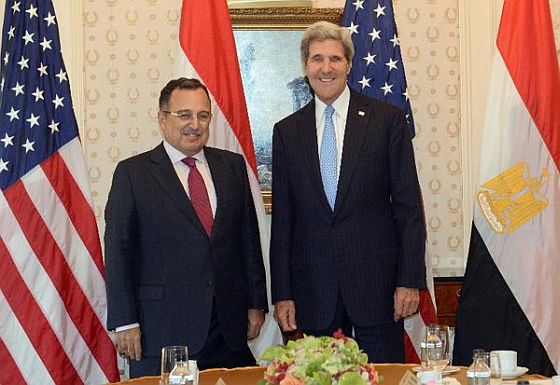
Egypt's Foreign Minister Fahmy meets with U.S. Secretary of State John Kerry in New York, September 22, 2013

Egypt's Foreign Minister Fahmy meets with U.S. Secretary of State Kerry in New York, September 22, 2013

“Things are moving forward in Egypt,” is the message officials are taking to the UN this week. Egypt’s rulers following the military coup in July want to placate Washington’s nominal concerns about democracy with this assurance:

Events for the most part are on the right track in Egypt, despite inevitable hiccups; the state is committed to a transitional process that will result in a referendum on an amended – and hopefully less controversial – constitution, and a full democratic process will be pursued.

Having ousted President Mohamed Morsi, killed hundreds of members of the Muslim Brotherhood and imprisoned thousands more, the effort to destroy the movement shows few signs of restraint.

“The plan is to drain the sources of funding, break the joints of the group, and the dismantle podiums from which they deliver their message,” a senior Egyptian security official tells Associated Press, using language reminiscent of then defense minister Yitzhak Rabin’s “broken bones” campaign as Israel attempted to crush the first Palestinian intifada.

Reuters reports: Murad Ali says he was put in a foul-smelling cell on death row, sleeping on a concrete floor, and denied light and human contact after his arrest in Egypt’s crackdown on the Muslim Brotherhood. “It was as dark as a grave,” he wrote in a letter addressed to friends and family and seen by Reuters.

The army-backed authorities deny claims Brotherhood leaders have been mistreated, and there is no way to independently verify such accounts; but people who have spoken to them in jail say some have been kept in similar conditions for days on end.

Their relatives describe it as a bid to break their spirit – a measure of the severity of the campaign against the group that was swept from power by the military on July 3, when Mohamed Mursi, a Brotherhood member, was deposed.

Analysts say it points to a state effort to weaken the Brotherhood by decapitating it. The movement says it has up to one million members and it is one of the most influential Islamist groups in the Middle East.

The New York Times reports: An Egyptian court on Monday issued an injunction dissolving the Muslim Brotherhood and confiscating its assets, escalating a broad crackdown on the group less than three months since the military ousted its ally, President Mohamed Morsi.

The ruling, by the Cairo Court for Urgent Matters, amounts to a preliminary injunction shutting down the Brotherhood until a higher court renders a more permanent verdict. The leftist party Tagammu had sought the immediate action, accusing the Brotherhood of “terrorism” and of exploiting religion for political gain. The court ordered the Brotherhood’s assets to be held in trust until a final decision.

If confirmed, the ban on the Brotherhood — Egypt’s mainstream Islamist group — would further diminish hopes of the new government’s fulfilling its promise to restart a democratic political process that would include Mr. Morsi’s Islamist supporters. For now, though, it effectively formalizes the suppression of the Brotherhood that is already well under way.

Since Mr. Morsi’s ouster, the new government appointed by Gen. Abdul-Fattah el-Sisi has killed more than 1,000 Brotherhood members in mass shootings at protests against the takeover and arrested thousands more, including almost all of the group’s leaders. Security services have closed offices of the group and its political party in cities around the country. Members are now sometimes afraid to speak publicly by name for fear of reprisals.

Abdullah Al-Arian writes: The military’s intervention reflects a longstanding desire among elements of the former regime to rid Egypt of its revolutionary movement and destroy any progress toward the establishment of democratic institutions.

If those intentions were not obvious in their posturing before July 3, they have certainly become clear since then. In the six-week long crisis that followed, there was no genuine attempt by the military-appointed interim government to resolve the situation in a manner that would allow Egypt to remain on the revolutionary track or even to avoid unnecessary bloodshed. The total war strategy employed against the Muslim Brotherhood and its supporters was meant to emulate the repression of prior eras, but on an even wider scale, due to the perception of widespread public support for this move.

Staying true to form as a movement with strong internal discipline and the capacity to mobilize, the Muslim Brotherhood employed the only means at its disposal, a non-violent mass protest, to oppose the clear attempts to overturn its democratic gains and destroy its presence in society for the foreseeable future. In fact, the Rabaa protests took the group’s leadership back to a place with which it is all too intimately familiar, the perpetual victimhood upon which it has built its eight-decade legacy. Far from the challenges of governance, the anti-coup protests recalled the common theme of standing up to tyranny and repression that marked the Muslim Brotherhood’s experiences under successive authoritarian rulers.

The military’s disproportionate response to the protests, unprecedented in Egypt’s modern history, reflects an attempt to establish a new political and social order that would not only marginalize the Muslim Brotherhood, but would destroy it altogether. The wholesale adoption of the “war on terror” discourse by the state and its media arm is not only intended to make the alarmingly high number of casualties seem justifiable. As with the Bush era policy of the same name, this paradigm is meant to convince those watching from the sidelines that the Islamic activist impulse that has been part and parcel of Egyptian society for a century could conceivably be eradicated.

The muted response from the liberal, leftist, and progressive currents within society suggest that this tactic has worked, with most groups hoping that the wave of violent repression is not indicative of a wider trend aimed at rolling back the gains of the revolution. Beyond wishful thinking, however, there is little to challenge the notion that the counter-revolution is in full swing.

Wishful thinking is in evidence today with the creation of a new anti-Brotherhood and anti-military group called the The Way of the Revolution Front (Facebook).

Facebooktwittermail

Secret recordings reveal Mubarak’s frank views on the U.S., Israel and the Brotherhood

The New York Times reports: Hosni Mubarak looked like a stalwart American ally but worried for years that Washington was trying to oust him as president of Egypt, he confided to a doctor recently in surreptitiously recorded conversations that came to light here last week.

“How did the revolution start?” Mr. Mubarak mused about his ouster, in early 2011. “The Americans worked on it since 2005, and I had a feeling then.”

The conversations were recorded over a period of months this year and were authenticated over the weekend when the doctor, an ear, nose and throat specialist, was summoned to testify about them. They offer a rare, unadulterated taste of the former president’s attitudes about a host of subjects — Washington, Israel, his Arab neighbors, Jews, the Muslim Brotherhood, Egypt’s new military leaders and most of all himself.

For all the aid the United States gave Egypt during his 30 years in power, his comments suggest that Washington gained little sway over Mr. Mubarak. And he expressed nothing but pride in his rule despite the steady decline of Egypt’s economy and influence.

The Islamists who won power after his removal “blame ‘the former regime’ for everything,” Mr. Mubarak is heard complaining in one recording. Speaking of the Egyptian population, he said, “They lived — they were 43 million when I received them and 90 million when I handed them over.”

The recordings were released last week through the Web site of the newspaper Youm el-Saba, and quickly captivated Egyptians with details like Mr. Mubarak’s boasts of his heroism as a pilot in the 1973 war against Israel, and his shock at the high prices of groceries. “An egg is one pound?” he said in shock, joking, “So let’s eat potato sandwiches!”

Mr. Mubarak apparently did not foresee the ouster in July of his successor, Mohamed Morsi of the Muslim Brotherhood. In a recording made in the spring, he was asked whether he thinks the military will act to stop the turmoil between Mr. Morsi’s opponents and his supporters; he responded, “What would they do?” He is heard guessing wrongly about Gen. Abdul-Fattah el-Sisi, the head of the military, saying he thought General Sisi supported Mr. Morsi and his Islamist allies: “The defense minister, I think, is to their liking.”

He realized his mistake after General Sisi seized power. In a later recording, someone said the general had turned out not to be a Muslim Brotherhood supporter after all. Mr. Mubarak laughed wryly: “No, no, he turned out to be devious.” [Continue reading…]

Facebooktwittermail

Egypt’s crackdown on Morsi supporters called worse than Mubarak era

McClatchy reports: In the two months since Egyptian authorities started rounding up supporters of ousted President Mohammed Morsi, a repressive regime has emerged here that appears to be far worse than the one political activists thought they’d ended when they pushed Hosni Mubarak from office two and a half years ago.

Egyptians caught in the roundup have told McClatchy they were tortured while awaiting charges. Islamist leaders claim that the government is rounding up family members in the night as leverage against them. Lawyers tasked with representing arrested Morsi supporters often are arrested when they go to be with their clients during prison interrogations. Once again, civilians are facing their charges in military courts.

“I saw torture chambers that made me wish they would shoot my husband dead,” said one woman who was arrested the same day her husband also was seized. “I would rather see him, the father of three children, dead than tortured,” she recounted in a phone interview, her voice still shaking 10 days after her two-week detention.

The woman, who asked not to be identified for fear she’d be arrested again, said she was mistreated while in custody but hadn’t been tortured. Her account matches that of other prisoners, who say they’ve gone on hunger strikes to protest the crowded conditions and refusals to let them see their lawyers.

Not just Morsi supporters have been arrested. A growing number of journalists and human rights advocates also have been detained, leaving fewer eyes to document what’s happening.

Ahmed Helmi, a human rights lawyer who represents many of those arrested, estimated that as many as 10,000 people have been arrested since the military deposed Morsi on July 3. That’s far more than human right groups’ estimates of 3,000. Diplomatic officials told McClatchy the number could be 5,000. [Continue reading…]

Facebooktwittermail

Egypt troops storm Islamist stronghold near Cairo

The Associated Press reports: Egyptian security forces backed by armored fighting vehicles and helicopters stormed a tourist town near the Great Pyramids that became an Islamist stronghold on Thursday, the latest in a stepped up campaign by the military-backed government to put down armed supporters of the ousted president.

As they moved into Kerdasa at around 6 a.m., the troops and policemen came under barrages of fire from gunmen on rooftops. Militants took control of the town just outside Cairo more than a month ago amid a nationwide backlash of violence by Islamists enraged by the military coup that removed President Mohammed Morsi and by a crackdown against his supporters that followed.

A police general fell in the first moments of the battle. Gen. Nabil Farrag had just given a pep talk to his men on the street, preparing them to roll into the town, when they came under a hail of gunfire, according to an Associated Press video journalist and a photographer working with AP. [Continue reading…]

AFP reports: Gaza rulers Hamas and residents of the Palestinian territory fear Egypt’s destruction of tunnels used to smuggle goods across the border is part of a plan to tighten a blockade of the Strip.

“The Egyptian army has destroyed 95 percent of the tunnels with the aim of setting up a security buffer zone,” Sobhi Ridwan, head of the Palestinian municipality in the border town of Rafah, told AFP.

Hamas spokesman Fawzi Barhum echoed the concern.

“We have big fears of a buffer zone being set up and the tunnels all being shut down,” Barhum said.

Egypt’s army has destroyed many of the tunnels on the Egyptian side of Rafah which are used to smuggle goods, including building material and fuel, into the blockaded Palestinian territory. [Continue reading…]

The New York Times reports: Security forces on Tuesday arrested Gehad el-Haddad, a senior official of the Muslim Brotherhood who handled the group’s communication with the foreign news media, security officials said. His arrest was part of a continuing roundup of thousands of Brotherhood members in the two months since the military ouster of President Mohamed Morsi, an ally of the group.

Mr. Haddad is an aide to Khairat el-Shater, a Brotherhood leader who was arrested last month, and the son of Mr. Morsi’s top foreign policy adviser, Essam el-Haddad, who was detained with Mr. Morsi at the time of the takeover. The arrests have already swept up much of the group’s leadership, effectively crippling its organizational ability.

Facebooktwittermail
