Category Archives: Egypt

Street fighters hold down the frontline against police

Al-Masry Al-Youm reports: During ongoing anti-military protests that erupted last week, a clear divide has emerged between the Gandhis and the Gueveras, in other words, the thousands who chant and march peaceably in Tahrir Square and the hundreds who throw rocks, bottles and Molotov cocktails in downtown Cairo’s side streets.

“We’re fighting the police because they are thugs,” 17-year-old Mohamed Karam said at the time, as he prepared to launch a Molotov cocktail at the “thugs” down the street. “The thuggery of the Central Security Forces (CSF) is the same as it was during the days of Mubarak. In fact, they might have grown more repressive since the revolution,” he added. In the background, dozens of Karam’s comrades chanted, “The police are thugs!”

This sentiment was common among frontline fighters.

“The authorities are calling us thugs on state-owned radio and TV, but in reality it is the police who are thugs,” Ahmed Atwa, a 29-year-old street vendor, said. He pulled down the neck of his shirt to reveal a large scar on his left shoulder. “This is from the police officer and his soldiers who tortured me in the Helwan police station in 2001.”

Most — though certainly not all — of the Gueveras are like Karam and Atwa, working class or unemployed men in their teens or twenties from some of Cairo’s poorest neighborhoods who say they haven’t yet finished their educations.

Karam, a high-school dropout, participated in the 18-day uprising against then-President Hosni Mubarak. He said he returned to the streets on 19 October “because I saw how the Central Security Forces brutally assaulted the peaceful protesters camped in Tahrir Square on Saturday. It’s my duty to protect these people — and to teach the police a lesson.”

Another street fighter, who called himself “Hamdy Molotov,” clenched a petrol bomb in his hand. Like Karam, “Molotov” is unemployed.

“The police and army, acting on the orders of the Supreme Council of the Armed Forces, instigated these clashes by attacking peaceful protesters in the square,” he screamed over the din of the battle.

Referring to 19 October, when the most recent clashes began, “Molotov” said, “On Saturday the police attacked the families of those martyred in the revolution, along with wounded and disabled revolutionaries camping in the square. Have the police not done enough harm already?”

“Yesterday the Central Security Forces and the military police dragged the corpses of protesters they had killed and piled them up in a garbage heap,” the 23-year-old revolutionary said. “This is against the basic tenets of Islam and Christianity. Not even the Zionists commit such barbaric crimes.”

“We cannot accept such crimes from the police or the army. Our revolution was meant to put an end Mubarak’s corruption and to end police brutality,” the street fighter added. “Our revolution started on 25 January, which was Egyptian Police Day, and this is why we must make sure that the police do not resort to their old ways. This is why we are fighting.”


Facebooktwittermail

‘We are Egypt’ — The story behind the revolution

A Documentary project in Cairo, Egypt by Lillie Paquette: Months before the momentous uprising in Egypt, many talked of a revolution – but no one knew when that day would come.

What we see in the 75 minute film are the highs and lows of the passionate leaders who toiled for years before seeing success from their sacrifice. It is an account of their struggle against extraordinary odds to remove an uncompromising authoritarian regime determined to stay in power.

“We Are Egypt” is the story behind the story of the Arab Spring.

This documentary goes beyond the headlines and highlights years of mounting political resentment against the ruling regime. The film follows the efforts of democracy activists and the political opposition as they used Facebook and Twitter to organize and express themselves in increasingly outspoken ways, even at great personal risk.

RESPONSE TO THE FILM

When Mubarak was ousted in early 2010, filmmaker Lillie Paquette began receiving invitations from universities across the US to screen a draft of the film, which has gained wide acclaim as the “backstory” to the Egyptian Revolution.

“To most of the world, the protests in Egypt looked like a spontaneous uprising. But according to filmmaker Lillie Paquette, it was actually the culmination of years of methodical organizing. We meet her and get a behind-the-scenes view of the buildup to a revolution.”The Current, CBC

The film has been screened, in some cases multiple times at various universities including: George Washington, NYU, Columbia, Harvard, Northeastern, Tufts, Yale, Stanford, Virginia Tech, UMASS Lowell, and Georgetown. It has also been screened at various community centers and at the 2011 Boston Palestine Film Festival.

Audience response and participation has been outstanding, and Paquette has reworked the draft to include valuable suggestions for improvement and understanding by students, professors, filmmakers, authors, activists, journalists, and policy-makers.

“Not only has Paquette interviewed practically everybody who matters (no small feat), she does so in a way that communicates their personalities, their hopes, and their not insignificant senses of humor. … ‘We Are Egypt’ is not just a film about the raw materials of revolution, it is a film about the soul of a long suffering country yearning to throw off the yoke of an aging autocrat and take its place among democratic nations.” Professor Tarek Masoud, Harvard University

A CALL FOR FUNDING

Paquette is now seeking financial contributions for post-production and distribution from individuals who have watched and shared their suggestions, as well as from others who look forward to seeing this film out there for a wider audience.

The plan is to make “We are Egypt” ready for global distribution by mid-January 2012 in order to help mark the one-year anniversary since the Egyptian Revolution, which began on January 25, 2011.

The timing of this film’s release is important for Egyptians and global communities alike.

For Egyptian citizens striving to rebuild their country and keep the Revolution alive, “We are Egypt” will help remind them of the steps that brought them to where they are now, which may serve as an encouragement to keep forging ahead in facing and overcoming new challenges on their path to democratic reform in Egypt.

The film will also be valuable for global communities who watched the Egyptian Revolution unfold in the news with bated breath. It will show how the events in January and February 2011 came as a result of years of activism and struggle against the regime.

The story also explores the history of U.S.-Egypt relations and why the U.S. has provided more than 30 years of political, economic, and military support to the dictatorship. It examines the more recent U.S. democracy promotion agenda for the Middle East, and addresses what the implications for the undergoing political changes in Egypt are for U.S. strategic interests in the Middle East region.

“We are Egypt” is a valuable history piece, and will be especially significant as communities worldwide join Egyptian citizens in celebrating the first anniversary since the toppling of their dictator and the ensuing “Arab Spring.”

This film is a reminder of the immense struggle that led to these moments in history. It is a reminder of the challenges still facing Egyptian people today.

Facebooktwittermail

Tahrir is not Egypt — and neither are the generals

Tony Karon writes: The message of the historic Egyptian election, which began Monday with huge crowds turning out to vote in the protest-scarred cities of Cairo and Alexandra, is a simple one: Egypt’s immediate political future will not be written in Tahrir Square, or by the revolutionaries who last week lost 40 of their comrades to violence by the security forces. But nor will the Supreme Council of the Armed Forces (SCAF), the junta that eased out former President Hosni Mubarak in February, be able to sustain its claim to a monopoly on decision making over the transition process. By creating a democratically elected assembly — no matter how flawed by SCAF’s arcane election laws, and how limited its mandate may be according to the junta’s plan — the election process, which may take months to complete, creates a political voice whose legitimacy to speak for Egyptians trumps that of both SCAF and Tahrir Square. And that could profoundly change the power game in the coming months.

“Egypt is not Tahrir Square,” a SCAF spokesman warned last week, vowing that the elections would go ahead despite calls from the revolutionaries that they be postponed, and that the junta immediately cede power to a civilian “government of national salvation” acceptable to the parties on the Square. The revolutionaries had even offered the job of Prime Minister to Dr. Mohammed ElBaradei, the Nobel Laureate former head of the International Atomic Energy Agency and liberal presidential candidate, who had reportedly accepted and vowed to drop his presidential bid in order to take the job.

But Tahrir Square had no real job to offer, outside of the fevered political imagination stoked by the protesters’ brave and bloody battle to hold their ground, with each new casualty deepening the protesters’ sense of their own legitimacy and claim to write their country’s future. The brutal reality, however, was that most of Cairo had stayed on the sidelines for last week’s “second revolution,” and huge numbers of Cairenes turned out to participate enthusiastically in an election widely dismissed by those on the Square as irrelevant or counterproductive.

The election turnout, alone, challenges last week’s picture of Egypt’s future being decided in the outcome of a Tahrir Square vs. SCAF showdown, each claiming popular legitimacy for its own claim to direct the post-Mubarak transition. The military claimed to represent a “silent majority” and vowed not to yield to a “slogan chanting crowd.” Those leading the Tahrir demonstrations demanded the ouster of the junta, which has essentially maintained the repressive autocratic foundation of Mubarak’s regime, insisting that power be handed to a civilian government selected from opposition political forces, and that “now is not the time for elections.”

But there were other options on offer: Last week’s protests, in fact, began as a far larger, peaceful demonstration called by the Muslim Brotherhood against the junta’s plans to entrench their own power over any new elected government. A far smaller group — led by secular liberal groups competing with both SCAF and the Brotherhood to shape the post-Mubarak agenda — remained behind to reoccupy the Square, and press their demands for a handover to a handpicked civilian government. It was the authorities’ decision to violently evict this group that touched off the latest wave of clashes.

The Muslim Brotherhood came under fierce criticism from liberal groups for failing to support the renewed occupation of Tahrir Square, with even many members of the organization questioning the leadership’s reluctance to more forcefully challenge the junta’s violent crackdown. Liberal groups accused the Brotherhood of “opportunism” for insisting that the elections go ahead, largely because it is widely expected that the Islamist movement’s Freedom and Justice Party will be the big winner at the polls. But, of course, the Brotherhood could make the same complaint against the liberals’ demand to postpone a poll in which they’re likely to be marginalized: most of the liberal parties lack a clear political identity, much less the grassroots presence and organizational machinery that the Brotherhood has built in working class communities despite decades of repression.

Facebooktwittermail

Egypt’s Islamists: Betting on the ballot box

Ursula Lindsey writes: One evening a few weeks ago, the Muslim Brotherhood (MB) invited journalists to attend one of their parliamentary campaign events in Cairo’s sprawling poor neighborhood of Imbaba.

A disciplined and cheerful crowd marched along the narrow, unpaved alleys. People leaned out their windows in the tightly packed red-brick apartment blocks. While their supporters chanted upbeat political and religious slogans, the candidates stopped at the local shops and cafes to shake hands with middle-aged men.

The march was like many other ones the MB has held in previous elections. But there were also some noticeable differences: the larger-than-usual female contingent and the yellow sashes bearing the name of the organisation’s newly established Freedom and Justice Party. The lack of plainclothes security officers lurking in the background and the palpable optimism also stood out.

For months now, Islamists have made holding elections their priority. That night in Imbaba, candidate Amr Darrag told me that electoral legitimacy would give him and others the power to truly represent the people. “This will be much more powerful than the force in Tahrir Square,” he said. “Rather than having a million people rally for a certain demand, if I represent one million people I can speak for them.”

The MB, and other new Islamist groups who formed parties in the last 10 months, expect to do well in the parliamentary elections. In the 2005 elections, seen as less corrupt as those of 2010, they won about 20 percent of the parliament seats available, and in this election many observers predict that, combined, Islamist parties may win a majority. The MB in particular is well-organized, well-funded and has a regional network across the country that no other party can match.

Ever since Mubarak’s ouster there has been a note of confidence bordering on triumphalism amongst Islamist parties in Egypt. It was they who organized the anti-army demonstration in Tahrir on November 18 to reject so-called “supra-constitutional” principles. Some opposed these principles for granting the army exceptional privileges and for enshrining freedoms that, they said, might contradict Islamic principles.

“People are afraid of Islamists,” a member of the MB told me that day. “But if Islamists win, isn’t that the will of the people? We’ve tried all the other forms of government – Mubarak’s rule, socialist, capitalist rule – why not try the Brotherhood? What’s the problem?”

The following day, the army and riot police violently cleared a small sit-in from the square after a week of bloody clashes that left 44 dead and hundreds wounded, and brought tens of thousands into the streets demanding an immediate end to military rule. The Islamists’ insistence that elections are the solution to the current political crises has reportedly caused some heated internal debates, and widened the gulf of mistrust between them and their secular counterparts.

Facebooktwittermail

Egyptian officer suspected of being ‘The Eye Hunter,’ shooting protesters

CNN reports: Egypt’s general prosecutor on Friday ordered a police officer to submit to questioning regarding his suspected role in shooting protesters in the eyes during recent clashes in Cairo’s Tahrir Square.

“The Ministry of Interior is preoccupied by the latest events, but he will come in for questioning soon,” Adel Saeed, a spokesman for Egypt’s general prosecutor, said about the suspect, 1st Lt. Mahmoud Sobhi El Shinawi.

The evidence offered against El Shinawi includes videos recorded by protesters and posted on Facebook, Saeed said. At least five demonstrators have been shot in the eye, according to authorities.

They are among hundreds of casualties over the past week. Some 41 people have died — 33 of them in Cairo — while an additional 3,250 had been wounded as of Friday, Health Ministry spokesman Hisham Shiha has said.

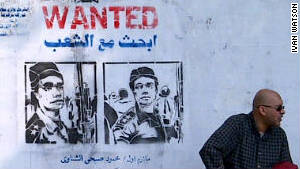
Protesters have called El Shinawi, specifically, “The Eye Hunter” and have sprayed “wanted” stencils featuring his face, name and rank on the walls around Tahrir Square.

Facebooktwittermail

Egypt: ElBaradei says ready to head salvation government

Al-Masry Al-Youm reports: Presidential hopeful Mohamed ElBaradei issued a statement Saturday night declaring his willingness to head a national salvation government if he was asked officially to do so and was given full powers. He added that he would give up his bid for presidency.

ElBaradei’s statement came after his nomination by revolutionary groups and Tahrir protesters to head a national salvation government to replace the military council in ruling the transitional period.

ElBaradei says in the statement that, if assigned officially to form the government, he will withdraw from the presidential race “to ensure confidence and total neutrality in his leadership of the transitional period.”

Names suggested to take part in the government include two other presidential candidates: Abdel Moneim Abouel Fotouh and Hamdeen Sabbahi.

ElBaradei met earlier today with youth groups who declared their refusal of newly appointed Prime Minister Kamal Ganzouri and reaffirmed that the only way out of the current crisis is the formation of a fully empowered national salvation government to manage the transitional period until the presidential elections.

Facebooktwittermail

Egypt military tries to woo wider public to keep power

Anthony Shadid reports: Some call it the silent majority. In Egypt these days, the preferred term is the Party of the Couch. And in that ill-defined constituency, sometimes more myth than reality, Egypt’s ruling military has staked its credibility as it seeks to fend off the greatest challenge yet from protesters seeking to force it from power.

Drawing on sentiments pronounced Friday in the grittier parts of Cairo, even just a few blocks from the protests in Tahrir Square, and in a defiantly nationalist rally near the Defense Ministry, the military is offering either a canny read of Egypt’s mood or yet another delusional estimation of its popularity, a mistake that has bedeviled so many autocrats. With a mix of bravado and disdain, it has hewed to a narrative first pronounced after it seized power from President Hosni Mubarak in February: It bears the mantle of Egypt’s revolution.

“Egypt is not Tahrir Square,” Maj. Gen. Mukhtar el-Mallah, a member of the 20-member military council ruling since February, said in a news conference this week. “If you take a walk on other streets in Egypt, you will find that everything is very normal.”

In much of Cairo, and elsewhere in Egypt, the military has found a receptive audience for that message in a country buckling under a stagnating economy and a lurking insecurity. Even as it promises to surrender power by June, it has deployed all the platitudes of authoritarian Arab governments: fear of foreign intervention, fear of chaos, and fear of the rabble. One doctor quipped Friday that the sole change since the revolution was an extra digit added this year to cellphone numbers.

“If the military goes, who will inherit power from them?” asked Mohammed Abdel-Aziz, 61, sitting before his watch store in Cairo’s Opera Square. Mr. Mubarak made the same bet, only to depart in disgrace in a helicopter 18 days after protests began in January. The lesson then was that a revolution is not a referendum, and the symbolism channeled by Tahrir Square represented a dynamic long dismissed by Arab rulers. The revolution was sometimes conflated with the square itself, so much so that Essam Sharaf, who resigned as prime minister this week, declared in a visit there in April that “I am here to draw my legitimacy from you.”

But back then, there was the military to force Mr. Mubarak’s departure. The question these days is, Who will force the military to relinquish its power?

Firas Al-Atraqchi writes: While Egyptian political parties attempt to gain an edge in the growing vacuum of governance since the resignation of the interim cabinet, it is the people of Tahrir Square who are outmanoeuvring them to win the hearts and minds of the rest of the country.

There are four stories to be told in Tahrir: tear gas suffocation and death; extreme police brutality; incredible acts of sacrifice, and the foundation of a new social contract.

To some, the scenes broadcast through Al Jazeera Mubasher Misr or local networks might at first appear apocalyptic, but I think that is a bit too morose an analysis.

There are those who have told me in recent days that the country is being destroyed bit by bit. I disagree. What I have seen emerge from Tahrir and beyond is evidence that the country is being slowly reconstructed. Bit by bit.

Something remarkable happened in the past days. Civic responsibility has become the norm, not the anomaly. During the regime of former President Hosni Mubarak, Egyptians slipped into a comfortable malaise as the rights and freedoms of the individual and their roles in developing the country were forcibly siphoned into a black hole.

The Egyptian regime, aided by its Soviet-style propaganda State media, convinced the average Egyptian that staying at home was the best option while the authorities took care of everything. From subsidizing food staples to idolizing the security forces as the benevolent protectors of the nation, the citizenry were rendered impotent.

But events in Tahrir Square, to some extent in January/February and more so in the past week, have forced the foundation of a new social contract along the lines of how nations were formed during the Greek city-state era.

Facebooktwittermail

Egypt on the edge

Wendell Steavenson writes: It was Friday today, and Tahrir Square was packed. It was in a mix of every mood I have seen it in over the past ten months: politically focussed, “The people want to topple the Marshal!”; carnival-like, with face painters and food stalls; determined, with tents and supplies and field hospitals; organized, with volunteers checking bags and I.D.s at the entrances; thuggish, with plenty of knots of young kids from poor neighborhoods; and creative: a new sign had been erected for Mohamed Mahmoud Street, renaming it, “The Street of the Eyes of Freedom”—a reference to the many who had lost their eyesight from police birdshot.

The army has built a wall out of concrete blocks on Mohamed Mahmoud Street. Doctors in white coats stand on top, as a volunteer cease-fire line. In the streets and alleys leading up to the charred stretch where the tear gas and rocks rained over between protesters and police for five days, protesters now man barbed-wire barricades, stopping kids and passersby from coming too close and provoking the authorities. The police have withdrawn; the army has replaced them, and there is a truce. But the wall that separates the crowds on Tahrir from the Military Council is actually a gulf of generation, perception, and culture. The violence may have stopped for the moment, but the clarion call for a transfer to civilian rule has not.

The Military Council is laboring under the belief that they are protecting the state of Egypt. The protesters on Tahrir see that they are protecting only the regime. Yesterday, I went to see Hossan Baghat, who runs the Egyptian Initiative for Personal Rights, an N.G.O. Baghat listed the litany of human-rights abuses, military trials, the harassment of bloggers and journalists, the interference of state and private media, the persecution of the human rights community (an investigation has been opened into the foreign funding of N.G.O.s in Egypt; he was expecting a legal summons imminently before the Square blew up again). We talked about the ongoing “bogus charges” leveled at those arrested over the past few days; the American Egyptian journalist Mona Eltahawy, held for twelve hours, her arm broken and badly groped; and worried about my friend Jehane Noujaim, a documentary filmmaker who has since been released.

He said he had recently seen the Clint Eastwood biopic about J. Edgar Hoover. “It’s almost identical!” He told me wryly. “Someone who thinks, ‘Only I am patriotic,’ that enemies within are undermining the country, and that citizens don’t have all the information that they have—now they may be against them, but one day they will be grateful. In their minds, they are protecting Egypt from outsiders.”

This mindset was illustrated in a press conference yesterday, when generals from the Military Council denied any responsibility for the recent violence or mismanagement of the transitional political process. “Egypt is not Tahrir Square,” Major General Mukhtar el-Mallah declared. “We will not relinquish power because of a slogan-chanting crowd.” Ignoring the hundreds of thousands on the square and appealing to the “silent majority” is the same mistake Mubarak made. Then they repeated the old shibboleth about third parties and foreign agendas agitating trouble to weaken Egypt, and announced a new Prime Minister, a seventy-eight-year-old former Prime Minister under Mubarak, a dinosaur with dyed black hair hauled out of retirement. The Square shrugged and rolled its eyes.

Facebooktwittermail

‘Preacher of the revolution’ electrifies Tahrir crowds

AFP reports: Once the preacher of a quiet mosque on the edge of Tahrir Square, Mazhar Shahin has become one of the most recognisable faces of the protests that ousted president Hosni Mubarak in February and which now call for the military to step down.

A roar of approval swept through the tens of thousands of demonstrators in Tahrir Square on Friday when Shahin called for the ruling generals to hand power to a government named by the protesters.

“The revolution is the one that thinks, the revolution is the one that decides, it is the one that judges,” said the cleric in his Friday prayer sermon.

“Our revolution was a body without a head. Today, the revolution will have a head,” he said of a proposed civilian government that includes opposition luminaries such as former UN nuclear watchdog chief Mohamad ElBaradei.

With his cropped beard and white turban wrapped around a red fez, Shahin looks like the traditional government-appointed mosque preacher who, for years under Mubarak’s rule extolled the regime’s virtues.

But the sheikh has become a thorn in the side of the country’s rulers — first Mubarak, and now the ruling generals — with his vigorous denunciations of their abuses and calls for protesters to hold firm to their demands.

“Few of the revolution’s demands have been met,” he told the protesters on Friday. “The people insist on completing their revolution. Either we live in dignity, or we die here in Tahrir.”

Facebooktwittermail

Egypt army officers join anti-junta protesters

Press TV reports: In Cairo, up to a million people gathered on Friday in and around Liberation Square, the focal point of a popular revolution which toppled the four-decade regime of former dictator Hosni Mubarak in February.

The protesters called for an end to the rule of the Supreme Council of Armed Forces which took over after Mubarak’s ouster, and voiced their opposition to SCAF’s nomination of Mubarak-era official Kamal el-Ganzouri as prime minister.

The calls were soon joined by Egyptians army officers, who supported popular demands for a civilian government and opposed the junta choice to head the transitional government.

“The Supreme Council of Armed Forces does not reflect the whole Egyptian army,” said Egyptian Army Captain Ahmed Shouman. “We must be in cohesion with the Egyptian people once again. This is the best way. We must resort to the essence of the revolution,” he stressed.

Shouman expressed regret about the crackdown on anti-junta protesters over the past days and described it as a sign of the despair of the remnants of the Mubarak regime, who want to stay in power.

The captain recalled that the people’s demand since the start of the uprising in Egypt has been the establishment of a civilian government. He then called for the formation of a “real parliament” representing the Egyptian people and their demands.

Facebooktwittermail

Pro-regime rally denounces Egypt’s ‘enemies’

The Guardian reports: Thumping his shoe against a poster of a television host, Ahmed Magdi called on the gathering crowd below to denounce Egypt’s enemies and back what he said was the only group that could hold the country together.

Beneath the overpass he was using as a pulpit, thousands of protesters were streaming into a roundabout in west central Cairo, to support the fragile state’s military rulers.

The flag- and banner-waving protesters, who by late afternoon was around 20,000-strong, were a varied lot. Some openly yearned for the Mubarak days. Others were standard-bearers of the 25 January revolution that overthrew the veteran leader. Another group championed Egypt’s – eventual – democratic transition; yet others thought that the military leadership should remain indefinitely.

Their common denominator was that none of them thought the Scaf (Supreme Command of the Armed Forces) should be run out of town. All instead appeared to believe the country’s combustible streets would rapidly ignite if the junta ceded power to a revived uprising that they variously described as “reckless”, “stupid” or “naive”.

But as crowds grew throughout a mild, hazy afternoon, those on the pro-regime rally seemed to know they were losing the numbers game. Though well-attended, their rally was dwarfed by renewed scenes of people power at Tahrir Square, where it all began 11 months ago.

The retort was simple. “They say they have one million, well we have 85 million,” said Mona el-Gemayel, from a nearby neighbourhood in the suburb of Abbasiya. “These people are not taking to the streets because the uncertainty scares them. People need someone to guide their steps in such times.”

Gemayel’s words had echoes of the last words uttered by former Egyptian intelligence chief Omar Suleiman when he announced that Hosni Mubarak was stepping down. Ever since, Suleiman has stayed clear of the limelight. However, now Scaf supporters hold photos of the Mubarak man in a plaintive plea for stability.

Many openly said the best way forward for Egypt was to return to a bygone era. All the senior members of Scaf were well represented on posters and in chants. And few in the boisterous crowd would countenance the idea that security forces were killing or maiming unarmed civilians in Tahrir Square.

Facebooktwittermail

Egypt’s Muslim Brotherhood continues to alienate itself from the people

Amira Nowaira writes: As the brutal crackdown against peaceful protesters in Cairo and several other Egyptian cities continued unabated for six days running, the Muslim Brotherhood stayed out of the fray, declaring clearly that it would not join the protests.

In deciding to stay away from these protests, the Brotherhood may have committed its gravest mistake to date. The footage showing a dead protester being dragged by a security officer and dumped near a rubbish heap, appearing on many satellite channels and the internet, has not only shocked and enraged Egyptians, but it has sent them out on to the streets in their thousands to protest against this outrage.

In going out they had no political calculations in mind and no gains to make. They simply wanted their voices to be heard. By staying away, the Brotherhood has sent the message that it rated its self-interest higher than Egyptian blood and its decision has angered many Egyptians, including some of its own members.

While this highlights the rift that has been growing over the past few months between the Brotherhood and a significant segment of the population, it also brings to light the various challenges facing the Brotherhood since the overthrow of Mubarak.

The first is that after having worked for most of its history as an underground movement, the Brotherhood has suddenly found itself exposed to the public gaze. While such exposure has afforded its members far more visibility and freedom of movement than they have ever enjoyed, it has also made them the object of public scrutiny, criticism and at times even scorn.

Facebooktwittermail