Category Archives: Egypt

Arms suppliers urged to halt transfers to the Egyptian army

Global arms suppliers must halt the transfer of small arms, ammunition and other repressive equipment to the Egyptian military and security forces, Amnesty International said today after the army again violently dispersed protests in Cairo.

The organization condemned the excessive use of force against protesters and called for a cessation of all transfers of small arms, light weapons and related munitions and equipment to Egypt, as well as a halt to all internal security equipment that could be used to violently suppress human rights, such as tear gas, rubber and plastic bullets and armoured vehicles.

“It can no longer be considered acceptable to supply the Egyptian army with the types of weaponry, munitions and other equipment that are being used to help carry out the brutal acts we have seen used against protesters,” said Hassiba Hadj Sahraoui, Deputy Director for the Middle East and North Africa at Amnesty International.

“It is clear that either the military police has been given orders to disperse demonstrators at any cost, or the Supreme Council of the Armed Forces does not control the army and security forces. Either scenario is equally worrying.”

Facebooktwittermail

Egyptian women march against military rule

Sarah Carr reports: It was an image that shocked Egypt and within hours went viral: the woman in the exposed blue bra being beaten and kicked by a gang of soldiers during an attack on Tahrir Square protesters.

In a press conference on Sunday, General Adel Emara, a member of the ruling Supreme Council of the Armed Forces (SCAF), downplayed the incident, telling reporters that “they should consider all the circumstances” before judging.

On Tuesday, women responded. Some 4000 took to the streets in a march organized by the Mohamed ElBaradei Campaign and the April 6 Youth Movement.

Later on Tuesday evening, the SCAF issued an apology to the “women of Egypt,” in its statement Number 91.

“The SCAF reaffirms its upmost respect and admiration for the women of Egypt and their right to protest and of positive participation in political life on the path of democratic change Egypt is currently witnessing,” the statement reads. “All legal measures have been taken to hold officials accountable for transgressions,” it continues.

In Tahrir Square, women gathered, surrounded by men whose linked hands formed a cordon to protect them. One of the men, Mohamed Fathy, said he supported the idea of a women-only march because “they are here defending their rights and have to have their say.”

After circling the square once the march proceeded through downtown Cairo — the scene in 2007 of horrific mass assaults during the Eid vacation when packs of youths sexually assaulted women.

Their chants, “Girls of Egypt are a red line” — a variation on the now-abandoned “The Egyptian army is a red line” — echoed around the street. From balconies, office workers clapped and cheered. The women chanted for them to join them saying, “Come down from your houses, Tantawi undressed your girls.” Field Marshal Hussein Tantawi is the head of the SCAF.

There was pervasive anger against the army, with frequent chants for the SCAF to leave power and condemnation of violence by military “riff-raff”.

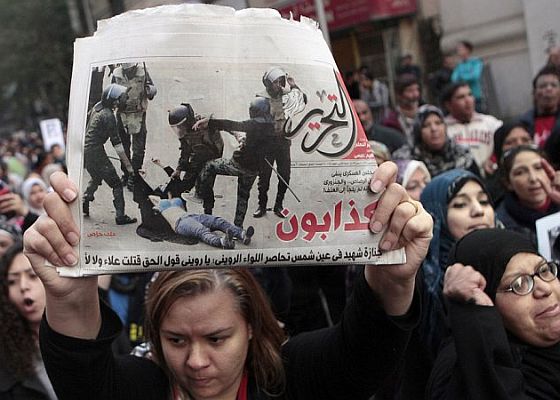
“Tantawi is the supreme commander of harassment and violation of honor,” one placard read. Other posters declared that the military consists of “liars” — a reference to the Sunday edition of independent newspaper Al-Tahrir, the front page of which made the accusation next to a picture of the woman in the blue bra.

Naglaa Talat marched carrying her two-year-old daughter.

“I had to come after I saw the picture of the naked girl in the newspapers — the images were enough to make any respectable person come. I have daughters and I came for them,” Talat told Egypt Independent.

Like many of the protesters, Talat insisted that Tantawi must leave power and the SCAF hand over power to civilian rule.

Facebooktwittermail

Mass march by Cairo women in protest over soldiers’ abuse

The New York Times reports: Thousands of women massed in Tahrir Square here on Tuesday afternoon and marched to a journalists’ syndicate and back in a demonstration that grew by the minute into an extraordinary expression of anger at the treatment of women by the military police as they protested against continued military rule.

Many held posters of the most sensational image of violence over the last weekend: a group of soldiers pulling the abaya off a prone woman to reveal her blue bra as one raises a boot to kick her. The picture, circulated around the world, has become a rallying point for activists opposed to military rule, though cameras also captured soldiers pulling the clothes off other women.

The march, guarded by a cordon of male protesters, was a surprising turn. In Egypt, as in other countries swept by the revolts of the Arab Spring, women played important roles, raising hopes that broader social and political rights would emerge along with more accountable governments. But with the main popular focus on preparing for elections and protesting the military’s continued hold on power, women here had grown less politically visible.

The women’s protest came on the fifth day of violent clashes between Egyptian soldiers and protesters. The severity of the military’s defense of its hold on power, even as the newly elected Parliament begins to take shape, has restored a degree of unity that had been missing among the civilian political factions, liberal and Islamist, since the ouster of President Hosni Mubarak in February.

Facebooktwittermail

Egyptian army targets women protesters

Egyptian army soldiers beat a woman protester

Al-Masry Al-Youm reports: Local human rights watchdogs on Sunday accused the Egyptian military of systematically targeting female political activists, and demanded that Egypt’s military rulers admit to violations committed against demonstrators.

In a joint statement, five human rights organizations accused military rulers of exercising “unprecedented violence against protesters, with the targeting of female activists being a distinctive feature of the proceedings to disperse sit-ins, as depicted in pictures and video clips showing protesters being arrested, beaten, dragged and stripped of their clothes.”

In this video, army soldiers are seen beating an older female activist named Khadiga al-Hennawy.

While this video shows army soldiers dragging, beating and striping a female protester in the street.

The statement was signed by Nazra for Feminist Studies, the Cairo Institute for Human Rights Studies, the Association for Freedom of Thought and Expression, the Hisham Mubarak Law Center and the Women and Memory Association.

They also called for the establishment of an independent judicial committee to investigate crimes against peaceful protestors.

Facebooktwittermail

The battle for Upper Egypt

Lauren E. Bohn writes: Assiut feels far away from the famed epicenter of Tahrir Square. The oft-neglected peripheral region of Upper Egypt (the cultivated valley of the Nile from Cairo in the north to Aswan, 535 miles south) has been plagued by institutional apathy for years, long dismissed as a dead-end, from where one travels to the capital for work and never returns. When Egypt’s contentious de-facto leaders, the Supreme Council of the Armed Forces (SCAF), speak of a silent but loyal majority, or “liberals,” fret about the backward religious and violence-prone rural areas, they have cities like Assiut in mind. But the reality is far more complicated. Assiut and Tahrir are bound together by personal connections and shared concerns — inextricable ties that suggest a far more nuanced emerging Egypt than is generally felt from the central nerve of Cairo.

The new Assiut, which prides itself on being the capital of Upper Egypt, features a distinct pastiche of Salafis, felool, or remnants (a word used to describe holdovers from the Mubarak era), the popular Muslim Brotherhood, a smattering of activists, and a vaguely Egyptian brand of tribalism. Officials from the Mubarak era still cling to power, while Tahrir’s activists find few points of entry into a skeptical environment. Outside the city’s few main streets, Assiut’s mustard-hazed landscape is home to 3.5 million people spread throughout some 1,000 villages. With 24 parliamentary seats, it was a major target, and now bellwether, in the new electoral competition reshaping Egyptian politics.

Though some activists will tell you they had their own “Tahrir Square” in Assiut, by and large, the countryside remained marginally engaged with the uprisings that took Cairo by hold. Protestors continue to call for a prompt end to military rule, blaming SCAF for their inept, and even malevolent, handling of Egypt’s transition to democracy. But, it is easy to find indifference or even hostility to ongoing protests in places where most people get their news from a largely pro-SCAF state television and almost nobody has access to follow revolutionaries on Twitter. Ayad Hamza, 46, a barber in the small village of Ezbet El Geish dismisses Tahrir as a farce. “These kids are stupid. They have nothing else to do but cause trouble,” he said, mopping his cracked floor. “It’s not a revolution they’re making, but a nightmare.” This is the kind of sentiment SCAF has been banking on — one they say resonates in Egypt. But it misses important linkages between the periphery and the political battles waged in Cairo, and naively exaggerates their indifference.

Facebooktwittermail

Egyptian soldiers shoot, chase, and beat unarmed protesters in Cairo

The New York Times reports: Egypt’s military rulers escalated a bloody crackdown on street protesters on Saturday, chasing down and beating unarmed civilians, even while the prime minister was denying in a televised news conference that security forces were using any force.

In one of the most incendiary developments, video cameras captured soldiers stripping the clothes off women they were beating on the pavement of Tahrir Square.

The contradiction in the military-led government’s statements and actions appeared to represent a shift in strategy by the military council. After trying for months to preserve some credibility and collaboration with the Egyptian political elite, the ruling generals on Saturday scarcely acknowledged the demands made by their newly appointed civilian advisory council the night before that the military cease its violence and apologize to demonstrators.

Instead, as the crackdown entered its second day, the military council appeared to be playing to those Egyptians impatient with the continuing protests and eager for a return to stability. Crowds of supporters turned out downtown on Saturday morning to cheer on the military police, hand them drinks of water and help them close off Tahrir Square from demonstrators massing to get in.

Protesters, for their part, charged that the military rulers were provoking the clashes to derail or discredit the continuing election of a new Parliament that could challenge their power. “The military council is responsible for everything that happens,” Ziad el-Elaimy, a newly elected member of Parliament who was beaten Friday by the military police, said in a television interview.

Facebooktwittermail

US-made tear gas becomes fatal ingredient of protests

Joseph Dana writes: Residents of Nabi Saleh in the West Bank have been demonstrating, each week for the past two years, against the slow encroachment on their land by Israeli settlers.

Gathering in the village centre on Friday afternoons, villagers along with Israeli and international activists attempt to march, under the watchful eye of soldiers, to a disputed agricultural spring which was confiscated recently by Israeli settlers.

Often protesters never even reach the edge of the village; crowd-control measures by the military regularly include barrages of tear gas and rubber bullets.

Palestinian villagers claim that hundreds of protesters have been injured, some seriously, in the Nabi Saleh demonstrations.

But no one had been killed there – until last week.

The death of 28-year-old Mustafa Tamimi may seem to have little in common with the more numerous deaths of protesters in Cairo over the past few days.

Indeed the demonstrations are different from each other in many ways. But in protests from Tunis to Cairo to little Nabi Saleh, the use of tear gas by authorities, and the increasing number of related fatalities, has become a common thread in recent months.

Facebooktwittermail

Death toll rises from clashes in Cairo

The New York Times reports: The death toll from renewed violence in Egypt’s capital rose overnight as clashes between Egyptian soldiers and protesters entered a second day on Saturday.

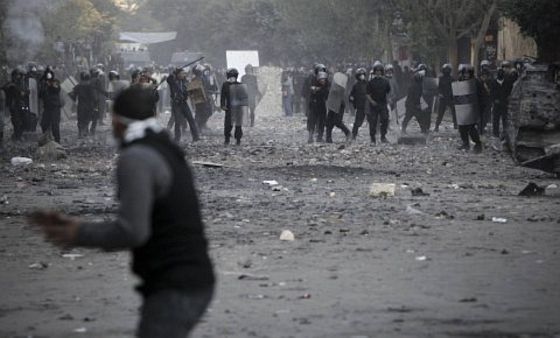
According to media reports, soldiers swept into Tahrir Square here on Saturday, chasing protesters and beating them with sticks.

Early Saturday, according to The Associated Press, hundreds of protesters hurled stones at security forces who sealed off the streets around Parliament with barbed wire and large concrete blocks. Soldiers on rooftops pelted the crowds below with stones, prompting many of the protesters to pick up helmets, satellite dishes or sheets of metal to try to shield themselves.

Reuters reported that protesters fled into side streets to escape the troops in riot gear, who grabbed people and battered them repeatedly even after they had been beaten to the ground.

Stones, dirt and shattered glass littered the streets downtown, while flames leapt out of the windows of a two-story building set ablaze near Parliament, sending thick plumes of black smoke into the sky, according to media reports. Soldiers set fire to tents inside the square, The A.P. reported, and swept through buildings where television crews were filming from and confiscated their equipment and briefly detained journalists.

In footage filmed by Reuters one soldier in a line of charging troops drew a pistol and fired a shot at retreating protesters.

The clashes began in the center of Cairo on Friday and at vote-counting centers around the country, preceding a decision by a new civilian advisory council to suspend its operations. That move, embarrassing to the country’s military rulers, was done in protest over the military’s deadly but ineffective treatment of peaceful demonstrators.

Facebooktwittermail

The success of Egypt’s Islamists marks a trend throughout the region

The Economist looks at the Muslim Brotherhood and the Salafists represented by the Nour party, whose combined successes in the first round of Egypt’s parliamentary elections give an overall majority to the Islamists.

Surrounded by well-wishers at his home on a narrow dirt street in the village of Nazla, Wagih al-Shimi insists his Nour party would have done even better if the Brothers had not cheated. Blind from birth and lushly bearded, Fayoum’s new MP is a doctor of Islamic jurisprudence, preaches in local mosques, and has a reputation for resolving disputes according to Islamic law.

“We owe our success to the people’s trust, to their love for us because we work for the common good, not personal gain,” says Mr Shimi. As for a party programme, he says his lot will improve schools, provide jobs and reform local government, introducing elections at every level to replace Mubarak-era centrally appointed officials. As for the wider world Mr Shimi is vague, except to say that Egypt should keep peace with any neighbour that refrains from attacking it.

The Brotherhood echoes this parochialism: its party’s 80-page manifesto mentions neither Israel nor Palestine. The two groups have more in common. The Brothers profess to share the Salafists’ end goal; namely, to regain the pre-eminent role for Islam in every aspect of life that they believe it once held. Some leading Brothers even describe themselves as Salafist in ideology. Many secular Egyptians, too, especially Coptic Christians, who make up an increasingly beleaguered 10% minority, see little difference between rival Islamists.

Yet within the broad spectrum of political Islam, the distinctions between two are telling. Muslim Brothers tend to be upwardly mobile professionals, whereas the Salafists derive their strength from the poor. The Brothers speak of pragmatic plans and wear suits and ties. The Salafists prefer traditional robes and clothe their language in scripture. The Brothers see themselves as part of a wide, diverse Islamist trend. The Salafists fiercely shun Shia Muslims. Asked what he thinks of Turkey’s mild Islamist rule, a Nour spokesman snaps that his party had nothing to take from Turkey bar its economic model.

Nour says it rejects Iranian-style theocracy, but equally rejects “naked” Western-style democracy. Instead, in what some Salafists see as a daring departure from previous condemnation of anything that might dilute God-given laws, it wants a “restricted” democracy confined by Islamic bounds. Yasir Burhami, a top Salafist preacher, says that his mission is to “uphold the call to Islam, not to impose it on people.” Still, he believes the party can convince Egyptians to accept such things as banning alcohol, adopting the veil and segregating the sexes in public because “we want them to go to heaven”.

Brotherhood leaders say instead that they must respect the people’s choice. Their party includes a few Christians. It worked hard to build a coalition with secularists, too, though most of its partners soon withdrew. Whereas Nour party leaders openly call for an alliance with the Brothers to pursue a determined Islamist agenda, the older group, with its long experience of persecution, is wary. It says fixing Egypt’s ailing economy should take priority over promoting Islamic mores. The Brotherhood would probably prefer a centrist alliance that would not frighten foreign powers or alienate Egypt’s army, which remains an arbiter of last resort.

In any case, a Brotherhood-led government is not in the immediate offing. Egypt’s generals, discomfited as anyone by the Islamists’ advance, seem determined to find ways to delay it.

The New York Times reports: In the aftermath of the vote, Egyptian liberals, Israelis and some Western officials have raised alarms that the revolution may unfold as a slow-motion version of the 1979 overthrow of the shah of Iran: a popular uprising that ushered in a conservative theocracy. With two rounds of voting to go, Egypt’s military rulers have already sought to use the specter of a Salafi takeover to justify extending their power over the drafting of a new constitution. And at least a few liberals say they might prefer military rule to a hard-line Islamist government. “I would take the side of the military council,” said Badri Farghali, a leftist who last week won a runoff against a Salafi in Port Said, northeast of Cairo.

A closer examination of the Salafi campaigns, however, suggests their appeal may have as much to do with anger at the Egyptian elite as with a specific religious agenda. The Salafis are a loose coalition of sheiks, not an organized party with a coherent platform, and Salafi candidates all campaign to apply Islamic law as the Prophet Muhammad did, but they also differ considerably over what that means. Some seek within a few years to carry out punishments like cutting off the hands of thieves, while others say that step should wait for the day when they have redistributed the nation’s wealth so that no Egyptian lacks food or housing.

But alone among the major parties here, the Salafi candidates have embraced the powerful strain of populism that helped rally the public against the crony capitalism of the Mubarak era and seems at times to echo — like the phrase “silent majority” — right-wing movements in the United States and Europe.

“We are talking about the politics of resentment, and it is something that right-wing parties do everywhere,” said Shadi Hamid, director of research at the Brookings Doha Center in Qatar. They have thrived, he said, off the gap between most Egyptians and the elite — including the leadership of the Muslim Brotherhood — both in lifestyle and outlook.

“They feel like they represent a significant part of Egypt,” Mr. Hamid said, “and that no one gives them any respect.”

Facebooktwittermail

Has Egypt’s revolution left women behind?

Mara Revkin writes: Millions of women were among the 52 percent of eligible voters who cast ballots in Egypt’s parliamentary elections this week, but preliminary results suggest that Egypt’s first popularly elected legislature since the revolution might not include a single female face. Despite anecdotal reports of massive female turnout in Cairo and the other eight governorates that cast ballots in this first of three rounds of voting, women may very well be the biggest losers of an election that has been hailed as the freest and fairest in Egypt’s recent history. Although 376 female candidates are running for parliament, not a single woman has won a seat so far in the 508-seat People’s Assembly after the first two days of voting on November 28 and 29 and this week’s runoff races. And there is good reason to believe that women will fare just as poorly in subsequent rounds of voting.The second and third stages of elections, slated for December and January, will include Egypt’s most rural and conservative districts where gender biases are more deeply ingrained than the urban centers of Cairo, Alexandria, and Port Said that voted this week. Faced with the possibility of an entirely male parliament, many Egyptians are wondering: Were women left behind by the Revolution?

Women have been on the frontlines of protests in Tahrir Square since the earliest days of the uprising and were instrumental in mobilizing the grassroots groundswell on Twitter and Facebook. But as activist youth movements like the Revolutionary Youth Coalition struggle to define their role in the post-revolutionary system — pondering if and how they should convert the momentum of the street into formal political representation — women are increasingly being left out of the conversation. While it’s true that the forty some-odd parties launched since last January have welcomed women as members and in some leadership positions, when it came time to nominate candidates for the parliamentary elections, women were conspicuously absent from the party lists. In late October, as parties began lining up their candidate rosters for the two thirds of parliamentary seats that will be allocated by closed-list proportional representation, Gameela Ismael, one of Egypt’s most prominent political activists and the ex-wife of presidential candidate Ayman Nour, publicly defected from the Democratic Alliance — a primarily Islamist coalition dominated by the Muslim Brotherhood’s Freedom and Justice Party — just weeks before the election, citing the coalition’s discriminatory stance against female candidates.

Facebooktwittermail

Military still stands in the way of democracy in Egypt

The New York Times reports: Egypt’s military rulers said Wednesday that they would control the process of writing a constitution and maintain authority over the interim government to check the power of Islamists who have taken a commanding lead in parliamentary elections.

In an unusual briefing evidently aimed at Washington, Gen. Mukhtar al-Mulla of the ruling council asserted that the initial results of elections for the People’s Assembly do not represent the full Egyptian public, in part because well-organized factions of Islamists were dominating the voting. The comments, to foreign reporters and not the Egyptian public, may have been intended to persuade Washington to back off its call for civilian rule.

“So whatever the majority in the People’s Assembly, they are very welcome, because they won’t have the ability to impose anything that the people don’t want,” General Mulla said, explaining that the makeup of Parliament will not matter because it will not have power over the constitution.

He appeared to say that the vote results could not be representative because the Egyptian public could not possibly support the Islamists, especially the faction of ultraconservative Salafis who have taken a quarter of the early voting.

“Do you think that the Egyptians elected someone to threaten his interest and economy and security and relations with international community?” General Mulla asked. “Of course not.”

The military’s insistence on controlling the constitutional process was the latest twist in a struggle between the generals’ council and a chorus of liberal and Islamist critics who want the elected officials to preside over the writing of a new constitution.

Facebooktwittermail

Al Jazeera — voice of the Arab spring

Mehdi Hasan writes: On Friday 11 February, thousands of Arabs spilled on to the streets of the Middle East’s capitals, from Rabat to Amman, to celebrate the downfall of the Egyptian dictator Hosni Mu­barak. Doha, in the sleepy Gulf emirate of Qatar, was no different: hundreds of youths brought traffic to a standstill on the coastal ­Corniche Road. Shortly before midnight, some of them recognised one of the drivers stuck in the jam: the then Al Jazeera director general, Wadah Khanfar, who was on his way home from the network’s headquarters to grab a few hours sleep. After pulling him out of his car, dozens of Qataris queued up to hug and kiss him and thank him for his channel’s unrelenting, round-the-clock coverage of the uprisings in Cairo and Tunis.

“I wept,” recalls Khanfar, seven months later, when I meet him in the café of a central-London hotel. “I was very emotional.” He pauses. “In the Arab world, journalism ­really is an issue of life and death.”

He isn’t exaggerating. So far this year, Al Jazeera’s correspondents and producers across the Middle East have been harassed, arrested, beaten and, in the case of the cameraman Ali Hassan al-Jaber, killed (by pro-Gaddafi fighters in Libya). As Arab governments toppled from Tunisia to Egypt to Libya – and, last month, Yemen – Al Jazeera has been on hand to beam the pictures of ecstatic protesters, revolutionaries and rebels into the living rooms of ordinary Arabs across the region – and beyond. In Tunisia, the network picked up camera-phone footage from Facebook and other social-networking sites of the riots and protests that took place in the wake of the fruit-seller Mohamed Bouazizi’s self-immolation in December 2010, and gave them a regional prominence they otherwise would not have achieved.

In Egypt, for 18 days straight, Al Jazeera’s cameras broadcast live from Cairo’s Tahrir Square, giving a platform to the demonstrators, while documenting the violence of the Mu­ba­rak regime and its supporters.

“The protests rocking the Arab world this week have one thread uniting them: Al Jazeera,” the New York Times observed on 27 January, as it reported on how the channel’s coverage had “helped propel insurgent emotions from one capital to the next”. “They did not cause these events,” argued Marc Lynch, a professor of Middle East studies at George Washington University, “but it’s almost impossible to imagine all this happening without Al Jazeera.” Or, as a spokesman for WikiLeaks tweeted: “Yes, we may have helped Tunisia, Egypt. But let us not forget the elephant in the room: Al Jazeera + sat dishes.”

Facebooktwittermail

Egypt’s Muslim Brotherhood says end to military rule is ‘top priority’

The Guardian reports: The Muslim Brotherhood has fired a warning shot at Egypt’s ruling generals, declaring that a swift end to military rule is the country’s “top priority” as it prepares to take charge of a newly elected parliament.

With provisional election results continuing to emerge, confirming earlier predictions of a strong victory for the Brotherhood’s Freedom and Justice party, the movement’s leaders emphasised that now was the time for “consensus not collision” and agreed to work with parties across the political spectrum to advance the revolution and facilitate a smooth transition to civilian government.

In a sign the Brotherhood will not tolerate parliament being treated as a rubber stamp by the Supreme Council of the Armed Forces (Scaf), which has clung to power despite almost two weeks of anti-junta protests and violent street clashes, senior members of the organisation told the Guardian the generals risked further unrest if they defied the people and failed to return to their barracks next year.

“Egypt is currently going through a critical era in its history, and I am confident the military will choose to cooperate with parliament and not confront it – any other path will create more chaos,” said Essam al-Arian, vice president of the Freedom and Justice Party.

Amr Darrag, the group’s chief in Giza, said a quick and painless handover to civilian rule was the most important issue facing the Arab world’s most populous nation at present. “We are going through a transitional phase and we are not yet at the optimum stage of this transition,” he argued. “Parliament must be formed, a president must be elected, and power must be transferred to civilian authority. Scaf currently wields executive and legislative power; as soon as parliament convenes the latter must be passed to the institution democratically elected by the Egyptian people.”

Facebooktwittermail

The Muslim Brotherhood’s democratic dilemma

Nathan Brown writes: For years, Egypt’s Muslim Brotherhood has been taunted by its critics to demonstrate its democratic commitments. Of course, without free and fair elections in the country, it could only offer promises. But as Egyptians now go to the polls in the country’s most democratic parliamentary elections in many decades, the Islamists are finally able to grasp a golden opportunity to show their democratic credentials with deeds. And that may be precisely the problem: They may be far too successful for their own good (and for Egypt’s).

For many years, the Brotherhood has set a regional trend by running in rigged elections under dictatorships, using the slogan “participation, not domination.” In return for the right to participate, Islamists in the Arab world assured suspicious rulers that they did not seek to replace them. In fact, they usually ran for fewer seats than they would need for a majority. Of course, there were exceptions—in Algeria in 1992 and Palestine in 2006, Islamists went for the win. In both cases, the result was civil war. Their counterparts elsewhere were explicit: they had learned the lesson that they should not push too hard too quickly.

In the aftermath of Egypt’s January 25 revolution, Brotherhood leaders consistently claimed that they still took the lesson to heart. They would only seek one third of the seats; they would foreswear the presidency. And they enthusiastically pressed to give the people a chance to vote as soon as possible, moving Egyptian politics away from demonstrations in the public square and toward the polling booth. The only time they called their foot soldiers out to demonstrate was when various political forces tried to place limits on the democratic process in the form of partisan “constitutional principles” that were meant to bind those selected by the new parliament to write the country’s new constitution.

Over the years in Egypt, the Brotherhood’s self-restraint has set a model in the region. Even after the fall of authoritarian regimes, most Islamists’ preferred outcome in the short term is an election that gives them a plurality but not a majority. Controlling the largest bloc of parliamentarians, for instance, gives them a considerable voice in the political process and allows them the opportunity to develop political skills and experience without making them appear threatening or provoking a strong reaction inside and outside the country. Such an electoral result enables the preferred Islamist strategy of gradual change and lets movements escape the burden of full responsibility for the tremendous economic and security problems of societies in turmoil.

The recent Tunisian and Moroccan elections delivered just such an outcome. Islamist parties in both countries will be in the driver’s seat as Tunisia writes a constitution and Morocco experiments with limited constitutional reform.

To be sure, this strategy of demonstrating democratic credentials by working not to win elections is ironic and arguably undemocratic. In the Egyptian case, the Brotherhood sought to pursue the policy through a particularly strange and undemocratic device: it worked hard to build a coalition of political parties across the spectrum to submit to Egyptians as a single list. Instead of allowing voters to pick their representatives, the Brotherhood wanted to divvy up the seats in advance.

But in the months since the revolution, Egypt’s Muslim Brotherhood has been wriggling free of the pledges to demonstrate its democratic credentials in such undemocratic ways; it is showing signs of abandoning the tendency to pull its political punches. Over the short term, it may gain many votes as a result. In the long term, it might come to regret its decision.

Facebooktwittermail

The rise of the Islamists

Mohamed Awad, director of the Alexandria and Mediterranean Research Center, describes to Patrick Martin from Toronto’s Globe and Mail, a scenario that many in Egypt’s liberal secular elite must now dread:

“My fear,” said Dr. Awad, whose office is surrounded by models of Alexandria’s prospective future waterfront, “is that the more extreme Islamists, the Salafists, may eventually come to power.”

That could happen, he explains, if the country’s economy collapses in the next few months. “In that event,” he says, “there will be another revolution, a revolution of the poor, and this one will be very violent.”

Is he describing the threat of Islamist rule or the threat of popular rule?

Early election results from Egypt make it clear that the new parliament will be dominated by Islamists — mostly from the Muslim Brotherhood but with the main Salafist party making a stronger than predicted showing, pushing the largest secular group into third place.

A recent poll showed that 41% of Egyptians hope Egypt will emulate Saudi Arabia, while 53% favor a democratic civil state. But what these polls obscure is the fact that whoever governs, one of their overriding concerns will be that they can govern successfully and thus ensure their continued power.

Who can offer Egypt’s newly empowered politicians the most useful tuition? The Saudis or Turkey’s AK Party? (That’s a rhetorical question.)

Atul Aneja reports: Early counting in Egypt’s parliamentary elections appears to confirm the region-wide trend of Islamists — moderate, hard-line and some who are yet to be fully tested — emerging as the most potent force in the aftermath of the Arab Spring.

Following the first phase of elections which ended on Tuesday, counting in Luxor, Cairo and elsewhere is showing that the Muslim Brotherhood’s Freedom and Justice Party (FJP) has solidly outpaced its rivals in many of the constituencies.

The ultra-conservative Al Nour party is also doing well in some districts. It is either leading over the other contenders or is in second place to the FJP.

Except in a few constituencies, non-religious parties are, so far, heavily trailing the Islamists, who are not contesting as a unified bloc. The FJP and Al Nour are not pre-poll allies, though the latter is open to participation in a coalition. The Al Nour comprises mainly Salafists, who seek to recreate a society based on pristine Islam.

The electoral picture, however hazy, that is emerging in Egypt, seems to amplify a political trend fast gathering momentum in West Asia and North Africa. Moderate Islamists have emerged as the most prominent political force in Tunisia and Morocco following recent elections. An Islamist assertion is also visible in Libya in the aftermath of the killing in October of Muammar Qadhafi. Some analysts say an Islamist political resurgence through the ballot can be traced to 2002, when the Justice and Development Party (AKP), the architect of the so-called “Turkish model” of new-age Islam, triumphed in Turkey.

Despite the AKP’s Islamist roots, Turkey remains secular and has deeply engaged with moderate Islamists in Tunisia and sections of the Muslim Brotherhood in Egypt.

Emile Nakhleh and Augustus R. Norton write: Misplaced fears about the implications of an Islamist sweep are often heard in Washington, where some media pundits have asked whether the Arab Spring is devolving into an Islamist Winter. But Tunisia’s election provides an instructive model on an alternative to that scenario. The election fostered a coalescence of Islamist and secular politicians. The victory of the Tunisian al-Nahda party, which won a 40-percent plurality, may be a harbinger for the coming of Arab political normalcy and the delegitimization of “Arab exceptionalism.’’ Al-Nahda’s leader, Rachid Ghannouchi, has begun reaching out to secular groups to form a coalition government, a move that would not have happened before the demise of authoritarian regimes in Tunisia, Egypt, and Libya.

The pragmatic behavior of Islamist parties in national legislatures should be the litmus test as to whether Western governments should engage them during transition to democracy. Their legislative performance, not ideological platforms or interpretations of the sacred text, should be the metric by which to judge their credibility as mainstream political actors.

Islamist parties that have been part of governments in Indonesia, Malaysia, Morocco, Turkey, and elsewhere have not threatened their countries’ national security and stability. On the contrary, they have been credible and legitimate defenders of good government and the rule of law, and strong proponents of tolerance and pluralism.

The lesson from the Tunisian elections should be equally clear to the remaining Arab authoritarian regimes. Dominating the political space, persecuting minorities, violating their peoples’ human and civil rights, and blaming foreign “agents and provocateurs” for anti-regime protests will no longer work. This regime narrative is no longer believable, whether in Syria, Bahrain, or Saudi Arabia.

What everyone in the West needs to remember is that when Egyptians or anyone else in the Middle East cast their votes for the Islamists, in most cases they are not making an ideological statement. They are doing what voters in all representative democracies do: picking out the candidates and parties with which they have the greatest affinity, which is to say, looking for representatives who appear to understand who they are meant to represent.

Facebooktwittermail

Ultras say: ‘All cops are bastards’

Al Jazeera reports: Not much is known about their organisation, but their presence is an accepted fact of Egyptian society. Most of them lack formal military training, or any training at all.

These are the Ultras, a group whose battle, usually reserved for the football stadium, has moved to the front line in the fight between anti-military protesters and government security forces in Egypt.

Often characterised as hooligans, the Ultras have been blamed for violence at football matches and are prone to clashes with police forces.

Even so, the membership in the group is a hard-won badge of honour for the young men gathered in Cairo’s Tahrir Square.

“It’s a way of life. You don’t just become one. You aren’t converted. You have to be an Ultra from within,” said Ahmed, a Cairo native and Ultra member who only agreed to an interview if his real name and appearance were not revealed.

The Ultras are notoriously media shy, even “anti-media”, according to Ahmed. He said they prefer to keep their identities secret, presumably to avoid unwanted police attention.

Ahmed is perched on the edge of a low stone wall, just to the south of Tahrir Square.

He and his fellow Ultras have pitched a number of tents there for their prolonged sit-in, along with thousands of other protesters demanding an end to military rule in the country.

Like many of the tents in the area, the Ultras’ lodgings are reinforced against the biting November wind with layers of blankets.

Their camp is set apart, however, by hastily sketched graffiti on the tents that proclaims their beliefs for those who know the code.

“A-C-A-B,” Ahmed said, reading aloud the red etchings on the outside of his tent. “All cops are bastards,” he explained.

According to Ahmed, the abbreviation is a motto for Ultras clubs around the world.

The phrase has particular meaning in Egypt, a country in which the police force is viewed with distrust and even outright loathing.

“Police are paid every month to serve us and help us and protect us, not to oppress us,” he said.

“I’m supposed to know when I go to a cop about a threat or harassment that I will get help, but that never used to happen. They should know they are here to serve us.”

It is sentiments such as this that brought hundreds of Ultras to central Cairo on November 19, the day Egyptian riot police entered Tahrir to forcibly disperse a sit-in by relatives of victims killed during the country’s January uprising.

Facebooktwittermail