Der Spiegel reports: There are growing calls in Germany not only to question Edward Snowden in connection with the ongoing NSA scandal, but also to offer him safe passage and asylum. Yet the heads of the two major political camps fear the wrath of the United States.
Hans-Christian Ströbele, a lawyer and parliamentarian for Germany’s Green Party, turned 74 this year. He has devoted more than 50 of those years to the political struggle for justice and for what is good in the world – or at least that’s how he sees it. “Have you ever been on the wrong side of things?” Ströbele was asked in a recent television interview.
“Politically speaking?” he asked the interviewer, glancing at the ceiling. For two seconds, it seemed as if he had to consider the question, but he quickly regained his composure and emphatically replied: “No.”
Now Ströbele is waging another political battle, probably the most noteworthy one of his life. Last Thursday, he went to Moscow and spent three hours speaking with Edward Snowden, the man whose revelations about the spying activities of the United States have both captivated the world for months and deeply changed its perceptions.
Ströbele, a lawmaker from the Friedrichshain-Kreuzberg election district in Berlin, was the first politician in the world to meet with Snowden in his Moscow exile. Snowden’s mission is now Ströbele’s mission. He wants to bring the American whistleblower to Germany to testify before an investigative committee of the German parliament, the Bundestag, and in doing so provide him with a secured right of residence in Germany.
Ströbele knows that granting Snowden the right to stay in Germany would create problems for German-American relations. The Americans have already submitted an extradition request, just in case Snowden ever sets foot on German soil. But Ströbele doesn’t care. He sets his own priorities and, once again, he believes himself to be on the right side of history, notwithstanding Germany’s trans-Atlantic partnership with the United States. “If the political will exists, as well as the courage, including the courage to stand up to presidents, then it’s possible,” Ströbele said after returning from Moscow.
Germany now faces a test of courage, one that affects the German parliament, the heads of the two major parties, the conservatives and the center-left Social Democratic Party (SPD), who are currently hammering out the details of a grand coalition government in negotiations set to conclude by Christmas. Most of all, it affects Chancellor Angela Merkel.
So should the Bundestag hear Snowden’s testimony before an investigative committee? The answer seems straightforward. Why shouldn’t German lawmakers hear what he has to say, the man on whose revelations the entire NSA scandal is based and who has already told Ströbele that he is willing to come to Germany?
The second, more fundamental question is harder to answer: whether Snowden should be granted the right to live in Germany or a comparable country, and therefore protection from the Americans. This is precisely the condition Snowden has set for his willingness to testify. He knows that his asylum in Russia is limited to one year, which means that it expires in nine months. He is testing the waters to see where he could live safely in the future. Germany appears to be his top choice. [Continue reading…]
Category Archives: Germany
Snowden asks U.S. to stop treating him like a traitor
The New York Times reports: Edward J. Snowden, the fugitive American security contractor granted temporary asylum by Russia, has appealed to Washington to stop treating him like a traitor for revealing that the United States has been eavesdropping on its allies, a German politician who met with Mr. Snowden said on Friday.
Mr. Snowden made his appeal in a letter that was carried to Berlin by Hans-Christian Ströbele, a veteran member of the Green Party in the German Parliament. Mr. Ströbele said he and two journalists for German news outlets met with Mr. Snowden and a person described as his assistant — probably his British aide, Sarah Harrison — at an undisclosed location in or near Moscow on Thursday for almost three hours.
Mr. Ströbele had gone to Moscow to explore whether Mr. Snowden could or would testify before a planned parliamentary inquiry into the eavesdropping. Any arrangements for Mr. Snowden to testify would require significant legal maneuvering, as it seemed unlikely that he would travel to Germany for fear of extradition to the United States.
In his letter, Mr. Snowden, 30, also appealed for clemency. He said his disclosures about American intelligence activity at home and abroad, which he called “systematic violations of law by my government that created a moral duty to act,” have had positive effects.
Yet “my government continues to treat dissent as defection, and seeks to criminalize political speech with felony charges that provide no defense,” Mr. Snowden wrote. “However, speaking the truth is not a crime. I am confident that with the support of the international community, the government of the United States will abandon this harmful behavior.” [Continue reading…]
Obama administration seems ‘almost helpless’ in face of NSA scandal
Der Spiegel reports: German diplomats have traveled to Washington to express anger over surveillance of Chancellor Angela Merkel’s phone — but they have yet to make headway. The Obama administration seems “almost helpless” in the face of continued leaks, says one diplomat.
Both groups sit together in a White House conference room for about 90 minutes. On one side are a half a dozen members of the European Parliament. Facing them is an equally-sized American delegation, including Karen Donfried, senior director for European affairs in the National Security Council (NSC) and a fluent German speaker.
The agenda is full of issues that have become day-to-day business in trans-Atlantic relations: the scandal surrounding US monitoring of Chancellor Angela Merkel’s cell phone, NSA espionage and accusations of spying. They’re all uncomfortable topics that diplomats of allied nations usually prefer to keep quiet about. But shortly before the meeting’s end, the Americans appear to look inward. How should we proceed, they ask contemplatively.
“They seemed almost helpless, as if they’d become obsessed,” says Jan Philipp Albrecht, a Green Party MEP and one of the participants in the meeting. “The US government representatives honestly looked like they didn’t know what to do. And they left no room for doubt that more spying revelations are to be expected.” The odd exchange is an accurate reflection of the mood in Washington. [Continue reading…]
Intelligence officials confirm Obama misled Merkel

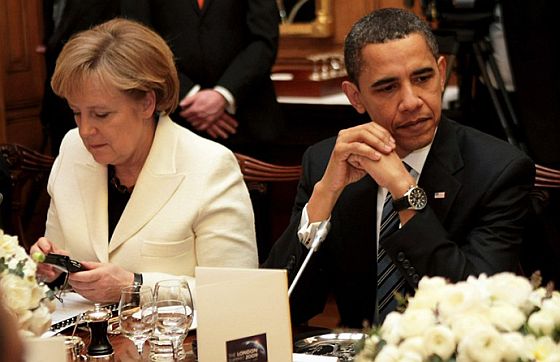
Obama pretending he can't see Merkel texting.
The Los Angeles Times reports: The White House and State Department signed off on surveillance targeting phone conversations of friendly foreign leaders, current and former U.S. intelligence officials said Monday, pushing back against assertions that President Obama and his aides were unaware of the high-level eavesdropping.
Professional staff members at the National Security Agency and other U.S. intelligence agencies are angry, these officials say, believing the president has cast them adrift as he tries to distance himself from the disclosures by former NSA contractor Edward Snowden that have strained ties with close allies.
The resistance emerged as the White House said it would curtail foreign intelligence collection in some cases and two senior U.S. senators called for investigations of the practice.
Precisely how the surveillance is conducted is unclear. But if a foreign leader is targeted for eavesdropping, the relevant U.S. ambassador and the National Security Council staffer at the White House who deals with the country are given regular reports, said two former senior intelligence officials, who spoke on condition of anonymity in discussing classified information.
Obama may not have been specifically briefed on NSA operations targeting a foreign leader’s cellphone or email communications, one of the officials said. “But certainly the National Security Council and senior people across the intelligence community knew exactly what was going on, and to suggest otherwise is ridiculous.”
If U.S. spying on key foreign leaders was news to the White House, current and former officials said, then White House officials have not been reading their briefing books.
Some U.S. intelligence officials said they were being blamed by the White House for conducting surveillance that was authorized under the law and utilized at the White House.
“People are furious,” said a senior intelligence official who would not be identified discussing classified information. “This is officially the White House cutting off the intelligence community.”
Any decision to spy on friendly foreign leaders is made with input from the State Department, which considers the political risk, the official said. Any useful intelligence is then given to the president’s counter-terrorism advisor, Lisa Monaco, among other White House officials.
When Angela Merkel phoned Barack Obama to tell him she didn’t appreciate being spied on by the NSA, it’s not as though Obama got blind-sided by the call. “You have a call on line one Mr President. It’s a woman with a German accent. She sounds pissed off.”
On the contrary, it’s reasonable to assume that Obama, in consultation with his staff, had time to craft a response, and if that response was not exactly crafted then it should at least have sounded halfway plausible.
Senior White House adviser: Just tell her you knew nothing about it but you promise it’ll never happen again.
Obama: But that’s going to sound like the lame excuse a 12-year-old would give in response to a reprimand from a school teacher.
Adviser: You got any better ideas?
The Most Powerful Man in the World: ….
What should he have said? How about:
I am aware of the reports you are referring to. I understand your concerns. I have ordered a comprehensive review of our surveillance policies and I am fully committed to taking whatever steps are necessary to restore trust between the United States and Germany. To that end, I’d like to invite you to send a team of your intelligence officials to meet their counterparts in Washington and in that context we will be able to address more specific issues and hopefully arrive at a common understanding.
You remain dear to my heart, Angela.
Well, maybe not the last bit.
Alexander did not ‘discuss’ Merkel surveillance with Obama, but was he briefed?
I think the main thing I want to emphasize is I don’t have an interest and the people at the NSA don’t have an interest in doing anything other than making sure that where we can prevent a terrorist attack, where we can get information ahead of time, that we’re able to carry out that critical task. We do not have an interest in doing anything other than that. — President Obama, August 9, 2013.
A report in the German newspaper Bild cites NSA sources claiming that in 2010, Gen. Keith Alexander briefed President Obama on the targeting of Chancellor Angela Merkel’s cellphone.
The NSA has responded with a statement saying:
[General] Alexander did not discuss with President Obama in 2010 an alleged foreign intelligence operation involving German Chancellor Merkel, nor has he ever discussed alleged operations involving Chancellor Merkel.
That sounds very much like a non-denial denial.
Given that as it was widely reported in the English-language press that Obama had been “briefed” on the surveillance, an unambiguous denial from the NSA would have simply said that Obama had not been briefed on this matter. He had not been briefed by Alexander or anyone else in the intelligence community.
A briefing involves nothing more than the exchange of information. Whether that exchange provokes discussion is another matter. Every U.S. president will be briefed on matters every single day during which he is a passive recipient of information.
That Obama presents the appearance of being a disengaged president, is well documented.
If Alexander presented Obama with a list of heads of state currently under U.S. surveillance — a list including Merkel’s name and/or position — and Obama scanned the list, noting who was being spied on and for how long, but this information provoked neither comments nor questions from the president, then he could certainly have been briefed while having no discussion.
Officials choose their words very carefully precisely because they are afraid of accused of lying. That they might at the same time be engaged in an effort to be deceptive is another matter, since in response to the suggestion that a statement might be misleading, they can always plead ignorance or regret or blame the press. Sorry if that wasn’t clear. Sorry if there’s a misunderstanding. You misinterpreted my statement.
The charade of a press briefing won’t, however, alleviate the credibility issue that Obama now has with Merkel. In her eyes the U.S. president must now appear to be either a liar, incompetent, or both.
What did the president know and when did he know it?
I haven’t evolved in my assessment of the actual [surveillance] programs. I consistently have said that when I came into office I evaluated them. — President Obama, August 2013.
The Wall Street Journal reports: The National Security Agency ended a program used to spy on German Chancellor Angela Merkel and a number of other world leaders after an internal Obama administration review started this summer revealed to the White House the existence of the operation, U.S. officials said.
Officials said the internal review turned up NSA monitoring of some 35 world leaders, in the U.S. government’s first public acknowledgment that it tapped the phones of world leaders. European leaders have joined international outrage over revelations of U.S. surveillance of Ms. Merkel’s phone and of NSA’s monitoring of telephone call data in France.
The White House cut off some monitoring programs after learning of them, including the one tracking Ms. Merkel and some other world leaders, a senior U.S. official said. Other programs have been slated for termination but haven’t been phased out completely yet, officials said.
The account suggests President Barack Obama went nearly five years without knowing his own spies were bugging the phones of world leaders. Officials said the NSA has so many eavesdropping operations under way that it wouldn’t have been practical to brief him on all of them.
They added that the president was briefed on and approved of broader intelligence-collection “priorities,” but that those below him make decisions about specific intelligence targets.
The senior U.S. official said that the current practice has been for these types of surveillance decisions to be made at the agency level. “These decisions are made at NSA,” the official said. “The president doesn’t sign off on this stuff.” That protocol now is under review, the official added.
Could Merkel have been spied on without Obama’s approval?
Der Spiegel reports: Among the politically decisive questions is whether the spying was authorized from the top: from the US president. If the data is accurate, the operation was authorized under former President George W. Bush and his NSA chief, Michael Hayden. But it would have had to be repeatedly approved, including after Obama took office and up to the present time. Is it conceivable that the NSA made the German chancellor a surveillance target without the president’s knowledge?
The White House and the US intelligence agencies periodically put together a list of priorities. Listed by country and theme, the result is a matrix of global surveillance: What are the intelligence targets in various countries? How important is this reconnaissance? The list is called the “National Intelligence Priorities Framework” and is “presidentially approved.”
One category in this list is “Leadership Intentions,” the goals and objectives of a country’s political leadership. The intentions of China’s leadership are of high interest to the US government. They are marked with a “1” on a scale of 1 to 5. Mexico and Brazil each receive a “3” in this category.
Germany appears on this list as well. The US intelligence agencies are mainly interested in the country’s economic stability and foreign policy objectives (both “3”), as well as in its advanced weapons systems and a few other sub-items, all of which are marked “4.” The “Leadership Intention” field is empty. So based on the list, it wouldn’t appear that Merkel should be monitored.
Former NSA employee Thomas Drake does not see this as a contradiction. “After the attacks of September 11, 2001, Germany became intelligence target number one in Europe,” he says. The US government did not trust Germany, because some of the Sept. 11 suicide pilots had lived in Hamburg. Evidence suggests that the NSA recorded Merkel once and then became intoxicated with success, says Drake. “It has always been the NSA’s motto to conduct as much surveillance as possible,” he adds.
Don’t underestimate Germany’s reaction to NSA surveillance
True partnership and true progress requires constant work and sustained sacrifice. They require sharing the burdens of development and diplomacy; of progress and peace. They require allies who will listen to each other, learn from each other and, most of all, trust each other. — Sen. Barack Obama, Berlin, July 2008.
Both among commentators and across America in general, there is a commonplace reaction to foreign anger provoked by offensive American actions: it is dismissive.
What are they getting worked up about? Aren’t they being hypocritical? What do they expect?
The pervasive attitude is one of indifference and beneath that an assumption that as much as others might protest, everyone ultimately bows to American might.
When Chancellor Merkel challenged President Obama on the issue of NSA surveillance, 62 percent of Germans approved of her harsh reaction, but an additional 25 percent felt she had not been harsh enough.
That’s German bluster, many Americans might now think.
But this outrage has the potential of being translated into a tangible, economic effect: opposition to a trans-Atlantic free-trade agreement.
Since the latest revelations came out, some 58 percent of Germans say they support breaking off ongoing talks, while just 28 percent are against it. “We should put the negotiations for a free-trade agreement with the US on ice until the accusations against the NSA have been clarified,” says Bavarian Economy Minister Ilse Aigner, a member of the Christian Social Union, the Bavarian sister party to Merkel’s Christian Democrats.
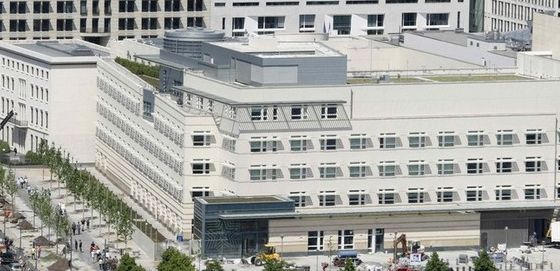
The U.S. embassy rooftop from which the NSA spies on the German government

Window-like indentations on the roof of the US Embassy are not glazed but rather veneered with 'dielectric' material and are painted to blend into the surrounding masonry. This material is permeable even by weak radio signals. Interception technology is allegedly located behind these radio-transparent screens.
Der Spiegel reports: A “top secret” classified NSA document from the year 2010 shows that a unit known as the “Special Collection Service” (SCS) is operational in Berlin, among other locations. It is an elite corps run in concert by the US intelligence agencies NSA and CIA.
The secret list reveals that its agents are active worldwide in around 80 locations, 19 of which are in Europe — cities such as Paris, Madrid, Rome, Prague and Geneva. The SCS maintains two bases in Germany, one in Berlin and another in Frankfurt. That alone is unusual. But in addition, both German bases are equipped at the highest level and staffed with active personnel.
The SCS teams predominantly work undercover in shielded areas of the American Embassy and Consulate, where they are officially accredited as diplomats and as such enjoy special privileges. Under diplomatic protection, they are able to look and listen unhindered. They just can’t get caught.
Wiretapping from an embassy is illegal in nearly every country. But that is precisely the task of the SCS, as is evidenced by another secret document. According to the document, the SCS operates its own sophisticated listening devices with which they can intercept virtually every popular method of communication: cellular signals, wireless networks and satellite communication.
The necessary equipment is usually installed on the upper floors of the embassy buildings or on rooftops where the technology is covered with screens or Potemkin-like structures that protect it from prying eyes.
That is apparently the case in Berlin, as well. SPIEGEL asked British investigative journalist Duncan Campbell to appraise the setup at the embassy. In 1976, Campbell uncovered the existence of the British intelligence service GCHQ. In his so-called “Echelon Report” in 1999, he described for the European Parliament the existence of the global surveillance network of the same name.
Campbell refers to window-like indentations on the roof of the US Embassy. They are not glazed but rather veneered with “dielectric” material and are painted to blend into the surrounding masonry. This material is permeable even by weak radio signals. The interception technology is located behind these radio-transparent screens, says Campbell. The offices of SCS agents would most likely be located in the same windowless attic.
This would correspond to internal NSA documents seen by SPIEGEL. They show, for example, an SCS office in another US embassy — a small windowless room full of cables with a work station of “signal processing racks” containing dozens of plug-in units for “signal analysis.”
On Friday, author and NSA expert James Bamford also visited SPIEGEL’s Berlin bureau, which is located on Pariser Platz diagonally opposite the US Embassy. “To me, it looks like NSA eavesdropping equipment is hidden behind there,” he said. “The covering seems to be made of the same material that the agency uses to shield larger systems.”
The Berlin-based security expert Andy Müller Maguhn was also consulted. “The location is ideal for intercepting mobile communications in Berlin’s government district,” he says, “be it technical surveillance of communication between cellphones and wireless cell towers or radio links that connect radio towers to the network.”
Apparently, SCS agents use the same technology all over the world. They can intercept cellphone signals while simultaneously locating people of interest. One antenna system used by the SCS is known by the affable code name “Einstein.”
When contacted by SPIEGEL, the NSA declined to comment on the matter.
The targeting of Chancellor Angela Merkel’s cellphone
Der Spiegel reports: There are strong indications that it was the SCS [the Special Collection Service jointly operated by the NSA and CIA] that targeted Chancellor Angela Merkel’s cellphone. This is suggested by a document that apparently comes from an NSA database in which the agency records its targets. This document, which SPIEGEL has seen, is what set the cellphone scandal in motion.
The document contains Merkel’s cellphone number. An inquiry to her team revealed that it is the number the chancellor uses mainly to communicate with party members, ministers and confidants, often by text message. The number is, in the language of the NSA, a “Selector Value.” The next two fields determine the format (“raw phone number”) and the “Subscriber,” identified as “GE Chancellor Merkel.”
In the next field, labeled “Ropi,” the NSA defines who is interested in the German chancellor: It is the department S2C32. “S” stands for “Signals Intelligence Directorate,” the NSA umbrella term for signal reconnaissance. “2” is the agency’s department for procurement and evaluation. C32 is the unit responsible for Europe, the “European States Branch.” So the order apparently came down from Europe specialists in charge of signal reconnaissance.
The time stamp is noteworthy. The order was transferred to the “National Sigint Requirements List,” the list of national intelligence targets, in 2002. That was the year Germany held closely watched parliamentary elections and Merkel battled Edmund Stoiber of Bavaria’s Christian Social Union to become the conservatives’ chancellor candidate. It was also the year the Iraq crisis began heating up. The document also lists status: “A” for active. This status was apparently valid a few weeks before President Obama’s Berlin visit in June 2013.
Finally, the document defines the units tasked with implementing the order: the “Target Office of Primary Interest”: “F666E.” “F6” is the NSA’s internal name for the global surveillance unit, the “Special Collection Service.”
Thus, the NSA would have targeted Merkel’s cellphone for more than a decade, first when she was just party chair, as well as later when she’d become chancellor. The record does not indicate what form of surveillance has taken place. Were all of her conversations recorded or just connection data? Were her movements also being recorded?
Obama lied to Merkel when claiming to know nothing about NSA bugging her phone, says new report
BBC News reports: Mrs Merkel phoned the US president when she first heard of the spying allegations on Wednesday.
President Barack Obama apologised to the German chancellor and promised Mrs Merkel he knew nothing of the alleged phone monitoring and would have stopped it if he had, Der Spiegel reports.
But on Sunday Bild newspaper quoted US intelligence sources as saying NSA head Keith Alexander personally briefed the president about the covert operation targeting Mrs Merkel in 2010.
“Obama did not halt the operation but rather let it continue,” the newspaper quoted a senior NSA official as saying.
Her number was still on a surveillance list in 2013.
Bild is a tabloid that does not have a reputation for journalistic excellence. Even so, if a conflict between the NSA and the White House is escalating, then an NSA source might turn to this type of publication as a way of making a veiled threat. The report has the effect of sowing doubt about Obama’s statements even if NSA officials now make dismissive responses, pointing out the unreliability of the press.
Obama has a dilemma. On the one hand it is becoming increasingly evident that he will need to steer some kind of reform in the NSA’s operations. But at the same time he doesn’t want to foster the appearance of the agency having become a rogue operation since that would also make him look like a negligent, ineffectual president. Neither does he want to get into an open fight since by their nature, intelligence agencies are dirty fighters. He can be reasonably confident that none of his communications are being monitored by any foreign intelligence agencies, yet why should he assume the NSA would never spy on an American president?
In a speech NSA chief Keith Alexander gave this summer, as he referred to when Obama “first came on board,” either unconsciously or intentionally, the four-star general seemed to be alluding to the transience of elected officials. The president, his cabinet, and members of Congress, sustain the facade of democracy, but the captains of the state like Alexander generally move around in the background, loyal to the president and the Constitution as they like to declare, yet harboring the conceit that they are America’s most stalwart defenders.
The NSA is undermining the fight against terrorism
The Guardian reports: Germany and France are to spearhead a drive to try to force the Americans to agree new transatlantic rules on intelligence and security service behaviour in the wake of the Snowden revelations and allegations of mass US spying in France and tapping of the German chancellor Angela Merkel’s mobile phone.
At an EU summit in Brussels that was hijacked by the furore over the activities of the National Security Agency in the US and Britain’s GCHQ, the French president, François Hollande, also called for a new code of conduct agreed between national intelligence services in the EU, raising the question of whether Britain would opt to join in.
Shaken by this week’s revelations of NSA operations in France and Germany, EU leaders and Merkel in particular warned that the international fight against terrorism was being jeopardised by the perception that mass US surveillance was out of control.
The leaders “stressed that intelligence-gathering is a vital element in the fight against terrorism”, a summit statement said. “A lack of trust could prejudice the necessary co-operation in the field of intelligence-gathering.”
Merkel drove the point home: “We need trust among allies and partners. Such trust now has to be built anew … The United States of America and Europe face common challenges. We are allies. But such an alliance can only be built on trust.” [Continue reading…]
NSA: Brazil and Germany lead calls for UN resolution on internet privacy
The Guardian reports: Brazil and Germany are spearheading efforts at the United Nations to protect the privacy of electronic communications in the wake of the Edward Snowden revelations and allegations of mass US spying.
Diplomats from the two countries, which have both been targeted by America’s National Security Agency, are leading efforts by a coalition of nations to draft a UN general assembly resolution calling for the right to privacy on the internet.
Although non-binding, the resolution would be one of the strongest condemnations of US snooping to date.
“This resolution will probably have enormous support in the GA [general assembly] since no one likes the NSA spying on them,” a western diplomat told Reuters on condition of anonymity.
The Brazilian president, Dilma Rousseff, has previously cancelled a state visit to Washington over the revelation that the NSA was scooping up large amounts of Brazilian communications data, including from the state-run oil company Petrobras. The drafting of the UN resolution was confirmed by the country’s foreign ministry.
The Associated Press quoted a diplomat who said the language of the resolution would not be “offensive” to any nation, particularly the US.
He added that it would expand the right to privacy guaranteed by the international covenant on civil and political rights, which went into force in 1976. [Continue reading…]
Outrage over U.S. spying in Germany: ‘We have recent experience of what totalitarianism means’
The Local reports: Chancellor Angela Merkel said on Thursday it was “really not on” for allies to spy on each other as the fall-out over allegations that the US National Security Agency tapped her mobile phone continues.
“We need trust between allies and partners, and such trust needs to be restored,” she said on arrival at an EU summit in Brussels.
Germany has reacted with anger over allegations the NSA tapped Merkel’s phone. Developments on Thursday include:
-Germany summoning the US ambassador in Berlin;
-The federal prosecutor’s office in Karlsruhe, part of the Ministry of Justice, intervening by stating on Thursday lunchtime it will investigate the case;
-Merkel’s phone number found in documents leaked by NSA whistleblower Edward Snowden. According to the Welt newspaper it was her old Nokia phone number;
-Germany’s parliamentary security services committee calling a special meeting.
Merkel’s mobile phone is expected to be examined by security services on Thursday to see whether it may have been tapped and what information could have been gained from it, the Bild newspaper reported.
And the revelations have also dominated the European Union summit in Brussels which was supposed to focus on economic issues.
European Commission president Jose Manuel Barroso said, in reference to life in Communist-era East Germany, that not so long ago “there was a part of Germany where political police were spying on people’s lives daily”.
“We have recent experience of what totalitarianism means,” he said. “We know what happens when a state uses powers that intrude on people’s lives.” [Continue reading…]
Germany says U.S. may have monitored Merkel’s phone
Reuters reports: The German government has obtained information that the United States may have monitored the mobile phone of Chancellor Angela Merkel and she called President Barack Obama on Wednesday to demand an immediate clarification, her spokesman said.
In a strongly worded statement, the spokesman said Merkel had told Obama that if such surveillance had taken place it would represent a “grave breach of trust” between close allies.
“She made clear that she views such practices, if proven true, as completely unacceptable and condemns them unequivocally,” the statement read.
White House spokesman Jay Carney, responding to the news in Washington, said Obama had assured Merkel that the United States “is not monitoring and will not monitor” the communications of the chancellor.
When pressed on whether spying may have occurred in the past, a White House official declined to elaborate on the statement.
“I’m not in a position to comment publicly on every specific alleged intelligence activity,” the official said. [Continue reading…]
Hitler’s underestimated charisma
Volker Ullrich, author of a new biography of Hitler, says that although the Holocaust — “this last, radical extreme of the political utopian vision of a racially homogeneous society” — was supported by “very many Germans,” it would have been “unimaginable without Hitler.”
Would another Holocaust be imaginable without another Hitler?
In terms of the scale of his destructive impact, Hitler was not unique. Stalin is widely viewed as having been responsible for 10 million or more deaths, yet rarely does one hear the phrase “another Stalin.”
Among genocidal dictators Hitler is singled out as exceptional. But those who warn of the danger of another Jewish Holocaust seem to imply that Hitler was the expression of an undercurrent of evil which could at any time give rise to another and equally dangerous manifestation — another Hitler.
The problem with this treatment of Hitler as a timeless embodiment of antisemitism is that it separates a principle of evil from an individual and the historical context in which he gained power.
While it’s certainly possible that there will be another genocidal dictator who turns out to be just as destructive as Hitler, there won’t be another Hitler. There might be another Holocaust, yet there seems just as much if not more risk that its victims turn out to be Muslims rather than Jews.
Volker Ullrich: [Hitler’s] great talent was for the games of politics. It’s easy to underestimate the exceptional qualities and abilities he brought to bear in order to succeed in this field. In the space of just three years, he rose from an unknown veteran to the king of Munich, filling the city’s largest halls week after week.
SPIEGEL: Hitler was a lone wolf. He didn’t smoke, didn’t drink, and eventually became a vegetarian. How does such an eccentric become a magnet for the masses?
Ullrich: Munich around 1920 was an ideal environment for a right-wing agitator, especially one who could give speeches as fiery as Hitler’s. But he was also a skilled tactician, outmaneuvering his competition step by step. He surrounded himself with followers who looked up to him devoutly. And he secured the support of influential patrons, especially the Bruckmanns, a well-respected couple in the publishing world; the Bechstein family, who made pianos; and of course the Wagners in Bayreuth, who soon came to treat him like one of the family.
SPIEGEL: Even the earliest reports of Hitler as a speaker note the exchange of energy between him and his listeners. “I had a peculiar sensation,” one eyewitness wrote in June 1919, “as if their excitement was his doing and at the same time also gave him voice in return.”
Ullrich: To understand Hitler’s power as a speaker, we must consider that he was not just the bellowing tavern demagogue we always picture, but in fact constructed his speeches very deliberately. He began very calmly, tentatively, almost as if he were feeling his way forward and trying to sense to what degree he had a hold of the audience so far. Not until he was certain of their approval did he escalate his word choice and gestures, becoming more aggressive. He continued this for two or three hours until he reached the climax, an intoxicating peak that left many listeners with tears running down their faces. When we watch clips of his speeches now, we’re generally seeing only the conclusion.
SPIEGEL: The writer Klaus Mann, who observed Hitler devouring a strawberry tart at Munich’s Carlton Tea Room in 1932, afterward wrote, “You want to be dictator, with that nose? Don’t make me laugh.” Did it require a certain sort of disposition to be fascinated by Hitler?
Ullrich: Klaus Mann had an instinctive, aesthetically motivated repulsion from the outset. But there are also reports of people who held a very negative view of Hitler at first, yet still got swept up and carried away when they experienced him. Among the effects of Rudolf Hess, who served as Hitler’s private secretary starting in 1925, I found letters in which he described to his fiancée their agitation tours around Germany. In one letter, he describes a gathering of business leaders in the city of Essen in April 1927. When Hitler entered the room, he was met with frosty silence, complete rejection. After two hours, it was thunderous applause. “An atmosphere such as at (Munich’s) Circus Krone,” Hess wrote.
Germany asks U.S. why NSA critic was denied entry
The Associated Press reports: Germany’s Foreign Ministry says it has contacted U.S. authorities over their decision to deny a German author entry to the United States.
Ilija Trojanow says he was refused permission to board a flight from Salvador da Bahia, Brazil, to Miami on Monday without explanation. He told the Spiegel Online website that the denial of entry might be linked to his criticism of the U.S. National Security Agency.
Trojanow was one of several prominent German authors who signed an open letter to Chancellor Angela Merkel urging her to take a firm stance against the mass online surveillance allegedly conducted by the NSA.
Once taboo, Germans’ criticisms of Israel grow louder
The New York Times reports: To judge by the outpouring of comments from politicians and writers and from the newspaper and magazine articles in response to the Nobel laureate Günter Grass’s poem criticizing Israel’s aggressive posture toward Iran, it would appear that the public had resoundingly rejected his work.
But even a quick dip into the comments left by readers on various Web sites reveals quite another reality.
Mr. Grass has struck a nerve with the broader public, articulating frustrations with Israel here in Germany that are frequently expressed in private but rarely in public, where the discourse is checked by the lingering presence of the past. What might have remained at the family dinner table or the local bar a generation ago is today on full display, not only in Mr. Grass’s poem, but on Web forums and in Facebook groups.
One word has surfaced consistently in such discussions: “keule,” which means club or cudgel. The charge of anti-Semitism aimed at Israel’s critics — and in the case of Mr. Grass, by bringing up his past as a member of the Waffen-SS — is widely viewed as a blunt instrument that silences debate, and in the process prevents Mr. Grass from making a point about the dangers of a first strike by Israel against Iran over its disputed nuclear program.
“Every time you speak out and say something that isn’t superpolitically correct, there is a 99 percent chance that you are regarded as right wing,” said Moritz Eggert, a composer based in Munich. Mr. Eggert posted his own musical interpretation of Mr. Grass’s poem with simplified lyrics on YouTube. “Israel, I love you, but don’t attack Iran,” he sings.
Mr. Eggert said he was trying to skewer both sides in the debate. While he said he did not like Mr. Grass’s poem, “it’s embarrassing the way the intellectuals try to paint him in the worst light possible.”
Mr. Grass’s critics hail mostly from the cultural and political elite, while his support appears to be far more broadly based — even if Mr. Grass is not himself seen as the best spokesman for that view, given his own Nazi past.
“The published opinions are all coming from the usual suspects,” said Claus Stephan Schlangen, one of the people behind a Facebook group formed in support of Mr. Grass’s poem. “People just don’t believe what the media is selling anymore.”
Mr. Schlangen is helping run a Facebook page called “Support Günter Grass — What Must Be Said.” The name is based on the title of the 69-line poem, which was published in the German newspaper Süddeutsche Zeitung last week. In the poem, Mr. Grass, winner of the Nobel Prize in Literature in 1999 and the author of the famous World War II novel “The Tin Drum,” said that Israel was a threat to world peace because of its warnings that it might attack Iran over its nuclear program.
The group’s page, which had more than 3,500 Facebook “likes” as of Thursday evening, shows a dove and Mr. Grass with his trademark pipe superimposed over the colors of the rainbow. “We say no to a war of aggression against Iran,” the text reads. Mr. Schlangen said that he and the site’s other manager policed the comments for anti-Semitic remarks, but that they just as often removed threatening language from Israel’s supporters.