Middle East Eye reports: Iran is prepared to send a team of “military advisers” to support Houthi rebels in Yemen, a senior military commander has said, amid suggestions that forces fighting on the ground could be moving towards a peace deal.
Massoud Jazayiri, deputy head of Iran’s armed forces, told Iran’s Tasnim news agency on Tuesday that the country would consider repeating its actions in Syria, where it is supporting President Bashar al-Assad.
“The Islamic Republic [of Iran] feels very deeply its obligation to help the Syrian government and its people. It also feels very deeply its obligation to help the Yemeni people in any way possible.”
Iran has sent large numbers of military advisers to fight alongside the Syrian army and Hezbollah, as well as footsoldiers thought to include Afghan migrants to Iran who are promised high rates of pay and Iranian citizenship in exchange for fighting.
Yemen’s Houthi rebels, who overran much of the country in September 2014, are already known to have received financial and military support from Iran. [Continue reading…]
Category Archives: Iran
Iranian state TV censors speech in which President Rohani hails former President Khatami
RFE/RL reports: Iran’s president has broken a long-standing taboo by publicly defending a reformist predecessor, but his remarks were met with a muted response.
In a speech broadcast live from Mohammad Khatami’s hometown on March 7, President Hassan Rohani hailed the former reformist president as a “dear brother.”
The crowd in the central Iranian city of Yazd cheered wildly at the mention of their native son. But Iran’s state-run IRINN television, well aware of a long-standing media ban against mentioning Khatami’s name, quickly cut the volume. [Continue reading…]
Rouhani praises ex-Pres Khatami visiting Yazd, audience erupts in cheers, stateTV mutes them
[2nd half from YouTube] pic.twitter.com/QlIGIBCWYX— Hadi Nili (@HadiNili) March 7, 2016
Russia freezes delivery of S-300 missile defense to Iran, reports Kuwaiti newspaper
The Times of Israel reports: ssian President Vladmir Putin reportedly froze the transfer of the S-300 anti-aircraft missile system to Iran after receiving evidence from Israel that Tehran had transferred advanced weapons to Hezbollah.
The Kuwaiti newspaper al-Jarida published the unconfirmed report on Saturday, citing an unnamed source allegedly “familiar” with Putin.
The source said that Putin scuppered the delivery after Israel showed that Iran had repeatedly attempted to transfer the SA-22 Greyhound short-range air defense system to the Lebanese-based terrorist group.
The report also said that Russian pilots claimed to have detected the presence of advance anti-aircraft systems in Hezbollah-controlled territory straddling the Syria-Lebanon border.
Israel, according to the report, has turned a blind eye to the Iranian-backed group’s possession of the Soviet-made SA-5 Gammon surface-to-air missile system, known also as the S-200. [Continue reading…]
Once I saw light in Iran — now it’s mostly shadows

Azadeh Moaveni writes: I remember vividly the first time I ever voted in an Iranian election. It was a balmy summer day in June 2001, in the election that won the reformist president Mohammad Khatami a second term. The blue stamp was the first on the voting page of my identification card, and I felt a sharp, exhilarating pride.
That election is much on my mind now, as I watch the results of Friday’s voting with my family, disagreeing on what it might mean for the future.
Back in 2001, Iran was heading down an irrevocable path toward internal reform, a process untainted by any Western intrusion, with citizens and progressive-minded leaders showing the way. Those leaders seemed, at the time, as exciting as Vaclav Havel and the revolutionary cleric Musa al-Sadr rolled into one. Elections felt — unlike the vote this past weekend — full of consequence, a genuine chance to recast political power rather than an exercise in slightly recalibrating it.
Tehran then was a naïve young intellectual’s paradise. There were Islamist reformers and secular reformers, women’s rights campaigners who went door to door in villages, and urban activists working to save everything from the Iranian cheetah to the rapidly evaporating Lake Urmia. You could sit at the feet of an ayatollah in the morning and hear a Koran-backed strategy for gender equality; by afternoon, you could be with the radical student opposition in a decaying house in the center of the city, still strewn with shredded documents removed from the United States embassy during the 1979 hostage-taking. There were literary readings almost every night, and subversive theater that lampooned the system, using metaphors from baseball to Moliere.
The reformists in those days were punchy; they invoked Karl Popper, and said one day freedom would come to Iran, and we would all support the Palestinians and thumb our noses at the West and be a beacon of progress for the rest of the Middle East, which in those days was a political wasteland, the kind of place that “didn’t have politics.” [Continue reading…]
How much change do Iranians really want?
Hooman Majd writes: Wash, rinse, repeat. If you’re a politician in Iran running for election or re-election, your best bet is to have the endorsement of Khatami. Mohammad Khatami, that is. In another era, Khatami was twice elected president, but today he is banned from leaving the country and his name and face are banned from the domestic media. No matter, his hands suffice these days: Election posters for the Reform and moderate list of candidates running for parliament last week showed only them, recognizable from the ring on his finger. People knew what that meant. Simultaneously, a reminder that he was backing the candidates and a “bilakh” (the finger) by the Reformists to those who insist he is so dangerous that his very features must remain hidden from the public.
Iranians are good at giving the finger: They collectively raised it almost three years ago, too. The same Khatami, only days before the 2013 presidential election — enough time for a message to register, but not enough time for hard-liners to counter it — endorsed the lesser-known Hassan Rouhani and urged the electorate to make their voices heard. They followed, if only to give the finger to those, inside and outside Iran, who claim Iranian elections don’t matter. This time, he endorsed a long list of candidates — whose names would have to be handwritten on ballots by voters — via video on the popular messaging app Telegram. To be safe, the video was also uploaded to YouTube, which is censored in Iran but available to those who want to access it via VPN. Wash, rinse, repeat.
There was always something unclean (haram) about certain members of parliament. Members who Iranians and outsiders alike call hard-liners, some who even threatened Rouhani’s Cabinet members — not with censure for making a nuclear deal with the West, but with death, buried in concrete, as one member of parliament, perhaps channeling Tony Soprano, suggested, and not in jest. As of this writing and where the vote count stands, parliament appears to have been washed and rinsed of that particular stain. Representing Tehran province, which has 30 seats in the parliament, the hard-liners have all but disappeared. There will be quite a few left in the body, of course, but they are somewhat defanged, if not fully declawed. And as with any bad stain, repeated washing and rinsing will eventually fade even the most stubborn. That is what voters seem to want, judging by how they also approached voting for the other state body — the Assembly of Experts. [Continue reading…]
Iran reformists cheer election gains, conservatives play down shift
Reuters reports: President Hassan Rouhani and his allies won big gains in elections that could deepen Iran’s engagement with the world after his government ended years of sanctions by agreeing to curb its nuclear program.
The outcome in the results for Tehran on Monday was a blow to the conservative Islamic establishment, although it retains decisive power due to Iran’s unwieldy dual system of clerical and republican rule.
Most of the lawmakers who failed to win re-election to the new parliament strongly opposed the nuclear deal, including Mehdi Kouchakzadeh, who called Foreign Minister Mohammad Javad Zarif a traitor, and Rouhollah Hosseinian, who threatened to bury the negotiators under cement for agreeing to concessions to world powers.
“This election can be a turning point in the history of the Islamic Republic,” said an editorial in reformist newspaper Mardomsalari, whose managing editor, Mostafa Kavakebian, won a parliamentary seat in Tehran.
“The biggest achievement of this election is the return of reformists to the ruling system … so they won’t be called seditionists or infiltrators anymore,” he said, referring to hardliners who accused reformists of links to the West.
Rouhani and allied centrists and moderates won 15 out of the 16 Tehran seats in the 88-member Assembly of Experts, which is tasked with choosing the country’s next supreme leader, final election results for Tehran showed. Some of the 15 elected in Tehran were in both conservative and reformist electoral lists. [Continue reading…]
Barbara Slavin writes: When given the chance, Iranians have generally voted for reformists or pragmatists, from Mohammad Khatami for President in 1997 and 2001, to Rouhani in 2013. The exception was Mahmoud Ahmadinejad, a populist hardliner who defeated a former President, Hashemi Rafsanjani, in 2005 and won again in 2009 in elections marred by fraud. Reformists swept parliamentary elections in 2000 but were disqualified en masse by the Guardian Council in 2004, 2008, and 2012.
The Guardian Council also ruthlessly pruned the candidate roster this year, removing nearly half of the more than 12,000 people who sought seats in the 290-member parliament, including almost all declared reformists. But a surviving reformist leader, a Stanford University-educated engineer and former Khatami Vice President, Mohammad Reza Aref, cobbled together candidates most supportive of Rouhani and the nuclear deal. Bolstered by a social media campaign that included a video of Khatami urging people to vote, this “List of Hope” swept all thirty seats allotted to the capital, Tehran. Among those defeated was the top hardline candidate, Gholam-Ali Haddad-Adel, a former Speaker of parliament whose daughter is married to Khamenei’s son, Mojtaba.
In polling for the eighty-eight-member Assembly of Experts, Rafsanjani, a former Chairman of the body, led the field for sixteen seats in Tehran. Among those who failed to make the cut was Mohammad Taqi Mesbah-Yazdi, who is known as “Ayatollah Crocodile” for his anti-democratic views, and Mohammad Yazdi, the incumbent chair of the Assembly.
While the final tallies depend on runoff elections in some constituencies, the gains for more pragmatic figures, particularly in parliament, should make it easier for Rouhani to implement economic reforms and to appoint and retain qualified cabinet ministers.
As the scope of the mandate became clear, Rouhani told the official Islamic Republic News Agency on February 27: “It’s time to open a new chapter in Iran’s economic development based on domestic abilities and international opportunities…The people showed their power once again and gave more credibility and strength to their elected government.” [Continue reading…]
Iran’s pragmatic Rouhani wins strong vote of confidence in elections
Reuters reports: Iranian President Hassan Rouhani won a strong vote of confidence and reformist partners secured surprise gains in parliament in early results from elections that could speed up the Islamic Republic’s emergence from years of isolation.
While gains by moderates and reformists in Friday’s polls were most evident in the capital, where they won all Tehran’s 30 seats according to early results, the sheer scale of the advances there suggests a legislature more friendly to the pragmatist Rouhani has emerged as a distinct possibility.
A loosening of control by the anti-Western hardliners who currently dominate the 290-seat parliament could strengthen his hand to open Iran further to foreign trade and investment following last year’s breakthrough nuclear deal.
A reformist-backed list of candidates aligned with Rouhani was on course to win all 30 parliamentary seats in Tehran, initial results released on Sunday showed. Top conservative candidate Gholamali Haddad Adel was set to lose his seat. [Continue reading…]
After elections, Iranian women’s demands are forgotten
Massoumeh Torfeh writes: Iran’s parliamentary elections this year included the highest number ever of women candidates from the combined reformist-moderate camp. Supporters of President Hassan Rouhani joined forces with the reformists presenting a combined list of 30 candidates for Tehran, eight – less than one-third – of which are women.
More or less, the same pattern was seen across the country. Photos of women candidates were branded around on campaign posters and the reformist media hailed this as a major success.
Despite persistent attempts by women to find a voice in the politics of the Islamic Republic, their presence has been minimal and, for the most part, cosmetic. It is now almost the norm that at important historical junctures, the male-dominated conservative establishment calls upon women to perform their “Islamic duty” and participate in elections. Once the elections are over, however, women’s demands are forgotten.
The encouragement to participate in this year’s elections came first from the spiritual leader Ayatollah Ali Khamenei. [Continue reading…]
Iran ahead on the hejab front: Newly-elected female MP already speaking in terms of a future Iran where women not forced to wear it.
— Tehran Bureau (@TehranBureau) February 28, 2016
Iran executed all adult men in one village for drug offences, official reveals
The Guardian reports: The entire adult male population of a village in southern Iran has been executed for drug offences, according to Iran’s vice-president for women and family affairs.
The matter came to light earlier this week after Shahindokht Molaverdi revealed it during an interview with the semi-official Mehr news agency in rare comments from a senior government official highlighting the country’s high rate of executions of drug traffickers.
“We have a village in Sistan and Baluchestan province where every single man has been executed,” she said, without naming the place or clarifying whether the executions took place at the same time or over a longer period. “Their children are potential drug traffickers as they would want to seek revenge and provide money for their families. There is no support for these people.” [Continue reading…]
Moktada al-Sadr reemerges at the center of Iraqi politics
The New York Times reports: Once an open client of Iran, Mr. Sadr has in recent years gone his own way, and is widely seen these days as an Iraq-first advocate of cross-sectarian unity. His militia, reconstituted after the extremists of the Islamic State captured Mosul in the summer of 2014, was renamed the Peace Brigades.
Today, as he seeks to redefine himself once again, Mr. Sadr, now 42, has positioned himself as a backer of Mr. Abadi, who is seen as increasingly weak in the face of the growing influence of Iran. Tehran supports Mr. Abadi’s political rivals, who command militias.
“Abadi, as a person, is kindhearted,” said Saad Thamer, 37, a supporter of Mr. Sadr’s who attended the rally. “But he is very weak.”
The militias have become exceedingly popular among the Shiite public, challenging Mr. Abadi’s authority, because they are seen as the protectors of the Shiite majority against the Sunni extremists of the Islamic State.
It has also been a challenge to Mr. Sadr, who has lost of some of his support at the grass-roots level as young men flock to other militias seen as more powerful. His embrace of the Iraqi state has also sometimes worked against him by contradicting his image as a populist figure.
“From an anti-establishment young leader, he compromised his stance by working more with the Iraqi political establishment, which cost him a loss of some popularity among his followers,” said Maria Fantappie, the Iraq analyst for the International Crisis Group.
Iraq is a place where everyone has his enemies, and Mr. Sadr has his share. One of his chief critics is former Prime Minister Nuri Kamal al-Maliki, who once counted on Mr. Sadr’s support to secure a second term after national elections in 2010. [Continue reading…]
How the White House disregarded mounting evidence of an imminent Russian intervention in Syria
Reuters reports: Last July, Syrian President Bashar al-Assad seemed to be losing his battle against rebel forces. Speaking to supporters in Damascus, he acknowledged his army’s heavy losses.
Western officials said the Syrian leader’s days were numbered and predicted he would soon be forced to the negotiating table.
It did not turn out that way. Secret preparations were already underway for a major deployment of Russian and Iranian forces in support of Assad.
The military intervention, taking many in the West by surprise, would roll back rebel gains. It would also accelerate two shifts in U.S. diplomacy: Washington would welcome Iran to the negotiating table over Syria, and it would no longer insist that Assad step down immediately.
“That involved swallowing some pride, to be honest, in acknowledging that this process would go nowhere unless you got Russia and Iran at the table,” a U.S. official said.
At the heart of the diplomacy shift – which essentially brought Washington closer to Moscow’s position – was a slow-footed realization of the Russian military build-up in Syria and, ultimately, a refusal to intervene militarily.
Russia, Iran and Syria struck their agreement to deploy military forces in June, several weeks before Assad’s July 26 speech, according to a senior official in the Middle East who was familiar with the details.
And Russian sources say large amounts of equipment, and hundreds of troops, were being dispatched over a series of weeks, making it hard to hide the pending operation.
Yet a senior U.S. administration official said it took until mid-September for Western powers to fully recognise Russia’s intentions. One of the final pieces of the puzzle was when Moscow deployed aircraft flown only by the Russian military, eliminating the possibility they were intended for Assad, the official said. [Continue reading…]
Obama’s cruelly pragmatic strategy in the Middle East
Gary Sick writes: [The current] violent chaos and unpredictability have prompted comparisons between this moment in the Middle East and the Thirty Years War in Europe (1618-1648). That terrible time, which started as a religious war but which was actually a restructuring of the power relationships in the center of Europe, destroyed entire regions and killed or displaced so many people that it took many generations to recover. In that case, the warring parties fought themselves to exhaustion and then settled their disputes in a series of agreements that defined a new rule-based political order — the Westphalian system — that is widely regarded as the essential underpinning of modern Europe and the West.
The Middle East could follow such a trajectory out of the current chaos. Certainly the process of peace-making after all other avenues have been exhausted — the so-called Lebanonization of the crisis — seems to be the way events are presently moving. But the timing and nature of the end game are impossible to know.
Under these circumstances, the Obama Doctrine, in which the United States will intervene only in the event of an external attack against one of its allies or to prevent a threat to the U.S. homeland, appears to be the least worst of the available options. It is a cruelly pragmatic strategy. It starts with the assumption that the United States cannot solve all the problems of the region — even those for which the United States bears a considerable degree of responsibility — and is unwilling to act as a surrogate for our friends in the region. This is a huge change from the unilateral containment doctrine adopted during the Clinton administration, and it is a total reversal of the Bush Doctrine of actively reshaping the Middle East. It is perhaps a distant relative of the Nixon Doctrine of the early 1970s when the United States relied primarily on local allies to protect U.S. interests in the region, while providing them with military training and support. [Continue reading…]
‘It’s easier to live in Iran without thinking about politics’
Ian Black reports: Even the most optimistic estimates say that reformists and moderates – once distinct terms that are now blurred – are unlikely to take more than 80 seats [in Friday’s parliamentary elections]. “We are not going to have a carnival,” concedes Mohammed Ali Vakil, a leading reformist candidate. “But a lot of people will vote for us. They will be calm, but they will surprise us.”
Sadegh Zibakalam, a political scientist who is campaigning for the reformist alliance, agrees. “I am excited,” he told the Guardian by phone while getting the vote out in Khuzestan in the south-west. “If we can persuade 10%-20% of undecided voters to overcome their indifference and go to the polling stations then there could be a historic outcome. Conservative voters are determined and will definitely vote. It’s the reformists who are undecided.”
Apathy is a huge problem, however. “I voted for the revolution when I was a young man, and that was it,” shrugged Hassan, a burly 60 something driver stuck in the traffic around the capital’s Ferdowsi Square. “Why should I bother now?”
The cynicism is just as strong in the leafy north Tehran suburb of Jamaran, where Ayatollah Khomeini lived. “If you are educated you never vote because you would just make a fool of yourself,” said Negin, a young dentist smoking shisha with four friends – their loose headscarves, makeup and fashionable clothes and boots a reminder of far-reaching social changes of recent years. “It’s easier to live in Iran without thinking about politics,” sighed Melina, a designer. [Continue reading…]
The paradox hindering Syrian peace
The Wall Street Journal reports: As world powers struggle to agree on a solution to Syria’s war, a United Nations report points to a paradox it says is hindering peace plans: the same countries pushing for peace are the ones fueling the war.
This ambiguity has radicalized the conflict, raised the political stakes and contributed to civilian suffering, said Paulo Pinheiro, the chairman of the U.N.-backed Independent Syria Commission group in an interview Monday.
“We have said this to the states themselves. We have said it’s better to be fully committed to the political process instead,” said Mr. Pinheiro. “The airspace [above Syria] is overcrowded and it has humanitarian consequences.”
The 31-page report, which laid out a detailed account of a nation at the brink of collapse, is the 11th produced since the commission was formed in 2011 to investigate and document Syria’s war. The report offers a list of recommendations for a lasting peace to Syria’s government, the opposition and the international and regional powers involved directly or through proxy groups. Most of what it has so far recommended has fallen on deaf ears. [Continue reading…]
Iran’s thwarted reformers set careful goals for coming vote
The New York Times reports: They clapped and cheered, and many shouted for the release of their political leaders under house arrest for the past five years. Some held up pictures of a popular former president, Mohammad Khatami. Pictures of his hands, to be exact, because displaying his portrait is illegal.
The young supporters of Iran’s reformist movement gathered behind the safe walls of a sports hall last week to campaign for elections on Friday for Parliament and an influential clerical council. Their longstanding demand has been tangible change, but the forced absence of most of their political leaders illustrated how far they were from their goal of a new and modern Iran.
A decade of relentless pressure from the judiciary, the Revolutionary Guards and clerical councils dominated by hard-liners has confined Iran’s reformists. The reformists were a force during the presidential contest of 2009, but the movement was decapitated after its political leaders voiced support for the millions of people who took to the streets to challenge the fairness of the vote. Reformist parties were closed down, and hundreds of activists, politicians and journalists were given long jail sentences.
The election of President Hassan Rouhani in 2013 raised the hopes of the reform movement, and Iran negotiated a nuclear deal with the West and rejoined the world economy. But internally, virtually nothing changed. The political space remained constrained, and the hope that reformers would re-emerge as a guiding force has not come to fruition. [Continue reading…]
Iranian state media renew fatwa on Salman Rushdie with $600,000 bounty

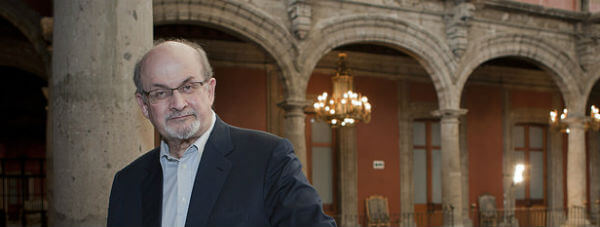
The Independent reports: Forty state-run Iranian media outlets have jointly offered a new $600,000 bounty for the death of British Indian author Salman Rushdie, according to the state-run Fars News Agency.
Fars News Agency, which is closely affiliated with the Islamic Revolutionary Guards Corps (IRGC), was among the largest contributors, donating one billion Rials – nearly $30,000.
The announcement coincides with the anniversary of the fatwa issued the Ayatollah Ruhollah Khomeini, the founder of the Islamic Republic, the agency said. [Continue reading…]
Reformist view of Iran’s Rouhani: ‘Yes he can’ becomes ‘No, he didn’t’
Scott Peterson reports: It was Hossein Dehbashi’s magic touch that added some of the inspirational glitter to Hassan Rouhani, when the cleric promised Iranians a new era of moderation and hope, and won the presidency by a landslide in 2013.
Not only did Mr. Dehbashi create the candidate’s two campaign videos, but he added a passion project of his own: An emotional Iranian version of President Obama’s “Yes We Can” video, which portrayed Mr. Rouhani as an inclusive, modern leader and brought tears to many Iranian eyes.
That video, “New Voyager,” marked Rouhani’s first 100 days in office and scored half a million hits in the first 48 hours it was posted online.
But as Iran prepares for parliamentary elections on Feb. 26, Rouhani’s shine has faded for Dehbashi and other disgruntled supporters who say he has failed to keep promises of loosened restrictions and an improved economy. [Continue reading…]
Iran’s revolutionary grandchildren

Robin Wright writes: When the revolutionary leader Ayatollah Khomeini died abruptly, from heart failure after surgery, in 1989, he left behind fifteen grandchildren. The fate of his heirs reflects the depth of tensions within the Islamic Republic as it marks the thirty-seventh anniversary of the Imam’s triumphant return from exile — and prepares for twin elections, on February 26th. All the Khomeini kids (eight males and seven females) are committed reformers pushing for Iran to open up at home — politically, economically, and socially — now that it has reëngaged with the world. In public letters and interviews, seven have challenged the theocracy’s political rules and rigid social strictures. Since 2004, three have registered to run for office.
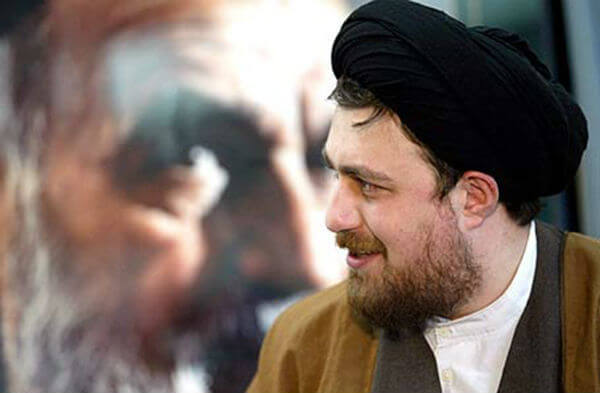
Hassan Khomeini is the family standard-bearer. He considered a soccer career before enrolling in a seminary, in the holy city of Qom, in his twenties. Now forty-three, he still plays the odd pickup game and goes to big matches. “I was good in defense, and if I had continued soccer I might have achieved something,” he joked at a meeting with Iran’s top players, in December. He is now more seriously employed as the caretaker of his grandfather’s legacy, at the Institute for the Compilation and Publication of Imam Khomeini’s Works. He is also a published scholar on Islam’s disparate sects. He wears a black turban, signifying that he descended from the Prophet Muhammed. He has all the right connections, too. His Instagram account, which has almost a quarter of a million followers, is loaded with images of him alongside top theocrats and politicians. In December, reformist newspapers ran front-page stories heralding him as Iran’s “Future Leader” and as a “Second Khomeini.” [Continue reading…]