Category Archives: Iran

Putin’s reward for doing a deal with OPEC overshadowed by risks

Bloomberg reports: Neither a recession nor a collapse in revenue has yet been enough to convince Russian President Vladimir Putin that it’s time to join with OPEC and cut oil output to boost prices. His reasons may be pragmatic rather than political.

Russia’s Energy Minister Alexander Novak and his Saudi Arabian, Venezuelan and Qatari counterparts agreed to freeze output at January levels on Tuesday. The world’s second-largest crude producer faces numerous obstacles to any deal that would actually cut production, even if Putin decides it’s in the national interest. Reducing the flow of crude might damage Russia’s fields and pipelines, require expensive new storage tanks or simply take too long.

In Siberia, Russia’s main oil province, winter temperatures can go below minus 40 degrees Celsius (minus 40 Fahrenheit). That’s a challenge for anyone thinking of turning off the taps.

The oil and gas that flows from wells always contains water, so once pumping stops, pipes may freeze, Mikhail Pshenitsyn, who has worked for more than 10 years in the Russian oil industry, said by e-mail. The problem goes away in summer, but there’s still the risk of a long-term reduction in output because a halted reservoir can become polluted with salts and residues, he said.

Production from a shut-in well might never be restored in full, Maxim Nechaev, director for Russia at consulting firm IHS Inc., said by phone. [Continue reading…]


Facebooktwittermail

A mini world war rages in the fields of Aleppo

The Washington Post reports: Across the olive groves and wheat fields of the northern Syrian province of Aleppo, a battle with global dimensions risks erupting into a wider war.

Russian warplanes are bombing from the sky. Iraqi and Lebanese militias aided by Iranian advisers are advancing on the ground. An assortment of Syrian rebels backed by the United States, Turkey, Saudi Arabia and Qatar are fighting to hold them back. Kurdish forces allied both to Washington and Moscow are taking advantage of the chaos to extend Kurdish territories. The Islamic State has snatched a couple of small villages, while all the focus was on the other groups.

Ahead of a supposed pause in the hostilities negotiated by world powers and due to be implemented later in the week, the conflict seems only to be escalating. Turkey joined in over the weekend, firing artillery across its border at Kurdish positions for a second day Sunday and prompting appeals from the Obama administration to both Turks and Kurds to back down.

Syria’s civil war long ago mutated into a proxy conflict, with competing world powers backing the rival Syrian factions almost since the earliest days of the armed rebellion against President Bashar al-Assad.

But perhaps never before have the dangers — or the complications — of what amounts to a mini world war been so apparent as in the battle underway for control of Aleppo. [Continue reading…]

Facebooktwittermail

The future of Aleppo will show whether Syria can rise from the ashes

Anshel Pfeffer reports: The forces besieging Aleppo will not try to capture it. Tens of thousands of fighters who have hardened by over four years of fighting for their homes are determined to defend their city and now every corner and rooftop of its ancient alleyways. Even a large and advanced army would emerge from such an urban warfare operation with hundreds, perhaps thousands of casualties. The ill-trained Shi’ite militias who have no experience of such warfare and are unacquainted with the city have little chance.

Abu Firas, a former Syrian army colonel and today a commander in the Shami Front, the largest rebel group fighting in Aleppo, says, “we haven’t seen on the battlefield recently any Syrian soldiers fighting for the regime. All the banners and the bodies of fighters we killed are of foreigners from Lebanon, Iraq, Afghanistan and Pakistan. We have no problem fighting them off, our men are well-trained after all these years of fighting. But they have the Russian airstrikes which make all the difference.”

Even if the forces fighting for President Bashar Assad’s regime cut off the last road leading to Aleppo, and close the last remaining kilometers in the ring of siege, the regime does not have sufficient forces to keep the pressure up for long. The rebels will succeed in breaking a way out and bringing in supplies. The local civil organizations have accumulated enough food for around a quarter of million civilians still in the city, which will last months and are meanwhile practicing growing vegetables on rooftops and digging supply tunnels. Instead of the fuel that cannot reach the city to powers it generators, they are working on alternative energy sources from waste.

Other large civilian areas in Syria, such as the rebel-held East Goutah suburb of Damascus, have withheld siege for years now. Aleppo will not fall. It will be bombarded and exhausted and as long as fighters are willing to remain, it won’t be occupied. But life there will become hell. An even worse hell than that which has existed in Syria for the last five years. And for how long can a nation live in hell?

That is, if there is still a Syrian nation.

In opposition circles, there is talk in recent months that the Assad regime has given up on recapturing most of the Syria’s territory and is now focusing on establishing “Suria al-mufida” – useful Syria. They’ve given up long ago on eastern Syria which is occupied by ISIS. The Kurdish enclaves in the north and the Druze area in the south will be allowed to remain autonomous without regime interference (no-one of course is talking any more of regaining the Golan from Israel). The regime is aiming at capturing and “cleansing” the Damascus and Aleppo districts and deepening its control of Latakia on the Mediterranean coast. That is enough to keep the Assad family regime, as a Russian client-state and an Iranian dependancy.

The regime’s main obstacle to achieving that goal is the rebel groups still controlling large areas of “Useful Syria” which continue to demand either democracy or the rule of Islam. The solution to this is carnage, exile and complete submission.

Last week, the international community’s diplomatic attempts at imposing a political solution totally failed, when the talks on Syria’s future ended in Geneva before they began. The official reason was the refusal of the opposition’s representatives to enter negotiations while Russian planes were bombing their homes back in Aleppo. Even if a ceasefire is announced at some stage, what is doubtful right now while the Russians believe they have the advantage, a “political solution” will be far from enough for a country that has lost a third of its population.

Syria has almost ceased to exist. There are enclaves and fiefdoms and an organized crime family which continues to safeguard its interests in Damascus and on the coast and a government in exile in Turkey and millions of refugees. The resilience of the people of Aleppo in face of the siege will be an indication of whether Syria can rise from the ashes. [Continue reading…]

Facebooktwittermail

UN fears for hundreds of thousands if Syria troops encircle Aleppo

Reuters reports: Hundreds of thousands of civilians could be cut off from food if Syrian government forces encircle rebel-held parts of Aleppo, the United Nations said on Tuesday, warning of a massive new flight of refugees from a Russian-backed assault.

Syrian government forces, backed by Russian air strikes and Iranian and Lebanese Hezbollah fighters, have launched a major offensive in the countryside around Aleppo, which has been divided between government and rebel control for years.

The assault to surround Aleppo, once Syria’s biggest city with 2 million people, amounts to one of the most important shifts of momentum in the five year civil war that has killed 250,000 people and already driven 11 million from their homes. [Continue reading…]

Facebooktwittermail

Anywhere but home: An Afghan child labourer in Iran dreams of life in Sweden

The Guardian reports: Mohammad, 14, is an Afghan immigrant who recently joined the flow of refugees arriving in the holding centre for unaccompanied minors on the Greek island of Lesvos.

Leaving his parents behind in Iran, he crossed the Aegean Sea on an overcrowded rubber dinghy with 38 other passengers. Mohammad describes the nighttime crossing as the scariest moment in his life. But he would not allow himself to cry. Unlike the other children on the boat, his parents were not there to comfort him. He “needed to be brave” and “be a man,” he says. His family’s decision to send their eldest son on an uncertain journey to Europe was a difficult one – but it was the most promising option compared to returning to his homeland or staying in Iran.

Afghans account for the largest proportion of unaccompanied minors arriving in Lesvos. Over one-third of the 2,248 minors that passed through Lesvos last year hail from Afghanistan, according the Greek NGO Metadrasi.

Most Afghans fleeing war and economic strife in their homeland have spent time in Iran, which has hosted the second-largest population of Afghan refugees for over 30 years. But worsening living conditions in Iran are forcing young migrants like Mohammad to leave even their temporary homeland in search of yet another one.

An estimated 2.3-3 million Afghans now live inside Iran, of whom 800,000 are children. The first wave of Afghan refugees arrived in Iran following the 1979 Soviet invasion of Afghanistan and subsequent civil war. They had access to public education and opportunities to work. Some 97% of Afghans lived outside refugee camps, and were integrated into urban communities.

Since the 2001 US invasion of Afghanistan and the fall of the Taliban, Iran began instituting increasingly restrictive laws on Afghans, including bureaucratic hurdles, limitations on movement, deportation of minors and separation of families, and reduced access to education. [Continue reading…]

Facebooktwittermail

Iran still ranks as one of the most repressive states in the world

In an editorial, The Guardian says: The government was probably looking for a public relations bonus in the west when it recently released a number of journalists, but the statistics tell another story: in 2015 Iran executed at least 830 people, including juveniles, many for non-violent crimes. The security services continue to harass and detain activists, writers and journalists. The methods used by the regime to crush the pro-democracy Green movement in 2009 are still very much in use today.

Nor has Iran become in any way more “moderate” in its behaviour in the Middle East. In Syria, Iran’s militias and Republican Guards are direct participants in the war crimes that the Assad regime inflicts on its own population. Iran’s close ally Hezbollah played a key role in the siege of Madaya, where children died of hunger as a result, and it is part of similar operations elsewhere.

It is to be hoped that a sustained implementation of the nuclear agreement will improve international security. But to draw from that the notion that Iran must now be spared any reproach would be foolish. Iran’s hardliners sought economic relief through the nuclear deal because they desperately want to keep their hold on power, not because they want to pursue a more democratic path at home or more rational policies abroad. Diplomacy is important, but it must not come at the expense of clearsightedness, nor should it be accompanied by the kind of simplistic analysis that puts the sole onus on Saudi Arabia rather than on Iran as far as human rights are concerned. The records of both countries are equally dismal. [Continue reading…]

Facebooktwittermail

How the Telegram messaging app is changing Iranian media

Saeid Jafari reports: “A grandson of the late founder of the Islamic Republic of Iran has been disqualified from running for the Assembly of Experts”; “The Joint Comprehensive Plan of Action has reached a deadlock”; “The bodybuilding champion of Iran and the world has been killed in a street fight”; and “Following in the footsteps of Djibouti and Sudan, Tunisia has also severed its ties with Iran.”

These are some of the stories that have been widely circulated among Iranians in recent weeks — but they weren’t reported by any of the licensed Iranian media outlets. Thanks to the power of social media, where ordinary Iranians can produce and broadcast their own news, many of these stories find their way into people’s homes. The same, unfortunately, also goes for mere rumors.

First it was Facebook, and then the smartphone messaging apps Viber and Line. Now, however, the hottest communication tool among Iranians is Telegram. It has more advanced features than its predecessors, and enjoys a high level of influence in Iranian society. Information and Communications Technology Minister Mahmoud Vaezi said there are roughly 13 million to 14 million Telegram users in Iran. More recent surveys, however, put this figure at over 20 million. The simplicity and ease associated with using Telegram has prompted users to see themselves as a rival of licensed media outlets. In fact, many governmental organizations are now using Telegram to create a bridge to communicate with their audiences. [Continue reading…]

Facebooktwittermail

Freed U.S. student: Now is not the time to go to Iran

Reuters reports: An American student detained in Iran who was freed this month under a prisoner swap said on Thursday he was accused of trying to overthrow the Iranian government and held for nearly a month in solitary confinement.

Matthew Trevithick, who had traveled to Iran to study Farsi, told CNN that interrogators at Iran’s Evin Prison also accused him of having access to millions of dollars and knowledge of secret weapons caches.

In his first television interview since his Jan. 16 release, he described his 41-day ordeal, including how he was captured and his treatment and conditions at the prison. [Continue reading…]

Facebooktwittermail

Iran forcing Afghan refugees to fight in Syria

Human Rights Watch: Iran’s Revolutionary Guards Corps (IRGC) has recruited thousands of undocumented Afghans living there to fight in Syria since at least November 2013, Human Rights Watch said today, and a few have reported that Iranian authorities coerced them. Iran has urged the Afghans to defend Shia sacred sites and offered financial incentives and legal residence in Iran to encourage them to join pro-Syrian government militias.

Human Rights Watch in late 2015 interviewed more than two dozen Afghans who had lived in Iran about recruitment by Iranian officials of Afghans to fight in Syria. Some said they or their relatives had been coerced to fight in Syria and either had later fled and reached Greece, or had been deported to Afghanistan for refusing. One 17-year-old said he had been forced to fight without being given the opportunity to refuse. Others said they had volunteered to fight in Syria in Iranian-organized militias, either out of religious conviction or to regularize their residence status in Iran.

“Iran has not just offered Afghan refugees and migrants incentives to fight in Syria, but several said they were threatened with deportation back to Afghanistan unless they did,” said Peter Bouckaert, emergencies director at Human Rights Watch. “Faced with this bleak choice, some of these Afghan men and boys fled Iran for Europe.” [Continue reading…]

Facebooktwittermail

Iraqis freed from ISIS’s rule now threatened by ethnic and sectarian ‘cleansing’

Aida al-Khatib reports: Thanks to the security crisis caused by the extremist group known as the Islamic State, the demographics of the province of Diyala are changing. The extremist group has been driven out of certain parts of the province and some of these are now controlled by Iraq’s sometimes-controversial Shiite Muslim volunteer militias while others are run by the Iraqi Kurdish military.

“Demographic changes have become a reality here,” says Raad al-Dahlaki, a Sunni Muslim MP and head of the Iraqi Parliament’s Committee on Immigration and Displacement. “There are many areas where security is extremely lax and there are violations of the law that should not be tolerated. For example certain areas have been shelled deliberately and it’s causing the mass displacement of [mostly Sunni] families.”

Al-Dahlaki believes the perpetrators of these acts are “militant gangs that pretend to be part of the volunteer militias but who are actually carrying out agendas set by foreigners”. And by this he means neighbouring Iran – many of the Shiite militias are funded or otherwise supported by the Iranian military.

“These gangs want to sow discord and change the demography of the province,” al-Dakhali argues.

Al-Dakhali believes the federal government should be doing more to stop the targeting of civilians by military groups, including the Shiite Muslim volunteers and Iraqi Kurdish troops. [Continue reading…]

Facebooktwittermail

For Sanders — unlike Clinton — there is no such thing as a noble cold war

Peter Beinart writes: In the final days before she and Bernie Sanders face the voters of Iowa, Hillary Clinton is leveling the same attack she leveled against Barack Obama. She’s saying that on foreign policy, she’s the only adult in the race.

In their January 17 debate, Sanders declared that, “What we’ve got to do is move as aggressively as we can to normalize relations with Iran. … Can I tell you that we should open an embassy in Tehran tomorrow? No, I don’t think we should. But I think the goal has got to be, as we’ve done with Cuba, to move in warm relations with a very powerful and important country in this world.”

When the debate ended, Team Hillary pounced. Ignoring the second half of Sanders’s statement, the campaign released a video of foreign-policy advisor Jake Sullivan asking, “Normal relations with Iran right now? President Obama doesn’t support that idea. Secretary Clinton doesn’t support that idea, and it’s not at all clear why it is that Senator Sanders is suggesting it. … It’s pretty clear that he just hasn’t thought it through.” Hillary herself added that Sanders’s comments reflect a “fundamental misunderstanding of what it takes to do the patient diplomacy that I have experience in.”

The language echoes Clinton’s attack on Obama after he pledged in a July 2007 debate to meet leaders of Iran, Syria, Venezuela, Cuba, and North Korea without preconditions — a pledge she called “irresponsible and frankly naive.” That attack, like this one, was contrived: Obama wasn’t planning to rush out to meet Iran’s supreme leader any more than Sanders would rush to build an embassy in Tehran. [Continue reading…]

Facebooktwittermail

Amnesty: Iran still a leading executioner of children

The New York Times reports: Iran is one of the leading executioners of juvenile offenders, despite its improved legal protections for children and a pledge more than two decades ago to end the death penalty for convicts younger than 18, Amnesty International said Monday.

In a new report, Amnesty International said that it had documented the execution of at least 73 juveniles in Iran from 2005 to 2015 and that 160 juvenile offenders are languishing on the country’s death row.

The report casts doubt on laws meant to improve children’s rights in Iran in the past few years, including new discretion by judges to impose alternative punishments on juveniles convicted of capital crimes. In reality, the report said, these changes are attempts by the authorities to “whitewash their continuing violations of children’s rights and deflect criticism of their appalling record as one of the world’s last executioners of juvenile offenders.”

Amnesty International, a leading global advocate for abolition of the death penalty, had also recorded the execution of juveniles in Pakistan, Saudi Arabia and Yemen, and there are juveniles on death row in the Maldives and Nigeria.

There is little doubt among rights groups that Iran has executed more people convicted of capital crimes committed as minors than any other country. [Continue reading…]

Facebooktwittermail

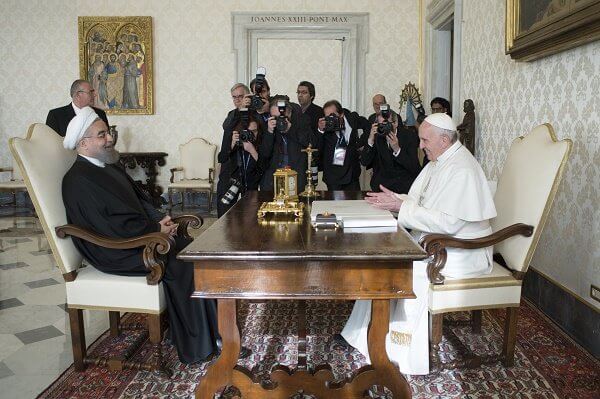
The bond between the Vatican and Iran is a partnership destined to endure

rouhani-francis

Following a meeting on Tuesday at the Vatican between Pope Francis and Iranian President Hassan Rouhani, and noting that the Vatican has had diplomatic ties with Iran since 1954 (30 years longer than U.S.-Vatican relations), John L. Allen Jr. writes: the close ties between Rome and Tehran reflect the often under-appreciated fact that both the Vatican and post-revolutionary Iran are basically theocracies, representing spiritual traditions — Catholicism and Shia Islam — that have a surprising amount in common.

Iranian writer Vali Nasr, author of the 2006 book “The Shia Revival,” argues that the divide between Sunni and Shia bears comparison to that between Protestants and Catholics, with Shia being the branch closer to Catholicism.

Among those points of contact are:

  • A strong emphasis on clerical authority
  • An approach to the Quran accenting both scripture and tradition
  • A deep mystical streak
  • Devotion to a holy family (in the case of Shiites, the blood relatives of Mohammad) and to saints (the Twelve Imams)
  • A theology of sacrifice and atonement through the death of Hussain, grandson of Mohammad and the first imam of Shia Islam
  • Belief in free will (as opposed to the Sunni doctrine of pre-destination)
  • Holy days, pilgrimages, and healing shrines
  • Intercessory prayer
  • Strongly emotional forms of popular devotion, especially the festival of Ashoura commemorating Hussain’s death

One recent sign of the spiritual vicinity is that Iranian scholars recently translated the Confessions of Augustine and the Catechism of the Catholic Church into Farsi, the result of a 12-year effort.

In terms of sheer realpolitik, both parties also have strong motives for keeping their relationship green.

From Iran’s point of view, it aspires to being not merely a regional but a global player, and to do so it requires not merely “hard” power, to invoke the famous distinction of Harvard political scientist Joseph Nye, but also “soft,” meaning moral legitimacy. The perception of being in dialogue with the Vatican is crucially important, counteracting Bush administration rhetoric about Iran being part of an “axis of evil.”

Tehran also sees the Vatican as a firebreak with sometimes hostile Western nations. In 2007, when it seemed as if concerns over Iran’s nuclear program might lead to armed conflict with the United States, Iranian diplomats quietly sought out the Vatican as a potential mediator. [Continue reading…]

Facebooktwittermail

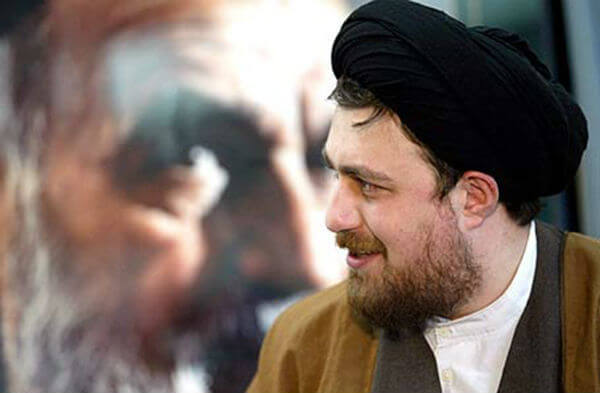
Hardliners disqualify Khomeini’s grandson in Iran power struggle

Hassan-Khomeini

Financial Times reports: Hassan Khomeini may be the grandson of the founder of Iran’s 1979 Islamic Revolution, but his religious and political credentials were deemed insufficient to qualify him for membership in the Assembly of Experts, the body that will determine Iran’s next supreme leader.

The Guardian Council, a constitutional watchdog that vets candidates standing for the council, disqualified Mr Khomeini despite “testimony by all those senior clerics” that he had reached a sufficiently high level of religious learning to interpret Islamic law or Ijtihad, Mr Khomeini’s son, Ahmad, said on his Instagram page on Tuesday.

“The reason for the disqualification is clear to all,” he added, implying that Mr Khomeini, whose candidacy outraged hardliners, was disqualified because of his alliance with reformists.

Mr Khomeini’s disqualification is a blow to centrist president Hassan Rouhani and comes amid a tense power struggle between moderate forces and hardliners. The implementation of the landmark nuclear agreement last week was seen as a big victory for pro-reform forces. But their conservative opponents are determined to maintain their hold on key institutions and say they will resist “infiltration” by western governments bent on “undermining the regime” through pro-reform forces. [Continue reading…]

IranWire reports: Reformists and moderates enthusiastically embraced Khomeini when he announced his candidacy, an excitement that Khomeini tried to quell in order to comply with electoral guidelines and to satisfy the Guardian Council — half of which are appointed by the Supreme Leader. Aware of the importance of pleasing the regime, Hassan Khomeini’s brother Ali spoke about his brother’s candidacy in a way that would meet the approval of Iran’s hardliners, particularly those on the Council.

Despite these overtures, the Council rejected Khomeini’s bid to join the Assembly of Experts.

Under Iranian law, disqualified Assembly candidates have the right to appeal the Council’s decision. The deadline for this is January 30. Khomeini has not stated whether he will launch an appeal.

Former president Akbar Hashemi Rafsanjani, currently the president of the Expediency Council, and Intelligence Minister Mahmoud Alavi, as well as President Hassan Rouhani, were all successful in their bids to run as candidates for the Assembly. [Continue reading…]

Facebooktwittermail

Why Iran backs Syria

Barak Barfi writes: The execution of a Shiite cleric in Saudi Arabia and the burning of Riyadh’s embassy in Iran has one again flamed Sunni-Shiite tensions and set the tiny Arab oil sheikhdoms on edge. Leaders from Lebanon to Yemen are fretting about Iranian machinations in Arab countries. But it is Tehran’s involvement in Syria that worries them the most. Tehran has bolstered its client state by dispatching senior military figures, pressing its Lebanese client Hezbollah to send fighters, providing much-needed petroleum products and extending Syria a hefty line of credit.

Without Iran’s help, the regime would likely have collapsed. Some believe Tehran has backed Syria to the hilt because of their common religious roots. Both ruling cliques claim affinity with the heterodox Shia, who are a minority in an Islamic world populated by orthodox Sunnis.

But Iran’s Syrian strategy derives less from spurious religious ties than it does from geopolitical factors. Surrounded by hostile pro-Western nations, Iran needs all the allies it can find to ensure that its regional interests are protected. [Continue reading…]

Facebooktwittermail

Rouhani enters Iran election row over barred candidates

AFP reports: Iran’s president has criticised moves by a powerful committee to exclude thousands of candidates, mostly reformists, from next month’s parliamentary election, saying Thursday the decision could undermine the vote’s legitimacy.

Hassan Rouhani openly questioned the actions of the Guardian Council, a conservative-dominated panel that vets all prospective lawmakers, after it said Monday that 60 percent of 12,000 election hopefuls had been excluded.

Reformists, largely sidelined from Iranian politics since the disputed 2009 re-election of hardline conservative president Mahmoud Ahmadinejad, bore the brunt of the vetting, with just one percent of its hopefuls winning approval.

Speaking in Tehran, Rouhani was warmly applauded when he suggested the public would see through steps that could amount to favouritism, saying it would dent the ballot’s competitiveness.

“It is called the House of the Nation, not the house of one faction,” he told an audience of provincial governors, implying that not only conservatives should contest the election for seats in parliament.

“If there is one faction and the other is not there, they don’t need the February 26 elections, they go to the parliament,” Rouhani said, laughing but then scorning such a prospect. [Continue reading…]

Facebooktwittermail

A nation of field mice where fear runs rampant

In an article titled, “One Nation Under Fear,” Mark Edmundson writes:

How did a people who settled a continent, created enormous wealth, and fought and (mostly) won war after war devolve into a nation of such tremulous souls? And how did it happen so quickly? Where once there was the generation of the Second World War, ready to leave home and fight fascists on the far sides of the world, we now have a nation that at times seems composed largely of field mice, prone to quiver when they detect an unfriendly shadow.

In the latest wave of mass hysteria, the barriers of entry to the United States imposed on people with darker skins will once again be raised higher.

The Visa Waiver Program Improvement and Terrorist Travel Prevention Act of 2015 does not make any mention of skin color, yet the officials who are responsible for enforcing this law will inevitably notice skin color when determining if it needs to be applied. Since the law will apply, for instance, to British citizens who are also Iranian nationals simply by virtue of having an Iranian father — such an individual might have been born in the UK, have never visited Iran and not possess an Iranian passport — the way in which they will get flagged for questioning will most likely be because they are Middle Eastern in appearance.

Ostensibly, the law was designed to block U.S. entry to Europeans who have joined ISIS.

Let’s imagine how that would work: A British citizen who fought with ISIS in Syria has now returned home and then decides to fly to New York. He shows up at the airline check-in desk, presents his passport and the clerk, seeing the stamp entered when he visited Syria, says: “Sorry mate, no trip to America for you!” The thwarted traveler responds: “Damn that Terrorist Travel Prevention Act!” … except, of course, such an individual would in reality neither declare nor present any evidence that they had been in Syria or belonged to ISIS. The terrorist would — surprise, surprise — break the rules.

In truth, this isn’t a serious piece of legislation. Those who drafted and passed this law were engaged in a piece of political theater. Indeed, anyone who can coin a phrase like “terrorist travel prevention” would be better employed at The Onion than in the U.S. Congress.

The only people who will be reliably prevented from travel are those innocently trying to do what most travelers do — visit relatives and friends; engage in tourism or business.

The terrorists are not so dumb that they would run afoul of such restrictions — just as no terrorist would subvert his own objectives by tangling himself in the vetting process imposed on asylum seekers. Continue reading

Facebooktwittermail

Iran’s elite Guards to gain regional, economic power in post-sanctions era

Reuters reports: Iran’s Revolutionary Guards did well under international sanctions, and the elite military force is destined to become still richer now they’ve been lifted.

Iran’s clerical rulers have supported economic growth of the Guards, rewarding the group for sanctions-busting as well as suppressing dissent at home and helping Tehran’s allies abroad – notably Syrian President Bashar al-Assad.

Now the country is expecting an economic boom in the post-sanctions era and the Iranian Revolutionary Guards Corps (IRGC), will be a beneficiary. Likewise, the leadership will ensure it is well funded to continue the effort in the regional crisis, including the Syrian civil war.

The Guards aren’t entirely off the hook, even though the United States, European Union and United Nations lifted most sanctions on Saturday under a deal with world powers where Tehran agreed to curbs on its nuclear program. [Continue reading…]

Facebooktwittermail