Category Archives: Iran

The moral case for ending America’s cold war with Iran

Peter Beinart writes: The debate over a final nuclear deal with Iran can be mind-numbingly technical. To what percentage will Tehran be allowed to enrich uranium? What rules will govern inspections of its nuclear sites? Which sanctions will be lifted and how?

But to a large extent, that debate misses the point. Yes, an agreement may contain Iran’s nuclear program somewhat. Yes, it could make the program more transparent. But deal or no deal, Iran will be a threshold nuclear power, able to build a nuke relatively quickly whenever it wants. (Attacking Iran, according to experts like former Shin Bet head Yuval Diskin, would only speed that process up). One day, I suspect, the people obsessing about the details of an Iranian nuclear deal will look a bit like the people who obsessed about the details of the Intermediate-Range Nuclear Forces treaty between the U.S. and U.S.S.R. in 1987. In retrospect, what mattered wasn’t the number of ballistic and cruise missiles each side dismantled. What mattered was ending the cold war.

When the cold war ended, America and the Soviet Union stopped viewing every third-world regime as a chess piece in their global struggle. They realized that by fueling civil wars in countries like Angola and Nicaragua, they were wasting money and subsidizing murder. Once the world’s superpowers scaled back their arms sales and began urging their former proxies to reach political agreements, some of the world’s most horrific wars stopped.

Obviously, U.S.-Iranian relations today differ in many ways from U.S.-Soviet relations in the late 1980s. But today, as then, the two sides are waging a cold war that is taking a horrifying toll on the people whose countries have been made battlefields. One hundred and thirty thousand Syrians have already died. More than 2 million are displaced. Many are at risk of starvation. Polio is breaking out. The best thing the United States can do for Syrians, by far, is to reach a nuclear deal that ends its cold war with Iran. [Continue reading…]

[Note: Two million “displaced” is incorrect. There are over 2.3 million Syrians as refugees who have fled the country, while another 6.5 million are internally displaced.]

Facebooktwittermail

Kerry opens door to Iran’s participation in Syrian peace talks

The New York Times reports: Secretary of State John Kerry suggested on Sunday that Iran might play a role at the peace talks on Syria that are scheduled to take place this month.

It was the first time that a senior American official had indicated that Iranian diplomats might participate in the session, which is to convene in Switzerland on Jan. 22.

But Mr. Kerry also made clear that there would be limits on Iran’s role if Tehran did not formally accept that the goal of the conference would be to work out arrangements for a transitional authority that would govern Syria if President Bashar al-Assad could be persuaded to give up power.

“Now, could they contribute from the sidelines? Are there ways for them conceivably to weigh in?” Mr. Kerry said, referring to the Iranians. “Can their mission that is already in Geneva be there in order to help the process?”

“It may be that that could happen, but that has to be determined by the secretary general,” he added, referring to Ban Ki-moon of the United Nations. “It has to be determined by Iranian intentions themselves.” [Continue reading…]

Facebooktwittermail

International investors flock to Tehran

Der Spiegel reports: Daniel Bernbeck has learned that in Tehran there’s no point getting worked up about things like the gridlock between Gholhak, his neighborhood in the northern part of the city, and downtown, where his office is located. Here he is again, stuck in traffic, with everyone honking their horns. Tehran is a murderous city, says Bernbeck, even without international sanctions and threats of attack from Israel.

Bernbeck is sitting in a gray SUV. He’s a wiry, tall blond man who wears lawyer-like glasses. The only departure from the standard business look is a narrow soul patch on his chin, which suggests a certain degree of individualism. His cell phone rings. Bernbeck’s Iranian secretary is on the line. She’s expecting him, and the deputy German ambassador has also arrived, along with two investment bankers from London and Hong Kong. They are asking about stock tips for Iran.

“Iranian stocks for Hong Kong?” Bernbeck exclaims with a grin, and then says in his best Farsi: “The same bankers would have said a year ago: You’re crazy.” Then he asks the driver to hurry up, although it doesn’t do any good.

Bernbeck is the head of the German-Iranian Chamber of Industry and Commerce in Tehran. He paves the way for business ties in a country where Western politicians have been trying for decades to make such relationships impossible, especially since 2006.

At the time, the Islamic Republic started to rapidly expand its nuclear program. Intelligence agencies predicted that it would be only a matter of a few years before the Iranians had a nuclear bomb. Arab Gulf states in the region felt threatened, and Israel was determined to go to war with Tehran if a political solution could not be found quickly.

For over five years now, Bernbeck, 50, has been living between these two adversarial worlds, more specifically “on the dark side of Mars, where the cannibals and Holocaust deniers live.” Bernbeck says that’s how Iran is portrayed in the West. [Continue reading…]

Facebooktwittermail

Israeli military intelligence sees genuine political change in Iran

Summarizing the assessment of Israeli military intelligence, Haaretz reports: Syria is continuing to fall apart, with forces that oppose the regime now in control of nearly half the country, in the north and the east. But the Assad regime continues to cling to the cities that are important to its survival and maintains a fairly wide corridor that includes the Alawite cities in the northwest of the country, as well as Aleppo, Homs, Damascus and the southern city of Daraa. Last March, Assad seemed to be on the verge of collapse, but was able to recover thanks to massive aid from Russia, Iran and Hezbollah. Since the victory organized for Assad in June by Hezbollah forces in the town of Qusair, on the Lebanese border, the fighting has become static, with no thrust of momentum or victory by either side. Presently, the opposition looks too weak and divided to topple the regime in the near future.

All the signs are that the upheaval in the Arab world will continue into 2014. The worsening economic situation – which the violence has only aggravated – will likely push more young people into the arms of the jihadist organizations, which will increasingly also clash with Israel on the margins of their main activity.

As for Iran, intelligence discerns a genuine struggle over the future image of the country between the spiritual leader Ali Khamenei and his conservative allies, and a more moderate group headed by the new president, Hassan Rohani. Expert analysis does not view Rohani’s election as a deception by Khamenei intended solely to mislead the West, but rather as an authentic leader who is creating an independent power center. The internal struggle between the blocs in Iran has yet to be resolved, but Rohani enjoys broad public support, despite the clout of the Revolutionary Guards and the senior army officers who are loyal to the spiritual leader.

Haaretz reported in September that on the eve of Netanyahu’s departure for the United Nations General Assembly in New York, the head of MI, Maj. Gen. Aviv Kochavi, provided him with an assessment holding that a deep strategic change was being played out in Iran, expressed in Rohani’s election victory in June.

Kochavi appears to be sticking to this opinion. Earlier this month, he presided over a ceremony at which prizes for creative thinking were awarded to intelligence officers. According to a report on Israel Radio, a group of officers from the research division who “identified the change in Iran” received a special certificate of appreciation from Kochavi. Officially, senior Israeli figures such as Netanyahu, Ya’alon and Foreign Minister Avigdor Lieberman are scoffing at the change in Tehran and saying that Rohani’s “charm offensive” is simply a mask assumed by the regime solely in order to get relief from the international sanctions. It turns out that MI, without for a moment detracting from the dangers of Iran’s nuclear project and its support for terrorism, thinks otherwise.

Facebooktwittermail

Iran, Turkey’s new ally?

Vali R. Nasr writes: In sharp contrast to Israel and the Persian Gulf monarchies, which have been alarmed by the interim deal on Iran’s nuclear program, Turkey sees benefit in serving as a bridge between Iran and the West and in providing the gateway to the world that Tehran needs as it emerges from isolation.

The Iranian turn has come at an opportune time for Turkish foreign policy in other ways, too. Iran has influence with Iraq’s Shiite-led government and Syria’s Alawite elite. In Iraq, where a crucial oil deal hangs in the balance, Turkey needs Iranian cooperation. It also needs Iran’s help on Syria.

Turkey initially tied its policy to America’s demand that President Bashar al-Assad quit. It was disappointed when the Obama administration signed on to a Russian-brokered deal with Mr. Assad on chemical weapons. With violence menacing across the border, Turkey wants to see an end to Syria’s civil war. The new moderate government in Tehran is Turkey’s best hope for leveraging a settlement.

Economic ties between Turkey and Iran have been strengthening, with trade now estimated to be worth $20 billion. The real number may be still higher, since the recent corruption charges allege that Turkish officials and the state-owned Halkbank have been helping Iranian businesses dodge international sanctions. In any case, Iranian exports still reach Turkey, and the proceeds fund the purchase of gold and silver that flow back to Iran. In turn, Turkey’s economy depends on Iran’s oil and gas, its investments dollars and large export market.

If Iran does conclude a long-term nuclear deal with the West, it still cannot expect a warm welcome from the Sunni Arab world. With the region divided by a widening sectarian rift, the Persian Gulf monarchies will become only more fretful about Iran’s regional ambitions. That makes Turkey potentially a key strategic partner for Iran, especially if its economy starts to grow as sanctions are relaxed. [Continue reading…]

Facebooktwittermail

UN envoy says Iran could attend Syria talks

Al Jazeera reports: Whether or not Iran will be among the nations invited to attend Syrian peace talks in Switzerland is still a source of disagreement between the UN and the United States, peace envoy Lakhdar Brahimi has said.

Speaking at a news conference in Geneva on Friday, Brahimi underlined that Tehran was not completely off the list of those who would attend Geneva 2, despite US objections.

“On Iran, we haven’t agreed yet. It’s no secret that we in the United Nations welcome the participation of Iran, but our partners in the United States are still not convinced that Iran’s participation would be the right thing,” Brahimi told reporters after talks with US and Russian officials.

Facebooktwittermail

Which Iran will we choose?

Trita Parsi, Bijan Khajehpour and Reza Marashi write: The historic interim agreement between the permanent members of the UN Security Council plus Germany (P5+1) and Iran over its nuclear dispute is not just about enrichment, centrifuges and breakout capabilities. Ultimately, it will help determine who and what will define Iran’s foreign and domestic policies for decades to come. Will it be the security-oriented, confrontational and internally repressive orientation preferred by the Iranian hardliners? Or will the more cooperative, moderate and win-win approach favored by President Hassan Rouhani and the majority of the population take root and prevail?

In a new report published today (“Extending Hands and Unclenching Fists“) — which relies on in-depth interviews with senior Iranian political officials, intellectuals and members of business community — we show that the West can weaken the hardline Iranian narrative of confrontation and resistance and facilitate a comprehensive nuclear deal by collaborating with Iran on scientific projects that carry no proliferation risk.

For the U.S. and Europe, this means augmenting a successful nuclear deal through other areas of mutual interest can help usher in a more cooperative and less threatening Iran whose domestic political liberalization positively impacts the Middle East as a whole. In the past, we have seen Iran take important steps in this direction, but without reaching the desired results.

The 2013 presidential election unexpectedly catapulted centrist leaders into power that have sought an opening to the West on numerous occasions. Such efforts include the 2001 collaboration with the U.S. in Afghanistan, the 2003 Grand Bargain offer, and the 2005 offer to limit Iran’s enrichment program to 3,000 centrifuges (Iran currently has 19,000). These offers were all made prior to the West imposing crippling sanctions. By rejecting this outreach, Washington strengthened the hand of Iranian hardliners who believe the only way to compel the U.S. to deal with Iran is not by sending peace offers, but rather by resisting American power. [Continue reading…]

Facebooktwittermail

Three months in Rouhani’s Iran

Farideh Farhi writes: I have recently returned from a three-month trip to Iran. I arrived in Tehran in early September before the famous Rouhani/Obama phone call and departed last week as the mood was turning more skeptical regarding the potential for some sort of final nuclear deal, which, in the words of Foreign Minister Javad Zarif, would “normalize” the status of Iran’s nuclear program if it were to happen.

Frankly, sitting in Tehran, it was hard to listen to various Obama administration officials’ frenzied explanations to the US Congress and Israeli government regarding how, even with the first-step agreement, Iran will remain in dire straits. It was hard to listen without becoming skeptical about the US political environment allowing an agreement that would also be acceptable to Iran. From the receiving end of all the nuclear chatter, the whole American demeanor on Iran appears imperious, even outright uncivilized; like people speaking calmly about the taking of others’ lives and imposing further economic misery on them as options that are still very much on the table.

As I write this, news has broken that the Iranian experts engaged in talks in Vienna over the first phase of the “Joint Plan” were abruptly recalled to Tehran in reaction to the blacklisting of 19 Iranian companies by the US Treasury Department — a move that both Iran and Russia said violated the “spirit” of the Geneva accord. The spokesperson of Iran’s Foreign Ministry, Marzieh Afkham, in describing the “unconstructive moves” by the Obama Administration, regretted “serious confusion in the approach, decisions, and statements of US officials.”

When I was in Tehran, Iranian officials of various political persuasions were rather soft in their reaction to all the hard talk coming out of Washington. Several officials, including key members of the Parliament, expressed their understanding of the Obama administration’s predicament in trying to sell the Geneva agreement to the US Congress. Talk about continuing pressure on Iran did provide ammunition to folks like Hossein Shariatmadari, the hawkish chief editor of the well-known Iranian daily, Kayhan, but Washington’s verbal assaults were mostly tolerated, even if Foreign Minister Zarif acknowledged that they were making his efforts to maintain support for the agreement difficult. But it appears that the latest Treasury Department move, which followed a rather harsh op-ed in the Wall Street Journal by David Cohen, the Undersecretary for Terrorism and Financial Intelligence, made looking the other way difficult. Lest we forget: Iran also has domestic politics. Unlike its reception in Washington, the Iranian nuclear agreement was mostly greeted positively in Tehran given the general consensus that it’s time to resolve the nuclear imbroglio. But there are limits to what Tehran can ignore.

I am inclined to view this event as an “enough is enough” public statement directed at Congress and aimed at limiting further moves by the Treasury Department. Both the Obama and Rouhani administrations have raised the stakes in the talks high enough to prevent unraveling at this early stage. Nevertheless, the chances of this are quite high, particularly if the Iranian context for the decision to engage in talks in the current manner is misunderstood or willfully misconstrued. [Continue reading…]

Facebooktwittermail

Iran nuclear talks hit snag after U.S. expands commercial ‘blacklists’

Reuters reports: A breakthrough agreement to end a standoff over Iran’s nuclear program appeared to face its first major difficulty on Friday with Russia warning that a U.S. sanctions move could “seriously” complicate its implementation.

Russia, which along with the United States is among the six world powers which negotiated the November 24 interim accord with Tehran, echoed Iran’s criticism by saying Washington’s sanctions decision violated the spirit of the deal.

Moscow’s statement came after diplomats said Iran had interrupted technical talks with the six nations in Vienna over how to implement the agreement, under which Tehran is to cap its nuclear program in return for limited sanctions easing.

The developments highlighted potential obstacles negotiators face in pressing ahead with efforts to resolve a decade-old dispute between the Islamic Republic and the West that has stirred fears of a new Middle East war.

Several Western diplomats insisted the inconclusive outcome of the December 9-12 expert-level discussions in Vienna should not be seen as a sign that the political deal hammered out nearly three weeks ago was in serious trouble.

But Russia made its concerns clear a day after the United States blacklisted additional companies and people under existing sanctions intended to prevent Iran from obtaining the capability to make nuclear weapons. Iran denies any such aims.

“The U.S. administration’s decision goes against the spirit of this document,” said Foreign Ministry spokeswoman Maria Zakharova, referring to the Geneva agreement between Iran and the United States, Russia, China, France, Britain and Germany.

“Widening American ‘blacklists’ could seriously complicate the fulfillment of the Geneva agreement, which proposes easing sanctions pressure.” [Continue reading…]

Facebooktwittermail

The disappearance of CIA contractor Robert Levinson: A rogue operation or a rogue intelligence agency? Updated

An Associated Press investigation has revealed that Robert Levinson, a former FBI agent who went missing in Iran in 2007 and who was at that time described by the State Department as “a private citizen involved in private business in Iran,” was in fact working for the CIA. He had been hired by a team of analysts who were running a rogue intelligence operation.

A 28-year veteran of the Drug Enforcement Administration and the FBI, Robert Levinson had a natural ability to cultivate informants. Former colleagues say he was an easy conversationalist who had the patience to draw out people and win their confidence. He’d talk to anyone.

“Bob, in that sense, was fearless,” said retired FBI Assistant Director Mark Mershon, who worked with Levinson in Miami in the 1980s. “He wasn’t concerned about being turned down or turned away.”

As the Soviet Union collapsed, Levinson turned his attention away from Mafia bosses and cocaine cartels and began watching the Russian gangsters who made their homes in Florida. Russian organized crime was a niche then and Levinson made a name as one of the few investigators who understood it.

At a Justice Department organized crime conference in Santa Fe, N.M., in the early 1990s, Levinson listened to a presentation by a CIA analyst named Anne Jablonski and spotted a kindred spirit.

Jablonski was perhaps the government’s foremost expert on Russian organized crime. Former colleagues say she had an encyclopedic memory and could, at the mere mention of a crime figure, quickly explain his place in the hierarchy and his method of moving money. When White House officials had questions about Russian organized crime, they often called Jablonski directly.

In the relatively staid world of CIA analysts, Jablonski was also a quirky character, a yoga devotee who made her own cat food, a woman who skipped off to Las Vegas to renew her vows in an Elvis-themed chapel.

After the Santa Fe conference, Levinson left a note for Jablonski at her hotel and the two began exchanging thoughts on organized crime. Jablonski invited Levinson to CIA headquarters in Langley, Va., to speak to her colleagues in the Office of Russian and European Analysis.

By the time Levinson retired from the FBI in 1998, he and Jablonski were close friends. She attended his going-away party in Florida, met his family and harvested his knowledge of organized crime.

In retirement, Levinson worked as a private investigator, traveling the world and gathering information for corporate clients. Jablonski, meanwhile, thrived at the CIA. After the Sept. 11 attacks, former colleagues say, she was assigned to brief Attorney General John Ashcroft and FBI Director Robert Mueller about terrorist threats every morning.

In 2005, Jablonski moved to the Office of Transnational Issues, the CIA team that tracks threats across borders. Right away, she arranged for Levinson to speak to the money-laundering experts in the office’s Illicit Finance Group.

In a sixth-floor CIA conference room, Levinson explained how to track dirty money. Unlike the analysts in the audience, Levinson came from the field. He generated his own information.

In June 2006, the head of Illicit Finance, Tim Sampson, hired Levinson on a contract with the CIA, former officials said. Like most CIA contracts, it was not a matter of public record. But it also wasn’t classified. [Continue reading…]

Following an internal investigation into the events leading up to Levinson’s disappearance, Jablonski and Sampson were forced to resign. [The New York Times reports that Jablonski says she refused to resign and was fired. See update below.]

Jablonski later became chief data officer for Regulatory DataCorp, Inc. (RDC), a private intelligence company serving major banks. Yesterday evening the company’s website leadership page included this description of her:
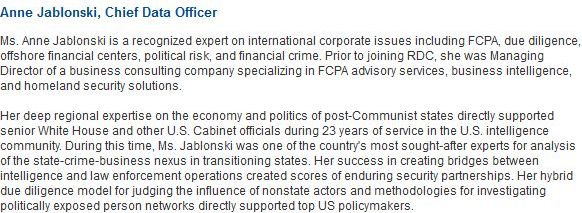
jablonski

Today a company representative I spoke to said that she no longer works there but couldn’t tell me when she left. Presumably it was within hours of the publication of the Associated Press report.

USA Today reports that the White House strongly urged AP not to run the story:

“Without commenting on any purported affiliation between Mr. Levinson and the U.S. government, the White House and others in the U.S. Government strongly urged the AP not to run this story out of concern for Mr. Levinson’s life,” said a statement from Caitlin Hayden, a spokesperson for the National Security Council.

NBC News, however, reports that Levinson’s family believe the disclosure may be helpful:

Friends and relatives of Robert Levinson, a retired FBI agent who disappeared in Iran more than six years ago, say they hope new disclosures that he was working for the CIA will lead to more action to get him home.

“Bob is a courageous man who has dedicated himself, including risking his own life, in service to the U.S. government,” Levinson’s family said in a statement provided to NBC News. “But the U.S. government has failed to make saving this good man’s life the priority it should be.”

While the account told by the AP places emphasis on the role of Anne Jablonski, characterizing her as “quirky” (like 20 million other Americans she practices yoga) and implies that as “kindred spirits” she and Levinson perhaps carry equal responsibility for conducting a rogue operation, the story says nothing about the prevailing culture in the CIA after Vice President Dick Cheney had said that it would need to operate on “the dark side.”

The idea of a group of analysts contracting an American to conduct a clandestine mission inside Iran might sound reckless, but the fact is, they were working inside an agency that was engaged in targeted killing, torture, kidnapping, and the operation of secret prisons.

Governments, their agencies, and companies, all expect unswerving loyalty from their employees, but the obligations of loyalty invariably seem to flow in only one direction.

Update: Following the publication of the AP report, the New York Times has also released a report which it has published after receiving the Levinson family’s permission. The report contains a great deal of additional information about the fruitless efforts to find Levinson. It also contains details that raise questions about whether Jablonski was turned into a scapegoat by the CIA. It should be noted that the agency’s own investigation was triggered by the intervention of Levinson’s senator, who had himself be informed about the case by the Levinson family’s lawyer.

In March 2008, a year after Mr. Levinson’s disappearance, his wife was called to a meeting at F.B.I. headquarters. There C.I.A. officials acknowledged for the first time that he had worked for them. Had it been left up to the C.I.A., it is unlikely that meeting would have occurred.

Mr. McGee [the family lawyer] and Mr. Silverman [a retired NBC investigative producer who had arranged Levinson’s meeting in Iran] had given records from Mr. Levinson’s files that documented his C.I.A. work to the Senate Select Committee on Intelligence. Senator Bill Nelson, Democrat of Florida, called in top agency officials and demanded an explanation. Those officials said they had never been alerted that an agency contractor was missing and promised to investigate.

Not long afterward, two C.I.A. officials met with Ms. Levinson and Mr. McGee at his office in Pensacola, Fla. They started by delivering a message. “They wanted to officially apologize on behalf of the C.I.A. to the Levinson family,” Mr. McGee recalled.

According to Mr. McGee, the C.I.A. officials said that while an inquiry had not found a “smoking gun” proving that the agency knew in advance about Mr. Levinson’s trip, it did conclude that Ms. Jablonski and her boss, Mr. Sampson, had misled officials about his work.

The agency gave Ms. Jablonski, Mr. Sampson and another top C.I.A. analytical official a choice: They could resign from the agency or be fired, according to several people familiar with the matter. Mr. Sampson and the other official resigned. Ms. Jablonski said she had refused and had been fired. In 2008, when Mr. McGee made it clear he was prepared to sue the C.I.A., the agency agreed to pay $2.25 million to Christine Levinson, whether or not her husband returned.

Ms. Jablonski later said in an interview that the C.I.A.’s suggestion she had abandoned a friend to protect her career was a lie. She said she had never imagined Mr. Levinson would go to Kish and insisted that she would have stopped him had she known.

She described herself as a convenient scapegoat for the C.I.A. She said that during the agency’s internal inquiry she had been repeatedly interrogated inside a windowless room by two former operatives. The men belittled Mr. Levinson’s intelligence reports as useless and suggested she might have been complicit in his disappearance.

“For all we know, you were angry with your friend and sent him to Iran to be killed,” she said one of them told her.

Facebooktwittermail

Revolutionary Guards chief criticizes Iran’s FM

The Associated Press reports: The head of Iran’s powerful Revolutionary Guards rebuked the country’s foreign minister Tuesday over comments he made about the military’s ability to withstand a potential American attack.

The criticism against Foreign Minister Javad Zarif appeared to be part of the broader political pushback by Iranian hard-liners against moderate President Hassan Rouhani’s new administration.

The latest spat revolves around comments Zarif made last week to students at a Tehran university, where he said a U.S. military attack could paralyze Iran’s defensive system.

On Tuesday, Guard chief Gen. Mohammad Ali Jafari dismissed Zarif’s remarks, saying the foreign minister “has no expertise in the field of defense,” and “his comments comparing the military power of Iran and the United States were incorrect.”

Speaking at another Tehran university, Jafari said the U.S. could only destroy up to 20 percent of Iran’s missile capability if it bombs the country heavily, according to a report Tuesday by the semiofficial Fars news agency.

Zarif has also faced pressure in parliament over his remarks. Dozens of lawmakers asked Rouhani Sunday whether the foreign minister should lose his job over the comments. [Continue reading…]

Facebooktwittermail

Iran’s FM says sanctions would kill nuclear deal

Time magazine: In a wide-ranging interview with TIME in Tehran on Dec. 7, Iran’s Foreign Minister Mohammed Javad Zarif spoke to writer and Iran expert Robin Wright about how the Geneva nuclear deal came together, how the government has to appeal to Iran’s own parliament not to undermine the interim pact, and how any new sanctions passed by the United States Congress would kill the deal. The agreement, reached between Iran and six world powers in November, calls for a freeze on parts of Iran’s nuclear program in exchange for an easing of sanctions. It is meant to pave the way for a final settlement between Iran and the international community on Iran’s nuclear program. Iran says the program is for civilian purposes only; world powers fear that it has a military component. Speaking in the ornate Foreign Ministry building, Zarif also indicated that Iran might not be wedded to Syria’s President Bashar Assad, a long-time ally, and he said that Iran hoped for a “duly monitored” democratic election in Syria. Iran’s most high-profile cabinet official warned that the deepening sectarianism playing out in Syria does not recognize borders and has implications “on the streets of Europe and America.” [Continue reading…]

Facebooktwittermail

The best and the brightest: More members with PhDs from U.S. universities in Rouhani’s cabinet than in Obama’s

Moisés Naím writes: Hassan Rouhani, Iran’s president, has more cabinet members with Ph.D. degrees from U.S. universities than Barack Obama does. In fact, Iran has more holders of American Ph.D.s in its presidential cabinet than France, Germany, Italy, Japan, Russia, or Spain — combined.

Take, for example, Rouhani’s chief of staff, Mohammad Nahavandian. He spent many years in the United States and has a Ph.D. in economics from George Washington University. Or Javad Zarif, the foreign affairs minister and chief negotiator in the recent nuclear deal between Iran and six global powers. He studied at the University of San Francisco and completed his doctorate at the University of Denver. For five years, he lived in New York and was Iran’s ambassador to the United Nations. Ali Akbar Salehi, head of Iran’s Atomic Energy Organization, has a Ph.D. in nuclear engineering from MIT. Mahmoud Vaezi, the communication minister, studied electrical engineering at Sacramento and San Jose State Universities and was enrolled in the Ph.D. program at Louisiana State University (he ultimately earned a doctorate in international relations at Warsaw University). Other cabinet members have advanced degrees from universities in Europe and Iran. Abbas Ahmad Akhoundi, the transportation minister, has a Ph.D. from the University of London, while President Rouhani got his from Glasgow Caledonian University in Scotland. The new government in Tehran, in other words, might well be one of the most technocratic in the world.

Does this matter? On the surface, perhaps not much. We all know how often the governments of the “best and the brightest” disappoint. And it’s important to keep in mind that many of these highly credentialed cabinet members were also active participants in former Iranian administrations and backed policies that earned Iran’s theocracy its bad name. [Continue reading…]

Facebooktwittermail

Zarif asks Saudi Arabia to work with Iran

Al Jazeera reports: Mohammad Javad Zarif, Iran’s foreign minister who is currently on a tour of the Gulf states, has appealed to Saudi Arabia to work with Iran towards achieving regional stability.

He said on Monday in Doha, Qatar, after visits to Kuwait and Oman for meetings on its recent nuclear deal with world powers that his goal was to assure Gulf Arab states that the deal was in their best interests.

“We believe that Iran and Saudi Arabia should work together in order to promote peace and stability in the region,” Zarif told AFP news agency.

Zarif suggested the deal should not be seen as a threat.

“This agreement cannot be at the expense of any country in the region,” he said on Sunday. [Continue reading…]

Facebooktwittermail

Iran’s hard-liners keep their criticism of nuclear pact to themselves

The New York Times reports: In a room in which journalists were outnumbered by security agents and paramilitary fighters, the tall Iranian commander stood and issued his judgment.

“Our ideology will not be undermined by some negotiations,” Mohammad Reza Naqdi, the hard-line head of the paramilitary Basij force, told the selected group of reporters in a gathering days before Iran signed an interim nuclear agreement with the United States and other world powers.

That pact, in which Iran’s moderate government agreed to freeze parts of its nuclear program for six months in exchange for limited relief from crippling economic sanctions, was greeted with wild enthusiasm in most quarters here. A conspicuous exception, however, were Iran’s hard-liners, who mostly maintained a studied silence, unwilling to risk a public confrontation with their patron over the years — the supreme leader, Ayatollah Ali Khamenei, who has cautiously welcomed the deal.

But that silence may not last, experts say. At the slightest signal from the supreme leader, they say, the hard-liners could unleash protests by hundreds of thousands on the streets along with an outpouring of criticism from state-run news media.

“They are biding their time,” watching from the sidelines, eager to pounce on any perceived signs of backtracking, weakness or capitulation, said Farshad Ghorbanpour, an Iranian journalist close to the government of President Hassan Rouhani. “When the opportunity arises they will strike back, searching for pretexts and playing into possible snags during the negotiations,” he said. “This is in no way a done deal.” [Continue reading…]

Facebooktwittermail

Britain’s ill-informed friends of Israel are refusing to face facts on Iran nuclear deal

Peter Oborne writes: It was one of those coincidences that a novelist might hesitate to invent. One of William Hague’s first tasks after signing a historic nuclear agreement with Iran was to address the grandest and most important gathering of Britain’s pro-Israel lobby.

Having flown back into London from Geneva on the Sunday, the Foreign Secretary then turned up the next day at the Park Plaza hotel at Westminster for the annual lunch of Conservative Friends of Israel (CFI). More than 100 Tory MPs, as well as hundreds more CFI supporters, were present to hear Daniel Taub, the Israeli ambassador, chide Mr Hague over Iran. One reporter present wrote that Mr Hague was “humiliated”, adding that when he rose to speak he was greeted with “light applause” and “heard in obvious silence”.

Some close to Mr Hague insist, by contrast, that it was a cheerful event. Nevertheless, the atmosphere was by no means as warm and easy as it was last year, when David Cameron was the guest of honour. At some tables, I am told, there was palpable resentment. Each guest had been given a briefing pack that included a caustic summary of the deal that Mr Hague had signed the previous day. A longer version of this document was then dispatched to Conservative MPs, ahead of the Foreign Secretary’s afternoon statement to the House of Commons on Iran.

I have obtained this briefing, which parroted the overblown rhetoric with which Benjamin Netanyahu, the Israeli prime minister, responded to the deal in Geneva. The CFI warned Tory MPs that “the world’s most dangerous regime has taken a significant step towards obtaining the world’s most dangerous weapon” – echoing Mr Netanyahu almost verbatim.

This was not merely propaganda. It was ignorant and poorly informed. [Continue reading…]

Facebooktwittermail

Iran — the next stage

David Ignatius writes: Now that the Obama administration has won its breakthrough first-step nuclear deal with Iran, officials are planning strategy for the decisive second round that, over the next six months, will seek a broader and tougher comprehensive agreement.

This “end state” negotiation, as officials describe it, promises to be more difficult because the United States and its negotiating partners will seek to dismantle parts of the Iranian program, rather than simply freeze them. Another complication is that negotiators will be fending off even more brickbats from hard-liners in Israel, Congress and Tehran.

If the interim deal was reached largely in secret, through a back channel provided by Oman, this one will have to be negotiated in the diplomatic equivalent of a circus ring, with hoots and catcalls from bystanders.

As administration strategists seek a comprehensive deal, they have several priorities. All will be harder to negotiate than was the limited six-month freeze on the Iranian program agreed to last weekend. Given the arduous bargaining ahead, the United States will need the leverage of the sanctions still in place after the release of $7 billion in frozen Iranian assets — and the threat of more sanctions if negotiations break down.

The negotiators’ agenda: [Continue reading…]

Facebooktwittermail

Five reasons Israel won’t attack Iran

Zachary Keck writes: Although not a member of the P5+1 itself, Israel has always loomed large over the negotiations concerning Iran’s nuclear program. For example, in explaining French opposition to a possible nuclear deal earlier this month, French Foreign Minister Laurent Fabius stated: “The security concerns of Israel and all the countries of the region have to be taken into account.”

Part of Fabius’ concern derives from the long-held fear that Israel will launch a preventive strike against Iran to prevent it from obtaining nuclear weapons. For some, this possibility remains all too real despite the important interim agreement the P5+1 and Iran reached this weekend. For example, when asked on ABC’s This Week whether Israel would attack Iran while the interim deal is in place, William Kristol responded: “I don’t think the prime minister will think he is constrained by the U.S. deciding to have a six-month deal. […] six months, one year, I mean, if they’re going to break out, they’re going to break out.”

Israeli prime minister Benjamin Netanyahu has done little to dispel this notion. Besides blasting the deal as a “historic mistake,” Netanyahu said Israel “is not obliged to the agreement” and warned “the regime in Iran is dedicated to destroying Israel and Israel has the right and obligation to defend itself with its own forces against every threat.”

Many dismiss this talk as bluster, however. Over at Bloomberg View, for instance, Jeffrey Goldberg argues that the nuclear deal has “boxed-in Israeli Prime Minister Benjamin Netanyahu so comprehensively that it’s unimaginable Israel will strike Iran in the foreseeable future.” Eurasia Group’s Cliff Kupchan similarly argued: “The chance of Israeli strikes during the period of the interim agreement drops to virtually zero.”

Although the interim deal does further reduce Israel’s propensity to attack, the truth is that the likelihood of an Israeli strike on Iran’s nuclear facilities has always been greatly exaggerated. There are at least five reasons why Israel isn’t likely to attack Iran. [Continue reading…]

Facebooktwittermail

