
Category Archives: Iraq

Send them parasols?

CODEPINK asks: “Why does our President want to take sides and get involved in a civil war? The US is not the target of ISIS, but if we become involved, we will be.”
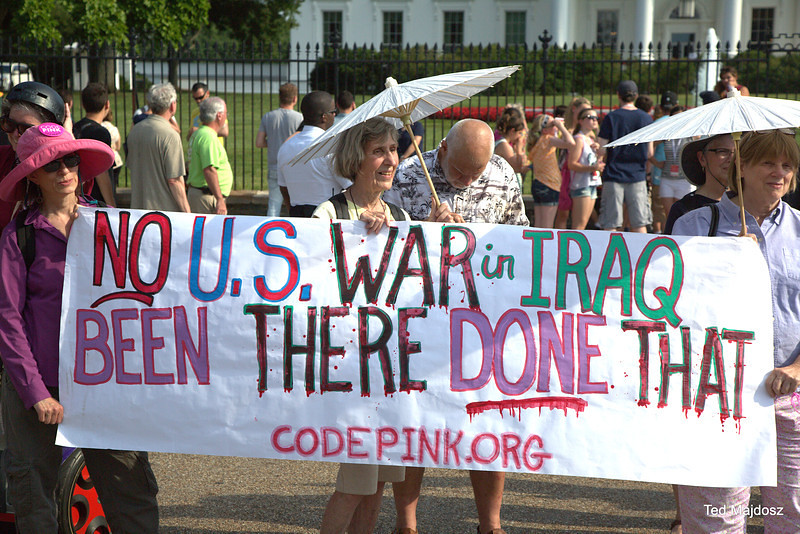
A lot of Americans these days, some of whom regard themselves as impeccable humanitarians, have formed the conviction that when it comes to the Middle East (or pretty much anywhere else in the world), intervention by the United States — especially military intervention — can do nothing but harm.

President Obama’s concerns about the Iraqi humanitarian crisis and the safety of US personnel can be solved without dropping bombs. Helping the besieged civilians in Iraq should be an orchestrated international effort, not carried out just by the US — the country that unleashed the sectarian turmoil in the first place. (CODEPINK)

Tens of thousands of Iraqis fled from ISIS, taking refuge on a mountain top where they have no food, water, or shelter. How long could anyone survive in these conditions when daytime temperatures often exceed 100F?

By the time CODEPINK’s wished for international effort could be orchestrated, thousands of those in need of help would be dead.


Channel 4 News
spoke to a Yazidi refugee, Barakat al-Issa, who is trapped in the Sinjar mountains: “the situation is very tragic, more than 100 thousand people are trapped in the mountains here, in need of water and food.”

The Americans and Turkish have carried out air drops of aid, but the effort was not sufficient said Mr al-Issa: “They are saying that planes are dropping aid, but this aid is only getting to some 5 per cent of the people who are trapped here, because of the mountainous terrain.”

“People are waiting here for international forces to intervene, in the hope that this will become a safe haven for aid to be delivered.”

“Most of the people here are civilians and they hope a peacekeeping force will come from Iraq or Nato.”

He accused the Islamic State militants of kidnapping at least 500 Yazidi women, whose fate remains unknown, and said that dozens of families had been murdered in the south of the Sinjar mountains as they tried to flee. He also repeated allegations that militants had been seen executing women and children.

To advocate neutrality in this conflict seems indicative of either being willfully deluded about the nature of ISIS or the result of simply not paying attention to what has been happening in Syria and Iraq over the last two years.

ISIS, or the Islamic State as it now prefers to be known, is utterly uncompromising. These men have chosen to fight a war that they will either win or lose — don’t expect them to ever send a delegation of negotiators to Geneva or start talking about how they want to live peacefully side by side with anyone. Coexistence is not part of their vocabulary.

Anyone in CODEPINK who is averse to taking sides should watch the video below — or at least as much of it as they can stomach — to witness how these jihadists whose passion for killing has no limit choose to portray themselves.

Some of the latest military action in Iraq appears to already by paying off but the situation remains dire, as Rudaw reports:

Local officials said today that 10,000 Yezidis who were stranded on Mount Shingal for one week were rescued and settled in the town of Zakho.

Medical teams and aid organizations in Zakho have rushed in to assist the rescued families, said Rudaw reporter.

Ashti Kocher, Zakho’s security chief said that Kurdish armed forces have opened a safe corridor for the Yezidis at Mount Shingal.

“We have also cleared about 30 kilometers of the ISIL forces in order to open a road for those families,” said Kocher, who currently leads a Peshmerga unit at Sinune village near Shingal.

Kocher said that the rescued civilians were transported to the Kurdistan Region through Rojava (Syrian Kurdistan) which is under the control of Kurdish forces known as the Peoples Protection Units (YPG).

Barakat Issa, Rudaw reporter on Mount Shingal said that the number of Yezidis stranded on the mountain is higher than initially reported. He said that nearly 100,000 people are hiding on the mountain.

Issa said that in the past few days 60 children and elderly have [died] … of hunger and thirst while there is fear that Islamic militants controlling the town of Shingal and other villages have massacred hundreds of others.

Stephen Walt proposes a course of inaction for the U.S. in the Middle East on the grounds that U.S. intervention never has its desired effects, but he adds this caveat:

[T]his argument would not preclude limited U.S. action for purely humanitarian purposes — such as humanitarian airdrops for the beleaguered religious minorities now threatened with starvation in Iraq. That’s not “deep engagement”; that’s merely trying to help people threatened with imminent death. But I would not send U.S. forces — including drones or aircraft — out to win a battle that the Iraqi government or the Kurds cannot win for themselves.

So the anti-interventionist “humanitarian” perspective is this — if I understand it correctly: we should try to make sure the Yazidi do not starve to death on the mountaintop. If, however, they manage to come back down only later to be slaughtered by ISIS, that’s their problem.


Facebooktwittermail

U.S. expands airstrikes against Islamic State militants in northern Iraq

The Washington Post reports: The U.S. military ramped up its campaign against Islamist militants in northern Iraq on Friday, with fighter jets and drones conducting additional airstrikes outside the Kurdish regional capital of Irbil, officials said.

The Pentagon said the strikes “successfully eliminated” militant targets and destroyed artillery being used by the Islamic State extremist group to shell Kurdish forces.

The first strikes took place at dawn, Washington time, with two F/A-18 combat jets flying from the aircraft carrier USS George H.W. Bush in the Persian Gulf. The aircraft dropped 500-pound laser-guided bombs on a “mobile artillery piece” near Irbil, said Rear Adm. John F. Kirby, the Pentagon press secretary.

Islamic State fighters were “using this artillery to shell Kurdish forces defending Irbil where U.S. personnel are located,” he said in a statement. “As the president made clear, the United States military will continue to take direct action against [Islamic State militants] when they threaten our personnel and facilities.”

Hours later, an MQ-1 Predator drone armed with Hellfire missiles struck an Islamic State mortar position. When “fighters returned to the site moments later, the terrorists were attacked again and successfully eliminated,” Kirby said. [Continue reading…]

Facebooktwittermail

U.S. warplanes strike #ISIS artillery to protect Kurds

Reuters reports: U.S. warplanes struck Iraq on Friday for the first time since American troops pulled out in 2011, attacking Islamist fighters advancing towards the Kurdish region after President Barack Obama said Washington must act to prevent “genocide.”

The fighters had advanced to within a half hour’s drive of Arbil, capital of Iraq’s Kurdish region and a hub for U.S. oil companies. A Pentagon spokesman said two F/A-18 aircraft dropped laser-guided bombs on a mobile artillery piece used by Islamic State fighters to shell Kurdish forces defending Arbil. [Continue reading…]

Facebooktwittermail

The jihadi gift shop in Istanbul

Joseph Dana visited the only known clothing store, located in the suburb of Bagcilar in Istanbul, which specializes in selling ISIS-branded merchandize: The idea of ISIS T-shirts shouldn’t actually be that surprising. For a terrorist organization hell-bent on creating a state based on a puritanical and bigoted form of Islam, ISIS has an incredibly savvy marketing and branding campaign. The group uses social media platforms, especially Twitter, to mold a specific media narrative and recruit funds, as well as fighters, from across the globe. Clothing targeting young men has come to be a central component of the group’s branding. By most accounts, the production and design inspiration of ISIS clothing stems from East Asia.

The Indonesian company Zirah Moslem has emerged as the world’s leading seller of ISIS merchandise. T-shirts are generally priced under $15 and, until recently, could be found on its Facebook page. Before Facebook removed the page for violating its terms of service, Zirah Moslem had more than 9,000 likes. The company still sells clothing on its website and likely acts as a wholesaler to smaller operations around the world, like Istanbul’s Islami Giyim. While it might be easy to buy ISIS T-shirts and other articles of clothing online, to date Islami Giyim is the only brick-and-mortar establishment to receive any press.

The popularity of ISIS clothing — most notably T-shirts emblazoned with the group’s initials flanked by AK-47s — demonstrates the next phase of ISIS’s international branding campaign. Islami Giyim’s Facebook page already has 6,400 likes and prominently displays a variety of ISIS-related clothing items. Without revealing exact sales figures, the store’s owner said that business was good. So good, in fact, that he plans to open more locations throughout Istanbul in the coming months. [Continue reading…]

Facebooktwittermail

Kurdish commander: ‘If [the Americans] plan to help they had better do it now’

McClatchy reports: Jet aircraft attacked Islamic State positions outside the town of Kalak, 25 miles northwest of Irbil, the capital of Iraq’s autonomous Kurdish region, a resident of Kalak told McClatchy early Friday.

The resident, reached by phone from Irbil, said she had seen the aircraft and had heard the explosions coming from behind Islamic State lines, which are slightly more than a mile away. The resident said because it was dark she could not see any markings on the aircraft.

Kurdish television reported that the bombers were American. There was no confirmation from U.S. officials in Washington.

The reported bombing came after a day of panic in the Kurdish capital following Islamic State militants’ seizure of four strategic towns on a key highway and their advance to positions just minutes from Irbil.

Hundreds of Kurdish peshmerga militiamen built earthen berms near Kalak on the highway that links Irbil with Mosul, the Iraqi city whose fall to Islamic State militants in early June touched off a sweep across northern and western Iraq that until Thursday had spared Kurdish areas.

But that quiet appeared to be over, with the Islamic State boldly saying in an Internet posting Thursday that it intended to capture Irbil, a city previously thought so secure that the United States two months ago chose it as one of two Iraqi cities safe enough to receive scores of staffers evacuated from the U.S. Embassy in Baghdad.

“The Americans keep saying they will help us,” said Rosg Nuri Shawess, a top Kurdish military commander who was overseeing the defensive preparations. “Well, if they plan to help they had better do it now.” [Continue reading…]

Facebooktwittermail

ISIS offensive sparks mass Iraq exodus of largest Christian town

Middle East Eye: Militants took over Iraq’s largest Christian town Qaraqosh and surrounding areas on Thursday and sent tens of thousands of panicked residents fleeing towards autonomous Kurdistan, officials and witnesses said.

Islamic State (IS) militants moved in overnight after the withdrawal of Kurdish peshmerga troops, who are stretched thin across several fronts in Iraq, residents said.

“I now know that the towns of Qaraqosh, Tal Kayf, Bartella and Karamlesh have been emptied of their original population and are now under the control of the militants,” Joseph Thomas, the Chaldean archbishop of Kirkuk and Sulaimaniyah, told AFP.

Qaraqosh is an entirely Christian town which lies between Mosul, the militants main hub in Iraq, and Erbil, the Kurdish region’s capital. It usually has a population of around 50,000.

“It’s a catastrophe, a tragic situation. We call on the UN Security Council to immediately intervene. Tens of thousands of terrified people are being displaced as we speak, it cannot be described,” the archbishop said.

Tal Kayf, the home of a significant Christian community as well as members of the Shabak Shiite minority, also emptied overnight. [Continue reading…]

Facebooktwittermail

ISIS holds sway for now

The Economist: The key to defeating the Islamic State (IS) could lie in the armed Sunni groups who already oppose it or who might turn against it if the political conditions were right after the formation of a new government in Baghdad. There are a wide variety of such groups, ranging from tribal militias and neo-Baathist remnants of the former regime to Salafi jihadi groups that have a similar ideology to IS but differ with it on tactics or leadership. At the moment IS has the upper hand, and, barring a few recent clashes, the other groups appear to have been largely co‑operating with it since it captured Mosul, in Nineveh province, in June.

Following the US invasion of Iraq in 2003, a plethora of jihadi militias emerged, of which al‑Qaida in Iraq, IS’s precursor, was the most prominent. However, despite sharing a similar religious ideology and an opposition to the US occupation and Shia rule, there were frequent disagreements and even clashes between the various jihadi groups, including squabbles over leadership, money and tactics. At the moment, relations with IS are complex and fluid, with some of the militias co‑operating with it in certain areas and clashing with it elsewhere.

Although other jihadi groups see themselves as fighting to establish an Islamic state, IS claims to be that entity, particularly since its declaration of a caliphate on June 29th and its demand that other groups pledge allegiance to its leader, Abu Bakr al‑Baghdadi. This is the issue on which it broke from al‑Qaida central, led by Ayman al‑Zawahiri in Pakistan/Afghanistan. Its relations with other militant groups in Syria is illustrative. Although it has co‑operated with them at times, it has also clashed with them, particularly in the eastern regions where it is strongest and has been consolidating control. It has clashed not only with secular and non‑Salafi militias, such as the Free Syrian Army and the Islamic Front, but also with fellow Salafi groups. It has even fought with its closest relation, Jabhat al‑Nusra (JN), a group that was formed in 2012 by Syrians who had been fighting in Iraq with IS but who rejected Mr Baghdadi’s demand in April 2013 that all other groups pledge allegiance to IS. One key difference is that JN seems to have a vision of an Islamic government within the Syrian nation state, whereas IS’s vision is transnational. [Continue reading…]

Facebooktwittermail

Kurds, #ISIS clash near Kurdish regional capital

Reuters reports: Kurdish forces attacked Islamic State fighters near the Kurdish regional capital of Arbil in northern Iraq on Wednesday in a change of tactics supported by the Iraqi central government to try to break the Islamists’ momentum.

The attack 40 km (25 miles) southwest of Arbil came after the Sunni militants inflicted a humiliating defeat on the Kurds on Sunday with a rapid advance through three towns, prompting Iraq’s prime minister to order his air force for the first time to back the Kurdish forces.

“We have changed our tactics from being defensive to being offensive. Now we are clashing with the Islamic State in Makhmur,” said Jabbar Yawar, secretary-general of the ministry in charge of the Kurdish peshmerga fighters.

The location of the clashes puts the Islamic State fighters closer than they have ever been to the Kurdish semi-autonomous region since they swept through northern Iraq almost unopposed in June. [Continue reading…]

Facebooktwittermail

“In one day, [#ISIS] killed more than 2,000 Yazidi … and the whole world says, ‘Save Gaza, save Gaza.’ ”

The Guardian reports: Tens of thousands of members of one of Iraq’s oldest minorities have been stranded on a mountain in the country’s north-west, facing slaughter at the hands of jihadists surrounding them below if they flee, or death by dehydration if they stay.

UN groups say at least 40,000 members of the Yazidi sect, many of them women and children, have taken refuge in nine locations on Mount Sinjar, a craggy mile-high ridge identified in local legend as the final resting place of Noah’s ark.

At least 130,000 more people, many from the Yazidi stronghold of Sinjar, have fled to Dohuk, in the Kurdish north, or to Irbil, where regional authorities have been struggling since June to deal with one of the biggest and most rapid refugee movements in decades.

Sinjar itself has been all but emptied of its 300,000 residents since jihadists stormed the city late on Saturday, but an estimated 25,000 people remain. “We are being told to convert, or to lose our heads,” said Khuldoon Atyas, who has stayed behind to guard his family’s crops. “There is no one coming to help.”

Another man, who is hiding in the mountains and identified himself as Nafi’ee, said: “Food is low, ammunition is low and so is water. We have one piece of bread to share between 10 people. We have to walk 2km [1.2 miles] to get water. There were some air strikes yesterday [against the jihadists], but they have made no difference.” [Continue reading…]

George Packer adds: Prince Tahseen Said, “the world leader of the Yazidis,” has issued an appeal to Kurdish, Iraqi, Arab, and European leaders, as well as to Ban Ki-moon and Barack Obama. It reads: “I ask for aid and to lend a hand and help the people of Sinjar areas and its affiliates and villages and complexes which are home to the people of the Yazidi religion. I invite [you] to assume [your] humanitarian and nationalistic responsibilities towards them and help them in their plight and the difficult conditions in which they live today.”

It’s hard to know what, if anything, is left of the humanitarian responsibilities of the international community. The age of intervention is over, killed in large part by the Iraq war. But justifiable skepticism about the use of military force seems also to have killed off the impulse to show solidarity with the helpless victims of atrocities in faraway places. There’s barely any public awareness of the unfolding disaster in northwestern Iraq, let alone a campaign of international support for the Yazidis — or for the Christians who have been driven out of Mosul or the Sunni Arabs who don’t want to live under the tyranny of ISIS. The front-page news continues to be the war in Gaza, a particular Western obsession whether one’s views are pro-Israel, pro-Palestinian, pro-peace, or pro-plague-on-both-houses. Nothing that either side has done in that terrible conflict comes close to the routine brutality of ISIS.

Karim couldn’t help expressing bitterness about this. “I don’t see any attention from the rest of the world,” he said. “In one day, they killed more than two thousand Yazidi in Sinjar, and the whole world says, ‘Save Gaza, save Gaza.’ ”

Yesterday, a senior U.S. official told me that the Obama Administration is contemplating an airlift, coördinated with the United Nations, of humanitarian supplies by C-130 transport planes to the Yazidis hiding in the Sinjar mountains. There are at least twenty thousand and perhaps as many as a hundred thousand of them, including some peshmerga militiamen providing a thin cover of protection. The U.N. has reported that dozens of children have died of thirst in the heat. ISIS controls the entrance to the mountains. Iraqi helicopters have dropped some supplies, including food and water, but the refugees are hard to find and hard to reach.

Facebooktwittermail

How the U.S. got mixed up in a fight over Kurdish oil — with a unified Iraq at stake

The Washington Post reports: Sixty miles off the coast of Texas sits a crude-oil tanker fully loaded with years of antagonism between the Kurdish region of Iraq and the central government in Baghdad.

The United Kalavrvta, a tanker the length of three football fields, is carrying about 1 million barrels of crude oil from the Kurdish region of Iraq. It set sail for Galveston, but it never got there.

The central government of Iraq, despite recent military setbacks, dispatched its American lawyers to do battle in the federal court in southern Texas, where a judge ruled that the tanker’s cargo, worth about $100 million, should be seized if it came within Texas state waters.

The core of the dispute: The Iraqi government says that the crude cargo belongs to the Baghdad Ministry of Oil and that it was never the property of the Kurdistan Regional Government. But the Kurds argue that the Texas court doesn’t have jurisdiction, and they filed a motion Monday in the court to lift the restrictions on the oil. Michael Howard, an adviser to the Kurdish minister of natural resources, said in an interview that “it’s a constitutional issue that should be determined in Iraq and shouldn’t be exported to U.S. courts.” [Continue reading…]

Facebooktwittermail

#ISIS ‘seize #Iraq’s biggest dam’ in defeat for #Kurdish forces

Reuters reports: Sunni insurgents have reportedly seized control of Iraq’s biggest dam, an oilfield and three more towns after inflicting their first major defeat on Kurdish forces since sweeping across much of northern Iraq in June.

Capture of the electricity-generating Mosul Dam, which was reported by Iraqi state television, could give the forces of the Islamic State (ISIS) the ability to flood Iraqi cities or withhold water from farms, raising the stakes in their bid to topple prime minister Nuri al-Maliki’s Shia-led government.

“The terrorist gangs of the Islamic State have taken control of Mosul dam after the withdrawal of Kurdish forces without a fight,” said Iraqi state television of the claimed 24 hour offensive.

Kurdish officials conceded losses to Isis but denied the dam had been surrendered. A Kurdish official in Washington told Reuters the dam was still under the control of Kurdish “peshmerga” troops, although he said towns around the dam had fallen to Isis. [Continue reading…]

Reuters also reports: A major Kurdish militant group called Monday for all Kurds to rise up against Islamic State of Iraq and Greater Syria (ISIS) fighters in northern Iraq, after the Sunni militants seized Kurdish territory in a dramatic advance.

“All Kurds in the north, east, south and west must rise up against the attack on Kurds in Sinjar (in northern Iraq),” the Kurdistan Workers Party (PKK), which has fought a 30-year insurgency against Turkey, said in a statement on it website.

Facebooktwittermail

Two Christian nuns from Mosul describe being kidnapped by #ISIS

Matthew Barber writes: The two nuns were well-known for their many years of work among Mosul’s needy. Though they were not harmed while being held, their unexplained disappearance was unnerving for the Christian population, and added to the number of factors that terrorized Christians before their final mass departure on Jul. 17.

Sister Miskinta al-Dosaky Myko and her superior, Sister Atur Joseph had initially fled to Kurdistan province when ISIS took over Mosul, as had many other Christians. And as many others had also done, they ventured back into Mosul after ISIS offered pledges of safety to minorities.

On June 27, the two nuns, along with three orphans in their care, drove from Kurdistan Province to Mosul, to check on the orphanage that they were in charge of, and to check on a number of poor families to whom they frequently gave assistance. In their car they carried food and money that they planned to deliver to needy families. The children were brought along to gather their things from the orphanage, as they were going to relocate to Kurdistan.

They were apprehended by ISIS fighters while in one of the neighborhoods where they often distributed food. Two jihadists spoke to them, a Syrian and an Iraqi. The nuns had the impression that the Iraqi was reluctant to give the nuns a hard time, but the Syrian pulled rank somehow and said that they had to come with them, “to answer questions.” He demanded their keys, saying he would drive their car, but the nuns refused, whereupon the jihadists allowed them to drive, and escorted their vehicle with their own vehicles. [Continue reading…]

Facebooktwittermail

#UN warns of ‘humanitarian tragedy’ as #ISIS seizes #Iraq’s Sinjar

France24 reports: The capture of the Iraqi town of Sinjar by militants from the Islamic State of Iraq and Greater Syria (ISIS or ISIL) has displaced up to 200,000 people and created a “humanitarian tragedy”, the UN said on Sunday.

“A humanitarian tragedy is unfolding in Sinjar,” the top UN envoy in Iraq, Nickolay Mladenov, said in a statement after ISIS militants had captured the northern town, which lies near the Syrian border. Thousands of previously displaced families had fled to Sinjar to seek safety.

“The United Nations has grave concerns for the physical safety of these civilians,” the statement said.

It said it was particularly concerned by the fate of civilians who fled into the Jabal Sinjar mountains and could be trapped inside an area completely surrounded by the militants.

“The humanitarian situation of these civilians is reported as dire, and they are in urgent need of basic items including food, water and medicine,” the statement said.

Sinjar had been controlled by Kurdish troops but they withdrew on Sunday, the second consecutive day of losses for the peshmerga fighters, who also lost the town of Zumar and two nearby oilfields to ISIS jihadists on Saturday. [Continue reading…]

Facebooktwittermail

A nation in peril — Iraq’s struggle to hold together

Reuters reports: Iraq’s latest – and gravest – crisis erupted when mostly Sunni fighters swept through the north last month. Now the jihadist black flag flies over of most of the country’s Sunni Arab territory.

Kurdish forces, exploiting the chance to take another step towards independence, seized the city of Kirkuk and nearby oilfields, leaving the Shi’ite-led government controlling only the capital region and the mainly Shi’ite south.

The government is trying to reverse this de facto, three-way split of the country, but its reliance on Shi’ite militia and volunteers rather than the ineffectual national army has deepened sectarian mistrust without pushing the rebels back.

Across Baghdad a Sunni living in the Shi’ite area of Maalef, cut off from the rest of the city by a checkpoint where non-residents are turned back, said life there had become unbearable for those who do not belong to the majority Shi’ite community.

“The Sunnis all want separation now,” said the 37-year-old electrician, who asked not to be named for his security. “Facts on the ground tell you this will be the final result. On both sides now you have extremists who don’t want to get along”.

Kurdish politician Hoshiyar Zebari, who still staunchly advocates Iraqi unity, described the new geography. “The country is divided literally into three states: the Kurdish state; the black state (under Sunni insurgents) and Baghdad,” he said.[Continue reading…]

Facebooktwittermail