Category Archives: Israel

Israel’s Orwellian message on human rights

It would appear that Israel’s borders now extend as far as most of Europe.

This weekend hundreds of people participating in the Welcome to Palestine campaign have been barred from “entering” Israel by being prevented from leaving their own country.

Article 13 of The Universal Declaration of Human Rights says:

Everyone has the right to leave any country, including his own, and to return to his country.

Israel provided airlines with a list of individuals whose right of entry it denies, ordered these airlines to prevent them from boarding their flights and threatened the airlines with sanctions if they failed to comply. So much for the human right of freedom of movement.

Anticipating that Israeli intelligence might not have been able to identify everyone they are afraid of, the Israeli Prime Minister’s Office prepared a letter to be handed to activists who manage to reach Ben-Gurion International Airport.

The letter looks like it could have been hammered out by Benjamin Netanyahu himself on a manual typewriter as he struggles to protect Israel from its latest existential threat. It’s ironic that a state that craves respect and recognition as a democratic state, expresses itself in the sarcastic language one might expect from a paranoid autocratic ruler.
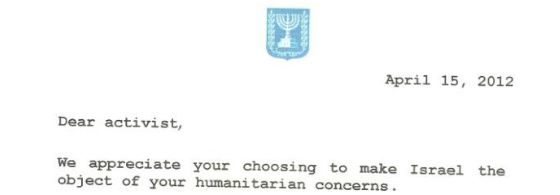
Unwelcome to Israel letter

The unsigned letter (without corrections) states:

Dear activist,

We appreciate your choosing to make Israel the
object of your humanitarian concerns.

We know there are manyother worthy choices.

You could have chosen to protest theSyrian
regime’s daily savagery against its own people,
which has claimed thousands of lives.

You could have chosen to protest the Iranian
regime’s brutal crackdown on dissent and support
of terrorism throughout the world.

You could have chosen to protest Hamas rule in
Gaza, where terror organizations commit a double
war crime by firing rockets at civilians and
hiding behind civilians.

But instead you chose to protest against Israel,
the Middle East’s sole democracy, where women are
equal, the press criticizes the government, human
rights organizations can operate freely,
religious freedom is protected for all and
minorities do not live in fear.

We therefore suggest that you first solve the
real problems of the region, and then come back
and share with us your experience.

Have a nice flight.

In 2008, Israel’s Ambassador to the UN, Gabriela Shalev, commemorated the 60th anniversary of the Universal Declaration of Human Rights, saying:

Let us reaffirm that each and every state –– regardless of circumstances –– must fulfill its primary responsibility to respect and protect the rights of all individuals, without distinction of any kind. Let us continue to promote the work of non-governmental organizations and human rights defenders who have played a critical role in assessing violations and protection gaps. Let us work towards supporting international mechanisms, such as human rights treaty bodies, international and regional tribunals and courts and the ICC – all of which seek to provide effective tools to ensure adequate redress and respect for human rights.

In an era when we are increasingly interconnected –– in a time when information rapidly flows across oceans and continents –– we must shine the light of the Universal Declaration to the four corners of the globe. We must commit our resources, as well as our collective resolve and determination, to secure human life, dignity and basic rights for all.

For in the end, human rights are not merely legal instruments. They are expressions of our common humanity, our common vision for a better, more just world.

Nice words. It’s a shame they have such little meaning in a state that repeatedly trumpets its claim to be the region’s “sole democracy” yet denies the human rights of almost four million Palestinians living under Israel military rule or control.

Meanwhile, this is how Israelis treat foreign human rights activists if they manage to reach the West Bank:

Just as disturbing as this soldier’s unprovoked use of violence are the comments below the video.


Facebooktwittermail

A lack of vision is making Israel a short-term state

Gideon Levy writes: There’s no country like Israel. The United States is uncertain how many Americans will be unemployed and have health insurance in a decade; Europe is asking how many more immigrants will enter and whether the euro will exist by 2022. In Israel, the existential issues are immeasurably more profound and wide-ranging, but no one bothers to address them.

The prime minister talks as if his problems were of the European kind (not including the Iranian nuclear hysteria ), yet much more fateful issues remain open and somehow nobody discusses them. Israel is 64 years old and the issues remain pending, as if the state had been established yesterday and there are no answers.

Nobody can say what this country will look like in 10 years. Some people even doubt that it will exist by then, an issue not raised about any other country. But even the preoccupation with this groundless question is reduced to sowing fear and whining at Friday night dinner. All other issues, no less critical, don’t even come up. Does anybody know whether Israel will be a democracy in a decade? Can anyone promise that it will be? Will it be a secular state or one based on Jewish law? Will it be a welfare state or a capitalist one? How many nations will live in it in a decade?

Who will be the majority in 10 years – another question you won’t hear anywhere else – and what will the borders be? That question, too, is raised only in Israel, the only borderless state.

Everything is open, fluid and alarmingly fragile. The three future scenarios for Israel as an occupation state – continuing the status quo forever, two states or one – appear groundless, and people have stopped addressing them, as if the absence of discourse will produce a feasible solution. But all other critical questions have no real answer either and hardly appear on the agenda, even though Israelis should focus on them.

A state without a (clear ) future, wallowing in the past and focusing on the present, is tantamount to a short-term state. Even on the eve of our national days of pathos, nobody asks what Israel will be like in a decade, which is no time at all in historical terms.

Last week I joined the pilgrims to Hebron on Passover eve. In the bus, one of them, using a derogatory term for Arabs, said loudly: “All the Arabushim should be sent to the stone crushers straight from the hospital, as soon as they’re born.” The whole bus roared with laughter. Some passengers muttered at us, a reporter and a photographer, the only secular people on the bus: “Collaborators, there are collaborators on the bus.” Nobody protested, naturally.

The thousands of pilgrims to Hebron, with their myriads of supporters, belong to another nation, with no connection or resemblance to the nation of Tel Aviv. Every society has an extreme right wing today, but in a small, fragile society like ours, this could become fatal. The United States can afford its dark Christian right and remain a democracy. Israel cannot. Can anyone guarantee that the hostile tone from the fortified bus to Hebron won’t turn into the prevailing tone? Clearly things are heading in that direction and nobody is doing anything to stop it.

Nobody is doing anything to stop democracy from rupturing, nobody is stopping Israel on its way to becoming a pariah, even more than it is already. Today, when 650 police officers will bravely storm a handful of human rights activists and harshly turn them away from Ben-Gurion International Airport, solely for seeking to visit Bethlehem in a display of solidarity, few people will protest or stop them. Neither the mobilized media nor the flaccid justice system will do anything to stop the disgrace.

This is how things stand regarding several other events and developments shaping Israel’s image, without any real discussion. The strong, not necessarily the many, triumph, battle by battle, and the majority, if it still is a majority, is silent. The question where we are heading remains unanswered.

Facebooktwittermail

Israel bravely faces threat of imminent invasion

Gideon Levy writes: And with what shall we frighten the Israeli public in advance of the seventh day of Passover? How will we provide the dose of fear to which it has long since become addicted? After a week of a quiet and safe vacation, we have to find something, after all. The Iranian threat has entered a negotiations freeze, terror is quiet, even the Grad missiles have diminished in number, there is no mass plague on the horizon and even the circumstances of the attack against the Jew in Kiev have not become sufficiently clear.

But Israel has not been abandoned, and the Israeli mind finally hit on something: the pro-Palestinian fly-in “provocation,” as it has already been called. The minister of public security is convening feverish consultations, the airlines have received the “blacklist” prepared in advance by the omniscient security networks, the crime reporter – of course this is about crime, what else? – has already been sent to Ben-Gurion International Airport to greet the looming danger.

Israel is prepared for D-Day this coming Sunday. They say 2,500 activists will land in Israel and sow great fear. Although the crime reporter explained to the nation that the activists do not plan to bear arms or resort to violence, still, when it comes to danger, to terror, to scare-mongering, the forces are already prepared for the big day. The last time, about a year ago, it ended with 127 detainees who were immediately expelled, as they deserved, and the danger was nipped in the bud.

The intentions of the organizers – a visit to demonstrate solidarity with the Palestinian people, a trip directly from Ben-Gurion to Bethlehem without any violent intent – were immediately blurred and replaced with the usual Israeli accusation: terror and delegitimization. As we accuse any peace lover or human rights activist.

Had Israel not inflated the story to such terrifying dimensions, few people would have paid attention to this innocent protest. Had Israel also welcomed them warmly and sent them on their way to Bethlehem, that would have embarrassed them and even undermined their objective. But the State of Israel will not stand by idly. It certainly won’t miss an opportunity to look ridiculous and even more contemptible in the eyes of the world. It will immediately turn them into personae non grata, as it did to Gunter Grass, as well as an airborne threat.

Entry into Israel is permitted only to its declared friends. Not a Spanish clown and not a German writer, certainly not human rights activists. An ignorant, extremist, Christian American right-winger is welcome; an intellectual, conscientious European left-winger is sent to the expulsion cell. Israel 2012.

In the case of flotillas as well as fly-ins, these are activists, most of whom mean well. The Swedish writer Henning Mankell turned to us before the most recent flotilla to Gaza: “For once report the truth. Don’t you see that there is no declaration of war here, but a declaration of peace?” And of course his words fell on deaf ears. Mankell participated in two flotillas to Gaza, was expelled twice from Israel in disgrace, and published his harsh impressions in the world’s leading newspapers.

Had Israel not confiscated his computer and his property and treated him like a terrorist, his impressions would have been different. Had Israel invited him to present its viewpoint, perhaps his criticism would have been less harsh. Mankell and his friends will not give up. Now another flotilla is being organized in Sweden, this time on a sailboat carrying flowers, which we will probably also treat as though it were an aircraft carrier about to attack Israel.

The roots of this paranoia are deep and thought-provoking. Were Israel convinced of the justice of its path, it wouldn’t behave this way. If Israel really thought the occupation is just and legal, it wouldn’t be frightened by every conscientious activist who opposes it. If it had nothing to hide, it would respectfully invite them to visit.

But when the ground is burning beneath our feet, and the fire of doubt and insecurity is consuming everything, the only response is a violent and unrestrained attack. On Sunday, when the farce of arrests and the grotesque expulsion take place once again, the activists will register another significant victory: Once again they will prove that Israel does have something to hide, that in spite of all its propaganda, Israel is well aware that there are skeletons in its closet and anyone who dares come near them will suffer the same fate – expulsion.

Facebooktwittermail

Omissions, half-truths, lies: Ambassador Oren in Foreign Policy

Noam Sheizaf writes: When Prime Minister Binyamin Netanyahu appointed Professor Michael Oren – a historian and researcher at the conservative Shalem institute, author of a popular book on the 1967 war – as his ambassador to Washington, he was probably hoping to capitalize on the latter’s name-recognition and credibility, especially with the political establishment and the Jewish elites. And indeed, as criticism of the occupation and of various Knesset legislative initiatives intensified, Prof. Oren has published numerous articles in leading publications, defending his government policies. In doing so, he has enjoyed the credibility of the scholar, while doing pure political advocacy work.

Ambassador Oren’s latest’s piece, titled “Israel’s Resilient Democracy,” is a good example of this fact. I decided to review some of the main problems with this text, due to the considerable attention it received, as well as the credibility people give to Professor Oren’s work.

Prof. Oren opens by citing some of the criticism over his government and its policies, before declaring his intention in writing this piece in an academic-like tone:

…are the allegations justified? Is Israeli democracy truly in jeopardy? Are basic liberties and gender equality — the cornerstones of an open society — imperiled? Will Israel retain its character as both a Jewish and a democratic state — a redoubt of stability in the Middle East and of shared values with the United States?

These questions will be examined in depth, citing comparative, historical, and contemporary examples. The answers will show that, in the face of innumerable obstacles, Israeli democracy remains remarkable, resilient, and stable.

So let’s go in depth.

One of Ambassador Oren’s major points is that democratic principles were upheld in Israel and minority rights were respected even in times of war. He writes:

Israeli democracy is distinguished not only by its receptiveness to public opinion but, perhaps most singularly, by its ability to thrive during conflict. Whether by suspending habeas corpus or imprisoning a suspected ethnic community, as the United States did in its Civil War and World War II, embattled democracies frequently take measures that depart from peacetime norms.

What Michael Oren doesn’t say is that Israel didn’t have to change its laws in wartime because it adopted upon inception – and still retains – the British Mandate’s emergency regulations, which allow the state to shut down newspapers, detain people in secrecy and/or without trial and much more at any given moment. The state of emergency was never lifted.

Furthermore, in the last 45 years (amounting to two-thirds of the country’s history), the Palestinian population in the occupied territories has been under military law, which grants the state even more power.

Israeli legal scholars I consulted on this matter tended to agree that habeas corpus, mentioned above, does exist under military occupation (due to the Supreme Court’s extended jurisdiction), but they also said that in the military court system, this fact is all but meaningless. Over the years, Israel has held between hundreds and thousands Palestinians under administrative detention at any moment (the current number is roughly 300), without trial. Detainees under administrative detention are brought before a military judge – an officer in uniform – only after seven days; the evidence against them is confidential and the hearing takes place behind closed doors. They are not tried, so they have no real way to defend themselves. At times, Israel also held Palestinians as “enemy combatants,” with even fewer rights. There is one person held with this status even now.

Even when Palestinians are brought to trial, the burden of proof resting on the prosecution in Israel’s military courts is extremely low, and the result is an astonishing 99.7 conviction rate. (It should be noted that the conviction rate in the Israeli criminal system is also in the high 90s; that’s not an excuse, but rather a different problem.) Again, these are not temporary measures, but the permanent system under which all Palestinians – including hundreds of minors – are tried. Their Jewish neighbors living in the settlements are tried in Israeli courts, where they enjoy full rights as citizens.

Professor Oren knows all this. He also knows, but somehow fails to mention, that upon its creation in 1948, Israel placed all of its Palestinian citizens under military rule, which was lifted only in December 1966. The six-month period that lasted from that date to the Six Day War comprises the only time in Israel’s history when a majority of the Arab population under its control was not subject to military rule.

“The litmus test for any democracy is its ability to protect the rights of its minorities,” writes Oren. But does subjecting millions of people – the largest minority under the state’s control – to the arbitrary and often abusive control of the army, and be that “the most moral army in the world,” constitute a success in this test? [Continue reading…]

Facebooktwittermail

Israel welcomes evangelical support — but not an evangelical presence

Pastor Alex Awad from East Jerusalem Baptist Church writes: For more than a year, I have repeatedly visited the office of the Christian Affairs Department at the Israeli Ministry of Religious Affairs in Jerusalem to seek a clergy visa for Rev. Jeff Hoover. Jeff is a U.S. citizen from Raleigh, North Carolina. Our international congregation in East Jerusalem called Rev. Hoover to come to Jerusalem to serve as an assistant pastor, since I am approaching retirement.

On December 1, 2011, I visited the Christian Affairs Department and spoke with the office’s director to see if there was progress on Rev. Hoover’s application. The official in charge told me openly that his office can’t give a recommendation for a clergy visa for Rev. Hoover because, he stated, “the State of Israel does not recognize the Baptist Church.” The statement surprised me, but not because our attempts to get Rev. Hoover a visa failed. We had many similar setbacks in the past, but this was the first time a lack of recognition was cited as the reason. In the past, the officials did not give us a reason for denying visas, and after a few months of trying, we just gave up. “Not recognized” means that no Evangelical church in Israel is officially recognized because they have not acquired the privilege of “Status Quo.” This privilege was granted during the Ottoman period to historic denominations, and more recently, to the Anglican and the Lutheran churches.

Israel’s Ministry of Religious Affairs may have the right to deny a Christian clergyperson a visa to enter Israel. But why should it take a year and a half before the applicant learns that his or her church is not recognized? In June, while in Israel, Rev. Hoover was told that if he left Israel, the officials would process his visa application. He returned to the U.S. and after six months, he was told that his application papers which he first submitted in 2010 were lost. He submitted new forms, but that didn’t help. In the last eight months, Rev. Hoover and I both–he from the US and I from Jerusalem–made repeated contacts with officials of the Ministry of Religious Affairs to ask about the status of his visa. All of our efforts came to a halt when I was told, “Baptists are not recognized in the State of Israel.”

Facebooktwittermail

Israel bans Günter Grass. Is this what democracy looks like?

Haaretz reports: Interior Minister Eli Yishai declared Sunday that German Nobel laureate Gunter Grass is a persona non grata in Israel, after Grass published a poem last week which was highly critical of Israel and its policies.

Yishai harshly condemned Grass’ poem, and said that he is declared a persona non grata in Israel for wearing SS uniform in the past.

“Grass’ poems are an attempt to guide the fire of hate toward the State of Israel and the Israeli people, and to advance the ideas of which he was a public partner in the past, when he wore the uniform of the SS,” Yishai said. “If Gunter wants to continue publicizing his distorted and false works, I suggest he do it in Iran, where he will find a supportive audience.”

Foreign Minister Avigdor Lieberman also issued a harsh condemnation of Grass’ poem on Sunday, during a meeting with Italian Prime Minister Mario Monti.

Lieberman said that Grass’ poem is the expression of “egoism of so-called Western intellectuals, who are willing to sacrifice the Jewish people on the altar of crazy anti-Semites for a second time, just to sell a few more books or gain recognition.”

Lieberman called on European leaders to condemn statements that could possibly influence public opinion toward anti-Semitism. “We have witnessed in the past how small seeds of anti-Semitic hate can turn into a large fire that harms all of humanity,” said Lieberman.

In his poem, which was published in several European newspapers last week, the 85-year-old author claims that Israel’s nuclear reactor – and not Iran’s – presents a threat to world peace. Grass’ poem calls for Germany to cease supplying Israel with submarines, and warns against an Israeli strike on Iran.

Grass’ poem entitled “What must be said” drew strong criticism from Prime Minister Benjamin Netanyahu as well. “His declarations are ignorant and shameful and every honest person in this world must condemn them,” Netanyahu said.

In an interview published in Germany on Saturday, Grass claimed that his poem was meant to target the current Israeli government, not the country as a whole. “It’s that which I criticize, a policy that keeps building settlements despite a UN resolution,” said Grass.

Facebooktwittermail

Rick Steves discovers Palestine and the Israeli occupation

Rick Steves is the Mr Rogers of travel shows. I picture him as someone who probably smiles even when he’s asleep. So if this guy gets upset about something, it has to be serious.

Here’s Steves’ commentary from one of his shows several years ago while visiting Israel:

Tourists become pilgrims at Israel’s Holocaust Memorial. All visiting heads of state are brought here to Yad Vashem. The Memorial Museum chronicles the slaughter of 6 million Jews by Nazi Germany. Artist David Olere left an excruciating record in these drawings of his 26 months in Nazi concentration camps. He was a prisoner at Drancy, Auschwitz, Mauthausen, Melk and finally liberated from Ebensee in 1945.

The boxcar monument is a chilling reminder of Hitler’s master plan to eliminate Jews, gypsies, homosexuals, the mentally ill and political dissenters. Train loads were carted away.

And here along the “Avenue of Righteous Gentiles”, trees are planted to honor non-Jews who risked their lives to help the persecuted. Yad Vashem imprints on visitors a searing impression of the horror. One must recognize the cause and the enormity of the Holocaust to understand the history of modern Israel.

The sky-scrapers of Tel Aviv are exclamation points which seem to declare that freedom is worth fighting for. The fruits of all the struggle may best be enjoyed here in the cosmopolitan heart of Israel. My best tip for enjoying Tel Aviv: see it as a fun-loving resort, just the opposite of Jerusalem.

Tel Aviv’s waterfront promenade is the place to rock to the rhythm of contemporary Israel — foamy cafes, sugar-sand beaches and the Mediterranean. With a “use it or lose it” approach to the good life, young Israelis embrace the present.

But then something happened… Yesterday, at Huffington Post, Steves wrote:

I’ve been duped.

Do you know the frustration you feel when you believed in something strongly and then you realize that the information that made you believe was from a source with an agenda to deceive?

I just watched a powerful and courageous documentary called Peace, Propaganda, and the Promised Land. It certainly has its own agenda and doesn’t present balanced coverage. Still, it showed me how my understanding of the struggles in the Middle East has been skewed by most of our mainstream media. I saw how coverage of the Israeli/Palestinian problem is brilliantly controlled and shaped. I pride myself in understanding how the media works… and I find I’ve been bamboozled.

Invest 75 minutes in watching this, because most of the time we only hear one viewpoint when it comes to the interminable struggle in the Holy Land. While this documentary would never be shown on commercial TV in the USA, it can be viewed online (Peace, Propaganda, and the Promised Land). In my view, many Palestinians live under inhumane conditions, and U.S. taxpayers help to make it happen. Please, watch this and then share your impressions.

Criticism of Israel’s policies is not automatically anti-Semitic (see J-Street for an example of a pro-Israel, pro-peace group). In fact, the irony is that for Israel’s hard-liners, their clever PR strategy could be their own worst enemy. While Israel certainly deserves security on its land, the Israeli occupation of Palestinian territory (in Gaza and the West Bank) degrades Israel and drives Palestinians to desperation. The question of whether Israel is conducting a brutal military occupation or a reasonable defense against terrorism gets no real airtime. If we care about the long-term security of Israel, we have a responsibility to understand what our government is funding and supporting.

I believe that watching this documentary is a painful first step to finding a just and lasting peace in the Middle East. If you are a friend of Israel, you must watch Peace, Propaganda, and the Promised Land.

Peace, Propaganda, and the Promised Land was made in 2003 during the Second Intifada. Very little of its content will come as news to regular readers of this site. What is striking about Rick Steves’ reaction to the documentary is that it reveals the degree to which Americans who are cosmopolitan and reasonably well-informed about the world still by and large have a deeply distorted view of Israel. When the veil falls away they are shocked by what they discover.

Ignorance provides the bedrock of the United States’ close relations with Israel and as that ignorance erodes, more and more Americans will become angry and ashamed about the role they unwittingly played in the support of a state whose brutality has for so long and so effectively been hidden from American eyes.

Facebooktwittermail

How Israeli Big Brother became a hotbed of thoughtful debate

Mia de Graaf writes: In the UK, Big Brother is known for turning fame-hungry contestants – the Nadias, Chantelles and Jade Goodys of this world – into instant celebrities. Though normally no more high-brow, Israel’s equivalent has this year achieved a surprising twist, by making a superstar out of “Palestine sympathiser” Saar Szekely.

Szekely, 27, is the wild-card candidate whose stated objective was to voice leftwing views on prime-time television. In a house full of reactionaries and with a predominantly rightwing audience, Szekely’s mission looked certain to be short-lived. But for all the Facebook pages clamouring for his annihilation, the Tel Aviv-based artist has made it to tomorrow night’s final, and along the way become something of a heart-throb.

Entering the house in January, Szekely was, for the first few weeks, overshadowed by the usual extreme eccentrics – a newlywed couple, a prostitute, a “transfer-housemate” from Big Brother Argentina. Nine weeks into the show, however, his conversations started to get more air time, and have become the focus of the series.

“I like the way he expresses himself,” says one viewer, Shelly Malnick, 23, from Haifa. “I don’t agree with everything he says. There are harsh things he has said about soldiers that were really hard to listen to. But he doesn’t stoop to bickering – he has a backbone and he never steps down from a well-mannered discussion. That is why most Israelis love him.” It helps, she says, that he is “very good looking”. More leftwing viewers, needless to say, are smitten.

But it was the development of his unlikely friendship with housemate Eran Tartakovsky – a former Israeli army officer – that, according to the Maariv Daily’s deputy editor, Shai Golden, sparked Szekely’s success. “Eran embracing him was like giving him a kosher stamp,” said Golden.

Eran, who claimed in his audition tape to “hate Arabs more than I hate cancer”, was Szekely’s hawkish counterpart on the show. But the ploy backfired when the pair bonded: “They became close. It took the leftist extremism out of Saar and put the man in front.”

In the following clip, Szekely does most of the talking while Tartakovsky, the man in black shorts lying on his back, mostly listens.

Facebooktwittermail

Why Israel should learn to stop worrying and love the bomb

Dmitry Adamsky writes: The debate over Iran’s nuclear program has made clear that when it comes to nuclear deterrence, Israeli strategic thinking is flawed. In the 1960s, Israel developed a nuclear capability as the ultimate security guarantee, a last resort to be used if the country’s very existence was threatened. This capability became popularly known as the “Samson Option,” after the Jewish biblical hero who, rather than face death alone, brought down the roof of a Philistine temple, killing both himself and his enemies. At the same time, Israeli strategy has been guided by a belief that any adversary developing weapons of mass destruction is an existential threat that must be stopped. This belief came to be known as the Begin Doctrine, after Prime Minister Menachem Begin used force to stop the Iraqi nuclear program in 1981.

This leads to a paradox: the basic potential advantage of the “Samson Option” is that it could deter a nuclear-armed foe. But the Begin Doctrine prevents Israel from benefiting from the “Samson Option,” as it seeks to ensure that the situation in which a nuclear capability would be most useful will never come to pass.

Today, the majority of Israel’s strategists promote some kind of a preventive attack on Iran, as they do not believe a nuclear-armed Iran could be deterred and reject the notion of stability based on mutual assured destruction (MAD). Some suggest that Iranian leaders, driven by messianic religious ideology, would use their weapons to destroy Israel, regardless of the costs. Others argue that even if Iranian decision-makers were rational, Iran’s conspiratorial worldview and lack of direct communications with Jerusalem could lead Tehran to misread Israeli signals and to miscalculate, triggering unintended nuclear escalation. Another common argument against MAD is that Iran’s acquisition of a nuclear weapon would result in a dangerous proliferation cascade across the Middle East.

But these attitudes obscure the real reason that Israel refuses to live with an Iranian bomb. Israel’s intolerance of MAD is not limited to any particular adversary or set of circumstances, but, rather, derives from its paradoxical nuclear strategy. The “Samson Option” is by nature an asymmetrical deterrence model: Israel seeks to deter without being deterred.

Maintaining asymmetrical deterrence would be impossible if Iran did ultimately develop a nuclear weapon. But Israel need not see that outcome as the end of the world. If anything, deterring a nuclear-armed adversary is exactly what Israel’s nuclear capability is good for. But in order to make the best use of its “Samson Option,” Israel needs to start thinking about and publicly debating how it would position itself against a nuclear-armed Iran. In short, Israel needs a new nuclear strategy. [Continue reading…]

Facebooktwittermail

The entwined personal history of Netanyahu and his defense minister

Dan Williams writes: Forty years before becoming Israel’s top decision-making duo, Benjamin Netanyahu and Ehud Barak first made news on the blood-stained wing of a hijacked Belgian airliner.

Disguised as tousle-haired mechanics, with slim pistols concealed beneath their white overalls, Israel’s future prime minister and defence chief had stormed the Sabena jet at Lod airport near Tel Aviv as part of Sayeret Matkal, the secret special forces regiment which Barak, then aged 30, led.

Netanyahu, eight years younger, was largely untested in counter-terrorism operations. “It was the first time I had ever held a handgun,” he would later remember.

The dozen or so clambering commandos killed two Palestinian Black September gunmen and overpowered two grenade-wielding women with them. One of the 100 hostages died but the raid was hailed a master-stroke, the only casualty among Barak’s men being Netanyahu, shot in the arm by a comrade – “He took it just fine,” the unit’s then deputy chief, Danny Yatom, recalls drily.

That mission in May 1972, one of the few by Sayeret Matkal on which details have been made public, crystallises for many Israelis the view that Netanyahu and Barak still today operate as a covert team, crafting strategy with a maverick intimacy born behind enemy lines and a clubby elitism that eclipses their markedly divergent personalities and politics.

The inner dynamics of the relationship resonate widely, as friends and foes weigh up whether they might order an attack on Iran’s nuclear sites. But this powerful odd couple, the old leftist and the right-winger, the ex-commander and his more popular former subordinate, the cool tactician and impulsive visionary, is an enigma, even for those who know them well.

Giving little away, Barak himself told a radio interviewer last week: “There is no difference between us on how we see things … There are always differences on this detail or that, but all in all we see things eye to eye.”

That is quite a statement for a man who, when Labour party leader in 1999, usurped Netanyahu as prime minister after an election where Barak campaigned to halt his liberal assault on Israel’s socialist economic model and seek a deal with Palestinians that was anathema to Netanyahu’s right-wing Likud.

And the portrayal of harmony, now that the shifting ground of Israeli politics has since 2009 brought them together in coalition, belies discernable public differences on Iran, albeit differences of emphasis rather than substance on whether Tehran, for all its denials, is seeking a nuclear weapons capability.

Netanyahu, a conservative ideologue fond of quoting Winston Churchill, casts an Iranian bomb as a second Holocaust in-the-making which must be prevented at all costs. Barak, a famously unflappable and cold-eyed political pragmatist, prefers to portray reining in Tehran as an international challenge and to remind his compatriots of Israel’s regional military supremacy.

Whether the balance of their views augurs a “pre-emptive” attack on Iran, or conversely, a hand-on-hilt resignation to its atomic ambitions, is, constitutionally, for Netanyahu to decide. But his reliance on his former Sayeret Matkal commander has some wondering who really calls the shots on such fateful questions.

“Barak’s status is nothing less than partnership in the prime ministership — ‘Prime Minister II’,” wrote Boaz Haetzni for the right-wing news service Arutz-7, whose contributors are often critical of Netanyahu’s support for his defence minister.

Amir Oren of the liberal Haaretz newspaper argues much of Barak’s support in the wider electorate derives from a belief among voters that he “would function as the ‘responsible adult’ on the Iranian issue and restrain Netanyahu” from rash decisions liable to plunge the region into unbridled conflict and fray Israel’s alliance with its vital ally in Washington.

Yet the idea that Netanyahu is subordinate to Barak, or even on an equal footing, is ridiculed by confidants of both men — including several who served with them in Sayeret Matkal, the Israeli version of Britain’s SAS or the American Delta Force.

Facebooktwittermail

Why Land Day still matters

Sam Bahour and Fida Jiryis write: Every year since 1976, on March 30, Palestinians around the world have commemorated Land Day. Though it may sound like an environmental celebration, Land Day marks a bloody day in Israel when security forces gunned down six Palestinians, as they protested Israeli expropriation of Arab-owned land in the country’s north to build Jewish-only settlements.

The Land Day victims were not Palestinians from the occupied territories, but citizens of the state, a group that now numbers over 1.6 million people, or 20.5 percent of the population. They are inferior citizens in a state that defines itself as Jewish and democratic, but in reality is neither.

On that dreadful day 36 years ago, in response to Israel’s announcement of a plan to expropriate thousands of acres of Palestinian land for “security and settlement purposes,” a general strike and marches were organized in Palestinian towns within Israel, from the Galilee to the Negev. The night before, in a last-ditch attempt to block the planned protests, the government imposed a curfew on the Palestinian villages of Sakhnin, Arraba, Deir Hanna, Tur’an, Tamra and Kabul, in the Western Galilee. The curfew failed; citizens took to the streets. Palestinian communities in the West Bank and Gaza, as well as those in the refugee communities across the Middle East, joined in solidarity demonstrations.

In the ensuing confrontations with the Israeli army and police, six Palestinian citizens of Israel were killed, about 100 wounded, and hundreds arrested. The day lives on, fresh in the Palestinian memory, since today, as in 1976, the conflict is not limited to Israel’s illegal occupation of the West Bank and Gaza Strip, but is ever-present in the country’s treatment of its own Palestinian Arab citizens.

Facebooktwittermail

Israel: Segregation, discrimination and forced displacement

Ben White writes: This is Israel in 2012 according to a top UN body. Using unprecedented strong language, the UN Committee on the Elimination of Racial Discrimination (CERD) criticised Israeli policies in terms of “apartheid”, as part of their published [PDF] observations following a regular review.

Affirming the kind of analysis that Israel’s advocates try to dismiss as lies or rhetorical excess, the Committee slammed Israel for violating the right to equality in numerous policy areas. CERD described “segregation between Jewish and non-Jewish communities”, a lack of “equal access to land and property”, and “the ongoing policy of home demolitions and forced displacement of the indigenous Bedouin communities” in the Negev.

The lack of a “prohibition of racial discrimination” in Israel’s Basic Law was highlighted, and more recent developments, such as the restrictions on family unification affecting Palestinian citizens were also part of CERD’s wide-ranging criticisms.

The Committee’s observations also covered Israel’s policies in the Occupied Territories, showing how the same discriminatory patterns are found on both sides of the Green Line. Israeli settlements in the West Bank form part of a regime of “de facto segregation” severe enough to cause the Committee to remind Israel of the “prohibition” of policies of “apartheid”.

According to Dr David Keane, senior lecturer in law at Middlesex University and author of ‘Caste-based Discrimination in International Human Rights Law’, this is “the most cutting CERD recognition and condemnation of a legal system of segregation since apartheid South Africa”.

Facebooktwittermail

Gilad Shalit’s father: I would kidnap Israelis if I were Palestinian

The Guardian reports: The father of an Israeli soldier held in captivity for more than five years by Hamas has said he would kidnap Israeli soldiers if he were a Palestinian.

Noam Shalit, who announced earlier this year that he would be standing for the opposition Labour party in the next Israeli elections, has provoked outrage among the Israeli right with the comments. His son, Gilad, was released in a prisoner swap in October 2011.

Shalit added that the kidnapping of Israeli soldiers by Hamas militants was comparable to the techniques used by Israeli paramilitary fighters the Haganah against the British, arguing “we also kidnapped British soldiers when we were fighting for our freedom”.

Facebooktwittermail

Israel, Iran and America: Auschwitz complex

Sometimes a piece of commentary simply has to be re-presented in its entirety. This comes from The Economist’s Democracy in America blog:

During his meeting with Barack Obama on Monday, Bibi Netanyahu said Israel “must have the ability always to defend itself, by itself, against any threat.”

“I believe that’s why you appreciate, Mr. President, that Israel must reserve the right to defend itself,” Netanyahu said. “After all, that’s the very purpose of the Jewish state, to restore to the Jewish people control over our destiny. That’s why my supreme responsibility as prime minister of Israel is to ensure that Israel remains master of its fate.”

News flash: Israel is not master of its fate. It’s not terribly surprising that a country with less than 8m inhabitants is not master of its fate. Switzerland, Sweden, Serbia and Portugal are not masters of their fates. These days, many countries with populations of 100m or more can hardly be said to be masters of their fates. Britain and China aren’t masters of their fates, and even the world’s overwhelmingly largest economy, the United States, isn’t really master of its fate.

But Israel has even less control over its own destiny than Portugal or Britain do. The main reason is that, unlike those countries, Israel refuses to give up its empire. Israel is unable to sustain its imperial ambitions in the West Bank, or even to articulate them coherently. Having allowed its founding ideology to carry it relentlessly and unthinkingly into what Gershom Gorenburg calls an “Accidental Empire” of radical religious-nationalist settlements that openly defy its own courts, Israel is politically incapable of extricating itself. The partisan battles engendered by its occupation of Palestinian territory render it less and less able to pull itself free. It is immobilised, pinned down, in a conflict that is gradually killing it. Countries facing imperial twilight, like Britain in the late 1940s, are often seized by a sense of desperate paralysis. For over a decade, the tone of Israeli politics has been a mix of panic, despair, hysteria and resignation.

No one bears greater responsibility for the trap Israel finds itself in today than Mr Netanyahu. As prime minister in the late 1990s, he did more than any other Israeli leader to destroy the peace process. Illegal land grabs by settlers were tolerated and quietly encouraged in the confused expectation that they would aid territorial negotiations. Violent clashes and provocations erupted whenever the peace process seemed on the verge of concrete steps forward; the most charitable spin would be that the Israelis failed to exercise the restraint they might have shown in retaliating against Palestinian terrorism, had they been truly interested in progress towards a two-state solution. Mr Netanyahu believed that the Oslo peace agreements were a mirage, and his government’s actions in the late 1990s helped make it true.

Having trapped themselves in a death struggle with Palestinians that they cannot acknowledge or untangle, Israelis have psychologically displaced the source of their anxiety onto a more distant target: Iran. An Iranian nuclear bomb would not be a happy development for Israel. Neither was Pakistan’s, nor indeed North Korea’s. The notion that it represents a new Holocaust is overstated, and the belief that the source of Israel’s existential woes can be eliminated with an airstrike is mistaken. But Iran makes an appealing enemy for Israelis because, unlike the Palestinians, it can be fitted into a familiar ideological trope from the Jewish national playbook: the eliminationist anti-Semite. With brain-cudgeling predictability, Mr Netanyahu marked his meeting with Mr Obama by presenting him with a copy of the Book of Esther. That book concerns a plot by Haman, vizier of King Ahasuerus of Persia, to massacre his country’s Jews, and the efforts of the beautiful Esther, Ahasuerus’s secretly Jewish wife, to persuade the king to stop them. It is a version of the same narrative of repression, threatened extermination and resistance that Jews commemorate at Passover in the prayer “Ve-hi she-amdah”: “Because in every generation they rise up to destroy us, but the Holy One, Blessed be He, delivers us from their hands.”

Mr Netanyahu is less attractive than Esther, but he seems to be wooing Mr Obama and the American public just as effectively. The American-Israeli relationship now resembles the sort of crazy co-dependency one sometimes finds in doomed marriages, where the more stubborn and unstable partner drags the other into increasingly delusional and dangerous projects whose disastrous results seem only to legitimate their paranoid outlook. If Mr Netanyahu manages to convince America to back an attack on Iran, it is to be hoped that the catastrophic consequences will not be used to justify the attack that led to them.

Mr Netanyahu thinks the Zionist mission was to give the Jewish people control over their destiny. No people has control over its destiny when it is at war with its neighbours. But in any case, that is only one way of thinking of the Zionist mission. Another mission frequently cited by early Zionists was to help Jews grow out of the “Ghetto mentality”. Mr Netanyahu’s gift to Mr Obama shows he’s still in it.

Facebooktwittermail

Netanyahu: Israel has acted against U.S. advice before

Benjamin Netanyahu flanked by Congressional courtiers

The Jerusalem Post reports: Citing historical precedents in which the US and Israel did not see eye-to-eye and Israel acted according to its own perception of its interests, Prime Minister Binyamin Netanyahu told congressional leaders Tuesday that Israel viewed things differently than the US did at times, because it was not a global power and was more vulnerable.

Israeli sources said Netanyahu, meeting congressional leaders before flying back to Israel Tuesday evening, noted that David Ben-Gurion declared independence against the advice of the US; Levi Eshkol launched a preemptive attack in 1967, against Washington’s counsel; and Menachem Begin decided to bomb the Iraqi nuclear reactor in 1981 despite US opposition.

America has global interests, while Israel is “on the ground and more vulnerable,” Netanyahu said in reference to Iran, saying that this made for a very different perspective.

Netanyahu followed up his meeting at the White House Monday with meetings on Capitol Hill on Tuesday, as leaders of both parties pledged commitment to a robust policy to keep Iran from getting nuclear arms.

Facebooktwittermail

It’s just a matter of time before U.S. tires of Israel

Gideon Levy writes: An elephant and an ant will meet in Washington on Monday for a critical summit. But wait, who here is the elephant and who the ant? Who is the superpower and who the patronage state?

A new chapter is being written in the history of nations. Never before has a small country dictated to a superpower; never before has the chirp of the cricket sounded like a roar; never has the elephant resembled the ant – and vice versa. No Roman province dared tell Julius Caesar what to do, no tribe ever dreamed of forcing Genghis Khan to act in accordance with its own tribal interests. Only Israel does this. On Monday, when Barack Obama and Benjamin Netanyahu meet at the White House, it will be hard to tell which one is the real leader of the world.

For the past few years the Israeli cricket has been chirping “Iran,” and the world responds with a muffled echo. It isn’t that Iran is only an Israeli problem, but North Korea could endanger Japan just as much as Iran endangers Israel – and the world has not come running to Japan’s side. Netanyahu’s Israel has dictated the global agenda as no small state has ever done before, just as its international standing is at its nadir and its dependence on the United States at a zenith.

To the miracles of the rebirth of the Hebrew language after two millennia, the establishment of a thriving country of immigrants in the Land of Israel in such a short span of time and the invention of the kibbutz, we must now add another, much more deserving of a place on the list of the seven wonders of the world than the statue of Christ the Redeemer in Rio de Janeiro, than the Roman Colosseum or the Great Wall of China: Israel’s wondrous power in the face of the United States. There is no rational explanation.

Israel features in the American presidential campaign as no other foreign country does, with the candidates vying for the sobriquet of “biggest Israel-lover” to the point where it often seems to be the main issue. Rich Jews like Sheldon Adelson donate enormous war chests to candidates for the sole purpose of buying their support for Israel, while the president of the United States, who won with a message of change, was forced to fold up, at lightning speed, the flag of planting peace in the Middle East simply because Israel said “No.” If last week a British member of the House of Lords was forced to resign from Parliament after daring to criticize Israel, in the United States she would never have even considered making her views known.

Israel is teaching the world a lesson in international relations: Size doesn’t matter. When it comes to foreign policy Europe toes the U.S. line much more than tiny Israel does. Prime Minister Benjamin Netanyahu also taught the world that it’s possible to tell the American president “No,” bluntly and explicitly, and not only remain alive but even to gain in strength. So Obama begged for an extension of the settlement construction freeze – so what? Netanyahu will take care of it: He took the issue off the agenda.

When he goes to the White House on Monday he will make a new demand: Either you or we (attack Iran ), putting the leader of the free world in a tight spot. Obama does not want to ensnare his country in another war or in an energy crisis, but when Netanyahu hath demanded, who will not fear?

This would appear to be a good thing, a reason to marvel at the prime minister. A cat may look at a king, but it doesn’t always end well. One day, perhaps, even in brainwashed America the questions may begin: another war? Is it right to put more American soldiers in harm’s way for an interest that is more Israeli than it is American? And perhaps we should also make demands from the small protege?

For now, Obama may be unable to prohibit Israel from a military adventure in Iran without offering serious quid pro quo. After all, we are talking about the prime minister of Israel. But one day the rope could snap and the whole thing could blow up in the face of power-drunk Israel: Israel doesn’t know when to stop, and it could pay dearly as a result.

Facebooktwittermail