I’m somewhat of a fool for excruciatingly bad Hasbara videos, but this one surely takes the cake:
From this video, we learn “Israel” is massively paranoid, even somewhat hysterical, believing edited second-hand evidence from biased sources (IDF spokesman’s video from the flotilla), suspicious of people trying to help her and storming out of treatment – so far so true. Apart from making rather poorly judged use of the experience of real women with real trauma, the July 1st video is also ridiculously sexist; beginning with the cheap camera-pan up the actress’s legs and ending with the fact it was first posted on Youtube a day earlier, under the title “Sex with the Psychologist”.
Is this for real? Your guess is as good as mine. This is so embarrassingly counterproductive one feels it simply has to be satire. But then again, so is our foreign policy.
Update: The actress is Tel Aviv based Aimee Niestat. Niestat confirmed to +972 it was her in the video, but declined to say who was behind it. However, +972 was able to confirm through a source with knowledge of the actress’ engagement that the gig was indeed a Hasbara video commissioned by the government. It’s unclear whether this was specifically the Information Ministry – we’ll confirm as soon as we get their response.
A source who works inside Haaretz told me that Neistat is a Haaretz employee who translates Hebrew content into English (occasionally staffers at the translation desk produce original journalist content and editorials). Of course, everyone at Haaretz is entitled to their opinion, but Neistat’s involvement in a government-sponsored propaganda campaign seems like an ethical breach. As appallingly bad as the video was, the fact that an apparent staffer for one of Israel’s major newspapers played a starring role is far worse.
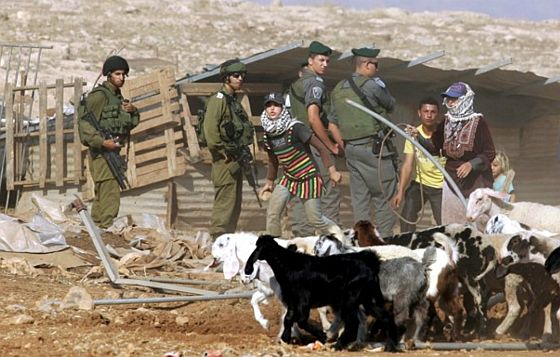
The Israeli troops and bulldozers arrived in the early morning and quickly got to work, tearing down shelters made of plastic netting and poles that had served as homes for about 100 people in this impoverished Bedouin community in the parched Jordan Valley.
The aftermath of the sweep last month against what Israeli authorities said were illegally built structures was still visible on a recent afternoon. Battered appliances, broken furniture, tattered clothing and other belongings that residents said they were prevented from removing were strewn in the dirt piled on the collapsed dwellings.
People took cover from the baking sun in makeshift tents constructed from the remains of their former homes and in others supplied by the Palestinian Red Crescent Society. Mobile tanks and electricity cables temporarily strung across the ground were the only sources of water and power.
“We have nowhere else to go,” said Talib Abayat, sitting in the shade of a lone tree.
The desolate scene reflected the state of the neglected Palestinian communities of the Jordan Valley, an area that amounts to more than a quarter of the West Bank but remains largely under Israeli control, with wide gaps between the resources allocated to Palestinians and Israeli settlers.
Running along the West Bank’s border with Jordan, the Jordan Valley has long been considered an area of strategic importance by Israel, and Prime Minister Binyamin Netanyahu has demanded a long-term military presence there as part of any future peace deal with the Palestinians.
Israeli settlements housing about 9,400 people line the road through the valley, scattered among ramshackle villages and encampments where about 80,000 Palestinians live. Nowhere in the West Bank is the contrast more stark between the settlements, with their intensively irrigated farmland, red-roofed homes and streets shaded by shrubs and trees, and the dusty Palestinian communities and their fields, dependent on limited water supplies.
A series of demolition operations last month underlined Israel’s claim to the area, which a recent poll showed most Israelis believe is part of Israel, not occupied territory, and populated mostly by Israelis. The poll was commissioned by the Association for Civil Rights in Israel.
Palestinian Prime Minister Salam Fayyad has asserted that there can be no Palestinian state without the Jordan Valley, which he called the Palestinian breadbasket. Yet with more than 70 percent of the area under Israeli control — designated as state land, military firing zones or nature reserves — the Palestinian Authority has little influence over the region’s development and the use of its resources.
In October 1991 he came with U.S. President George H.W. Bush to the Madrid Conference, which squandered the fruits of the Gulf War victory. In September 1993 he celebrated, with U.S. President Bill Clinton, the birth of the battered Oslo Accords. In early 1997 he managed to get Prime Minister Benjamin Netanyahu to sign the Hebron Accord, which left tens of thousands of Palestinians to the mercy of the students of Rabbi Dov Lior of Kiryat Arba. In late 1998 he was among those who gave birth to the Wye River Memorandum, which died in infancy. In 2000 he was a senior partner to the reverberating failure of American diplomacy in Israeli-Syrian and Israeli-Palestinian negotiations. And here he is again, this time as U.S. President Barack Obama’s special envoy responsible for prolonging the death throes of the terminally ill patient known as the peace process.
Before Dennis Ross’ comeback, our acquaintance managed to write a new book (together with David Makovsky ) called “Myths, Illusions, and Peace: Finding a New Direction for America in the Middle East.”
It would be tough to find a bigger expert than Ross on the myths and illusions related to peace between Israel and the Palestinians. For years he has been nurturing the myth that if the United States would only meet his exact specifications, the Israeli right would offer the Arabs extensive concessions.
During the years he headed the American peace team, Israeli settlement construction ramped up. Now Ross, the former chairman of the Jewish People Policy Institute, is trying to convince the Palestinians to give up on bringing Palestinian independence for a vote in the United Nations in September and recognize the State of Israel as the state of the Jewish people – in other words, as his country, though he was born in San Francisco, more than that of Palestinian Authority President Mahmoud Abbas, who was born in Safed.
If they give up on the UN vote, Ross argues, then Netanyahu will be so kind as to negotiate a final-status agreement with them. Has anyone heard anything recently about a construction freeze in the settlements?
Ross is trying to peddle the illusion that the most right-wing government Israel has ever seen will abandon the strategy of eradicating the Oslo approach in favor of fulfilling the hated agreement. In an effort to save his latest boss from choosing between recognizing a Palestinian state at the risk of clashing with the Jewish community and voting against recognition at the risk of damaging U.S. standing in the Arab world, Ross is trying to drag the Palestinians back into the “peace process” trap.
If Obama really intended to justify his receipt of the Nobel Peace Prize, he would not have left the solution to the Israeli-Palestinian conflict in the hands of this whiz at the never-ending management of the conflict.
Let us hope that the Palestinians are not tempted to give up on the UN vote in favor of the appearance of negotiations, which will serve to further prolong settlement expansion under the cover of the Oslo Accords. All we need is to recall the statement by Netanyahu, in which he was recorded telling settlers in Ofra in 2001 that he had previously extorted from the Americans a commitment that he would be the one to determine what qualifies as the “defined military sites” in the territories that will remain under Israeli control.
Netanyahu said that from his perspective the entire Jordan Valley qualifies. “Why is this important?” he asked. “Because from that moment I put a halt to the Oslo Accords.”
As for Foreign Minister Avigdor Lieberman, the Palestinians need to trap him with his own words; he had previously threatened that if the United Nations recognizes a Palestinian state, Israel will annul the Oslo Accords.
If I were in Abbas’ place, I would tell Dennis Ross that he should tell his president to forget about negotiations without recognition in writing from Netanyahu stating that the permanent borders will be based on the 1967 lines with agreed-upon changes and committing to a total freeze of settlement construction during negotiations and a set timetable for withdrawal from the territories.
You don’t want Oslo? Fine, we don’t need it. No more “Palestinian Authority”; no more Area A, B or C (a division that has in effect created a Land of the Settlers on 60 percent of the territory ); no more “peace process.”
Restore military rule in the West Bank. At the same time, you can reoccupy Gaza and go back to Gush Katif.
According to the Oslo Accords, the final-status agreement was supposed to have been decided upon 13 years ago – meaning that we would be celebrating its bar mitzvah this year. On September 13, the accords themselves will be turning 18, the number signifying life in the Jewish mystical tradition. The time has come to put the Oslo Accords out of their misery.
He is an Islamic “preacher of hate” whose views reflect “virulent anti-Semitism” and who has funded Hamas terror operations, according to much of the British media.
The furore last week over Sheikh Raed Salah, described by the Daily Mail newspaper as a “vile militant extremist”, goaded the British government into ordering his late-night arrest, pending a fast-track deportation. The raid on his hotel, from which he was taken handcuffed to a police cell, came shortly before he was due to address a meeting in the British parliament attended by several MPs.
The outcry in Britain against Sheikh Salah has shocked Israel’s 1.3-million Palestinian citizens. For them, he is a spiritual leader and head of a respected party, the Islamic Movement. He is also admired by the wider Palestinian public. The secular Fatah movement, including Salam Fayyad, the Palestinian Authority’s prime minister, were among those condemning his arrest.
Many Palestinians, like millions of Muslims in the Middle East, revere Sheikh Salah for his campaign to protect Muslim and Christian holy places from Israel’s neglectful, and more often abusive, policies. They struggle to recognise the British media’s characterisation of him as an Osama Bin Laden-like figure.
Most in Israel’s Jewish majority would not have been aware of Sheikh Salah’s supposed reputation as a Jew hater either, despite their hyper-vigilance for anything resembling anti-Semitism. True, he is generally loathed by Israeli Jews, but chiefly because they regard his brand of Islamic dogma as incompatible with the state ideology of Jewish supremacism. They fear him as the leader of a local Islam that refuses to be tamed. Those Israelis who conclude that this qualifies him as an anti-Semite do so only because they class all pious Muslims in the same category.
Why hasn’t President Obama visited Israel yet? Is his love of the Jewish state not deep enough? Does he not have a strong enough commitment to the unshakable relationship with America’s closest ally?
I guess no one need have worried over such troubling questions when the answer has long been obvious: Obama always intended to visit Israel when to do so would yield the maximum political profit, i.e. during the 2012 presidential campaign.
Of course his visit will be billed as part of his presidential rather than election campaign agenda, but have no doubt: it will be a campaign event.
James Cunningham, the outgoing U.S. ambassador to Israel, said Tuesday that U.S. President Barack Obama intends on visiting Israel.
Cunningham mentioned that Israel is on Obama’s agenda during a farewell meeting with Knesset Speaker Reuven Rivlin, who thanked Cunningham for his service as the two discussed the current state of U.S.-Israel relations.
In their discussion, Rivlin told Cunningham that many Israelis feel the mood in the White House has changed for the worse. “[They worry] Israel has become a burden rather than a strategic asset to the United States,” Rivlin said.
Every year, a few days before the Fourth of July, the U.S. ambassador’s residence in Herzliya Pituach opens its gate to thousands of guests in a celebration of American independence. The usual ritual – lots of American kitsch, a notable presence of the business, political and military elite, McDonald’s and Pizza Hut stands and sappy speeches by the prime minister and the president.
Over the past three years, despite the growing tensions between Washington and Jerusalem, the event held last Thursday did not rock the boat. Prime Minister Benjamin Netanyahu played the role he was assigned. “When the American people celebrate their independence, the people in Israel celebrate with them, – because we know how blessed we are, how meaningful what happened on July 4, 1776 is for us,” he said. “Over the years we have had to defend ourselves again and again. Our freedom, our independence. This struggle was possible because of the U.S.’ support.”
Netanyahu kept congratulating and the audience kept cheering, yet beneath the surface it is clear that the relations between the U.S. and Israel are undergoing a crisis, and that both sides are re-examining those very relations. There is a reason that these days there is a cynical remark being uttered around Washington – “For the U.S., Israel has been turned lately from an asset to a pain in the ass-et.”
International law and international relations scholar, Richard Falk, writes:
The reports that two of the foreign flagged ships planning to be part of the ten vessel Freedom Flotilla II experienced similar forms of disabling sabotage creates strong circumstantial evidence of Israeli responsibility. It stretches the imagination to suppose that a sophisticated cutting of the propeller shafts of both ships is a coincidence with no involvement by Israel’s Mossad, long infamous for its overseas criminal acts in support of contested Israeli national interests. Recalling the lethal encounter in international waters with Freedom Flotilla I that took place on 31 May 2010, and the frantic diplomatic campaign by Tel Aviv to prevent this second challenge to the Gaza blockade by peace activists and humanitarian aid workers, such conduct by a state against this latest civil society initiative, if further validated by incriminating evidence, should be formally condemned as a form of ‘state terrorism’ or even as an act of war by a state against global civil society.
The Israeli Government has so far done little to deny its culpability. Its highest officials speak of the allegations in self-righteous language that is typically diversionary, asserting an irrelevant right of self-defense, which supposedly comes mysteriously into play whenever civil society acts nonviolently to break the siege of Gaza that has persisted for more than four years. From the perspective of the obligations to uphold international law it is the Flotilla participants who are acting legally and morally, certainly well within their rights, and it is Israel and their friends that are resorting to a variety of legally and morally dubious tactics to insulate this cruel and unlawful blockade from what is essentially a symbolic challenge. The behavior of the Greek Government, surely a reflection of its precarious financial and political situation, also violates the law of the sea: foreign flagged vessels can be detained in port only if they are acting in violation of national law or are proven to be unseaworthy and dangerous to international navigation. Otherwise, interference by detention or by seizing while en route within Greek territorial waters is an unlawful interference with the right of innocent passage. Greece would be very vulnerable to defeat and damages if the Freedom Flotilla victims of these encroachment on rights were to have recourse to the Hamburg International Tribunal for Law of the Sea.
The most relevant precedent for such government-sponsored sabotage is the Rainbow Warrior incident of 1985. There French agents detonated explosives on a Greenpeace (an environmental NGO) fishing trawler docked in the Auckland, New Zealand harbor prior to proactively challenging the French plans to conduct underwater nuclear tests off the shore of the nearby Pacific atoll, Moruroa. Fernando Pereira , Greenpeace photographer for the mission, was killed by the explosions, although the devices were detonated at night when no one from Greenpeace was expected to be on board the vessel. At first, the French government completely denied involvement, later as incriminating evidence mounted, Paris officially claimed that its agents who were identified as being near the scene were only spying on Greenpeace activities and had nothing to do with the explosives, and later still, as the evidence of French culpability became undeniable, officials in France finally admitted government responsibility for this violent undertaking to eliminate activist opposition to their nuclear test, even acknowledging that the operation had been given the bizarre, although self-incriminating, code-name of Operation Satanique.
After some further months of controversy the French Prime Minister, Laurent Fabius cleared the air by issuing a contrite statement: “The truth is cruel. Agents of the French secret service sank the boat. They were acting on orders.” (the decision to destroy the Rainbow Warrior were later confirmed to have come from France’s supreme leader at the time, the president of the Republic, Francois Mitterand) The French agents who had by then been arrested by the New Zealand police, charged with arson, willful damage, and murder, but due to pressure from the French government that included a threatened European economic embargo on New Zealand exports, the charges were reduced. The French defendants were allowed to enter a guilty plea to lesser charges of manslaughter that was accepted by the Auckland court, resulting in a ten-year prison sentence, and later supplemented by an inter-governmental deal that virtually eliminated the punishment. The French paid New Zealand $6.5 million and issued an apology, while the convicted agents were transferred to a French military base on Hao atoll, and were later wrongly released only two years after being genteelly confined in comfortable quarters provided by the base.
It is useful to compare the Flotilla II unfolding experience with the Rainbow Warrior incident. At the time, the French nuclear tests in the Pacific were considered legal, although intensely contested, while the blockade of Israel is widely viewed as a prolonged instance of collective punishment in violation of international humanitarian law, specifically Article 33 of the 4th Geneva Convention. Although Israel could argue that it had a right to monitor ships suspected of carrying arms to occupied Gaza, the Freedom Flotilla II ships made themselves available for inspection, and there was no sufficient security justification for the blockade as the investigation by the UN Human Rights Council of the 2010 flotilla incident made clear. The overriding role of the blockade is to inflict punitive damage on the people of Gaza. Even before the blockade was imposed in 2007 all shipments at the Gaza crossing points were painstakingly monitored by Israel for smuggled weapons.
A Canadian ship taking part in a planned aid flotilla to Gaza has been forced to return to harbour in Crete after an attempt to reach international waters was thwarted by coast guards, according to onboard activists.
Most of the vessels which hoped to sail to Gaza in an effort to break Israel’s blockade of the Palestinian territory have been stuck in Greek ports after being refused permission to embark on the journey by Greek authorities.
The Tahrir sailed 15 minutes out of harbour before it was intercepted by coastguards, activists told Al Jazeera on Monday.
The boat, carrying activists from Canada, Belgium, Italy, Switzerland and Turkey, was forced to turn back to Aghios Nikolaos port in Crete.
“We are just being pulled into docks as we speak right now … [the coast guards] are in complete control of the boat,” Jesse Rosenfeld, a reporter with Toronto’s Now Magazine, who was on board the Tahrir when it set sail, told Al Jazeera.
Rosenfeld explained how the vessel managed to leave port: “In a matter of minutes, the people on the boat turned on the engines while two of the activists kayaked, trying to block the coast guard in port. At that point, the Tahrir made an open break through the port, shooting for international waters.”
The coast guard ship pursued the Tahrir, using water cannons and eventually boarding the ship, Rosenfeld said.
For what must be the third or fourth time since the Egyptian revolution began on January 25, the Sinai gas pipeline that takes Egyptian gas to Israel has been attacked. These attacks are not particularly dramatic, but are enough of a bother that it takes several weeks to restore the flow of gas to Israel — and often Jordan, which is affected by the pipeline. The people behind the attacks are thought to be Sinai-based Islamists who oppose the sale of gas to Israel, but we don’t really know for sure. The attack took place only 60km east of the Suez Canal, and it could very well be people from the Nile Valley carrying out the attacks — and they don’t have to be Islamists, either, since plenty of other people oppose the gas deal.
Since the revolution, the interim government has reviewed gas prices but thus far everything indicates that the sale of gas will continue. From what I’ve been able to gather (and I’d like to write something longer on this one day), Egypt was selling the gas to Eastern Mediterranean Gas (EMG), the private firm that then sold the gas to the Israeli National Electricity Company, at around $3 per mbtu (that’s million British thermal units — the standard measurement for these things). EMG then sold it to the Israelis for around $4.5 per mbtu, pocketing a 50% profit margin for no more than the transaction costs and some of the infrastructure between the two countries. The market price for gas (which is not as fungible as oil since it tends to rely on pipeline infrastructure unless shipped as LNG) is currently around $4.40 for futures in North America, but spot markets in recent years passed the $10 per mbtu mark. Either way, there is no doubt that the price of the gas sold by Egypt to EMG was well below market prices, and that the company made an easy profit without investment of its own (I’ll leave the issue of whether EMG sold the gas to Israel at a fair price aside.)
EMG is owned in large part by an Egyptian business, Hussein Salem, who has long been known to be a frontman for the Mubarak family (and is a former security official), and Yossi Meiman, an Israeli businessman close to the Sharon clan in Israeli politics (he owns the Israeli energy company Merhav), as well as some additional minority investors from South East Asia. Incidentally, although this was not widely known until after the revolution, Salem (who has been arrested in Madrid recently and is wanted by the Egyptian authorities) also had a similar deal set up with Jordan, involving the same kind of markup, and this deal (it’s not clear with who on the Jordanian side, but I’d look at the royal family or the security services) is also being reviewed by the Egyptian authorities.
In the last few years, when lawsuits were filed in Egypt against the sale of gas to Israel, the government often claimed that it was only selling gas to EMG, and has no transactional relationship with Israel. This is the ideal time to turn the argument on its head. If EMG was involved in high-level corruption under the previous regime, it is perfectly understandable if the Egyptian government, which controls the sale of natural gas, were to decide to terminate its relationship with EMG. This does not mean that EMG can’t sell gas to Israel: it would just have to meet its commitment from elsewhere than Egypt. Legally, this procedure may be dicey. EMG is free to resort to international arbitration, or even sue (which would provide an opportunity to look into its accounts). But my feeling talking to energy people in Cairo from multinationals (many operate in Egypt — huge ones like BP, BG or Statoil and independents like Apache) is that they don’t care if the Israeli gas contract is not honored. They want to cover their bacon first, and have assurances that their own substantial investments in Egypt will be untouched. They don’t care about the Israelis and understand if the deal is cancelled, it will be an understandable political exception.
Now, it’s likely that there were personal commitments from Mubarak to successive Israeli governments that the gas would continue. If these exists on paper, let the government make them public. If they don’t — well, an oral contract is as good as the paper it’s written on and we fall back to a relationship between Egypt and EMG. And then let’s see that contract and get the details of how this massive fraud was conducted.
A retired general speaking to the Los Angeles Times had little doubt that whoever is responsible for blowing up the gas pipeline has a patriotic motivation for doing so.
“Whether these attacks are carried out by large groups or individuals, many Egyptians are against supplying Israel with gas,” retired Gen. Mohamed Ali Belal told Babylon and Beyond. “Those who’ve been bombing the pipeline believe that they are fulfilling their national responsibility and playing a part in stopping gas exports to Israel.”
While Benjamin Netanyahu treats non-violent international activists in the Freedom Flotilla as though they pose a dire threat to Israel, a much larger and truly violent threat is growing inside Israel and the occupied territories. Its members are fanatical xenophobic Jews.
Following the brief arrest of Rabbi Yaakov Yosef who was questioned over incitement to racism and violence because of his endorsement of the “The King’s Torah” — a book which advocates killing non-Jews, including children and babies — his supporters demonstrated in Jerusalem where Knesset member Yaakov Katz and others addressed the crowd:
MK Katz told the demonstrators that settlers are a threat to the state attorney, because they are strong and multiplying. He said that the day will come when the settlers will run the state, write the legislation, investigate and see who put rabbis on trial, and that they will take revenge.
According to Rabbi Melamed, “it is impossible to stop scholars from coming forward and speaking the teachings of the Torah.” He also spoke about the dream that one day the media and High Court of Justice will have observant Jews working for them, who will discuss the law of the Torah. “This is a development that will be impossible to stop,” he said.
Kiryat Arab Chief Rabbi Dov Lior was also detained earlier this week following his endorsement of the book on suspicion of incitement to violence and racism, after he refused to be questioned on the matter.
Following Yosef’s arrest, police stationed security forces throughout Jerusalem fearing disorderly conduct by protesters. Several demonstrators had burned tires on the Tel-Aviv-Jerusalem highway, and three youths were detained after they had tried to block the path of the Jerusalem light rail near Yosef’s home.
About 18 months ago, Yosef issued a written endorsement of the book Torat Hamelech (“The King’s Torah”). The book considers various situations in which killing non-Jews is permitted.
The marble-patterned, hardcover book embossed with gold Hebrew letters looks like any other religious commentary you’d find in an Orthodox Judaica bookstore – but reads like a rabbinic instruction manual outlining acceptable scenarios for killing non-Jewish babies, children and adults.
The prohibition ‘Thou Shalt Not Murder’ applies only “to a Jew who kills a Jew,” write Rabbis Yitzhak Shapira and Yosef Elitzur of the West Bank settlement of Yitzhar. Non-Jews are “uncompassionate by nature” and attacks on them “curb their evil inclination,” while babies and children of Israel’s enemies may be killed since “it is clear that they will grow to harm us.”
“The King’s Torah (Torat Hamelech), Part One: Laws of Life and Death between Israel and the Nations,” a 230-page compendium of Halacha, or Jewish religious law, published by the Od Yosef Chai yeshiva in Yitzhar, garnered a front-page exposé in the Israeli tabloid Ma’ariv, which called it the stuff of “Jewish terror.”
The fate of the flotilla to the Gaza Strip was in jeopardy on Saturday after Greek authorities prevented an American vessel from leaving Athens and issued a blanket order forbidding ships from sailing to the Gaza Strip.
Despite the order and additional setbacks, Adam Shapiro, an American co-founder of the International Solidarity Movement, and one of the organizers of the flotilla, told The Jerusalem Post on Saturday night that the group still planned to sail to the Gaza Strip in the coming days.
He said that the Greek- Swedish ship Juliano, which was allegedly sabotaged last week, was expected to be repaired by Sunday morning and that an Irish ship, also allegedly sabotaged in Turkey, was set to begin repairs soon.
“We are still arranging to go and are working on different fronts to get permission to leave,” Shapiro said by phone from Athens.
He also denied reports that organizers were considering canceling the flotilla since they had already achieved their goal by raising awareness regarding the sea blockade on the Gaza Strip.
“Gaza is still blockaded and there is still a need to sail there,” he said.
Members of the Dutch-Italian boat issued an open letter to the Greek Prime Minister Georgios Papandreou on Sunday, expressing outrage over his “government’s decision to close the ports of Greece to our humanitarian initiative, even by force if needed”.
The letter demanded that they be allowed to sail and said, “It is totally incomprehensible to us and fills us with just wrath that the Greek government closes the ports to our ships…
“You and your government acting as an ally of Israel in the Palestinian question means you also seem to have forgotten the struggle against the military dictatorship in your own country.”
Joe Meadors, a US Navy veteran [and survivor of Israel’s attack on the USS Liberty], is one of the roughly 100 passengers on board a flotilla vessel that finds itself standed. Meadors, however, still expects to sail.
“We are waiting for the Greek government to release us,” he told Al Jazeera, “We are here for the long haul, and we’re ready to go just as soon as the Greeks say we can go. We’re pleased we can do something for the Palestinians and remain excited to go.”
Khalid Tuhraani, an American Palestinian activist whose ship is stuck in the port of Corfu, is also frustrated and feels that it perhaps would have been better if the flotilla had orginated from a port in an Arab country such as Tunisia or Egypt.
“However, many of the Arab countries have, like Greece now, become hostages of the political will of the United States and Israel,” he said.
Tuhraani said he remained committed to doing what was necessary to end the Israeli blockade against Gaza, but he expressed disappointment at the Greek government.
“We chose Greece because this country has a history of support for the Palestinian struggle for freedom,” he said.
“Unfortunately we did not expect the Greek government to just roll over and die. But the Middle East Quartet issued a statement against our flotilla, so I think the pressure on the Greek government just might have been too enormous for it to bear.”
Is it possible to break the siege of Gaza if no one notices?
As an exercise in directing global attention to the plight of a population subject to collective punishment, the first flotilla in August 2008 was a bit of a flop — even though it reached Gaza.
In the Jerusalem Post, Herb Keinon cynically wrote at the time:
Ever since the Free Gaza Movement made known its intent a few weeks ago to set sail for the Gaza Strip to “break” the Israeli blockade, it was clear that the two boatfuls of professional left-wing demonstrators and tag-along journalists were after one thing: a huge media event.
Nothing, therefore, would have given them a greater media buzz than if a couple of Israel Navy boats stopped them on the high seas, arrested the protesters (hopefully, from the point of view of the organizers of the protest, with some gratuitous brutality), and dragged the Greek-registered vessels into the Ashdod port.
Imagine the footage, imagine the images, and imagine the public relations bonanza for those few “brave souls” on the sea-weary vessels. Israel would, undoubtedly, have faced a public relations drubbing. So by deciding to let the boats through, the government deprived the protesters of the huge media event they so obviously wanted.
Indeed, instead of footage of heavyhanded Israelis stopping boats carrying an 81-year-old American nun and the sister-in-law of former British prime minister Tony Blair leading the nightly news broadcasts in the West on Saturday night, the story of the boats’ arrival in Gaza barely made a blip on the CNN, Fox, or Sky news broadcasts. With the world’s eyes still glued to the Olympics in Beijing, and the media focusing on US presidential candidate Barack Obama’s choice of Joe Biden as his vice presidential nominee, the Gaza blockade-running story didn’t register in the electronic media.
And in the written press, the protesters didn’t fare that much better. The New York Times ran a small piece on page 16 on Sunday; The Washington Post on page 12; and The St. Louis Post-Dispatch relegated it to a three-paragraph brief. As media events go, this one was not particularly successful.
But — as Keinon also noted — the story was not over. Indeed.
What the flotilla organizers understood was that whatever the outcome, each challenge to the siege could in fact never fail. Ships could succeed by reaching Gaza, or succeed without reaching Gaza by exposing Israel to the eyes of the world as a cowardly bone-headed bully.
The only solution to Israel’s problem was and remains the one that it refuses to entertain: backing itself out of a dead-end policy that by any metric one wants to use, has been a demonstrable failure — a policy which hasn’t weakened Hamas; hasn’t turned Gaza’s population against its rulers; hasn’t made Israel safer; and above all has brought Israel’s global image to an all-time low while callously inflicting yet more suffering on the Palestinian people.
The Israeli columnist, Asaf Gefen, suggested this week:
If the Marmara that took part in the previous sail sought to present Israel’s brutality to the world (and managed to do so, thanks to our kind assistance,) it appears that the current flotilla was meant to present Israel’s stupidity.
At this time already, when it’s still unclear whether and when the ships shall arrive, it appears that this objective had also been fully achieved.
But now that the flotilla appears stuck in Greece, can’t Netanyahu claim victory? Some Israeli reporters seem to think so:
Prime Minister Benjamin Netanyahu sometimes seems almost too arrogant and self assured for his own good. However, unlike in most instances, this weekend he actually has justification for his haughtiness.
Really?
Look at The Audacity of Hope as it chugged out of a Greek harbor yesterday and ask yourself: what kind of prime minister and what kind of nation could feel threatened by this kind of challenge?
The need to subjugate others; the obsession with existential threats; the insatiable hunger for loving affirmations; and the fear of equality between Jews and non-Jews — all of this exposes Israel’s intrinsic weakness, a weakness that cannot be overcome by belligerence, isolation or warfare.
In truth, nothing threatens Israel more than its own fear of the world.
It’s time not just for Israel to end the siege of Gaza but for Zionists to break out of their own self-made prison.
Prime Minister Benjamin Netanyahu sometimes seems almost too arrogant and self assured for his own good. However, unlike in most instances, this weekend he actually has justification for his haughtiness.
Netanyahu’s personal investment in his relationship over the past year-and-a-half with Greek Prime Minister George Papandreou in which he increased diplomatic ties with the floundering European nation seems to have put the final nail in the Gaza flotilla’s coffin.
In his speech Thursday night for the Israeli Air Force Flight School graduation ceremony, Netanyahu discussed diplomatic efforts being made to prevent the Gaza flotilla from setting sail. The only leader that Netanyahu mentioned by name in his address was Greece’s George Papandreou.
Just a day before, the prime minister spoke with his Greek counterpart, imploring him to issue an order preventing ships from disembarking from Greece toward the Gaza Strip. Unlike in the past, Papandreou responded positively, and a top Israeli official involved in the talks between the Greek prime minister and Netanyahu said that Israel knew as early as Thursday afternoon that Greece was planning to block ships from leaving its ports toward the strip.
On Thursday, the passengers of the Audacity of Hope, the US boat in the “Freedom Flotilla 2” to Gaza—a convoy of ten boats, two cargo ships and some 300 civilians—emerged from their hotel on the edge of an Athens turned upside down. The air was heavy from the stench of garbage and tear gas, after two days of a general strike and fighting between police and demonstrators protesting the latest austerity measures. But the dramatic urban landscape barely caught the passengers’ attention as they boarded a chartered bus to a distant Athenian port, kept secret until then due to security concerns.
Standing in front of more than seventy journalists from around the world, the thirty-five passengers called on the Greek government to allow their boat to sail. The idea was that if the government were to continue its efforts—coming after intense Israeli lobbying—to prevent the boat from sailing, it would be forced to do so in front of the world media, and thus might back down. But just one hour before the press conference was set to begin, the captain of the US boat announced that he was abandoning the mission, saying that he risked losing his maritime license and could face jail time if he didn’t. But this was only the latest setback for the flotilla.
This website or its third-party tools use cookies, which are necessary to its functioning. By closing this banner, you agree to the use of cookies.