Hassan Hassan writes: To understand American policy short-sightedness in the region, look no further than northern Syria today. One can predict with utmost confidence that the policy that Washington insists on pursuing in Raqqa will do two things. It will heat up a secondary conflict in the broader Syrian civil war to a boiling point, and it will reset the conditions for the return of extremist forces.
A common way to deflect the troubling issues with the policy is to make it principally about Turkey. The overarching concern, though, is how a YPG-led campaign to dislodge ISIL from Raqqa will be perceived locally and beyond, and what the YPG seeks to gain from fighting in a predominantly Arab city that ISIL took from the Syrian rebels after the latter expelled the regime from it in 2013.
A YPG commander, Sipan Hemo, told Reuters on Friday that the attack on Raqqa will begin in early April. Everyone should wish the anti-ISIL forces luck, but it should be made clear that the United States is operating below the credit line politically. By that, I mean two things.
First, the win against ISIL would be purely tactical: the removal of ISIL militants from Raqqa will not damage the group’s image, as it should ideally have been designed to do. If policymakers involved in the campaign think the demise of the group in Raqqa in this manner will undermine its narrative, they will be mistaken and out of touch with reality. [Continue reading…]
Category Archives: Lands
Syrian UN envoy: Putin sent message to Israel that its freedom to act in Syria is over
Haaretz reports: Russia has sent a clear message to Israel that the rules of the game have changed in Syria and its freedom to act in Syrian skies is over, Syria’s ambassador to the United Nations said on Sunday night.
“Putin sent a clear message,” said Bashar Jaafari, speaking on Syrian television. “The fact is that the Israeli ambassador [to Russia] was summoned for a conversation only a day after he submitted his credentials [to the Russian Foreign Ministry last Thursday], and was told categorically that this game is over.”
Syria’s use of anti-aircraft fire against Israel last Thursday night has changed the rules of the game, too, Jaafari said, adding that Syria will not stand idly by in the face of an Israeli threat.
He also claimed that when the civil war began in Syria in 2011, opposition militia groups sabotaged the anti-aircraft defense systems belonging to President Bashar Assad’s regime, giving Israel freedom to operate.
In a separate incident, Syrian media reported Sunday that the commander of a militia fighting alongside the regime was killed in an Israeli airstrike around Quneitra, in the Golan Heights.
The Lebanese TV channel Al Mayadeen, which is associated with Hezbollah, identified the casualty as Yasser Assayed, a member of the national defense militia. A source associated with the Assad regime said Assayad was a commander in the Golan brigade, a militia of Druze fighters (from villages in the Syrian part of the Golan Heights) who are fighting with the regime.
Between Thursday night and Friday morning, Israeli fighter jets attacked several targets in Syria, triggering the most serious clash between Israel and Syria since the civil war erupted six years ago. In response to the airstrikes, the Assad regime’s aerial defense system fired several missiles at the jets. Israel’s Arrow anti-missile defense system was launched, shooting down one of the missiles north of Jerusalem. The incident forced Israel to admit for the first time that it had launched an aerial attack in Syria.
Following that, Israel’s ambassador to Moscow, Gary Koren, was summoned to the Russian Foreign Ministry for talks with Deputy Foreign Minister Mikhail Bogdanov – again, an unusual development. Since Russian forces began operating in Syria in 2015, there have been a number of airstrikes that foreign media have attributed to Israel. But the Israeli ambassador had never previously been called in to clarify Israel’s actions. [Continue reading…]
The Associated Press reports: Fierce clashes broke out in the Syrian capital on Sunday after insurgents infiltrated government-held parts of the city through tunnels overnight in a rare advance after months of steady losses elsewhere in the country.
It was a surprising breach of the security perimeter in Damascus, where the government has effectively walled itself off from opposition forces encamped in two enclaves in the eastern parts of the city.
Bashar al-Assad’s government has endeavoured to maintain a veneer of normality in the capital as his forces bomb opposition areas on the edges and suburbs of the city.
Residents said artillery shells and rockets had landed in the heart of the city. Damascus Today, a Facebook group run by activists, reported government airstrikes in the area where the clashes took place.
Government infantry and tank reinforcements arrived to repel the attackers in the afternoon, the group said. [Continue reading…]
The Trump administration has become a leading purveyor of the Kremlin’s fake news
John R. Schindler writes: The threat to the West posed by Kremlin lies—what is properly termed disinformation—is something that I and a few other specialists have raised the alarm over for years. After 2016, when Moscow weaponized disinformation to influence our presidential election, this problem is finally getting the public attention it merits, not least because identical Russian espionage techniques are currently aimed at France and Germany, which have their own elections coming up.
The previous administration ignored this rising problem, shuttering a tiny State Department effort to counter Russian propaganda only months before the Kremlin lie machine went into overdrive against President Obama’s own party. As I’ve pointed out, Obama and his White House bear part of the blame for the Russian havoc wrought last year on Hillary Clinton and the Democratic National Committee, thanks to their abject unwillingness to confront Vladimir Putin. By refusing to seriously confront Kremlin disinformation and deception, President Obama got more of both.
Now this problem, which shows no signs of going away, has become even more dangerous, since the new administration has taken to parroting Russian disinformation when it suits their political needs. A propaganda loop has emerged with Kremlin lies emerging on Putin regime outlets like RT and Sputnik, then being pushed by far-right conspiracy websites such as Breitbart and InfoWars, and finally winding up on Fox News where they receive a mass audience. [Continue reading…]
Trump ‘looks forward to visiting China’ says Tillerson
BBC News reports: US Secretary of State Rex Tillerson has told China’s President Xi Jinping that President Donald Trump looks forward to visiting his country, and to enhancing understanding between the states.
Mr Tillerson met the Chinese leader in Beijing’s Great Hall of the People, as his East Asian tour comes to an end.
Mr Xi said he was glad to see good progress from Mr Tillerson’s meetings.
“You said that China-US relations can only be friendly. I express my appreciation for this,” he said. [Continue reading…]
The Washington Post reports: After meeting China’s Foreign Minister Wang Yi on Saturday, Tillerson voiced Chinese catchphrases about the relationship, including the avoidance of conflict and confrontation and the need to build “mutual respect” and strive for “win-win” cooperation.
The phrase “mutual respect” is key: In Beijing, that is taken to mean each side should respect the other’s “core interests.”
In other words: The United States should stay away from issues such as Taiwan, Tibet or Hong Kong — and in principle almost anything China’s Communist Party deems a vital national security concern. Increasingly, that also appears to include China’s territorial claims in the contested waters of the South China Sea.
Several Chinese foreign policy experts called the comments “very positive” and in line with a concept Beijing has long advocated — what it calls “a new model of great power relationships,” which would put the two nations on a roughly equal footing.
Jin Canrong, a Sino-U.S. relations expert at Renmin University of China in Beijing, said Tillerson’s comments came as a surprise.
“China has long been advocating this, but the United States has been reluctant to accept the point of ‘mutual respect,’ ” Jin said. “Tillerson’s comment will be very warmly welcomed by China.”
But Bonnie Glaser, senior adviser for Asia at the Center for Strategic and International Studies, said the United States should use its own language to describe bilateral relations, not embrace China’s.
More importantly, “mutual respect” signals acceptance of “a litany of issues that China views as non-negotiable,” she said. “By agreeing to this, the U.S. is in effect saying that it accepts that China has no room to compromise on these issues.” [Continue reading…]
In an interview with Independent Journal Review, Tillerson said: I do think we’re at somewhat of a historic moment in the U.S.-China relationship. It has been defined for the past 40 years by the opening of China, the Nixon-Kissinger visit. During that time, by and large, the U.S. and China have found a way to exist together in this world, to deal with our conflicts. We’ve never fought a war with each other, other than on the Korean peninsula. That’s the only time we’ve fought a war with each other. And even as China’s country and economy have grown, and now occupies its place in the global economy, we have always managed to exist with one another in a spirit of non-conflict. It doesn’t mean we don’t have differences, but we’ve always found ways to either resolve them or to live with them. Accept that we have differences and move on and still do what’s in the best interest of our people, and China in the best interest of theirs. But I do think because of what is happening globally with people in the world over — globalization itself — that we’re at perhaps at an inflection point in the relationship of global powers in general. And I do think that the Chinese and the U.S. need to have a fresh conversation about what will define the relationship between the United States and China for the next 50 years. We can look back and see how successful we’ve been, 40 years of what I would say has been a very successful relationship with two very powerful nations living with one another without conflict. But now we find that there are issues arising that have gone unresolved. And I think how we are able to talk about those and how we are able to chart our course forward is going to set, potentially, the relationship in a new era of existing together without conflict, in an era of non-conflict. Again, it doesn’t mean we won’t have differences, but we will find how are we going to live with one another for the next 50 years. Because I think there’s a question, perhaps even in the minds of the Chinese: How will the American people, the Chinese people, live with each other in this world for the next half century? [Continue reading…]
Ready or not, here come Trump and North Korea
Albert Hunt writes: President Donald Trump is a reckless bully with authoritarian leanings and a craving for attention. Kim Jong-un is a reckless bully with dictatorial powers and a craving for attention. Oh yes, and both have fingers on nuclear triggers. That’s why so many national security experts of both political parties struggle to think of a scarier pair.
It’s not just that Kim’s outlaw North Korean regime has accelerated its nuclear weapons capacity and delivery capability, or that Kim sees nuclear weapons as his insurance policy against adversaries.
It’s also that Trump has displayed little appreciation of history or knowledge and a compulsion to show that he’s tough.
Trump has called Kim a “madman,” one of the few things he has gotten right about North Korea. Dealing with him, though, requires measured patience and smart diplomacy — not Trump’s forte — and a reliance on alliances and relationships that he has dismissed.
On his current Asia trip, Secretary of State Rex Tillerson said that diplomacy with North Korea hasn’t worked and that there’d be a “new approach.” That sounds like just talk. More important, Defense Secretary James Mattis impressed Asia experts during his visit last month to Japan and South Korea, in essence assuring the allies that U.S. commitments were unchanged despite Trump’s “America First” oratory.
There are few Asia specialists in this slow-to-form administration. But if Trump listens to Mattis and H.R. McMaster, his national security adviser, there will be a sense of relief in Tokyo, Seoul and Washington about the approach to North Korea. Let’s hope the president doesn’t revert instead to his penchant for relying on gut instincts or his nationalist Svengali, Steve Bannon.[Continue reading…]
Max Fisher writes: A full war, entered deliberately or accidentally, would risk terrible costs.
Gen. Curtis M. Scaparrotti told a congressional committee in 2016, when he was commander of United States forces in South Korea, that war with North Korea “would be more akin to the Korean War and World War II — very complex, probably high casualty.”
Analysts doubt that the United States could reproduce the rapid military victory it achieved against Iraq in 2003. In the event of war, North Korean plans are thought to call for nuclear attacks against major ports and air bases in South Korea and Japan, halting any American invasion before it could fully begin.
In the meantime, nuclear and chemical strikes against major population centers would be intended to shock the world into capitulating. Missile defense would be of limited use against short-range rockets and of no use against North Korea’s hundreds of artillery pieces, many of which target Seoul, the South Korean capital.
Potentially the hardest question of all is whether such plans would achieve American strategic aims.
Military strikes may be an imperfect tool, analysts say, for solving what is essentially a political problem: the leadership’s belief that it requires an advanced nuclear program to survive.
Strikes short of war would risk deepening, rather than altering, this calculus. Strikes that led to war would risk exactly the nuclear exchange they are meant to forestall. [Continue reading…]
Germany rejects Trump’s claim it owes NATO and U.S. ‘vast sums’ for defense
The New York Times reports: President Trump criticized Germany on Saturday for paying too little to both NATO and the United States for security support, a day after he held a chilly meeting at the White House with Chancellor Angela Merkel that showcased the two leaders’ disagreements.
“Despite what you have heard from the FAKE NEWS, I had a GREAT meeting with German Chancellor Angela Merkel,” Mr. Trump wrote in a post on Twitter as he began his weekend at Mar-a-Lago, his estate in Palm Beach, Fla.
“Nevertheless, Germany owes vast sums of money to NATO & the United States must be paid more for the powerful, and very expensive, defense it provides to Germany!” he continued.
The message was misleading because no nation actually “owes” money to NATO; its direct funding is calculated through a formula and paid by each of the 28 nations that are members.
Mr. Trump may have been referring to the fact that Germany, like most NATO countries, falls short of the alliance’s guideline that each member should allocate 2 percent of its gross domestic product to military spending, but that money is not intended to be paid to NATO or to the United States. [Continue reading…]
Reuters reports: German Defense Minister Ursula von der Leyen on Sunday rejected U.S. President Donald Trump’s claim that Germany owes NATO and the United States “vast sums” of money for defense.
“There is no debt account at NATO,” von der Leyen said in a statement, adding that it was wrong to link the alliance’s target for members to spend 2 percent of their economic output on defense by 2024 solely to NATO.
“Defense spending also goes into UN peacekeeping missions, into our European missions and into our contribution to the fight against IS terrorism,” von der Leyen said.
She said everyone wanted the burden to be shared fairly and for that to happen it was necessary to have a “modern security concept” that included a modern NATO but also a European defense union and investment in the United Nations. [Continue reading…]
The way Trump talks about NATO suggests he has the wrong model in his mind. He seems to view the international organization as an American-run club who members pay fees in order to enjoy services provided by the U.S., but it doesn’t work like that.
Perhaps Trump’s suspicions about getting “ripped off” are further reinforced by the fact that this club (for which the U.S. in reality only pays 22% of the organizational operating costs) is based in Brussels and led by a Norwegian.
For more details on NATO funding, it’s worth reading NATO’s own explanation. If Trump had the slightest interest in educating himself — he clearly doesn’t — he could learn a lot simply by reallocating 30 minutes of his time away from Fox News to Nato.int. On funding, the site even includes a Trump-friendly summary of “highlights” reduced to six bullet points.
(Just in case Trump and the other conspiracy theorists in the White House are perplexed by NATO’s logo which shows “NATO” and beneath that those letters in reverse, OTAN is not a secret code — it stands for Organisation du Traité de l’Atlantique Nord (NATO in French).)
One Trump advisor really does know all about Putin
Michael Weiss writes: “People person” is not necessarily the first description that comes to mind when one thinks of Russian President Vladimir Putin.
Though barely a year into his unlikely presidency of the Russian Federation, that’s more or less how he described himself to Christian Caryl, then Moscow bureau chief at Newsweek. Asked what it was about his KGB training that he believed informed his administration of a country with 11 time zones and around 8,000 nuclear warheads, Putin answered unexpectedly that it was garrulousness that he found most useful from his days in special services:
“To be able to work with people effectively, you have to be able to establish a dialogue, contact; you have to activate everything that is best in your partner. If you want to achieve results, you have to respect your partner. You need to make that person an ally; you have to make that person feel that you and he have something that unites you, that you have common goals.”
Putin was never a spy as properly understood or mythologized. In his rather shabby posting to Dresden in East Germany, during which he spent the majority of the perestroika era observing the collapse of the Soviet Union from a distance, his role was that of a case officer, a recruiter and manager of spies.
There is every indication that he not only ran West German assets who ventured into Dresden but even recruited the odd double agent in the infamous East German security service, the Stasi, between 1985 and 1989. Putin’s deployment coincided with the KGB’s “Operation Luch,” a campaign to steal technological secrets but also, allegedly, to ensure that hardliners in the East German intelligence apparatus remained loyal to the ongoing reforms taking place in Moscow and not to their putative boss, Eric Honecker. (Still the best encapsulation of the Stalinist rigidity of Honecker’s GDR is this celebrated scene from The Lives of Others.)
I’m not quite sure if it’s an irony or a tragedy that the analyst best able to understand Putin’s talent for seducing foreign agents is now beholden to a commander-in-chief believed by many to have been turned by that little man in Moscow’s high castle.
Fiona Hill, the dual British-American citizen and former national intelligence officer with the U.S. National Intelligence Council, was recently named the White House’s senior director for Europe and Russia. She is therefore the most influential Putinologist on a National Security Council that badly needs them.Her book Mr. Putin: Operative in the Kremlin, co-written with Clifford Gaddy, distills the actuating impulses of one the most scrutinized and yet misunderstood men on the planet into six mutually inclusive categories: the Statist, the History Man, the Survivalist, the Outsider, the Free Marketeer, and the Case Officer. Although they claim no one category supersedes any other, their subtitle suggests that Putin’s training in Yuri Andropov’s KGB is the foundation upon which the other five were constructed. [Continue reading…]
Senators ask Trump adviser, Roger Stone, to preserve any Russia-related documents
The New York Times reports: Roger J. Stone Jr., an informal adviser to President Trump, has been asked by the Senate Intelligence Committee to preserve any records he may have in connection to a broader inquiry into Russian attempts to interfere with United States elections.
The letter sent to Mr. Stone, a copy of which was obtained by The New York Times, represents the first public indication of the scope of the committee’s inquiry, and possible connections to Mr. Trump’s campaign.
The Senate committee asked Mr. Stone, who is also under scrutiny from other federal investigators, to “preserve and retain all hard copies and electronically stored information as specified below in furtherance of the committee’s ongoing investigation into Russian actions targeting the 2016 U.S. elections and democratic processes globally.”
Mr. Stone confirmed the existence of the letter, which was dated Feb. 17. However, he said he had received it only on Friday, by email. Mr. Stone has acknowledged trading messages over Twitter with Guccifer 2.0, the online persona that officials believe was actually Russian intelligence officers.
The letter to Mr. Stone was signed by the committee’s chairman, Senator Richard M. Burr, Republican of North Carolina, and its ranking Democrat, Senator Mark Warner of Virginia. Press officers for Mr. Burr and Mr. Warner declined to comment on the letter.
Democrats and some investigators, as well as some Republicans, have been watching Mr. Stone, a Richard M. Nixon acolyte and self-described “dirty trickster,” more closely since he posted on Twitter in August 2016 about John D. Podesta, Hillary Clinton’s campaign chairman, whose private emails were hacked and provided to WikiLeaks. [Continue reading…]
After six years of war, Syria’s rebels reflect on whether revolution has been worth it
The Independent reports: Almost half a million dead. More than 10.9 million forced to flee their homes, many into the arms of traffickers or graves at the bottom of the Mediterranean.
Cities starved into submission by government sieges, tens of thousands disappeared in regime prisons, and the rampant growth of extremist ideology intent on sucking the little life and joy left out of Syria.
An entire generation of children who don’t flinch at explosions or artillery fire in the distance.
Such is the state of the Syrian revolution, six years on since the hopes of the Arab Spring.
No one who took to the streets of Damascus and Aleppo in a “Day of Rage” on 15 March 2011, demanding the release of 15 Deraa teenagers arrested for daubing walls with anti-government graffiti, could foresee the scale of the war to come.
“Your turn, Doctor [Bashar al-Assad],” demonstrators chanted, drawing courage from the recent fall of Hosni Mubarak in Egypt and Zine El Abidine Ben Ali in Tunisia.
Arrests and beatings did not deter them. After three days of the exceptionally rare protests against authority, the government had had enough. On March 18, four protesters in Deraa – most reports say they were unarmed – were shot by security forces which opened fire on a crowd.
The killings provided the catalyst for a revolution which has morphed into a conflict unlike any other modern war.
Its full repercussions are still yet to be understood.
On the sixth anniversary of the uprising, Syria now shows dangerous signs of descending into an entrenched state of warfare such as that suffered by Iraq and Afghanistan, subject to the whims of internal warlords and proxy powers.
In diplomatic circles, once-strident calls that “Assad must go” are no longer very loud.
Despite round after round of failed peace talks, the UN is adamant a diplomatic solution to the crisis must be agreed, even as Russian and Iranian intervention on the battlefield has once again put a military victory within the Assad government’s reach.
The fall of Aleppo at the end of the last year and election of US President Donald Trump means that 2017 is a turning point for Syria’s opposition.
Most Western players in Syria’s war now operate on the understanding that the best outcome rebel fighters can hope for is free elections in which the embattled ruler agrees to step down.
“The extent to which the West is willing to continue to provide military support for the rebels is uncertain, particularly with Trump so narrowly focused on defeating Isis,” said Tim Eaton, a research fellow with the Middle East and North Africa Programme at Chatham House.
“Without significantly increased backing, which is not forthcoming, the rebels are in a position where they can’t win.
“That doesn’t mean, though, that they won’t continue to fight, and that there aren’t things to fight for. But six years in, the rebels may be forced to reign in some of their ambitions.”
Most of those either involved in the original peaceful protest movement or the armed resistance to the Assad regime that The Independent spoke to, whether still in Syria or abroad, were initially hesitant to share their thoughts on the country’s future.
Some said they could not possibly put into words what the revolution means to them now.
“I have too much and too little to say,” said one Istanbul-based activist, who asked not to be named. “I was on the side of freedom in 2011, and I am on the side of freedom now. But how many more will have to die? How do I judge that? It’s impossible.” [Continue reading…]

China urges U.S. to remain ‘coolheaded’ on North Korea as Tillerson warns of danger
The Washington Post reports: China urged the United States to remain “coolheaded” over North Korea and not to turn its back on dialogue, as visiting Secretary of State Rex Tillerson expressed a “sense of urgency” to curb dangerous levels of tension on the Korean Peninsula.
On his first trip to Asia this week, Tillerson earlier declared that diplomacy has failed to persuade North Korea to abandon its nuclear program and that a new approach was needed. On Friday in Seoul, he warned ominously that all options were on the table to counter the threat from Pyongyang.
President Trump weighed in Friday by goading China over Twitter for not doing enough to help prevent its ally from “behaving very badly.”
But in a joint news conference Saturday with his Chinese counterpart, Tillerson struck a more diplomatic note, choosing to play down differences with Beijing and affirm that both countries share the goal of a denuclearized Korean Peninsula. [Continue reading…]
What to ask about Russian hacking
Louise Mensch writes: On Monday, the House Intelligence Committee holds its first hearing on Russia’s hacking of the election. (No date has yet been set for the Senate Intelligence Committee’s parallel investigation.) The list of initial witnesses does not inspire confidence in the House committee’s effectiveness.
It should be relatively easy to get at the truth of whether there was collusion between the Trump campaign and Russia over the hacking. I have some relevant experience. When I was a member of Parliament in Britain, I took part in a select committee investigating allegations of phone hacking by the News Corporation. Today, as a New York-based journalist (who, in fact, now works at News Corp.), I have followed the Russian hacking story closely. In November, I broke the story that a Foreign Intelligence Surveillance Act court had issued a warrant that enabled the F.B.I. to examine communications between “U.S. persons” in the Trump campaign relating to Russia-linked banks.
So, I have some ideas for how the House committee members should proceed. If I were Adam Schiff, the leading Democrat on the committee, I would demand to see the following witnesses: Carter Page, Paul Manafort, Richard Burt, Erik Prince, Dan Scavino, Brad Parscale, Roger Stone, Corey Lewandowski, Boris Epshteyn, Rudolph Giuliani, Michael Flynn, Michael Flynn Jr., Felix Sater, Dmitry Rybolovlev, Michael Cohen, Jack Dorsey, Mark Zuckerberg, Peter Thiel, Robert and Rebekah Mercer, Stephen Bannon, Sebastian Gorka, Michael Anton, Julia Hahn and Stephen Miller, along with executives from Cambridge Analytica, Alfa Bank, Silicon Valley Bank and Spectrum Health.
There are many more who need to be called, but these would be a first step. As to lines of questioning, here are some suggestions. [Continue reading…]
Most American young adults see Trump presidency as illegitimate
The Associated Press reports: A majority of young adults – 57% – see Donald Trump’s presidency as illegitimate, including about three-quarters of blacks and large majorities of Latinos and Asians, a new poll has found.
GenForward is a poll of adults age 18 to 30 conducted by the Black Youth Project at the University of Chicago with the Associated Press-NORC Center for Public Affairs Research.
A slim majority of young whites in the poll, 53%, consider Trump a legitimate president, but even among that group 55% disapprove of the job he’s doing, according to the survey. [Continue reading…]
Syrian defector who documented Assad’s atrocities returning to Washington
Josh Rogin writes: The Syrian defector known as “Caesar,” who brought the world the largest trove of evidence of mass atrocities perpetrated by the regime of Bashar al-Assad, is returning to Washington this weekend. Three years after he helped expose some of the worst war crimes of our generation, the victims of those crimes are still a long way from getting justice.
From 2011 to 2013, Caesar worked as a military photographer in the Syrian army, forced to meticulously document the torture and murder of thousands of men, women and children inside Assad’s jails. When he fled Syria in 2013, he brought with him over 55,000 images that show the killing of over 11,000 civilians in custody, along with documents detailing the Syrian government’s highly organized system of mass murder.
The photos, some of which were released publicly in 2014, show bodies starved, tortured and mutilated. The Syrian government kept detailed records. Assad’s “machinery of death” was the worst since the Nazis, the State Department’s ambassador-at-large for war crimes Stephen Rapp said at the time.
Caesar testified before Congress in the summer of 2014 and explained to U.S. lawmakers that the evidence he smuggled out of Syria showed only a small segment of the overall government operation and that tens of thousands of civilians were still being tortured and murdered in Assad’s prisons.
The U.S. Holocaust Memorial Museum took up Caesar’s cause and helped build an effort to raise public awareness about the Syrian government’s mass atrocities, working with elements of the Syrian opposition. Caesar’s photos were shown in the halls of Congress, the United Nations and the European Parliament. In 2015, the FBI verified the authenticity of the photos after an extensive forensic investigation.
Now, Caesar is returning to the United States with a simple question: What progress has been made? For those pushing for accountability, justice and a halt to the slaughter, the sad answer is not enough. [Continue reading…]
Among British intelligence officials, growing concern about security threat posed by Trump
Financial Times reports: Shaken by the leaks of Edward Snowden, beset with strategic threats from Islamist militants and Russian aggression, the US-UK intelligence alliance is now facing a more unexpected although no less serious challenge — from the most powerful man within it.
Serving and former British intelligence officials worry that the US president has the power — if not necessarily the inclination — to weaken intelligence ties. After all, the White House has in the past tried to choke off sharing information with the UK and political disagreements have also sometimes led to selective disclosures on both sides.
They also fret that Mr Trump’s fast-and-loose style could lead to the disclosure of highly sensitive information provided by Britain. Most sensitive of all, some British intelligence officials wonder how carefully Mr Trump might treat their “product” — particularly over Russia — if it was deemed damaging to his own political interests. [Continue reading…]
Russian elite invested nearly $100 million in Trump buildings
Reuters reports: During the 2016 presidential campaign, Donald J. Trump downplayed his business ties with Russia. And since taking office as president, he has been even more emphatic.
“I can tell you, speaking for myself, I own nothing in Russia,” President Trump said at a news conference last month. “I have no loans in Russia. I don’t have any deals in Russia.”
But in the United States, members of the Russian elite have invested in Trump buildings. A Reuters review has found that at least 63 individuals with Russian passports or addresses have bought at least $98.4 million worth of property in seven Trump-branded luxury towers in southern Florida, according to public documents, interviews and corporate records.
The buyers include politically connected businessmen, such as a former executive in a Moscow-based state-run construction firm that works on military and intelligence facilities, the founder of a St. Petersburg investment bank and the co-founder of a conglomerate with interests in banking, property and electronics.
People from the second and third tiers of Russian power have invested in the Trump buildings as well. One recently posted a photo of himself with the leader of a Russian motorcycle gang that was sanctioned by the United States for its alleged role in Moscow’s seizure of Crimea. [Continue reading…]
Trump’s foolish effort to blame GCHQ and Fox News for a diplomatic mess of his own making
Shep: FOX News cannot confirm Judge Napolitano's commentary https://t.co/Y5Z8HT9rNm
— Shepard Smith (@ShepNewsTeam) March 17, 2017
Former NSA analyst and counterintelligence officer, John Schindler, writes: Napolitano has zero background in intelligence and has no idea what he’s talking about. His accusation against Britain’s Government Communications Headquarters, London’s NSA equivalent, was patently absurd, as well as malicious, demonstrating that neither Napolitano nor Fox News have the slightest notion how intelligence works in the real world.
Yet here the White House was publicly endorsing this crackpot theory—and blaming perhaps our closest ally for breaking American laws at the behest of Barack Obama. Our domestic crisis thereby became an international one, for no reason other than the administration has gone global in its efforts to deflect blame from its own stupidity and dishonesty.
This is no small matter. NSA and GCHQ enjoy the most special of special relationships, serving since the Second World War as the cornerstone of the Anglosphere Five Eyes signals intelligence alliance (the others are Canada, Australia, and New Zealand) which defeated Hitler and won the Cold War. This constitutes the most successful espionage alliance in history, and just how close NSA and GCHQ are would be difficult to overstate.
Affectionately calling each other “the cousins,” they interchange personnel and, in the event of disaster—for instance a crippling terrorist attack on agency headquarters—NSA would hand most of its functions over to GCHQ, so that Five Eyes would keep running. It’s long been a source of consternation at Langley that NSA appears to get along better with GCHQ than with CIA. I once witnessed this issue come up in a top-secret meeting with senior officials, in which a CIA boss took an NSA counterpart to task when it became apparent that a piece of highly sensitive intelligence had been shared with “the cousins” before Langley was informed. The NSA senior official’s terse reply silenced the room: “That’s because we trust them.”
Publicly attacking the NSA-GCHQ relationship was therefore a consummately bad idea, particularly by a White House that has already gone so far out of its way to anger and alienate our own spies, and the British reply was one for the record books. Late yesterday, GCHQ issued a remarkable statement:
Recent allegations made by media commentator judge Andrew Napolitano about GCHQ being asked to conduct ‘wiretapping’ against the then president-elect are nonsense. They are utterly ridiculous and should be ignored.
American spy services are famously tight-lipped in their public utterances, falling back on “we can neither confirm nor deny” with a regularity that frustrates journalists. And our spooks are positively loquacious compared to British partners, who seldom say anything on the record to the media. Calling out Fox News and the White House in this manner has no precedent, and indicates just how angry British officials are with the Trump administration. For Prime Minister Teresa May, whose efforts to build bridges with the new president have been deeply unpopular at home, this had to be galling. [Continue reading…]
Erdogan’s growing army of volunteer citizen informers
Financial Times reports: Browsing Facebook at home one Saturday, Bilgin Ciftci saw a post that made him chuckle. It was a montage of images of Turkey’s President Recep Tayyip Erdogan placed alongside Gollum from The Lord of the Rings. In the first, the president and the shrivelled inhabitant of Middle-earth shared a look of astonishment. The second showed both figures wide-eyed with wonder. In the third, Erdogan gnawed on a chicken drumstick while Gollum bit into a scaly fish.
Sign up By signing up you confirm that you have read and agree to the terms and conditions, cookie policy and privacy policy.
Ciftci, a doctor from the western town of Aydin, clicked “share” and thought no more of it. But a few weeks later, he was summoned to see the police and charged with insulting the president — a criminal offence in Turkey. He lost his job at a public hospital and became trapped in a legal ordeal that has so far dragged on for more than 18 months. At one stage, the judge appointed a panel of Tolkien experts to advise whether Gollum should be deemed good or bad (they ruled that he is good at heart).Amid the absurdity, there was another, darker layer to the story. When he shared the meme, Ciftci, 48, believed he was only showing it to those in his private Facebook network. But the police had a screenshot of his page. They had not hacked his account or snooped on his computer. The truth was far more unsettling: he had been betrayed by someone he knew. Ciftci deduced that the culprit was the husband of one of his relatives. When he called up to confront him, the relative first denied it and then hung up the phone.
Ciftci’s ordeal reflects something bigger happening in Turkey, something that could come straight from the pages of a dystopian novel. On an almost weekly basis, stories emerge of friends, colleagues and even spouses reporting each other for a catalogue of offences. “This has become a phenomenon in our society,” says Ciftci from a café near Aydin courthouse, an institution now more familiar than he could ever have imagined. “There are people who are more royalist than the king. They become citizen informers.” [Continue reading…]
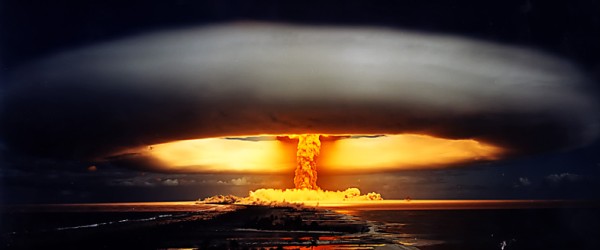
U.S. policy of ‘strategic patience’ with North Korea over, says Tillerson, raising the specter of nuclear war

Reuters reports: A U.S. policy of strategic patience with North Korea has ended, Secretary of State Rex Tillerson said in South Korea on Friday, adding that military action would be “on the table” if North Korea elevated the threat level.
Tillerson began his first Asian visit as secretary of state in Japan on Wednesday and will travel to China on Saturday with a main focus on finding a “new approach” on North Korea after what he described as two decades of failed efforts to denuclearize the insular nation.
“Let me be very clear: the policy of strategic patience has ended. We are exploring a new range of security and diplomatic measures. All options are on the table,” Tillerson told a news conference in Seoul.
He said any North Korean actions that threatened the South would be met with “an appropriate response”.
“If they elevate the threat of their weapons program to a level that we believe requires action, that option is on the table,” Tillerson said when asked about military action. [Continue reading…]
Arms control expert, Jeffrey Lewis, underlines the implications of threatening military action by citing a March 9 statement published by the Korean Central News Agency (KCNA), the state news agency of North Korea:
Your periodic reminder from KCNA that North Korea plans to go nuclear on day one of a war on the Korean peninsula. pic.twitter.com/uPhDB8CnmP
— Jeffrey Lewis (@ArmsControlWonk) March 17, 2017