RFE/RL reports: Russia appears to have rejected U.S. President-elect Donald Trump’s offer to lift U.S. economic sanctions against Russia in exchange for a deal to curb nuclear arms.
Russian Deputy Foreign Minister Sergei Ryabkov told reporters at the United Nations in New York on January 16 that Moscow was willing to talk to the United States about nuclear disarmament, but it was not going to discuss arms control as part of a deal to lift sanctions.
“Sanctions are not a subject for dialogue,” Ryabkov said. “We have never discussed any criteria for the listing of sanctions and are not doing it now. All these sanctions were introduced under contrived and illegitimate pretexts.” [Continue reading…]
Category Archives: Lands
For Trump, three decades of chasing deals in Russia
The New York Times reports: Mr. Trump repeatedly sought business in Russia as far back as 1987, when he traveled there to explore building a hotel. He applied for his trademark in the country as early as 1996. And his children and associates have appeared in Moscow over and over in search of joint ventures, meeting with developers and government officials.
During a trip in 2006, Mr. Sater and two of Mr. Trump’s children, Donald Jr. and Ivanka, stayed at the historic Hotel National Moscow opposite the Kremlin, connecting with potential partners over the course of several days.
As recently as 2013, Mr. Trump himself was in Moscow. He had sold Russian real estate developers the right to host his Miss Universe pageant that year, and he used the visit as a chance to discuss development deals, writing on Twitter at the time: “TRUMP TOWER-MOSCOW is next.”
As the Russian market opened up in the post-Soviet era, Mr. Trump and his partners pursued Russians who were newly flush with cash to buy apartments in Trump Towers in New York and Florida, sales that he boasted about in a 2014 interview. “I know the Russians better than anybody,” Mr. Trump told Michael D’Antonio, a Trump biographer who shared unpublished interview transcripts with The New York Times.
Seeking deals in Russia became part of a broader strategy to expand the Trump brand worldwide. By the mid-2000s, Mr. Trump was transitioning to mostly licensing his name to hotel, condominium and commercial towers rather than building or investing in real estate himself. He discovered that his name was especially attractive in developing countries where the rising rich aspired to the type of ritzy glamour he personified. [Continue reading…]
‘Europe’s fate is in our hands’: Angela Merkel’s defiant reply to Trump
The Guardian reports: Angela Merkel has responded curtly but defiantly after Donald Trump cast further doubt on his commitment to Nato and gave strong hints that he would not support EU cohesion once in office.
“We Europeans have our fate in our own hands,” the German chancellor said after the publication of the US president-elect’s interviews with The Times and Bild. “He has presented his positions once more. They have been known for a while. My positions are also known.”
In the Times interview, Trump complained that Nato had become “obsolete” because it “hadn’t taken care of terror” – a comment later welcomed by the Kremlin. He also suggested that other European countries would follow in Britain’s footsteps and leave the EU.
Germany’s foreign minister, Frank-Walter Steinmeier, said the criticism of Nato had caused concern in the political and military alliance. “I’ve spoken today not only with EU foreign ministers but Nato foreign ministers as well and can report that the signals are that there’s been no easing of tensions,” he said. [Continue reading…]
How a UN health agency became an apologist for Assad atrocities
Annie Sparrow writes: For years now, the World Health Organisation (WHO) has been fiddling while Syria burns, bleeds and starves. Despite WHO Syria having spent hundreds of millions of dollars since the conflict began in March 2011, public health in Syria has gone from troubling in 2011 to catastrophic now.
To put this in perspective, while life expectancy for someone born in the United States has risen half a year from 78.7 years in 2010 to 79.3 years in 2015, over the same time period in Syria, it has plummeted more than 15 years from 70.8 years in 2010 to 55.4 years in 2015.
This new and devastating figure is comparable with South Sudan (57.3) and considerably lower than Afghanistan (60.5), Rwanda (66.1), and Iraq (68.9) while disturbingly, the global average life expectancy for babies born in 2015 is 71.4 years, baby boys in Syria can expect to live just 48 years, baby girls, 65 years.
Even Haitian babies can expect to live an average of 63.5 years, despite two centuries of political turmoil and the worst rates of infectious diseases such as HIV and cholera in the Western hemisphere.
The reason for Syria’s plummeting public health can be illustrated by the final, devastating fall of eastern Aleppo. [Continue reading…]
Putin’s puppet: Trump says NATO is ‘obsolete,’ doesn’t care if EU breaks up, calls refugees ‘illegals,’ and wants ‘good deals with Russia’
I'm still waiting for Trump to say something about global affairs that hasn't literally been said first by the Kremlin. https://t.co/b6ZLd2h7Ka
— Garry Kasparov (@Kasparov63) January 15, 2017
Hard to say how Trump's talking points on NATO, EU & Russia would be different if they were actually written by the Kremlin.
— ian bremmer (@ianbremmer) January 15, 2017
Bloomberg reports: Donald Trump called NATO obsolete, predicted that other European Union members would follow the U.K. in leaving the bloc, and threatened BMW with import duties over a planned plant in Mexico, according to two European newspapers which conducted a joint interview with the president-elect.
Trump, in an hourlong discussion with Germany’s Bild and the Times of London published on Sunday, signaled a major shift in trans-Atlantic relations, including an interest in lifting U.S. sanctions on Russia as part of a nuclear weapons reduction deal.
Quoted in German by Bild from a conversation held in English, Trump predicted that Britain’s exit from the EU will be a success and portrayed the EU as an instrument of German domination designed with the purpose of beating the U.S. in international trade. For that reason, Trump said, he’s fairly indifferent to whether the EU stays together, according to Bild.
The Times quoted Trump as saying he was interested in making “good deals with Russia,” floating the idea of lifting sanctions that were imposed as the U.S. has sought to punish the Kremlin for its annexation of Crimea in 2014 and military support of the Syrian government.
“They have sanctions on Russia — let’s see if we can make some good deals with Russia,’’ Trump said, according to the Times. “For one thing, I think nuclear weapons should be way down and reduced very substantially, that’s part of it.’’
Trump’s reported comments leave little doubt that he’ll stick to campaign positions and may in some cases upend decades of U.S. foreign policy, putting him fundamentally at odds with German Chancellor Angela Merkel on issues from free trade and refugees to security and the EU’s role in the world. [Continue reading…]
Germany hits back at Trump criticism of refugee policy and BMW tariff threat
The Guardian reports: Berlin has mounted a staunch defence of its policies after Donald Trump criticised the German chancellor, Angela Merkel, for her stance during the refugee crisis and threatened a 35% tariff on BMW cars imported into the US.
Germany’s deputy chancellor and minister for the economy, Sigmar Gabriel, said on Monday morning that a tax on German imports would lead to a “bad awakening” among US carmakers since they were reliant on transatlantic supply chains.
“I believe BMW’s biggest factory is already in the US, in Spartanburg [South Carolina],” Gabriel, leader of the centre-left Social Democratic party, told the Bild newspaper in a video interview.
“The US car industry would have a bad awakening if all the supply parts that aren’t being built in the US were to suddenly come with a 35% tariff. I believe it would make the US car industry weaker, worse and above all more expensive. I would wait and see what the Congress has to say about that, which is mostly full of people who want the opposite of Trump.” [Continue reading…]
In 2014, Automotive News reported from Spartanburg: BMW will invest $1 billion in its factory here by 2016 to expand capacity by 100,000 units and add production of a fifth crossover, the X7 — making the plant its biggest worldwide.
Norbert Reithofer, CEO of BMW AG, said Spartanburg’s annual production will top that of BMW’s Dingolfing, Germany, plant, which can build 350,000 vehicles a year.
BMW’s current capacity has just been boosted to 350,000 units. Last year, the plant produced 297,326 vehicles.
Reithofer said building 450,000 vehicles a year will mean the equivalent of “a whole new plant” of output beyond last year’s total.
“This is the fifth expansion since production began 20 years ago and represents another major investment,” said Manfred Erlacher, president of BMW Manufacturing Co.
The plant has begun building the new X4 crossover, which is to go on sale in June in the United States. Spartanburg also produces the X3, X5 and X6.
Harald Krueger, BMW board member for production, said the group has 28 factories in 13 countries. More than 70 percent of the plant’s production is exported to more than 140 countries worldwide, he said.
“And we are really proud that this plant annually exports vehicles valuing over $7.5 billion — which, according to the U.S. Department of Commerce, makes BMW the largest U.S. vehicle exporter by value to non-NAFTA countries. ‘Freude am Fahren’ — made in America,” Krueger said. [Continue reading…]
Watch out, Europe. Germany is top of Russian hackers’ list
Natalie Nougayrède writes: One year ago in Berlin, Lisa F, a 13-year-old German-Russian girl, disappeared for 30 hours. When she returned to her parents, she claimed she had been kidnapped and raped by “Arab” men. This was a lie – as she later admitted. She had fallen out with her parents and invented the whole story. But that did little to stop the episode from becoming the centrepiece of a whirlwind Russian disinformation campaign aimed at destabilising Angela Merkel and German institutions.
Russian state media and pro-Russian websites in Germany immediately swirled with reports. Merkel was already under pressure for her open-door policy on refugees. Now German far-right groups and representatives of Germany’s ethnic Russian community held demonstrations. The Russian foreign minister, Sergey Lavrov, described Lisa (a dual German-Russian citizen) as “our girl” and accused German authorities of a cover-up and “whitewashing reality to make it politically correct”.
A diplomatic spat ensued, with the German foreign minister accusing Russia of “political propaganda”. Berlin officials struggled to counter the Russian campaign. But Moscow’s overt meddling in Germany’s domestic politics seeped into the public consciousness – for a while, at least.
Fast-forward to January 2017. The fallout from the Trump-Russia dossier has now placed Vladimir Putin and his power structure at the centre of American politics. For Europeans, a question arises: what could this all mean for the old continent, as it approaches key elections? This year, voting will take place in France, the Netherlands and in Germany. Remembering the Lisa scandal is important, for it says something about what may lie ahead.
Now that Russia’s covert activities are being so intensely discussed in the US, it is high time Europe placed as much attention on what it might, in turn, be confronted with – and to prepare itself. [Continue reading…]
Beware the dark art of Russian blackmail
Christian Caryl writes: In 1999, Russia’s prosecutor general — the rough equivalent of a U.S. attorney general — vowed to investigate corruption allegations involving the family of then-President Boris Yeltsin.
Then a funny thing happened. Russian TV began showing grainy video footage of the prosecutor, Yuri Skuratov, cavorting in the nude with two young women. Some observers expressed skepticism that the man in the video was actually Skuratov. But any doubts were put to rest by the head of Russia’s internal security service, who declared that his agency’s experts had confirmed the prosecutor’s identity. The man who made the statement was Vladimir Putin, and his words sealed Skuratov’s political fate. The corruption probe faded away, and a few months later a grateful Yeltsin appointed Putin to the office of prime minister, and later as his own successor.
Blackmail exists everywhere, of course. But nowhere else has it become such a prominent part of political life as in post-Soviet Russia. In the wild 1990s, the gray men of the old KGB sold their talents to the highest bidders, and plenty were willing to bid: newly minted millionaires, would-be politicians, mobsters. Countless private security services competed to see who could produce the dirtiest dirt, and journalists — another feature of a strange new world of turbulent freedom — were happy to publish what they dug up.
Putin learned well. As president he soon cracked down on both the freelance spies and the journalists, but he never forgot his early lessons about the uses of kompromat, from the Russian for “compromising material.” Discrediting an enemy, he realized, can be far more effective than throwing them in jail, so the culture of kompromat has continued to thrive under his rule — though it’s now primarily deployed in the services of the Russian state. [Continue reading…]
Ignoring any ‘secrets,’ what we already know about Trump and Russia is bad enough
Anne Applebaum writes: Here, for the record, once again, are things we already know about Trump and Russia, and they aren’t remotely secret:
- Trump’s real estate empire relies, though we don’t know how much, on Russian money. Trump says he never invested in Russia or got loans from Russia. But he did get investment from Russia. In 2008, his son said that Russian investment was “pouring in” to Trump properties. Even before that, Trump had a whole series of partners and investors linked to post-Soviet oligarchs and even Russian organized crime. Has Trump concealed his tax returns for this reason?
- Paul Manafort, Trump’s former campaign manager, spent many years working on behalf of the thuggish Russian-backed Ukrainian president, Viktor Yanukovych, who eventually fled his own country. Manafort maintains links to pro-Russian groups in Ukraine. His name appeared on a list of people who took large chunks of cash from Yanukovych. He hasn’t gone away — in fact, he has lived in Trump Tower. There is no secret about his Russian connections. On the contrary, they define him.
- Last summer, Trump operatives at the convention changed the Republican Party platform to soften the language on Ukraine. There was no explanation for this change, one of the few substantive changes made to the entire party platform. Was this a signal, from Manafort or Trump, that the candidate was on Vladimir Putin’s side?
- Throughout the campaign, Trump repeated slogans and conspiracy theories — “Obama invented ISIS,” “Hillary will start World War III” — lifted from Sputnik, the Russian propaganda website. Was this just Trump campaign chief Stephen K. Bannon borrowing ideas, or Manafort using tactics he perfected in Ukraine? Or was there deliberate linkage?
- Finally, and most important: Trump is willing to risk serious conflict with China, to destroy U.S. relations with Mexico, to dismiss America’s closest allies in Europe and to downgrade NATO, our most important military alliance. But he has repeated many times his admiration for Russia and its president. In 2013 he told MSNBC, “I do have a relationship” with Putin, who is “probably very interested in what you and I are saying today” and will “be seeing it in some form.” In 2014 he bragged that Putin had sent him a “beautiful present” and claimed — apparently untruthfully — to have spoken to him as well. Nothing that Putin has done since — invade Ukraine, murder journalists, jail opponents — has induced Trump to change his mind.
To that list, we can now add the fact that Russia hacked material from the Clinton campaign, fed it to WikiLeaks and passed it on through their bot and troll network, which transformed it into hysterical slogans. Eventually, our intelligence agencies may learn more about that process, but at this point it doesn’t matter.
Information doesn’t have to be secret to be shocking. Trump doesn’t have to be a Manchurian candidate who has been hypnotized or recruited by foreign intelligence. It’s enough that he has direct and indirect links to a profoundly corrupt and violent foreign dictator, whose policies he admires, whose advisers he shares and whose slogans he uses. That’s kompromat enough for me. [Continue reading…]
Iran moderates hope Rafsanjani’s death can soften attitudes
Saeed Kamali Dehghan reports: The turnout was huge and for those who still hope that Iran’s hardline theocratic regime can be reformed, it was full of pathos. As Ali Akbar Hashemi Rafsanjani, the Islamic republic’s former president, was laid to rest on Tuesday in south Tehran, hundreds of thousands of Iranians gathered in and around Tehran University.
For many of those present, the scene was reminiscent of the heady days of protest during the stillborn “green revolution” of 2009. Mourners turned the funeral into a rare display of public dissent, in the biggest gathering of its kind for seven years. The volume of state loudspeakers was turned up to drown out the chants in support of the two main opposition leaders under house arrest, Mir Hossein Mousavi and Mehdi Karroubi, as well as former reformist president Mohammad Khatami, who has also faced growing harassment.
Rafsanjani’s sudden death has deprived moderates of a key powerbroker who retained significant influence in the regime despite his views becoming steadily less hardline in recent years.
Iran’s current president, Hassan Rouhani, a close ally of Rafsanjani, urged unity after the ceremony, tweeting “let’s make bridges, not walls”. A deputy speaker of the parliament, Ali Motahari, a rare outspoken MP, said the passion on display showed the establishment had to end the house arrests.
Though many mourners took part simply to show respect for Rafsanjani, others took the size of the crowd as grounds for hope that a campaign for greater democracy, women’s rights and personal freedoms could be revived. Leading student activist Bahareh Hedayat, who was released in September after nearly seven years in prison, was among the crowd. “Rafsanjani’s popularity was a sign that people still want change and that they’re pursuing this through legal and peaceful means,” she told the Observer from Tehran. [Continue reading…]
Spy agencies around the world are digging into Trump’s Moscow ties
BuzzFeed reports: The dossier alleging that the Russian government has compromised President-elect Donald Trump has not only been circulating at the highest levels of the US government, but also among the intelligence agencies of other countries, two Israeli intelligence officers told BuzzFeed News. And while the dossier’s claims haven’t been verified, the officers said that intelligence services from other countries have been doing their own digging into Trump’s connections to Moscow.
“You can trust me that many intelligence agencies are trying to evaluate the extent to which Trump might have ties, or a weakness of some type, to Russia,” one of the intelligence officers said.
Part of Israel’s interest, he said, came from wanting to know how much of the intelligence it routinely shares with the Unites States might be fed to Russia.
The document published by BuzzFeed News “had been circulating for some months” among intelligence officers from various governments, one of the officers said. Both asked to speak on condition of anonymity, citing the sensitive nature of the claims in the dossier, a 35-page collection of memos commissioned by political opponents of Trump and written by a former British intelligence agent, identified in news reports as Christopher Steele.
Besides the Steele dossier, several unconfirmed reports of ties between Moscow and Trump are being circulated among Western intelligence agencies, said one of the Israeli officials familiar with the reports.
“There have been various reports about Trump’s ties to Russia,” the officer said in reference to other unpublished reports. “The dossier is one of them, but there are others, they make other allegations. Some are more specific, and some are less. You can trust me that many intelligence agencies are trying to evaluate the extent to which Trump might have ties, or a weakness of some type, to Russia.” [Continue reading…]
Assad linked to Syrian chemical attacks for first time
Reuters reports: International investigators have said for the first time that they suspect President Bashar al-Assad and his brother are responsible for the use of chemical weapons in the Syrian conflict, according to a document seen by Reuters.
A joint inquiry for the United Nations and global watchdog the Organisation for the Prohibition of Chemical Weapons (OPCW) had previously identified only military units and did not name any commanders or officials.
Now a list has been produced of individuals whom the investigators have linked to a series of chlorine bomb attacks in 2014-15 – including Assad, his younger brother Maher and other high-ranking figures – indicating the decision to use toxic weapons came from the very top, according to a source familiar with the inquiry. [Continue reading…]
First sign of enhanced U.S.-Russia relations under Trump: An invite to Syria talks
The Washington Post reports: Russia has invited the incoming Trump administration to Syrian peace talks it is sponsoring later this month with Turkey and Iran, part of a process from which the Obama administration pointedly has been excluded.
U.S. participation, especially if an agreement is reached, would be the first indication of the enhanced U.S.-Russia cooperation that President Vladimir Putin and President-elect Donald Trump have forecast under a Trump administration.
The invitation, extended to Trump’s designated national security adviser, Michael T. Flynn, came in a Dec. 28 phone call to Flynn by Sergey Kislyak, Russia’s ambassador in Washington, according to a transition official. [Continue reading…]
How Russian ‘kompromat’ destroys political opponents, no facts required
Sarah Oates writes: The 2016 presidential election and Donald Trump have given Russia a wonderful opportunity to showcase one of its best national products: a particularly effective type of media manipulation called “kompromat.”
Short for “compromising material” in Russian, kompromat is all about the intersection of news and blackmail. It’s the ability to sully the reputations of political opponents or pressure allies through hints, images, videos, promises of disclosures, perhaps even some high-quality faked documentation. Sex or pornography often figures prominently. The beauty of kompromat is that it has to create only a sense of doubt, not prove its case conclusively. This sounds a bit like “fake news,” but in a classic kompromat operation, real Russian state media organizations work in tandem with the Kremlin to find appealing and effective ways to discredit the target. Often, that means in the most visceral and personal ways possible.
Now kompromat may have come to the United States.
This past week, news broke that U.S. intelligence officials had briefed Trump on unsubstantiated allegations that Russian operatives had gathered scandalous information on him or had had contacts with his advisers. But kompromat was a constant undercurrent in the campaign, too: National security officials say hackers linked to Russian intelligence got into the Democratic National Committee’s servers and the Gmail account of Hillary Clinton’s campaign chairman in order to leak damaging information about her. And Trump’s love of conspiracy theories and baseless accusations isn’t so far from the Russian concept, either — which may be why the idea that he might have been a target of kompromat himself is resonating so clearly with his political opponents. [Continue reading…]
At Paris meeting, major powers to warn Trump over Middle East peace
Reuters reports: Major powers will send a message to U.S. President-elect Donald Trump on Sunday that a two-state solution between Israelis and Palestinians is the only way forward, and warn that his plan to move the U.S. Embassy to Jerusalem could derail peace efforts.
Some 70 countries, including key European and Arab states as well as the permanent members of the U.N. Security Council, are due in Paris for a meeting that Israeli Prime Minister Benjamin Netanyahu has rejected as “futile” and “rigged”. Neither the Israelis nor the Palestinians will be represented.
But, just five days before Trump is sworn in, the conference provides a platform for countries to send a strong signal to the future American leader. [Continue reading…]
Did the Trump transition team conspire with Russia to undermine U.S. sanctions?
As the primary beneficiary of Russian interference in the U.S. presidential election, it stands to reason that Donald Trump would not want to punish his benefactor, Vladimir Putin. For that reason, we might expect that when President Obama imposed the most recent round of sanctions on Russia in retaliation for the attack on American democracy, Trump would want to reassure his patron that sanctions relief is close at hand. Moreover, for this reassurance to have the greatest value it would need to be conveyed before Russia gave the standard tit-for-tat response to having dozens of diplomats expelled.
That’s probably why David Ignatius raised these questions on Thursday:
According to a senior U.S. government official, [Retired Lt. Gen. Michael T.] Flynn [Trump’s choice for national security adviser] phoned Russian Ambassador Sergey Kislyak several times on Dec. 29, the day the Obama administration announced the expulsion of 35 Russian officials as well as other measures in retaliation for the hacking. What did Flynn say, and did it undercut the U.S. sanctions? The Logan Act (though never enforced) bars U.S. citizens from correspondence intending to influence a foreign government about “disputes” with the United States. Was its spirit violated?
The Associated Press now reports: President-elect Donald Trump’s national security adviser and Russia’s ambassador to the U.S. have been in frequent contact in recent weeks, including on the day the Obama administration hit Moscow with sanctions in retaliation for election-related hacking, a senior U.S. official says.
After initially denying that Michael Flynn and Ambassador Sergey Kislyak spoke Dec. 29, a Trump official said late Friday that the transition team was aware of one call on the day President Barack Obama imposed sanctions.
It’s not unusual for incoming administrations to have discussions with foreign governments before taking office. But repeated contacts just as Obama imposed sanctions would raise questions about whether Trump’s team discussed — or even helped shape — Russia’s response.
Russian President Vladimir Putin unexpectedly did not retaliate against the U.S. for the move, a decision Trump quickly praised.
More broadly, Flynn’s contact with the Russian ambassador suggests the incoming administration has already begun to lay the groundwork for its promised closer relationship with Moscow. That effort appears to be moving ahead, even as many in Washington, including Republicans, have expressed outrage over intelligence officials’ assessment that Putin launched a hacking operation aimed at meddling in the U.S. election to benefit Trump.
In an interview published Friday evening by The Wall Street Journal, Trump said he might do away with Obama’s sanctions if Russia works with the U.S. on battling terrorists and achieving other goals.
“If Russia is really helping us, why would anybody have sanctions?” he asked. [Continue reading…]
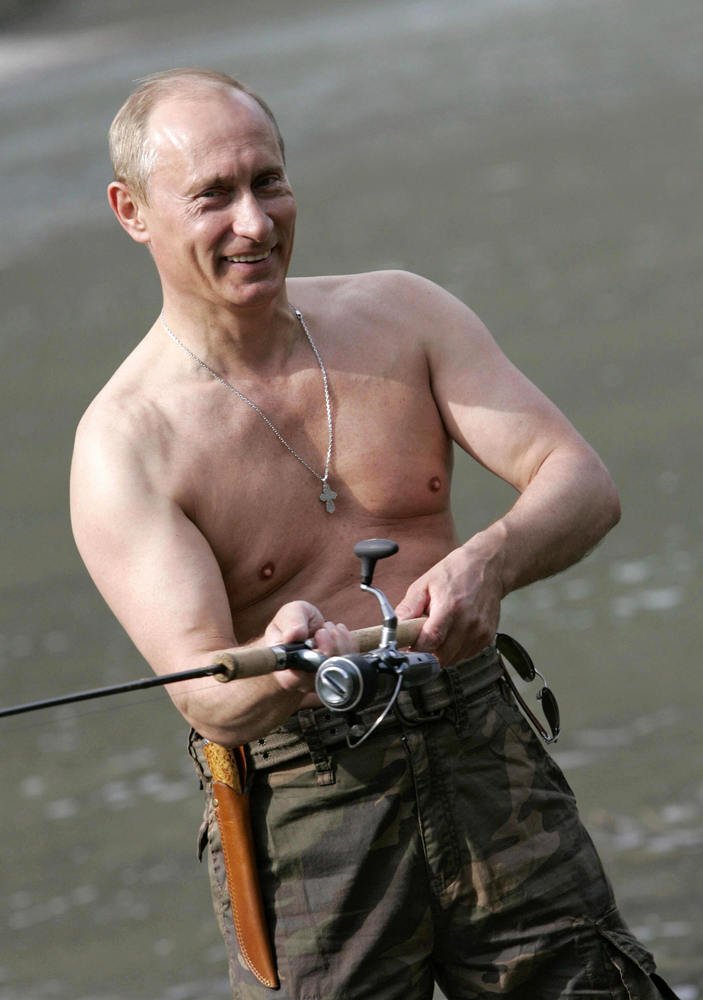
Putin helps Trump and Trump helps Putin — but no one should be in any doubt about who is the dominant partner in this bromance: it’s the one who’s rather proud of showing off his body; not the one who lives in fear of the day he might show up naked on the nightly news.

The Trump dossier and the FBI cover-up
The Independent reports: Christopher Steele, the former MI6 agent who investigated Donald Trump’s alleged Kremlin links, was so worried by what he was discovering that at the end he was working without pay, The Independent has learned.
Mr Steele also decided to pass on information to both British and American intelligence officials after concluding that such material should not just be in the hands of political opponents of Mr Trump, who had hired his services, but was a matter of national security for both countries.
However, say security sources, Mr Steele became increasingly frustrated that the FBI was failing to take action on the intelligence from others as well as him. He came to believe there was a cover-up, that a cabal within the Bureau blocked a thorough inquiry into Mr Trump, focusing instead on the investigation into Hillary Clinton’s emails. [Continue reading…]
The Guardian reports: Embattled FBI director James Comey has refused to clarify whether his organization is investigating Donald Trump’s ties to Russia in a closed briefing on Friday for members of Congress, angering legislators who recall his high-profile interjections about Hillary Clinton during the 2016 presidential campaign, the Guardian has learned.
Comey’s lack of candor in a classified setting, intended to brief members on the intelligence agencies’ assessment that Russia interfered in the election to benefit Trump, follows a public rebuff this week to senators seeking clarification.
In that earlier hearing, Comey said he would “never comment” on a potential FBI investigation “in an open forum like this”, raising expectations among some attendees of Friday’s briefing that Comey would put the issue to rest in a classified setting.
But according to sources attending the closed-door Friday morning meeting, that was not the case. As such, frustration with Comey was bipartisan and heated, adding to intense pressure on the director of the FBI, whose conduct in the 2016 election itself is now being investigated by an independent US justice department watchdog.
One source in the meeting said Comey would not answer “basic questions” about the FBI’s current investigative activities. The FBI chief was grilled “over and over again”, according to the source, about his standards for acknowledging FBI investigations, with legislators repeatedly bringing up Comey’s dramatic public confirmation that the bureau was revisiting classification issues with Hillary Clinton’s private email server days before the election, as well as his summer press conference announcing that he would not seek indictment. [Continue reading…]
Intelligence Committee will investigate possible Russia-Trump links
Politico reports: Senate Intelligence Chairman Richard Burr (R-N.C.) said late Friday that his committee will investigate possible contacts between Donald Trump’s campaign and Russia, reversing himself one day after telling reporters that the issue would be outside of his panel’s ongoing probe into Moscow’s election-disruption efforts.
Burr and the intelligence panel’s top Democrat, Virginia Sen. Mark Warner, said in a joint statement that the committee’s probe would touch on “intelligence regarding links between Russia and individuals associated with political campaigns” as well as Russian cyberattacks and other election meddling outlined in an intelligence report released last week.
The committee will use “subpoenas if necessary” to secure testimony from Obama administration officials as well as Trump’s team, Burr and Warner said.
The bipartisan Senate announcement came hours after several House Democrats aired their frustrations with FBI Director James Comey following a classified briefing on Russian election disruption. The Democrats were livid that Comey refused to confirm whether he is conducting an inquiry into potential Trump ties to Russia — a question that he publicly declined to answer earlier this week. [Continue reading…]