Category Archives: Lands

Leak reveals Rex Tillerson is director of Bahamas-based U.S.-Russian oil company

The Guardian reports: Rex Tillerson, the businessman nominated by Donald Trump to be the next US secretary of state, is the long-time director of a US-Russian oil firm based in the tax haven of the Bahamas, leaked documents show.

Tillerson – the chief executive of ExxonMobil – has been a director of the oil company’s Russian subsidiary, Exxon Neftegas, since 1998. His name – RW Tillerson – appears next to other officers who are based at Houston, Texas; Moscow; and Sakhalin, in Russia’s far east.

The leaked 2001 document comes from the corporate registry in the Bahamas. It was one of 1.3m files given to the Germany newspaper Süddeutsche Zeitung by an anonymous source. The registry is public but details of individual directors are typically incomplete or missing entirely.

Though there is nothing untoward about this directorship, it has not been reported before and is likely to raise fresh questions over Tillerson’s relationship with Russia ahead of a potentially stormy confirmation hearing by the US senate foreign relations committee.

ExxonMobil’s use of offshore regimes – while legal – may also jar with Trump’s avowal to put “America first”.

Tillerson’s critics say he is too close to the Russian president, Vladimir Putin, and that his appointment could raise potential conflicts of interest. [Continue reading…]

Facebooktwittermail

China’s great leap backward

James Fallows writes: In both word and deed, U.S. presidents from Nixon onward have emphasized support for China’s continued economic emergence, on the theory that a getting-richer China is better for all concerned than a staying-poor one, even if this means that the center of the world economy will move toward China. In one of his conversations with The Atlantic’s Jeffrey Goldberg, Barack Obama said, “I’ve been very explicit in saying that we have more to fear from a weakened, threatened China than a successful, rising China.”

Underlying this strategic assessment was an assumption about the likely direction of China’s development. This was not the simplistic faith that if China became richer, it would turn into a liberal democracy. No one knows whether or when that might occur — or whether China will in fact keep prospering. Instead the assumption was that year by year, the distance between practices in China and those in other developed countries would shrink, and China would become easier rather than harder to deal with. More of its travelers and students and investors and families would have direct connections with the rest of the world. More of its people would have vacationed in France, studied in California, or used the internet outside China, and would come to expect similar latitude of choice at home. Time would be on the world’s side in deepening ties with Chinese institutions.

For a long period, the assumption held. Despite the ups and downs, the China of 2010 was undeniably richer and freer than the China of 2005, which was richer and freer than the China of 2000, and so on.

But that’s no longer true. Here are the areas that together indicate a turn: [Continue reading…]

Facebooktwittermail

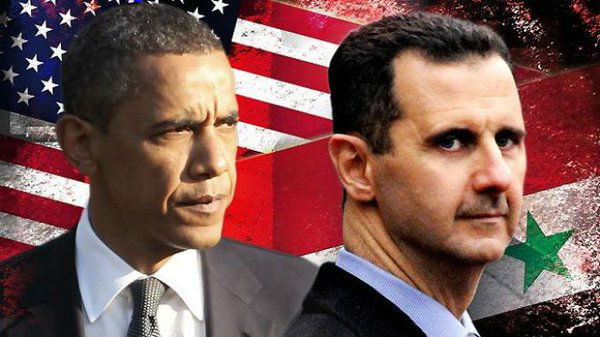
Barack Obama’s presidency will be defined by his failure to face down Assad

Muhammad Idrees Ahmad writes: In an interview with Jeffrey Goldberg of the Atlantic magazine earlier this year, President Obama said he was “very proud” of the moment in 2013 when, against the “overwhelming weight of conventional wisdom”, he decided not to honour his own “red line”, allowing Assad to escape accountability for a chemical attack that had killed more than 1,400 civilians.

Obama may be alone in this judgment. A year earlier, seemingly on a whim, he had set a red line on the use of chemical weapons at a time when none were being used. The red line was, in effect, a green light to conventional killing. But the regime called Obama’s bluff – and, predictably, he backed down. No longer fearing punishment, the regime escalated its tactics.

Nearly four times as many people were killed in the two years after the chemical attack as had died in the two years before. Obama’s abandonment discredited Syria’s nationalist opposition and empowered the Islamists. It helped Isis emerge from the shadows to establish itself as a major force. Together, these developments triggered a mass exodus that would displace over half the country’s population. And as the overflow from this deluge started trickling into Europe, it sparked a xenophobic backlash that has empowered the far right across the west.

These, however, weren’t the only consequences of Obama’s retreat. The inaction also created a vacuum that was filled by Iran and Russia. Emboldened by his unopposed advances into Ukraine and Syria, Putin has been probing weaknesses in the west’s military and political resolve – from provocative flights by Bear bombers along the Cornwall coast to direct interference in the US elections. [Continue reading…]

Facebooktwittermail

Are the United States and China destined for war?

Ali Wyne writes: Concern about an armed confrontation between the United States and China is growing.

U.S. President-elect Donald Trump has stated that the United States should not be bound by the “One China” policy unless as part of a grand bargain of sorts, whereby China reduces taxes on U.S. exports, stops construction in the South China Sea, and cooperates more closely to counter North Korea’s nuclear and missile threats. Chinese Foreign Ministry Spokesman Geng Shuang has warned that if that policy “is compromised or disrupted, the sound and steady growth of the China-U.S. relationship as well as bilateral cooperation in major fields would be out of the question.” China recently flew a conventional bomber over the South China Sea to reinforce its claim to the “nine-dash line,” a demarcation that the United States claims is in violation of international maritime law
Growing strategic tensions offer a useful occasion to revisit well-trodden terrain: are the United States and China fated to repeat the mistakes Britain and Germany made a century earlier? Given that the two countries account for roughly a third of the world’s output, a fifth of its trade, and a quarter of its people, observers cannot pose the question enough.

No matter how forcefully the United States and China may avow that they will devise an enlightened model of interaction, they, too, are subject to structural dynamics dating back to ancient Greece. Political scientist Graham Allison has encapsulated those dynamics with his famous term “Thucydides’s trap,” which journalist David Sanger defines as “that deadly combination of calculation and emotion that…can turn healthy rivalry into antagonism or worse.” [Continue reading…]

Facebooktwittermail

Donald Trump raises the specter of treason

John Shattuck, a former assistant secretary of state for democracy, writes: A specter of treason hovers over Donald Trump. He has brought it on himself by dismissing a bipartisan call for an investigation of Russia’s hacking of the Democratic National Committee as a “ridiculous” political attack on the legitimacy of his election as president.

Seventeen US national intelligence agencies have unanimously concluded that Russia engaged in cyberwarfare against the US presidential campaign. The lead agency, the CIA, has reached the further conclusion that Russia’s hacking was intended to influence the election in favor of Trump.

Admiral Michael Rogers, director of the National Security Agency and commander of the US Cyber Command, has stated, “This was not something that was done casually, this was not something that was done by chance. This was not a target that was selected purely arbitrarily. This was a conscious effort by a nation state to attempt to achieve a specific effect.” On Thursday, a senior intelligence official disclosed that there is substantial evidence that Russian President Vladimir Putin himself authorized the cyberattack.

Why does Trump publicly reject these intelligence agency conclusions and the bipartisan proposal for a congressional investigation? As president-elect, he should have a strong interest in presenting a united front against Russia’s interference with the electoral process at the core of American democracy. [Continue reading…]

Facebooktwittermail

How a Putin fan overseas pushed pro-Trump propaganda to Americans

The New York Times reports: The Patriot News Agency website popped up in July, soon after it became clear that Donald J. Trump would win the Republican presidential nomination, bearing a logo of a red, white and blue eagle and the motto “Built by patriots, for patriots.”

Tucked away on a corner of the site, next to links for Twitter and YouTube, is a link to another social media platform that most Americans have never heard of: VKontakte, the Russian equivalent of Facebook. It is a clue that Patriot News, like many sites that appeared out of nowhere and pumped out pro-Trump hoaxes tying his opponent Hillary Clinton to Satanism, pedophilia and other conspiracies, is actually run by foreigners based overseas.

But while most of those others seem be the work of young, apolitical opportunists cashing in on a conservative appetite for viral nonsense, operators of Patriot News had an explicitly partisan motivation: getting Mr. Trump elected. [Continue reading…]

Facebooktwittermail

Donald Trump’s pick for ambassador to Israel opens a world of unknowns

Karl Vick writes: Don’t even try thinking of Donald Trump’s choice for ambassador to Israel as a diplomat. David M. Friedman is far from that. But he serves very well as a reply in kind, an answer in human form.

It’s like this: For the last three years Prime Minister Benjamin Netanyahu, the man who leads Israel, has sent signal after signal that he’s done with peace talks, or ever pulling Israeli troops out of the West Bank. Sometimes these signals were verbal — in the 2015 election campaign, Netanyahu declared flat out that there would be no Palestinian state. More recently the signals arrived in the form of diplomats — men who, like Friedman, had no prior experience in the subtle arts of statecraft, but whose biographies and attitudes said a great deal. In August, Dani Dayan became Israel’s Consul General in New York. To get his stuff, the moving van had to leave Israel and drive across the Green Line into Palestinian territory, where Dayan lived. He is a settler, a Jewish Israeli who moved to the West Bank in order to stake a claim to rocky hills that are also home to some two million Palestinians. In fact, for six years, Dayan headed the settlers’ primary organization, the Yesha Council. Earlier in the year, Brazil rejected his appointment as Israel’s ambassador to Brasilia, citing his settler background.

In New York, Dayan joined a man with a similar name — Danny Danon, the new Israeli ambassador to the United Nations. Danon was Netanyahu’s remarkable choice for the international body where the topic of Israel’s 50-year occupation of Palestinian territory is a chronic one. The new ambassador had written wrote a book suggesting that Israel simply annex the West Bank, perhaps leaving the Palestinians some urban areas. His rhetoric is famously scalding; after Israeli Defense Forces commandos killed nine Turks on a relief boat headed to the Gaza Strip, Danon wrote to Turkey’s prime minister saying “We are sorry that due to the IDF’s over-cautious behavior, only nine terrorists were killed…” Danon’s appointment to Israel’s premiere diplomatic post — like Dayan’s as envoy to the largest concentration of American Jews — was as far as you can get from business as usual in Israeli diplomacy. For more than a generation, it at least nodded to the idea of a Palestinian state. That’s no longer the case. Not even from the next U.S. ambassador — a bankruptcy lawyer who has represented Trump’s casinos.

“There has never been a two-state solution,” Friedman wrote in August, “only a two-state narrative.” And if it was that was a narrative in which moderate Palestinians invested pretty much everything, a story in which almost the entire world continues to believe, the crystalline signal from both Trump Tower and Jerusalem is that it’s all over now. [Continue reading…]

Facebooktwittermail

China says U.S. is ‘appropriately handling’ seizure of marine research robot — a lesson for Trump?

Reuters reports: China and the United States are using military channels to “appropriately handle” the seizure by the Chinese navy of a U.S. underwater drone in the South China Sea, China said on Saturday, and a Chinese state-run newspaper said it expected a smooth resolution.

The drone was taken on Thursday, the first seizure of its kind in recent memory, about 50 nautical miles northwest of Subic Bay off the Philippines, just as the USNS Bowditch was about to retrieve the unmanned underwater vehicle (UUV), U.S. officials said.

“It is understood that China and the United States are using military channels to appropriately handle this issue,” China’s Foreign Ministry said in a brief statement sent to Reuters, without elaborating. [Continue reading…]

Given Donald Trump’s focus on attending victory rallies and his lack of interest in receiving intelligence briefings, it’s possible that this brief diplomatic incident escaped his attention. At least we can surmise at this point that the president-elect did not deem this matter tweet-worthy.

Nevertheless, I have to wonder whether the Chinese had the intention of providing Trump with a teachable moment so that he can understand that it’s possible to deal with a small provocation without starting World War III.

Let’s hope this isn’t the last time we hear a foreign power saying that the U.S. is appropriately handling an unexpected situation.

But given that even before Trump has entered office he has rocked U.S.-Chinese relations, his destabilizing influence on global affairs seems much more likely to grow before or if it can be held in check.

I spoke too soon!

Literally as I was writing this, Trump tweeted this:


I don’t know if Trump corrects his tweets, so just in case, here’s a screenshot:
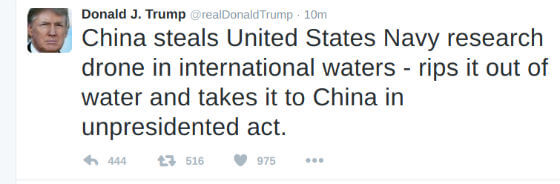
Unpresidented?

I guess Trump could be coining an expression that means an action unworthy of a president. Much more likely, it just means that early on a Saturday morning he doesn’t have any staff nearby to tell him how to spell unprecedented.

As for the substance, Trump is incorrect in claiming that China’s action is unprecedented. Moreover, from China’s point of view it is the U.S. surveillance operations which are the provocation as it has previously made clear.

In 2002, the same U.S. ship was involved in a flare of tensions between the U.S. and China. As the Associated Press reported at the time:

Chinese patrol planes buzzed an unarmed U.S. Navy ship several times while it was conducting what the Pentagon called routine military surveys in the Yellow Sea, and Beijing demanded that it cease “illegal operations” inside China’s 200-mile economic exclusion zone.

The incidents happened over a period of weeks starting in early September. After Chinese officials lodged private protests at least twice, the United States responded Thursday with a note that asserted its right to conduct such activities inside any nation’s economic exclusion zone.

In Beijing, Foreign Ministry spokeswoman Zhang Qiyue said, “We think it violates the international maritime law, and we have made several representations to the U.S. side.”

The report also said:

This was not the first time the Bowditch’s work has rankled the Chinese. On March 23, 2001, just nine days before the EP-3 collision, a Chinese warship chased the Bowditch out of the Yellow Sea.

That collision being between a Chinese fighter plane and a U.S. Navy surveillance aircraft over the South China Sea — an incident that caused much of the world to hold its breath as it waited to see whether an inexperienced and brash American president, George W. Bush, would over-react.

Who could imagine that 16 years later, Bush would, in retrospect, look like a seasoned statesman compared to the man who is about to enter the White House!?

Of course, Bush’s test with China was a prelude to a much greater test six months later whose consequences still reverberate around the world.

The prospect of Trump facing a similar test are too horrific to imagine.

Stay informed. Click below to sign up for daily email updates from War in Context:

sign up now

Facebooktwittermail

Trump’s swaggering sparks war talk from China

Newsweek reports: In mid-summer 2015, the Pentagon deployed a vast fleet to the Western Pacific with an invasion force of 33,000 troops. The little reported exercise was supported by warplanes and attack helicopters, along with 21 ships, including the aircraft carrier George Washington and three nuclear missile-bearing submarines.

It was only a game, the Navy said. But it looked very much like practice for the real thing on or near Chinese shores. On the night of July 4 — Independence Day in the U.S. — Operation Talisman Saber kicked off with U.S. high-altitude paratroopers dropping from the sky near Fog Bay, in Australia’s Northern Territory. Naval artillery boomed. Tanks rolled ashore. The invasion was on.

A U.S. Navy press release made it sound routine, an “exercise [that] illustrates the closeness of the Australian and U.S. alliance…” But Military Times, a close observer of the Defense Department, put its finger on what it was really about: “Talisman Sabre: Trying to Deter China,” its headline said. [Continue reading…]

Facebooktwittermail

Russia’s fear of Hillary Clinton eclipsed any affection for Donald Trump

Max Fisher writes: Russia’s unprecedented intervention in the United States election came amid more than United States-Russia tension and Donald J. Trump’s praise of Vladimir V. Putin, the Russian president. It also coincided with a growing belief, in Moscow, that Russia faced an imminent threat in Hillary Clinton’s candidacy.

Mrs. Clinton is viewed in Moscow as innately hostile to Russia. Widely held conspiracy theories portray her as seeking to foment unrest that will return Russia to the chaos and depression of the 1990s. Even many government technocrats view her with suspicion that at times verges on paranoia.

She referred to these views at an event on Thursday, telling donors that Mr. Putin’s “personal beef” with her had driven Russia’s intervention in the American election.

Mark Galeotti, a Russia expert at the Institute of International Relations, based in Prague, said the Kremlin was consumed by something more urgent than petty revenge: self-preservation.

“It’s not just they didn’t like Clinton, but they actually thought that she represented a threat,” he said, describing Russia’s actions as a matter of “policy, not pique.”

No one factor can fully explain Russia’s decision to hack and pass on Democratic emails, analysts say, and intelligence agencies appear divided on assessing Russian motives. But, in Moscow, fear of Mrs. Clinton has loomed as large or larger than any warmth for Mr. Trump. [Continue reading…]

Facebooktwittermail

Everyone connected with the abomination in Aleppo will pay a heavy price

Fred Hof writes: Some 70 months ago, unarmed, ordinary Syrians rose peacefully against a regime whose incompetence and corruption they had come grudgingly to accept. It was their rulers’ detention and beating of children that provided the tipping point. The same regime seeks now to capitalize on a bloody victory in Aleppo, where children again have been targeted. But the actual and prospective costs associated with the deliberate slaughter of civilians in Aleppo and elsewhere in Syria are steep, and everyone connected with this abomination will pay, especially those who have stood by and watched.

For Syrians hoping for a future free of the Assad family and entourage, the price of Aleppo is bitter. Prodded by a violent regime into armed resistance it did not want, undermined by regime-facilitated extremists and abandoned by pseudo-friends unwilling to match words with deeds, Syrian nationalists must now acknowledge that Syrian President Bashar al-Assad’s survival strategy is working.

That strategy is rooted in collective punishment. The regime, with the enthusiastic support of Russia and Iran, does not hesitate to kill, maim, terrorize and displace civilians in areas where rebel forces are present. Indeed, the Russian air force has demonstrated a special aptitude for destroying hospitals. For Assad and his allies, no atrocity is unthinkable.

Nationalists opposing Assad must ask and answer some hard questions. Has armed resistance run its course? Would it be more humane to lay down arms in the hope that fewer people will be killed, maimed, tortured, starved and displaced than is currently the case? Should ending industrial-strength terror from the skies and starvation sieges down below be the top priority? Given the carnage of Aleppo and all that has preceded it, there is no doubt about what the regime and its allies are willing to do. Neither can there be any doubt about the refusal of the West, notwithstanding its “Never Again” rhetoric, to offer a modicum of protection. [Continue reading…]

Facebooktwittermail

FBI backs CIA view that Russia intervened to help Trump win election

The Washington Post reports: FBI Director James B. Comey and Director of National Intelligence James R. Clapper Jr. are in agreement with a CIA assessment that Russia intervened in the 2016 election in part to help Donald Trump win the presidency, according to U.S. officials.

Comey’s support for the CIA’s conclusion reflects the fact that the leaders of the three agencies have always been in agreement on Russian intentions, officals said, contrary to suggestions by some lawmakers that the FBI disagreed with the CIA.

“Earlier this week, I met separately with (Director) FBI James Comey and DNI Jim Clapper, and there is strong consensus among us on the scope, nature, and intent of Russian interference in our presidential election,” CIA Director John Brennan said in a message to the agency’s workforce, according to U.S. officials who have seen the message.

“The three of us also agree that our organizations, along with others, need to focus on completing the thorough review of this issue that has been directed by President Obama and which is being led by the DNI,” Brennan’s message read. [Continue reading…]

Facebooktwittermail

Assad’s lesson from Aleppo: Force works, with few consequences

The New York Times reports: For months, the bodies have been piling up in eastern Aleppo as the buildings have come down, pulverized by Syrian and Russian jets, burying residents who could not flee in avalanches of bricks and mortar.

And now it is almost over, not because diplomats reached a deal in Geneva, but because President Bashar al-Assad of Syria and his foreign allies have won the city. Cold, hungry and scarred by the deaths of loved ones, tens of thousands of civilians and fighters are awaiting buses to take them from their homes to uncertain futures.

It is not the first victory that Mr. Assad has secured with overwhelming force in the Syrian conflict. But his subjugation of eastern Aleppo has echoed across the Middle East and beyond, rattling alliances, proving the effectiveness of violence and highlighting the reluctance of many countries, perhaps most notably the United States, to get involved.

President Obama, on Friday at his final news conference of the year, acknowledged that the nearly six-year-old war in Syria had been among the hardest issues he has faced, and that the world was “united in horror” at the butchery in Aleppo. But Mr. Obama — who came into office committed to reducing America’s military entanglements in the Middle East — also defended his decision not to intervene more forcefully.

To do otherwise, he said, would have required the United States to be “all in and willing to take over Syria.”

The message for autocratic leaders in the region and elsewhere is that force works — and brings few consequences, said Maha Yahya, the director of the Carnegie Middle East Center in Beirut.

The lesson for the victims of that force is that they are on their own. [Continue reading…]

Facebooktwittermail

My friends in Aleppo would rather die than face capture by Assad’s militias

Zaina Erhaim writes: Bustan al-Qasr is falling into the hands of the regime and its militias.” As I read these words, a multitude of images and thoughts pass through my mind. What has happened to those familiar faces living in that neighbourhood in Aleppo, with whom I shared a smile but also fear? I can only imagine the horror they are feeling, trapped there right now.

Those of us who are in exile, elsewhere in Syria or beyond, haven’t slept for the last four days, since receiving news of the city’s fall. We are scattered all over the world now, glued to our phones for the latest update. A notification can shake your heart with relief: “We are coming out of the siege.” Another can cause you to break down: “The deal is cancelled, we are being attacked again.” And the appearance of a few words on your screen is like being struck by lightning: “Your […] has been killed.” It is the end. Goodbye.

New levels of helplessness have developed over these last few terrible days. But we are the lucky ones. We have got out and have to be strong enough to give hope to our friends who are still there. A good imagination is necessary in these circumstances. For example, while reading that the Russian defence ministry is declaring that the “Syrian national army” will take over the besieged areas within two days, I translate this as: “They are using this as justification to get a better deal in the negotiations.” I reassure friends: “I am in touch with people, you will get out, it’s a matter of time, believe me.”

“I want nothing any more but to see my new daughter. My wife, Rania, is due next month,” my friend Malek told me. “I want to get out and be there for both of them.” Rania is 5km (three miles) away from him, and they haven’t seen each other for five months.

My husband, Mahmoud Rashwani, who is still in Syria, is busy keeping a record of all the wills he has received from his besieged friends and comrades. One common theme is that they would all prefer to be killed than captured by Assad militias. “I would have wanted the same, otherwise I will be wishing for death without getting it,” he tells me, speaking about the torture practised in Assad’s prisons that he knows too well from his own experiences. [Continue reading…]

Facebooktwittermail

Chinese naval ship seizes U.S. underwater research robot in South China Sea

The Washington Post reports: A Chinese naval ship seized an underwater naval drone that was being used by the U.S. Navy to test water conditions in the South China Sea, the Pentagon said Friday.

Navy Capt. Jeff Davis, a Pentagon spokesman, said the incident occurred on Dec. 15 about 50 nautical miles northwest of Subic Bay, in international waters in the South China Sea.

The USNS Bowditch, an oceanographic survey vessel with a mostly civilian crew, was in the process of recovering two unmanned ocean gliders, which are used to collect information about water conditions that can help U.S. vessels operate. A Chinese ship, a Dalang-III class submarine rescue vessel, approached the area, coming within about 500 yards of the Bowditch before dropping a small boat in the water. It seized one of the gliders and brought it aboard, Davis said.

The Bowditch contacted the Chinese ship and asked for the glider to be returned. Officials aboard the Chinese ship acknowledged the radio communication, Davis said, but said they were returning to normal operations. The ship then left the area.

“We would like it back and we would like this not to happen again,” Davis said, referring to the underwater drone. The incident occurred around 1:45 p.m. local time, the Navy said. [Continue reading…]

Facebooktwittermail

Aleppo’s fall is Obama’s failure

Leon Wieseltier writes: Contemplating the extermination of Aleppo and its people, I was reminded of a sentence that I read this summer. It appeared in an encomium to Elie Wiesel shortly after his death. It was a sterling sentence. It declared: “We must never be bystanders to injustice or indifferent to suffering.” That was Wiesel’s teaching, exactly. The problem with the sentence is that it was issued by the White House and attributed to President Obama. And so the sentence was not at all sterling. It was outrageously hypocritical.

How dare Obama, and members of his administration, speak this way? After five years and more in which the United States’ inaction in Syria has transformed our country into nothing other than a bystander to the greatest atrocity of our time, they have forfeited the right to this language. Their angry and anguished utterances are merely the manipulation of the rhetoric of conscience on behalf of a policy without a trace of conscience. You cannot be cold-hearted and high-minded at the same time. Historians will record — they will not have to dig deeply or interpret wildly to conclude — that all through the excruciations of Aleppo, and more generally of Syria, the United States watched. As we watched, we made excuses, and occasionally we ornamented our excuses with eloquence. The president is enamored of his eloquence. But eloquence is precisely what the wrenching circumstances do not require of him. In circumstances of moral (and strategic) emergency, his responsibility is not to move us. It is to pick up the phone. “Elie did more than just bear witness,” Obama said in his eulogy, “he acted.” And he added: “Just imagine the peace and justice that would be possible in our world if more people lived a little more like Elie Wiesel.” Just imagine.

If Obama wants credit for not getting us into another war, the credit is his. If he wants credit for not being guilty of “overreach,” the credit is his. If he wants credit for conceiving of every obstacle and impediment to American action in every corner of the globe, the credit is his. But it is a shameful and incontrovertible fact of our history that during the past eight years the values of rescue, assistance, protection, humanitarianism and democracy have been demoted in our foreign policy and in many instances banished altogether. The ruins of the finest traditions of American internationalism, of American leadership in a darkening world, may be found in the ruins of Aleppo. Our ostentatious passivity is a primary cause of that darkening. When they go low, we go home. The Obama legacy in foreign policy is vacuum-creation, which his addled America-First successor will happily ratify. Aleppo was not destroyed by the Syrian army. It was destroyed by a savage coalition led and protected by Russia. While they massacred innocent men, women and children, we anxiously pondered scenarios of “deconfliction.”

We need to be unforgivingly clear. The obligation to act against evil in Aleppo was no different from the obligation to act against the evil in Sarajevo and Srebrenica. (Has anyone ever heard Obama mention Bosnia?) It was no different from the obligation to act against the evil in Rwanda. It was no different from the obligation to act against the evil in Auschwitz. And we scorned the obligation. We learned nothing. We forgot everything. We failed. We did not even try. [Continue reading…]

Facebooktwittermail

Donald Trump’s rigged election

The New York Times reports: President Obama said on Thursday that the United States would retaliate for Russia’s efforts to influence the presidential election, asserting that “we need to take action,” and “we will.”

The comments, in an interview with NPR, indicate that Mr. Obama, in his remaining weeks in office, will pursue either economic sanctions against Russia or perhaps some kind of response in cyberspace.

Mr. Obama spoke as President-elect Donald J. Trump on Thursday again refused to accept Moscow’s culpability, asking on Twitter why the administration had waited “so long to act” if Russia “or some other entity” had carried out cyberattacks.

The president discussed the potential for American retaliation with Steve Inskeep of NPR for an interview to air on Friday morning. “I think there is no doubt that when any foreign government tries to impact the integrity of our election,” Mr. Obama said, “we need to take action. And we will — at the time and place of our choosing.”

The White House strongly suggested before the election that Mr. Obama would make use of sanctions authority for cyberattacks that he had given to himself by executive order. But he did not, in part out of concern that action before the election could lead to an escalated conflict.

If Mr. Obama invokes sanctions on Russian individuals or organizations, Mr. Trump could reverse them. But that would be politically difficult, as his critics argue that he is blind to Russian behavior. [Continue reading…]

NBC News reports: [In this tweet] Trump was no longer disputing, as he has for months, that Russia was involved. And his top transition aide, Anthony Scaramucci, went even further Wednesday night in an interview with MSNBC’s Brian Williams.

“I don’t think anybody thinks that you’re wrong,” he said of the NBC News report. “Our position right now is that we’re waiting for more information. We reject the notion that people would cyber attack our institutions. We are very upset about it.”

Scaramucci went on to suggest that Trump needed time to digest the intelligence.

“I wonder whether the tweet the president-elect sent out today is the beginning of his pivot, the beginning of his acknowledgement of the intelligence that Russia has been hacking our institutions,” said Rep. Adam Schiff, the ranking Democrat on the House Intelligence Committee.

In an exclusive report Wednesday, U.S. intelligence officials told NBC News they now believe with “a high level of confidence” that Putin became personally involved in the covert Russian campaign in October.

Two senior officials with direct access to the information say new intelligence shows that Putin personally directed how hacked material from Democrats was leaked and otherwise used. The intelligence came from diplomatic sources and spies working for U.S. allies, the officials said. [Continue reading…]

The New York Times reports: It remains to be seen whether Mr. Trump’s stated doubts about Russia’s involvement will subside after Monday’s Electoral College vote. He and his allies have been concerned that the reports of Russian hacking have been intended to peel away votes from him, although even Democrats have not gone so far as to say the election was illegitimate.

“Right now, certain elements of the media, certain elements of the intelligence community and certain politicians are really doing the work of the Russians — they’re creating this uncertainty over the election,” Representative Peter T. King, Republican of New York, told reporters on Thursday after meeting with Mr. Trump.

But many other Republicans, including Senator Mitch McConnell of Kentucky, the majority leader, and Senator John McCain of Arizona, have publicly argued that the evidence leads straight to Russia. They have called for a full investigation, and Senator Dianne Feinstein, Democrat of California, who sits on the Senate Intelligence Committee, urged Mr. Obama on Thursday to complete an administration review quickly.

Mr. Trump’s Twitter post was his latest move to accuse the intelligence agencies he will soon control of acting with a political agenda and to dispute the well-documented conclusion that Moscow carried out a meticulously planned series of attacks and releases of information to interfere in the presidential race.

But as he repeated his doubts, Mr. Trump seized on emerging questions about the Obama administration’s response: Why did it take months after the breaches had been discovered for the administration to name Moscow publicly as the culprit? And why did Mr. Obama initially opt not to openly retaliate, through sanctions or other measures?

White House officials have said that the warning to Mr. Putin at the September summit meeting in China constituted the primary American response so far. When the administration decided to go public with its conclusion a month later, it did so in a statement from the director of national intelligence and the Homeland Security secretary, not in a prominent presidential appearance.

Officials said they were worried that any larger public response would have raised doubts about the election’s integrity, something Mr. Trump was already seeking to do during the campaign when he insisted the election was “rigged.” [Continue reading…]


Facebooktwittermail

Trump picks hardline pro-settler bankruptcy lawyer to become U.S. ambassador to Israel

The Guardian reports: Donald Trump has named as his ambassador to Israel a pro-settler lawyer who has described some US Jews as worse than concentration camp prisoner-guards.

David Friedman, a bankruptcy lawyer who represented the president-elect over his failing hotels in Atlantic City, served Trump’s advisory team on the Middle East. He has set out a number of hardline positions on Israeli-Palestinian relations, including fervent opposition to the two-state solution and strong support for an undivided Jerusalem as Israel’s capital.

He has called President Barack Obama an antisemite and suggested that US Jews who oppose the Israeli occupation of the West Bank are worse than kapos, Nazi-era prisoners who served as concentration camp guards.

Liberal Jewish groups in the US denounced the appointment as “reckless” and described Friedman – a man with no experience of foreign service – as the “least experienced pick” ever for a US ambassador to Israel.

Yossi Dagan, a prominent Israeli settler leader and friend of Friedman, welcomed the news, describing him as “a true friend and partner of the state of Israel and the settlements”. Morton Klein, the president of the Zionist Organization of America, said Friedman had “the potential to be the greatest US ambassador to Israel ever”. [Continue reading…]

Facebooktwittermail