The New Arab reports: The regime of Bashar al-Assad is reportedly seeking to rehabilitate and operate oil fields and power plants in areas controlled currently by the rebels and the Islamic State group respectively — areas that the regime forces began recapturing in northern and Western Syria backed by Russian airstrikes.
Measures are already in place by the Syrian regime to hand over the Syrian energy sector to Russian companies, led by a law on partnership between the private sector and foreign companies issued in early 2016.
Last month as well, Russian press reports said Bashar al-Assad, during a recent visit to Moscow, signed an agreement consisting of ten clauses purportedly giving Russia the right to freely operate in Syria, which cannot be revoked except by written agreement.
In the same vein, a recent report published by Russia’s RIA agency said Syria’s ambassador to Moscow, Riad Haddad, had met with the chairman of Russian gas company Gazprom Alexei Miller, and discussed giving Russian energy firms oil and gas concessions in Syria and other forms of cooperation. [Continue reading…]
Category Archives: Lands
Start preparing for the collapse of the Saudi kingdom
Sarah Chayes and Alex de Waal write: For half a century, the Kingdom of Saudi Arabia has been the linchpin of U.S. Mideast policy. A guaranteed supply of oil has bought a guaranteed supply of security. Ignoring autocratic practices and the export of Wahhabi extremism, Washington stubbornly dubs its ally “moderate.” So tight is the trust that U.S. special operators dip into Saudi petrodollars as a counterterrorism slush fund without a second thought. In a sea of chaos, goes the refrain, the kingdom is one state that’s stable.
But is it?
In fact, Saudi Arabia is no state at all. There are two ways to describe it: as a political enterprise with a clever but ultimately unsustainable business model, or so corrupt as to resemble in its functioning a vertically and horizontally integrated criminal organization. Either way, it can’t last. It’s past time U.S. decision-makers began planning for the collapse of the Saudi kingdom.
In recent conversations with military and other government personnel, we were startled at how startled they seemed at this prospect. Here’s the analysis they should be working through.
Understood one way, the Saudi king is CEO of a family business that converts oil into payoffs that buy political loyalty. They take two forms: cash handouts or commercial concessions for the increasingly numerous scions of the royal clan, and a modicum of public goods and employment opportunities for commoners. The coercive “stick” is supplied by brutal internal security services lavishly equipped with American equipment. [Continue reading…]
The world’s failure to stop the massacre in Syria is based on a string of lies
Amir Tibon writes: In my conversations with the refugees [at a camp in Serbia] last month, I asked them about some of these lies as if they were well-established truths. Not because I believe them — but rather, because so many people, all over the world, hear and read these lies every day that it’s impossible to ignore them.
It felt dumb, for instance, to ask a family — father, mother, three children aged 12 to 3 — who had just escaped from the burning city of Aleppo, what they thought about “Russia’s bombing campaign against ISIS.” Of course, there is no such thing. Russia isn’t focusing its effort on bombing ISIS, but rather on trying to kill the people I was talking to, who are Syrian civilians. Yet conducting the interview without treating this big lie as if it is simply an alternate explanation of events would be considered “biased reporting.” So, I ask the question and get looks of disbelief, and worse.
Nadia, the mother of this family, told me that “the Russians are the worst thing that happened to us. We survived everything before them, but when they came in to help Bashar, we said — enough. They bomb schools, hospitals, refugee camps, buses carrying people to the border.” What specifically did their involvement mean, I asked her. Her reply: “I would ask myself every morning — how are the Russians going to try to kill my children today?”
Her husband, Yasser, a merchant who owned two stores in the city, disagrees with this analysis — he thinks Shiite militias supported by Iran are an even greater danger than Putin’s air force. “We ran away from the city because we know that after the Russians will finish it, the Iranians will come in. The Iranians are sending people to kill us for Assad.”
These militias, which are entering Syria from neighboring Iraq, have quite a reputation when it comes to killing. “They are just like ISIS, only difference is they are Shi’a and they talk Farsi,” says Yasser. “Tell me — why isn’t anyone bombing them? Why is the entire world only talking about ISIS? The Iranians in Syria burn people alive, burn children and women. Where is the world?” The couple then apologized, explaining they had much more to say, but their youngest daughter started crying, and anyway, they had to leave for the bus. They have six more days on the road ahead of them before reaching Germany.
The biggest lie of them all is that Bashar al-Assad, even more than Vladimir Putin, wants to defeat ISIS. The civil war in Syria, we are told more and more as of late, is actually a choice between Assad and ISIS. Framing the conflict in such terms makes it legitimate and acceptable to cooperate with Assad, a man who is responsible for the deaths of over a quarter of a million people. I tried to ask each and every Syrian I talked to one simple and “neutral” question that has to do with this falsehood. The question was — “Who are you running away from?” The vast majority of people didn’t choose Assad or ISIS — they said they are running away from both.
“The world needs to understand that Assad and ISIS are not enemies — they are partners in destroying our lives,” explained Muhammad, 24, from Aleppo, who stayed in the bombarded city for the last five years because he wanted to complete his university studies before getting out. “It’s like a coin that has two bad sides to it. Doesn’t matter which way you flip it, you’ll end up dead. As long as there is Assad, there will be ISIS. His violence against the Sunni people in Syria is what created ISIS in the first place.”
One man in his 50s, who presented himself in perfect English as a university professor from Aleppo, added: “I’m running away from Da’esh (the Arabic name for ISIS), but there are many different kinds of Da’esh operating in Syria today. There is Da’esh-Da’esh, the people who cut off heads and burn prisoners in cages. There is also Da’esh-Assad, which is actually much worse, and Da’esh-Iran, the Iranian militias who rape and murder women in front of their children’s eyes. They have much more money and capabilities, and they don’t film themselves while doing their atrocities. They are smart enough to hide it from the world. In addition to all these, there is also Da’esh-Putin. I’m coming from Aleppo; I’ve seen the results of his bombings. It’s a massacre. People are killed like cockroaches under a shoe. And then there is Da’esh-the West, which I think is the worst! I mean the civilized world, doing nothing to stop all of this.” [Continue reading…]

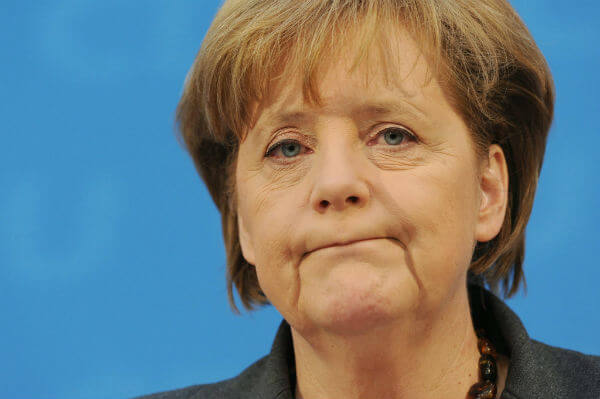
Will Merkel pay for doing the right thing?

Roger Cohen writes: A former German chancellor, Gerhard Schröder, recently called Angela Merkel’s decision to open the door to an unlimited number of refugees a “mistake” and offered this verdict: Merkel had a “heart, but no plan.”
This view of the German leader, who is beloved but now begrudged, is gaining ground as refugees from a ravaged Syria and elsewhere pour in. Local authorities are strained to the limit. Billions of euros have been spent with no end in sight. Many people came in whose identities are unknown; they have to register if they want handouts, but some have not and there are security concerns. Cologne has become a byword for concern over how a large influx of Muslim men will affect the place and security of women in German society.
Three important state elections loom next month. It seems inevitable the far-right Alternative for Germany Party will surge. Merkel will be blamed. Her support has already tumbled. One poll this month showed 46 percent of Germans support her, compared with 75 percent in April last year — and that’s with a strong economy. She could be vulnerable if her Christian Democratic Party turns on her. Europe without Merkel will sink.
So why did this customarily prudent chancellor do it? Because she is a German, and to be German is to carry a special responsibility for those terrorized in their homeland and forced into flight. Because she once lived in a country, East Germany, that shot people who tried to cross its border. Because a united Europe ushered Germany from its darkest hour to prosperity, and she is not about to let the European Union pitch into mayhem on her watch — as it would with more than a million ragged refugees adrift. And, yes, because she has a heart.
Merkel did the right thing. The question now is how she handles the consequences. [Continue reading…]
To be a refugee is much harder for a woman than for a man
Renate van der Zee reports from the transit camp of Vinojug on the Macedonian-Greek border: In the camp’s supposedly “child-friendly” space, 25-year-old Nameen, from Homs, is nursing her tiny baby daughter. She went into labour as she was travelling through Turkey. “Fortunately they could get me to the hospital in time. The delivery went well,” she says with a faint trace of a smile.
Nameen stayed in the hospital for two days, rested for another 10 days in Turkey, and then crossed the Mediterranean in a dinghy with her baby in her arms.
“All I could think of was my girl, I was so scared she would drown or get ill. It was so cold. I am still worried for her safety, day and night.”
The other women in Vinojug agree: to be a refugee is much harder for a woman than for a man.
Amnesty International and the UN refugee agency, UNHCR, recently presented reports on the vulnerable position of women refugees and the dangers they face.
Europe is failing to provide basic protection for them, the Amnesty report stated.
This problem is now all the more critical because the percentage of women among the refugees who travel through Europe has risen dramatically. Exact data is not available, but according to UNHCR, last summer, a quarter of the refugees were women and children – now it is 55 percent. [Continue reading…]
Russian airstrikes targeted hospitals: ‘The planes returned several times,’ says eyewitness

Syria Direct reports: Reported Russian airstrikes knocked three hospitals in northern Syria out of service on Monday, depriving more than 5,000 patients a month of care ahead of the deadline for a “cessation of hostilities” deal worked out between major powers at last week’s annual Munich Security.
The ceasefire, notably, excludes the Islamic State in addition to Jabhat a-Nusra, one of the lead factions in the Victory Army that controls nearly all of Idlib province.
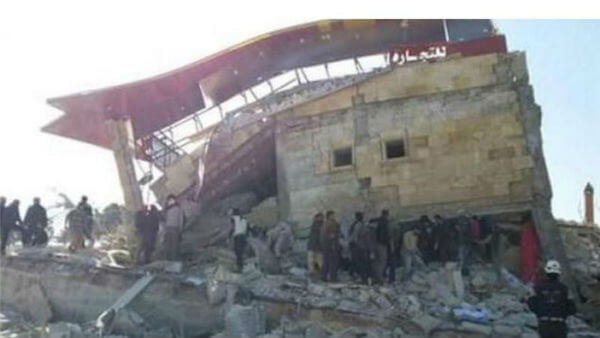
Two hospitals, one belonging to Doctors Without Borders (MSF), were bombed in Idlib province on Monday. A third, a women and children’s hospital in the city of Azaz near the Turkish border, was also hit.
The National Hospital, also in Maarat al-Nuaman, was bombed shortly after the strikes on the MSF facility, Amjed al-Idlibi, a first responder with the Civil Defense who worked to extract the dead and wounded, told Syria Direct Tuesday.
“Both hospitals were hit directly…the planes returned several times to conduct air raids, with roughly 10 minutes between each raid,” said al-Idlibi. He said that the planes were Russian. [Continue reading…]
Meanwhile, Russia’s TASS reports: The Kremlin has dismissed as unacceptable the allegations the Russian air group in Syria has destroyed a hospital in Syria.
“We are strongly against such claims, the more so, since each time those who come up with such charges prove unable to somehow confirm their groundless accusations,” Russian presidential spokesman Dmitry Peskov has said.
Asked for a comment regarding reports a hospital in Syria’s Idlib province had been bombed, as well as claims the Russian air group was responsible, Peskov invited everybody to rely “on the root source first and foremost.” “In this particular case the representatives of Syrian authorities are the root source,” he said.
Peskov recalled that Syria’s ambassador to Russia, Riyadh Haddad, said on Tuesday the hospital in Idlib province was destroyed by the Americans, and not the Russian air group. [Continue reading…]
Note the reasoning of the propagandists: The allegations that the airstrikes on hospitals were carried out by Russia are firstly dismissed as “groundless accusations” and secondly dismissed by repeating a groundless accusation made by Syria’s ambassador to Russia — that these were U.S. airstrikes.
Unfortunately, there exists an uncritical audience all too willing to swallow this kind of shameless lying and tortured reasoning.
‘Unprecedented increase in the number of attacks on healthcare’ in Syria, say aid groups
BuzzFeed reports: Monday marked an “unprecedented” surge in attacks on health facilities in Syria, according to an internal report by affiliates of the World Health Organization that was rushed out to take the toll of the damage.
The report, compiled by the consortium of medical facilities the WHO oversees in the country and provided exclusively to BuzzFeed News, documents a series of what appeared to be targeted bombings of hospitals and other health facilities in Syria. The attacks — which local doctors and international observers alike blamed on Syrian and Russian missiles — killed patients and medical staff at seven different medical sites, the report said, adding that Monday marked “an unprecedented increase in the number of attacks on healthcare in one single day.” [Continue reading…]
Kurds carve out new reality in northern Syria
The Guardian reports: Amid the chaos in northern Syria in recent months, several themes have emerged.
The first is that Islamic State has been spared from intensified Russian airstrikes and advances by pro-regime forces. The second, and potentially more important development, is that one of the war’s least visible players – the Kurds – have done more than anyone else to carve out a new reality.
As Lebanese Hezbollah, militias from Iraq, and Syrian troops – all led by Iran – have inched their way around the top of Aleppo, the Kurdish YPG, supported by Russian air cover, has been making strident moves towards areas they have avoided throughout the conflict.
Over the weekend, the YPG moved towards two Syrian towns between the Turkish border and the almost besieged Aleppo, after earlier seizing an airbase that had been held by the opposition. Throughout the war, the YPG had been viewed warily by the opposition, and given a wide berth by the regime.
Now, though, its moves have sharply expanded a footprint in the north, alarming rebels who have been distracted by other foes, and Turkey, which had vowed never to let the Kurds dominate its border with Syria.
The Kurds are ascendant, and the Turks are enraged. Ankara sees YPG militants, who are affiliated with the Kurdistan Workers’ party (PKK), as vying to own areas they have never before controlled, to establish a foothold from Irfin in Syria’s north-west to the Iraqi border, a frontier dominated for decades by Arabs.
Helping the YPG do that are the same Russian jets that are steadily destroying Turkish-supported rebel groups, whose three-year push to oust Bashar al-Assad increasingly looks lost. [Continue reading…]
Russia uses world war threat to dictate Syria policy, says Turkish PM
Hurriyet Daily News reports: Russia is deliberately using the threat of a possible world war in order to dictate its policy in Syria, according to Turkish Prime Minister Ahmet Davutoğlu.
“Russia is consciously engaging in a perception operation to suggest ‘there could be a world war.’ By keeping this on the agenda, Russia continues to bother the world and dictate its policy,” Davutoğlu said Feb. 15 en route to Kyiv for a one-day visit.
“We should not be tricked with this perception operation,” he added.
Davutoğlu was referring to Russian Prime Minister Dmitry Medvedev’s words in Germany’s Handelsblatt newspaper on Feb. 11 that “world war” was possible if international powers failed to negotiate an end to the conflict in Syria. [Continue reading…]
Turkey to hold back on Syria ground offensive
The New Arab reports: Turkey has said it will only commit forces to a ground operations in Syria if its allies – including the US – back the offensive with troops.
A senior Turkish official told reporters that Ankara has asked its partners to intervene in Syria’s war, but his country will not take any action alone.
“We want a ground operation with our international allies,” the official told reporters in Istanbul on Tuesday.
“There is not going to be a unilateral military operation from Turkey to Syria… [but] without a ground operation it is impossible to stop the fighting in Syria. We are asking the coalition partners that there should be a ground operation.”
It comes as speculation mounts about possible Turkish intervention in Syria’s war to prevent Kurdish forces estabishing a mini-state on its borders and protect Syrian rebel forces from losing further ground. [Continue reading…]
Iran’s revolutionary grandchildren

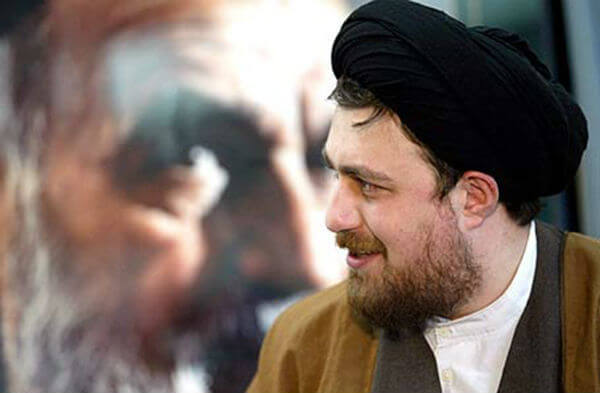
Robin Wright writes: When the revolutionary leader Ayatollah Khomeini died abruptly, from heart failure after surgery, in 1989, he left behind fifteen grandchildren. The fate of his heirs reflects the depth of tensions within the Islamic Republic as it marks the thirty-seventh anniversary of the Imam’s triumphant return from exile — and prepares for twin elections, on February 26th. All the Khomeini kids (eight males and seven females) are committed reformers pushing for Iran to open up at home — politically, economically, and socially — now that it has reëngaged with the world. In public letters and interviews, seven have challenged the theocracy’s political rules and rigid social strictures. Since 2004, three have registered to run for office.
Hassan Khomeini is the family standard-bearer. He considered a soccer career before enrolling in a seminary, in the holy city of Qom, in his twenties. Now forty-three, he still plays the odd pickup game and goes to big matches. “I was good in defense, and if I had continued soccer I might have achieved something,” he joked at a meeting with Iran’s top players, in December. He is now more seriously employed as the caretaker of his grandfather’s legacy, at the Institute for the Compilation and Publication of Imam Khomeini’s Works. He is also a published scholar on Islam’s disparate sects. He wears a black turban, signifying that he descended from the Prophet Muhammed. He has all the right connections, too. His Instagram account, which has almost a quarter of a million followers, is loaded with images of him alongside top theocrats and politicians. In December, reformist newspapers ran front-page stories heralding him as Iran’s “Future Leader” and as a “Second Khomeini.” [Continue reading…]
Putin’s reward for doing a deal with OPEC overshadowed by risks
Bloomberg reports: Neither a recession nor a collapse in revenue has yet been enough to convince Russian President Vladimir Putin that it’s time to join with OPEC and cut oil output to boost prices. His reasons may be pragmatic rather than political.
Russia’s Energy Minister Alexander Novak and his Saudi Arabian, Venezuelan and Qatari counterparts agreed to freeze output at January levels on Tuesday. The world’s second-largest crude producer faces numerous obstacles to any deal that would actually cut production, even if Putin decides it’s in the national interest. Reducing the flow of crude might damage Russia’s fields and pipelines, require expensive new storage tanks or simply take too long.
In Siberia, Russia’s main oil province, winter temperatures can go below minus 40 degrees Celsius (minus 40 Fahrenheit). That’s a challenge for anyone thinking of turning off the taps.
The oil and gas that flows from wells always contains water, so once pumping stops, pipes may freeze, Mikhail Pshenitsyn, who has worked for more than 10 years in the Russian oil industry, said by e-mail. The problem goes away in summer, but there’s still the risk of a long-term reduction in output because a halted reservoir can become polluted with salts and residues, he said.
Production from a shut-in well might never be restored in full, Maxim Nechaev, director for Russia at consulting firm IHS Inc., said by phone. [Continue reading…]
Peter Van Buren: Minimum wage, minimum chance
To say that we live on a 1% planet isn’t just a turn of phrase. In fact, it would undoubtedly be more accurate to speak of a .1% or a .01% planet. In recent years, wealth and income inequalities have grown in a notorious fashion in the United States — and, as it turns out, globally as well. In January, Oxfam released a report on the widening gap between global wealth and poverty. It found that, between 2010 and today, the wealth of the poorest half of the planet’s population fell by a trillion dollars, a drop of 41%, while that of the richest 62 people (53 men and nine women) increased by half a trillion dollars. Put another way, those 62 billionaires were wealthier than the bottom 50% of the world’s people, while the richest 1% owned more than the other 99% combined. The direction in which we’re heading is obvious. Just consider that, in 2010, it took 388 of the super-rich to equal the holdings of the bottom 50%; now, that number is 326 people smaller.
Keep that trend line in mind as you read about TomDispatch regular Peter Van Buren’s latest adventures in the minimum-wage economy. Back in 2014, he described for this site how, having lost his State Department job for being a whistleblower on the Iraq War, he fell for a time into the low-wage world. As he wrote, “And soon enough, I did indeed find myself working in exactly that economy and, worse yet, trying to live on the money I made. But it wasn’t just the money. There’s this American thing in which jobs define us, and those definitions tell us what our individual futures and the future of our society is likely to be. And believe me, rock bottom is a miserable base for any future.” His experiences in a big-box retail store inspired him to write his novel, Ghosts of Tom Joad: A Story of the #99Percent. As last year ended, he returned to the minimum-wage world, now — thanks in particular to Bernie Sanders — part of the national conversation. And here’s what he found. Tom Engelhardt
Nickel and dimed in 2016
You can’t earn a living on the minimum wage
By Peter Van BurenWhen presidential candidate Bernie Sanders talks about income inequality, and when other candidates speak about the minimum wage and food stamps, what are they really talking about?
Whether they know it or not, it’s something like this.
My Working Life Then
A few years ago, I wrote about my experience enmeshed in the minimum-wage economy, chronicling the collapse of good people who could not earn enough money, often working 60-plus hours a week at multiple jobs, to feed their families. I saw that, in this country, people trying to make ends meet in such a fashion still had to resort to food benefit programs and charity. I saw an employee fired for stealing lunches from the break room refrigerator to feed himself. I watched as a co-worker secretly brought her two kids into the store and left them to wander alone for hours because she couldn’t afford childcare. (As it happens, 29% of low-wage employees are single parents.)
At that point, having worked at the State Department for 24 years, I had been booted out for being a whistleblower. I wasn’t sure what would happen to me next and so took a series of minimum wage jobs. Finding myself plunged into the low-wage economy was a sobering, even frightening, experience that made me realize just how ignorant I had been about the lives of the people who rang me up at stores or served me food in restaurants. Though millions of adults work for minimum wage, until I did it myself I knew nothing about what that involved, which meant I knew next to nothing about twenty-first-century America.
A mini world war rages in the fields of Aleppo
The Washington Post reports: Across the olive groves and wheat fields of the northern Syrian province of Aleppo, a battle with global dimensions risks erupting into a wider war.
Russian warplanes are bombing from the sky. Iraqi and Lebanese militias aided by Iranian advisers are advancing on the ground. An assortment of Syrian rebels backed by the United States, Turkey, Saudi Arabia and Qatar are fighting to hold them back. Kurdish forces allied both to Washington and Moscow are taking advantage of the chaos to extend Kurdish territories. The Islamic State has snatched a couple of small villages, while all the focus was on the other groups.
Ahead of a supposed pause in the hostilities negotiated by world powers and due to be implemented later in the week, the conflict seems only to be escalating. Turkey joined in over the weekend, firing artillery across its border at Kurdish positions for a second day Sunday and prompting appeals from the Obama administration to both Turks and Kurds to back down.
Syria’s civil war long ago mutated into a proxy conflict, with competing world powers backing the rival Syrian factions almost since the earliest days of the armed rebellion against President Bashar al-Assad.
But perhaps never before have the dangers — or the complications — of what amounts to a mini world war been so apparent as in the battle underway for control of Aleppo. [Continue reading…]
Russia facilitates ceasefire deals with safe passage for ISIS and Nusra Front fighters
Reuters reports: Pro-government sources say the Russian role has expanded to include facilitating local ceasefires in rebel-held areas around Damascus, with the aim of creating a secure buffer around the capital. Syrian Minister of National Reconciliation Ali Haidar described the process as purely Syrian even if there had at times been Russian help.
“The truth is that since the presence of the Russians on Syrian land, they can play the role of mediator in some areas,” he said at his offices in Damascus. “The Russians make contact (with militants) when they can, of course – in Douma and other areas,” he said, in reference to an area east of Damascus.” Sometimes it is the militants who request mediation by the Russians,” he said. Those wishing to relocate wanted guarantees of safe passage to rebel strongholds, and those wishing to stay wanted to be sure they wouldn’t be killed later on, he said. According to the non-Syrian sources interviewed by Reuters, Russian advisers orchestrated two deals in which hardline Islamist fighters were evacuated from the south toward areas their groups control in the northern and central provinces.
One of the non-Syrian military sources said the Russians worked “in the shadows” to facilitate the ceasefire deals. In some cases the Russians operated as guarantors for the deals.
Dozens of cars left southern towns of Syria in December carrying fighters from Nusra Front with their families to the northern province of Idlib which is under control of an alliance of rebels including Nusra Front. Weeks later a convoy left Hajar al-Aswad and Yarmouk camp areas near Damascus carrying fighters and families from Islamic State to the group’s stronghold of Raqqa.
A second source who was informed of the deals said the fighters were given safe passage. The aim was to empty these areas of hardline Islamists so clearing the way for the government to strike deals with the remaining rebels.
“The Russians want all the battles to be focused in the north, they want the south and Damascus and the coastal line all neutralized. Ultimately they are working toward achieving a wider political solution,” said the source. [Continue reading…]
Obama called Putin and Putin agreed to carry on taking calls from Obama
Following a phone conversation between President Obama and President Putin “to discuss the decisions and agreements made at the February 11 meeting of the International Syria Support Group (ISSG),” the White House said: “The leaders agreed that the United States and Russia will remain in communication on the important work of the ISSG.”
That’s it: they’ll remain in communication.
Obama can stress the importance, emphasize the importance, reiterate the importance, and do as much urging as he wants. To Putin, this is just yada yada yada.
The Washington Post reports: President Obama and Russian President Vladimir Putin have agreed to intensify diplomatic and military cooperation to implement a cease-fire and the delivery of aid in Syria, the Kremlin said early Sunday.
A statement from Putin’s office said that Obama initiated a telephone conversation between the two. The White House, which said the call took place Saturday, did not mention increased U.S.-Russia cooperation but said that Obama stressed the importance “of rapidly implementing humanitarian access to besieged areas.” Obama also urged Putin to cease Russia’s air campaign against “moderate opposition forces” in Syria, according to a White House statement released Sunday.
The call came amid reports that at least one siege had been broken with the first delivery of humanitarian aid to the rebel-held Douma area, east of the Syrian capital of Damascus. Douma had been cut off by government troops since 2013. A United Nations spokesperson said from Geneva, where a task force is organizing aid under an agreement reached Friday in Munich, that the Douma delivery was a previously scheduled shipment by the Syrian Red Crescent. [Continue reading…]
Airstrikes hit hospitals in northern Syria; MSF views Russia or Assad’s forces as responsible

The Guardian reports: Airstrikes have hit hospitals in two locations in northern Syria – marking the latest in a series of attacks on medical facilities and workers in the five-year civil war.
Médecins Sans Frontières said seven people were killed when a facility it supports in Maaret al-Numan, Idlib province, was hit four times in two separate raids. Mego Terzian, MSF’s France president, told Reuters he thought that either Russia or Syrian government forces were responsible. Both have been engaged in an unrelenting aerial bombardment in Idlib.
The hospital, which has 54 staff and 30 beds, is financed by the medical charity, which also supplies medicine and equipment.
“The destruction of the hospital leaves the local population of about 40,000 people without access to medical services in an active zone of conflict,” said Massimiliano Rebaudengo, MSF’s head of mission in Syria.
In separate incident, Syrian opposition activists said a missile struck a children’s hospital in the rebel-held town of Azaz, near the Turkish border, killing 10 and wounding more than 30. The Turkish prime minister, Ahmet Davutoğlu, said a Russian ballistic missile had hit the town. [Continue reading…]
Reuters adds: Residents in both towns blamed Russian strikes, saying the planes deployed were more numerous and the munitions more powerful than the Syrian military typically used. [Continue reading…]
Looking forward to hearing anti-war mvmt on bombing of MSF hospital but as Karam Nachar said, I think I'll be waiting for Godot instead.
— Omar (@omarsyria) February 15, 2016
Merkel isolated as EU partners slam door on refugees
AFP reports: Abandoned by France, defied by eastern Europe, German Chancellor Angela Merkel cuts a lonely figure in her struggle for EU “solidarity” on the refugee crisis ahead of a Brussels summit.
Merkel is battling for a deal that will see refugees more evenly spread around the European Union after Germany welcomed 1.1 million asylum seekers last year.
But instead, eastern European countries are planning new razor wire fences, and even Paris — traditionally Berlin’s closest EU ally — has shown little enthusiasm for Merkel’s welcome policy.
French Prime Minister Manuel Valls said Saturday that the mood in France was “not favourable” to Merkel’s call for a permanent quota system.
“Europe cannot take in all the migrants from Syria, Iraq or Africa,” Valls told German media. “It has to regain control over its borders, over its migration or asylum policies.”
US Secretary of State John Kerry praised Merkel for showing “great courage in helping so many who need so much” amid “the gravest humanitarian crisis in Europe since World War II”.
But he also told the Munich Security Conference that the mass influx spells a “near existential… threat to the politics and fabric of life in Europe”. [Continue reading…]