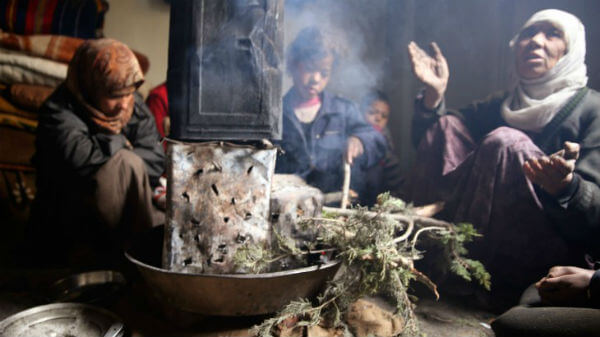
Gordon Brown writes: mid the Syrian chaos of carnage, starvation and evacuation, there is a tiny glimmer of hope. The Lebanese government has declared that it has taken 207,000 Syrian refugee children off the streets and given them places in their country’s public schools.
And today I am setting out a plan to extend the opportunity of education to 1 million refugee boys and girls across Lebanon, Jordan and Turkey during the course of 2016 – with the ambition that by next year every refugee child will be offered a place at school.
Through a combination of generous European Union funding by development commissioner Johannes Hahn and contributions from both public and private sectors in the region itself, $250m has been raised – the first instalment of the $750m we need to deliver this bold initiative. And in the run-up to the UN pledging conference in London on 4 February we are asking donors from public and private sectors to do more.
What has unlocked the chance of hundreds of thousands of extra school places is the introduction of a “double-shift school system”. Local Lebanese children are educated in the morning in their neighbourhood schools but the same classrooms are now being thrown open to refugee children in the afternoon and early evenings.
Because the double-shift system uses existing schools and so avoids the huge capital costs of building, the average cost is just $10 per school place per week. Already 200 Lebanese schools are offering double-shift education and there are now robust plans to offer 400,000 places by doubling the number of schools.
And as a direct result of Lebanon’s success, Turkey and Jordan are now ready to make double-shift schools the centrepiece of this year’s educational efforts for refugees. Working with Unicef, Turkey has set out its goals to double its school places for refugees to more than 450,000 this year. In Jordan, where just over 100,000 refugees are already in school, the aim is to double places. [Continue reading…]
Category Archives: Lands
Convoys enter besieged Syrian towns to deliver food and medical aid
The New York Times reports: The first trucks from a convoy carrying food and medical aid entered the besieged Syrian town of Madaya on Monday, only to discover harrowing scenes of desperation, including 400 people who needed immediate medical evacuation, United Nations officials said Monday night.
The 400 were in the town hospital and included patients who were severely malnourished and were facing other medical complications, the United Nations emergency relief coordinator, Stephen O’Brien, said after briefing members of the Security Council behind closed doors. “They are in grave peril of losing their lives,” he said.
The delivery of food packages, which included rice, lentils and oil, came amid a growing international outcry over the increasing number of deaths from malnutrition in Madaya, which along with neighboring Zabadani, is besieged by pro-government forces, including the Lebanese militia group Hezbollah.
The aid shipment there was being coordinated with a similar delivery to the northern Syrian towns of Fouaa and Kfarya in Idlib Province, which are surrounded by Syrian insurgent groups.
After a last-minute flurry of negotiations as the convoys idled at the entrances to the towns, trucks and sport utility vehicles began rolling in, Pawel Krzysiek, a spokesman for the Syria branch of the International Committee of the Red Cross, said by text message from Madaya. Unloading was expected to last through the night, he said on Twitter. [Continue reading…]
A lesson of Madaya: it was strong public advocacy, not quiet diplomacy, that got convoy in. https://t.co/PGBiFQLpLq pic.twitter.com/iUJpYcMVdH
— Kenneth Roth (@KenRoth) January 12, 2016
Russia is arming Hezbollah, say two of the group’s field commanders
The Daily Beast reports: Lebanese Hezbollah field commanders with troops fighting in Syria tell The Daily Beast they are receiving heavy weapons directly from Russia with no strings attached. The commanders say there is a relationship of complete coordination between the Assad regime in Damascus, Iran, Hezbollah, and Russia. At the same time they say the direct interdependence between Russia and Hezbollah is increasing.
The United States and the European Union have both listed Hezbollah as a terrorist organization with global reach and accuse it of serving Tehran’s interests. But there is more to it than that. Organized, trained, funded, and armed by Iran with Syrian help after the Israeli invasion of Lebanon in 1982, it initially gained fame for suicide bombings hitting Israeli, French, and American targets there, including the U.S. Marine barracks in Beirut where 241 American servicemen were killed in 1983.
Over the years Hezbollah grew to be a parallel army in Lebanon, stronger than the national military, and for years it was regarded in much of the Arab world as the avant-garde of the fight against Israeli occupation of Lebanese territory. It also developed into the most powerful political party in the fractured Lebanese parliamentary system. But its reputation as a nationalist force has been tarnished since it began fighting in Syria to defend the Assad regime, and as The Daily Beast reported in December, some of its soldiers have refused to go back.
The Daily Beast met the commanders on separate occasions at the end of December and the beginning of this year in Dahiya, a majority Shia working-class southern suburb of Beirut. They declined to use their real names because they are not authorized to speak to the media, but both say Hezbollah is directly receiving long-range tactical missiles, laser guided rockets, and anti-tank weapons from Russia. [Continue reading…]
ISIS suicide bomber targets foreign tourists in Istanbul
Hurriyet Daily News reports: An Islamic State of Iraq and the Levant (ISIL) militant killed at least 10 foreign nationals, most of them Germans, and wounded 15 other people after blowing himself up at a tourist spot in Istanbul’s old city on Jan. 12.
Nabil Fadli, a 28-year-old ISIL militant of Syrian origin who was born in Saudi Arabia in 1988, blew himself up after blending into a tourist group of 33 German citizens on a visit to the Obelisk of Theodosius in Sultanahmet Square near the Blue Mosque in the morning hours of Jan. 12 when the popular square was relatively less crowded compared to the rest of the day.
Tourist sites including the Hagia Sophia and the nearby Basilica Cistern were closed by the Istanbul Governor’s Office following the attack.
Turkish Prime Minister Ahmet Davutoğlu said all victims killed in the Sultanahmet suicide attack were foreigners while the suicide bomber was an ISIL militant. [Continue reading…]
ISIS has been driven out of Ramadi, but does Iraq have a future?
Emma Sky talked to Jaber al-Jaberi, a former member of the Iraqi parliament for Anbar province, about how ISIS gained control of his native city, Ramadi. She writes: I peppered Jaber with questions: How had everything gone so badly wrong in Ramadi? How had Daesh been able to take over? Who were these people?
Looming large is the question of how to break the corrosive cycle of revenge and retribution.
Jaber described a subculture in Ramadi of uneducated men in their twenties and thirties. Some were thieves and petty criminals. Others had developed fundamentalist thinking. And when al-Qaeda in Iraq came into existence after the fall of the former regime, it was within that organization that they found a sense of power and identity.However, when the Sahwa, the Anbar Awakening, turned against al-Qaeda, and aligned with US forces during the Surge in 2007, many of these same young men were drawn away from the insurgency and swapped sides, turning themselves into local police. And that was why the violence in Anbar had dramatically declined from 2007 onwards and stability had returned to the province.
The agreement that my former boss, Gen. Raymond Odierno, the then-commander of U.S. forces in Iraq had negotiated with former Prime Minister Nuri al-Maliki was that 20 percent of the Sahwa would be integrated into the security forces and 80 percent into civilian jobs. But the deal was never implemented.
Rather, as U.S. forces withdrew, Maliki reneged on his promises to the Sahwa and arrested its leaders. He accused Sunni politicians of terrorism, driving them out of the political process. In response, Sunnis set up protest camps. But Maliki refused to meet their demands and sent in security forces to violently crush the demonstrations.
With the citizens of Ramadi so at odds with the central government once again, it had been easy for Daesh to rise up out of the ashes of al-Qaeda in Iraq and proclaim itself as the defender of the Sunnis. Daesh had taken over Anbar university and converted it into a prison.
Jaber explained that the tribes in Anbar had lost trust in the government and refused to fight Daesh. They remembered only too clearly how the Sahwa had been betrayed. “We could not convince them that the experience would be different from before.”
Finally, 9,000 tribesmen were persuaded to join the tribal al-Hashd, the popular mobilization force, and received training from U.S. troops in bases at Taqqadum and al-Asad. And it was these tribesman who had supported the counter-terrorism forces in their efforts to liberate Ramadi from Daesh at the end of 2015.
Governor al-Rawi has been nominated as the head of the Crisis Committee, which includes representatives of ministries, and is tasked with cleaning up the city, removing explosives, and restoring basic services to make Ramadi inhabitable once more so that its displaced citizens will return.
But difficult times remain ahead. There are huge challenges to rebuilding Ramadi, particularly with scarce resources available from the government due to the steep drop in oil prices to under $35 a barrel.
And looming large is the question of how to break the corrosive cycle of revenge and retribution that has led to so many deaths and displacement.
Jaber was recently appointed to the new Higher Committee for National Reconciliation established under the auspices of Iraq’s prime minister, the president, and the speaker of parliament, and with the mandate to promote “historic national reconciliation.”
Reconciliation has been talked about continually in Iraq over the last decade—but little has been done to address the structural challenges facing the country, to agree on a workable system of government and to reinvent an inclusive national identity to which Iraqi’s diverse peoples can relate.
Many observers believe that Iraq is finished: the Kurds are moving increasingly towards independence; Shia militias dominate the Iraqi government; Iranian influence is pervasive; and Sunni leadership is weak and fragmented. [Continue reading…]
Afghan forces struggle as ranks thinned by ‘ghost’ soldiers
The Associated Press reports: Afghan forces are struggling to man the front lines against a resurgent Taliban, in part because of untold numbers of “ghost” troops who are paid salaries but only exist on paper.
The nationwide problem has been particularly severe in the southern Helmand province, where the Taliban have seized vast tracts of territory in the 12 months since the U.S. and NATO formally ended their combat mission and switched to training and support.
“At checkpoints where 20 soldiers should be present, there are only eight or 10,” said Karim Atal, head of Helmand’s provincial council. “It’s because some people are getting paid a salary but not doing the job because they are related to someone important, like a local warlord.”
In some cases, the “ghost” designation is more literal — dead soldiers and police remain on the books, with senior police or army officials pocketing their salaries without replacing them, Atal said. [Continue reading…]
Iran ‘fills Arak nuclear reactor core with concrete’
BBC News reports: Iran has removed the core of its Arak heavy-water nuclear reactor and filled it with cement, according to the country’s Fars news agency.
The fate of the reactor was one of the toughest sticking points in Iran’s long nuclear negotiations last year.
Under the terms of the deal, Iran agreed the heavy-water reactor would be reconfigured so it was not capable of yielding material for a nuclear weapon.
The removal of the core is one of the final steps required by the deal. [Continue reading…]
Syrians in Madaya who once dreamed of freedom now dream of food

The New York Times reports: In the hills near the Lebanese border, an hour’s drive from downtown Damascus, much of a Syrian town is starving, according to residents and international humanitarian workers.
The town, Madaya, is controlled by rebels and encircled by pro-government forces with barbed wire, land mines and snipers. People there make soups of grass, spices and olive leaves. They eat donkeys and cats. They arrive, collapsing, at a clinic that offers little but rehydration salts. Neighbors fail to recognize neighbors in the streets because their faces are so sunken.
Syria, once classified as a middle-income country, now reports periodic malnutrition deaths. At least 28 people, including six babies, have died from hunger-related causes at a clinic in Madaya aided by Doctors Without Borders, medics there say. And the 42,000 people that the United Nations counts as trapped in Madaya are about a tenth of those stranded in besieged or hard-to-reach areas as conditions grow steadily worse.
Their plight represents a stark failure of international powers that has worsened even as they intensify military and diplomatic activities, all in the name of resolving the conflict.
This is happening as the United Nations plans a new round of peace talks for Jan. 25. It is happening amid escalating military interventions by Russia and the United States. And in some ways, according to diplomats and humanitarian workers, it is happening not just despite those efforts, but also because of them, as the warring parties flout international law while being courted for negotiations.
Yet in Madaya and neighboring Zabadani, once popular mountain resorts, thoughts of political change have receded in the face of hunger. Hamoudi, 27, a business-school graduate who took up arms after the government’s crackdown on protests in 2011, said many people would surrender in order to eat, even though they expected arrests and retribution to follow.
“In the revolution I was dreaming of democracy, freedom,” Hamoudi said slowly in an interview via Skype, exhaustion evident in his voice. “Today all my dreams are food. I want to eat. I don’t want to die from starvation.” [Continue reading…]
Nearly 400,000 Syrians starving in besieged areas
Al Jazeera reports: As aid agencies prepare to deliver food to Madaya, on the outskirts of Damascus and two other besieged towns in Idlib province, an estimated 400,000 people are living under siege in 15 areas across Syria, according to the UN.
A deal struck in recent days permits the delivery of food to Madaya, currently surrounded by forces loyal to Syrian President Bashar al-Assad, and the villages of Foua and Kefraya in Idlib, both of which are hemmed in by rebel fighters.
Due to a siege imposed by the Syrian government and the Lebanese Hezbollah group, an estimated 42,000 people in Madaya have little to no access to food, resulting in the deaths of at least 23 people by starvation so far, according to the charity Doctors Without Borders (MSF). [Continue reading…]
Syrians wonder why Russia is bombing their marketplaces
Michael Weiss reports: “When I’m sitting here and we hear a plane, which is a lot now, I know from the sound. If the plane is above us—you can tell if it’s above you, because that’s when it’s the loudest—and if it’s a Russian plane, then it doesn’t attack where we are. It attacks two or three kilometers away.”
Rami Jarrah is telling me how he distinguishes which government is now bombing civilians in Syria’s Aleppo City. It’s a question that used to answer itself—but no more, given the presence of Syrian, Russian, and coalition aircraft in the skies. Syrian jets, he says, once flew so low that you could actually see the pilots in the cockpits; Russian fixed-wing aircraft fly at much higher altitudes such that they look like crosses or plus-signs in the clouds. They fire from far away, the better to evade the bullets of the Dushka (the name means “sweetie” in Russian), a Soviet-era antiaircraft machine gun, which is typically all anti-Assad rebels have to deter helicopters and attack jets, sometimes successfully.
Jarrah lives in the war-ravaged provincial capital of Syria’s industrial province, documenting the gruesomeness of multisided civil war for his open source newsgathering service ANA Press. Born in Cyprus and educated in London, he first became famous in 2011 as an English-speaking eyewitness on Western TV channels to what was then still a peaceful protest movement against a Ba’athist dictatorship. He used to call himself Alexander Page, a pseudonym he doesn’t need anymore because what good is a pseudonym against one of Putin’s jets? [Continue reading…]
Turkey wages lengthy battle for Kurdish stronghold
The Wall Street Journal reports: To most Turks living outside Diyarbakir’s ancient citadel walls, the military operation inside the city [the de facto Kurdish capital in southeastern Turkey] is something they see only in television images of flag-draped solders’ coffins and civilians fleeing urban battle zones.
But the outcome of the broader military operation is likely to have a major impact on the rekindled aspirations of millions of ethnic Kurds in Turkey, whose ancestors’ hopes of building a Kurdish nation were thwarted by world powers after World War I.
Kurdish leaders say they want to make sure they don’t let this new opportunity slip away. “The fate of the Middle East is being rewritten,” said Selahattin Demirtas, the top Kurdish lawmaker whom Mr. Erdogan wants to see stripped of parliamentary immunity. “As Kurds, we don’t want the mistakes made 100 years ago to be made again.”
Mr. Demirtas leads a political group drawing inspiration from the successes of American-backed Kurdish militants in neighboring Syria, where they are governing an autonomous region carved out of parts of the country they’ve seized from Islamic State rivals.
“The Kurds are a growing power in the Middle East,” Mr. Demirtas said in an interview last week with The Wall Street Journal.
Emboldened by the gains in Syria and prodded by Mr. Erdogan’s efforts to marginalize his pro-Kurdish Peoples’ Democratic Party, Mr. Demirtas is stepping up his calls for self-rule, a politically charged stance in Turkey that skeptics see as a precursor to Kurdish demands for outright independence.
That is becoming an increasing concern for Mr. Erdogan, who has championed the expanding military and political crackdown on Kurdish activists and insurgents across the country.
One of the most important battlegrounds is in Diyarbakir, where more than 2,000 Turkish security forces have spent weeks battling small numbers of Kurdish militants who have laid deadly booby traps throughout a neighborhood that is home to some of the oldest mosques in Islamic history.
Since Dec. 2, large parts of Diyarbakir’s Sur District have been under 24-hour curfew. Many of the 24,000 people living in the now-closed military zone have fled, said Huseyin Aksoy, the Ankara-appointed governor of Diyarbakir. About 4,000 residents are believed to be trapped in their homes while Turkish forces try to uproot what the governor estimates to be no more than 100 Kurdish militants.
Since mid-December, when Turkey sent 10,000 members of its security forces into a “decisive” military operation targeting thousands of Kurdish militants who have declared self-rule in parts of cities and towns across southeastern Turkey, more than 440 Kurdish fighters have been killed, according to the military. [Continue reading…]
If Iraqi dam fails, 500,000 people could be killed
The New York Times reports: More than 16 months after Iraqi and Kurdish forces reclaimed Mosul Dam from Islamic State fighters, the structure faces a new threat: the danger that it may collapse because of insufficient maintenance, overwhelming major communities downstream with floodwaters.
In the worst-case scenario, according to State Department officials, an estimated 500,000 people could be killed while more than a million could be rendered homeless if the dam, Iraq’s largest, were to collapse in the spring, when the Tigris is swollen by rain and melting snow. The casualty toll and damage would be much less if Iraqi citizens received adequate warning, if the dam collapsed only partially or if it were breached in the summer or fall, when the water level is lower.
Mosul Dam, which was completed in 1984 by a German and Italian consortium and is 30 miles upstream from the city of Mosul, has long been a maintenance nightmare. Before fighters from the Islamic State, also known as ISIL or ISIS, swept across northern Iraq in 2014, approximately 600 Iraqis worked at the dam.
Because the water was eating away at the gypsum base under the dam, Iraqi teams drilled holes in that foundation and filled them with a cement grout mixture. That work was carried out three times a day, six days a week.
The Islamic State controlled the dam for a little more than a week in August 2014, but its fighters did not damage the structure. After it was retaken later that month, however, many of the Iraqi workers never returned and the Iraqi government did not resume regular maintenance. The Iraqis also lost their usual source of grouting material, which was produced by a factory in Mosul, now under the control of the Islamic State. [Continue reading…]
On the issue of executions, Iran has as much moral authority as the U.S. has on gun control
Sharif Nashashibi writes: There are several grounds on which to oppose the Saudi execution of Shia cleric Nimr al-Nimr. One can do so due to a principled opposition to capital punishment in general. One can criticise the country’s judicial system – Human Rights Watch said this week that it “has documented longstanding due process violations in Saudi Arabia’s criminal justice system that make it difficult for a defendant to get a fair trial even in capital cases.”
One can criticise Nimr’s trial in particular, which Amnesty International called “grossly unfair”. One can argue that he should not have been arrested in the first place – HRW cited “vague charges that do not resemble recognisable crimes”.
One can oppose his execution because of the repercussions it will have regionally and beyond. One can even do so out of concern for Saudi Arabia itself, not just in terms of domestic unrest among its Shia population, but also its foreign interests.
However, in any situation, condemnation is meaningless when based on hypocrisy. As such, Iran – which has arguably been most vocal about Nimr’s execution – does not have a leg to stand on. “It is perhaps surprising that a regime which imprisons journalists, censors cartoonists and holds activists without charge for years on end should be in any position to moralise against another,” wrote Evan Bartlett, news editor at The Independent newspaper.
It is galling – almost comical – for the world’s second-biggest executioner after China to criticise the third-biggest on the subject of executions. It carries the same moral authority as the US lecturing others about gun control, or Japan discouraging other countries from whale-hunting. [Continue reading…]
Murder in Istanbul: The latest in a series of audacious killings of enemies of the Russian state
The Guardian reports: Abdulvakhid Edelgireyev survived for years hiding in the Chechen mountains, launching attacks on Russian security forces and evading capture. He survived the battlefields of Syria, and those of east Ukraine. But in November his life came to an abrupt end in a flurry of bullets: he was shot dead in broad daylight in Istanbul as he embarked on a shopping trip with his three-year-old niece.
Edelgireyev and his niece walked out of their apartment block in Kayasehir, a far-flung suburb of nondescript new towers, shortly before 2pm on 1 November. The 32-year-old Chechen sat the girl in the passenger seat of his car, and was about to start the engine when a white car rammed into them from behind, closing him in. Pushing his niece on to the floor under the seat, Edelgireyev scrambled out and started running. One of the assassins gave chase, firing at him, and he crumpled to the ground. When paramedics arrived a few minutes later he was already dead, in a pool of blood. He had been shot five times.
The dead man’s biography, as set out by family and associates, paints a picture of a key figure in the Caucasus Emirate, the umbrella group of Chechen and other fighters in Russia’s North Caucasus that has resorted to terrorist methods, including suicide attacks on Moscow’s metro and Domodedovo airport. Edelgireyev’s experiences during his year in Syria also revealed how the Chechen resistance fight has slowly grown links to Islamic State , and the infighting and turmoil among the foreign fighters in Syria. [Continue reading…]
Britain smites ISIS with Brimstone
The Guardian reports: The Royal Air Force has used Brimstone missiles against Isis in Syria for the first time, Downing Street has confirmed.
Four Brimstone missiles were deployed on two missions on Sunday. One missile was used against enemy positions near Raqqa, including targeting an Isis vehicle. Three Brimstone missiles were also used in an attack on the Omar oilfield on the same day. There were also three other RAF missions in Syria on Sunday that did not use Brimstone missiles, including striking enemy tunnels near Raqqa.
The prime minister’s spokeswoman declined to say whether the strikes had resulted in casualties, saying: “These will all have been focused on either targeting Daesh [Isis]’s resources or targeting Daesh terrorists who are seeking to destabilise Iraq, Syria and threatening other countries.” [Continue reading…]
Could anything, moreover, be stupider than fighting a theocracy with a missile named after the biblical punishment for infidels? (Rev 21:8)
— Alex Rowell (@disgraceofgod) January 11, 2016
How Rolling Stone handled Sean Penn’s exclusive interview with El Chapo
The New York Times reports: Several months ago, Jann Wenner, a founder of Rolling Stone magazine, received a call from the actor Sean Penn.
Mr. Penn, Mr. Wenner said in an interview on Sunday, wanted to discuss something important. But he did not want to speak openly over the phone, so the two began to speak elliptically about a potential project.
That vague conversation was the beginning of what eventually became an article, written by Mr. Penn, that rocked both Mexico and the United States when it was published Saturday night. It was an exclusive interview with Joaquín Guzmán Loera, the notorious drug kingpin known as El Chapo, that was conducted while Mr. Guzmán was on the run from the authorities after an audacious escape from a Mexican prison last year.
The 10,000-word article includes accusations of cooperation between the military and Mr. Guzmán’s Sinaloa cartel, as well as Mr. Guzmán’s acknowledgment of his status as a drug dealer and his thoughts about the ethical implications of his business. Mr. Guzmán, whose escape from prison — his second — made him one of the most wanted fugitives in the world, was caught on Friday, before the article was published.
But after its publication, questions have been raised about the ethics for the magazine in dealing with Mr. Guzmán, a criminal being sought on charges of drug trafficking and murder, and in allowing him to approve what would ultimately be published about him. The Republican presidential candidate Marco Rubio, speaking Sunday on “This Week,” on ABC News, acknowledged Mr. Penn’s “constitutional right” to meet with Mr. Guzmán, but called the interview “grotesque.”
Steve Coll, the dean of the Columbia University Graduate School of Journalism, said he was concerned by the editorial approval offered to Mr. Guzmán. But ultimately, he said, “scoring an exclusive interview with a wanted criminal is legitimate journalism no matter who the reporter is.” [Continue reading…]
The Islamization of radicalism

Olivier Roy writes: France is at war! Perhaps. But against whom or what?
Last November, when the Islamic State staged the shootings that killed 130 in Paris, it did not send Syrians. A year ago, when al Qaeda in the Arabian Peninsula purportedly ordered the deadly attack on the office of Charlie Hebdo, it did not send gunmen from Yemen. Rather, both groups drew from a reservoir of radicalized French youth who, no matter what happens in the Middle East, are already disaffected and are seeking a cause, a label, a grand narrative to which they can add the bloody signature of their personal revolt.
The rallying cry of these youth is opportunistic: Today it is the Islamic State; yesterday, they were with al Qaeda; before that, in 1995, they were subcontractors for the Algerian Armed Islamic Group, or they practiced the nomadism of personal jihad, from Bosnia to Afghanistan, by way of Chechnya. Tomorrow they will fight under another banner, so long as combat death, age, or disillusion do not empty their ranks.
There is no third, fourth, or nth generation of jihadis. Since 1996, we have been confronted with a very stable phenomenon: the radicalization of two categories of French youth — second-generation Muslims and native converts. The essential problem for France, therefore, is not the caliphate in the Syrian desert, which will disappear sooner or later, like an old mirage that has become a nightmare. The problem is the revolt of these youth. And the real challenge is to understand what these youth represent: whether they are the vanguard of an approaching war or, on the contrary, are just a rumbling of history.
* * *
Two readings of the situation dominate at the moment and are shaping the debates on television and in the opinion pages of newspapers: These are, basically, the cultural explanation and the Third World explanation.
The first puts forth that recurring and nagging “war of civilizations” theory: The revolt of young Muslims demonstrates the extent to which Islam cannot be integrated into the West, at least not so long as theological reform has not struck the call of jihad from the Quran. The second interpretation evokes post-colonial suffering, the identification of these youth with the Palestinian cause, their rejection of Western intervention in the Middle East, and their exclusion from a French society that is racist and Islamophobic. In short, the old song: So long as we haven’t resolved the Israel-Palestine conflict, there will be a revolt.
But the two explanations run up against the same problem: If the causes of radicalization are structural, then why do they affect only a tiny fraction of those in France who call themselves Muslims? Only a few thousand, among several million.
But these young radicals have been identified! All the terrorists who have actually taken action were, notoriously, in the “S File” — that is, on the government’s watch list. I don’t wish to get into a discussion here of prevention — I simply note that the information about them is there, and it is accessible. So let us look at who they are and try to draw some conclusions.
Nearly all the French jihadis belong to two very precise categories: They are either “second-generation” French — that is, born or raised from a very young age in France — or they are “native” French converts (whose numbers have increased with time, but who already constituted 25 percent of radicals at the end of the 1990s). This means that, among the radicals, there are practically no “first-generation” jihadis (including recent arrivals), but especially no “third-generation” jihadis.
The third-generation category in France is growing: The Moroccan immigrants of the 1970s are now grandparents. But one does not find their grandchildren among the terrorists. And why do converts, who never suffered from racism, wish to brutally avenge the humiliation experienced by Muslims? Especially since many of these converts — like Maxime Hauchard, the Normandy-born man who appeared in the Islamic State’s beheading videos — come from rural France and have little reason to identify with a Muslim community that for them exists only in theory. In short, this is not a “revolt of Islam” or one of Muslims, but a specific problem concerning two categories of youth, the majority of whom are of immigrant origin. This is not, then, the radicalization of Islam, but the Islamization of radicalism.
What is the common ground between the second generation and the converts? It is, first of all, a question of a generational revolt: Both have ruptured with their parents or, more precisely, with what their parents represent in terms of culture and religion. [Continue reading…]

Sexism is not an imported product

Silke Stöckle and Marion Wegscheider, whose original article in German appeared in marx21, write: The NYE festivities in Cologne, Hamburg and other cities witnessed a high number of sexual attacks on women, and in at least one case, a rape. It is disturbing that this could happen, and outrageous that the authorities in the first instance failed to take victims’ reports seriously.
Sexual violence against women in Germany is in general a large and indeed a long-existing problem: women are commonly and frequently sexually harassed at large festivals, at the Oktoberfest in Munich or during the Carnival in Cologne and other cities. According to a new study commissioned by the Federal Ministry of Family Affairs, one in seven women in Germany experiences sexual violence. One in four women – irrespective of education level or socio-economic status – is exposed to domestic violence. The perpetrators are almost always men, among whom no significant distinction according to religion, background, educational level or social status exists.
In other words, every day there are more than enough reasons for a society-wide outcry over sexism and sexualised violence in Germany. Both phenomena are closely connected to the dominant image of women. Accordingly, sexual assaults on women are all too often not taken seriously, and are at first marginalised – as in Cologne, where victims have had the pleasure of being schooled by local politicians about “rules of behaviour for mass gatherings”, as though the victims, in the face of their determined assaulters, had the possibility to negotiate their way out of harm.
Women are continually portrayed as sexual objects in films, advertising and mass media. But more than this, women’s oppression is structurally anchored in our society, evidenced by differences in pay, employment opportunities or dominant role models. There is no equality here, despite frequent public proclamations to the contrary.
Rather than connecting the events in Cologne and Hamburg to the everyday sexist violence faced by women in Germany, politicians and the media establishment have, from the moment the events occurred, focused above all on the background of the alleged perpetrators, and on questions of public security. Where sexual molestation is acknowledged as a structural manifestation at all, it is only ever in relation to the “culture” in the supposed countries of origin of the perpetrators. In this way, the debate about the attacks has been instrumentalised from the get-go and, in line with a classic racist line of argument, Muslims or refugees have been stereotyped en masse. [Continue reading…]
Deutsche Welle reports: A few kilometers away [from the main station in Cologne], in the “Multi Kulti” center in the neighborhood of Mülheim, several women have gathered in an attempt to work out what measures should be taken to make the streets of Cologne safe again.
“No one is talking about the fact that this is happening to women every day,” Tanja, an activist and one of the initiators of the event told DW.
“People are insisting on making this a political story, trying to shift the focus on pro- or anti-refugees. But in fact, no one is listening to what we have to say – the women who have been suffering from this violence in the streets on a daily basis long before refugees even came here,” she says.
The violence on New Year’s Eve was not different from that during any other big-scale celebration in the city, according to Tanja. “Because refugees are now a burning topic, the media all of a sudden report about these events, but what nobody wants to admit is that these things happen all the time. I’m sorry to break this to you, but German-born men also harass and rape.” [Continue reading…]