#Saudi FM on left sitting very far from #Iran FM. Vienna table on #Syria with No Syrians. pic.twitter.com/GoNjwuJYtF
— Joyce Karam (@Joyce_Karam) October 30, 2015




#Saudi FM on left sitting very far from #Iran FM. Vienna table on #Syria with No Syrians. pic.twitter.com/GoNjwuJYtF
— Joyce Karam (@Joyce_Karam) October 30, 2015
The Wall Street Journal reports: On Thursday, Thomas Shannon, President Barack Obama’s nominee to be undersecretary of state, said Mr. Kerry is seeking to ascertain whether Russia and Iran are prepared “to convince Mr. Assad that during a political transition process, he will have to go.”
During his confirmation hearing, Mr. Shannon said Mr. Kerry “thought it was time to bring everybody together and effectively call their bluff.”
The U.S. diplomacy is placing the Arab states and Turkey in a bind, as many of them have provided significant arms and funding to the largely Sunni rebel forces seeking to overthrow Mr. Assad.
Saudi Arabia, in particular, has publicly criticized Russia’s military intervention in Syria, arguing it could strengthen Mr. Assad and Shiite-dominated Iran, his closest Middle East ally.
Still, Saudi Arabia is finding it difficult to oppose the new round of diplomacy because of Russian President Vladimir Putin’s heavy military investment in Syria. Saudi officials have been holding their own direct talks with the Kremlin and have also pressed for a clear time line for when Mr. Assad would be forced to stand down, senior Arab officials said.
Mr. Obama’s position in the early days of Syria’s civil war was that Mr. Assad had to step down immediately as part of any resolution to the conflict, but that position shifted as the regime held together and the spread of Islamic State has become a higher priority.
The administration’s primary aim now is to get warring parties to abide by a cease-fire, so the U.S. can more effectively zero in on Islamic State and give new momentum to the stalled fight.
As a result, the administration’s view is Mr. Assad’s future can be dealt with later.
Current and former U.S. officials say the White House’s acceptance of Russian and Iranian demands on keeping Mr. Assad in power at least temporarily will make it hard — if not impossible — for the administration to get the different rebel factions fighting the regime to sign on to a cease-fire. [Continue reading…]
Reuters reports: U.S. officials disclosed plans on Friday to station the first American boots on the ground in Syria in the war against Islamic State fighters, saying dozens of special forces troops would be sent as advisers to groups fighting against the jihadists.
The announcement of the small ground force came as diplomats from more than a dozen countries held talks over Syria, which for the first time in the more than four-year-old civil war were attended by President Bashar al-Assad’s ally Iran.
In a rare hint of diplomatic progress, Tehran signaled it would back a six-month political “transition” period in Syria followed by elections to decide Assad’s fate, although his foes rejected the proposal as a trick to keep the president in power.
The Vienna talks ended without a specific conclusion apart from an agreement to reconvene in some form next week, delegates said. In addition to Assad’s fate, key sticking points have long included the question of which rebel groups should be considered terrorists and who should be involved in the political process. [Continue reading…]
Sam Charles Hamad writes: Earlier this month in the Afghan city of Kunduz, the U.S. committed an apparent war crime. At some point in the early hours of Oct. 3, a U.S. gunship fired on a hospital run by Medicins Sans Frontieres, destroying the facility, killing 22 people and injuring over 30. There is no doubt of the criminality of this act — even if, as the U.S. and Afghani governments have suggested, the attack occurred due to Taliban militants having some presence within the hospital compound (a claim vigorously denied by eyewitnesses and victims), it was still a crime.
In the hours following the attack, many people of all political persuasions from around the world rightfully condemned it, but perhaps most vocal were those on the political left. Public outrage over war crimes is of course not just to be welcomed passively, but it can be actively useful in terms of demanding accountability from those who committed the crimes, while giving a voice to its victims. All too often, when it comes to activity against these acts of criminality, it is organizations, political parties, and individuals who identify with the left that lead the charge on these matters — the consequences of this can be impressive.
And the left are no longer marginal. The so-called “alternative media” is catching up with the mainstream media in terms of its reach, while political forces that identify as left-wing are now once again in the mainstream of politics, whether it’s forces like SYRIZA in Greece or Jeremy Corbyn’s new role as the leader of Her Majesty’s Opposition in the U.K. What these people do and say now matters on a global scale. Millions of politically-aware people from around the world hang on every word that prominent leftists write and say, whether it’s a figure such as Glenn Greenwald, whose news site The Intercept has become the go-to place for so-called “anti-imperialists,” or a leading politician such as Corbyn.
For a self-identified leftist like me, you might think I’d be over the moon at the way things were steadily — or exponentially, if you consider the rise of the left in this era relative to its fate in the past two decades — developing for the global left, but you’d be wrong. For there’s a bitter catch to all this. [Continue reading…]
The Guardian reports: The actor Benedict Cumberbatch has shown his growing frustration over the migration crisis during a speech after his Hamlet performance – reportedly saying “fuck the politicians”.
The Sherlock star has been giving nightly speeches after his curtain call at the Barbican in London and asking for donations to help Syrian refugees. So far, audience contributions have raised more than £150,000 for Save the Children.
Cumberbatch has been particularly critical of the British government’s decision to accept only 20,000 refugees over five years.
During the speeches, Cumberbatch has been reading a poem called Home by Somali poet Warsan Shire, the same one he read in the introduction to Help is Coming, Save the Children’s charity single, released in the summer. It includes the line: “No one puts children in a boat unless the water is safer than the land.” [Continue reading…]
Matthew M. Reed writes: The early estimate for ISIS oil revenues was $2-3 million a day. Media coverage ran with that number and so did U.S. officials for a time. However, the price/volume assumptions built into it were never clear. “It’s not an estimate that the U.S. intelligence community or the Pentagon is endorsing or has come up with,” a Pentagon spokesman said in September 2014.
The first official U.S. government estimate for ISIS oil revenue came in October last year. Then-Treasury Undersecretary David Cohen estimated that ISIS probably earned $1 million a day in June—before the anti-ISIS coalition intervened. That estimate held up until February 2015 when Cohen said ISIS revenues had fallen to just $2 million a week (or ~$300,000 a day). At that point, U.S. officials became convinced oil was not the top money maker for ISIS; instead the group relied more on taxation, tolls, ransom and theft. Official estimates came with big caveats but the U.S. government apparently believed it had cut down ISIS oil revenues by two-thirds.
That estimate lasted until July, when Treasury’s Assistant Secretary for Terrorist Financing Daniel Glaser concluded that oil ranked third among ISIS revenue streams, but it was still significant. “Earlier this year ISIL made about $40 million in one month, off of the sale of oil. So if you want to extrapolate that out, you get to about $500 million in the course of a year,” he said. $500 million a year works out to almost $1.4 million a day, which is almost a five-fold increase from the lowball claim made in February. (FT estimates revenue at $1.5 million a day as well.) [Continue reading…]
See also Part Two of this report.
The Associated Press reports: The Russian province of Dagestan, a flashpoint for Islamic violence in the North Caucasus, is feeding hundreds of fighters to the Islamic State in Syria — and now some are coming back home with experience gained from the battlefield.
The departures mean that the region itself has become markedly less violent recently with fewer bombings and shootings. And the returning fighters have either landed in jail or been kept under close police surveillance. But there are long-term concerns that the presence of radical Muslims trained in IS warfare could lead to greater instability and violence.
“We can’t allow them to use the experience they have just gained in Syria back home,” Russian President Vladimir Putin said recently.
Eduard Urazayev, a former minister in Dagestan’s provincial government, and now a political analyst, said that poverty and unemployment in the region made the IS recruiters’ job easier. “If the high level of corruption and unfavorable socio-economic situation remain,” Urazayev said, “it may further fuel protest sentiments and increase sympathy for the IS.” [Continue reading…]
The Independent reports: Eight of the 12 surviving sons of Saudi Arabia’s founding monarch are supporting a move to oust King Salman, 79, the country’s ailing ruler, and replace him with his 73-year-old brother, according to a dissident prince.
The prince also claims that a clear majority of the country’s powerful Islamic clerics, known as the Ulama, would back a palace coup to oust the current King and install Prince Ahmed bin Abdulaziz, a former Interior Minister, in his place. “The Ulama and religious people prefer Prince Ahmed – not all of them, but 75 per cent,” said the prince, himself a grandson of King Ibn Saud, who founded the ruling dynasty in 1932.
Support from the clerics would be vital for any change of monarch, since in the Saudi system only they have the power to confer religious and therefore political legitimacy on the leadership.
The revelation suggests there is increasing pressure within the normally secretive Saudi royal family to bring to a head the internal power struggle that has erupted since King Salman inherited the throne at the beginning of this year. The prince, who cannot be named for security reasons, is the author of two recently published letters calling for the royal family to replace the current Saudi leadership.
In 1964 King Saud was finally deposed after a long power struggle, when the majority of senior royal family members and the Kingdom’s religious establishment spoke with one voice and withdrew their support. The prince says something similar is going to happen again soon. [Continue reading…]
The New York Times reports: While the lawyers believed that Mr. Obama was bound to obey domestic law, they also believed he could decide to violate international law when authorizing a “covert” action, officials said.
If the SEALs got Bin Laden, the Obama administration would lift the secrecy and trumpet the accomplishment. But if it turned out that the founder and head of Al Qaeda was not there, some officials thought the SEALs might be able to slip back out, allowing the United States to pretend the raid never happened.
Mr. Preston wrote a memo addressing when the administration had to alert congressional leaders under a statute governing covert actions. Given the circumstances, the lawyers decided that the administration would be legally justified in delaying notification until after the raid. But then they learned that the C.I.A. director, Leon E. Panetta, had already briefed several top lawmakers about Abbottabad without White House permission.
The lawyers also grappled with whether it was lawful for the SEAL team to go in intending to kill Bin Laden as its default option. They agreed that it would be legal, in a memo written by Ms. DeRosa, and Mr. Obama later explicitly ordered a kill mission, officials said. [Continue reading…]
Alex Rowell writes: The loose coalition of non-jihadist Syrian rebels often dubbed the Free Syrian Army (FSA) has not had an easy time of the past two years.
Between annihilating defeats at the hands of Al-Qaeda-linked rivals across key provinces in 2014 and longstanding fears of expanding Islamist influence and ideology even within comparatively moderate brigades, a perception has taken root among many observers — particularly in the West — that the FSA is neither a viable nor an especially desirable alternative to the Bashar al-Assad regime. In an August 2014 interview, US President Barack Obama dismissed the fighters as “former doctors, farmers, pharmacists and so forth,” whose chances of victory had “always been a fantasy.” An October 2014 poll found only 35% of Americans favored arming Syrian rebels to fight ISIS, with strong fears cited that the weapons would later be used against the US.
Yet, as the killing last week of a member of Jabhat al-Nusra, Al-Qaeda’s official Syrian subsidiary, by a non-jihadist brigade in Daraa underscored, the notion that the remaining FSA factions today are all happily subservient comrades of the Bin Ladenists is clearly simplistic. Indeed, the FSA’s Southern Front coalition, which controls important territory along Syria’s southern border, including crossings with Jordan (whence it receives military and financial aid from both Gulf and Western nations), officially repudiated Nusra in April 2015, saying “neither [Nusra] [n]or anything else with this ideology represents us […] We can’t go from the rule of Assad to [Al-Qaeda leader Ayman al-]Zawahiri and Nusra.”
Equally, a string of recent FSA accomplishments on the battlefield — most notably the well-publicized destruction of dozens of regime tanks by rebels wielding CIA-supplied anti-tank missiles, leading to territorial gains in Hama and Aleppo — suggests the doctors, farmers, and pharmacists are not as martially feckless as President Obama would have New York Times readers think.
In short, reports of the FSA’s death have been greatly exaggerated. Or, as Brookings Doha Center Visiting Fellow Charles Lister, who has recently completed a book on the Syrian insurgency, put it in a column last week, “Although it is often overlooked, Syria does have a powerful and socially entrenched moderate opposition on the ground.” [Continue reading…]
The following maps come from a recent Congressional Research Service report, “Armed Conflict in Syria: Overview and U.S. Response.”
Iraq and Syria: ISIS’s Areas of Influence, August 2014 to August 2015
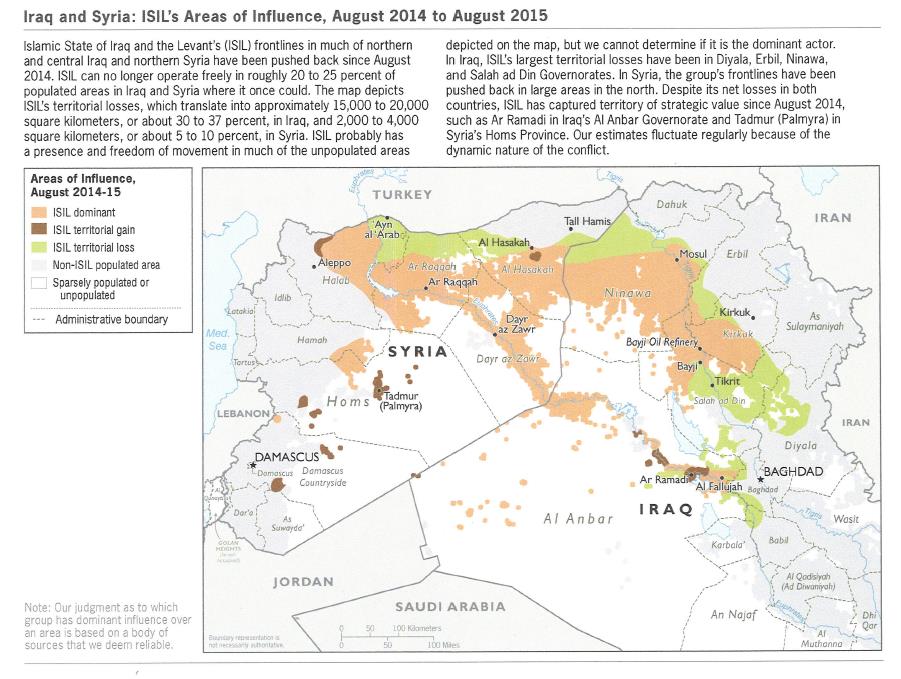
Source: Map and text produced by U.S. Department of Defense, September 2015.
Syria Conflict Map: Estimated Areas of Control as of October 1, 2015
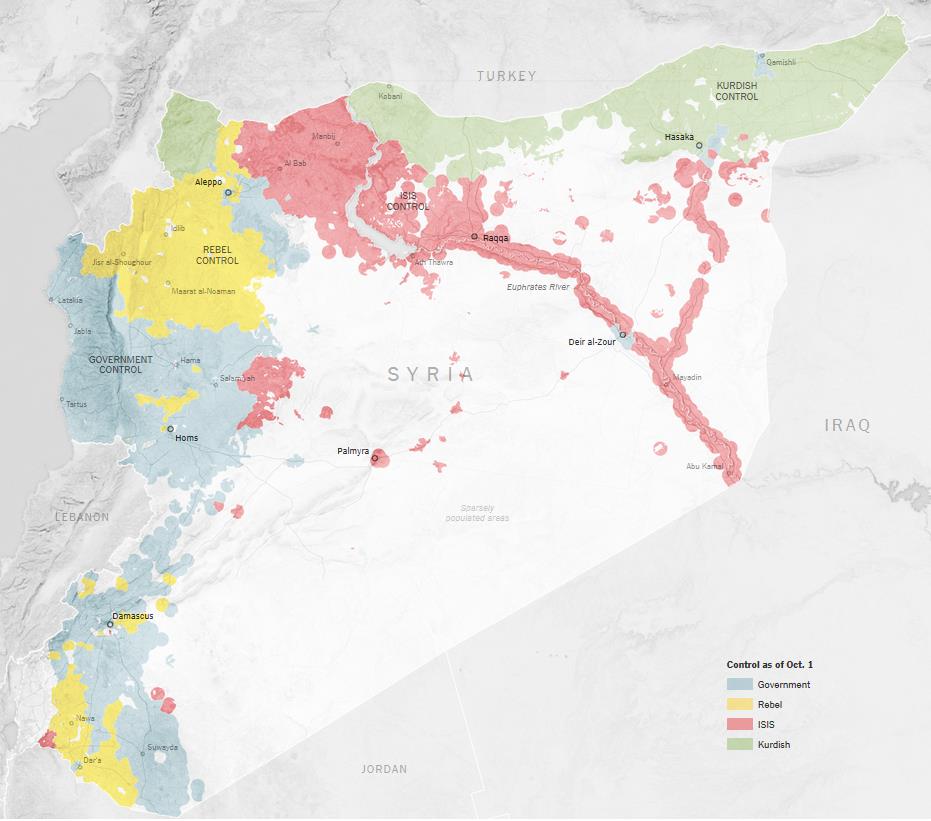
Source: Tim Wallace, New York Times. Area of control data source is Carter Center, October 1, 2015.
Notes: All areas approximate. Yellow area of “Rebel Control” includes areas under Jabhat al Nusra (Al Qaeda affiliate) control, and includes
areas controlled by a wide variety of anti-Asad forces. White color denotes sparsely populated or unpopulated areas.

The New York Times reports: Just a few weeks ago, Ayatollah Ali Khamenei said any new talks with the United States were forbidden. He described the United States as a persistent enemy of the Islamic revolution, and said that despite the nuclear agreement, it needed to be kept at a distance.
But participating in the multination Syria talks does not contradict Mr. Khamenei’s dictums, some Iranian analysts say.
“Our leader has banned the bilateral relations between Iran and America or any negotiation aimed at resuming relations,” said Hamidreza Taraghi, a political analyst in Tehran considered close to the ayatollah. “Case-by-case negotiations or finding solutions for regional problems on a multilateral basis is all right.”
So, while publicly siding with the hard-liners, the Supreme Leader may well be giving more negotiating room to President Hassan Rouhani, who has advocated more open engagements with the rest of the world. There has already been an unspoken cooperation between Iran and the United States in Iraq, where both are fighting the Islamic State.
“We should thank President Rouhani for his efforts in reaching out to the international community, and the nuclear deal,” said Farshad Ghorbanpour, a political analyst close to the government in Tehran. “Now we are seeing the rewards: We are playing an increasing active role in the international arena.”
That role is something that Iran has desperately sought: Diplomatic weight and respect that bolsters its claim that it, not Saudi Arabia, is the most influential power in the region. “It’s very important because it shows that, following the nuclear agreement, Iran is now ready to cooperate on crisis management in the Middle East,” Seyed Hossein Mousavian, a former Iranian diplomat and nuclear negotiator who now teaches at Princeton, said in a telephone interview. “I’m not surprised, because the leader had said that if the deal were done fairly, with face-saving for all parties, Iran would agree to next steps on other issues. This is a big step forward.”
Cliff Kupchan, an Iran specialist and chairman of the Eurasia Group, a Washington political consultancy, said that given Russia’s recent intervention in Syria to support Mr. Assad, it was clear he would remain in charge for a while, which meant Iran would be attending the Vienna talks from a position of strength.
Still, Mr. Kupchan said in an email, “as U.S.-Iran contacts spread to a broader array of issues, it will be harder and harder for Iranian conservatives to quarantine cooperation.” [Continue reading…]
Christopher de Bellaigue writes: In the autumn of 1990, 16 years into the Kurdistan Workers party’s (PKK) insurgency against the Turkish state, a political activist named Vedat Aydin rose to his feet to address a human rights conference in the capital, Ankara. When Aydin began to speak, it was not in Turkish, the official language of the state, but Kurmanji, a Kurdish dialect that had for decades been effectively banned in public places. The result of this gesture was pandemonium. The moderator of the conference demanded that Aydin switch to Turkish; a fellow Kurd came mischievously onto the platform to translate. Around half those present walked out, and Aydin was detained by police and briefly jailed.
Eight months later Aydin was arrested again, back home in the city of Diyarbakir, in what is effectively the capital of Turkish Kurdistan. Two days after that, his mutilated body was discovered in the countryside outside the city.
Turkish security forces perpetrated thousands of extra-judicial executions of Kurdish activists in the 1990s – along with village clearances and torture on a massive scale – but few provoked the anger of ordinary Kurds more than the killing of the man who had achieved notoriety by standing up to the linguistic proscriptions of the state. On 5 July, 1991, the day of Aydin’s funeral, they came out in their tens of thousands in Diyarbakir.
Among the mourners that day was an 18-year-old local boy called Selahattin Demirtaş, the second son of a plumber and his wife who had given their seven children as stable an upbringing as they could manage in the dirt-poor regional capital.
To Tahir and Sadiye Demirtaş this had meant acquiescing to the official claim that all citizens of the country, bar a few tiny minorities, were Turks. It was only from school friends that Selahattin had learned of the existence of the Kurds, a people that had been living on the mountainous intersection of Mesopotamia and Asia Minor long before the first incursions by Turkish nomads in the 11th century. State propaganda and the collusion of his parents had left Demirtaş unsure as to whether he was a Turk or a Kurd. On 5 July all ambiguity was removed.
The first that Demirtaş saw of the violence that day was when he was swept up in a wave of youngsters being chased by plainclothes policemen wielding planks of wood. Later on, as he recalled in an interview last year with a Turkish newspaper, “they opened fire on the crowd from all sides … the wounded couldn’t be treated because if they went to hospital they would be arrested. And despite all this the newspapers depicted the people of Diyarbakir as responsible for what happened!”
According to the government, eight people were killed that day. Kurdish sources put the figure at more than 20. For Demirtaş, the Diyarbakir killings were an epiphany of the kind that hundreds of thousands of Kurds have experienced over the past 40 years – generally in response to a government atrocity. Such incidents have secured continuous support for the PKK’s war against the Turkish state. “That day,” Demirtaş has said, “I became a different person. My life’s course changed … although I didn’t fully understand the reason behind the events, now I knew: we were Kurds, and since this wasn’t an identity I would toss away, this was also my problem.”
A quarter of a century later, Demirtaş is the embodiment of the Kurds’ political aspirations in Turkey. He is also the exponent of an inclusive politics that is startlingly new, and that owes much to the liberal traditions of the west – so much, in fact, that an admiring ambassador in Ankara recently described him to me as “the only Turkish politician that would not be out of place in a European capital”. But Demirtaş is also the civilian adjunct of a brutal armed movement, caught between bomb and ballot box – a man in the middle. [Continue reading…]
The National reports: Police armed with water cannon, tear gas, and a court order, forced their way into the headquarters of a media group in Istanbul on Wednesday, just days ahead of fresh parliamentary elections.
Earlier this week, Turkish authorities effectively seized control of the media group’s parent company, Koza Ipek Holding, by placing it under the management of a panel of trustees. The company has been placed under investigation over its links to the Gulen movement, an Islamic group opposed to the ruling Justice and Development Party (AKP). Prosecutors have accused the two TV channels and two newspapers run by the company of spreading terrorist propaganda.
The Council of Europe’s commissioner for human rights, Nils Muiznieks, called the police raids “a particularly disturbing illustration of the dangerous path Turkey has undertaken in recent months as regards its stance on media freedom”.
The press in Turkey is no stranger to censorship and intimidation. Top officials, including president Recep Tayyip Erdogan, are known to order editors to pull content and sue unsympathetic cartoonists. Journalists shy from investigative reporting, particularly when it comes to corruption, for fear of treading on tender corporate toes. Those who rub government bigwigs the wrong way are routinely let go.
But in the run-up to Sunday’s election, poised to determine Mr Erdogan’s political future, and amid renewed fighting in the Kurdish south-east, the media crackdown has grown increasingly fierce. Some of the Turkey’s most renowned journalists have been placed under investigation for allegedly defaming Mr Erdogan in opinion columns or on social media. A leading cable provider has removed seven channels, all run by companies linked to the Gulenists, from its platform. [Continue reading…]
By Brian Whitaker, al-bab, October 27, 2015
When Jeremy Corbyn became leader of the opposition Labour party in Britain last month I wrote a blog post looking at his public statements on international affairs and trying to draw some conclusions about how British policy in the Middle East might change under a Corbyn-led government.
While some of Corbyn’s ideas struck me as naive there were others that looked more promising. Along with his unwillingness to be drawn into military adventures his declared intention to place human rights “in the centre” of foreign policy seemed like a positive development.
Corbyn has since had some success in that area, embarrassing the government over its cosy relationship with Saudi Arabia and other Gulf states. The government has been struggling to justify its eagerness to do business with the Saudis in the face of their egregious human rights abuses and on this issue the British public, together with large sections of the media, appear to be on Corbyn’s side. This is clearly one of the government’s weak spots, ripe for Labour to exploit.
Last week brought a distraction from the business of opposing the government, however, with the appointment of Guardian columnist Seumas Milne as Executive Director of Strategy and Communications – in effect, as Corbyn’s chief spin doctor. It’s the post formerly held by Alastair Campbell in Tony Blair’s government, and it gives the holder a lot of influence if not actual power. At the very least we can expect Milne to be in daily contact with Corbyn, discussing how to present Labour’s policies and respond to events. Continue reading
The Guardian reports: On a Friday night in Beirut, tiny figures weave in and out of the traffic between moving cars. They stand on tiptoes to peer through vehicle windows in an attempt to charm drivers out of a dollar or two.
The children are Syrian refugees, often the sole breadwinners for their families, working through the night selling flowers and shining shoes. They come from families stuck in limbo in Lebanon, and whose parents desperately want to go back to Syria.
A group of young boys between 11 and 19 seem to have marked their territory along the stretch of bars and restaurants between the Gemmayzeh and Mar Mikhael neighbourhoods in the north-eastern part of the Beirut.
One of them, Abdullah, smokes heavily but still sucks his thumb. He alternates between the two habits while tucking a plastic container of crumpled flowers under his arm. He says he is 13 but looks much younger as he recalls his first night selling flowers in Beirut, after fleeing his home in Aleppo with his family nearly five years ago. [Continue reading…]
By Mike Wells, Cardiff Metropolitan University
For young asylum seekers who are separated from their families, the first few months after arriving in the UK are crucial to their mental health. Many will have gone through traumatic experiences before arriving in Britain.
From our ongoing research interviewing young asylum seekers living in independent accommodation in the UK, we’ve found that if children and young people are placed in a safe and supportive environment when they arrive, it can act as a buffer against the challenges of resettling in a new community. If they are placed in unsuitable accommodation and left to fend for themselves, however, they are at greater risk of developing mental health issues.
In the UK, the placement of unaccompanied minors or separated children and young people is the responsibility of the social services department of the local authority in which they are seeking assistance. The number of these children and young people is increasing, according to recent immigration data from the Home Office. It was reported that 1,986 asylum applications were made by unaccompanied minors or separated children in the year ending March 2015. With the continuing refugee crisis in Europe, this number now is expected to rise.

Joshua Meservey writes: In 2012, Syrians fleeing their country’s brutal civil war began arriving in significant numbers in Iraqi Kurdistan, a semi-autonomous enclave of ethnic Kurds in the north of the country. Two years later, ISIS vaulted out of northern Syria and swept across swathes of Iraq, scattering millions of Iraqis. Many of them, in addition to fleeing to Europe, made their way to the Kurdistan region and the protection of its military forces, the peshmerga, which have, for now at least, turned back ISIS’s attempts to overrun northern Iraq’s last sanctuary.
In contrast to many countries, the Kurdistan region has not hesitated to accept large flows of displaced people. Part of this is because nearly all of the Syrians who fled to Kurdistan are ethnic Kurds themselves. So too are members of several religious minorities sheltering in Kurdistan, such as the Kaka’i and the Yazidi, who faced annihilation last year at the hands of ISIS before escaping to Kurdistan.
However, the Kurds have also welcomed non-Kurds fleeing ISIS. Arab Sunni and Shiite Muslims, the latter considered heretics by ISIS, have found protection in the territory, as have the Turkmen, Shabaks, and Assyrian Christians, who have been virtually cleansed from their ancestral home in the Nineveh Plains region.
The cost of caring for so many dispossessed people is straining Kurdistan’s modest resources. Its estimated 2013 GDP was $25 billion, compared to Europe’s 2014 GDP that was more than $16 trillion. Its oil-dependent finances were already being squeezed due to plunging global oil prices, and there is the cost of fighting a war along a more than 600-mile front. The regional government also accuses the Iraqi government of withholding for more than a year its federal budget share, which Baghdad had already slashed in February 2014. The Kurdistan region, with a native population of only 5.4 million, now hosts more than a million refugees — many of whom require shelter, food, and medical care. [Continue reading…]