Category Archives: Lands

Palmyra and its ancient ruins have fallen to ISIS

The New York Times reports: Islamic State militants swept into the desert city of Palmyra in central Syria on Wednesday, and by evening were in control of it, residents and Syrian state news media said, a victory that gives them another strategically important prize five days after the group seized the Iraqi city of Ramadi.

Palmyra has extra resonance, with its grand complex of 2,000-year-old colonnades and tombs, one of the world’s most magnificent remnants of antiquity, as well as the grimmer modern landmark of Tadmur Prison, where Syrian dissidents have languished over the decades.

But for the fighters on the ground, the city of 50,000 people is significant because it sits among gas fields and astride a network of roads across the country’s central desert. Palmyra’s vast unexcavated antiquities could also provide significant revenue through illegal trafficking.

Control of Palmyra gives the Islamic State command of roads leading from its strongholds in eastern Syria to Damascus and the other major cities of the populated west, as well as new links to western Iraq, the other half of its self-declared caliphate.

The advance, in which residents described soldiers and the police fleeing, wounded civilians unable to reach hospitals and museum workers hurrying to pack up antiquities, comes even as the United States is scrambling to come up with a response to the loss of Ramadi, the capital of Iraq’s Anbar Province.

The two successes, at opposite ends of a battlefield sprawling across two countries, showed the Islamic State’s ability to shake off setbacks and advance on multiple fronts, less than two months after it was driven from the Iraqi city of Tikrit — erasing any notion that the group had suffered a game-changing blow. [Continue reading…]

Prof Kevin Butcher writes: From modest beginnings in the 1st Century BC, Palmyra gradually rose to prominence under the aegis of Rome until, during the 3rd Century AD, the city’s rulers challenged Roman power and created an empire of their own that stretched from Turkey to Egypt.

The story of its Queen Zenobia, who fought against the Roman Emperor Aurelian, is well known; but it is less well-known that Palmyra also fought another empire: that of the Sasanian Persians.

In the middle of the third century, when the Sasanians invaded the Roman Empire and captured the Emperor Valerian, it was the Palmyrenes who defeated them and drove them back across the Euphrates.

For several decades Rome had to rely on Palmyrene power to prop up its declining influence in the east.

Palmyra was a great Middle Eastern achievement, and was unlike any other city of the Roman Empire.

It was quite unique, culturally and artistically. In other cities the landed elites normally controlled affairs, whereas in Palmyra a merchant class dominated the political life, and the Palmyrenes specialised in protecting merchant caravans crossing the desert. [Continue reading…]


Facebooktwittermail

Anyone telling you ISIS is in decline isn’t paying attention

Hassan Hassan writes: Once again, in less than a year, Iraqi soldiers abandoned their positions en masse and fled in the face of advancing Islamic State forces. The fall of the city of Ramadi, the provincial capital of Anbar province, leaves no doubt about the jihadi group’s capabilities: Despite U.S. attempts to paint it as a gravely weakened organization, the Islamic State remains a powerful force that is on the offensive in several key fronts across Syria and Iraq.

Ramadi is far from the only front on which the Islamic State is advancing. The group last week launched an offensive, supported by multiple suicide operations, in the eastern Syrian city of Deir Ezzor against President Bashar al-Assad regime’s holdouts in the military air base. In the central city of Palmyra, it attacked a regime base near the ancient Roman ruins. It also recently clashed with Syrian rebels and the regime in the eastern countryside of Aleppo, the provinces of Homs and Hama, and the southern city of Quneitra, near the border with Israel.

Nor are the Islamic State’s gains in Iraq confined to Ramadi. The group has advanced deep into the Baiji oil refinery, the largest in the country. And it has since pushed on from Ramadi, attacking the nearby town of Khalidiya; if the group is successful, that might provide it with the territorial depth to advance on Baghdad.

The Islamic State’s recent advance did not take the world by surprise, as it did when the group captured Mosul and other areas across Iraq last year. This time, the United States said it conducted seven airstrikes in Ramadi, in an effort to prevent its fall, in the 24 hours before the city was lost. Local officials in Ramadi, meanwhile, had repeatedly warned that the city would be overrun if they did not receive urgent reinforcements. But the international and Iraqi support that arrived was simply insufficient to hold the city.

Therefore, the prevalent narrative that the Islamic State is destined to decline appears to be false. Rather than suffering from resource and manpower shortages, the group is only increasing its grip on the local populations in its strongholds of Mosul and Raqqa, Syria; it is also attracting a considerable number of recruits, especially among teenagers. [Continue reading…]

Facebooktwittermail

Fall of Ramadi to ISIS weakens rule of Iraqi premier

The New York Times reports: As Shiite militiamen began streaming toward Ramadi on Monday to try to reverse the loss of the city to the Islamic State, the defeat has given new momentum to Prime Minister Haider al-Abadi’s rivals within his own Shiite political bloc.

At the urging of American officials who sought to sideline the militias, Mr. Abadi had, in effect, gambled that the combination of United States airstrikes and local Sunni tribal fighters would be able to drive Islamic State fighters out of the city as fighting intensified in recent weeks. The hope was that a victory in Ramadi could also serve as a push for a broader offensive to retake the Sunni heartland of Anbar Province.

But as the setback brought the Shiite militias, and their Iranian backers, back into the picture in Anbar, intensified Shiite infighting appeared to leave the prime minister more vulnerable than ever. And it presented a new example of how developments on the Iraqi battlefield have sometimes instantly shifted political currents in the country.

“Abadi does not have a strong challenge from Iraq’s Sunnis or Iraqi Kurds,” said Ahmed Ali, an Iraqi analyst in Washington with the Education for Peace in Iraq Center. “It’s from the Shia side.” [Continue reading…]

Facebooktwittermail

Fall of Ramadi reflects failure of Iraq’s strategy against ISIS, analysts say

The Washington Post reports: As Islamic State militants repeatedly attacked ­Ramadi this year, police solicited cash from local families and businessmen to buy weapons, one officer recalled. The Iraqi government didn’t pay the police for months, he said.

“We begged and begged for more support from the government, but nothing,” said Col. Eissa al-Alwani, a senior police officer in the city.

The fall of Ramadi amounts to more than the loss of a major city in Iraq’s largest province, analysts say. It could undermine Sunni support for Iraq’s broader effort to drive back the Islamic State, vastly complicating the war effort.

Prime Minister Haider al-Abadi on Tuesday reiterated a government pledge to train and arm Sunni fighters to rout the extremists from the predominantly Sunni province. The government had announced a military campaign that envisioned taking back Anbar province in the coming months and then moving on for a climactic battle with the extremists in Mosul, Iraq’s ­second-largest city.

But the plan to form an effective Sunni fighting force was slow to take shape, hobbled by government concerns that some of the Sunnis might be close to the Islamic State, analysts say. [Continue reading…]

Facebooktwittermail

Kurds advance against ISIS in northeastern Syria

Reuters: Kurdish forces backed by U.S.-led air strikes are pressing an attack on Islamic State in northeastern Syria that has killed at least 170 members of the jihadist group this week, a Kurdish official and a monitoring group said on Wednesday.

The official said Kurdish YPG fighters and allied militia have encircled Islamic State militants in a dozen villages near the town of Tel Tamr in Hasaka province. The region is important in the battle against Islamic State because it borders land controlled by the jihadists in Iraq.

The Kurdish YPG appear to be trying to drive Islamic State from a stronghold in the mountainous Jabal Abdul Aziz area to the southwest of Tel Tamr, said Rami Abdulrahman, who runs the Syrian Observatory for Human Rights monitoring group.

Facebooktwittermail

Government appears helpless as hundreds of young Britons click through to jihad

By Natasha Underhill, Nottingham Trent University

We have been hearing for some time now that hundreds of mainly young people have left the UK and found their way to Iraq and Syria to join the Islamic State. Headlines about young schoolgirls with excellent exam results and bright prospects sneaking across the border from Turkey, or the cold brutality of “Jihadi John” as a representative of Britain’s IS executioners have made for chilling reading.

While the media obsesses about the individual stories behind these defections, the UK government – like those in Australia, Germany, France, the United Kingdom, United States, Spain, as well as a number of northern African states – are desperately seeking a strategy to combat the lure of recruitment to jihad.

Overall, the police have noted that more than 700 potential terrorist suspects have travelled to Syria over the past year.

Meanwhile Scotland Yard reported recently that a record 338 people were arrested for terror-related activities in the UK in the year to march 2015 – almost one per day. This represents a dramatic increase of 33% on the 254 who were arrested in 2013/14 – a shocking statistic. Close analysis of those 338 arrests, shows that more than half were arrested in relation to their activities in Syria. Almost eight in ten of these suspects arrested were British nationals.

Continue reading

Facebooktwittermail

Russia bans ‘undesirable’ international organisations ahead of 2016 elections

The Guardian reports: Russia’s parliament has passed a law banning “undesirable” international organisations, raising fears of a further crackdown on voices critical of the Kremlin.

According to the legislation, the prosecutor general and foreign ministry can register as undesirable any “foreign or international organisation that presents a threat to the defensive capabilities or security of the state, to the public order, or to the health of the population”.

Blacklisted groups will be forbidden from operating branches or distributing information in Russia and banks will have to notify the prosecutor general and justice ministry of any financial transfers involving them. Although the language of the threat posed was vague, the bill’s authors suggested that international NGOs often work in the interests of foreign intelligence agencies. [Continue reading…]

Facebooktwittermail

Stakes getting dangerously high for Saudi Arabia and its young prince

Bruce Riedel writes: As the war in Yemen resumes after a short humanitarian truce, the stakes are getting higher for Saudi Arabia’s princes.

The Royal Saudi Air Force and its allies resumed their bombing campaign this week after a five-day cease-fire to allow humanitarian supplies into Yemen. Saudi Arabia’s 29-year-old Defense Minister Prince Mohammed bin Salman has staked his future and his country’s on achieving some kind of victory in the kingdom’s war in Yemen. A truce that leaves Sanaa under the control of what the Saudis claim is an Iranian protégé regime is clearly not a decisive victory for the royals.

Instead — after weeks of air attacks on the Zaydi Shiite Houthi rebels and their allies — the prince’s war looks like a stalemate. The immense damage done to Yemen’s weak infrastructure has created considerable bad blood between Yemenis and their rich Gulf neighbors that will poison relations for years. Yemenis always resented their rich brothers, and now many will want revenge. Iran is scoring a victory on its Gulf rival without any cost to Tehran and with only limited Iranian assistance to the Zaydis. [Continue reading…]

Facebooktwittermail

Wanted in Saudi Arabia: Executioners

The New York Times reports: Job seekers in Saudi Arabia who have a strong constitution and endorse strict Islamic law might consider new opportunities carrying out public beheadings and amputating the hands of convicted thieves.

The eight positions, as advertised on the website of the Ministry of Civil Service, require no specific skills or educational background for “carrying out the death sentence according to Islamic Shariah after it is ordered by a legal ruling.” But given the grisly nature of the job, a scarcity of qualified swordsmen in some regions of the country and a rise in the frequency of executions, candidates might face a heavy workload.

Saudi Arabia’s justice system punishes drug dealing, arms smuggling, and murder and other violent crimes with death, usually by beheading in a public square.

Although the law also mandates that thieves in some cases have their hands cut off, that punishment is rarely carried out because judges consider it distasteful, according to Saudi lawyers.

On Sunday, Saudi Arabia beheaded a man for a drug offense, making him the 85th person to be executed this year, according to a count by Human Rights Watch based on Saudi government statements. That is almost as many people as the country executed in all of last year, when 88 people were beheaded. Thirty-eight of this year’s executions, including the one on Sunday, were for drug-related crimes with no allegations of violence, according to Adam Coogle, a researcher with Human Rights Watch.

In the United States, 35 prisoners were executed in 2014. [Continue reading…]

Facebooktwittermail

Israeli scheme to ban Palestinians from buses tantamount to apartheid

The Guardian reports: Israel’s prime minister, Binyamin Netanyahu, has cancelled a pilot scheme banning Palestinian workers from Israeli buses in the occupied territories – denounced as tantamount to apartheid – only hours after it was announced.

The plan had been approved by Netanyahu’s defence minister, Moshe Yaalon, but was cancelled amid fierce criticism from Israeli opposition figures, human rights groups and a former minister in Netanyahu’s own party, who said it was a “stain on the face Israel” that would damage its international image.

The move had been enthusiastically welcomed by settler groups and pro-settlement MPs who had long been lobbying for the ban.

The three month pilot scheme – which had been due to come into force on Wednesday – would have imposed strict new controls on thousands of Palestinians with permits to work in Israel, insisting they travel home through certain designated checkpoints and banning them from using Israeli run buses in the occupied West Bank.

The timing of the scheme’s launch – during visits by world football head Sepp Blatter and the EU’s foreign policy chief, Federica Mogherini – had seemed bizarre. Blatter is seeking to defuse moves to have a vote on Israel’s suspension from Fifa for alleged discrimination against Palestinians. [Continue reading…]

Facebooktwittermail

Defense Intelligence Agency report in 2012 warned about rise of ISIS in Iraq

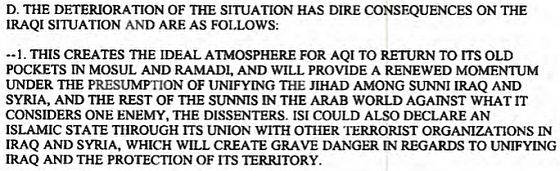
Fox News reports: Seventeen months before President Obama dismissed the Islamic State as a “JV team,” a Defense Intelligence Agency report predicted the rise of the terror group and likely establishment of a caliphate if its momentum was not reversed.

While the report was circulated to the CIA, State Department and senior military leaders, among others, it’s not known whether Obama was ever briefed on the document.

The DIA report, which was reviewed by Fox News, was obtained through a federal lawsuit by conservative watchdog Judicial Watch. Documents from the lawsuit also reveal a host of new details about events leading up to the 2012 Benghazi terror attack — and how the movement of weapons from Libya to Syria fueled the violence there. [Continue reading…]

Facebooktwittermail

Experts: U.S. claims Ramadi a mere setback are ‘delusional’

McClatchy reports: The Obama administration Monday called the fall of the capital of Iraq’s Anbar province to the Islamic State a temporary setback that Iraqi forces would reverse with U.S. support. Experts dismissed that assessment as ludicrous.

“Delusional, really, is the better word,” Ali Khedery, a former U.S. official who served as an adviser to five U.S. ambassadors to Iraq and three heads of U.S. Central Command, said of the administration’s statement. “It’s unbelievable, frankly. I now know what it’s like to have lived through Vietnam, I guess.”

Experts called the loss a stunning blow to the Iraqi government and U.S. strategy.

It wasn’t clear why the administration clung to an upbeat message three days after the Islamic State overran most of Ramadi and a day after Iraq’s best special forces unit fled the city with other troops, local police and tribal fighters. The message was delivered in nearly identical verbiage by White House, State Department and Pentagon spokesmen and was reinforced by a statement from Army Gen. Martin Dempsey, the chairman of the Joint Chiefs of Staff. [Continue reading…]

Facebooktwittermail

Giving ISIS the battle they want in Iraq

Imran Khan writes: It was the worst defeat for Iraq’s elite security forces since the f‎all of Mosul just under year ago.

The images coming from Ramadi, the capital of Anbar province, looked more like a force in defeat rather than a tactical withdrawal.

They fled in the face of a campaign by the Islamic State of Iraq and the Levant (ISIL) group, which used firepower, car bombs and brute force for over a year to wear the Iraqi security forces down.

For ISIL it was a big victory.

Reports from Anbar suggest ISIL forces are now massing and gearing up for the next battle. A battle that they have wanted for a long time.

On Monday the Iraqi government announced that it had deployed at least ,3000 ‎Shia militia members to Habbineyeh airbase in Anbar in preparation for an assault on ISIL fighters.

The Iranians have stepped up support for the militias and the US-led coalition has increased air strikes in the last 72 hours on ISIL targets in Ramadi.

A very loose coalition of Iraqi Shia forces, Iranian support and America and the West. It is the war that ISIL have always wanted.

Across ISIL messages boards and social media accounts, ISIL sympathisers have drawn parallels between this conflict and ‎the Battle of Badr fought in 624 CE between the earliest followers of the Prophet Muhammad and the Quraish, the largest tribe in what is now Saudi Arabia. [Continue reading…]

Facebooktwittermail

To recapture Ramadi from Islamic State, Iraq must use this formula

Hayder al-Khoei writes: The fall of Ramadi, the capital of Iraq’s largest province, is a major defeat for the Iraqi security forces. It follows a period in which a number of strategic advances have been made by Iraqi forces elsewhere in the north and east of the war-torn country. Dreams of an offensive to defeat Islamic State in Mosul this year will now be crushed. Iraq will instead focus its resources and attention on liberating Ramadi, which lies just 60 miles to the west of Baghdad.

The complex realities on the ground will also lead to difficult choices being made on all sides of the conflict. Iraqi Prime Minister Haidar al-Abadi’s approval to send in the Shi’ite-dominated Hashid Shaabi paramilitary forces to the Sunni-dominated Anbar region will worry many, but it comes at the request of local Sunnis who are desperate to defend their areas against Islamic State. The Anbar governor, provincial council and local tribes have publically asked Baghdad to send in these paramilitary forces to support Iraq’s security forces and Sunni tribesmen.

Unlike in Tikrit, several Sunni tribes in Ramadi have already been resisting Islamic State for years now. As 3,000 Shi’ite fighters have deployed to the west of Ramadi following Abadi’s green light, 4,000 Sunni tribesmen have now been deployed in the west to prevent further Islamic State advances in Anbar. Sunni-Shi’ite military cooperation — aside from the official security forces that are themselves mixed — will be a crucial element in this campaign. Sunni tribal fighters are also officially part of the Hashid Shaabi in Anbar, so this paramilitary force is no longer exclusively Shi’ite. [Continue reading…]

Facebooktwittermail

ISIS solidifies foothold in Libya to expand reach

The Wall Street Journal reports: Islamic State leaders in Syria have sent money, trainers and fighters to Libya in increasing numbers, raising new concerns for the U.S. that the militant group is gaining traction in its attempts to broaden its reach and expand its influence.

In recent months, U.S. military officials said, Islamic State has solidified its foothold in Libya as it searches for ways to capitalize on rising popularity among extremist groups around the world.

“ISIL now has an operational presence in Libya, and they have aspirations to make Libya their African hub,” said one U.S. military official, using an acronym for the group. “Libya is part of their terror map now.”

Islamic State’s growth as a powerful anti-Western force has militant groups throughout the world trying to latch onto its notoriety. But until recently, affiliates have operated with a great degree of independence and there was little evidence they were taking orders from the group’s core leadership in Syria and Iraq, American officials said.

The core group benefited by pointing to the mushrooming number of affiliates to show its self-styled caliphate was expanding. But the gains in North Africa mark the first expansion of the group’s reach outside the Middle East beyond rebranding efforts by militants trying to secure direct support from the Syrian-based extremists, U.S. officials said. [Continue reading…]

Facebooktwittermail

Give up on Netanyahu, go to the United Nations

Henry Siegman writes: The greetings President Obama extended last week to Israel’s new government may have sounded conciliatory, but Mr. Obama no longer entertains any illusions about Israel’s leaders.

In the wake of last month’s election, the longtime peace activists and diplomats who have devoted much of their professional lives to achieving a two-state solution to the Israeli-Palestinian conflict are more depressed and demoralized than ever before.

Well before Mr. Netanyahu declared during the recent election campaign that Palestinians would remain under Israeli military occupation as long as he is Israel’s prime minister, Mr. Obama understood that the Israeli government’s enthusiasm for continued peace talks with the Palestinians served no purpose other than to provide cover for Israel’s continued expansion of Jewish settlements and to preclude the emergence of anything resembling a Palestinian state in the West Bank.

Faced with this grim reality, some observers naïvely rooted for the center-left Zionist Union during the campaign. But the notion that a government led by Isaac Herzog and Tzipi Livni might have produced a two-state accord with the Palestinians was also a delusion. An agreement based on the 1967 lines never appeared in the Zionist Union’s platform or crossed Mr. Herzog’s lips.

Indeed, it was clear to anyone familiar with the history of the Israeli-Palestinian conflict that what little hope remained for a two-state solution would depend on the emergence of an Israeli government entirely under the control of Israel’s far right. Only a far-right government that so deeply offends American democratic sensibilities — as this one surely will — could provide the political opening necessary for a change in America’s Middle East policy. [Continue reading…]

Facebooktwittermail

How Somalia’s Al Shabaab turned against its own foreign fighters

Jeremy Scahill reports: U.S. counterterrorism agencies have long been preoccupied with the threat posed by the recruiting successes of the Somali terrorist group al Shabaab in Western countries. The group has managed to lure hundreds of foreign fighters — including some 40 Americans — to Somalia through online propaganda videos and word-of-mouth in disaffected immigrant communities.

In recent years, however, al Shabaab has turned on the foreign fighters in its own ranks, waging a brutal campaign to purge the perceived spies from its midst. An intimate account of the Shabaab civil war was provided to The Intercept in a series of interviews conducted with a current member of al Shabaab and a source who has maintained close contacts with the group.

Al Shabaab has assassinated several foreign fighters on the CIA’s kill/capture list over the past few years and currently runs a network of secret prisons that hold, on charges of spying, U.S., British and other Western citizens who came to Somalia to join Shabaab, The Intercept has found. Shabaab operatives torture detainees using techniques such as waterboarding, beatings, and food and sleep deprivation, and conduct public executions of suspected spies, including by crucifixion. [Continue reading…]

Facebooktwittermail

The Rohingya crisis is not an isolated tragedy – it’s the shape of things to come

Tahmima Anam writes: In 1971 Ravi Shankar and George Harrison organised a concert in New York City’s Madison Square Gardens to fund relief efforts for war-torn Bangladesh. The album featured the image of a starving child on the cover, which became a symbol of an impoverished country emerging out of the rubble of war. Forty-four years later, another image is now associated with Bangladesh: that of the abandoned refugees who float on the Andaman Sea with no hope of rescue.

We’ve all seen the photographs of these refugees. We’ve seen them hanging their emaciated limbs off the sides of their boats. We’ve seen the scars on their backs,earned in fights over scarce food and water. We’ve read their harrowing stories of their being abandoned at sea, rejected by one government after another.

It is estimated that up to 8,000 refugees are marooned in the sea between Bangladesh and Malaysia. Most of them come from Rakhine state, in Burma, where as members of the Rohingya community they are denied the basic rights of citizenship. The rest are economic migrants from Bangladesh. [Continue reading…]

Facebooktwittermail