BuzzFeed: An alliance of 180 of Israel’s top former military and intelligence officials are criticizing Israeli Prime Minister Benjamin Netanyahu’s decision to speak to Congress, in a rare public stance against the Israeli leader.
Just hours after Netanyahu boarded a plane bound for Washington, the group of former generals and intelligence heads held a press conference in Tel Aviv where they stated that Netanyahu’s policies and upcoming speech to Congress were doing irreparable harm to U.S.-Israel relations and would do nothing to stop Iran’s nuclear program.
“When the Israeli prime minister argues that his speech will stop Iran from obtaining nuclear weapons, he is not only misleading Israel – he is actually strengthening Iran,” said Gen. (Res). Amnon Reshef, head of the group, Commanders for Israel’s Security, and former head of Israel’s armored corps. “It is time the prime minister listened to us before he wrecks our strategic interests with our closest ally. Nothing good for Israel can come from humiliating the U.S. president.”
Category Archives: Lands
Saudi blogger Raif Badawi could be facing the death penalty
Channel 4 News: Raif Badawi, 31, was expected to serve a 10-year jail sentence, and a fine of £175,000 for offences related to his setting up of an online forum for public debate, as well as accusations he insulted Islam.
On 9 January, the Saudi writer was lashed 50 times as the first part of his sentence to be flogged 1,000 lashes over a course of 20 weeks. However, subsequent floggings were postponed due to injuries that he sustained.
Mr Badawi’s wife, Ensaf Haider, has told Channel 4 News that judges in Saudi Arabia’s criminal courts are wanting him to undergo a re-trial for apostasy. If found guilty, he would face the death penalty.
The atmosphere of hate in which Boris Nemtsov was murdered
Michael Weiss writes: “We need to talk about Magnitsky.”
The last time I saw Boris Nemtsov, in Tallinn, Estonia in 2013, he had wanted to find a way to tack on more Putin regime officials to a U.S. law that would ban them from entering the country or freeze whatever assets they held here. The former first deputy prime minister of Russia, who was brutally shot to death within eyeshot of the Kremlin this evening, had many enemies, not least of them the president of Russia. He was handsome, charismatic and popular in the West and in Eastern Europe. “First we liberate Belarus, and then Russia!” former Belarusian presidential candidate, dissident and Lukashenko torture victim Andrei Sannikov told him on that same occasion. Nemtsov joyfully agreed. On Sunday he had planned to lead a march against Vladimir Putin’s unacknowledged dirty war in Ukraine. He was shot repeatedly in the back by several assailants emerging from a car while he walking down the Moskvoretskiy bridge with Anna Durickaya, a Ukrainian model.
Two years ago, Nemtsov and his colleague Leonid Martynyuk released a report titled, “Winter Olympics in the Sub-Tropics: Corruption and Abuse in Sochi,” which alleged that Putin had personally overseen the enormous, profligate project and was therefore responsible for the estimated $26 billion frittered away in “embezzlement and kickbacks.” They named names. Nemtsov, who was born in Sochi, and Martynyuk debunked the myth peddled by the Kremlin that the bulk of the costs for the Olympics was borne by private investors, showing that actually only two — aluminum magnate Oleg Deripaska and nickel magnate Vladimir Potanin — were the private financiers of the world’s most expensive Winter Games.
Moreover, they showed how brothers Boris and Arkady Rotenberg, childhood friends of Putin, were awarded 15 percent of the money controlled by Olimpstroy, the state company created to finance the Olympics; and that the bulk of this percentage was spent in awarding no-bid sweetheart contracts. They also suggested that Vladimir Yakunin, the chairman of the state-owned Russian Railroads, who along with Putin helped found the St. Petersburg Ozero Dacha Cooperative, commanded 20 percent of the Olympstroy budget and then purchased property which, according to his official declared income, he simply could not afford.
“Putin is part of a mafia,” Nemtsov told me and my colleague Olga Khvostunova, in an interview about his report. “They do not turn in their own. He gave his friends an opportunity ‘to earn some cash.’” [Continue reading…]
Joshua Yaffa writes: Without knowing who gave the orders, it’s possible to understand that the current political environment allowed for this to happen. Over the past year, in the wake of the annexation of Crimea and the war in eastern Ukraine, Russia has seen the rise of a new, much coarser and more doctrinaire political language. During the first decade of Putin’s rule, the Kremlin depicted its opponents as freaks or idiots, but now they are portrayed as outright enemies of their country. In a triumphant address to parliament last March, as Russia was formalizing its takeover of Crimea, Putin warned of “a fifth column,” a “disparate bunch of national traitors” determined to sow discord inside the country. Its members were obvious, if at first unmentioned: people like Navalny, an anti-corruption activist who had become the most popular leader in the country’s fractured opposition; Aleksei Venediktov, the editor-in-chief of Echo of Moscow, a long-beleaguered radio station that is one of the last homes for critical and liberal voices; and of course Nemtsov, a recognizable facefrom all his years in politics, and a favorite opponent of pro-Kremlin activists and propagandists.
It wasn’t long before the political technologists in the Kremlin and those who do their bidding in the media — whether at state-run television channels with national reach or on pro-Kremlin Web sites that publish memes and jokes disparaging the West and Russia’s small number of liberals — seized on the idea, releasing pseudo-documentaries on the evils of the fifth column and designing graphics that surrounded their disembodied heads with images of space aliens. For a while, a giant poster hung on the side of Moscow’s main bookstore with the face of Nemtsov, among others. “The fifth column: there are strangers among us,” it read. The most apocalyptic and vile of Russia’s television hosts, Dmitri Kiselyov, a man who once warned that Russia could turn the United States into “radioactive ash,” took pleasure in naming and insulting members of the so-called “fifth column.” “Putin legalized that term in the political language of Russia,” he said. “We know their names.”
That act of legalization, as Kiselyov aptly put it, means any number of people or factions could have murdered Nemtsov. In an interview two weeks ago, Nemtsov admitted that he was afraid Putin could have him killed, but “not that much.” In the hours after Nemtsov’s death, Vladimir Ryzhkov, a co-founder of R.P.R.-PARNAS with Nemtsov, told Echo of Moscow that he blamed “the atmosphere of hate that was artificially created” by the state and its supporters. Putin, for his part, called the killing a “provocation,” and said that he would personally oversee the investigation, evoking Stalin’s oversight of the prosecution of Sergei Kirov’s supposed killers in 1934. Will Nemtsov’s death similarly presage a wave of political purges? In the current climate, almost anything seems possible. Either the authorities would kill someone who poses little real political danger, or they have given rise to a venomous hatred that they can no longer control.
Mohammed Emwazi was not a fine young man driven to murder
Shashank Joshi writes: Cage is a British organisation that “campaigns against state policies” towards “communities impacted by the war on terror”. It had been in contact with Emwazi until 2012. They portray him as an “extremely gentle, kind” and “beautiful young man” – words that might lead one to question their judgment – radicalised under relentless and arbitrary pressure from the British government. In this version, Emwazi is a tragic victim crushed by the power of an overweening security state. The world sees a butcher; Cage sees a dupe. In case anyone was in danger of missing the point, Cage’s website broadcast a simpler message: “the state is the only terrorist”.
This narrative would be funny, were the charge not so serious. Cage’s account of Emwazi’s radicalisation is self-serving, disingenuous, and highly selective. They start the story in 2010, when Kuwait cancelled Emwazi’s visa – under British pressure, he alleges – and he was prevented from returning to the country of his birth. This is presented as unprovoked harassment, borne of MI5’s sadistic compulsion to target the Muslim community as a whole. There’s a reason that Cage have left out the backstory, which helps us understand why Emwazi was on the government’s radar in the first place.
In 2009, he had travelled to Tanzania to go on “safari”. He was refused entry, deported, and questioned by MI5, who reportedly accused him of seeking to join al-Qaeda’s Somali affiliate al-Shabab. This is entirely plausible. Why? Because British court papers identify Emwazi as a member of a network of Islamist extremists connected to Somalia.
This network had been in contact with a 7/7 bomber, and one key member, Bilal Berjawi, had also tried to go on a “safari” earlier that year – eventually ending up fighting in Somalia, later dying in a drone strike. It’s also worth noting that Emwazi, in his incarnation as Jihadi John, was “obsessed with Somalia” and forced hostages to watch al-Shabab videos.
So if you think that Emwazi was really going on safari, I have a bridge to sell you. And some free travel advice: if you desperately want to see lions and elephants, my suggestion is that you opt for a reputable travel agency rather than a well-established jihadist network. [Continue reading…]
Mohammed Emwazi triable in British courts for war crimes, say prosecutors
The Guardian reports: Prosecutors and detectives have been working on building a criminal case against Mohammed Emwazi, 26, for potential offences of war crimes and multiple counts of murder, the Guardian has learned.
The the Islamic State militant dubbed “Jihadi John” has featured in seven propaganda videos claiming responsibility for the beheadings of hostages from Britain, the US and other countries.
The Crown Prosecution Service on Friday confirmed it is working with detectives from Scotland Yard’s counter-terrorism command to prosecute Emwazi over the videos and other suspected crimes if he ever comes within Britain’s jurisdiction.
A former top prosecutor said Emwazi’s crimes would be triable in British courts if committed overseas in territory seized by Isis in Syria during the civil war there.
A CPS spokesperson said: “We are liaising with the MPS [Metropolitan Police Service] Counter Terrorism Command (SO15) on their assessment of the content of videos that have been posted online that appear to show the murder of hostages.”
Lord MacDonald QC, the former director of public prosecutions, said the fact the offences took place in Syria would not prohibit a prosecution in a British court: “Since Victorian times it has been a criminal offence for British citizens to commit murder anywhere.” [Continue reading…]
Öcalan calls on PKK to convene conference on laying down arms
Today’s Zaman reports: The jailed leader of the Kurdistan Workers’ Party (pkk) calls on the outlawed group to convene a conference in spring on laying down its arms, the pro-Kurdish Peoples’ Democratic Party (hdp) announced on Saturday, in a landmark step towards ending the PKK’s 30-year-old armed campaign.
“I invite the PKK to convene an extraordinary congress in spring months to make the strategic and historic decision on the basis of ending the armed struggle,” HDP’s Sırrı Süreyya Önder quoted Öcalan as saying at a joint news conference with Deputy Prime Minister Yalçın Akdoğan and Interior Minister Efkan Ala in İstanbul. Two other HDP lawmakers, Pervin Buldan and İdris Balüken, also attended the conference, which followed a 45-minute meeting between the HDP delegation and Akdoğan and Ala.
“We call on all democratic parties to support this democratic solution,” Önder said, asserting that Turkey is “closer than ever to peace.”
“We have reached an important point in the settlement process,” Akdoğan told the same conference. He said the democratic progression will gather momentum once arms are left aside. [Continue reading…]
Israel lobbies U.S. Congress for extra cash
Bloomberg reports: For the second consecutive year, Israeli officials have asked the U.S. Congress to add more than $300 million to President Barack Obama’s budget request for their nation’s missile-defense programs.
The $317 million wish list that Israeli’s missile defense chief gave lawmakers this month is in addition to the $158 million the Pentagon proposed for the fiscal year that starts Oct. 1. The Israeli request would provide first-time production funds for two programs — David’s Sling and Arrow-3.
Israel’s latest lobbying on Capitol Hill, instead of through the White House and Pentagon, comes at a low point in political relations between the U.S. and Israel over Prime Minister Benjamin Netanyahu’s planned speech to Congress on March 3 to derail what he calls an emerging “bad deal” by the Obama administration to curb Iran’s nuclear program.
Yair Ramati, the director of Israel’s missile defense organization, visited lawmakers and aides to the congressional defense committees on Feb. 2 and 3 to outline the case for more money and thank them for past assistance, according to people familiar with the meetings who asked not to be identified describing the private discussions. Obama’s proposed budget was released on Feb. 2.
The U.S. provides funds for Israel’s missile defenses — including the Iron Dome interceptors that have gained fame for fending off Hamas rockets from Gaza — separately from the $3.1 billion a year given to Israel in “foreign military financing” to buy weapons through the budget for the State Department and foreign operations. [Continue reading…]
U.S. rethinks plan to retake Mosul
The Wall Street Journal reports: The U.S. military is considering a months-long campaign of airstrikes to squeeze Islamic State fighters in Mosul before inserting Iraqi ground forces to retake the city, officials said Friday.
The on-the-ground fight to retake Mosul isn’t likely to start until the fall at the earliest, after an intensified air campaign to target Islamic State leaders and cut off supply lines in and around the city, the officials said.
The emerging plan is at odds with a briefing by a U.S. military’s Central Command official in February in which he said the U.S. and Iraq were looking at starting a campaign to liberate Mosul, Iraq’s second-largest city, by April or May.
Afterward, Iraqi and American officials cast doubt on the likely readiness of Iraqi forces.
U.S. military officials now say they believe that Iraqi’s best military units are many months away from being in a position to successfully conduct such an operation. Those forces haven’t yet begun their training at the bases set up by American military officers in Iraq.
“When we feel that the Iraqi forces are ready to go and win decisively, we will go and advise the Iraqis to begin the operation,” a military official said. [Continue reading…]
ISIS may not be a global threat, but neither is it a problem with a ready solution
The New York Times reports: The reports are like something out of a distant era of ancient conquests: entire villages emptied, with hundreds taken prisoner, others kept as slaves; the destruction of irreplaceable works of art; a tax on religious minorities, payable in gold.
A rampage reminiscent of Tamerlane or Genghis Khan, perhaps, but in reality, according to reports by residents, activist groups and the assailants themselves, a description of the modus operandi of the Islamic State’s self-declared caliphate this week. The militants have prosecuted a relentless campaign in Iraq and Syria against what have historically been religiously and ethnically diverse areas with traces of civilizations dating to ancient Mesopotamia.
The latest to face the militants’ onslaught are the Assyrian Christians of northeastern Syria, one of the world’s oldest Christian communities, some speaking a modern version of Aramaic, the language of Jesus.
Assyrian leaders have counted 287 people taken captive, including 30 children and several dozen women, along with civilian men and fighters from Christian militias, said Dawoud Dawoud, an Assyrian political activist who had just toured the area, in the vicinity of the Syrian city of Qamishli. Thirty villages had been emptied, he said. [Continue reading…]
In the aftermath of the war in Iraq, some Americans, perceiving echoes of the government-fueled national hysteria that followed 9/11, now regard the attention being given to ISIS as disproportionate to the size of the threat.
A few days ago, one commentator described ISIS as: “A nasty nuisance, which has killed thousands in the Middle East, but a nuisance nonetheless.”
If one subscribes to the Steven Pinker view of the world, then how bad the current situation is, just comes down to numbers.
Fewer people have been killed by ISIS than by barrel bombs dropped by the Assad regime in Syria, or were killed during the U.S.-led invasion and occupation of Iraq.
The threat to humanity posed by climate change, far exceeds all other global threats, including what can arguably be called a minor threat from ISIS.
But if an issue is defined as not rising above the threshold of being a nuisance, solely based on numbers, then since between 1882 and 1968 only 3,446 blacks were lynched in America, should the racial violence occurring during that chapter in this country’s history be described as having been no more than a nasty nuisance?
The very fact that we view lynching as emblematic of a chapter in history, illustrates the fact that significance can never be reduced to numbers.
In France, the death toll from the Charlie Hebdo shootings was little more than the average number of fatalities that occur every day on France’s roads.
Since statistically, the French face little more risk from terrorism than they face from traffic accidents, does that mean the French government should devote the same amount of time and resources to addressing road safety as they do to tackling terrorism?
Again, this doesn’t just come down to numbers. For one thing, there’s no reason to view road safety as a problem that risks escalating. Neither is there reason to imagine that individuals or groups of people have a specific interest in making the roads more dangerous. Road safety is an issue that gains ongoing and appropriate attention from every relevant constituency from central government to local government, town planners to school teachers, and vehicle manufacturers to medics.
The fact that it is the type of issue that generally gets effectively addressed, is the very reason it is largely ignored in political and popular discourse.
Conversely, while it’s easy to say that ISIS presents a problem that needs “to be dealt with,” the very fact that it remains unclear what mechanisms might be effective in tackling this problem, is one of the main reasons ISIS continues to grab the headlines.
ISIS might not represent an unstoppable force and yet its campaign of violence has proved very difficult to contain.
Politicians glibly talk about the strategy for defeating ISIS, yet no one has made a convincing case that such a strategy has been found.
Some observers believe that each time another ISIS headline appears, the group has simply been served up the attention it craves, but to dismiss this as a group of attention-seekers is to gravely misjudge ISIS’s ambitions.
A year ago, before ISIS had become a household name but after it taken over Fallujah, President Obama wanted to downplay its significance in what became an infamous dismissal — he said they were just “a jayvee team.”
In those early months of 2014, ISIS used America’s inattention to its full advantage.
Whether showered with or starved of attention, ISIS pursues its goals because they have less concern about how they are perceived by Americans, or for that matter the rest of the world, than we might imagine.
The issue now is less about the quantity of attention ISIS garners that it is about the quality of that attention.
When viewed through the paradigm of the war on terrorism, it’s natural and appropriate to point to that neocon project’s manifold failures. We might also see this as the latest manifestation in a problem that cannot wholly be solved. In other words, that we need to learn how to live with what can be regarded as a manageable amount of terrorism.
But maybe we are being distracted by the category of terrorism itself.
In spite of the fact that ISIS has engaged in what are generally viewed as some of the most grotesque acts of terrorism ever carried out, it differs from all other terrorist groups in at least two fundamental ways:
- It has spawned a mass movement, and
- It has captured and now governs large tracts of territory.
While there was recent furious debate about whether ISIS should be called Islamic, there has been little discussion about its claim to have created a state.
That claim is treated as too preposterous as to merit consideration — the so-called Islamic State is surely destined to implode.
And yet that hasn’t happened and it isn’t about to happen. Neither is this a state that stands any chance of being recognized by any other, but nor does it seek such recognition. On the contrary, the recognition it seeks is from all those who reject the legitimacy of nation states — and this constituency is large and growing.

ISIS executioner, Mohammed Emwazi, was under watch by British intelligence
The New York Times reports: Mr. Emwazi was called “Jihadi John” by the foreign hostages he guarded, a number of whom he apparently beheaded in widely circulated videos. He was first identified on Thursday by The Washington Post website, and his name was confirmed by a senior British security official. The official said that the British government had identified Mr. Emwazi some time ago but had not disclosed his name for operational reasons. The identification was also confirmed in Washington by a senior United States military intelligence official.
Information is still vague about Mr. Emwazi, with Britain officially refusing to confirm that he is indeed “Jihadi John” because of what are described as continuing operations.
But Mr. Emwazi appears in 2011 court documents, obtained by the BBC, as a member of a network of extremists who funneled funds, equipment and recruits “from the United Kingdom to Somalia to undertake terrorism-related activity.”
Mr. Emwazi is alleged to be part of a group from West and North London, sometimes known as “the North London Boys,” with links to the Somalia-based terrorist group Al Shabab, organized by an individual who had returned to London in February 2007 and whose name was redacted in court documents.
Another person associated with that group was Bilal al-Berjawi, who was born in Lebanon but brought to West London as a baby. He fought in Somalia and rose through the ranks of Al Shabab and Al Qaeda in Africa before being killed in a drone strike in January 2012, according to Raffaello Pantucci, also a fellow at the Royal United Services Institute.
Mr. Berjawi traveled to Kenya in February 2009, telling his family he was heading for a safari; he and a friend were detained in Nairobi and shipped back to London, but made it to Somalia in October that year.
The neighborhood group “is a tight community and it’s very probable that they knew each other and were part of the same crew,” Mr. Pantucci said.
So it is likely that Mr. Emwazi’s own safari a few months later in May, from Britain to Germany to Tanzania, using the name of Muhammad ibn Muazzam, set off alarms with the British security services, and that he had started on the road to radicalism even before his encounter with MI5 in 2009. [Continue reading…]
The contradiction between the secular and fundamentalist roots of ISIS is more apparent than real
ISIS: Inside the Army of Terror, by Hassan Hassan and Michael Weiss — a Chatham House review: Despite its declaration of a new ‘caliphate’ based on jihadist principles, much of the senior leadership Islamic State is actually made up of Saddam-era Baath Party members.
A study of the origins and make-up of Islamic State characterizes the jihadist group as a ‘spectral hold-over’ of the old regime.
‘Most of its top decision-makers served either in Saddam Hussein’s military or security services. In a sense, ‘secular’ Baathism has returned to Iraq under the guise of Islamic fundamentalism.’
The authors, Syrian researcher Hassan Hassan, who hails from the town of Albu Kamal on the Iraqi border, and the American journalist Michael Weiss, write that this contradiction between secular and fundamentalist is more apparent than real.
Despite the secular origins of the Baath party, Saddam Hussein used it to preserve the dominance of Iraq’s Sunni Muslims – only 20 per cent of the population – and repress the majority Shia. In the declining years of his rule Saddam Hussein adopted an overtly religious path, in the hope of co-opting the Sunni Muslim leadership. In fact, Saddam lost control of his so-called Islamic Faith Campaign and many Baath Party members fell under the spell of the imams. [Continue reading…]
Libya’s revolution and its aftermath
Nicolas Pelham writes: As in the time of Qaddafi, words and reality in postrevolutionary Libya often seem to inhabit separate spheres. Twenty minutes before landing in Tripoli, women returning from Egypt drape their highlighted hair and designer jeans in black cloth. The women at passport control have gone, and the man in charge of immigration is the one with the bushiest beard. Inside the city, Muslim iconoclasts are purging the capital of its colonial-era images. Soon after capturing the capital in August, they fired a shell through the belly of the Bride of the Sea, a sculpture of a bare-breasted mermaid entwined with a tender gazelle, which since Italian times had served as a backdrop for wedding photos. And last month they stole the sculpture itself. Herati only got it back because the thieves could be traced by the cameras Qaddafi hid in the capital’s roadside trees. For now, though, he says, it is safer for it to remain under wraps.
Other monuments in the capital are disappearing too. The three tombs of Ottoman mystics that graced the entrance of the eighteenth-century Ahmed Pasha Qaramanli mosque at the entrance of the souk have been smashed, and replaced with an already overgrown patch of grass. Islamists have snapped off the antique Koranic inscriptions in the souk’s other old mosques, lest believers be led astray into polytheism by venerating the ornaments instead of God alone.
Libya Dawn’s officials blame the attacks on the local followers of a Saudi scholar, Rabi’ al-Mudkhali. He works, says an official, with Saudi intelligence, seeking to tarnish the name of Islamist groups that do not follow Saudi’s puritanical doctrines or more importantly their politics. Others suggest that acolytes of Caliph Abu Bakr al-Baghdadi’s Islamic State, or ISIS, are finding a foothold thanks to Libya Dawn’s relaxed approach to Islamic extremists. I failed to find evidence of the Islamic State cadres that had been reported in Tripoli, but cafés frequented by couples have been torched and embassies car-bombed. A couple of days after I left Tripoli, a gunman shot dead an unveiled woman driving home near the city center. Lest anyone be tempted to investigate, in mid-November Libya Dawn raided the National Commission for Human Rights, seized its database, and padlocked its doors. [Continue reading…]
Boehner’s campaign rally for Netanyahu
Jeffrey Goldberg writes: It would be reassuring—sort of—to believe that Benjamin Netanyahu decided to set the U.S.-Israel relationship on fire mainly because he fears that President Obama is selling out Israel. But Netanyahu’s speech to Congress on March 3—a speech arranged without Obama’s knowledge by Israeli Ambassador Ron Dermer and by Obama’s chief Republican rival, House Speaker John Boehner—is motivated by another powerful fear: the fear of unemployment. The message Bibi is preparing to deliver on Tuesday (a “statesmanlike message,” according to an official close to him) has as its actual target not Congress but, instead, Israeli voters who need reminding, in Netanyahu’s view, that he is the only leader strong enough to face down both the genocidal regime in Tehran and the Israel-loathing regime in Washington. (Make no mistake: Netanyahu sees Obama as an actual adversary. If only all of Israel’s adversaries would veto U.N. Security Council resolutions hostile to Israel…)
Bibi is facing an existential threat to his career, and Boehner is staging for him the ultimate campaign rally, 6,000 miles away from home. People I’ve spoken with in Israel who have a sophisticated understanding of current campaign dynamics—the Israeli election is set for March 17—say that a well-delivered, well-received speech (standing ovations in Congress seem very impressive unless you know better) could gain Netanyahu two or three extra seats in the Knesset, which might be what he needs to retain his job. [Continue reading…]
ISIS ‘Jihadi John’ named as Mohammed Emwazi, portrayed as victim of UK counter-terrorism policies

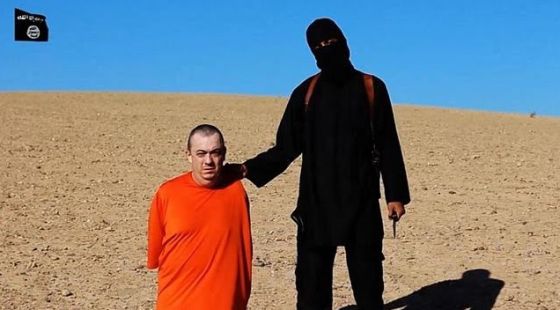
British aid worker, Alan Henning, and his executioner, alleged to be British jihadist, Mohammed Emwazi.
The Washington Post reports: The world knows him as “Jihadi John,” the masked man with a British accent who has beheaded several hostages held by the Islamic State and who taunts audiences in videos circulated widely online.
But his real name, according to friends and others familiar with his case, is Mohammed Emwazi, a Briton from a well-to-do family who grew up in West London and graduated from college with a degree in computer programming. He is believed to have traveled to Syria around 2012 and to have later joined the Islamic State, the group whose barbarity he has come to symbolize.
“I have no doubt that Mohammed is Jihadi John,” said one of Emwazi’s close friends who identified him in an interview with The Washington Post. “He was like a brother to me. . . . I am sure it is him.”
A representative of a British human rights group who had been in contact with Emwazi before he left for Syria also said he believed Emwazi was Jihadi John, a moniker given to him by some of the hostages he once held.
“There was an extremely strong resemblance,” Asim Qureshi, research director at the rights group, CAGE, said after watching one of the videos. “This is making me feel fairly certain that this is the same person.” [Continue reading…]
Qureshi, in a statement on the CAGE website, portrays Emwazi as a victim of British counter-terrorism policies:
This case should trigger thinking about British domestic and foreign policy. What risk assessments, if any, have been made about British counter-terrorism policy and the key part it plays in radicalising individuals? How have the security services been allowed to get away with abusing British citizens without redress? Why are the long-standing grievances over Western interventions in the Muslim world been ignored?
Propagandists have a habit of becoming the most devout believers in their own narrative, but I think it requires a particularly distorted mindset to portray Emwazi, given his alleged actions, as a victim.
In a press conference today, Qureshi described Emwazi as a “kind” and “gentle” young man.
In a video released today, Qureshi says: “The questions shouldn’t be about Jihadi John but they should be about what role our security services have played in alienating people in this society and turning them away from being able to find solutions to the problems they have.”
Moazzam Begg, CAGE’s director of outreach and a former detainee at Guantánamo, can also reasonably argue that he has been a victim of Britain’s counter-terrorism policy and what some see as its over-zealous security services.
Given Qureshi’s reasoning, are we to imagine that Begg or anyone else finding themselves in a similar position might be just as likely to follow in Emwazi’s footsteps and become another of ISIS’s executioners?
In fact, Begg has no illusions about ISIS: “You have no idea how dangerous these people are,” he wrote on Facebook in early 2014.
He also wrote:
“I saw muhajireen (foreigners), locked in cages, by Allah worse, than my Guantanamo cell.
“They beat people to make them confess…just like the Arab regimes, there is no difference.
“I have been to many places, Bosnia, Afghan… but never seen this kind of fitnah [turmoil] and such dangerous extremism and readiness for takfeer [excommunication].
“Syrians on the ground have started to hate foreigners because of them.
“ISIS have even detained and killed aid workers…brothers from UK who have taken convoys [have] been looted by ISIS, guns shoved in faces of brothers who have crossed Europe to bring aid.
“And what’s the basis of detaining the non-Muslim aid worker [Alan Henning] who came in as a guest of Muslims, under their protection? They’ve probably murdered him too, just like many Muslims they’ve done that to.”
The world is full of people who for multitudes of justifiable reasons regard themselves as victims, yet this doesn’t absolve them of responsibility for their own actions.
The Guardian adds: “Jihadi John” is one of a trio of Britons who held hostage Spanish, French, Danish, British and US nationals. The hostages were captured in northern Syria, some in Idlib province, others in Aleppo and a third group in and around Raqqa province, which has since become the main Syrian stronghold of Isis.
The jihadi cell that spawned Isis was initially strong in Idlib province, having taken root there in the summer of 2012. From there it spread to Aleppo, where hostages that had been captured at that point were held in one of two locations – under the eye hospital in the centre of the city or in a factory deep in an industrial zone on its northern outskirts.
By February last year, all the hostages, including Briton John Cantlie, who is one of two remaining western hostages, were moved to Raqqa.
It was in Raqqa that the hostages first became aware of the status that Emwazi had developed among Isis. One former hostage described him as “cold, sadistic and merciless”.
Why Bashar Assad won’t fight ISIS
Time reports: The regime of Syrian President Bashar Assad has long had a pragmatic approach to the Islamic State of Iraq and Greater Syria (ISIS), says a Syrian businessman with close ties to the government. Even from the early days the regime purchased fuel from ISIS-controlled oil facilities, and it has maintained that relationship throughout the conflict. “Honestly speaking, the regime has always had dealings with ISIS, out of necessity.”
The Sunni businessman is close to the regime but wants to remain anonymous for fear of repercussions from both ISIS supporters and the regime. He trades goods all over the country so his drivers have regular interactions with ISIS supporters and members in Raqqa, the ISIS stronghold in Syria, and in ISIS-controlled areas like Dier-ezzor.
The businessman cites Raqqa’s mobile phone service as an example of how there is commerce between the regime, Syrian businesses, and ISIS. The country’s two main mobile phone operators still work in Raqqa. “Both operators send engineers to ISIS-controlled areas to repair damages at the towers,” he says. In addition, there are regular shipments of food to Raqqa. “ISIS charges a small tax for all trucks bringing food into Raqqa [including the businessman’s trucks], and they give receipts stamped with the ISIS logo. It is all very well organized.”
The businessman has a driver who lives in an ISIS-controlled area near Dier-Ezzor. “My driver is always telling me how safe things are at home. He can leave the door to his house unlocked. ISIS requires women to veil, and there is no smoking in the streets. Men can’t wear jeans either. But there are no bribes, and they have tranquility and security. It’s not like there are killings every day in the streets like you see on TV.”
And, he notes, ISIS pays well — slightly less than the pre-war norms but a fortune in a war-torn economy: engineers for the oil and gas fields are paid $2,500 a month. Doctors get $1,500. Non-Syrians get an expatriate allowance, “a financial package that makes it worthwhile to work for ISIS,” says the businessman.
Assad does not see ISIS as his primary problem, the businessman says. “The regime fears the Free Syrian Army and the Nusra Front, not ISIS. They [the FSA and Nusra] state their goal is to remove the President. But ISIS doesn’t say that. They have never directly threatened Damascus.” As the businessman notes, the strikes on ISIS targets are minimal. [Continue reading…]
More Assyrian Christians captured as ISIS attacks villages in Syria
The New York Times reports: Continuing its assaults on a string of Assyrian Christian villages in northeastern Syria, the Islamic State militant group has seized scores more residents over the past two days, bringing the number of captives to as many as several hundred, Assyrian organizations inside and outside Syria said on Thursday.
The number of captives reported by different Assyrian groups has varied because, in the chaos of fighting, many families are fleeing and it has taken time to verify by name those captured.
The Syriac Military Council, a militia formed in recent years to protect Assyrian villages in the traditionally diverse area of Hasaka, in northeastern Syria, said in a statement that more than 350 civilians from 12 villages had been abducted.
George Stifo, a leader of the United States branch of the Assyrian Democratic Organization, part of the Syrian opposition, provided the names of 96 captives, which included several children. The Assyrian International News Agency, a website tracking community news, reported that 150 were missing.
The Syrian Observatory for Human Rights, an antigovernment monitoring group with a network of contacts in Syria, said on Thursday that 220 were missing. [Continue reading…]
UN’s plan to ‘freeze’ the conflict in Syria is a gift to Assad
Emile Hokayem writes: Military and diplomatic efforts in Syria are converging in Aleppo, once the country’s largest city and commercial center. Last week, U.N. Special Envoy Staffan de Mistura reported to the Security Council that Syrian President Bashar al-Assad had agreed to suspend for six weeks all aerial and artillery bombardment of the besieged city, which is divided between the regime and rebel groups.
The supposed agreement, however, does not represent much of a breakthrough, especially when compared with the diplomat’s initial ambitions of a broad “freeze” over the whole province of Aleppo, which would then be replicated in other regions later. Behind closed doors and in front of the media afterward, de Mistura sought to lower expectations, saying he had “no illusions” about the difficult task ahead. He also did not explain how a limited freeze in Aleppo could change the calculations of the various local and regional players or create new incentives for a political negotiation among the warring sides.
De Mistura’s New York briefing coincided with a large-scale regime offensive to fully encircle Aleppo from the north. Regular military units, the paramilitary auxiliaries of the National Defense Force, and Hezbollah fighters sought to press their advantage in the areas of Handarat and Malaah, north of the city, with the intention of seizing three important villages and breaking rebel groups’ siege of the Shiite towns of Zahra and Nubl. Controlling these villages and connecting roads would sever the links between the Aleppo countryside and the vitally important border with Turkey.
But the initially rapid advance of the pro-regime forces was stopped and rolled back in several areas. Bad weather grounded Assad’s helicopters and aircraft during much of the battle — overcast weather, a rebel commander quipped to me, imposed the no-fly zone that the Americans had denied the rebellion since 2011. After capturing important territory in surprise attacks over two days, Assad’s forces were surrounded by Syrian rebels who killed well over 100 soldiers and captured dozens more, making this time among the costliest days for the regime since the beginning of the armed uprising. [Continue reading…]
Exile instead of murder: A Syrian refugee’s choice
Al Jazeera reports: Ammar Kassir became a refugee to avoid killing fellow Syrians.
In 2012, as pro-democracy marches on the streets of Damascus were increasing, Kassir was a part of a police unit working under the direct control of President Bashar al-Assad. One afternoon, he was ordered to open fire on protesters marching for democracy.
“Assad told us we must kill these people who are making demonstrations. The protesters were shouting ‘Freedom! Freedom!’, and he said we must kill these people. I did not want to do that,” Kassir told Al Jazeera.
The safe choice would have been to follow the orders he was given. The policeman, who was 20-years old at the time, chose to resist, even though he knew refusing orders meant he would have to escape for his own safety.
Kassir became a refugee, one of three million Syrians who have fled their country in the past three years.
He left Damascus, heading north to his family’s home in Idlib. From there, he made his way alone to Turkey, crossing the border by foot.
Since the Syrian uprising began, 95 percent of the Syrians who fled their native country remained in the region, mainly in Lebanon, Jordan, and Turkey.
Kassir had other plans.
He wanted to get to Europe, to reach a safer country that would give him a chance to restart his life.
Legal pathways to Europe for Syrian refugees are rare and Kassir – like many other Syrians who sought refuge in Europe – was forced onto dangerous and expensive smuggling routes. [Continue reading…]
