Category Archives: Lands

ISIS fighters admit defeat in Kobane

Associated Press: The Islamic State group has acknowledged for the first time that its fighters have been defeated in the Syrian town of Kobani and vowed to attack the town again.

In a video released by the pro-ISIS Aamaq News Agency late Friday, two fighters said the airstrikes by the U.S.-led coalition were the main reason why ISIS fighters were forced to withdraw from Kobani. One fighter vowed to defeat the main Kurdish militia in Syria, the People’s Protection Units known as the YPG.

Facebooktwittermail

Greece will repay ECB, IMF, reach deal with EU, Tsipras says

Bloomberg: Prime Minister Alexis Tsipras sought to repair relations with Greece’s creditors ahead of a diplomatic push to win support for his economic program, as euro area officials said they’re looking for concessions from the new government.

Greece will repay its debts to the European Central Bank and the International Monetary Fund and reach a deal “soon” with the euro-area nations that funded most of the country’s financial rescue, Tsipras said in a statement e-mailed to Bloomberg News on Saturday.

“The deliberation with our European partners has just begun,” Tsipras said. “Despite the fact that there are differences in perspective, I am absolutely confident that we will soon manage to reach a mutually beneficial agreement, both for Greece and for Europe as a whole.”

Facebooktwittermail

Al Jazeera journalist Peter Greste deported from Egypt

The Guardian: One of the three al-Jazeera journalists jailed in Egypt, Peter Greste, has landed in Cyprus after being deported from Egypt following 400 days in jail, his brother has told the Guardian.

Mike Greste confirmed that the Australian journalist had arrived in Cyprus and said he would issue a full statement later on. An interior ministry spokesman had earlier confirmed Peter Greste’s deportation under a recently enacted decree.

“A presidential decree has been issued to deport him to continue his punishment period in Australia. The foreign ministry co-ordinated with the Australian embassy and his plane took off at 4.10pm [local time],” he said.

Facebooktwittermail

Killing in a media blackout

AFP’s Phil Hazlewood reports: The fishing town of Baga in the far north of Borno is a no-go zone, as is much of the state, which has been worst hit by the violence.

No one can travel there, not even AFP’s local Nigerian staff. Telecommunications are destroyed. The only option is for survivors of Boko Haram raids to make it to an area still under government control – like the Borno state capital, Maiduguri – or over the border into Chad to tell their stories. Sometimes that can take weeks.

Photos and video, the proof that seems to be increasingly required to establish beyond doubt that an attack took place? Forget it.

Initial reporting of the attack in Baga went to type: AFP got word of the attack and issued a one-line alert on January 4. Beyond that, all we knew was that hundreds of people had fled and Boko Haram had overrun a military base used by Nigerian, Nigerien and Chadian troops in the counter-insurgency.

Four days later, President Goodluck Jonathan was in Lagos to launch his election campaign when Musa Bukar went on the Hausa-language service of BBC radio.

Bukar, a local government official from near Baga, claimed as many as 2,000 people may have been killed when Boko Haram fighters stormed the town, razing it and at least 16 surrounding settlements. [Continue reading…]

Facebooktwittermail

Angela Merkel must accept that her austerity policy is now in tatters

Joschka Fischer writes: Not long ago, German politicians and journalists confidently declared that the euro crisis was over; Germany and the European Union, they believed, had weathered the storm. Today, we know that this was just another mistake in a continuing crisis. The latest error, as with most of the earlier ones, stemmed from wishful thinking – and, once again, it is Greece that has broken the reverie.

Even before the leftist Syriza party’s overwhelming victory in the recent Greek election it was obvious that, far from being over, the crisis was threatening to worsen. Austerity – the policy of saving your way out of a demand shortfall – simply does not work. In a shrinking economy, a country’s debt-to-GDP ratio rises rather than falls, and Europe’s recession-ridden crisis countries have now saved themselves into a depression, resulting in mass unemployment, alarming levels of poverty and scant hope.

Warnings of a severe political backlash went unheeded. Shadowed by Germany’s deep-seated inflation taboo, Chancellor Angela Merkel’s government stubbornly insisted that the pain of austerity was essential to economic recovery; the EU had little choice but to go along. Now, with Greece’s voters having driven out their country’s exhausted and corrupt elite in favour of a party that has vowed to end austerity, the backlash has arrived. [Continue reading…]

Facebooktwittermail

The rise and fall of PEGIDA: how the anti-Islam movement has changed German politics

Derek Scally writes: The grassroots Islam-critical movement appears to be imploding after a mass walkout of leading figures on Wednesday. But whether it goes under or not is far less interesting than the effect it has had on German politics.

In just three months it grew exponentially via Facebook, stripping away the politically-correct veneer of German public debate to reveal – and reactivate – the slumbering intolerance beneath.

For many it’s a worrying sign that populism is in, Islam is fair game and Germany’s race to the political bottom is on. A pertinent question posed by Pegida’s rise and possible fall is: who stands to benefit?

The nascent Alternative für Deutschland (AfD) in Saxony could offer a political home to the 25,000 people who marched through Dresden to express concern at the supposed “islamisation of the west”.

The AfD pulled in nearly 10 per cent at its first state election in Saxony last September by going beyond euro criticism to appeal to conservative voters’ worst instincts: warning of “criminal” foreigners and protesting against mosques. [Continue reading…]

Facebooktwittermail

Argentinian prosecutor feared pro-government fanatics, says employee

The Guardian reports: The Argentinian prosecutor who was found dead after accusing the country’s president of conspiring to cover up the country’s deadliest terror attack was more afraid of fanatical government sympathisers than foreign terrorists, according to the last person known to have spoken to him before his death.

Alberto Nisman was found lying in a pool of blood in his bathroom on 18 January – the day before he was due to formally present to Congress his allegation that President Cristina Fernández de Kirchner had plotted to cover up Iran’s involvement in the 1994 bombing of a Jewish community centre that killed 85 people.

Diego Lagomarsino, who lent Nisman the gun which killed him, said the lawyer confided his fears in an emotional encounter in which he also expressed his suspicions of his own security detail and fears for the safety of his two daughters.

“He wasn’t afraid of terrorists. He was afraid of fanatics who might attack his car with sticks while he was driving his daughters,” the 38-year-old told The Guardian.

In his first media interview since he handed himself in to the courts for questioning, Lagomarsino – an IT specialist at Nisman’s office – gave a detailed account of his relationship with the late prosecutor and their last meeting. [Continue reading…]

Facebooktwittermail

British army creates social-media brigade

The Daily Beast reports: The British army is creating a special force of Facebook warriors, skilled in psychological operations and use of social media to engage in unconventional warfare in the information age.

The 77th Brigade, to be based in Hermitage, near Newbury, in Berkshire, will be about 1,500-strong and formed of units drawn from across the army. It will formally come into being in April.

The brigade will be responsible for what is described as non-lethal warfare. Both the Israeli and US army already engage heavily in psychological operations.

Against a background of 24-hour news, smartphones and social media, such as Facebook and Twitter, the force will attempt to control the narrative.

The 77th will include regulars and reservists and recruitment will begin in the spring. Soldiers with journalism skills and familiarity with social media are among those being sought. [Continue reading…]

Facebooktwittermail

Erdoğan’s push for presidential system reveals lust for power

Today’s Zaman reports: The president’s insistence on a presidential system, demonstrated by his recent remarks that the issue should be a topic during the upcoming election campaign, may be considered a reflection of his lust for power as well as an attempt to prepare the groundwork for a shift to that system should the ruling party be victorious in the June elections.

President Recep Tayyip Erdoğan said in the past week that he wants a strong presidential system to replace the current parliamentary system of government, saying the shift should be a topic during the upcoming election campaign.

Claiming, in sharp contrast to reality, that most developed countries are governed by a presidential system, he told a group of journalists on his way back to Turkey from Africa: “That shows that this [system] produces [better] results. Given this, why should we put shackles on our feet [by sticking to a parliamentary regime]?”

But according to Mahmut Akpınar, a security analyst at the Ankara-based Center of Law, Ethics and Political Studies (HESA), Erdoğan’s real motive might be different.

“His [the president’s] lust for power as well as his desire to keep the ruling party under control at all times has a role in Erdoğan’s effort,” Akpınar told Sunday’s Zaman.

If the ruling Justice and Development Party (AK Party) manages to get enough votes in the elections on June 7 to change the Constitution in favor of a presidential system, Erdoğan will have all the power in his hand, whereas now he mostly enjoys symbolic powers.

According to Akpınar, Erdoğan aims, by bringing the issue up for discussion ahead of the elections, to psychologically prepare society for a shift to a presidential system from a parliamentary democracy, hoping that the ruling party will win the elections.

“By repeatedly bringing the issue up for discussion, he wants to create the impression among the public that voters will have also voted on this issue. If the AKP [AK Party] gets enough votes [to obtain power], the voters will be considered to have in this way given their approval [for a presidential system],” he said. [Continue reading…]

Facebooktwittermail

Al Qaeda in Yemen says France is top enemy of Islam

AFP reports: The ideological leader of Yemen-based Al-Qaeda in the Arabian Peninsula (AQAP) said Friday that France had surpassed the United States as the top enemy of Islam.

With the “weakening” of the United States in recent years, France has replaced America in the “war on Islam,” Ibrahim al-Rubaish said in an audio message published by AQAP’s media arm on YouTube.

US intelligence agencies consider AQAP to be the most dangerous branch of the jihadist network.

One of the group’s ideologues, Nasser bin Ali al-Ansi, has claimed in a video that AQAP was behind the January 7 attack on French satirical weekly Charlie Hebdo that left 12 people dead.

Cartoons of the Prophet Mohammed published by the magazine have angered many Muslims.

Western governments say it remains unclear if AQAP directly orchestrated the attack on the weekly, although they do believe one or both of the attackers, brothers Said and Cherif Kouachi, spent time with jihadists in Yemen. [Continue reading…]

Facebooktwittermail

ISIS surprises Kurds in Iraq, killing a commander in a day of attacks

The New York Times reports: Exploiting a foggy night as cover, Islamic State militants launched a surprise attack on Iraqi Kurdish positions on the outskirts of Kirkuk early Friday, killing a senior Kurdish commander and at least five of his men, security officials in the city said.

The assault was one of the most aggressive undertaken against Kirkuk in months by the Islamic State, the jihadist group that straddles a large stretch of Iraq and Syria. The city, in northern Iraq, is an oil hub that is seen as central to the aspiration of Iraqi Kurdish leaders and that poses an attractive strategic target for the Islamic State, also known as ISIS or ISIL.

Families fled their homes as the fighting intensified, and at one point, the militants stormed an abandoned hotel in the Kirkuk city center.

The deadly foray on Friday demonstrated the continued ability of Islamic State fighters to harass Iraq’s cities, despite a punishing monthslong campaign by Iraqi forces backed by United States airstrikes to dislodge the extremists. [Continue reading…]

Facebooktwittermail

How hostage pilot drama is feeding an antiwar movement in Jordan

Taylor Luck reports: The ongoing drama of a Jordanian pilot held hostage by the Islamic State has escalated into a political crisis for King Abdullah II, threatening the position of a stalwart US ally and leading player in the coalition against the jihadist group.

Jordanians have been gripped by the detention of Lt. Muath Kassasbeh, whose fighter jet crashed near Raqqa, Syria on Dec. 24.

A sunset deadline passed Thursday with the government refusing to pull the trigger on a prisoner swap with the jihadist movement, saying IS had failed to provide proof Lt. Kassasbeh was still alive and well.

Rather than blame IS for the protracted hostage crisis, the public at large and members of the pilot’s family have turned on the government. They are hitting the streets and faulting Amman for putting Jordanians into harm’s way in a war they say is not their own. [Continue reading…]

Facebooktwittermail

CIA interrogations took place on British territory of Diego Garcia, senior Bush administration official says

Vice News reports: Interrogations of US prisoners took place at a CIA black site on the British overseas territory of Diego Garcia, a senior Bush administration official has told VICE News.

The island was used as a “transit location” for the US government’s “nefarious activities” post-9/11 when other places were too full, dangerous, insecure, or unavailable, according to Lawrence Wilkerson, Colin Powell’s former chief of staff.

There was no permanent detention facility such as the CIA facility in Poland, he told VICE News in a wide-ranging interview. His intelligence sources indicated to him that the island was however home to “a transit site where people were temporarily housed, let us say, and interrogated from time to time.” [Continue reading…]

Facebooktwittermail

Russian bombers disrupt civil aviation over Britain after Litvinenko murder inquiry opens

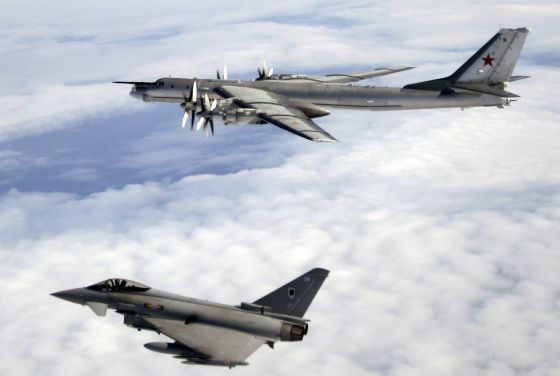
bear-typhoon

Reuters reports: Britain summoned the Russian ambassador on Thursday and asked him to explain why two Russian “Bear” long-range bombers had flown over the English Channel the previous day, forcing British authorities to reroute civil aircraft.

A British government source told Reuters the incident, which forced Britain to scramble Typhoon interceptor jets, was viewed as “a significant escalation” and marked a change in strategy since Russian aircraft had previously largely confined themselves to flying close to Scotland.

“It was very dangerous. Civil aircraft flying to the UK had to be rerouted,” the source said. “The Russians were flying with their transponders turned off so could only be seen on military radar. They haven’t flown this far south before.”

The Foreign Office said it had summoned Russian Ambassador Alexander Yakovenko to account for the incident, saying the episode was part of an increasing pattern of “out of area operations” by Russian aircraft.

“The Russian planes caused disruption to civil aviation. That is why we summoned the Russian Ambassador today to account for the incident,” it said in a statement.

Last year, NATO conducted more than 100 interceptions of Russian aircraft, about three times as many as in 2013, amid increased tensions between the West and Moscow over the Ukraine crisis. [Continue reading…]

The Guardian reports: Observers said a possible explanation of the timing ofWednesday’s flypast was the start this week of a public inquiry in London into the 2006 killing of a former Russian intelligence officer, Alexander Litvinenko, by radioactive poisoning.

The UK has charged two former KGB agents with the murder. A lawyer for Litvinenko’s widow has claimed in court that the assassination was ordered by Vladimir Putin.

“This may be timed with the Litvinenko court case as a signal of displeasure,” Ian Kearns, the director of the European Leadership Network, and an associate fellow at the Royal United Services Institute, said. “But it fits with a wider posture of a more assertive Russian demonstration of a growing capability to defend and assert its interests as it sees fit.”

Facebooktwittermail

How Syriza could make a debt relief deal palatable to Germany

Henning Meyer writes: Following the formation of the new Greek government we are entering a period of negotiation. This is good news, and overdue given the scale of the social and economic crisis in Greece. The new prime minister, Alexis Tsipras, has announced that he will not unilaterally walk away from Greek obligations but seek dialogue with creditor countries. He has a clear mandate for change, but it is also important to bear in mind the constraints on the other side of the negotiation table.

Angela Merkel’s coalition government in Germany also operates within clear political limits, partly because a faulty narrative about the origins of the eurozone crisis has been circulating in Germany for half a decade. This is very unfortunate but makes a full U-turn on Greece unlikely. The anti-euro AfD – Alternative for Germany – has been gaining political support since the European elections last May, and is now trying to use the anti-Islam Pegida protests in some parts of the country to further draw disaffected citizens into its orbit. These are new phenomena in German politics and help to explain – though not excuse – the stubbornness with which misguided policies have been pursued. As in other countries, the German political elites are afraid of losing traction in society and have become excessively cautious as a result.

But there is light at the end of tunnel. The opposing parties might be at loggerheads at the moment but there is scope for a political deal that would allow both sides to keep their integrity. Here are the three things that need to come together. [Continue reading…]

Facebooktwittermail

Syriza’s finance minister has a big idea – but will Germany accept it?

Linsey McGoey writes: Since Syriza’s victory in the Greek elections on Sunday, it is the new Essex-educated finance minister Yanis Varoufakis who has been grabbing most of the headlines. Much of his appeal lies in his iconoclasm: in his 1998 book Foundations of Economics, a kind of bible for the growing alternative economics movement, he cites the British Keynesian Joan Robinson: “The purpose of studying economics is to learn how not to be deceived by economists.”

But what can we expect from this reluctant economist and reluctant politician intellectually? Announcing his decision to run for a parliamentary seat on Syriza’s ticket on his personal blog, Varoufakis stressed that he never wanted to run for office, preferring to channel his policy ideas across the political spectrum. But he grew tired of seeing his policies ignored. Above all he wants to draw attention to an idea that was first conceived by one of his major intellectual influences: John Maynard Keynes. It’s an idea that even ardent Keynsians often neglect; an idea that Keynes dramatically announced to a group of sceptical listeners at the 1944 Bretton Woods conference; an idea that runs diametrically counter to the current policies of Germany’s government. That idea is a global surplus recycling mechanism. [Continue reading…]

Facebooktwittermail

Does defeat in Kobane mark the beginning of the end for ISIS?

Al Jazeera reports: Losing Kobane after more than four months of intense fighting is a significant propaganda blow to ISIL. The group invested extensive military resources to capture the isolated town on the border with Turkey.

“Daesh [ISIL] took most of the places it wanted in Syria and Iraq but could not capture Kobane,” said Anwar Muslim, the prime minister of the self-ruled administration of Kobane, referring to the organisation by its Arabic name.

“This victory marks the beginning of the end for Daesh.”

Kurdish forces have so far taken control of at least three villages in the southern surroundings of Kobane. It will be a highly challenging task for them to expel ISIL from the dozens of villages that dot the plains around the agricultural town. [Continue reading…]

Robin Wright writes: Stuart Jones, the U.S. Ambassador to Iraq, told Al Arabiya last week that more than six thousand militants, including many top commanders, have died in Iraq and Syria since launching their blitz last summer. Some are apparently no longer so keen on martyrdom. The senior Administration official also said that the human toll may be demoralizing to ISIS. “We track quite closely the over-all attrition of its ranks, its vehicles, and the dissension it has caused within the organization,” he said. “We understand that a lot of its fighters now are simply refusing to go to Kobani, and the fighters refusing to go to Kobani are being assassinated by ISIL.”

The campaign has been expensive for the West. The U.S.-led coalition ran more than six hundred airstrikes on Kobani — eighty per cent of all its bombings in Syria — which cost hundreds of millions of dollars. Kobani has certainly paid a price. Fighting and bombings have destroyed half the city, which now has no economy, let alone electricity. There is little left for the forty thousand residents who fled; many may remain refugees for some time.

Kobani’s fate could have little impact on how the rest of Syria fares. It may be true, as the senior Administration official told me, that in areas of northern Iraq where ISIS’s command and control is broken down, “its ability to direct fighters to certain areas of the front — where, whenever fighters go there, they never return — is not nearly what it was four months ago.” But the Islamic State nevertheless appears capable of recruiting more men. Twenty thousand foreigners have now gone to fight in Syria and Iraq. It is “the largest mobilization of foreign fighters in Muslim countries since 1945,” the International Centre for the Study of Radicalisation and Political Violence, at King’s College London, reported on Monday.

The total number of foreign fighters now exceeds that of foreigners mobilized during the ten-year war against the Soviet occupation in Afghanistan, which was the genesis of extremist movements like Al Qaeda. Unlike the situation in the eighties, though, nearly a fifth of today’s fighters — some four thousand — are residents or nationals of Western European countries, the I.C.S.R. reported. The largest numbers come from France, Britain, and Germany. Others come from Ukraine, China, and New Zealand. [Continue reading…]

Facebooktwittermail

ISIS affiliate in Egypt claims responsibility for attack that killed 32 in Sinai

Reuters: Egyptian President Abdel Fattah al-Sisi cut short a visit to Ethiopia for an African Union summit on Friday after Islamic State’s Egyptian wing claimed the killing of at least 30 soldiers and police officers in the Sinai Peninsula.

The four separate attacks on security forces in North Sinai on Thursday night were among the bloodiest in years and the first significant assault in the region since the most active Sinai militant group swore allegiance to IS in November.

Militant attacks in Sinai, while far from Cairo and tourist attractions, has crimped government efforts to project an image of stability to woo back foreign investors and tourists driven away by frequent political violence since a popular uprising four years ago that overthrew veteran autocrat Hosni Mubarak.

Facebooktwittermail