The New York Times reports: The United States has conducted an escalating campaign of deadly airstrikes against the extremists of the Islamic State for more than a month. But that appears to have done little to tamp down the conspiracy theories still circulating from the streets of Baghdad to the highest levels of Iraqi government that the C.I.A. is secretly behind the same extremists that it is now attacking.
“We know about who made Daesh,” said Bahaa al-Araji, a deputy prime minister, using an Arabic shorthand for the Islamic State on Saturday at a demonstration called by the Shiite cleric Moktada al-Sadr to warn against the possible deployment of American ground troops. Mr. Sadr publicly blamed the C.I.A. for creating the Islamic State in a speech last week, and interviews suggested that most of the few thousand people at the demonstration, including dozens of members of Parliament, subscribed to the same theory. (Mr. Sadr is considered close to Iran, and the theory is popular there as well.)
When an American journalist asked Mr. Araji to clarify if he blamed the C.I.A. for the Islamic State, he retreated: “I don’t know. I am one of the poor people,” he said, speaking fluent English and quickly stepping back toward the open door of a chauffeur-driven SUV. “But we fear very much. Thank you!” [Continue reading…]
Category Archives: Lands
Christianity in Iraq is finished
Daniel Williams writes: In the part of his Sept. 10 speech on confronting the Islamic State that probably drew the least attention, President Obama mentioned the need to help Christians and other minorities, expelled from cities and villages in northern Iraq, return from where they came. “We cannot allow these communities to be driven from their ancient homeland,” he said.
Obama got that wrong. Christians, of whom around 120,000 have taken refuge in Iraqi Kurdistan, will not be going home even if their tormentors suddenly disappear.
I spent 10 days talking with Christian refugees in Irbil, the capital of the northern autonomous region of Kurdistan, this month, and they are adamant they will not be returning to Mosul and nearby towns on what is known as the Nineveh Plain.
It is not simply that these Christians have gone through tremendous trauma. It is not only because they lost everything, including their homes and businesses, and in some cases spent days and even weeks in detention while being badgered to convert to Islam, where they saw babies taken from mothers’ arms to be held for ransom and busloads of young people ferried off into the unknown.
Nor is it because their neighbors, in Mosul but especially in the countryside, welcomed and even joined fighters from the Islamic State, pointed out the homes of minorities and let them know which ones were wealthy.
No, it is because, for Christians in Iraq, the past three months have been the climax of 11 years of hell. We Americans have short memories (that goes for you, too, in the “Bush Was Right” crowd), but it’s worth noting that Christians began having serious problems within a year after the fall of Saddam Hussein in 2003. Sometimes it was the work of al-Qaeda, sometimes Sunni insurgents pining for the return of Sunni control of Iraq. Sometimes it was Shiite militias fighting the Sunnis but finding time to persecute Christians. [Continue reading…]
Turkey somehow secures release of 49 hostages held by ISIS
Not a shot fired, no ransom paid, no prisoners exchanged, but somehow Turkish intelligence (MİT) agents managed to escort 49 captives out of Syria and back to Turkey earlier today.
So far, the only clue on how Turkey managed to pull off this operation comes from Hurriyet Daily News reporting this: “there are indications of a kind of false flag, or deception operation by MİT. In answering such a question one ranking official said MİT ‘has tried every possible method and left no stone unturned’ to get the hostages alive.”
But the same report also describes ways in which the operation was coordinated with ISIS:
It was ISIL’s condition to give the hostages to Turkey at the border with Syria, “Because of their own security concerns due to their heavy clashes with Kurdish forces. They did not want to make the handover through the Kurdish region,” a security source told HDN.
The report also says: “One official source said ISIL might have ‘not wanted to get into a clash with Turkey’.”
As has widely been reported, a reluctance to put the lives of these hostages in jeopardy was one of Turkey’s main reasons for declining to join the U.S.-led coalition against ISIS — all the more reason to assume that ISIS must have believed that its interests would in some other way be served by releasing the hostages.
The PKK has called on Kurds in Turkey to join their comrades in Kobane, northern Syria, where they are fighting alone against ISIS. Perhaps Turkey threatened ISIS that if it did not free the hostages, Turkey would do nothing to prevent the flow of Kurdish recruits into Syria.
In spite of the suggestion that ISIS was deceived in some way, I’m inclined to believe that the group had reason to expect that it had more to gain by releasing its Turkish hostages than it could by holding on to them.
Slemani Times, an independent English language news publication, covering the Kurdistan Region, Iraq, and the Middle East, in an unsourced tweet offers this explanation for how Turkey successfully negotiated the release of the hostages:
#Turkey has released over 180 #ISIS detainees and transported them by military trucks to the Turkish-Syrian border close to #Kobane. #ISIL
— Slemani Times (@SlemaniTimes) September 20, 2014
About 60,000 Syrian Kurds flee to Turkey as ISIS advances
Reuters reports: About 60,000 Syrian Kurds have crossed into Turkey in the past 24 hours, a deputy prime minister said on Saturday, fleeing an advance by Islamic State militants who have seized dozens of villages close to the border and are advancing on a Syrian town.
Turkey opened a stretch of the frontier on Friday after Kurdish civilians fled their homes, fearing an imminent attack on the border town of Ayn al-Arab, which is also known as Kobani. Islamic State is now within 15 km (9 miles) of the town, a Kurdish commander on the ground said.
Islamic State’s advances in northern Syria have prompted calls for help by the region’s Kurds who fear a massacre in Kobani. The town sits in a strategic position on the border and has prevented the radical Sunni Muslim militants from consolidating their gains across northern Syria.
Lokman Isa, a 34-year-old farmer, said he had fled with his family and about 30 other families after heavily-armed Islamic State militants entered his village of Celebi. He said the Kurdish forces battling them had only light weapons. [Continue reading…]
The PKK’s strategy for fighting ISIS
Jamil Bayek, the head of the PKK Leadership Committee, says in an interview appearing in As-Safir and translated by Al-Monitor: We have a clear strategy, the most important thing in it is that we do not view IS as an organization, but as a group of mercenaries and murderers who pose a threat to the region’s peoples, cultures and religions, even a threat to all humanity. Since the PKK is a humanitarian movement and in light of this brutal onslaught against the peoples of the region in general and [against] the will of our people in western Kurdistan in particular, we are determined to break the will of those mercenaries. Our directives are clear in this regard: we will attack IS wherever it is found, with all our capabilities. We will not allow it to advance and achieve its goals. And we will be ready to lead a joint struggle alongside all those who resist IS and who have a clear position toward it, in order to defeat these mercenaries, liquidate them, and obliterate them from existence.
As-Safir: What is your position regarding the international coalition led by the United States against the Islamic State?
Bayek: Humanity should be aware what IS is and how it arose. This group did not fall from the sky and did not appear accidentally or suddenly. Many analyses indicate that Middle Eastern and international powers used IS to achieve their interests. At the moment, we see that the US does not want IS to achieve progress that allows it to become a great Middle Eastern power, especially since it has reached a dangerous point.
There are objective and good American attempts to confront this danger. But the problem, in our view, is not limited to IS, as there is a structure upon which these mercenaries stand, launch from, and protect themselves with. Therefore, we see that there is a need to get rid of this structure by establishing a shared democracy and freedom among the peoples of the Middle East on the basis of fraternity and equality as a substitute for the authority of the nation-state. We believe that the basis of the solution starts from here. Regarding the US measures to address IS, they are good steps without a doubt. They may produce certain results at a certain time. As long as IS constitutes a threat, military measures remain necessary. But achieving the desired results requires a radical solution. It involves, as I said earlier, “democratizing” the Middle East and achieving freedom for its all peoples. [Continue reading…]
How oil is smuggled from Syria into Turkey
Fehim Taştekin reports: From Ezmerin [a village in Syria], about 500 illegal oil pipelines, small-diameter plastic pipes normally used for irrigation, extend to the Turkish side of the Asi River. On the Turkish side, they are buried under agricultural fields to reach the village. Just like the village’s underground water distribution lines, oil pipelines crisscross under streets to reach the back yards of private houses. Diesel fuel pumped from a tanker on the Syrian side fills the private tanks. Simple “pump” and “stop” commands are given over cellular phones.
Consumers come to the houses of sellers and buy the diesel for 1.25 Turkish lira per liter ($0.56). This is how the system worked for a long time.
The state began to intervene only after the international media started to question whether Turkey was supporting IS and whether IS oil was being sold in Turkey. At the end of March, soldiers that had until then been watching the goings on from a hilltop about 100 meters from the river began digging up the pipes from the fields and cutting the ones that lay visible in the streets. Checkpoints were established to prevent the diesel from leaving Hacipasa. But the smugglers always found ways to bypass the gendarmerie, the latest being shipping the fuel in barrels. [Continue reading…]
Iraq’s Shiite militias are becoming as great a danger as ISIS
Phillip Smyth writes: Armed men posing with severed heads, massacres of mosque-goers during Friday prayers, massive reliance on transnational jihadists — these are crimes that are usually associated with the Islamic State (IS). However, they’re also the actions of some of Iraq’s growing Shiite militia organizations, which are playing an increasingly prominent role in fighting the Sunni jihadists. These groups, many of which have deep ideological and organizational links to Iran, are sweeping away what is left of any notion of the Baghdad government’s authority — and represent a massive challenge to President Barack Obama’s stated goal of working with an inclusive Iraqi government to push back IS.
Over 50 Shiite militias are now recruiting and fighting in Iraq. These groups are actively recruiting — drawing potential soldiers away from the Iraqi army and police and bringing fighters into highly ideological, anti-American, and rabidly sectarian organizations. Many of these trainees are not simply being used to push back Sunni jihadists, but in many cases form a rear guard used to control districts that are supposedly under Baghdad’s control.
Shiite militias have embedded themselves within the structures of the Iraqi government, which has become far too reliant on their power to contemplate cracking down on them. Together, they have committed horrifying human rights abuses: In early June, Shiite militias, along with Iraqi security forces, reportedly executed around 255 prisoners, including children. An Amnesty International report from June detailed how Shiite militias regularly carried out extrajudicial summary executions, and reported that dozens of Sunni prisoners were killed in government buildings. [Continue reading…]
Harsh sentences for Happy Iranians
IranWire reports: It’s been a tense, worrying time for Iran’s “Happy” group, the seven young men and women arrested in May for posting their version of Pharrell Williams’ music video on YouTube. Over the last few days, they’ve been pacing up and down the hallways of the Tehran courthouse where their trial was due to take place , making sure all their legal papers were in order.
Today their lawyer, Farshid Rofugaran, told IranWire that six of his clients had been sentenced to six months in prison and 91 lashes. One of them was given a sentence of one year in prison and 91 lashes. “Fortunately,” said Rofugaran, “the sentences were suspended.” But he was quick to point out that, until he received official notification, he could not be 100 percent sure of his clients’ situation.
“A suspended sentence becomes null and void after a certain period of time,” Rofugaran said. For the Happy Group, that period will be three years. “When it’s a suspended sentence, the verdict is not carried out, but if during this period a similar offense is committed, then the accused is subject to legal punishment and the suspended sentence will then be carried out as well.” [Continue reading…]
I expect that among the anti-imperialist left, this story will pass without comment or perhaps without even being noticed — don’t expect it to be covered by Press TV.
Iran’s credentials as a resolute critic of American hegemony along with its vocal opposition to Zionism, means that for some in the West, the Islamic republic’s failings can mostly be forgiven.
There is in such an attitude a perverse contradiction.
On the one hand the West is viewed as fundamentally undemocratic, operating a system of rule in which the masses are pacified with distractions and trivial freedoms while their lives are controlled by corporate and political interests that are indifferent to the common good. But at the same time, political oppression in a state like Iran is largely ignored — as though, depending on the circumstances, oppression can be justified in the name of a noble cause.
What to my mind is inexcusable is that anyone, anywhere, should find it excusable that someone could be threatened with imprisonment and lashing because they were “guilty” of dancing and failing to follow a dress code.
If this kind of harmless self-expression is not viewed as a human right, it calls into question the very notion of human rights.
The root cause of extremism among British Muslims is alienation
Afua Hirsch writes: Britain has a problem with terrorism. Nothing focuses the mind more than the image of an apparently British man addressing the world in high definition as he brutally beheads a fellow Brit. But while the numbers of violent extremists are, by all accounts, relatively small, the issues underlying their reasons for turning towards terrorism are widespread.
I’ve been talking to young Muslims for a documentary on the root causes of extremism, and it’s clear there are a series of common complaints. Primarily, even though David Cameron may have said the killers of David Haines “are not Muslims, they are monsters”, young Muslims still have a profound and consistent sense of being demonised by society, and as creating a source of fear.
Further, many people still fail to distinguish between the different motivations for Brits travelling to the Middle East. It struck me how many young Muslims want to travel to Syria to help with the desperate humanitarian situation, or to join rebels trying to bring down President Assad – a goal that until recently was in line with Britain’s own foreign policy. However, the people I spoke to fully expected to be welcomed back to the UK by being arrested, slapped with a TPim and stripped of their passport.
For a passionate teenager, watching the suffering in Syria and believing that they are barred from contributing because of double standards driven by Islamophobia can create extreme feelings of alienation. And for those who are converted to extremism, there are usually other factors: contact with a seductive and effective hate preacher, indifference towards or a desire for violence, a sense of purposelessness – in some cases the same factors that attract young people to criminal gangs.
For a generation of non-Arabic speaking Muslims for whom the complexities of their faith can be lost in translation, recruiters from groups such as Islamic State (Isis) can play on this vulnerability. [Continue reading…]
5 reasons to be cheerful — even if you voted Yes for Scottish independence
Alex Andreou writes: Very few political issues have made me vacillate as much as the Scotland independence referendum. I started as an instinctive no, but by the end of the campaign significant strands of my thinking had moved so completely over to yes that I woke up this morning feeling both relieved and disappointed. There are, however, reasons to be universally cheerful, even for people who campaigned for and voted yes.
1. Hope is a vote-winner
Some have concluded that the result means that “fear works”. The truth is quite the opposite. Remember, this was supposed to be a cake-walk for the Better Together campaign. Instead, the government had to cobble together a contingency-plan in a panic two weeks ago. For a message of optimism to have narrowed the gap to that from 20 points a year ago is a tremendous victory. In fact, Better Together only pushed against that momentum when they themselves made positive promises for future devolution. It is a vision for the future, not fear, that ultimately worked.
2. Wider political engagement is possible
The unprecedented turnout of 85% – but also the astonishing sophistication of the debate at every level – means that the voting public are neither congenitally apathetic nor impenetrably thick, as the ruling classes would have us believe. Apathy results from the choices on offer being indistinguishable from each other and an electoral system where individual votes do not matter. [Continue reading…]
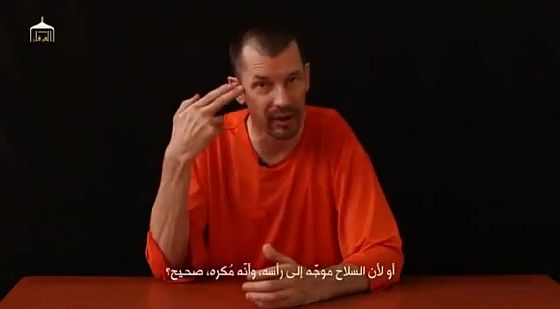
‘Lend me your ears’ (and pay up) — an ISIS ransom note
“After two disastrous and hugely unpopular wars in Afghanistan and Iraq, why is it that our governments appear so keen to get involved in yet another unwinnable conflict?”
The question comes from a British journalist, John Cantlie, who has been a prisoner of ISIS for most of the last two years and who has now been compelled to become the organization’s spokesman.
In a newly released video he continues:
I’m going to show you the truth behind these systems and motivation of the Islamic State, and how the western media, the very organisation I used to work for can twist and manipulate that truth to the public back home.
There are two sides to every story – think you’re getting the whole picture? And I’ll show you the truth behind what happened when many European citizens were imprisoned and later released by the Islamic State and how the British and American governments thought they could do it differently to every other every other European country.
They negotiated with the Islamic state and got their people home while the British and Americans were left behind.
It’s very alarming to see where this is all headed and it looks like history repeating itself yet again. There is time to change this seemingly inevitable sequence of events, but only if you, the public act now. Join me for the next few programmes and I think you may be surprised by what you learn.
Stay tuned.
ISIS is frequently credited for its media sophistication, but its use of a prisoner to serve as a spokesman shows how impoverished the organization must be when from among its thousands of Western recruits apparently there aren’t any fit to represent and articulate the cause they are all fighting for. (Individuals like Moner Mohammad Abusalha from Florida might accurately represent the Western face of ISIS, but they also undermine the organization’s credibility.)
When we are told that several European governments successfully negotiated with ISIS and “got their people home,” no mention is made of ransoms being paid.
While ISIS’s latest message tries to leverage antiwar sentiment in the West, no one should mistake this as a wise warning whose purpose is to forestall another military misadventure.
Put most simply the message is: hold fire, pay up, or John Cantlie will meet the same fate as James Foley, Steven Sotloff, and David Haines.
Other commentators have argued that ISIS’s use of beheading videos has been designed to bait the West — to draw the U.S. and its allies into another unwinnable war — but the latest video seems to confirm what I have said repeatedly: ISIS wants to consolidate and expand its caliphate since its success in doing that serves as a much potent magnet for recruits than the prospect of being targeted in U.S. airstrikes.
In response to the start of U.S. military operations in Iraq, ISIS seems to have focused most of its efforts beyond America’s current reach by making gains in Syria.
Even though President Obama says he is ready to order airstrikes in Syria, there seems little reason to believe that these are imminent, and ISIS wants to use the intervening period to its full advantage.
The Cantlie video is the second ISIS releases this week.

“Fighting has just begun” declares the “trailer” for its Hollywood-style “Flame of War,” but as it did in its other video release this week, Alhayat Media Center is addressing the public, rather than Western governments, in an effort to increase war fears more than war fever.

Obama’s recipe for endless war in Syria
Shortly before President Obama unveiled his strategy for defeating ISIS (aka Daesh), NotGeorgeSabra wrote: Obama is expected to announce a grand strategy to defeat the Islamic State (ISIS, or Daesh) one year after he sold Syria’s rebels down the river and betrayed his own self-imposed “red line.”
This strategy will be billed as comprehensive, encompassing all elements of American imperialism’s tremendous national power — military, economic, diplomatic, political — but there are unresolved contradictions with the Syrian aspect of this grand strategy that, taken together, will add up to the kind of strategic and political incoherence that Daesh will surely exploit to survive and persist in their Syrian safe haven for years, a safe haven created by Obama’s do-nothing-but-stupid-shit policies.
The central problem with Washington’s policy from the standpoint of ending Daesh is the U.S. goal of a negotiated settlement between the revolution and the counter-revolution in Syria, one that removes Bashar al-Assad from the presidency but preserves the state he and his father built intact.
Why is this a problem? Judge a policy by its results — a ruinous, intractable war that has resulted in the biggest humanitarian catastrophe of the century, a weak and divided rebel movement starving for weapons and money, a militarily robust failed state in the making headed by a man who doesn’t hesitate to gas his own people, and Daesh, a fascist organization that wields state power in one-third of both Syria and Iraq whose thousands of veteran fighters have years of combat experience and Western passports!
How did America’s preference for a negotiated, peaceful settlement in Syria lead to endless war and bloodshed?
Simple: the U.S. (tandem with its regional allies) provided rebel forces with just enough weapons to keep fighting but not to win. [Continue reading…]
(H/t Scott Lucas)
If Obama wanted to, he could help free thousands of enslaved Yazidi women in a single day
Matthew Barber writes: The plight of thousands of Yazidi women, kidnapped by the Islamic State (IS) during its August 3 attack on Iraq’s Sinjar mountains and in the following weeks, has received some media attention, but most people are unaware of just how far-reaching this disastrous phenomenon is. Boko Haram kidnapped girls in the hundreds, prompting international outcry and an online campaign demanding that they be freed; IS has kidnapped Yazidi women and girls in the thousands in a sexually-motivated campaign that has rent apart countless families and wrought unimaginable levels of pain and destruction.
During the Syria conflict there have been numerous allegations of forced jihadi marriages that have been difficult to confirm, and widely denied by IS supporters online. Many of those stories were dropped, lacking credible evidence. As the past few years in Syria have demonstrated, rumors run rampant in contexts of conflict, and the initially difficult-to-confirm cases of kidnapped Yazidi women of this summer have been treated with appropriate caution.
Despite this initial caution, the sheer scale of the kidnapping of Yazidi women and the firsthand reports of escaped survivors—and those still in captivity via telephone—have made details of the phenomenon, and its sexual motivations, certain.
Having stayed in northern Iraq all summer, I can confirm the assertions of the journalists who have written about the problem. I have worked directly with those involved in rescue efforts and have personally interacted with families whose daughters have been kidnapped and are now calling their relatives from captivity.
I have no trace of doubt that many women have been carried off and imprisoned; the question that remains is about the numbers. Restrained estimates have posited numbers of kidnapped Yazidi women in the hundreds. However, the reality is likely to be in the thousands. [Continue reading…]
ISIS captures 21 Kurdish villages in northern Syria
Syrian Observatory for Human Rights reports: ISIS have taken over 21 villages inhabited by Kurdish civilians, in the western and eastern countrysides of Ein al-Arab “Kobane” after a massive attack using heavy artillery and tanks, confirmed reports of losses in both of YPG and ISIS sides, in addition to human losses in Kurdish civilians, the area is witnessing a migration of civilians into areas nearby, amid fears of committing massacres by ISIS in these areas in case it broke into it, the clashes continue between the two sides near these areas.
SOHR also reports: Reliable resources have confirmed to SOHR that 162 people have joined to IS military camps in the northern eastern and eastern countryside of Aleppo since September 10 and after the President Barack Obama’s speech where he has declared war on the Islamic States. Among those who have joined in the past seven days, 15 fighters from different Arab and foreign nationalities, including 4 Australian persons entered to Syria through Turkish territory and 147 ex- Syrian combatants of al Nusra Front and the Islamic battalions.
It is worth mentioning that reliable resources reported to SOHR that 6300 fighters joined to the training camps of the Islamic State in the two cities of Aleppo and Al Raqqa in the last July in 2014, where this is considered the widest process of recruiting fighters in the Islamic State’s ranks since the declaration of establishment in April/2013 in the city of Al Raqqa until it transferred to the Islamic State in the late of June/2014.
Anti-terror operation in Australia ‘thwarted’ beheading plot
ABC (AU) reports: Police say a large-scale anti-terrorism raid in Sydney this morning has foiled a plot to “commit violent acts” in Australia, including a plan to behead a member of the public.
More than 800 officers launched the raids as part of Operation Appleby in suburbs across Sydney’s west and north-west, with a further 70 police involved in raids on properties in Brisbane’s south.
Police said 15 people had been detained in Sydney as part of the operation between NSW officers, the Australian Federal Police and ASIO.
Court documents are expected to reveal that the raids, at 25 different properties, were aimed at a cell which planned to behead a member of the public in Sydney.
The documents are expected to say that the plan involved snatching a random member of the public in Sydney, draping them in an Islamic State group (IS) flag and beheading them on camera. [Continue reading…]
There is a ruthless logic in terrorism: it always aims to produce the maximum effect from the minimum amount of resources.
At a time when increased security measures have made international plots aimed at bombing or hijacking aircraft especially difficult, it is easy to see why beheading is becoming the preferred technique through which an organization such as ISIS can terrorize its enemies.
No need for any expertise or hard-to-acquire materials — all that is required is a knife, a camera, a YouTube account, and someone willing to murder a helpless victim.
Up until recently, we might have imagined that executioners of this kind would be hard to find, but unfortunately we are learning otherwise.
British Muslim leaders unite to call on ISIS to release Alan Henning
The Independent reports: Over one hundred Muslim leaders today make an unprecedented joint appeal to the kidnappers of Alan Henning to release the aid worker unharmed or commit the “worst condemnable sin” against Islam.
The joint statement to The Independent has been signed by dozens of Imams from across the UK as well as community leaders and other prominent Muslims. It has been passed on to Mr Henning’s family.
Among those signing the letter are representatives of all strands of Islam from Shia to Sunni to Salafi, Sufi, and Deobandi.
The Muslim Council of Britain an umbrella body with over 500 affiliated national, regional and local organisations including mosques, charities and schools is also a signatory. [Continue reading…]
Egypt begins surveillance of Facebook, Twitter, and Skype on unprecedented scale
BuzzFeed reports: Egyptians’ online communications are now being monitored by the sister company of an American cybersecurity firm, giving the Egyptian government an unprecedented ability to comb through data from Skype, Facebook, Twitter, and YouTube, among others.
See Egypt, the sister company of the U.S.-based Blue Coat, won the contract over the summer, beating out the British Gamma System, and the Israeli-founded Narus System. See Egypt has begun monitoring Egyptians’ online communications, according to several Egyptian government officials who spoke to BuzzFeed News.
“See Egypt has already worked with the government and has strong ties to the State Security Services,” said one official. He asked to remain anonymous, to protect his position within the government. “They were a natural choice and their system is already winning praise.”
While Egypt has tracked online communication in the past using surveillance systems that allowed officials to loosely monitor local networks, See Egypt is the first time the government will be widely using the Deep Packet Inspection technology that enables geolocation, tracking, and extensive monitoring of internet traffic. [Continue reading…]
Leading Egyptian blogger and activist granted bail
BuzzFeed reports: One of Egypt’s most prominent activists has been granted release on bail, but still faces a lengthy judicial process that could see him sent back to prison.
Alaa Abdel Fattah was tried in absentia and handed a 15-year prison sentence in June over charges that he violated new laws that severely curtail protests. He was arrested along with several other activists on the steps of the courthouse immediately after the verdict, and a court has ordered that he be retried now that he is no longer in absentia.
“The court ordered the release on bail of Alaa Abdel Fattah and two other detainees,” Abdel Fattah’s defense lawyer, Mohamed Abdel Aziz, said outside the court in comments broadcast on Egyptian television. “The court also recused itself because of the defendants’ lack of respect for it.” [Continue reading…]


