Category Archives: Lands

Palestinian leaders poised to join #ICC in order to pursue #Israel for #WarCrimesInGaza

The Guardian reports: Palestinian political leaders are poised to join the International Criminal Court (ICC) with the aim of putting Israel in the dock on war crimes charges, officials said today.

“Israel has left us with no other option,” Riad Malki, the Palestinian foreign minister, told reporters after meeting ICC officials in The Hague to discuss the implications of signing the Rome Statute. It would make the Palestinian state a member of the court with the authority to call for an investigation into possible war crimes and crimes against humanity.

The Palestinian Authority has asked Hamas and Palestinian Islamic Jihad (PIJ) to sign the accession document before it is formally presented, and officials say they now expect both organisations to agree. [Continue reading…]

Facebooktwittermail

International criminal court urged to investigate #Gaza ‘crimes’

The Guardian reports: Senior British lawyers have written to the international criminal court (ICC) in The Hague, urging it to investigate “crimes” committed in Gaza, including the destruction of homes, hospitals and schools.

The letter was sent by Kirsty Brimelow QC, the chair of the Bar Council’s human rights committee, and was signed by a host of senior British barristers and law professors.

Addressed to the ICC prosecutor, Fatou Bensouda, it calls on the court to launch a preliminary inquiry into abuses committed during the conflict.

“The initiation of an investigation would send a clear and unequivocal message to those involved in the commission of these crimes that the accountability and justice called for by the United Nations on the part of victims are not hollow watchwords,” the letter states.

“It would bring about an end to the impunity which has prevailed in the region to date, fuelling ever increasingly brutal cycles of violence. The international community cannot continue to act simply as witness to such bloodshed and extreme civilian suffering.”

The lawyers say that it is within the ICC’s jurisdiction to act because the government of Palestine made a declaration in 2009 accepting the court’s role and the UN has since acknowledged Palestine as a non-member observer state. [Continue reading…]

Facebooktwittermail

Israel and its allies need to recognize that Hamas has political legitimacy

Jimmy Carter and Mary Robinson write: Unity between Fatah and Hamas is currently stronger than it has been for many years. As Elders, we believe this is one of the most encouraging developments in recent years and welcome it warmly. This presents an opportunity for the Palestinian Authority to reassume control over Gaza — an essential first step towards Israel and Egypt lifting the blockade.

The Palestinian Authority cannot manage the task of administering Gaza on its own. It will need the prompt return of the EU Border Assistance Mission, an international effort to help monitor border crossings that was launched in 2005 and suspended in 2007. EU High Representative Catherine Ashton has already offered to reinstate the program, covering not only Rafah but all of Gaza’s crossings. Egypt and Israel would, in turn, cooperate with international monitors to be deployed in Gaza and along its borders, backed by a U.N. Security Council mandate to protect civilian populations. A valuable precedent for trust-building between Egypt and Israel is the international peacekeeping force operating in the Sinai, mandated by the peace treaty signed by the two countries in 1979.

The international community’s initial goal should be the full restoration of the free movement of people and goods to and from Gaza through Israel, Egypt, and the sea. Concurrently, the United States and EU should recognize that Hamas is not just a military but also a political force. Hamas cannot be wished away, nor will it cooperate in its own demise. Only by recognizing its legitimacy as a political actor — one that represents a substantial portion of the Palestinian people — can the West begin to provide the right incentives for Hamas to lay down its weapons. Ever since the internationally monitored 2006 elections that brought Hamas to power in Palestine, the West’s approach has manifestly contributed to the opposite result. [Continue reading…]

Facebooktwittermail

No innocent civilians in #Gaza, says former head of #Israel’s National Security Council

Giora Eiland is a retired Major General from the Israel Defense Forces. As head of Ariel Sharon’s National Security Council, Eiland helped draft Israel’s disengagement plan for removing Israeli military forces and settlers from Gaza.

In an op-ed for Ynet today, “In Gaza, there is no such thing as ‘innocent civilians’,” Eiland provides a rationale for making no distinction between Palestinian fighters and Palestinian children — they all in his mind belong to an “enemy state.”

[W]e must avoid the artificial, wrong and dangerous distinction between the Hamas people, who are “the bad guys,” and Gaza’s residents, which are allegedly “the good guys.” We are dealing with an enemy state, not with a terror organization which is seemingly operating from within an innocent civilian population.

He hardly needed to articulate this view as though it constitutes a policy recommendation, since it appears to be perfectly in accordance with the way in which the Israeli government, its military commanders, and its individual soldiers, have conducted the latest war.

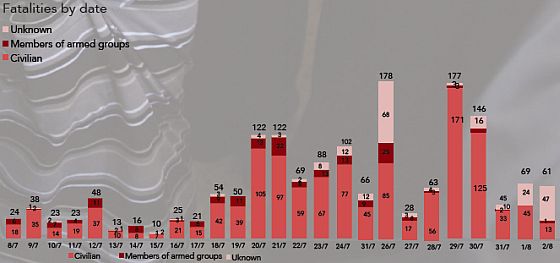
The casualty figures, as compiled by the UN, speak for themselves:

war-on-civilians

Facebooktwittermail

British government minister resigns because UK policy on Gaza is ‘morally indefensible’

It used not to be such a rarity — that a top government official would resign on a matter of principle — yet in this century it has become virtually unheard of.

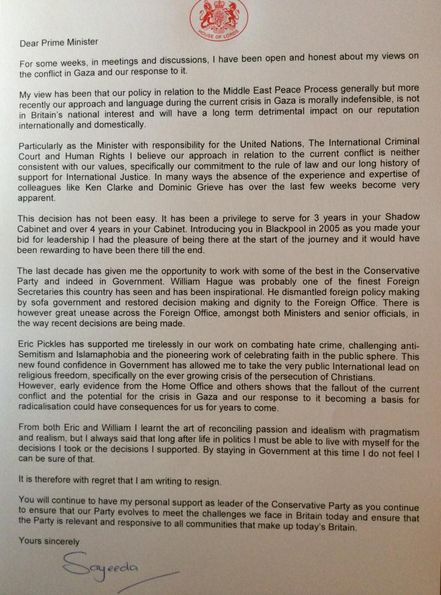
In her letter to Prime Minister David Cameron, Sayeeda Warsi wrote: “I have always said that long after life in politics I must be able to live with myself for the decisions I took or the decisions I supported. By staying in Government at this time I do not feel I can be sure of that.”

The Guardian reports: Lady Warsi, the senior Foreign Office minister, has resigned from the government in protest at its policy on Gaza, describing it as “morally indefensible”.

Warsi announced her departure on Twitter on Tuesday, saying: “With deep regret I have this morning written to the Prime Minister & tendered my resignation. I can no longer support Govt policy on #Gaza.”

In her resignation letter, Warsi said the government’s “approach and language during the current crisis in Gaza is morally indefensible, is not in Britain’s national interest and will have a long term detrimental impact on our reputation internationally and domestically”.

She said the UK’s stance was “not consistent with the rule of law and our long support for international justice”, adding: “The British government can only play a constructive role in solving the Middle East crisis if it is an honest broker and at the moment I do not think it is.” [Continue reading…]

This is Warsi’s resignation letter:

resignation-letter

Facebooktwittermail

#Obama won’t end #Israel’s war on #Gaza

After an Israeli airstrike near a UN shelter which killed at least 10 people on Sunday, the State Department issued a statement saying: “The suspicion that militants are operating nearby [a UN shelter] does not justify strikes that put at risk the lives of so many innocent civilians.”

From day one in the current war, Israel has attempted to absolve itself for responsibility for civilian casualties by arguing that they are “human shields.” What the State Department finally made clear is that describing civilians as human shields does not make their lives expendable.

The State Department has understood this legal fact from day one but it waited almost a month before asserting this with any force. And even while the Obama administration caught the media’s attention in the last few days for voicing “harsh” criticism of the Israelis, it did so at the very same time as replenishing Israel’s supply of munitions.

The New York Times reports:

For all its outrage over civilian casualties, the United States steadfastly backs Israel’s right to defend itself and shares Israel’s view that Hamas is a terrorist organization. In a world of bitter enmities, the Israeli-American dispute is more akin to a family quarrel.

The White House seems determined to tamp down the latest eruption in tensions. “The nature of our relationship is strong and unchanged,” the press secretary, Josh Earnest, told reporters on Monday, pointing to comments by Mr. Netanyahu over the weekend, in which he said, “I think the United States has been terrific.”

The two statements are part of a recurring pattern for this administration: an angry outburst, followed by calmer words and the grudging recognition that little is going to change in the fundamental relationship between the United States and its closest ally in the Middle East.

Disputes between the United States and Israel are hardly new. President Ronald Reagan sold Awacs surveillance planes to Saudi Arabia over Israel’s fierce objections. George H.W. Bush held up loan guarantees because of Israeli settlement construction. Bill Clinton fumed after his first Oval Office encounter with a newly elected Israeli prime minister, Mr. Netanyahu.

But the chronic nature of this tension is unusual — and, according to current and former officials, rooted in ill will at the very top. “You have a backdrop of a very acrimonious relationship between the president and the prime minister of Israel,” said Robert M. Danin, a Middle East expert at the Council on Foreign Relations.

While tensions between Mr. Obama and Mr. Netanyahu only occasionally spill into the open, Mr. Kerry became the subject of very public and vitriolic — albeit anonymous — criticism from Israeli officials for his efforts two weeks ago to negotiate a cease-fire between Israel and Hamas. His proposal, the officials said, was tilted in favor of Hamas and did not do enough to protect Israel’s security.

Mr. Kerry, American officials responded, based his efforts on an Egyptian cease-fire proposal that had already been accepted by the Israelis. He submitted his ideas to the Israelis, anticipating that they would have concerns. Whatever the precise circumstances, Mr. Kerry found himself excoriated across the political spectrum in Israel.

At the White House, officials were incensed by what they saw as shabby treatment of Mr. Kerry, a loyal friend of Israel. In addition to the cease-fire and the peace talks, they noted, Mr. Kerry went to bat for Israel with the Federal Aviation Administration after it imposed a ban on commercial flights to Tel Aviv following a rocket attack near Ben-Gurion International Airport.

What does batting for Israel against the FAA mean? That at a moment when Israel seemed particularly vulnerable, the Secretary of State for the United States thought that it was his job to place the interests of Israel’s economy above those of his own citizens.

Now that a ceasefire has tentatively taken hold, the U.S. role in negotiations in Cairo, nominally promoting mediation yet predictably operating as Israel’s most loyal supporter, is to make sure that Israel’s interests take precedence above all others.

It is in Israel’s interests that it now contrive an expression of its humanitarian concerns — that after having flattened many parts of Gaza it will pay lip service to the need to consider the welfare of the population.

Yet there seems little doubt that even if the siege is “eased” is various ways, Israel’s war against Gaza will continue.

Facebooktwittermail

One in three #Gaza children already showed signs of PTSD before the latest war

The New York Times reports: Hassan al-Zeyada has spent decades counseling fellow residents of the Gaza Strip who suffer from psychological trauma. Now, as he prepares to aid his neighbors after a new round of combat and carnage, he has a challenging new patient: himself.

An Israeli airstrike demolished Dr. Zeyada’s family home on July 20, killing six close relatives, including his mother and three of his brothers.

“You try to help the people with their suffering,” the doctor said recently in his Gaza City living room lined with psychology textbooks. “It’s totally different when you have the same experience. You lose six from your family — three brothers, your mom, one of your nephews, your sister in-law. It’s really” — he paused, red-eyed — “unexpected.”

He took a mental step back, to diagnose the hallmarks of trauma in himself: He was exhibiting dissociation, speaking in the second person to distance himself from pain, as well as denial. When he heard about new shelling near where his family lived in the Bureij refugee camp, he picked up the phone to call his oldest brother there. He had forgotten that the house was already gone, his brother already dead.

Dr. Zeyada, 50, works to destigmatize mental health care for a Palestinian population exposed repeatedly to war and displacement, practicing at the Gaza Community Mental Health Program, which was led by the pioneering Palestinian psychiatrist and human-rights advocate Dr. Eyad El-Sarraj until his death from leukemia in December.

Dr. Zeyada is not the only Palestinian caregiver to become a trauma victim. In the three weeks of attacks that Israel has said are meant to root out militant rocket fire and destroy clandestine tunnels into Israel, one of Dr. Zeyada’s colleagues at the program lost a brother, and their boss, Dr. Yasser Abu Jamei, lost 26 members of his extended family, including 19 children, in a single bombing.

It is difficult — even absurd, the clinicians say at their darkest moments — to try to mend psyches in the Gaza Strip, where even in calmer times the conditions are hardly conducive to psychological health, and safety is never more than provisional under the many cease-fires that have come and gone.

People cannot flee from Gaza; Israel and Egypt keep their borders virtually sealed. Residents can flee their neighborhoods, but even United Nations schools being used as shelters in Gaza have come under deadly fire. And in downtown Gaza City, where Israel has urged people to go for safety, Israeli airstrikes have repeatedly hit apartment buildings packed with residents and refugees. One strike collapsed most of a building and killed the family of a bank employee who had fled there on Israeli instructions.

The border restrictions, stemming from an eight-year standoff between Israel and Hamas, the militant group that dominates Gaza, have steadily eroded livelihoods in Gaza, adding to a sense of powerlessness. Even during relative lulls in violence, Israeli strikes periodically kill militants — and bystanders. People who do not want Hamas and other militants to use their farm fields to fire rockets, for fear of return fire from Israel, say they cannot always stop the combatants.

The healthy processing of grief and fear works best when sufferers feel they are out of danger, Dr. Zeyada said. But that is impossible in Gaza as long as the larger conflict persists.

Sometimes, he said, he was troubled by the ethics of treating people who were likely to be traumatized again. [Continue reading…]

Facebooktwittermail

Why #Hamas’ rockets weren’t worth a war

Mark Perry writes: [I]n training and deploying its rocket battalions, Hamas has modeled its strategy on other liberation movements. In November 1965, the United States’ 1st Cavalry Division faced off against a number of North Vietnamese regiments in the Ia Drang Valley, in western Vietnam. What was important about the Ia Drang battle was that the Vietnamese had purposely lured U.S. units into a close-quarters fight, where the Americans could not use their artillery or helicopter-mounted missile systems. As one Vietnamese commander said in a meeting with a U.S. military commander after the war, the North Vietnamese tactic was to “grab you by your belt buckle.”

Palestinians used these same tactics during the second intifada in April 2002, when militants battled the IDF in the streets of the West Bank city of Jenin. The Jenin battleground was a close-quarters fight in which the Israeli advantage in firepower was negated by having to fight house-to-house and street-to-street. Twenty-three IDF soldiers were killed, along with 54 Palestinians. The Palestinian Authority’s president at that time, Yasser Arafat, extolled the Jenin fight as a victory, comparable in importance to Stalingrad. “It is Jeningrad,” he said.

The Jenin model has had a powerful impact on the way the Palestinians have fought subsequent wars, including in Gaza. This time, Hamas’ rockets are the lure. To stop the rockets (and unearth Hamas’ tunnels), the IDF has been forced to fight in the streets and warrens of Gaza City and Palestinian refugee camps, thereby negating Israel’s huge firepower advantage and leading to increased Israeli military casualties. In that sense, although Hamas’ rockets haven’t taken large numbers of Israeli lives, they’ve called into question the IDF’s ability to defend the Israeli populace, choked off the country’s most important international airport, and helped level the military playing field. But all of that has only been possible because the Israeli government has overreacted to what has always been a minor material threat. [Continue reading…]

Facebooktwittermail

What do #Gazans think of #Hamas, Abbas and #Israel’s strikes?

During a lull in the Israeli assault, Middle East Eye spoke to several residents of the Gaza Strip to find out their views on the war. Othman Swaliem, a 38 years old taxi driver, gave this response:

I never liked Hamas, because I disagree with their approach to ending conflict, but I am afraid we could not achieve our rights through other methods. Israel failed Abbas in negotiations and empowered Hamas by making people like me see them as the only option for changing a grim reality. The siege is killing people like me who need to feed 8 children. Now, Hamas sacrifices their lives and are owed our respect for trying the new approach – which is armed struggle – to end Israel’s siege and open the borders to freedom.

Islamic Jihad has always been a good fighter in the field. I’ve never had problems with them. They are softer than Hamas, but their relationship with Egypt will open doors for Hamas in Egypt, after being shut by Sisi after Morsi was pushed out.

As for Abbas, I wish he’d pay more attention to people like us who are lost in 7 years of siege and Palestinian factional divides. I understand he did his best with Israel, offering so many compromises. But, my advice to him is that he dismantles the PA and tells the world, ‘We are finished and occupying Israel must assume responsibility for providing services. If you keep an animal in a zoo, you are obliged to take care of it. You can’t just leave it to starve and die.’

When Egypt is mentioned I can’t help but see the image of Sisi. He’s done so much damage to us, bringing us to a strangulation point, because some of us stood and cheered for Morsi. I am personally being punished, because before Sisi ordered closure of the Rafah crossing, I did two or three trips from Gaza City to Rafah to meet international visitors arriving with money to spend here and new faces that brought a few smiles here among the depression. None of that exists today. Egypt carries the responsibility. I can’t say I am outwardly angry with them, but I remain silently unhappy, because although revolution ended an era of tyranny in Egypt, that tyranny has expanded to us through Israel and Egyptian regimes working together. I wish we could have back the old Egypt which we loved.

Facebooktwittermail

#Israel and #Hamas agree to Egypt’s proposal for 72-hour ceasefire

The Guardian reports: A definitive end to the four-week conflict in Gaza appeared possible on Monday night, with reports that Hamas and Israel had accepted a 72-hour ceasefire.

The ceasefire could be declared as early as 8am on Tuesday morning, clearing the way for further discussions about ending the four-week war in Gaza.

Representatives of Palestinian factions had been in Cairo since Sunday to agree a set of demands and a possible end to hostilities. More than 1,800 Palestinians have died, health officials in Gaza say. Israeli casualties include 64 soldiers and three civilians killed by rocket fire.

The new proposal was communicated late on Monday night to the Israelis, who accepted the ceasefire plan around midnight.

“Israel will be honouring the ceasefire from tomorrow [Tuesday] at 8:00am [0500 GMT],” an Israeli official told Agence France Presse on condition of anonymity.

The official confirmed an Israeli delegation would be heading to Cairo for talks.

Ziad al-Nakhala, deputy secretary-general of Palestinian Islamic Jihad, had earlier told the Guardian that he believed a deal will be reached.

At least one key issue for Israel – of cross-border tunnels that allow infiltration by militants – had not been discussed, al-Nakhala said, but Egyptian officials accepted the need to ease the siege of Gaza. [Continue reading…]

Facebooktwittermail

#Israel bombed 161 mosques in #Gaza

Middle East Monitor: Israel has so far destroyed 161 mosques in the Gaza Strip, Palestinian Awqaf Minister Yousef Dois said yesterday.

He said 41 mosques were completely destroyed and 120 were partially destroyed during the war adding that a number of religious institutions have also been attacked.

Dois continued by saying Israel is taking advantage of the fact that the world’s attention is on Gaza and using this to stop Muslim worshippers from gaining access to Al-Aqsa Mosque. He said rabbis are delivering provocative speeches.

The video below apparently shows the IDF using 11 tons of explosives to blow up a mosque in Khuzaa on July 30.

Facebooktwittermail

#Israel has broken my heart: I’m a rabbi in mourning for a Judaism being murdered by Israel

Rabbi Michael Lerner writes: My heart is broken as I witness the suffering of the Palestinian people and the seeming indifference of Israelis. All my life I’ve been a champion of Israel, proud of its many accomplishments in science and technology that have benefited the world, insistent on the continuing need for the Jewish people to have a state that offers protections from anti-Semitism that has reared its head continuously throughout Christian and Islamic societies, willing to send my only child to serve in the Israeli Army (the paratroopers unit-tzanchanim), and enjoying the pleasures of long swaths of time in which I could study in Jerusalem and celebrate Shabbat in a city that weekly closed down the hustle and bustle of the capitalist marketplace for a full 25 hours. And though as editor of Tikkun I printed articles challenging the official story of how Israel came to be, showing its role in forcibly ejecting tens of thousands of Palestinians in 1948 and allowing Jewish terrorist groups under the leadership of (future Israeli Prime Ministers Menachem Begin and Yitzhak Shamir) to create justified fears that led hundreds of thousands of other Palestinians to flee for their lives, I always told myself that the dominant humanity of the Jewish people and the compassionate strain within Torah would reassert itself once Israel felt secure.

That belief began to wane in the past eight years when Israel, faced with a Palestinian Authority that promoted nonviolence and sought reconciliation and peace, ignored the Saudi Arabian-led peace initiative that would have granted Israel the recognition that it had long sought, an end to hostilities, and a recognized place in the Middle East, refused to stop its expansion of settlements in the West Bank and imposed an economically crushing blockade on Gaza. Even Hamas, whose hateful charter called for Israel’s destruction, had decided to accept the reality of Israel’s existence, and while unable to embrace its “right” to exist, nevertheless agreed to reconcile with the Palestinian Authority and in that context live within the terms that the PA would negotiate with Israel.

Yet far from embracing this new possibility for peace, the Israeli government used that as its reason to break off the peace negotiations, and then, in an unbelievably cynical move, let the brutal and disgusting kidnapping and murder of three Israeli teens (by a rogue element in Hamas that itself was trying to undermine the reconciliation-with-Israel factions of Hamas by creating new fears in Israel) become the pretext for a wild assault on West Bank civilians, arresting hundreds of Hamas sympathizers, and escalating drone attacks on Hamas operatives inside Gaza. When Hamas responded by starting to send its (guaranteed to be ineffective and hence merely symbolic in light of Israel’s Iron Shield) missiles toward civilian targets in Israel, the Netanyahu government used that as its excuse to launch a brutal assault on Gaza.

But it is the brutality of that assault that finally has broken me into tears and heartbreak. While claiming that it is only interested in uprooting tunnels that could be used to attack Israel, the IDF has engaged in the same criminal behavior that the world condemns in other struggles: the intentional targeting of civilians (the same crime that Hamas has been engaged in over the years, which correctly has earned it the label as a terrorist organization). Using the excuse that Hamas is using civilians as “human shields” and placing its war material in civilian apartments, Israel has managed to kill more than 1,000 civilians and wounded thousands. The stories that have emerged from eyewitness accounts of hundreds of children being killed by Israel’s indiscriminate destructiveness, the shelling of United Nations schools and public hospitals, and finally the destruction of Gaza’s water and electricity, guaranteeing deaths from typhoid and other diseases as well as widespread hunger among the million and a half Gazans most of whom have had nothing to do with Hamas, highlights to the world an Israel that is rivaling some of the most oppressive and brutal regimes in the contemporary world. [Continue reading…]

Facebooktwittermail

A short history of #Israeli impunity

Evan Jones writes: Let’s not mince words. Israel is an abomination. One is hard pressed to find words in English powerful enough to describe the grotesqueries. There are numerous bread-and-butter tyrannies – some of which (foremost, Saudi Arabia), curiously, we have as friends. But Israel is unique. Israel was conceived as necessitating ethnic cleansing, and was created and is sustained by ethnic cleansing. Israel was created and is sustained by terrorism. Israel is, sui generis, a force for terrorism and ethnic cleansing.

There is the view, fashionable amongst middle-of-the-road optimists harbouring a two-state solution pie-in-the-sky, that the problem is that the state has been appropriated by the political Right and the Far Right. The good Israel has been hijacked by the nasties. On the contrary. The current Israel is the natural heir of its origins and subsequent entrenchment of ethnically-based legal and cultural structures. Israel now produces racists as a majority voice, with citizens imbued with universalist values reduced to near powerlessness.

As a consequence, Palestinians, having been designated as without humanity, can be deprived of their residual dogged hold on their existence, deprived of their property and murdered at will. The current mass murder of Gazans is merely par for the course. It has become a spectator sport. Sadism against the non-people is a rite of passage.

Moshe Menuhin, famous by association as father of Yehudi and Hephzibah, appears to be now neglected as a resolute anti-Zionist. His 1965/1969 The Decadence of Judaism in Our Time explains why. His ‘almost preferred’ original title, “Jewish” Nationalism: A Monstrous Historical Crime and Curse, better conveys the book’s contents. It retains its pertinence. In Decadence we read:

‘As to Zionist Israel of the present day, I prefer the truth as fearlessly told by one honest repentant Israeli, Nathan Chofshi, in reply to all the sordid and revolting propaganda, brazenly and inhumanly and hypocritically told by such tribalistic barbarians as Ben Gurion, Moshe Dayan, Shimeon Peres, Levi Eshkol, Abba Eban and the entire lot of the military gang that runs poor misguided Israel. Said Nathan Chofshi [in 1959]: “We came and turned the native Arabs into tragic refugees. And still we dare slander and malign them, to besmirch their name; instead of being deeply ashamed of what we did, and trying to undo some of the evil we committed, we justify our terrible acts and even attempt to glorify them …”.’

The ‘entire lot of the military gang’, now fronted by the sociopath Benjamin Netanyahu, is still in charge. [Continue reading…]

Facebooktwittermail

#Israel, trapped by 19th century nationalism

Pankaj Mishra writes: Successive Israeli governments may appear to have succeeded in creating indestructible boundaries on the ground, as well as in the air. The Israeli Defense Forces’ barrier, which separates Israeli territory from the West Bank, has successfully blocked the flow of suicide bombers. The so-called Iron Dome prevents most Hamas rockets from reaching their targets.

In the past, too, freedom and democracy depended upon the exclusion of others; the walls of the Greek polis drew clear lines between citizens and enemies. But the impulse to shut oneself off in an interconnected world can only clash with other aspirations that modernity creates: whether to grow and expand or to live a quiet and dignified life.

The IDF’s barrier and the settler enclaves not only make a Palestinian state unachievable and, if it was ever attained, ungovernable. It also, ironically, contradicts the expansionist vision of “Eretz Yisrael.”

In any case, the most primitive rockets can clear all fences and walls; better-designed ones will no doubt beat even the Iron Dome; and deeper tunnels will be dug. Not surprisingly, punitive Israeli measures — the blockade of Gaza from 2007 and military incursions in 2008-2009, 2012 and 2014 — eventually reveal themselves as futile exercises in self-assertion. Each time, the increased sophistication and ferocity of the attacks is matched by greater resilience on the other side.

The consistent Palestinian refusal to be shocked and awed by superior firepower will puzzle only those who have failed to grasp the central idea and event of the 20th century: the urge of self-determination and decolonization. [Continue reading…]

Facebooktwittermail