Category Archives: Lands

Iraq parliament chaos deepens as MPs fail to agree on new speaker

AFP reports: A solution to the Iraq crisis appeared to slip away into the distance as a crucial parliament session aimed at kickstarting the formation of a government was delayed when MPs failed to agree on a new speaker.

They were reportedly bickering despite calls for unity to see off a jihadist offensive that has overrun swaths of the country.

The Iraqi security forces have struggled to repel the swift advance of fighters for the Islamic State in Iraq and the Levant, which has forced hundreds of thousands of people to flee their homes. The developments have also alarmed the international community and heaped pressure on Nouri al-Maliki, the prime minister, as he bids for a third term in office.

But the government formation process – which international leaders and top clerics have urged should be completed as quickly as possible – suffered a setback when the session set for Tuesday was postponed to 12 August because political leaders could not reach an agreement. [Continue reading…]

Facebooktwittermail

‘Water war’ threatens Syria lifeline

Al Jazeera reports: When severe water cuts began to hit Aleppo province in early May, residents started referring to a “water war” being waged at the expense of civilians. Images of beleaguered women and children drinking from open channels and carrying jerry cans of untreated groundwater only confirmed that the suffering across northern Syria had taken a turn for the worse.

However, lost in the daily reports was a far more pernicious crisis coming to a head: a record six-metre drop in Lake Assad, the reservoir of Syria’s largest hydroelectric dam and the main source of water for drinking and irrigation to about five million people.

Under the watch of the Islamic State group – formerly known as the Islamic State of Iraq and the Levant (ISIL) – levels in Lake Assad have dropped so low that pumps used to funnel water east and west are either entirely out of commission or functioning at significantly reduced levels. The shortages compel residents in Aleppo and Al Raqqa to draw water from unreliable sources, which can pose serious health risks.

The primary reason behind the drop appears to be a dramatic spike in electricity generation at the Euphrates Dam in al-Tabqa, which has been forced to work at alarmingly high rates.

“[Lake Assad] is pumping out more than it is receiving. This is because the electricity generators are working 24 hours a day, more than they should be,” Waleed Zayat, a mechanical engineer working for the Syrian opposition’s interim government’s Ministry of Water Resources and Agriculture in Aleppo, told Al Jazeera. [Continue reading…]

Facebooktwittermail

How Kerry streamlined Israeli-Palestinian negotiations — by leaving out the Palestinians

Barak Ravid has a detailed report on the nine months of so-called Israeli-Palestinian talks on a final-status agreement initiated by U.S. Secretary of State John Kerry in July 2013.

Warning lights began to go on among the Israeli team at a quite early stage of the negotiations. It wasn’t clear to Netanyahu and his aides what exactly the Palestinians thought about each of the clauses in the draft framework document that were hammering out with the Americans. “At one point we discovered that throughout the entire period, the Americans didn’t actually talk to the Palestinians, only to us,” a senior Israeli official said.

A senior American official who took part in the talks admits that the bulk of the work on the document was done with the Israelis. He explained that this was due to the fact that because the Americans viewed themselves as being closer to the Palestinian approach on a large number of the issues, their major effort had to be invested in trying to get Netanyahu to soften his positions. Fearing that the Palestinians would lock themselves into a rejectionist posture, the Americans decided not to present any proposal to them until they felt their contacts with Israel had reached a sufficiently serious outcome.

However, the Americans’ comportment brought about exactly the result they had feared. On February 19, 2014, when Kerry met with Abbas in Paris and apprised him orally of the main points of the emerging framework document, the secretary of state was stunned at the reaction.

The Palestinian leader, who was unwell and in a foul mood when he arrived for the meeting, had the feeling that the Americans had pulled “a Dennis Ross” on him – referring to the veteran American diplomat who was known throughout all the years of the negotiations for his practice of first striking a deal with the Israelis and then selling it to the Palestinians as an American proposal. Abbas thought Kerry was presenting him with a done deal and trying to stuff it down his throat.

The Kerry-Abbas meeting in Paris was a total bust. Senior American and Palestinian officials maintain that Abbas has been unbudgeable since that day. He refused to hold talks on the framework document, insisting first on getting a promise that Israel would release all the prisoners it had undertaken to free at the start of the negotiations.

Throughout the whole succeeding month, the Americans tried to extract from Abbas a response or a comment on the framework document, but to no avail. Abbas viewed the document as part of a plot against him. Things came to a head on March 17, when Abbas met with President Obama at the Oval Office for more than two hours and declined to give Obama anything other than a vague promise that he would get back to him in a few days about the framework document. Which he never did.

Both Abbas and chief negotiator Erekat say rightly that the Americans never gave them a copy of the framework document, but only presented ideas orally. They could thus not peruse the paper thoroughly and formulate an opinion. At this time, drafts of the document were being exchanged between Washington and Jerusalem on a daily basis. The Palestinians’ response, when they grasped what was going on, was that they were being duped. So great was their suspiciousness and so intense their frustration with the Americans that they lost interest in the process completely.

Facebooktwittermail

Why Kuwait’s protests are important

Following a renewal of demonstrations in Kuwait last week, Rami G Khouri writes: Kuwait highlights the new reality that Arab citizens are now demanding rights from their governments simply on the basis of being entitled to those rights, and not necessarily because they are poor, suffer uneven access to social services, or have been politically abused and oppressed, as was the case with uprisings in countries such as Egypt, Libya, Bahrain and Syria.

Kuwait also speaks of deeper discontents among other citizens in oil-rich Gulf states who can only express their grievances through websites and social media. This is evident in several Arab countries, which, like Kuwait, try to suppress public political accusations and grievances, even by jailing individuals who Tweet sentiments that are critical of state policies.

The demonstrators in Kuwait are not calling for the overthrow of the regime, but rather for constitutional political reforms. The demonstrators this week chanted their demands to reform the judiciary. When such basic, reasonable and non-violent demands are almost totally ignored across most of the Arab world, citizens have only a few options, including expressing themselves through social media or via pan-Arab satellite television, or by taking to the streets. As with almost every other public protest throughout the world, the actual number of citizens on the street is not the most important factor.

It is irrelevant if 500 or 15,000 demonstrate one night. What matters is that groups of citizens speak out in public on a regular basis, and address their complaints directly to the national leaders. It is likely that those who do take to the streets – for instance, recently in Ukraine, Turkey, Thailand or Burma – represent much deeper and wider legitimate societal grievances that require a political resolution through dialogue, negotiations and credible representation and accountability.

Facebooktwittermail

Egypt’s president says Al Jazeera journalists should never have been tried

The Associated Press reports: Egypt’s president has acknowledged for the first time that the heavy sentences handed down to three al-Jazeera journalists had a “very negative” impact on his country’s reputation, saying he wished they had never been put on trial.

The comments by Abdel Fatah al-Sisi to Egyptian media editors, published late on Sunday, are the first public recognition by Egyptian officials that the case has damaged the country’s international relations.

The sentencing of the Australian reporter Peter Greste, Egyptian-Canadian acting bureau chief Mohamed Fahmy and Egyptian producer Baher Mohamed on 23 June, after a five-month trial described as a “sham” by rights groups, caused an international outcry.

“The verdict issued against a number of journalists had very negative consequences, and we had nothing to do with it,” Sisi said, suggesting it had no political element. “I wished they were deported immediately after their arrest instead of being put on trial.” [Continue reading…]

Facebooktwittermail

Netanyahu’s offspring

Gideon Levy writes: The youths of the Jewish state are attacking Palestinians in the streets of Jerusalem, just like gentile youths used to attack Jews in the streets of Europe. The Israelis of the Jewish state are rampaging on social networks, displaying hatred and a lust for revenge, unprecedented in its diabolic scope. Some unknown people from the Jewish state, purely based on his ethnicity. These are the children of the nationalistic and racist generation – Netanyahu’s offspring.

For five years now, they have been hearing nothing but incitement, scaremongering and supremacy over Arabs from this generation’s true instructor, Prime Minister Benjamin Netanyahu. Not one humane word, no commiseration or equal treatment.

They grew up with the provocative demand for recognition of Israel as a “Jewish state,” and they drew the inevitable conclusions. Even before any delineation of what a “Jewish state” means – will it be a state that dons tefillin (phylacteries), kisses mezuzot (doorpost fixtures with prayer scrolls), sanctifies charms, closes down on the Sabbath and keeps strict kashrut laws? – the penny has dropped for the masses.

The mob was the first to internalize its true significance: a Jewish state is one in which there is room only for Jews. The fate of Africans is to be sent to the Holot detention center in the Negev, while that of Palestinians is to suffer from pogroms. That’s how it works in a Jewish state: only this way can it be Jewish.

In the Jewish state-in-the-making, there is no room even for an Arab who strives his utmost to be a good Arab, such as the writer Sayed Kashua. In a Jewish state, the chairman of the Knesset plenary session, MK Ruth Calderon (from Yesh Atid – the “center” of the political map, needless to say), cuts off Arab MK Ahmed Tibi (United Arab List-Ta’al), who has just returned all shaken up from a visit to the family of the murdered Arab boy from Shoafat, impudently preaching to him that he must also refer to the three murdered Jewish teens (even after he did just that).

In a Jewish state, the High Court of Justice approves the demolition of a murder suspect’s family home even before his conviction. A Jewish state legislates racist and nationalist laws.

The media in the Jewish state wallows in the murder of three yeshiva students, while almost entirely ignoring the fates of several Palestinian youths of the same age who have been killed by army fire over the last few months, usually for no reason.

No one was punished for these acts – in the Jewish state there is one law for Jews and another for Arabs, whose lives are cheap. There is no hint of abiding by international laws and conventions. In the Jewish state, there is pity and humane feelings only for Jews, rights only for the Chosen People. The Jewish state is only for Jews.

The new generation growing in its shadow is a dangerous one, both to itself and its surroundings. Netanyahu is its education minister; the militaristic and nationalist media serves as its pedagogic epic poem; the education system that takes it to Auschwitz and Hebron serves as its guide.

The new sabra (native-born Israeli) is a novel species, prickly both on the outside and the inside. He has never met his Palestinian counterpart, but knows everything about him – the sabra knows he is a wild animal, intent only on killing him; that he is a monster, a terrorist.

He knows that Israel has no partner for peace, since this is what he’s heard countless times from Netanyahu, Foreign Minister Avigdor Lieberman and Economy Minister Naftali Bennett. From Yair Lapid he’s heard that they are “Zoabis” – referring dismissively to MK Haneen Zoabi (Balad).

Being left wing or a seeker of justice in the Jewish state is deemed a crime, civil society is considered treacherous, true democracy an evil. In a Jewish state – dreamed of not only by the right wing but also by the supposed center-left, including Tzipi Livni and Lapid – democracy is blurred.

It’s not the skinheads that are the Jewish state’s main problem, it’s the sanctimonious eye-rollers, the thugs, the extreme right wing and the settlers. It’s not the margins but the mainstream, which is partly very nationalistic and partly indifferent.

In the Jewish state, there is no remnant of the biblical injunction to treat the minority or the stranger with justice. There are no more Jews left who marched with Martin Luther King or who sat in jail with Nelson Mandela. The Jewish state, which Israel insists the Palestinians recognize, must first recognize itself. At the end of the day, at the end of a terrible week, it seems that a Jewish state means a racist, nationalistic state, meant for Jews only.

Facebooktwittermail

Mossad chief: Palestinian conflict top threat to Israel’s security, not Iran

Haaretz reports: The biggest threat to Israel’s security is the conflict with the Palestinians and not Iran’s nuclear program, Mossad chief Tamir Pardo said Thursday at a meeting at a private home attended by 30 businesspeople.

According to a person present during the 90-minute talk, Pardo dealt largely with the organizational changes he had made at the Mossad, as well as management policies at the spy agency. But during the question-and-answer period, participants asked him to assess the greatest threats facing Israel.

Pardo said, according to the source, that the major threat to Israel is the conflict with the Palestinians. When some of the participants asked him to repeat what he said, he answered: “Yes, the biggest threat is the Palestinian issue.”

Someone asked whether the Iranian nuclear threat was the second largest threat. Pardo surprised his audience by saying Iran might produce or purchase a nuclear weapon in the future, but he wouldn’t “recommend rushing to obtain a foreign passport.”

One person noted that Pardo’s words suggested he did not share the urgency in speeches by Prime Minister Benjamin Netanyahu on Tehran’s nuclear program. It was clear that Pardo did not consider this issue a significant threat, let alone an existential one.

Pardo listed the threats facing Israel, including a takeover of parts of Iraq by the Islamic State organization and its threats to neighboring Jordan under King Abdullah.

“This is a worrisome problem for Israel,” Pardo said. “This organization is here to stay. They embrace the public like [Israeli ultra-Orthodox party] Shas does, with a welfare and education system. They espouse murder for its own sake. Hamas is a lightweight organization by comparison.” [Continue reading…]

Facebooktwittermail

Could Chalabi replace Maliki?

Patrick Cockburn writes: The ablest candidate to be prime minister is Ahmed Chalabi on the grounds that he is intelligent, energetic, an excellent organiser and has a good understanding of what has gone wrong. Several times in the past couple of years he told me with complete accuracy that the Iraqi security services were so rotted by corruption that they would speedily disintegrate if they had to fight a real war.

The very fact that Chalabi would be good as prime minister of Iraq does not mean that he will get the job. Listening to conversations among politically active Iraqis about the next prime minister, I notice that they all focus on how many players each candidate gets on with – the different power centres in the Shia, Sunni and Kurdish communities and foreign states such as the US, Iran and the Sunni neighbours – and not whether a new PM could reorganise the army before the Islamic State of Iraq and the Levant (Isis) attacks Baghdad.

Commending Chalabi and his abilities invariably causes dismay in the West – though not in Iraq these days – because he has acquired an impressive array of enemies. At different moments Chalabi has been high up on the most-hated lists of the US State Department, the CIA, Saddam Hussein, the British Foreign Office, Democrats and all those, mostly but by no means exclusively on the left and centre, who opposed the invasion of Iraq by the US and Britain in 2003.

The Guardian reports: The son of an establishment Baghdad family, Chalabi left Iraq as a child in 1956, spending much of his time between the US and the UK, along with stints in academia in Lebanon and finance in Jordan from the early 1970s. Along the way, he received a doctorate in mathematics and founded Petra Bank in Amman, which failed more than a decade later.

“In all of Iraq, nobody knows how to punch above their weight or play the convoluted game of Iraqi politics better than Ahmad Chalabi,” said Ramzy Mardini, a Jordan-based political analyst for thinktank The Atlantic Council. “His enduring survival is beyond our comprehension. Unlike Ayad Allawi [another former exile], Ahmad Chalabi is close to Iran. This is the key relationship that makes Chalabi’s candidacy something of a realistic prospect should Maliki be ousted. If Iran has a redline against a candidate, [he doesn’t] have a shot in making it in the end.

“If Iraqi politics were Game of Thrones, Chalabi would play Lord Baelish, a consummate puppet master behind the scenes, constantly plotting his path to power. For him, chaos isn’t a pit, but a ladder and Chalabi knows the ways and means of exploiting a crisis to suit his interests and elevation in Iraq’s political circles. He apparently has good relations with everyone, except Maliki.”

The next month will determine how willing Chalabi’s patrons are to throw in their lot with him. Maliki, apparently emboldened after a private talk with the office of Iraq Shia Islam’s highest authority, Ayatollah Ali al-Sistani, said on Friday that he was not going anywhere.

Facebooktwittermail

Sadr urges Maliki’s bloc to choose new Iraq PM candidate

Reuters reports: Iraqi Prime Minister Nuri al-Maliki’s coalition should withdraw its support for his bid for a third term and pick another candidate, Shi’ite Muslim cleric Moqtada al-Sadr urged, amid parliamentary deadlock over the formation of a new government.

Maliki has come under mounting pressure since Islamic State militants took swathes of the north and west of Iraq last month and declared a caliphate on land they and other Sunni armed groups have captured in Iraq and Syria.

In a statement published on his website late on Saturday, Sadr said Maliki “has involved himself and us in long security quarrels and big political crises” and suggested that preventing Maliki from serving a third term would be a “welcome step”.

“It is necessary to demonstrate the national and paternal spirit by aiming for a higher, wider goal from individuals and blocs and by that I mean changing the candidates,” said Sadr, who gained political influence during the U.S. occupation.

Facebooktwittermail

Allawi warns risk of Iraq’s dismemberment unless Maliki goes

Reuters reports: Former Iraqi prime minister Iyad Allawi called on incumbent Nuri al-Maliki on Saturday to give up his bid for a third term in power or risk the dismemberment of Iraq.

Maliki on Friday rejected a chorus of such calls since militants of a group now calling itself the Islamic State rampaged through swathes of Iraq and declared a mediaeval-style caliphate in land they control in Iraq and neighbouring Syria.

“I think it is time for Mr Maliki to leave the scene,” Allawi told Reuters in an interview in Istanbul.

“If he stays on, I think there will be significant problems in the country and a lot of troubles. I believe that Iraq would go the route of dismemberment, ultimately, if this happens. [Continue reading…]

Facebooktwittermail

A Shiite family fleeing Tal Afar — among Iraq’s 1.2 million internally displaced citizens

McClatchy reports: The mortars rained down for 12 hours, an eternity for members of the Hassan family who huddled together in a single room, the children screaming and the adults praying to die in the shelling rather than be slaughtered by the Islamic State militants who rampaged into the northern Iraqi city of Tal Afar two weeks ago.

Unlike many of their neighbors, the Hassans survived, all 19 of them, and the next day they fled their hometown on the same road they’d used in two previous displacements — once when U.S. forces battled Sunni Muslim extremists in 2004, and again in 2005 during sectarian pogroms. But after a harrowing, five-day journey to this southern Shiite holy city, the family has given up on Tal Afar.

Qassim Hassan, 53, the patriarch of this clan of Shiite Muslim Turkmen, a minority that dates back to the 7th Century, said there hasn’t been a peaceful year since the U.S.-led invasion of Iraq in 2003. This third narrow escape will be their last, he declared, ending more than 200 years of his family’s presence in Tal Afar, which once was considered a showpiece of U.S. counterinsurgency successes.

“We’re desperate now,” Hassan said. “We can no longer live there because we are the targets every time, and the government cannot protect us. We’re starting from zero here. We’re building a new life.”

The sectarian cleansing of Tal Afar is now complete, according to accounts from the city that say not a single Shiite family remains. The Islamic State, an al Qaida splinter group that’s captured roughly a third of Iraq, views Shiites as heretics deserving of death.

Not that the Sunnis who stayed behind fared much better — witnesses reached by phone say the extremists demanded two women from each remaining tribe. Leaders refused and at least eight people were killed in a single night of clashes last week, creating another wave of fleeing families. [Continue reading…]

Facebooktwittermail

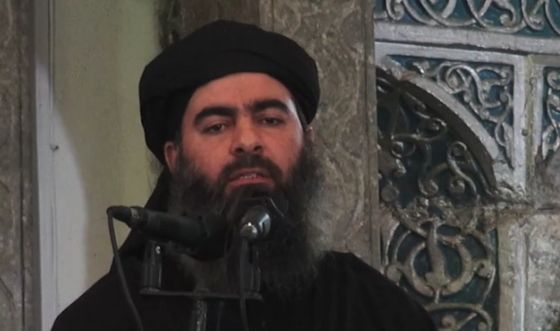
Has the leader of ISIS been killed?

Caliph-Ibrahim

Abu Bakr al-Baghdadi, the ISIS leader and recently self-declared Caliph Ibrahim, ruler of the so-called Islamic State, has until now kept a very low profile.

His first officially released video shows him delivering a sermon in Mosul.

Why the appearance now?

Perhaps in order to dispel rumors that he has been severely injured or might even be dead. Of course such reports might be a ruse to draw him out of hiding and thus make him an easier target to be killed. Either way, there’s no disputing al-Baghdadi’s vulnerability.

International Business Times reports: Abu Bakr al-Baghdadi, the leader of the Sunni militant outfit Islamic State of Iraq and the Levant (Isis), is said to have been severely injured in the raging battle forcing him to flee to neighbouring Syria.

According to a report in the Iraqi news network Al Sumaria, the insurgent leader was injured during a raid led by Iraq’s Shiite-led security forces in the west of Anbar.

“The Iraqi security forces carried out an operation in the city of Qaim on the border with Syria based on accurate intelligence and with the help of the Air Force where the leader of ISIL, Abu Bakr Al-Baghdadi was seriously injured,” said Haidar al-Shara, a representative of the international parliament in Iraq.

However, the report has so far not been independently verified. If confirmed, it will be a severe blow to the militant group which has been marching on several Iraqi cities.

The Iraqi official said: “After being hit, al-Baghdadi, with a range of elements of his organisation fled into Syrian territory because of its proximity to Qaim,” adding: “al-Baghdadi might be killed as a result of the severity of his injuries.”

If al-Baghdadi has indeed fled back to Syria, so much for ISIS’s claim that it has erased the boundary between Syria and Iraq. At this point in time, ISIS appears to recognize that one side of a supposedly non-existent border is safer than the other.

Facebooktwittermail

ISIS destroys mosques and shrines in Iraq

AFP reports: Jihadists who overran Mosul last month have demolished ancient shrines and mosques in and around the historic northern Iraqi city, residents and social media posts said Saturday.

At least four shrines to Sunni Arab or Sufi figures have been demolished, while six Shiite mosques, or husseiniyahs, have also been destroyed, across militant-held parts of northern Nineveh province, of which Mosul is the capital.

Pictures posted on the Internet by the Islamic State (IS) jihadist group showed the Sunni and Sufi shrines were demolished by bulldozers, while the Shiite mosques and shrines were all destroyed by explosives.

The photographs were part of an online statement titled “Demolishing shrines and idols in the state of Nineveh.”

Local residents confirmed that the buildings had been destroyed and that militants had occupied two cathedrals as well.

Facebooktwittermail

Maliki to run for a third term as Iraq’s prime minister

The New York Times reports: Despite sharp criticism from almost every political party in Iraq and pressure from friendly foreign powers to step down, Prime Minister Nuri Kamal al-Maliki announced Friday that he would seek a third term as prime minister.

He never suggested that he would step down. But the chorus of criticism over his sectarian policies, which helped create the conditions that led to a large portion of the country falling to Islamic extremists, had left many believing that lacking supporters, he might relinquish power.

They appear to have underestimated his desire to hold on to it.

“I will not give up my candidacy for a third term,” Mr. Maliki announced in a statement read on Iraqiya, the state television channel.

He noted that the bloc of lawmakers that supported his nomination was the largest in the Parliament and that they should not be asked to meet any conditions imposed by other legislative groups, such as supporting a different candidate. [Continue reading…]

Facebooktwittermail

Iranian pilot killed fighting in Iraq: Can Iran avoid ‘mission creep’?

The Wall Street Journal reports: Iran is pursuing a delicate strategy of supporting fellow Shiite Muslims and preserving its influence in neighboring Iraq—where the government is under siege by radical Sunni militants—without pushing the confrontation into outright sectarian warfare.

For the second straight week, influential clerics, who are appointed by the Islamic Republic’s Supreme Leader Ayatollah Ali Khamenei, used their Friday sermons to denounce the militant groups and support Iraq’s government. But their speeches steered clear of explicitly encouraging individual Shiites to act against the Sunni insurgents.

“We are ready to help Iraq as they ask for help,” Ayatollah Mohammad Saeedi told thousands of Iranians gathered for Friday prayers in Qom, Iran’s religious capital.

The country has openly sent top military advisers to help the Iraqi government, and blamed a collection of foreign enemies from Saudi Arabia to Israel and the U.S. for the violence. It deployed at least three battalions of elite Revolutionary Guards units to Iraq, according to Iranian security officials—an action Iran’s foreign ministry denied.

Yet it has stopped short of sending in large numbers of its own troops and discouraged ordinary Iranians from crossing the border to fight or defend holy sites in Iraq. [Continue reading…]

Al Jazeera reports: An Iranian pilot has been killed while fighting in Iraq, in what is thought to be the first military casualty that Tehran officially acknowledged during battles against Sunni fighters led by the Islamic State group.

Iran’s official IRNA news agency said on Saturday that Colonel Shoja’at Alamdari Mourjani was killed while “defending” the Shia Muslim holy sites in the city of Samarra, north of Baghdad.

Al Jazeera’s Imran Khan, reporting from Baghdad, said there were no reports of a plane being shot down in Iraq and the pilot probably died while fighting on the ground. [Continue reading…]

Facebooktwittermail

Palestinian Mohammad Abu Khdair ‘was burned alive’

BBC News reports: A Palestinian teenager killed in Jerusalem was burned alive, first post mortem examination findings quoted by the Palestinian attorney-general say.

“The direct cause of death was burns as a result of fire,” Mohammed al-A’wewy was quoted as saying.

Israeli authorities say the circumstances surrounding the death of Mohammad Abu Khdair, 16, are unclear.

His death followed the abduction and murder of three young Israelis, with violent clashes spreading overnight.

The post mortem examination on Mohammad Abu Khdair was carried out by Israeli doctors, with Saber al-Aloul, the director of the Palestinian forensic institute, in attendance.

The Palestinian official news agency Wafa quoted the attorney-general as saying that Mr Aloul had reported fire dust in the respiratory canal, meaning the victim had “inhaled this material while he was burnt alive”.

Mohammad Abu Khdair, who had also suffered a head injury, had burns to 90% of the body, it was reported.

Facebooktwittermail

German man arrested as spy implicates U.S.

The New York Times reports: In the latest turn in the yearlong tensions with Germany over American spying, a German man was arrested this week on suspicion of passing secret documents to a foreign power, believed to be the United States. The American ambassador, John B. Emerson, was summoned to the Foreign Office here and urged to help with what German officials called a swift clarification of the case.

The arrest came as Washington and Berlin were trying to put to rest a year of strains over the National Security Agency’s monitoring of Germans’ electronic data, including Chancellor Angela Merkel’s cellphone, and just months after the collapse of an effort by Germany to strike a “no spy” accord with the White House.

While the White House and American intelligence officials refused to comment on the arrest, one senior American official said that reports in the German news media that the 31-year-old man under arrest had been working for the United States for at least two years “threaten to undo all the repair work” the two sides have been trying to achieve.[Continue reading…]

Facebooktwittermail

Iran and Saudi Arabia in secret talks to replace Maliki

The Times reports: Iran is sending officials to Saudi Arabia for secret talks about replacing Iraq’s embattled prime minister, Nouri al-Maliki, with a compromise candidate who might broker a political solution to the deepening crisis there.

The move towards co-operation by the two regional enemies reflects growing alarm at the situation in Iraq, where lightning gains by the al-Qaeda splinter group Islamic State of Iraq and al-Sham (Isis) threaten both countries. Saudi Arabia deployed 30,000 extra troops along its border with Iraq yesterday after Baghdad pulled its forces out of the area, leaving the world’s largest oil producer to defend its frontier alone.

The move by Iran’s President Rouhani to solicit Saudi backing for a compromise candidate is a remarkable step, given the enmity between the two powers, but reflects the desperation in both capitals. With Iraq’s semi-autonomous Kurdish government taking steps towards declaring full independence, it falls to Tehran and Riyadh to break the political deadlock in Baghdad.

Iran has been Mr al-Maliki’s principal backer since he took power in 2006, but has reluctantly conceded that he must step aside to save Iraq from implosion. After years of discrimination against Iraq’s Sunni and Kurdish minorities by his Shia-led government, Mr al-Maliki is considered too widely hated to lead the country out of crisis.

Tehran is therefore ready to ditch the prime minister and has drawn up a list of potential replacements. Saudi Arabia, the dominant Sunni power in the region, has said it will urge Iraqi groups it can influence to join a unity government, but only if Mr al-Maliki goes. [Continue reading…]

Facebooktwittermail