Category Archives: Lands

In mountains of scrap, America leaves its mark on Afghanistan

After thirteen years of war, a mission long described as an effort to win hearts and minds, for many Afghans for generations to come, the enduring memory of America will be of this nation’s grotesque wastefulness. America will have become synonymous with trash as the legacy of a pointless war will be precisely that: a pile of trash.

But as if to highlight America’s exceptional relationship with trash, in this instance in an orgy of destruction, items of value are first getting crushed before they get left behind.

The Washington Post reports: The armored trucks, televisions, ice cream scoops and nearly everything else shipped here for America’s war against the Taliban are now part of the world’s biggest garage sale. Every week, as the U.S. troop drawdown accelerates, the United States is selling 12 million to 14 million pounds of its equipment on the Afghan market.

Returning that gear to the United States from a landlocked country halfway around the world would be prohibitively expensive, according to U.S. officials. Instead, they’re leaving behind $7 billion worth of supplies, a would-be boon to the fragile Afghan economy.

But there’s one catch: The equipment is being destroyed before it’s offered to the Afghan people — to ensure that treadmills, air-conditioning units and other rudimentary appliances aren’t used to make roadside bombs.

“Many non-military items have timing equipment or other components in them that can pose a threat. For example, timers can be attached to explosives. Treadmills, stationary bikes, many household appliances and ­devices, et cetera, have timers,” said Michelle McCaskill, a spokeswoman for the Pentagon’s Defense Logistics Agency.

That policy has produced more scrap metal than Afghanistan has ever seen. It has also led to frustration among Afghans, who feel as if they are being robbed of items such as flat-panel televisions and armored vehicles that they could use or sell — no small thing in a country where the average annual income hovers at just over $500.

In Afghanistan, nicknamed the “graveyard of empires,” foreign forces are remembered for what they leave behind. In the 1840s, the British left forts that still stand today. In the 1980s, the Russians left tanks, trucks and aircraft strewn about the country. The United States is leaving heaps of mattresses, barbed wire and shipping containers in scrap yards near its shrinking bases.

“This is America’s dustbin,” said Sufi Khan, a trader standing in the middle of an immense scrap yard outside Bagram air base, the U.S. military’s sprawling headquarters for eastern Afghanistan. [Continue reading…]


Facebooktwittermail

NSA hacked Mexican president’s email

Der Spiegel reports: The NSA has been systematically eavesdropping on the Mexican government for years. It hacked into the president’s public email account and gained deep insight into policymaking and the political system. The news is likely to hurt ties between the US and Mexico.

The National Security Agency (NSA) has a division for particularly difficult missions. Called “Tailored Access Operations” (TAO), this department devises special methods for special targets.

That category includes surveillance of neighboring Mexico, and in May 2010, the division reported its mission accomplished. A report classified as “top secret” said: “TAO successfully exploited a key mail server in the Mexican Presidencia domain within the Mexican Presidential network to gain first-ever access to President Felipe Calderon’s public email account.”

According to the NSA, this email domain was also used by cabinet members, and contained “diplomatic, economic and leadership communications which continue to provide insight into Mexico’s political system and internal stability.” The president’s office, the NSA reported, was now “a lucrative source.” [Continue reading…]

Facebooktwittermail

Jewish Americans see generational split on Israel-Palestine

Sarah Posner writes: In an eatery here, 28-year-old Israeli human rights activist Avner Gvaryahu described the first time he came face to face with a Palestinian.

He was 19 and serving in the Israel Defense Forces when his unit invaded the home of a Palestinian family in the dead of night. They were there to perform a “straw widow,” a raid during which soldiers forcibly seize control of a Palestinian civilian home.

“This is the reality of the occupation,” said Gvaryahu, now the Jewish diaspora coordinator for the Israeli human rights group Breaking the Silence, which, using the testimony of veterans such as himself, educates the Israeli public about military tactics and abuses in the occupied territories.

“This is the story of my generation,” said Gvaryahu, who said only a small fraction of Israelis serve in combat units in the West Bank. “No one knows about it. They don’t really understand what we’re asked to do.”

He was on tour for Breaking the Silence’s book “Our Harsh Logic,” the timing of which coincided with the publication of the Pew Research Center’s major survey of Jewish American attitudes. The survey showed an increasing secularization of American Jews, and decreasing affiliation with synagogues and organized religion, a phenomenon that exists within American Christianity as well. It also tracked changes in Jewish American attitudes to Israel.

While 30 percent of respondents professed to be very attached to Israel and 39 percent said they felt “somewhat” attached, 31 percent answered that they felt not very or not at all attached to Israel. Asked whether caring about Israel was an “essential” part of being Jewish, 43 percent answered in the affirmative. And the Pew researchers noted a demographic shift: “Older Jews are more likely than younger Jews to see caring about Israel as an essential part of what being Jewish means to them,” the study noted, with more than half of respondents over 65 believing that caring about Israel was an essential part of their Jewish identity, whereas only 32 percent of respondents under 30 shared that belief. [Continue reading…]

Facebooktwittermail

Egypt ‘looking to Russia’ for arms after U.S. aid freeze

The Times of Israel reports: Egypt is looking to Russia to supply it with arms now that the US has frozen much of its military aid to the Egyptians, Israeli television reported Friday night.

The “historic achievement,” under which the US brought Egypt into its orbit in the years since the 1979 Camp David Israel-Egypt peace treaty, is about to “go down the drain,” the Channel 2 report said.

It referred to comments earlier this week by Egypt’s Foreign Minister Nabil Fahmy, who said ties between Cairo and Washington were in “turmoil” and told CNN that Egypt would have to “find other sources” to meet its national security needs.

By “other sources,” said the TV report, Fahmy was referring to Russia, with whom Egypt was now looking to conclude a major arms deal.

This would represent a major change of orientation for Egypt, since its entire army had been built on US equipment for the past three decades.

The news came four days after reports that Israel had argued “directly and bluntly” with the Obama administration against US aid cuts to Egypt, telling Washington it was making “a strategic error” in reducing financial assistance to Cairo in the wake of the military’s ouster of president Mohammed Morsi. [Continue reading…]

U.S. military support for Egypt is much like that it provides to other countries: it’s involves the desire to foster political cooperation through dependence. However much independence Egypt’s current rulers might now want to assert, military support from Russia won’t remove the need for American hardware. With its F-16 fighters, Apache and Black Hawk helicopters, and C-130 Hercules transport aircraft, the Egyptian military remained tied to the U.S.

Facebooktwittermail

Jewish fear of irresistible Arab men

Ma’an News Agency reports: Jewish women have been banned from working night shifts as a part of their national service at hospitals in Israel in order to avoid “contact with Arabs,” Israeli Channel 10 reported on Wednesday.

Israeli National Service Administration Director Sar-Shalom Jerbi issued the directive two weeks ago banning any volunteer shifts past 9 p.m. for women fulfilling their national service duties.

The director explained that “we reached the decision based on concern for our volunteers, and Minister [Naftali] Bennett gave his blessing.”

Naftali Bennett is the leader of the far-right Israeli political party “Jewish Home,” and is currently the minister of religious services.

Many young Jewish women in Israel choose to volunteer at hospitals in order to fulfill their national service requirements. The national service is an alternative to service in the Israeli army, which is required for most Israeli Jews.

The decision marks a victory for an intense campaign led by religious Zionist rabbis and other right-wing groups within Israel to prevent contact of any sort between Israeli Jews and Palestinians, especially between Jewish women and Palestinian men.

According to the Channel 10 report, these groups began a campaign against women’s night-time service last year after reports surfaced of “intimate relations” between some Jewish volunteers and Palestinian doctors at hospitals.

In response to the decision, the director of the Lehava organization which was involved in the campaign issued a statement lamenting that the move did not go far enough. “Unfortunately, this is too narrow and too late a step. National service should be terminated anywhere there are non-Jews,” he said.

Facebooktwittermail

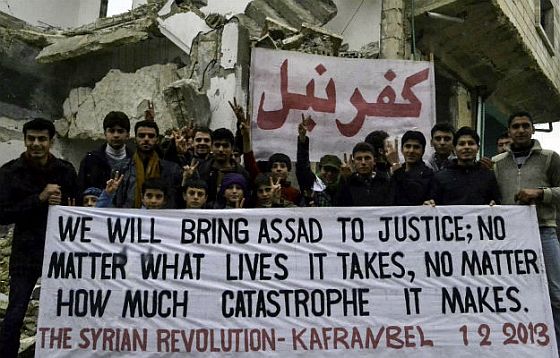
Kafranbel’s fight against isolationism abroad and at home

Kafranbel

Amal Hanano traveled to Kafranbel in northern Syria, famous for its witty posters and banners, where she met 40-year-old Raed Faris and his partner, 33-year-old Ahmad Jalal, the creative couple behind the banners.

For six weeks this summer, Kafranbel went silent.

The people of the town had been coming to Faris for months. They begged him to stop creating the antagonistic banners and organizing the protests that had attracted international attention. They blamed the protests for the regime’s air raids that were devastating the town.

This is the twisted logic that plagues people in Syria. Facing continuously escalating violence, many civilians have directed blame toward the revolution. Obviously, you can’t blame the Syrian regime for being vicious and relentless — that’s just what it is, and always was. It was the revolution that should have known its limits: In many Syrians’ eyes, the revolution had brought death and destruction, invited unwanted extremists, and steered the country to the point of no return. Returning to silence, they reasoned, was the way to end the nightmare that had been unleashed on their country.

Faris tried to compromise. He moved the protests to an inconspicuous side street, away from the main square. He banned children from attending the Friday protests and changed the set time of the gathering. Nothing stopped the residents’ complaints. And so after a protest on July 15 that featured a banner dedicated to Trayvon Martin’s family, he stopped.

“Without popular support, we can’t do this anymore,” Faris said. At first he was angry — especially when the air raids did not stop. On July 27, during the holy month of Ramadan, the bombs fell at sunset while the town broke its fast. Several people were killed in the now-silent town. And still the people blamed the protests.

“While I search for your mistakes and you search for mine, while we search for someone to blame, we realize that we have lost because we no longer trust each other,” Faris wrote on his Facebook page on July 31. “Our revolution needs us all. Let us search for each other, for victory is nothing but grasping each others’ hands in solidarity.”

After a few weeks, Faris’s anger waned. The time off had given him time to reflect. He stopped focusing on what the world wanted to hear and see. Instead, he began to listen to the town, and worked on a plan to regain his lost legitimacy.

One August evening, activists set up screens, projectors, and sound systems in five different public spaces across Kafranbel. For two hours, news was broadcast on the screens — a report from Al Jazeera, a compilation of YouTube videos, and a special local news broadcast produced by the media team. Men stopped on the street to watch. They pulled up chairs and lined the sidewalks. Some had not watched the news for months. Others had not seen the YouTube videos at all.

After two years of projecting Kafranbel to the world, Faris had brought back the world into Kafranbel.

The media team started to put together the broadcasts every day. They compiled videos of the early protests, of the banners shared around the word, and stories about Kafranbel’s martyrs. Faris and his team ignored calls from journalists who asked for new banners and cartoons. They didn’t even create artwork or organize a protest after the horrific Aug. 21 chemical weapons attack on the eastern Damascus suburbs.

After a few weeks of these outdoor events, people requested that the protests and banners return. They regained their pride in their town’s defiance. And so on Aug. 30, Kafranbel reclaimed its revolutionary role.

Isolationism — which many Syrians view as President Barack Obama’s foreign policy with regards to their home country — works both ways. Many activists inside and outside Syria realize that there is no longer a reason to convince the world to action. No one is coming to save Syria.

The collective message of Kafranbel’s body of work is the opposite of isolationism. It’s an awakening to the world after decades of neglect and forced isolation by the Assad regime. Sadly, Syrians have realized their costly awakening has come to an unwelcoming world.

Over the last two and a half years, Kafranbel’s banners projected the same message over and over: “Listen to us. Watch us. Respond.”

The message is slightly different now. Children and men alike proudly walk the streets of Kafranbel. They chant for their brave town. They are no longer hiding on side streets or standing on a stage for the world. Instead, their message is: “We are here. We are not going anywhere. Watch us if you wish.”

Facebooktwittermail

How the CIA and the Taliban undermined the global campaign to eradicate polio

The New York Times, July 2012: Did the killing of Osama bin Laden have an unintended victim: the global drive to eradicate polio?

In Pakistan, where polio has never been eliminated, the C.I.A.’s decision to send a vaccination team into the Bin Laden compound to gather information and DNA samples clearly hurt the national polio drive. The question is: How badly?

After the ruse by Dr. Shakil Afridi was revealed by a British newspaper a year ago, angry villagers, especially in the lawless tribal areas on the Afghan border, chased off legitimate vaccinators, accusing them of being spies.

And then, late last month, Taliban commanders in two districts banned polio vaccination teams, saying they could not operate until the United States ended its drone strikes. One cited Dr. Afridi, who is serving a 33-year sentence imposed by a tribal court, as an example of how the C.I.A. could use the campaign to cover espionage.

“It was a setback, no doubt,” conceded Dr. Elias Durry, the World Health Organization’s polio coordinator for Pakistan. “But unless it spreads or is a very longtime affair, the program is not going to be seriously affected.”

Reuters, October 18, 2013: A Taliban ban on vaccination is exacerbating a serious polio outbreak in Pakistan, threatening to derail dramatic progress made this year towards wiping out the disease worldwide, health officials say.

Health teams in Pakistan have been attacked repeatedly since the Taliban denounced vaccines as a Western plot to sterilize Muslims and imposed bans on inoculation in June 2012.

In North Waziristan, a region near the Afghan border that has been cordoned off by the Taliban, dozens of children, many under the age of two, have been crippled by the viral disease in the past six months.

And there is evidence in tests conducted on sewage samples in some of the country’s major cities that the polio virus is starting to spread beyond these isolated pockets and could soon spark fresh polio outbreaks in more densely populated areas.

“We have entered a phase that we were all worried about and were afraid might happen,” Elias Durry, head of the Global Polio Eradication Initiative (GPEI) in Pakistan, told Reuters in a telephone interview.

“The risk is that as long as the virus is still circulating, and as long as we have no means of reaching these children and immunizing them to interrupt virus transmission, it could jeopardize everything that has been done so far – not only in Pakistan, but also in the region and around the globe.”

Facebooktwittermail

Iran’s FM on nuclear proposal: secrecy is sign of seriousness

Al Monitor reports: Following the conclusion of the first nuclear talks between Iran and the P5+1 since the election of President Hassan Rouhani, buzz over the exact details of what transpired in Geneva is aplenty.

The exact contents of the Iranian proposal, formulated in a Powerpoint presentation titled, “Closing an Unnecessary Crisis, and Opening a New Horizon,” are unclear. However, reports have surfaced with purported details of the Iranian position.

Amid the reports, officials in Tehran involved in the nuclear negotiations remain adamant in their insistence that their proposal will remain under wraps pending an agreement.

In an interview with Al-Monitor, Iranian Foreign Minister and chief nuclear negotiator Mohammad Javad Zarif, referring to the reports about alleged details of the Iranian proposal, categorically denied their authenticity. “These are speculations that have little in common with reality,” he told Al-Monitor, maintaining his posture that “our refusal to unveil details of the proposal is a sign of our sincerity and seriousness.”

Asked about the anonymity of the source who claimed to have knowledge about the details of the Iranian proposal, Zarif said, “None of the officials involved in the nuclear negotiations speak off the record. We only speak on the record.” [Continue reading…]

Facebooktwittermail

Saudi Arabia rejects U.N. Security Council seat in protest move

The New York Times reports: Saudi Arabia stunned the United Nations and even some of its own diplomats on Friday by rejecting a highly coveted seat on the Security Council, a decision that underscored the depth of Saudi anger over what the monarchy sees as weak and conciliatory Western stances toward Syria and Iran, Saudi Arabia’s regional rival.

The Saudi decision, which could have been made only with King Abdullah’s approval, came a day after it had won a Security Council seat for the first time, and it appeared to be unprecedented.

The Saudi Foreign Ministry released a statement rejecting the seat just hours after the kingdom’s own diplomats — both at the United Nations and in Riyadh, the Saudi capital — were celebrating their new seat, the product of two years of work to assemble a crack diplomatic team in New York. Some analysts said the sudden turnabout gave the impression of a self-destructive temper tantrum.

But one Saudi diplomat said the decision came after weeks of high-level debate about the usefulness of a seat on the Security Council, where Russia and China have repeatedly drawn Saudi anger by blocking all attempts to pressure Syria’s president, Bashar al-Assad. Abdullah has voiced rising frustration with the continuing violence in Syria, a fellow Muslim-majority nation where one of his wives was born. He is said to have been deeply disappointed when President Obama decided against airstrikes on Syria’s military in September in favor of a Russian-proposed agreement to secure Syria’s chemical weapons. [Continue reading…]

Facebooktwittermail

GCHQ revelations show Britain needs a parliamentary inquiry into mass surveillance

Member of Parliament Tom Watson writes: Spymasters past and present have been busy of late condemning Edward Snowden and the Guardian. The “most catastrophic loss to British intelligence ever” is how Sir David Omand described the whistleblower’s leaks of confidential data.

The MI5 chief, Andrew Parker, stopped short of a direct attack on the Guardian for exposing GCHQ’s data surveillance programme Tempora, but his speech claimed that publishing such information gives terrorists the ability “to strike at will”.

Even some sections of the media have taken the side of the spooks. The Daily Mail said the Guardian had shown a “lethal irresponsibility”. Now the police have been asked by Tory MP Julian Smith to investigate the Guardian, while Liam Fox has successfully called on parliament to do the same with the support of the prime minister.

In truth, the Guardian is under attack for carrying out its public duty. It acted courageously, in the public interest, to uncover and reveal a government programme that has gained access to the private communications of millions of individuals. Tempora has been mining our internet communications data, en masse, without public knowledge or any kind of public debate. So the newspaper should be thanked for bringing this to our attention so that we can now have a proper conversation about whether mass surveillance is necessary and proportionate in the fight against terrorism. [Continue reading…]

Facebooktwittermail

Libya has become virtually ungovernable

Jason Pack and Mohamed Eljarh write: American Special Forces captured Nazih Abdul-Hamed al-Ruqai, an operative of Al Qaeda living in Libya. Five days later, a group of Libyan militiamen kidnapped their own prime minister, Ali Zeidan. After five hours, having faced no opposition from the police or the army, they released him. The prime minister’s captors made no demands for cash, nor did they overtly request any changes in current government policy. Nor was anyone hurt — an aspect that gave the whole affair the air of a vast publicity stunt.

Some have described the kidnapping as a pseudo-coup. But coups usually aim to overthrow one government and replace it with another. Things are different in Libya.

None of the country’s competing armed factions are capable of governing alone. Each wishes to protect its special privileges while preventing its opponents from governing. Libya is truly ruled by everyone and no one.

In the early days of the anti-Qaddafi rebellion, the rebels’ top brass attempted to form a nascent national army, yet various “civilian” (read: Islamist) groups refused to submit to the proposed chain of command. In July 2011, Islamists were suspected in the murder of the national army’s leader, Gen. Abdul Fattah Younes. Since then, myriad civilian militias have proliferated. They dwarf the national army and police force combined. The government has tried to co-opt some of the civilian brigades with big salaries and fancy titles, but most remain loyal only to their commanders.

Consequently, the Libyan government lacks even 100 armed men who would lay their lives on the line to defend the abstract concept of the state. Conversely, the militias can rely on thousands.

In Western Libya, the most staunchly anti-government forces are a loose alliance of Islamists and certain powerful militias from the city of Misurata. Counterbalancing them are non-Islamist militias from the city of Zintan. In the East, “federalist” militias seek to obtain “justice” (meaning more power and money for their region).

As a result of this multipolar struggle, the country has become virtually ungovernable. Each group has its supporters inside the parliament: the Martyrs and the Muslim Brotherhood blocs have worked to further the influence of the Revolutionaries Operations Room — the group that kidnapped Mr. Zeidan. With the Islamists’ support, Nouri Abusahmain became Libya’s president in June. And he quickly bolstered his power as a counterweight to the prime minister by endowing the Revolutionaries Operations Room with $700 million.

Prime Minister Zeidan’s various opponents have long sought to force him out of office. Despite his waning popularity and effectiveness, they failed to oust him via a secret no-confidence vote on Oct. 1. He survived the vote not because he enjoys widespread support but rather because no one can agree on who should replace him. [Continue reading…]

Facebooktwittermail

The U.S. and Iranian nuclear talks may be close to a historic breakthrough

Fred Kaplan writes: Readers glancing away from the debt ceiling showdown may have noticed the hopeful headlines on some other unlikely negotiations in Geneva over the fate of Iran’s nuclear program. Two points are missing from most of the stories about these talks. First, the chances for a truly historic breakthrough are pretty good — which, at this stage in talks of such magnitude, is astonishing. Second, the Iranians’ main demands—at least what we know of them — are pretty reasonable.

Toward the end of Iranian President Hassan Rouhani’s ground-shaking trip to New York last month, it was announced that his foreign minister, Mohammad Javad Zarif, would meet Tuesday and Wednesday in Geneva with delegates from the P5+1 states — the five nuclear powers (the United States, Russia, China, France, and Britain) plus Germany — with the goal of finishing an accord within a year.

Many saw this timetable as way too ambitious, and given how talks of this sort typically proceed, it was. But these talks—the first round anyway — turned out to be far from typical. Rather than recite boilerplate principles and opening gambits, Zarif presented an hourlong PowerPoint briefing — in English, so there would be no misunderstandings — laying out a path for negotiations and a description of a possible settlement, replete with technical detail.

Not only that, but after the first day of meetings, the U.S. and Iranian delegations broke away for an hourlong bilateral session, which American officials described as “useful” in clearing up ambiguities. After the second day, another meeting was set for Nov. 7–8. Some said it would be at the “ministerial” level, which, if true, would mean Secretary of State John Kerry would head the American delegation. A U.S. secretary of state doesn’t usually become so visibly involved until much closer to the end of a negotiation, suggesting that maybe we’re closer to the end than anyone could have imagined.

This is remarkably fast work for any set of nations negotiating any issue — much less for nations that haven’t had diplomatic relations in 34 years, and on an issue that ranks among the globe’s most perilous and contentious. [Continue reading…]

Barbara Slavin adds: Iran has put forward a new proposal to resolve the nuclear crisis that includes a freeze on production of 20% enriched uranium, a pledge to convert its stockpile to fuel rods and an agreement to relinquish spent fuel for a still-to-be completed heavy water reactor, according to an Iranian source who has proven reliable in the past.

The offers, combined with increased scrutiny by the International Atomic Energy Agency (IAEA), are meant to provide confidence that Iran could not quickly break out of its nuclear obligations and make nuclear weapons.

The Iranian, who asked not to be identified because the negotiations that resumed Tuesday, Oct. 16, in Geneva are supposed to be confidential, said the proposal presented by Iranian Foreign Minister Mohammad Javad Zarif included two stages, each to last a maximum six months.

In the first stage, the source said, Iran would stop producing 20% enriched uranium and “try to convert the stock” it has amassed to fuel rods for the Tehran Research Reactor, an old American-origin facility that produces medical isotopes.

Iran has already converted or set aside the bulk of the more than 370 kilograms [815 pounds] of uranium it has enriched to 20% — which is easy to further enrich to weapons grade — but it isn’t clear whether Iranians have the know-how to produce workable fuel rods. [Continue reading…]

Facebooktwittermail

Blogging for old media

News this week that eBay founder Pierre Morad Omidyar is ready to invest $250 million in a new media venture, should have come as unsettling news to staff at the Washington Post.

Jay Rosen says Omidyar “was one of the people approached by the Washington Post Company about buying the Post,” and since Amazon’s Jeffrey Bezos paid $250 million for the Post, it doesn’t sound like he outbid Omidyar. On the contrary, it sounds more like Omidyar felt like if he was going to spend that amount of money, it would be better spent creating a new organization than taking over an old institution.

Technology journalist David Kirkpatrick, describes the Post’s buyer like this: “Bezos is like a trickster. He’s like a very calculating, secretive genius.” Chances are, he views his purchase as a technologist and entrepreneur would: the acquisition of a platform and a strong brand. The bits inside that structure — traditionally known as journalists — must all be aware that they are each expendable.

So what’s a lowly blogger inside the newspaper going to do when afraid that he might seen get trimmed off like a piece of fat? Take new risks and try and stand out? Or curry favor inside the organization by flattering his superiors?

There is a social and journalistic taboo around speculating about motives. After all, since motives are inherently private, such speculation can easily be refuted — even if it happens to be accurate. Still, assessing motives is something that human beings do all the time, even if discretion usually dictates that those assessments, like the motives themselves, also remain concealed. Once in a while, though, it’s worth breaking the taboo.

On Wednesday, the Post’s associate editor and columnist, David Ignatius, revealed this:

The Turkish-Israeli relationship became so poisonous early last year that the Turkish government of Prime Minister Recep Tayyip Erdogan is said to have disclosed to Iranian intelligence the identities of up to 10 Iranians who had been meeting inside Turkey with their Mossad case officers.

Opinion writers like Ignatius revel in their occasional ability to break news, since it underlines their privileged access to high-level sources. At the same time, they have a habit of making themselves a mouthpiece for such sources. Ignatius, for instance, has been branded as “the CIA’s spokesman at The Washington Post.”

On Thursday, Max Fisher, the Post’s foreign affairs blogger, took the opportunity to give Ignatius’s column an extra boost and suggested that it might have helped resolve an enduring mystery: why it had taken the Israeli prime minister Benjamin Netanyahu, almost three years to apologize to Turkey for the deadly attack on the Mavi Marmara in 2010.

That refusal to apologize is now “much more understandable” — at least in Fisher’s mind — now that (thanks to Ignatius) we know about Turkey’s “effort to slap the Israelis” by outing their Iranian intelligence assets.

Under the headline, “Now we know why Netanyahu wouldn’t apologize for the Gaza flotilla raid,” Fisher is nevertheless forced to concede that this “explanation” explains virtually nothing: “This does not explain, of course, why Netanyahu wouldn’t have apologized between the initial 2010 raid and this reported 2012 spy outing.”

Indeed. On the other hand, Netanyahu’s unwillingness to apologize may in fact answer what Fisher regards as a remaining mystery: “Why did the Turkish government out these Israeli spies?” Urrmmm… how about because the Israelis wouldn’t apologize for killing nine Turkish citizens. (Note, Turkey now denies the outing ever occurred and says Ignatius’s story is a smear campaign.)

Now if Fisher really wanted to dig into the bad blood between Turkey and Israel, he might want to make a less complimentary reference to Ignatius and look back at the 2009 row at Davos which the columnist seriously mishandled.

Recep Tayyip Erdogan took exception to a thundering address delivered by Israeli president Shimon Peres who claimed that the IDF’s conduct, while slaughtering hundreds of Palestinians in Gaza, was above reproach. Ignatius tried to hush Erdogan by insisting that everyone would rather get to dinner, after which the Turkish prime minister famously stormed off the stage.

Fisher wants to point out that “many developments in international relations happen in secret,” as indeed they do, and that only later are some of these mysteries unraveled by sage-like columnists.

But in this case, the columnist was no sage and the most important developments were highly visible.

Facebooktwittermail

Turkey rejects claims it blew Israeli agents’ cover

CNN reports: Turkey’s top diplomat angrily rejected U.S. newspaper reports alleging the Turkish government leaked Israeli intelligence secrets to Iran.

“This is just a smear campaign. This is not true. It is dirty propaganda,” Foreign Minister Ahmet Davutoglu said, according to a ministry spokesman.

Davutoglu was referring to a column published in the Washington Post on Thursday. Citing “knowledgeable sources,” the Post’s David Ignatius reported that in early 2012, the Turkish government revealed to Iranian intelligence “the identities of up to 10 Iranians who had been meeting inside Turkey with their Mossad case officers.”

The Mossad is Israel’s intelligence service.

The reported leak took place at a time when relations between Turkey and Israel were at an all-time low, after Israeli commandos killed eight Turks and an American activist during a botched 2010 raid against the Mavi Marmara, a Turkish aid ship seeking to break the Israeli blockade of Gaza.

Until then, Turkey and Israel had enjoyed decades of close military, intelligence and economic ties. [Continue reading…]

Facebooktwittermail

Jets bomb Syrian city after intelligence general killed

Reuters reports: Syrian air force jets bombarded the eastern city of Deir al-Zor on Friday after heavy overnight clashes and the killing of one of President Bashar al-Assad’s top military intelligence officers, activists said.

General Jama’a Jama’a was shot dead on Thursday by snipers in the midst of a battle with rebels including forces linked to al Qaeda, the Syrian Observatory for Human Rights said.

His death, celebrated by rebels and opposition activists, marked a significant setback for Assad’s bid to retain a hold over the city, capital of the eastern oil-producing province.

A death notice published on Facebook said Jama’a’s body was being flown back for burial on Friday in his home village of Zama in the mountains overlooking the Mediterranean – the heartland of Assad’s Alawite sect. [Continue reading…]

Facebooktwittermail

Snowden says he took no secret files to Russia

The New York Times reports: Edward J. Snowden, the former National Security Agency contractor, said in an extensive interview this month that he did not take any secret N.S.A. documents with him to Russia when he fled there in June, assuring that Russian intelligence officials could not get access to them.

Mr. Snowden said he gave all of the classified documents he had obtained to journalists he met in Hong Kong, before flying to Moscow, and did not keep any copies for himself. He did not take the files to Russia “because it wouldn’t serve the public interest,” he said.

“What would be the unique value of personally carrying another copy of the materials onward?” he added.

He also asserted that he was able to protect the documents from China’s spies because he was familiar with that nation’s intelligence abilities, saying that as an N.S.A. contractor he had targeted Chinese operations and had taught a course on Chinese cybercounterintelligence.

“There’s a zero percent chance the Russians or Chinese have received any documents,” he said.

American intelligence officials have expressed grave concern that the files might have fallen into the hands of foreign intelligence services, but Mr. Snowden said he believed that the N.S.A. knew he had not cooperated with the Russians or the Chinese. He said he was publicly revealing that he no longer had any agency documents to explain why he was confident that Russia had not gained access to them. He had been reluctant to disclose that information previously, he said, for fear of exposing the journalists to greater scrutiny.

In a wide-ranging interview over several days in the last week, Mr. Snowden offered detailed responses to accusations that have been leveled against him by American officials and other critics, provided new insights into why he became disillusioned with the N.S.A. and decided to disclose the documents, and talked about the international debate over surveillance that resulted from the revelations. The interview took place through encrypted online communications. [Continue reading…]

Facebooktwittermail

Turkey exposed Mossad operation

David Ignatius writes: The Turkish-Israeli relationship became so poisonous early last year that the Turkish government of Prime Minister Recep Tayyip Erdogan is said to have disclosed to Iranian intelligence the identities of up to 10 Iranians who had been meeting inside Turkey with their Mossad case officers.

Knowledgeable sources describe the Turkish action as a “significant” loss of intelligence and “an effort to slap the Israelis.” The incident, disclosed here for the first time, illustrates the bitter, multi-dimensional spy wars that lie behind the current negotiations between Iran and Western nations over a deal to limit the Iranian nuclear program. A Turkish Embassy spokesman had no comment.

Israeli anger at the deliberate compromise of its agents may help explain why Prime Minister Benjamin Netanyahu became so entrenched in his refusal to apologize to Erdogan about the May 2010 Gaza flotilla incident. In that confrontation at sea, Israeli commandos boarded a Turkish-organized convoy of ships carrying humanitarian aid to Gaza. Nine Turks were killed.

Netanyahu finally apologized to Erdogan by phone in March after President Obama negotiated a compromise formula. But for more than a year before that, the Israeli leader had resisted entreaties from Obama and Secretary of State Hillary Clinton to heal the feud.

Top Israeli officials believe that, despite the apology, the severe strain with Erdogan continues. The Turkish intelligence chief, Hakan Fidan, is also suspect in Israel because of what are seen as friendly links with Tehran; several years ago, Israeli intelligence officers are said to have described him facetiously to CIA officials as “the MOIS station chief in Ankara,” a reference to Iran’s Ministry of Intelligence and Security. The United States continued to deal with Fidan on sensitive matters, however.

Though U.S. officials regarded exposure of the Israeli network as an unfortunate intelligence loss, they didn’t protest directly to Turkish officials. Instead, Turkish-American relations continued warming last year to the point that Erdogan was among Obama’s key confidants. This practice of separating intelligence issues from broader policymaking is said to be a long-standing U.S. approach. [Continue reading…]

Like many of Washington’s leading op-ed writers, Ignatius has a habit of parroting his sources — part of the long-standing gentleman’s agreement that the privilege to talk to high officials tends to be reserved for the most sycophantic members of the press. Thus this piece raises no questions about the operations that Israel’s Iranian agents would have been conducting — most likely acts of terrorism targeting civilian Iranian nuclear scientists — nor acknowledges that Turkey might have perfectly legitimate political reasons for not wanting to be complicit in Israel’s secret war against Iran.

Facebooktwittermail