Rami G Khouri writes: An Egyptian court’s decision Monday to ban all activities in the country by the Muslim Brotherhood is the kind of foolish act that autocratic governments take when they do not know how to engage in a process of democratic pluralism and seek refuge in their mistaken sense of infallibility. The real issue at hand is not a decision by a minor court regarding the legality of the Muslim Brotherhood’s registration last March; it is rather about the ongoing attempt by the armed forces and allied political groups to eliminate the Muslim Brotherhood from the public scene in Egypt.This is foolish in every respect – in politics, culture, religion, constitutionalism – and shows the crude immaturity of the armed forces as an instrument of governance. The ongoing assault against the Muslim Brotherhood has included killings, beatings and mass arrests that have temporarily thrown the organization into disarray. Trying to eliminate it will not work, and will only send Egypt into a deeper cycle of political polarization, immobility and some violence. Egypt requires pluralism, engagement, negotiations and compromise, in order to achieve consensus on key issues. Banning the Brotherhood goes against all these imperatives, and will only make things worse.
Egypt is passing through a period of relativities, not absolutes, regarding both the armed forces and the Brotherhood who are both key actors in society. The vast majority of Egyptians have repeatedly asserted that they trust the armed forces to manage a short-term transitional process that ends with the installation of a legitimate, elected government, president and parliament.
The citizenry also values the security forces’ role in ensuring stability and security throughout the country. But Egyptians do not want the military to rule the country. They experienced that for 60 years from 1952 to 2011. The revolution in January 2011 demonstrated their clear rejection of that kind of system that saw Egypt become a forlorn global backwater of mediocrity and mismanagement. Egyptians do not view the military in absolute, black-and-white terms.
Similarly, Egyptians also do not view the Muslim Brotherhood and other Islamists in absolute terms, but rather through a much more nuanced lens of relative benefits, concerns and practical efficiencies. The Brotherhood was the leading opposition movement in the country for decades, and paid the price for its courage by having thousands of its members jailed and tortured. Its social assistance programs endeared it to millions of poor Egyptians, as did its provision of the basic succor of religious hope and faith. It was always present at the local level in neighborhoods and villages everywhere. It spoke the language of the ordinary man and woman. It was always a strong element in the basic values and the core identity of most Egyptians. It did all these things naturally and efficiently, while the old soldiers who ruled the country with an iron fist did almost none of these things. [Continue reading…]
Category Archives: Lands
Video: Rouhani condemns the Holocaust but says crimes against Jews don’t justify crimes against Palestinians
Mass starvation feared in Syria; ‘We have no food’
The Associated Press reports: Syrian opposition groups and international relief organizations are warning of the risk of mass starvation across the country, especially in the besieged Damascus suburbs where a gas attack killed hundreds last month.
With the world’s attention focused on the regime’s chemical weapons, activists said six people – including an 18-month girl – have died for lack of food in one of the stricken suburbs in recent weeks.
Save the Children said in an appeal Monday that more than 4 million Syrians, more than half of them children, do not have enough to eat. Food shortages have been compounded by an explosion in prices.
“The world has stood and watched as the children of Syria have been shot, shelled and traumatized by the horror of war,” said Roger Hearn, Save the Children’s regional director for the Middle East. “The conflict has already left thousands of children dead, and is now threatening their means of staying alive.”
Thousands of people are believed trapped in suburbs east and west of the capital that have been held for months by rebels fighting to topple President Bashar Assad. Regime troops are besieging the areas, and residents say food is increasingly had to find. Rebels say they are trying to break the blockade.
The suburbs were the site of the Aug. 21 attack that a U.N. report found included the use of the nerve gas sarin. They were home to more than 2 million people before the war, but it is unclear how many are there now.
In some hard-hit areas such as the western suburb of Moadamiyeh, people are running out of food and are mostly relying on lentils, olives and dried figs, according to residents and activists.
“We have no food, no milk and no medicine,” said a woman from Moadamiyeh, who identified herself by her nickname Um Lujain for fear of government reprisals. “We are surviving on one meal a day”
Um Lujain said her 18-month-old daughter has lost half her weight and spends most of her days sleeping. The woman said her daughter’s diet is based on the liquid she makes by boiling lentils.
“There has been no children formula or bread for about a year,” the woman said. She added that sometimes rebels find expired boxes of powdered milk in abandoned shops or pharmacies, and people still give it to their children for lack of food.
According to the Moadamiyeh Media Center, six people have died of starvation over the past 20 days: two women and four children ages 18 months to 7 years. It added that 15 other children are in intensive care in clinics, suffering from malnutrition.
On Monday, the opposition Syrian National Coalition accused government forces of tightening their months-long siege. “Assad’s forces are starving people to death in those areas,” the coalition claimed. “Famine looms in the horizon.”
Rana Obeid, the 18-month-old girl, was the latest to die on Monday. An amateur video showed her lying on a bed, her ribs visible and her stomach bloated. [Continue reading…]
A malnourished baby in Moadamiyyat Ash Sham, near Damascus: (Video via EA Worldview)
Egyptian court bans Muslim Brotherhood in ongoing campaign to eradicate the million-strong movement

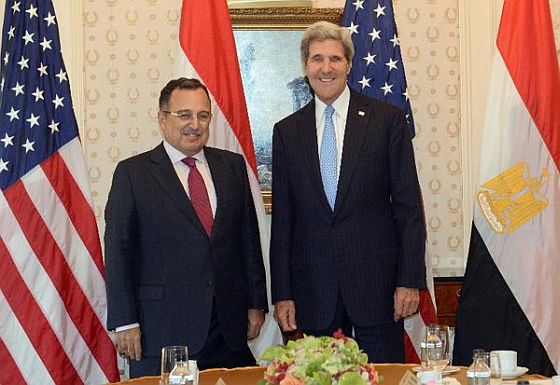
Egypt's Foreign Minister Fahmy meets with U.S. Secretary of State Kerry in New York, September 22, 2013
“Things are moving forward in Egypt,” is the message officials are taking to the UN this week. Egypt’s rulers following the military coup in July want to placate Washington’s nominal concerns about democracy with this assurance:
Events for the most part are on the right track in Egypt, despite inevitable hiccups; the state is committed to a transitional process that will result in a referendum on an amended – and hopefully less controversial – constitution, and a full democratic process will be pursued.
Having ousted President Mohamed Morsi, killed hundreds of members of the Muslim Brotherhood and imprisoned thousands more, the effort to destroy the movement shows few signs of restraint.
“The plan is to drain the sources of funding, break the joints of the group, and the dismantle podiums from which they deliver their message,” a senior Egyptian security official tells Associated Press, using language reminiscent of then defense minister Yitzhak Rabin’s “broken bones” campaign as Israel attempted to crush the first Palestinian intifada.
Reuters reports: Murad Ali says he was put in a foul-smelling cell on death row, sleeping on a concrete floor, and denied light and human contact after his arrest in Egypt’s crackdown on the Muslim Brotherhood. “It was as dark as a grave,” he wrote in a letter addressed to friends and family and seen by Reuters.
The army-backed authorities deny claims Brotherhood leaders have been mistreated, and there is no way to independently verify such accounts; but people who have spoken to them in jail say some have been kept in similar conditions for days on end.
Their relatives describe it as a bid to break their spirit – a measure of the severity of the campaign against the group that was swept from power by the military on July 3, when Mohamed Mursi, a Brotherhood member, was deposed.
Analysts say it points to a state effort to weaken the Brotherhood by decapitating it. The movement says it has up to one million members and it is one of the most influential Islamist groups in the Middle East.
The New York Times reports: An Egyptian court on Monday issued an injunction dissolving the Muslim Brotherhood and confiscating its assets, escalating a broad crackdown on the group less than three months since the military ousted its ally, President Mohamed Morsi.
The ruling, by the Cairo Court for Urgent Matters, amounts to a preliminary injunction shutting down the Brotherhood until a higher court renders a more permanent verdict. The leftist party Tagammu had sought the immediate action, accusing the Brotherhood of “terrorism” and of exploiting religion for political gain. The court ordered the Brotherhood’s assets to be held in trust until a final decision.
If confirmed, the ban on the Brotherhood — Egypt’s mainstream Islamist group — would further diminish hopes of the new government’s fulfilling its promise to restart a democratic political process that would include Mr. Morsi’s Islamist supporters. For now, though, it effectively formalizes the suppression of the Brotherhood that is already well under way.
Since Mr. Morsi’s ouster, the new government appointed by Gen. Abdul-Fattah el-Sisi has killed more than 1,000 Brotherhood members in mass shootings at protests against the takeover and arrested thousands more, including almost all of the group’s leaders. Security services have closed offices of the group and its political party in cities around the country. Members are now sometimes afraid to speak publicly by name for fear of reprisals.
Abdullah Al-Arian writes: The military’s intervention reflects a longstanding desire among elements of the former regime to rid Egypt of its revolutionary movement and destroy any progress toward the establishment of democratic institutions.
If those intentions were not obvious in their posturing before July 3, they have certainly become clear since then. In the six-week long crisis that followed, there was no genuine attempt by the military-appointed interim government to resolve the situation in a manner that would allow Egypt to remain on the revolutionary track or even to avoid unnecessary bloodshed. The total war strategy employed against the Muslim Brotherhood and its supporters was meant to emulate the repression of prior eras, but on an even wider scale, due to the perception of widespread public support for this move.
Staying true to form as a movement with strong internal discipline and the capacity to mobilize, the Muslim Brotherhood employed the only means at its disposal, a non-violent mass protest, to oppose the clear attempts to overturn its democratic gains and destroy its presence in society for the foreseeable future. In fact, the Rabaa protests took the group’s leadership back to a place with which it is all too intimately familiar, the perpetual victimhood upon which it has built its eight-decade legacy. Far from the challenges of governance, the anti-coup protests recalled the common theme of standing up to tyranny and repression that marked the Muslim Brotherhood’s experiences under successive authoritarian rulers.
The military’s disproportionate response to the protests, unprecedented in Egypt’s modern history, reflects an attempt to establish a new political and social order that would not only marginalize the Muslim Brotherhood, but would destroy it altogether. The wholesale adoption of the “war on terror” discourse by the state and its media arm is not only intended to make the alarmingly high number of casualties seem justifiable. As with the Bush era policy of the same name, this paradigm is meant to convince those watching from the sidelines that the Islamic activist impulse that has been part and parcel of Egyptian society for a century could conceivably be eradicated.
The muted response from the liberal, leftist, and progressive currents within society suggest that this tactic has worked, with most groups hoping that the wave of violent repression is not indicative of a wider trend aimed at rolling back the gains of the revolution. Beyond wishful thinking, however, there is little to challenge the notion that the counter-revolution is in full swing.
Wishful thinking is in evidence today with the creation of a new anti-Brotherhood and anti-military group called the The Way of the Revolution Front (Facebook).
The Iranian general ‘running the war’ in Syria
In the New Yorker, Dexter Filkins has a 10,000 word profile of Major General Qassem Suleimani, the leader of a branch of Iran’s Revolutionary Guard called the Quds Force, thousands of whose members are now fighting in Syria. It’s worth reading the whole article, but I’ve picked out some of the most important passages below.
For Suleimani, defending Assad is a matter of pride. He is quoted as having said: “We’re not like the Americans. We don’t abandon our friends.”
Iran’s intervention in Syria escalated sharply late last year.
A turning point came in April, after rebels captured the Syrian town of Qusayr, near the Lebanese border. To retake the town, Suleimani called on Hassan Nasrallah, Hezbollah’s leader, to send in more than two thousand fighters. It wasn’t a difficult sell. Qusayr sits at the entrance to the Bekaa Valley, the main conduit for missiles and other matériel to Hezbollah; if it was closed, Hezbollah would find it difficult to survive. Suleimani and Nasrallah are old friends, having coöperated for years in Lebanon and in the many places around the world where Hezbollah operatives have performed terrorist missions at the Iranians’ behest. According to Will Fulton, an Iran expert at the American Enterprise Institute, Hezbollah fighters encircled Qusayr, cutting off the roads, then moved in. Dozens of them were killed, as were at least eight Iranian officers. On June 5th, the town fell. “The whole operation was orchestrated by Suleimani,” Maguire, who is still active in the region, said. “It was a great victory for him.”
Despite all of Suleimani’s rough work, his image among Iran’s faithful is that of an irreproachable war hero—a decorated veteran of the Iran-Iraq War, in which he became a division commander while still in his twenties.
*
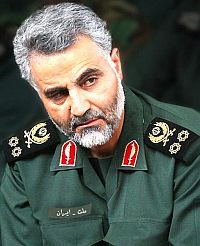
In March, 2009, on the eve of the Iranian New Year, Suleimani led a group of Iran-Iraq War veterans to the Paa-Alam Heights, a barren, rocky promontory on the Iraqi border. In 1986, Paa-Alam was the scene of one of the terrible battles over the Faw Peninsula, where tens of thousands of men died while hardly advancing a step. A video recording from the visit shows Suleimani standing on a mountaintop, recounting the battle to his old comrades. In a gentle voice, he speaks over a soundtrack of music and prayers.
“This is the Dasht-e-Abbas Road,” Suleimani says, pointing into the valley below. “This area stood between us and the enemy.” Later, Suleimani and the group stand on the banks of a creek, where he reads aloud the names of fallen Iranian soldiers, his voice trembling with emotion. During a break, he speaks with an interviewer, and describes the fighting in near-mystical terms. “The battlefield is mankind’s lost paradise—the paradise in which morality and human conduct are at their highest,” he says. “One type of paradise that men imagine is about streams, beautiful maidens, and lush landscape. But there is another kind of paradise—the battlefield.”
*
In the chaotic days after the attacks of September 11th, Ryan Crocker, then a senior State Department official, flew discreetly to Geneva to meet a group of Iranian diplomats. “I’d fly out on a Friday and then back on Sunday, so nobody in the office knew where I’d been,” Crocker told me. “We’d stay up all night in those meetings.” It seemed clear to Crocker that the Iranians were answering to Suleimani, whom they referred to as “Haji Qassem,” and that they were eager to help the United States destroy their mutual enemy, the Taliban. Although the United States and Iran broke off diplomatic relations in 1980, after American diplomats in Tehran were taken hostage, Crocker wasn’t surprised to find that Suleimani was flexible. “You don’t live through eight years of brutal war without being pretty pragmatic,” he said. Sometimes Suleimani passed messages to Crocker, but he avoided putting anything in writing. “Haji Qassem’s way too smart for that,” Crocker said. “He’s not going to leave paper trails for the Americans.”
Before the bombing began, Crocker sensed that the Iranians were growing impatient with the Bush Administration, thinking that it was taking too long to attack the Taliban. At a meeting in early October, 2001, the lead Iranian negotiator stood up and slammed a sheaf of papers on the table. “If you guys don’t stop building these fairy-tale governments in the sky, and actually start doing some shooting on the ground, none of this is ever going to happen!” he shouted. “When you’re ready to talk about serious fighting, you know where to find me.” He stomped out of the room. “It was a great moment,” Crocker said.
The coöperation between the two countries lasted through the initial phase of the war. At one point, the lead negotiator handed Crocker a map detailing the disposition of Taliban forces. “Here’s our advice: hit them here first, and then hit them over here. And here’s the logic.” Stunned, Crocker asked, “Can I take notes?” The negotiator replied, “You can keep the map.” The flow of information went both ways. On one occasion, Crocker said, he gave his counterparts the location of an Al Qaeda facilitator living in the eastern city of Mashhad. The Iranians detained him and brought him to Afghanistan’s new leaders, who, Crocker believes, turned him over to the U.S. The negotiator told Crocker, “Haji Qassem is very pleased with our coöperation.”
The good will didn’t last. In January, 2002, Crocker, who was by then the deputy chief of the American Embassy in Kabul, was awakened one night by aides, who told him that President George W. Bush, in his State of the Union Address, had named Iran as part of an “Axis of Evil.” Like many senior diplomats, Crocker was caught off guard. He saw the negotiator the next day at the U.N. compound in Kabul, and he was furious. “You completely damaged me,” Crocker recalled him saying. “Suleimani is in a tearing rage. He feels compromised.” The negotiator told Crocker that, at great political risk, Suleimani had been contemplating a complete reëvaluation of the United States, saying, “Maybe it’s time to rethink our relationship with the Americans.” The Axis of Evil speech brought the meetings to an end. Reformers inside the government, who had advocated a rapprochement with the United States, were put on the defensive. Recalling that time, Crocker shook his head. “We were just that close,” he said. “One word in one speech changed history.”
*
Last December, when Assad’s regime appeared close to collapse, American officials spotted Syrian technicians preparing bombs carrying the nerve agent sarin to be loaded onto aircraft. All indications were that they were plotting an enormous chemical attack. Frantic, the Americans called leaders in Russia, who called their counterparts in Tehran. According to the American defense official, Suleimani appeared to be instrumental in persuading Assad to refrain from using the weapons.
Suleimani’s sentiments about the ethics of chemical weapons are unknown. During the Iran-Iraq War, thousands of Iranian soldiers suffered from chemical attacks, and the survivors still speak publicly of the trauma. But some American officials believe that his efforts to restrain Assad had a more pragmatic inspiration: the fear of provoking American military intervention. “Both the Russians and the Iranians have said to Assad, ‘We can’t support you in the court of world opinion if you use this stuff,’ ” a former senior American military official said.
The regime is believed to have used chemical weapons at least fourteen times since last year. Yet even after the enormous sarin attack on August 21st, which killed fourteen hundred civilians, Suleimani’s support for Syria has been unbending. To save Assad, Suleimani has called on every asset he built since taking over the Quds Force: Hezbollah fighters, Shiite militiamen from around the Arab world, and all the money and matériel he could squeeze out of his own besieged government. In Baghdad, a young Iraqi Shiite who called himself Abu Hassan told me that he was recruited to fight by a group of Iraqi men. He took a bus to the Iranian city of Mashhad, where he and three dozen other Iraqis received two weeks of instruction from Iranian trainers. The men travelled to the Shiite shrine of Sayyidah Zaynab, near Damascus, where they spent three months fighting for the Assad government, along with soldiers from Hezbollah and snipers from Iran. “We lost a lot of people,” Abu Hassan told me.
Suleimani’s greatest achievement may be persuading his proxies in the Iraqi government to allow Iran to use its airspace to fly men and munitions to Damascus. General James Mattis, who until March was the commander of all American military forces in the Middle East, told me that without this aid the Assad regime would have collapsed months ago. The flights are overseen by the Iraqi transportation minister, Hadi al-Amri, who is an old ally of Suleimani’s—the former head of the Badr Brigade, and a soldier on the Iranian side in the Iran-Iraq War. In an interview in Baghdad, Amri denied that the Iranians were using Iraqi airspace to send weapons. But he made clear his affection for his former commander. “I love Qassem Suleimani!” he said, pounding the table. “He is my dearest friend.”
So far, Maliki has resisted pressure to supply Assad overland through Iraq. But he hasn’t stopped the flights; the prospect of a radical Sunni regime in Syria overcame his reservations about becoming involved in a civil war. “Maliki dislikes the Iranians, and he loathes Assad, but he hates Al Nusra,” Crocker told me. “He doesn’t want an Al Qaeda government in Damascus.”
This kind of starkly sectarian atmosphere may be Suleimani’s most lasting impact on the Middle East. To save his Iranian empire in Syria and Lebanon, he has helped fuel a Sunni-Shiite conflict that threatens to engulf the region for years to come—a war that he appears happy to wage. “He has every reason to believe that Iran is the rising power in the region,” Mattis told me. “We’ve never dealt him a body blow.”
In June, a new, moderate President, Hassan Rouhani, was elected in Iran, promising to end the sanctions, which have exhausted the country and demolished its middle class. Hopes have risen in the West that Khamenei might allow Rouhani to strike a deal. Although Rouhani is a moderate only by Iranian standards—he is a Shiite cleric and a longtime adherent of the revolution—his new administration has made a series of good-will gestures, including the release of eleven political prisoners and an exchange of letters with President Obama. Rouhani is in New York this week to speak at the United Nations and, possibly, to meet with Obama. The talks will surely center on the potential for Iran to restrain its nuclear program, in exchange for relaxed sanctions.
Many in the West are hoping that Iran will also help find an end to the grinding war in Syria. Assad’s deputy prime minister recently offered the possibility of a cease-fire, saying, “Let nobody have any fear that the regime in its present form will continue.” But he did not say that Assad would step down, which the rebels have said is a necessary condition of negotiations. There have been hints from powerful Iranians that Assad isn’t worth holding on to. In a recent speech, the former President Hashemi Rafsanjani said, “The people have been the target of chemical attacks by their own government.” (After a leaked recording of the speech caused a stir in Iran, Rafsanjani denied the remarks.) But a less sympathetic regime in Syria would split the Axis of Resistance, and radically complicate Iran’s partnership with Hezbollah. In any case, the Iranian regime may be too fragmented to come to a consensus. “Anytime you see a statement coming out of the government, just remember there’s a rat’s nest of people fighting underneath the surface,” Kevan Harris, a sociologist at Princeton who has studied Iran extensively, told me. As Rouhani tries to engage the West, he will have to contend with the hard-liners, including Suleimani and his comrades, who for more than a decade have defined their foreign policy as a covert war on the U.S. and Israel. “They don’t trust the other side,” Harris said. “They feel that any concession they make will be seen by the West as a sign of weakness.”
For Suleimani, giving up Assad would mean abandoning the project of expansion that has occupied him for fifteen years. In a recent speech before the Assembly of Experts—the clerics who choose the Supreme Leader—he spoke about Syria in fiercely determined language. “We do not pay attention to the propaganda of the enemy, because Syria is the front line of the resistance and this reality is undeniable,’’ he said. “We have a duty to defend Muslims because they are under pressure and oppression.” Suleimani was fighting the same war, against the same foes, that he’d been fighting his entire life; for him, it seemed, the compromises of statecraft could not compare with the paradise of the battlefield. “We will support Syria to the end,” he said.
Al Shabaab attack in Kenya
Jamal Osman, a Somali-born reporter for Channel 4 News in the UK says that his sources say that “some or most” of the attackers in this weekend’s attack on Westgate shopping mall in Nairobi are “Western passport holders”.
Channel 4 News reports: Striking at the heart of the capital city and a symbolic place, it is designed to have the maximum effect on the locals.
Kenyans who have generally enjoyed peace will find it hard to go about their daily lives, for some time to come.
It is also going to have an impact on the nation’s economy, a country that prides itself of being a regional hub.
Foreign companies invest in every sector. Tourism makes huge contribution to the local economy.
Many aid organisations including the UN are based there. This attack is likely to scare off foreign tourists, investors and international aid workers.
The al-Qaeda-linked group, which still controls large parts of southern and central Somalia, has been under pressure in the last three years.
A coalition of forces from several African nations, supporting a weak Somali government, is fighting to defeat the militants.
Kenya is part of the alliance that pushed the Islamist from the main cities and its forces captured Kismayo from the group in 2011.
For the Islamists, losing Kismayo was very difficult to swallow.
The port city, third largest in the country, was a strategic place and it generated an enormous source of income.
Therefore, they chose their target and planned the assault carefully. Westgate shopping mall was the perfect place for them.
The centre is popular with westerners, wealthy Kenyans and Somali politicians.
All of them targets for al-Shabaab. More so, it is reportedly owned by Israelis.
Targeting Israeli interests will win al-Shabaab supporters amongst the jihadi community and some in the Arab world.
Yahya Ababneh, source of Mint Press chemical weapons ‘report’ appears to be a fraud
Yahya Ababneh, source of a report which alleged that Saudi Prince Bandar bin Sultan was responsible for the chemical weapons attack outside Damascus on August 21, now appears to be a fraud operating under multiple names using a fake work history and comes from Russia.
Brian Whitaker writes: According to Ababneh’s profile on LinkedIn, the professional networking website, he has carried out journalistic assignments “in Jordan, Syria, Lebanon, Saudi Arabia, Russia, and Libya for clients such as al-Jazeera, al-Quds al-Arabi, Amman Net, and other publications”.
So far, though, no evidence has emerged to support this claim and internet searches in English and Arabic for articles that carry his byline have drawn a blank.
To add to this mystery, Ababneh’s profile was deleted from LinkedIn yesterday, though a cached copy can be found here.
One thing that doesn’t show up in the cache is the endorsements given to Ababneh by other LinkedIn users. On the deleted page, he had received endorsements for his skills from two people – Ghazal Omid of the Iran Future organisation and Sufian Ababneh, a legal adviser at the Jordanian embassy in London. Among other things, Sufian Ababneh had endorsed him for his skills as an actor.
@snarwani @Brown_Moses #Syria Mint Press journalist Yahya Ababneh claims to work for Al Jazeera. But Al Jaz web has no record of him.
— Anita McNaught (@anitamcnaught) September 21, 2013
And seems to have a Russian VKontakte page that says he was born in St. Petersburg http://t.co/AQkNczvYJ0 @daoudkuttab
— Laura Rozen (@lrozen) September 22, 2013
Dwindling faith in the American dream
Gary Younge writes: The final chapter of America’s Promise, a high-school textbook on American history, ends with a rallying cry to national mythology. “The history of the United States is one of challenges faced, problems resolved, and crises overcome,” it states. “Throughout their history Americans have remained an optimistic people, carrying this optimism into the new century. The full promise of America has yet to be realised. This is the real promise of America; the ability to dream of a better world to come.”
Such are the assumptions beamed from the torch of Lady Liberty, coursing through the veins of the nation’s political culture and imbibed with mothers’ milk. Their nation, many will tell you, is not just a land mass but an ideal – a shining city on the hill beckoning a bright new tomorrow and a dazzling dawn for all those who want it badly enough. Such devout optimism, even (and at times particularly) in the midst of adversity makes America, in equal parts, both exciting and delusional. According to Gallup, since 1977 people have consistently believed their financial situation will improve next year even when previous years have consistently been worse.
But when President Barack Obama was planning his run for a second term his pollsters noticed a profound shift in the national mood. The optimism was largely gone – and with it both the excitement and the delusion. The time-honoured rhetorical appeals to a life of relentless progress, upward mobility and personal reinvention didn’t work the way they used to.
“The language around the American dream wasn’t carrying the same resonance,” Joel Benenson, one of Obama’s key pollsters, told the Washington Post. “Some of the symbols of achieving the American dream were becoming burdens – owning that house with the big mortgage was expensive, owning two cars and more debts; having your kid go to college. The cost and burden of taking out those loans was making a lot of Americans ambivalent. They weren’t sure a college education was worth it.”
This wasn’t just about the recession – though of course that didn’t help – but a far more protracted, profound and painful descent in expectations and aspirations that has been taking place for several decades. For underpinning that faith in a better tomorrow was an understanding that inequality in wealth would be tolerated so long as it was coupled with a guarantee of equality of opportunity. In recent years they have seen both heading in the wrong direction – the gap between rich and poor has grown even as possibilities for economic and social advancement have stalled. [Continue reading…]
Secret recordings reveal Mubarak’s frank views on the U.S., Israel and the Brotherhood
The New York Times reports: Hosni Mubarak looked like a stalwart American ally but worried for years that Washington was trying to oust him as president of Egypt, he confided to a doctor recently in surreptitiously recorded conversations that came to light here last week.
“How did the revolution start?” Mr. Mubarak mused about his ouster, in early 2011. “The Americans worked on it since 2005, and I had a feeling then.”
The conversations were recorded over a period of months this year and were authenticated over the weekend when the doctor, an ear, nose and throat specialist, was summoned to testify about them. They offer a rare, unadulterated taste of the former president’s attitudes about a host of subjects — Washington, Israel, his Arab neighbors, Jews, the Muslim Brotherhood, Egypt’s new military leaders and most of all himself.
For all the aid the United States gave Egypt during his 30 years in power, his comments suggest that Washington gained little sway over Mr. Mubarak. And he expressed nothing but pride in his rule despite the steady decline of Egypt’s economy and influence.
The Islamists who won power after his removal “blame ‘the former regime’ for everything,” Mr. Mubarak is heard complaining in one recording. Speaking of the Egyptian population, he said, “They lived — they were 43 million when I received them and 90 million when I handed them over.”
The recordings were released last week through the Web site of the newspaper Youm el-Saba, and quickly captivated Egyptians with details like Mr. Mubarak’s boasts of his heroism as a pilot in the 1973 war against Israel, and his shock at the high prices of groceries. “An egg is one pound?” he said in shock, joking, “So let’s eat potato sandwiches!”
Mr. Mubarak apparently did not foresee the ouster in July of his successor, Mohamed Morsi of the Muslim Brotherhood. In a recording made in the spring, he was asked whether he thinks the military will act to stop the turmoil between Mr. Morsi’s opponents and his supporters; he responded, “What would they do?” He is heard guessing wrongly about Gen. Abdul-Fattah el-Sisi, the head of the military, saying he thought General Sisi supported Mr. Morsi and his Islamist allies: “The defense minister, I think, is to their liking.”
He realized his mistake after General Sisi seized power. In a later recording, someone said the general had turned out not to be a Muslim Brotherhood supporter after all. Mr. Mubarak laughed wryly: “No, no, he turned out to be devious.” [Continue reading…]
Syria’s refugees: the catastrophe
Hugh Eakin and Alisa Roth write: In early June 2011, some three months into the uprising against the regime of Syrian leader Bashar al-Assad, Syrian government forces began preparing for a large-scale assault on Jisr al-Shughour, a rebellious border town sixty-five miles southwest of Aleppo. The events that led to this operation are a matter of some dispute. Residents of the town said that Assad’s security forces shot and killed an unarmed man during a protest after Friday prayers. At his funeral the next day, thousands of mourners marched to a post office where security forces were gathered.
According to eyewitnesses, government snipers on top of the building began shooting at the crowd, while more troops arrived to back them up. But numerous accounts also describe soldiers defecting and joining with the mourners, a number of whom had brought guns, to attack the regime forces; Syrian state media later claimed that 120 soldiers had been massacred by “armed gangs.”
What is certain is that an exceptionally violent confrontation took place. As the regime sent reinforcements to retake control, most of the town’s 44,000 inhabitants and many from the surrounding area fled. “They were burning houses and fields and killing animals. They started shooting. And killed two families,” a woman who called herself Lajia told us when, reporting for a public radio story, we met her in a tiny Turkish village two weeks later. With her six children, then aged six to seventeen, she had escaped from her farm near Jisr al-Shughour across the border to Turkey, where she was staying with relatives. “Villages were increasingly empty from around forty kilometers away,” a United Nations official reported after a fact-finding mission later that month. “Jisr al-Shughour itself was almost deserted.” Like Lajia and her family, much of the population had crossed into Turkey’s Hatay province—the first refugees in a conflict that has since produced more than two million of them.
In more than one way, what happened in Jisr al-Shughour is unusually revealing about the course of Syria’s civil war: it was the first well-documented case of protesters arming themselves and fighting back against Syrian troops. It was also one of the first occasions that large numbers of Syrians were forced to flee to a neighboring country. At the time, the Turkish government had not yet endorsed the Syrian opposition; it had spent the previous decade building economic and political ties with the Assad regime and still hoped for a negotiated solution to the uprising. But Turkey is a Sunni country whose current leadership has Islamist sympathies. Jisr al-Shughour was a Sunni town with a history of Islamist activism and violent repression by Syria’s ruling Baath regime, which is dominated by the Alawite sect. The refugees who left for Turkey soon became the first links in a crucial supply chain for the rebel cause. In July 2011, a few weeks after we met Lajia and other Syrians in the border region of Hatay province, a group of military defectors among them announced the founding of the Free Syrian Army (FSA), dedicated to the armed overthrow of Assad. [Continue reading…]
How to destroy Syria’s chemical arsenal
BBC News reports: Syria has been given until the middle of 2014 to destroy its chemical weapons stockpile.
But in a country torn apart by civil war, the disposal process is likely to be fraught with difficulties. So how will it work?
Different techniques are used for destroying chemical munitions and chemical agents, but most methods involve either:
- Incineration at very high temperatures to destroy the toxicity of the chemicals, or
- Neutralisation of the chemicals by the addition of water and a product like caustic soda.
Destroying chemical weapons, armed with explosives, carries extra risks. One solution is the use of mobile destruction units, which can be moved into place relatively quickly and therefore avoid the dangers of transporting live weapons through a warzone.
Some of these mobile units destroy chemical agents by surrounding them with explosives and placing them in an armour-plated chamber, known as a “bang box”. The explosion destroys the munition and the chemical agent.
The US military has developed a mobile unit, called the Explosive Destruction System (EDS), which uses chemicals to neutralise the toxic agent. It has been used to destroy more than 1,700 items in the US since 2001 and can handle up to six weapons at a time. [Continue reading…]
Syria meets first test of accord on chemical weapons
The New York Times reports: A senior Obama administration official said Friday that the United States was encouraged by the initial inventory that the Syrian government had submitted of its chemical weapons arsenal.
“We were pleasantly surprised by the completeness of their declaration,” said the official, who declined to be identified because he was not authorized to speak publicly on the matter.
“It was better than expected,” he added.
The Organization for the Prohibition of Chemical Weapons, the watchdog group known as the O.P.C.W. that oversees the international agreement banning poison gas, said on Friday that Syria had provided “an initial declaration” of its chemical weapons program.
The submission met the first deadline for Syrian compliance that was set down by the framework agreement that the United States and Russia concluded in Geneva last weekend.
American, British, Chinese, French and Russian diplomats are debating the terms of a United Nations Security Council resolution that would enforce the agreement. Secretary of State John Kerry said on Thursday that it was essential for the Council to adopt the resolution next week.
“It started coming in yesterday,” Michael Luhan, a spokesman for the O.P.C.W., said of the Syrian declaration. Mr. Luhan, who spoke in a telephone interview from The Hague, said that the organization’s technical experts were studying the declaration but would not give additional details.
The declaration’s completeness is an early test of President Bashar al-Assad’s commitment to relinquish Syria’s chemical weapons arsenal.
The United States and Russia agreed in Geneva that Syria has about 1,000 tons of precursor chemicals and chemical agents, including sulfur mustard and sarin gas.
The fact that Russia, which has been one of the principal supporters of the Assad government, reached a consensus with the United States on the size of the arsenal after receiving an intelligence briefing by American experts suggested that the Syrian government would eventually declare a similar figure. [Continue reading…]
Israel’s spies inside Damascus
The Israeli journalist, Ronen Bergman, who covers military and intelligence affairs for Yedioth Ahronoth, provides an Israeli-sourced history of Israel’s decades long surveillance and sabotage of Syria’s WMD programs.
In the mid-1990s, Syria succeeded in the manufacture of the most toxic chemical agent, VX. This agent is so hazardous that it consists of two separate substances that are kept apart inside a missile warhead and combine only when the warhead hits the ground, creating an extremely lethal neurotoxic agent. Unlike other chemical warfare elements, VX does not disperse in a short time. The know-how for the manufacture of this weapon was supplied by Russian President Boris Yeltsin’s advisor on chemical weapons disarmament, Gen. Anatoly Kuntsevich.
Under the guise of a routine working visit to Syria, and as part of the good military relations that had remained between Syria and Russia (with the Russians still maintaining intelligence bases in the Golan Heights and in northern Syria), Kuntsevich began forming personal links with the heads of the Syrian regime. He received huge amounts of money from them, and in turn, he supplied them with the know-how and some of the equipment, which he acquired in Europe, for the manufacture of VX weapons.
In 1998, the Mossad learned details of some of these transactions. Israeli Prime Minister Ehud Barak tried to warn the heads of the government in Moscow about the general’s doings in meetings he held with them in 1999, but to no avail. It seemed as though Yeltsin could not, or would not, intervene. When the Israelis saw that their pressure was not working, Mossad agents in Europe were assigned to pose as independent researchers working on the background for a documentary film on gas warfare. They repeatedly contacted high-ranking officials in the Kremlin and the Russian army and said that according to their information, Kuntsevich was selling chemical warfare agents to Syria. The goal was to scare Moscow into believing that the information was about to be made public. Unfortunately, this didn’t work either, and apart from a stern warning, nothing was done to curb the general.
On April 3, 2002, Kuntsevich died mysteriously while on a flight from Damascus to Moscow. Also mysterious is the inscription on his headstone in Moscow, which states his death date as March 29. Syrian intelligence is convinced that the Mossad was behind his demise. Israeli officials have not commented on such allegations.
Historically, Israel has devoted many resources to keeping a watch on the Scientific Studies and Research Center, the main Syrian agency in charge of the effort to produce chemical and biological weapons. The SSRC was identified by U.S. intelligence as the front organization for the Syrian defense establishment, and the U.S. Treasury Department consequently imposed financial sanctions.
With over 10,000 personnel, the SSRC is responsible for operating the main facilities in Syria where chemical weapons are manufactured and stored, according to Israeli military intelligence estimates. The main site is at al-Safir, in northern Syria, where the chemical weapons are assembled and stored and some of the Scud missiles and launchers are kept.
Al-Safir was one of the prime targets for the possible American attack proposed in late August. Now that such an attack has been called off, it will be a site of enormous interest to international weapons inspectors. Al-Safir is an enormous facility, covering dozens of square kilometers and comprising several sections, surrounded by patrol roads and high double fences.
On July 25, 2007, at al-Safir, a horrendous breakdown occurred in the production line of VX warhead components, a line that was constructed by the Syrians and North Koreans. One of the pipes feeding substances to the assembly line burst, and within seconds the entire line became a blazing inferno. The blast was so powerful that doors were blown off the building and the noxious gases escaped and spread across the entire al-Safir facility. The initial explosion killed 15 Syrians and, according to reports reaching the Mossad, 10 Iranian engineers at the site. An unknown number of people were seriously wounded, and some 200 are believed to have been affected. The rescue and first-aid forces permanently stationed at al-Safir were unable to handle all the casualties, and the authorities had to call in outside firefighting and rescue services, violating their goal of maintaining maximum secrecy at the site.
Investigations carried out after the incident by a special team appointed by the Syrian president reached the unequivocal conclusion that this was an intentional act of sabotage, though to this day footprints leading to the perpetrators have not been traced. A senior Israeli cabinet minister speaking with me under terms of not identifying him would not refer directly to the al-Safir explosion, but would only say with a wink and a nod that it was “a marvelous mishap.” [Continue reading…]
The challenge of chemical weapons disarmament in Syria
Amy Smithson writes: On September 14, 2013, the Chemical Weapons Convention, which bans the development, production, storage, and use of poison gas, welcomed its 190th member. The milestone shows just how far the world has come on chemical weapons.
To appreciate the change, it is worth remembering that, throughout the 1980–88 Iran-Iraq War, Saddam Hussein’s regime used poison gas repeatedly, including to slaughter thousands of civilians in an attack on the Kurdish town of Halabja in March 1988. Beyond a few rhetorical complaints, the world turned a blind eye. This time around, within a month of poison-tipped rockets falling on a Damascus suburb and killing 1,400 civilians, U.S. Secretary of State John Kerry and Russian Foreign Minister Sergey Lavrov announced a joint framework for chemical disarmament in Syria and Damascus acceded to the Chemical Weapons Convention. In short, the outcry and action after the August 21 attacks indicate that 2013 is not 1988.
The U.S.-Russian agreement is an important first step, but many make-or-break moments remain. As Kerry introduced the deal, he announced that the United States and Russia had agreed that Syria’s chemical stockpile comprises roughly 1,000 metric tons of the blister agent mustard gas, the nerve agent sarin, and the precursor chemicals used to make other agents. He voiced Washington’s belief that the chemicals weapons program involves 45 sites, indicating a large array of deployment locations and to several research, development, production, and storage sites. (The Russian delegation was silent on this particular matter.) Compared with the massive 32,000-metric-ton and 40,000-metric-ton arsenals that the United States and the Soviet Union produced during the Cold War, Syria’s is rather small. Still, its dispersal across a country embroiled in conflict will make disarmament tremendously challenging.
The U.S.-Russian framework is premised on a highly compressed version of the Chemical Weapons Convention’s timelines for the declaration and destruction of weapons, as well as on an adjusted version of the treaty’s inspection procedures for declared sites. The convention’s inspectorate in The Hague, called the Organization for the Prohibition of Chemical Weapons (OPCW), will carry out the bulk of the work. A close examination of where this effort will break with precedent shows just how challenging carrying out this plan will be.
First, when it comes to chemical weapons nonproliferation, things usually move at a snail’s pace. The convention itself took 24 years to negotiate, and decisions often languish in the convention’s governing body, the OPCW’s executive council. Destruction plans have historically taken many months to draft and approve, and destruction facilities take years to construct, given the need to build in safeguards against accidents during the process, which often mates explosives and propellants with deadly chemical warfare agents. The U.S.-Russian framework stipulates complete destruction of Syria’s chemical weapons by mid-2014 — a tall order indeed. [Continue reading…]
Another of Assad’s useful idiots: Cynthia McKinney praises Syria’s ‘free health care’
The Lede: Writing on Facebook from Damascus, Cynthia McKinney, a former Democratic Congresswoman from Georgia, praised Syria for its “free health care.”
Ms. McKinney, a liberal activist who traveled to the Syrian capital as part of a delegation led by former Attorney General Ramsey Clark, posted the update late Wednesday, after meeting with President Bashar al-Assad. In addition to Assadcare, she noted, Syrians living under the Baathist dynasty also “enjoy free education.”
She concluded her brief report with kind words for Ogarit Dandash, a young Assad supporter who had offered herself as a human shield to defend Syrian government military installations from American air strikes. As Ms. McKinney explained, Ms. Dandash “founded ‘Over Our Dead Bodies,’ a group of young people who climbed atop Mount Qasioun and dared U.S. bombs to target them. They are still there in defiant resistance to any war against Syria. Mount Qasioun should be the site of a peace party, not bombing strikes.”
Let’s be honest about Israel’s nukes
Victor Gilinsky and Henry D. Sokolski write: The recent agreement between the United States and Russia on Syria’s chemical weapons made clear what should have been obvious long ago: President Obama’s effort to uphold international norms against weapons of mass destruction in the Middle East will entangle the United States in a diplomatic and strategic maze that is about much more than Syria’s chemical arsenal.
President Bashar al-Assad of Syria insists that the purpose of his chemical arsenal was always to deter Israel’s nuclear weapons. If Syria actually disarms, what about Egypt and Israel? Egypt (about whose chemical weapons the United States has been strangely silent) points to Israel. And Israel of course has its own chemical weapons to deter Syria’s and Egypt’s, and it is not about to give them up. A headline in the Israeli daily Haaretz a few days ago stated: “Israel adamant it won’t ratify chemical arms treaty before hostile neighbors.”
These three countries have not adhered to the Biological Weapons Convention either. And Israel is not a member of the Nuclear Nonproliferation Treaty, despite having developed a formidable nuclear arsenal of its own, which will soon become the central fact in this drama, whether the United States likes it or not.
An obstacle of America’s own making has long prevented comprehensive negotiations over weapons of mass destruction in the Middle East. While the world endlessly discusses Iran’s nuclear capabilities and the likelihood that it will succeed in developing an atomic arsenal, hardly anyone in the United States ever mentions Israel’s nuclear weapons.
Mr. Obama, like his predecessors, pretends that he doesn’t know anything about them. This taboo impedes discussions within Washington and internationally. It has kept America from pressing Egypt and Syria to ratify the chemical and biological weapons conventions. Doing so would have brought immediate objections about American acceptance of Israel’s nuclear weapons. [Continue reading…]
Syrian jihadi groups are now kidnapping and killing one another
Hassan Hassan writes: If the United States wants to move against jihadists in Syria, there has never been a better time. Tensions between moderate rebel groups and extremist forces are coming to a head across the country.
The potential of a U.S. military strike over the past several weeks — which mainstream forces largely welcomed, and jihadists, fearing that the United States would target them, opposed — appears to have exacerbated tensions between the groups. Full-blown clashes broke out in the north and east of the country today, with Free Syrian Army (FSA)-affiliated groups in the city of Deir Ezzor battling with the jihadist Islamic State of Iraq and Syria (ISIS). Meanwhile, ISIS also launched an offensive on the northern town of Azaz, which lies close to the Turkish border.
The clashes follow an ISIS announcement earlier this week declaring war against the FSA-affiliated Farouk Brigades in Aleppo, along with another moderate rebel brigade. Dubbing its operation “The Repudiation of Malignity,” the jihadist group said its offensive was in response to an attack by the brigades against its headquarters in the northern city of al-Bab last week.
ISIS even appears to be picking fights with more radical brigades. The jihadist group reportedly kidnapped nine commanders from the Ahrar Souria group in the northern city of Raqqa on Sept. 12. It also killed a commander from the powerful Ahrar al-Sham militia, after the man objected to ISIS’s kidnapping of Malaysian aid workers. In going after Ahrar al-Sham, ISIS is turning a former friend into an enemy: The Salafist group stood by ISIS last month when it clashed with Ahfad al-Rasoul, an FSA-affiliated rebel group, and as popular protests erupted against ISIS.
ISIS’s feuding with moderate Syrian rebels seems to be sanctioned by the very top of the al Qaeda hierarchy. In an audio statement last week, al Qaeda chief Ayman al-Zawahiri warned his followers in Syria to avoid cooperation with “secular groups that are allied to the West.”
That’s not to say that mainstream rebel groups can afford to shun al Qaeda affiliates entirely. In the absence of an international push to help the opposition, jihadists are still the rebels’ most lethal weapon. Jihadist suicide attacks have been responsible for some of the most important strategic gains recently: Rebel groups besieged Mennagh military airbase in Aleppo for more than a year, for example, but were unable to completely capture it — until ISIS dispatched its suicide bombers on Aug. 5. The same thing happened at the Hamidiya military complex in the northern province of Idlib last month.
But there is no doubt that rebel groups are growing increasingly uneasy with the behavior of al Qaeda affiliates, particularly in rebel-held areas in the country’s north and east. Jihadists may be an indispensable asset on the front lines, but their behavior in liberated areas — where they have kidnapped activists and aid workers, terrorized civilians, and tried to implement an alien form of Islamic law — is alienating Syrians. [Continue reading…]
Liwa al Islam issue statement after videos attempt to implicate them in chemical weapons attacks
EA Worldview reports: In an official statement on Thursday, the Liwa al-Islam Brigade accused the Assad regime of deliberately fabricating video footage purporting to show its fighters firing chemical weapons.
The videos, disseminated on YouTube, gained a degree of prominence when blogger Brown Moses wrote about them.
Liwa Al Islam said that the videos were not published on their official channels, were “forged and completely fake”.
“Liwa al-Islam does not have the kind of artillery shown in the videos. Only the Assad regime has this capability. Furthermore, this kind of artillery cannot in any way carry warheads that might be filled with chemical weapons,” the statement read.
The statement later reads:
“In the targeted areas in Ghouta, there was a battalion affiliated with Liwa al-Islam. Ten soldiers of this battalion were killed and around 50 were injured”
Liwa Al Islam accused the Assad regime of also faking a video showing its members beheading soldiers, which it called a “cheap lie”.
“Liwa al-Islam denounces this kind of behavior, and it is not part of its policy to execute detainees,” the group said.
Vowing to continue to fight, the group said,”The world has forgotten all crimes by the Assad regime and focused only on the use of chemical weapons. When the international community makes a deal with Assad to eliminate his stockpile of chemical weapons and then hands him a certificate of good conduct, which puts him in a position to freely continue killing with other means, it becomes a partner in Assad’s murderous crimes.”

In March, 2009, on the eve of the Iranian New Year, Suleimani led a group of Iran-Iraq War veterans to the Paa-Alam Heights, a barren, rocky promontory on the Iraqi border. In 1986, Paa-Alam was the scene of one of the terrible battles over the Faw Peninsula, where tens of thousands of men died while hardly advancing a step. A video recording from the visit shows Suleimani standing on a mountaintop, recounting the battle to his old comrades. In a gentle voice, he speaks over a soundtrack of music and prayers.