Category Archives: Lands

Syria’s main arms suppliers among least generous aid donors, says Oxfam

The Guardian reports: Countries in the forefront of arming either side in Syria’s civil war have been among the least generous when it comes to dealing with the resulting humanitarian disaster, according to a new Oxfam report.

The aid agency and advocacy group found that Russia and Qatar had committed just 3% of their fair share to the United Nations humanitarian appeal, measuring their contributions as a proportion of national income and wealth.

Russia has long been the Syrian government’s main arms supplier, providing nearly half its imports in 2006-10, according to the Stockholm International Peace Research Institute.

On Wednesday, Moscow launched a diplomatic assault in defence of the Syrian regime, claiming to have evidence implicating Syrian rebels in the chemical attack in Damascus on 21 August, in which hundreds were killed. Russia’s move once again pits it against the UK, France and the United States, which blamed the attack squarely on Bashar Al Assad.

Meanwhile, Qatar is widely reported to be the main source of finance for weapons for the rebels, particularly jihadist groups.

France, the most vociferous supporter of the opposition in western Europe, has given less than half its fair share, the Oxfam report found.

At the other end of the scale, Kuwait has contributed more than four times its share, while Britain has given more than one and a half times what the agency estimated a proportionate contribution to the UN fund. Saudi Arabia has given nearly twice its share.

Overall, under-payers far outnumber over-payers, especially among rich countries. The US, despite being the biggest contributor in absolute terms, has given 63% of its fair share in relation to national income, Oxfam found. Japan has paid 17% of its fair share and South Korea 2%.

As a result, the £3bn Syrian humanitarian fund launched by the UN in June this year is so far only 44% funded, with days to go before a high-level donor meeting on the sidelines of the UN general assembly next week. [Continue reading…]


Facebooktwittermail

Syrian border town overrun by al-Qaeda group

Al Jazeera: Fighters linked to al-Qaeda have overrun a Syrian town near the border with Turkey after fighting broke out with units of the anti-government Free Syrian Army, opposition activists say.

Fighters from the Islamic State of Iraq and the Levant on Wednesday stormed the town of Azaz, 5km from the Syrian-Turkish border, and killed at least five FSA members, the activists said, adding 100 people were taken captive.

Reports in the late evening said that fighting was continuing and getting closer to a border crossing at Bab Al Salama, which is controlled by the FSA.

The fighting is the most severe since tensions mounted earlier this year between the rebel factions fighting to overthrow Syrian President Bashar al-Assad.

The fighting could pose a dilemma for the Turkish government, which has been allowing fighters to cross into Syria from its territory, but may not be keen to see al-Qaeda so close to its border.

Facebooktwittermail

Sectarian violence reignites in an Iraqi town

The New York Times reports: The orange archway at the entrance to this farming community welcomes visitors in “peace.” The lush palm groves are heavy with ripe dates. For generations, Shiite and Sunni families worked the land, earning a living from their sheep and cows, their wheat fields and lemon trees.

On a recent morning, though, the only talk was of how to stop them from killing one another.

The latest strategy: new concrete walls with separate entryways for the different sects.

“So there’s a Sunni way in, and a Shiite way in,” Abu Jassim, a Sunni resident who recently fled his home after sectarian revenge killings by Shiite gunmen, explained to a local representative in Parliament.

During the worst of Iraq’s carnage over the last decade, this area of Diyala Province, a mixed region where Shiites, Sunni Arabs and Kurds still compete for power, faced killings and displacement. But what is happening now, villagers say, is worse — what one Western diplomat described in an interview as “Balkans-style ethnic cleansing.”

Iraqi leaders worry that the violence here may be a sign of what awaits the rest of the country if the government cannot quell the growing mayhem that many trace to the civil war in Syria, which has inflamed sectarian divisions, with Sunnis supporting the rebels and Shiites backing the Assad government. Attacks have become more frequent this year, with major bombings becoming almost a daily occurrence. The violence countrywide has increased to a level not seen in five years, according to the United Nations, reinforcing fears that the type of sectarian warfare that gripped the country in 2006 and 2007 will reignite. [Continue reading…]

Facebooktwittermail

Wave of car bombs, other attacks kill 33 in Iraq

The Associated Press reports: A new wave of car bombs rocked commercial streets in the Iraqi capital on Tuesday, part of a series of attacks across the country that left 33 dead.

Meanwhile, Sunni leaders in Basra said unknown gunmen had shot dead 17 Sunnis in the Shiite-dominated southern city over the past two weeks, following threats to retaliate against them for attacks on Shiites in other parts of Iraq.

Car bomb attacks blamed on hard-line Sunnis aiming to undermine confidence in the Shiite-led government, coming alongside revenge killings by Shiites, are reminiscent of the cycle of violence that brought the country to the brink of civil war some years ago. A surge of bloodshed is now in its fifth month, although overall death tolls are still lower than at the height of the conflict in 2004-2008. [Continue reading…]

Facebooktwittermail

Iraq’s latest surge: state executions

Samir Goswami writes: In the bloody shadow of Iraq’s recent surge in violence lurks another troubling statistic: this year, Iraq has executed nearly 70 people accused of terrorist-related activities, including 17 men and women last month alone. Let me be clear, the death penalty should be abolished everywhere, including in the United States. Tragically in Iraq, though, it seems the death penalty has become a key component in Baghdad’s counterterrorism strategy.

And the trend is headed in the wrong direction. A recent Amnesty International report showed that in 2012, Iraqi executioners killed at least 129 people, almost twice as many as the previous year, putting Iraq in third place among countries using the death penalty (the United States was fifth, with 43).

With reports showing that more than 1,000 people were killed in sectarian and terrorist attacks in July alone, it is easy to understand why Iraqi authorities might seek desperate measures. But violence thrives where justice, due process, and human rights are denied. Continuing that cycle of violence by executing people only serves to further erode confidence in the government’s ability to protect its citizens, especially when its own institutions do not live up to their own standards.

Simply put, adherence to the rule of law grounded in human rights principles can help prevent violence. This is especially true for fragile governments that are trying to instil confidence in their core governance responsibilities. [Continue reading…]

Facebooktwittermail

Time for Americans to stop defending their right to kill each other

Rosa Brooks writes: Here we go again. With 12 dead bodies at Washington’s Navy Yard, not including that of the shooter, Americans are back to the usual handwringing: Why, oh why can’t we stem the tide of gun violence?

People, this is not rocket science. (Yes, I’m mad).

For a start, we have too many guns sloshing around. A recent Council on Foreign Relations (CFR) backgrounder notes that “The United States, with less than 5 percent of the world’s population, has about 35-50 percent of the world’s civilian-owned guns.” Reading the news, you might imagine that Syria, Iraq, Afghanistan, the Democratic Republic of the Congo, or some other conflict-ravaged nation would be leading the most guns-per-capita race, but nope: That’s us. We’re number one.

Yes, you say, but guns don’t kill people, people do. Well, bless your shrunken little NRA heart, that’s true! Last I checked, guns just lying around all by themselves don’t spontaneously start shooting at elementary-school children or random passersby. With rare exceptions (“I dropped it on the floor and it just went off…”), it takes a finger on the trigger to get them going.

But while guns don’t kill people on their own, they sure make it easier for people to kill people. This, incidentally, is why our troops carry guns, instead of slingshots or brass knuckles: If you need to be able to kill quickly and surely, guns will do the trick. [Continue reading…]

Facebooktwittermail

Egypt’s crackdown on Morsi supporters called worse than Mubarak era

McClatchy reports: In the two months since Egyptian authorities started rounding up supporters of ousted President Mohammed Morsi, a repressive regime has emerged here that appears to be far worse than the one political activists thought they’d ended when they pushed Hosni Mubarak from office two and a half years ago.

Egyptians caught in the roundup have told McClatchy they were tortured while awaiting charges. Islamist leaders claim that the government is rounding up family members in the night as leverage against them. Lawyers tasked with representing arrested Morsi supporters often are arrested when they go to be with their clients during prison interrogations. Once again, civilians are facing their charges in military courts.

“I saw torture chambers that made me wish they would shoot my husband dead,” said one woman who was arrested the same day her husband also was seized. “I would rather see him, the father of three children, dead than tortured,” she recounted in a phone interview, her voice still shaking 10 days after her two-week detention.

The woman, who asked not to be identified for fear she’d be arrested again, said she was mistreated while in custody but hadn’t been tortured. Her account matches that of other prisoners, who say they’ve gone on hunger strikes to protest the crowded conditions and refusals to let them see their lawyers.

Not just Morsi supporters have been arrested. A growing number of journalists and human rights advocates also have been detained, leaving fewer eyes to document what’s happening.

Ahmed Helmi, a human rights lawyer who represents many of those arrested, estimated that as many as 10,000 people have been arrested since the military deposed Morsi on July 3. That’s far more than human right groups’ estimates of 3,000. Diplomatic officials told McClatchy the number could be 5,000. [Continue reading…]

Facebooktwittermail

Egypt troops storm Islamist stronghold near Cairo

The Associated Press reports: Egyptian security forces backed by armored fighting vehicles and helicopters stormed a tourist town near the Great Pyramids that became an Islamist stronghold on Thursday, the latest in a stepped up campaign by the military-backed government to put down armed supporters of the ousted president.

As they moved into Kerdasa at around 6 a.m., the troops and policemen came under barrages of fire from gunmen on rooftops. Militants took control of the town just outside Cairo more than a month ago amid a nationwide backlash of violence by Islamists enraged by the military coup that removed President Mohammed Morsi and by a crackdown against his supporters that followed.

A police general fell in the first moments of the battle. Gen. Nabil Farrag had just given a pep talk to his men on the street, preparing them to roll into the town, when they came under a hail of gunfire, according to an Associated Press video journalist and a photographer working with AP. [Continue reading…]

AFP reports: Gaza rulers Hamas and residents of the Palestinian territory fear Egypt’s destruction of tunnels used to smuggle goods across the border is part of a plan to tighten a blockade of the Strip.

“The Egyptian army has destroyed 95 percent of the tunnels with the aim of setting up a security buffer zone,” Sobhi Ridwan, head of the Palestinian municipality in the border town of Rafah, told AFP.

Hamas spokesman Fawzi Barhum echoed the concern.

“We have big fears of a buffer zone being set up and the tunnels all being shut down,” Barhum said.

Egypt’s army has destroyed many of the tunnels on the Egyptian side of Rafah which are used to smuggle goods, including building material and fuel, into the blockaded Palestinian territory. [Continue reading…]

The New York Times reports: Security forces on Tuesday arrested Gehad el-Haddad, a senior official of the Muslim Brotherhood who handled the group’s communication with the foreign news media, security officials said. His arrest was part of a continuing roundup of thousands of Brotherhood members in the two months since the military ouster of President Mohamed Morsi, an ally of the group.

Mr. Haddad is an aide to Khairat el-Shater, a Brotherhood leader who was arrested last month, and the son of Mr. Morsi’s top foreign policy adviser, Essam el-Haddad, who was detained with Mr. Morsi at the time of the takeover. The arrests have already swept up much of the group’s leadership, effectively crippling its organizational ability.

Facebooktwittermail

Egypt’s constitutional disorder

Ursula Lindsey writes: The divisive constitution that the Muslim Brotherhood pushed through last year — over howls of indignation from the opposition — was one of the great mistakes of the Islamist organization’s short time in power. The Brothers and other Islamist parties were determined to give the country a more Islamic charter, and in doing so they ran roughshod over the concerns of many non-Islamists and their own promises of inclusiveness.

Last year’s constitution was suspended when President Mohamed Morsi was deposed by the army on July 3 after mass protests. The interim government appointed a 10-person legal panel to amend the charter, and now a 50-person committee is revising it further. They have two months to produce a new document, which will be put to a national referendum.

Egypt’s current authorities say they want to correct the Brotherhood’s mistakes and produce a truly representative, inclusive national charter. But some of the ways this constitution is being written inspire a sense of déjà vu.

The constitution drafted by the Islamist-dominated assembly was socially conservative and contained provisions that extended the role of Islam and the purview of religious institutions in public life. It seemed to open the door to the state and regular citizens enforcing a particular interpretation of Islamic values and behavior.

Much of that — except for an introductory article stating that “the principles of Islamic Shariah” are the basis of Egyptian law — is likely to be scrapped. There is also talk of reinstituting the ban on religious parties that existed under President Hosni Mubarak.

This is where the similarity between the previous and the current constitution-writing process lies: Both reflect and enshrine a particular imbalance of power rather than trying to represent the aspirations of all citizens.

The last assembly was drawn overwhelmingly from Islamist parties that had just performed well at the polls. Non-Islamists didn’t have the numbers to exercise veto power and complained about their marginalization; eventually almost all of them withdrew. The new drafting committee looks like a photo negative of the old one: It contains a single delegate from an Islamist party, and he has already walked out in protest over being ignored. [Continue reading…]

Facebooktwittermail

Diplomacy over Syria brings another chance to talk with Iran

Hans Blix writes: For some weeks the world’s attention has turned from the brutal civil war that continues to rage over much of Syria, and focused instead on the horrible large-scale use of chemical weapons near Damascus – which has now been verified in a report by UN appointed impartial inspectors. After several bewildering political turns, the framework agreed in Geneva by the foreign ministers of the US and Russia may be viable and meet the interest of their own and many other governments – even though it is bitterly denounced by Syrian rebels, who had hoped for strong US military action, and even though there is no consensus on the question of guilt.

Rather than a fast-track, global-police action with the US ignoring the UN security council – and charter – to punish Syria with limited military strikes, we now see Damascus brought on a fast-track to the chemical weapons convention and an accelerated process for those weapons to be declared (within a week), verified by international inspectors and removed from or destroyed in Syria (within the first half of 2014). The executive council of the Organisation for the Prohibition of Chemical Weapons and the security council are, quite properly, to run the process and supervise it.

This “framework” takes the US off a military course that appeared to go against American public opinion, might have been rejected in Congress, and could have led to loss of many lives in Syria and dragged Washington into further armed conflict. Many governments welcomed that, under the framework, the security council is no longer ignored but made the central forum for action and supervision. For Russia, as a permanent council member with a veto, this meant preserved influence. Through the framework, Russia also protected the Syrian government from the loss of military assets that would have been destroyed in punitive strikes. While Moscow reaped praise for preventing armed action, the only price it paid was the destruction of a chemical arsenal that the Syrian government could hardly have used a second time.

What now looks almost like an international “due process” will undoubtedly raise questions. It seems unlikely the Syrian government will seek to obstruct the process and raise a need for enforcement measures, but troublesome practical and political problems will inevitably arise. The reset that has already taken place between the US and Russia in Geneva will be needed to solve such problems. Even more co-operation will be needed between the two, and within the security council, to tackle the much greater challenge of achieving a ceasefire in Syria and a conference to bring about a transitional government.

It is welcome that the US now seems fully aware that Iran is central to this challenge, and that dialogue with Tehran – and not only threats – are needed. In comments made before the final deal was struck, President Obama made clear that Iran will have a place at the conference about peace in Syria. He cautioned Iran that its getting closer to a nuclear weapon is a far larger issue to the US than Syrian chemical weapons, and warned Tehran it should not conclude that the readiness to strike against it was gone. However, Obama also signalled that the deal reached in Geneva showed there is a potential to resolve these issues diplomatically. One would hope this potential will soon be explored. It could improve the atmosphere. [Continue reading…]

Facebooktwittermail

Fox News contributor Dennis Kucinich’s latest interview with Assad

An interview between Dennis Kucinich and Bashar al-Assad took place yesterday (?) and according to Damascus is due to be broadcast this evening. As Kucinich and Assad spoke to each other in English, hopefully there weren’t any problems in translation as happened two years ago when some of Kucinich’s statements were subject to “mistranslations” when published in English by the Syrian Arab News Agency. At that time, Fox News reported:

It’s unclear exactly which statements he claims were taken out of context. It’s also unclear how a mistranslation could have occurred since Kucinich speaks English and the article was written in English.

But that was before Kucinich became a Fox contributor. Maybe Fox gave him a crash course on how to speak English in Syria before this week’s visit.

It looks like — at least from Assad’s perspective — the interview went well:

Facebooktwittermail

UN data on sarin attack points to Assad’s top forces

C.J. Chivers reports: Details buried in the United Nations report on the Syrian chemical weapons attack point directly at elite military formations loyal to President Bashar al-Assad, some of the strongest findings to date that suggest the government gassed its own people.

The inspectors, instructed to investigate the attack but not to assign blame, nonetheless listed the precise compass directions of flight for two rocket strikes that appeared to lead back toward the government’s elite redoubt in Damascus, Mount Qasioun, which overlooks and protects neighborhoods and Mr. Assad’s presidential palace and where his Republican Guard and the army’s powerful Fourth Division are entrenched.

“It is the center of gravity of the regime,” said Elias Hanna, a retired general in the Lebanese Army and a lecturer on strategy and geopolitics at the American University of Beirut. “It is the core of the regime.”

In presenting the data concerning two rocket strikes — the significance of which was not commented upon by the United Nations itself — the report provides a stronger indication than the public statements of intelligence services of the United States, France or Britain that the Syrian military not only carried out the attack, but apparently did so brazenly, firing from the same neighborhoods or ridges from which it has been firing high-explosive conventional munitions for much of the war.

Looming over a tense capital and outlying neighborhoods bristling with anger and fear, Mount Qasioun is Damascus’s most prominent military position. It is also a complex inseparably linked to the Assad family’s rule, a network of compounds and positions occupied by elite units led by members of the president’s inner circle and clan.

The units based on the mountain are “as close to the Assad regime as it’s going to get,” said Emile Hokayem, an analyst at the International Institute for Strategic Studies. Mr. Hokayem added that theories that the chemicals had been launched by a rebel mole seeking to discredit the government were unlikely because of the solidity and tight control of those units. [Continue reading…]

Facebooktwittermail

Mapping the sarin flight path

sarin-flight-path

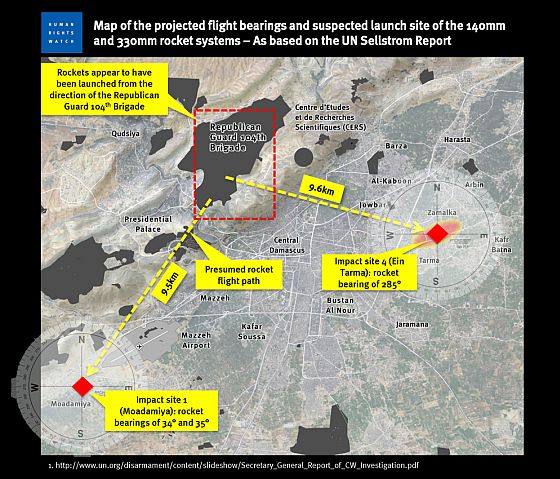
Human Rights Watch: The UN inspectors investigating the chemical weapons attack on two suburbs in Damascus last month weren’t supposed to point the finger at the party responsible for the killings. But even so, the Sellstrom report revealed key details of the attack that strongly suggest the government is to blame, and may even help identify the location from which the Sarin-filled rockets that killed hundreds of people on August 21 were fired.

In appendix 5 of their report, after describing the size and structure of two rocket delivery systems used, they go one step further and actually reveal the direction some of the rockets likely came from. Using standard field investigative techniques examining the debris field and impact area where the rockets struck, the report provides precise azimuths, or angular measurements, that allow us to work out the actual trajectory of the rockets.

“Impact site number 1 (Moadamiya) and impact site number 4 (Ein Tarma),” the inspectors wrote, “provide sufficient evidence to determine, with a sufficient degree of accuracy, the likely trajectory of the projectiles.” They go on to say that 3 of the rockets they inspected had bearings of 34 and 35 degrees for 2 of the rockets that landed in Moadamiya, and 285 degrees for 1 of the rockets that landed in Ein Tarma.

Connecting the dots provided by these numbers allows us to see for ourselves where the rockets were likely launched from and who was responsible.

The two attack locations are located 16 kilometers apart, but when mapping these trajectories, the presumed flight paths of the rockets converge on a well-known military base of the Republican Guard 104th Brigade, situated only a few kilometers north of downtown Damascus and within firing range of the neighborhoods attacked by chemical weapons.

According to declassified reference guides, the 140mm artillery rocket used on impact site number 1 (Moadamiya) has a minimum range of 3.8 kilometers and a maximum range of 9.8 kilometers. The Republican Guard 104th Brigade is approximately 9.5 km from the base. While we don’t know the firing range for the 330mm rocket that hit impact site number 4, the area is only 9.6km away from the base, well within range of most rocket systems. [Continue reading…]

Facebooktwittermail

Sarin: the deadly history of the nerve agent used in Syria

The Guardian reports: Now we know. On the morning of 21 August, as the air above Damascus cooled, rockets filled with the nerve agent sarin fell on rebel-held suburbs of the Syrian capital and left scores of men, women and children dead or injured. UN inspectors had been in the country for three days, on a mission to investigate allegations of earlier atrocities. They quickly changed tack. They brokered a temporary ceasefire with the regime and the rebels and made straight for Ghouta. Video reports from the area showed hospital staff overwhelmed and desperate.

Never before had UN inspectors worked under such pressure and in the midst of a war zone. The small team, headed by the Swedish chemical weapons expert Åke Sellström, was threatened with harm. Their convoy was shot at. But their 41-page report was completed in record time.

Sarin was that breed of accident that scientists come to regret. Its inventors worked on insecticides made from organophosphate compounds at the notorious IG Farben chemical company in Nazi Germany. In 1938, they hit on substance 146, a formula that caused massive disruption to the nervous system. The chemical name was isopropyl methylfluorophosphate, but the company renamed it sarin to honour the chemists behind the discovery – Schrader, Ambros, Ritter and Van der Linde – according to Benjamin Garrett’s 2009 book The A to Z of Nuclear, Biological and Chemical Warfare. The chemical they created had the grim distinction of being many times more lethal than cyanide.

Substance 146 is not hard to make, but it is hard to make without killing yourself. There are more than a dozen recipes that lead to sarin, but all require technical knowhow, proper lab equipment and a serious regard for safety procedures. One major component is isopropanol, more commonly known as rubbing alcohol. Another is made by mixing methylphosphonyl dichloride with hydrogen or sodium fluoride. But methylphosphonyl dichloride is not easy to come by. Under the Chemical Weapons Convention it is listed as a schedule 1 substance, making it one of the most restricted chemicals in existence. [Continue reading…]

Facebooktwittermail

The big issues revolve around Tehran

Rami G Khouri writes: The Moscow-Washington tango that resulted in the Syrian chemical weapons agreement was a first-class diplomatic show that will be analyzed by political scientists and pretzel makers for a generation. As always in successful diplomacy, every actor in the spectacle claims victory and national strategic benefits. The complexity of the cause-and-effect debate is what interests the pretzel makers, whose own fine handiwork defies the attempts of rational people to determine with precision where the pretzel starts and where it ends.

The Russian-American agreement on Syria begs analysis and any possible credible answers on three important questions. The first is for academics and historians because it is unlikely to receive a definitive answer: What role did the American threat of the use of force against Syria play in pushing the parties to an agreement?

Arguments on both sides of this question reflect existing ideological positions on issues such as the degree of coherence in U.S. policy in the Middle East and the efficacy and ethics of Washington’s proclivity to use military force unilaterally and at will anywhere in the world. This is a fascinating and important debate because the U.S. will threaten or use force again and again – as President Barack Obama and Secretary of State John Kerry both repeated several times in recent days while explaining their policies toward Syria and Iran.

The second key issue to examine now is how the agreement will impact the internal fighting in Syria, and the condition of Syria and Syrians.

I expect fighting to continue unabated across the country, and increase in places, as both sides seek to show that they gained from the accord – while their respective external supporters in the United States, Russia, Iran and Saudi Arabia will continue to feed them money and guns. Any drop in American aid to rebels will be compensated for by increased Arab Gulf aid.

The third and most important political question that the U.S.-Russia agreement raises is about its likely implications for a set of critical relationships revolving around a central actor in this wider drama–Iran. In the short run two dynamics matter here: American and Russian relations with Iran, and Iranian-Saudi Arabian relations. [Continue reading…]

Facebooktwittermail