Category Archives: Lands

Protests in Turkey are ‘tremendous democratic advance’

Ziya Meral writes: Often, it is fair to say that most of what we read on Turkey in the international media tells us more about those who write it than guide us towards a healthy analysis of developments in the country. The same goes for vast majority of the commentary on the protests we saw in Istanbul and across the country over the last week.

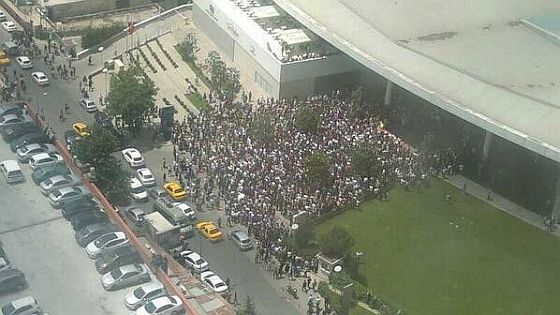
While protests in each of the cities have a different context and local factors, without a doubt initial protests on and around Gezi Park have triggered a larger social eruption. Therefore, understanding the Gezi Park protests would be important as a reflection on trends that unite these protests.

So far, the most credible data that emerged on protestors in Istanbul’s Taksim Square has been a poll among 3,000 protestors in the Taksim area by Bilgi University. The findings signal important insights.

Bilgi’s survey has found that 39 per cent of protestors are 19 to 25 years old and 24 per cent are 26 to 30 years old. Some 53 per cent have never joined a protest before, while 70 per cent do not feel close to any opposition party. Only 7 per cent say they joined the protests due to mobilisation by a political group. As to the reasons for the protest – some 92 per cent blame the prime minister’s attitude, 91 per cent say police brutality, 84 per cent the media’s silence on the events, and 56 per cent say the cutting of the trees. [Continue reading…]

Facebooktwittermail

What’s Happening In Turkey?

The Guardian reports: A crowd-funding campaign has raised over $55,000 in under 24 hours to help pay for a full-page ad in the New York Times calling for democratic action and new dialogue on Turkey.

The Indiegogo campaign – “Full Page Ad for Turkish Democracy in Action: OccupyGezi for the World” – called on contributors to raise a stated goal of $53,800, and asks people to “wake up”.

The text of the full-page New York Times ad:

Millions of Turkish citizens have been outraged by the violent reaction of their government to a peaceful protest aimed at saving Istanbul’s Gezi Park.

Outraged, yet not surprised.

Over the course of Prime Minister Erdogan’s 10-year term, we have witnessed a steady erosion of our rights and freedoms. Arrests of numerous journalists, artists, and even elected officials; restrictions on freedom of speech, women’s rights, and even alcohol sales have all demonstrated that the ruling party is not serious about democracy. Time and again, the prime minister has mocked and trivialised his nation’s concerns while Turkey’s own media has remained shamefully silent.

The people protesting bravely throughout Turkey are the proud inheritors of Atatürk’s legacy. We are not looters or extremists. We are students, teachers, workers, mothers, fathers. We represent various ethnicities and creeds, religions and ideologies. We stand united now because of our concern for Turkey’s future.

We demand an end to police brutality.

We demand a free and unbiased media.

We demand an open dialogue, not the dictate of an autocrat.

We hope that you will join the conversation and stand with us in solidarity.

http://en.wikipedia.org/wiki/2013_protests_in_Turkey

#GeziPark #OccupyGezi #DirenGeziParki (En. Resist Gezi Park)

This statement is crowdfunded by concerned individuals from around the world.

Facebooktwittermail

Turkish police arrest suspected Iranian agent in Ankara protests

Today’s Zaman reports: Turkish police have arrested, among others, an Iranian national named Shayan Shamloo in connection with violent demonstrations in the Turkish capital that followed what was initially a peaceful environmental protest at Gezi Park in İstanbul.

According to a source in the government who wanted to remain anonymous because of the pending investigation into violent events held in a couple of locations in Ankara, the Iranian national was suspected to have played a provocateur role.

The same source also told Today’s Zaman that authorities suspect Mr. Shamloo has connections with the Iranian intelligence. Police have reportedly arrested some 15 foreign nationals across the country in connection with events and most of them have turned out to be Iranian nationals.

Facebooktwittermail

A turning point in Turkey’s history?

Emre Caliskan and Simon A. Waldman write: The protests come as Turkey’s Prime Minister Recep Tayyip Erdogan is seeking to change the Turkish constitution to give more powers to the president, an office Erdogan is believed to be eyeing when his term as prime minister soon expires. Many Turks believe that this will give him further powers. Already there are deep concerns over sweeping laws and policies passed by Erdogan which threaten to alter the nature of Turkey’s identity to one that favors Islam over secularism without transparency or due process.

Last week, with little public debate, Turkey’s parliament passed legislation to restrict the sale of alcohol. “We don’t want a generation wandering around in a merry state day and night,” declared Erdogan. This is despite the fact that Turkey enjoys one of the lowest levels of alcohol consumption and drink-related problems in the Organization for Economic Cooperation and Development (OECD).

Also last week at a groundbreaking ceremony for a third Bosporus bridge in Istanbul, it was announced that the bridge would be named after Selim the Grim, a conquering Ottoman sultan known for his aversion to alcohol and his massacres of Alevis, a constituency that represents roughly 15% of Turkey’s population. This controversial decision was again made without public consultation.

Meanwhile, the independent media, a pillar of any healthy democracy, has been consistently targeted by Erdogan and his Justice and Development Party (AKP). According to the Reporters Without Borders’ 2013 World Press Freedom Index, Turkey is “the world’s biggest prison for journalists,” where approximately 70 journalists are still behind bars. Turkey was ranked 154th for open press out of 179 countries, a worse ranking than Iraq, Afghanistan and Russia.

This has not gone unnoticed by the public. The almost total media blackout of the first day of protests shocked many Turkish demonstrators who took to Twitter and Facebook to transmit news. But even social media has not escaped the wrath of Erdogan. “There is a now menace which is called Twitter,” the prime minister remarked, “Social media is the worst menace to society.”

Another source of public concern is the peace talks between Ankara and the Kurdistan Workers Party (PKK). Considered a terrorist group by Ankara, the PKK has waged a battle against Turkey since 1984 in its demand for Kurdish rights and autonomy. However, there was little public knowledge or debate about the negotiations. When a team of “elders” was finally selected to discuss the issue with the public, its members were drawn almost exclusively from supporters of Erdogan’s party. Many Turks and Kurds doubt the sincerity of the peace process; there are more than 8,000 Kurdish politicians, journalists and activists behind bars, mostly for non-violent offenses. [Continue reading…]

Facebooktwittermail

Viewing the Gezi Park protest the right way

Ziya Meral writes: Much has been and will be written about why and how a small and peaceful protest in Taksim Square’s Gezi Park evolved into a large social eruption. Relatively little has been said about what this might mean politically, socially, economically and diplomatically in the near future.

No matter from which political angle one looks at the events we have seen in Turkey over the past days, it is clear that one of the biggest problems in Turkey is our weak democratic culture. We have problems in handling different opinions, lifestyles, beliefs and political views and expressing ourselves, compromising, negotiating and reconciling.

Soon, there will be healthy calls for accountability and justice over how the police and authorities and, in some cases, protesters have conducted themselves and how the government handled this process. All of these are necessary, but if we want to see a lasting impact of what we have experienced last week and if we want to learn lessons from it as a nation beyond our usual polarization of “us” versus “them,” we must find ways to conceptualize Gezi Park’s memory from now on.

One way of not only memorializing but also seeking to develop Turkey’s democratic culture would be to declare Gezi Park as a Speakers’ Corner in the style of Hyde Park in London. This would not only make sure that protesters’ voices are not lost amid all the party politics and finger pointing that will follow, but also it would give us an inclusive platform to learn to communicate, listen and disagree. Thus, it would be a memorial site with a dynamic and future-looking aspect, which not only seeks to establish an account of what happened but universalizes what we learn or should learn from it. [Continue reading…]

Facebooktwittermail

France says tests confirm sarin gas used in Syria

The Associated Press reports: Samples taken from Syria and tested in France have confirmed that sarin gas has been used there multiple times, France’s foreign minister said Tuesday.

Laurent Fabius said the tests carried out by a French laboratory “prove the presence of sarin in the samples in our possession.” He said France “now is certain that sarin gas was used in Syria multiple times and in a localized way.”

The brief statement concluded: “It would be unacceptable that those guilty of these crimes benefit from impunity.”

Earlier Tuesday, a U.N. report on Syria said there are “reasonable grounds” to believe that limited quantities of toxic chemicals have been used as weapons in at least four attacks in Syria’s civil war, but that more evidence is needed to determine the precise chemical agents used or who used them.

The U.N. Commission of Inquiry said conclusive findings can be reached only after testing samples taken directly from victims or the site of the alleged attacks. It called on Damascus to allow a team of experts into the country, saying lack of access continues to hamper the commission’s ability to fulfill its mandate.

Facebooktwittermail

Nationwide strike call in Turkey likely to inflame anti-Erdogan protests

McClatchy reports: Police clashed with anti-government protesters in major cities around Turkey for a fourth day Monday as one of the country’s biggest public service unions threatened a nationwide strike Tuesday to show its discontent with Prime Minister Recep Tayyip Erdogan’s government.

In Ankara, police in helicopters, firing tear gas and plastic bullets, pursued groups of demonstrators throughout the city, Turkish television reported; on the ground, they discharged tear gas at one group of about 1,000 demonstrators. But more young people flocked to the city center.

In the western port city of Izmir, protesters threw fire bombs at the offices of Erdogan’s Justice and Development Party overnight, setting the building ablaze, Turkish television reported.

In Istanbul, where the protests began over the government’s plans to build a shopping center in one of the few parks in the city center, a Turkish doctors association announced the first fatality of the clashes – a young leftist who was killed when a car struck him during a protest on a major highway.

The Obama administration Monday took the unusual step of delivering a public dressing down of the Turkish government, a vital ally, for excess use of force.

Secretary of State John Kerry called for “a full investigation” of reports of excessive force and “full restraint from police.” He urged both the government and the protesters “to avoid any provocations and violence.”

The White House said those protesting were peaceful, law-abiding citizens, exercising their right to free expression – a very different take on the nature of the protests from that offered by Erdogan.

The combative leader, boasting that he’s won three elections and has the support of half the country, showed no intention of defusing the tensions, which erupted after police used heavy-handed tactics against a peaceful protest in Istanbul’s Gezi Park that began last week after workers began chopping down trees. After calling the protesters “looters” and “extremists” over the weekend, he charged on Monday that they were walking “arm in arm with terrorists,” Reuters reported. [Continue reading…]

Facebooktwittermail

A breakout role for Twitter? Extensive use of social media in the absence of traditional media by Turks in Turkish in Taksim Square protests

A protest outside Turkey's NTV against their lack of coverage of the #occupygezi protests.

Pablo Barberá and Megan Metzger write: Over the past several years the role of social media in promoting, organizing, and responding to protest and revolution has been a hot topic of conversation. From Occupy Wall Street to the Arab Spring Revolutions, social media has been at the center of many of the largest, most popular demonstrations of political involvement. The protests taking place in Turkey add to this growing trend, and are already beginning to add new layers to our understanding of how social media can contribute to public participation.

Protests have been ongoing since early this week in Istanbul’s Taksim Square. Organized in response to government plans to tear down the green space in the center of the square and replace it with a shopping center, the protests have morphed into a more visceral expression of the general discontent with the government’s policies over the last several years In response, the police fired massive amounts of tear gas and pepper spray into the crowd and set fire to tents set up for protesters to sleep in, leaving several people injured. Protesters have begun wearing homemade gas masks while continuing to protest on the street. As of 2 AM Turkish time on Saturday, the protests are still in progress and some protestors have reportedly breached the barrier and entered the park.

The social media response to and the role of social media in the protests has been phenomenal. Since 4pm local time yesterday, at least 2 million tweets mentioning hashtags related to the protest, such as #direngeziparkı (950,000 tweets), #occupygezi (170,000 tweets) or #geziparki (50,000 tweets) have been sent. As we show in the plot below, the activity on Twitter was constant throughout the day (Friday, May 31). Even after midnight local time last night more than 3,000 tweets about the protest were published every minute. [Continue reading…]

Facebooktwittermail

Erdogan says social media is ‘the worst menace to society’

The Guardian reports: Thousands of protesters have controlled Istanbul’s main square once more after two days of violent clashes with rampaging riot police, as Turkey’s prime minister vowed to press on with the controversial redevelopment that provoked the clashes.

Calling the protesters an “extremist fringe”, Recep Tayyip Erdogan blamed the opposition Republican People’s party for provoking the protests.

“We think that the main opposition party, which is making resistance calls on every street, is provoking these protests,” Erdogan said on Turkish television, as an estimated 10,000 demonstrators streamed into the area waving flags and calling on the government to resign.

“There is now a menace which is called Twitter,” Erdogan said. “The best examples of lies can be found there. To me, social media is the worst menace to society.”

Facebooktwittermail

Ten tweets on the hypocrisy of the Turkey protests

Yavus Selim writes: “What’s going on in Turkey?” is a common question on the lips of people as varied as Joseph Gordon-Levitt and some American Muslim scholars. People are finding it hard to wrap their head around the facts. The most stable, economically successful and popular democratically elected government in the Middle East has been experiencing widespread protests over… a planning application? That doesn’t sound right and of course, it isn’t the case at all.
I do not condone violence against protestors-there is definitely some police brutality at play which President Erdogan himself hinted at and said that it would be investigated and dealt with- but do want to take a closer look at the why people are gathering in Taksim Square and elsewhere in Turkey.

Here are ten tweets that expose what the current “protests” in Turkey are all about:

Tweet 1: So much for the trees


Yes. The figures are astronomical but in the last ten years this Turkish government has planted enough trees to repopulate a sizable section of Amazon. So we can now establish that these protests have nothing to do with the environment at all and they were merely using it as a cover. A cover for what?

Tweet 2: With friends like these


For once, Pamela Gellar (the well known anti-Islam blogger who stated that she hopes Israel bombs Mecca and Madīnah) is right. This isn’t about trees at all. It is about the secular bloc in Turkey making a final anarchic stand against what they hate most in this world – their nation coming closer to Islam once more.

Tweet 3: Don’t believe me?


[Continue reading…]

Facebooktwittermail

Not a ‘Turkish Spring’ but still important

Mustafa Akyol and H.A. Hellyer dismiss the idea that the protests currently sweeping across Turkey should be viewed as a “Turkish Spring,” but Prime Minister Tayyip Erdoğan needs to draw the right lessons.

Erdoğan has certainly attracted the ire of his opponents more prominently recently. He named Istanbul’s new intercontinental bridge after an Ottoman Sultan, who is widely respected among the Sunni majority, but also seen by the Turkish Alevi minority as a bloody tyrant; and he’s implemented limitations on alcohol consumption, which infuriated secularist Turks, who feel that a conservative and intimidating Erdoğan threatens their lifestyle. Erdoğan has other illiberal enemies as well: nationalist groups despise Erdoğan for initiating a peace process with the PKK, the Kurdish separatist guerrilla army, while communist groups condemn him for being “an American collaborator,” & an enemy of the Assad regime in Syria, which they hold dear.

These protests weren’t begun by any of these groups – and Erdoğan’s government made a grave mistake by not restraining the police, resulting in state brutality upon the protestors. Indeed, had the police not responded so viciously, it’s likely the protests would have fizzled out quite quickly. That brutality brought out many Turks without any particular political agenda onto the streets, including those who took seriously the allegations of corruption with regards to the construction projects. Perhaps less than interested in the serious environmental issue that results from the loss of green spaces (which is rare indeed in Istanbul), many political groups then found a locus for their cumulative discontent.

Nevertheless, none of this means that Erdoğan has to resign, as some protestors have demanded: he is the most popular Turkish Prime Minister in the past half-century, and while thousands went on the streets to protest him, millions who support him remained in their homes. Yet that ought not be a reason for Erdoğan to be complacent either. Indeed, it is he who needs to take the greatest lesson from all this. He and his government ought to recognise that the ballot box is not the only thing that counts in truly participatory democracy – and those that govern the largest Arab country on the other side of the Mediterranean sea should acknowledge the same. Here, there are indeed some similarities – as governments in both Turkey and Egypt need to identify that the lack of consensus does come at a price, and causes unnecessary tensions.

A report in The Independent reveals no signs of Erdoğan expressing an interest in consensus building as he contemptuously dismisses his critics.

Turkey’s Prime Minister has rejected claims from protesters, who have taken to the streets across the country over the past two days, that he is an authoritarian leader, as thousands of people marched and reoccupied the centre of Istanbul.

Protesters returned to Istanbul’s Taksim Square on Sunday, the site where a small protest over plans to redevelop a park spiralled into violent confrontations on Friday when police moved to evict the demonstrators.

The heavy-handed tactics of authorities sparked more than 90 demonstrations around the country on Friday and Saturday, officials said. More than 1,000 people have been injured in Istanbul and several hundred more in Ankara, according to medical staff.

In Taksim Square on Sunday afternoon, people were chanting slogans against Mr Erdogan and calling for him to resign. Undeterred, Mr Erdogan used a television interview to rebuke the demonstrators, who he dismissed as “a few looters”.

“[They say] Tayyip Erdogan is a dictator. If they call one who serves the people a dictator, I cannot say anything,” said the Prime Minister during a televised speech. Erdogan insisted the project to revamp Gezi Park would go on despite the protests. “We will build a mosque in Taksim and we do not need the permission of the CHP [Republican People’s Party, the main opposition party in Parliament] or of a few bums to do it.”

Facebooktwittermail

Reports of Anonymous attack on Turkish government

Today’s Zaman reports: Global “hacktivist” group Anonymous has announced a campaign to disrupt communications channels of the Turkish government in response to its handling of the Gezi protests, with reports of two cyberattacks on Sunday.

Turkish media reported on Monday that Anonymous had “managed to take down access” to the Official Gazette, the Turkish government’s journal for publishing legislation and announcements, on Sunday. As of Monday morning, the site appeared fully functional.

An early-Monday attack on the website of the private news channel NTV was also reported. NTV is among the many Turkish media outlets that have been criticized for their scant coverage of the ongoing protests and violence.

Addressed to “citizens of Turkey,” a video apparently posted by Anonymous on Sunday on YouTube and titled “#opTurkey” took aim at the Turkish government’s response to protests against the demolition of İstanbul’s Gezi Park, a small sit-in that morphed into demonstrations involving thousands after police responded with tear gas and water cannon.

Facebooktwittermail

Turks rally against Erdogan rule

Tulin Daloglu writes: Just like that iconic picture in 1989 known as the “Tank Man of Tiananmen,” Reuters’ top photo on Tuesday [May 28] showing a young woman wearing a short-sleeve burgundy dress, carrying a white tote bag over her shoulder while a police officer wearing a gas mask spraying pepper into her face will be equally remembered as a historic picture down the road.

Something changed for the decade-long rule of the Justice and Development Party (AKP) on Friday [May 31], as the police crackdown took a turn for the worse. Pepper was sprayed and pressured water canons were used on the peaceful protesters in downtown Istanbul; protesters who have been unable to stop the government’s plan to demolish one of the city’s few remaining parks, cutting down 70-year-old trees to rebuild the Ottoman Artillery Barracks that were originally built in 1740 and destroyed in 1940.

Addressing the General Convention of Turkey Exporters Assembly (TIM) on Saturday [June 1], Turkish Prime Minister Recep Tayyip Erdogan, however, stressed over and over again in his speech, “We will build that Ottoman Artillery Barrack there.” The prime minister insists that this protest “is not an issue about those 5 or 6 trees [in the park]. This has now become an ideological struggle. They say that we will build a shopping mall there, but there is no concrete decision. Whoever is my counterpart here [on the side of the protesters] should sincerely say what they want, but we will build that Ottoman Artillery Barracks there because it was once there.”

Erdogan does not seem to be getting the message. While this protest may now turn ideological, it all started as a small gathering of about 500 people on Monday [May 27]. The reason it got out of control with massive protests in 10 other cities around the country — Adana, Konya, Tunceli, Mersin, Mugla, Marmaris, Izmit, Adana, Izmir, Van and Sivas — is that Erdogan has shown no culture of consensus building with those who disagree with him. Instead, he painted the protesters as “anti-democratic” and engaging in “illegal” activities. [Continue reading…]

Facebooktwittermail

More than 1,000 killed in Iraq violence in May

Reuters reports: More than 1,000 people were killed in violence in Iraq in May, making it the deadliest month since the sectarian slaughter of 2006-07, the United Nations said on Saturday, as fears mounted of a return to civil war.

Nearly 2,000 people have been killed in the last two months as al Qaeda and Sunni Islamist insurgents, invigorated by the Sunni-led revolt in Syria and by Sunni discontent at home, seek to revive the kind of all-out inter-communal conflict that killed tens of thousands five years ago.

“That is a sad record,” Martin Kobler, the U.N. envoy in Baghdad, said in a statement. “Iraqi political leaders must act immediately to stop this intolerable bloodshed.”

The renewed bloodletting reflects worsening tensions between Iraq’s Shi’ite-led government and the Sunni minority, seething with resentment at their treatment since Saddam Hussein was overthrown by the U.S.-led invasion of 2003 and later hanged.

Facebooktwittermail

Syria, not too worried about killing its citizens, advises them to avoid getting pepper-sprayed in Turkey

AFP reports: War-torn Syria on Sunday advised its citizens to avoid travel to neighbouring Turkey, where massive protests have rocked several cities, because of “a deterioration in the security situation.”

The warning issued by the foreign ministry comes as a civil war that has killed tens of thousands ravages Syria, pitting rebels backed by Turkey and other countries against the regime of President Bashar al-Assad.

“The foreign ministry advises Syrian citizens to avoid travel to Turkey for their own safety because of a deterioration in the security situation in a number of Turkish cities,” it said in a statement carried on Syrian state television.

Facebooktwittermail

Losing the Syrian revolution

Edward Dark is the pseudonym for a Syrian currently residing in Aleppo. He writes: So what went wrong? Or to be more accurate, where did we go wrong? How did a once inspirational and noble popular uprising calling for freedom and basic human rights degenerate into an orgy of bloodthirsty sectarian violence, with depravity unfit for even animals? Was it inevitable and wholly unavoidable, or did it not have to be this way?

The simple answer to the above question is the miscalculation (or was it planned?) of Syrians taking up arms against their regime, a ruthless military dictatorship held together by nepotism and clan and sectarian loyalties for 40 years of absolute power. Former US ambassador to Syria Robert Ford specifically warned about this in his infamous visit to Hama in the summer of 2011 just as the city was in the grip of massive anti-regime protests and before it was stormed by the Syrian army. That warning fell on deaf ears, whether by design or accident, and we have only ourselves to blame. Western and global inaction or not, we are solely responsible for our broken nation at the end of the day.

Nietzsche once said, “Whoever fights monsters should see to it that in the process he does not become a monster.” That has proved to be very prophetic in the Syrian scenario. Away from all the agendas, whitewashing, propaganda, and outright lies of the global media stations, what we saw on the ground when the rebel fighters entered Aleppo was a far different reality. It hit home hard. It was a shock, especially to those of us who had supported and believed in the uprising all along. It was the ultimate betrayal.

To us, a rebel fighting against tyranny doesn’t commit the same sort of crimes as the regime he’s supposed to be fighting against. He doesn’t loot the homes, businesses and communities of the people he’s supposed to be fighting for. Yet, as the weeks went by in Aleppo, it became increasingly clear that this was exactly what was happening.

Rebels would systematically loot the neighborhoods they entered. They had very little regard for the lives and property of the people, and would even kidnap for ransom and execute anyone they pleased with little recourse to any form of judicial process. They would deliberately vandalize and destroy ancient and historical landmarks and icons of the city. They would strip factories and industrial zones bare, even down to the electrical wiring, hauling their loot of expensive industrial machinery and infrastructure off across the border to Turkey to be sold at a fraction of its price. Shopping malls were emptied, warehouses, too. They stole the grain in storage silos, creating a crisis and a sharp rise in staple food costs. They would incessantly shell residential civilian neighborhoods under regime control with mortars, rocket fire and car bombs, causing death and injury to countless innocent people, their snipers routinely killing in cold blood unsuspecting passersby. As a consequence, tens of thousands became destitute and homeless in this once bustling, thriving and rich commercial metropolis. [Continue reading…]

Facebooktwittermail