Category Archives: Lands

Bush administration official blasts Trump over Russia

Reuters reports: A former U.S. diplomat who served under Republican President George W. Bush criticized the Trump administration on Wednesday for failing to do more to investigate allegations that Russia sought to meddle in the 2016 U.S. election.

“Russia’s going to do this again,” Nicholas Burns, who was undersecretary of state from 2005 to 2008, testified to the Senate Intelligence Committee.

“Russia’s our most dangerous adversary in the world today, and if he continues to refuse to act, it’s a dereliction of the basic duty to defend the country,” Burns said. [Continue reading…]

Facebooktwittermail

Tensions rising in Balkans as hopes for EU future fade

Der Spiegel reports: The man who hopes to become the prime minister of Kosovo has a past, documented under case file IT-04-84 at the International Criminal Tribunal for the former Yugoslavia in The Hague. Forty-eight-year-old Ramush Haradinaj, aka Smajl, was accused of crimes against humanity in 37 cases, including murder and torture.

The allegations are from the 1990s, when he was a field commander for the Kosovo Liberation Army (UÇK) in the war against the Serbs. The court ultimately found Haradinaj not guilty, a product of witnesses declining to testify at the last moment or, in some cases, dying suddenly. The United Nations police force in Kosovo has accused the UÇK veteran of dealing cocaine, while Germany’s foreign intelligence service, the BND, described him in a 2005 analysis as being the head of a group involved in “the entire spectrum of criminal activities.”

Despite his past, though, Haradinaj’s alliance of former fighters managed to emerge victorious in Kosovo parliamentary elections earlier this month. With 34 percent of the voters supporting his alliance, it is now up to him to form a governing coalition.

The news from Kosovo, the mini-republic located northeast of Albania, is consistent with the atmosphere in the Western Balkans these days. Kosovo, Macedonia and Bosnia-Herzegovina, all part of former Yugoslavia, have spent years waiting to become members of the European Union, but it seems in the early summer of 2017 as though they have almost been forgotten. And people there are beginning to lose their patience. The result: increasing numbers of people leaving the region, accelerated Islamization and rising nationalism. Violent protests recently in the Macedonian capital of Skopje along with ranting about a Greater Albania in both Tirana and Pristina, the capitals of Albania and Kosovo respectively, have served to demonstrate just how tense the situation has become. [Continue reading…]

Facebooktwittermail

As ISIS’s ‘caliphate’ crumbles, its ideology remains

Farah Najjar writes: Three years ago on Wednesday, ISIL leader Abu Bakr al-Baghdadi stood at the pulpit of Mosul’s Grand Al Nuri mosque, which was destroyed last week amid fighting between the armed group’s fighters and US-backed Iraqi forces, and announced the creation of a Sunni caliphate.

While ISIL proceeded to balloon in size – at its peak it covered territory across Iraq and Syria roughly equivalent to the size of the United Kingdom – it has lost nearly 47 percent of its territory since January, according to Conflict Monitor by IHS Markit, a security and defence observer.

Experts say that despite being seemingly on the brink of military defeat, the group’s widespread ideology will be much harder to erase and may re-emerge in other manifestations.

“The structure of ISIS is destroyed, but the underlying forces are not – they are being worsened,” Rami Khouri, senior fellow and professor at the American University of Beirut, told Al Jazeera, using a different acronym for ISIL.

“The rise of ISIS is a sign of deeper problems,” he said.

Though it is unclear how ISIL may re-establish itself, some believe that poor economic conditions and volatile war-torn areas are the basis for the emergence of such groups.

Khouri said that unless underlying regional issues such as unemployment, human rights abuses and political repression are addressed, the group’s ideology will continue to attract the disenfranchised and politically excluded. [Continue reading…]

Facebooktwittermail

Tillerson and Mattis struggle to clean up Trump and Kushner’s Middle East mess

Mark Perry writes: On March 25, 2011, a Qatar Air Force Mirage 2000-5, took off from Souda Air Base, in Crete, to help enforce a no-fly zone protecting rebels being attacked by Libyan strongman Muammar Qaddafi. Qatar was the first Persian Gulf nation to help the U.S. in the conflict.

Qatari operations were more than symbolic. The Qatari military trained rebel units, shipped them weapons, accompanied their fighting units into battle, served as a link between rebel commanders and NATO, tutored their military commanders, integrated disparate rebel units into a unified force and led them in the final assault on Qaddafi’s compound in Tripoli.“We never had to hold their hand,” a retired senior U.S. military officer says. “They knew what they were doing.” Put simply, while the U.S. was leading from behind in Libya, the Qataris were walking point.

The Qatar intervention has not been forgotten at the Pentagon and is one of the reasons why Defense Secretary James Mattis has worked so diligently to patch up the falling out between them and the coalition of Saudi-led countries (including the UAE, Bahrain and Egypt), that have isolated and blockaded the nation. In fact, Mattis was stunned by the Saudi move. “His first reaction was shock, but his second was disbelief,” a senior military officer says. “He thought the Saudis had picked an unnecessary fight, and just when the administration thought they’d gotten everyone in the Gulf on the same page in forming a common front against Iran.”

At the time of the Saudi announcement, Mattis was in Sydney with Secretary of State Rex Tillerson to dampen concerns about the Trump administration’s withdrawal from the Trans-Pacific Partnership and the Paris climate accords. The two glad-handed Australian officials and issued a reassuring pronouncement on U.S. intentions during a June 5 press briefing with that nation’s foreign and defense ministers. When the burgeoning split between the Saudis and Qataris was mentioned, Tillerson described it as no more than one of “a growing list or irritants in the region” that would not impair “the unified fight against terrorism …”

But while Tillerson’s answer was meant to soothe concerns over the crisis, behind the scenes he and Mattis were scrambling to undo the damage caused by Saudi action. The two huddled in Sydney and decided that Tillerson would take the lead in trying to resolve the falling out. Which is why, three days after the Sydney press conference, Tillerson called on Saudi Arabia, the UAE, Bahrain and Egypt to ease their anti-Qatar blockade and announced that the U.S. supported a Kuwaiti-led mediation effort. The problem for Tillerson was that his statement was contradicted by Donald Trump who, during a Rose Garden appearance on the same day, castigated Qatar, saying the emirate “has historically been a funder of terrorism at a very high level.”

A close associate of the secretary of state says that Tillerson was not only “blind-sided by the Trump statement,” but “absolutely enraged that the White House and State Department weren’t on the same page.” Tillerson’s aides, I was told, were convinced that the true author of Trump’s statement was U.A.E. ambassador Yousef Al Otaiba, a close friend of Trump son-in-law Jared Kushner. “Rex put two-and-two together,” his close associate says, “and concluded that this absolutely vacuous kid was running a second foreign policy out of the White House family quarters. Otaiba weighed in with Jared and Jared weighed in with Trump. What a mess.” The Trump statement was nearly the last straw for Tillerson, this close associate explains: “Rex is just exhausted. He can’t get any of his appointments approved and is running around the world cleaning up after a president whose primary foreign policy adviser is a 31-year-old amateur.”

Worse yet, at least from Tillerson’s point of view, a White House official explained the difference between the two statements by telling the press to ignore the secretary of state. “Tillerson may initially have had a view,” a White House official told the Washington Post, “then the president has his view, and obviously the president’s view prevails.”

Or maybe not. While Trump’s June 9 statement signaled that the U.S. was tilting towards the Saudis and the UAE, Tillerson and Mattis have been tilting towards Qatar. And for good reason. [Continue reading…]

Facebooktwittermail

Trump is handing the world to China, says UN secretary-general

Politico reports: Can António Guterres scare Donald Trump into taking the United Nations seriously?

Since taking office in January, the United Nations secretary-general has done his level best to build a decent working relationship with the new administration. He has kept criticisms of the White House’s nationalist agenda to a bare minimum. While pleading with Washington to refrain from deep cuts to the U.N. budget, he has worked assiduously to build a rapport with U.S. ambassador Nikki Haley. Testifying in Congress on Tuesday, Haley noted that Guterres had agreed that the U.S. could safely make some cuts to its funding of blue-helmet peace operations – a message likely to rile up other U.N. members who may have to make up the difference.

But there are limits to even the most discreet international civil servant’s patience. Over the last month, Guterres has been trying out a new message: Trump is handing the world to China.

The secretary-general, who is also visiting Washington this week for consultations on Capitol Hill, tried out this line for the first time in late May. Speaking on the eve of President Trump’s decision to withdraw from the Paris climate change agreement, he warned that if the U.S. created a “geostrategic vacuum” by giving up its global role, “I guarantee that someone else will occupy it.” He clearly implied this would be Beijing.

Guterres, who was once a professional physicist, summoned up the vacuum metaphor in a mid-year press conference last week, but with more of a pro-American twist. “I don’t think this is good for the United States,” he said of other powers’ potential power grab, “and I don’t think this is good for the world.”

Many pundits have highlighted how China is benefiting from Trump’s foreign policy mess in far starker terms. But it is striking that a U.N. secretary-general is talking even this frankly about geostrategic power shifts. Whatever the U.N.’s conservative foes say about the organization, international officials hate criticizing America in public. The U.S. remains the organization’s predominant funder. Washington has been brutal with previous secretaries-general who have criticized its policies, as Kofi Annan did over Iraq.

So Guterres will not have played the China card lightly. He is not the sort of politician who picks unnecessary fights. A former Portuguese prime minister with decades of experience in top-level political wheeling and dealing, the secretary-general prefers to work quietly behind closed doors. [Continue reading…]

Facebooktwittermail

Trump campaign chief’s firm got $17 million from pro-Russia party

The New York Times reports: Paul Manafort, who was forced out as President Trump’s campaign chairman last summer after five months of infighting and criticism about his business dealings with pro-Russian interests, disclosed Tuesday that his consulting firm had received more than $17 million over two years from a Ukrainian political party with links to the Kremlin.

The filing serves as a retroactive admission that Mr. Manafort performed work in the United States on behalf of a foreign power — Ukraine’s Party of Regions — without disclosing it at the time, as required by law. The Party of Regions is the political base of former President Viktor F. Yanukovych, who fled to Russia during a popular uprising in 2014.

The disclosure hints at the vast fortunes available to top American political consultants plying their trade in other countries.

It was not immediately clear if Mr. Manafort would be required to pay any fines for the late filing. He has maintained that a majority of his work for Mr. Yanukovych was political consulting in Ukraine, where his firm, Davis Manafort International, operated an office at the time. [Continue reading…]

Facebooktwittermail

Ransomware attack strikes companies across Europe and U.S.

The Guardian reports: Victims of a major ransomware cyberattack that has spread through the US and Europe can no longer unlock their computers even if they pay the ransom.

The “Petya” ransomware has caused serious disruption at large firms including the advertising giant WPP, French construction materials company Saint-Gobain and Russian steel and oil firms Evraz and Rosneft.

Infected computers display a message demanding a Bitcoin ransom worth $300. Those who pay are asked to send confirmation of payment to an email address. However, that email address has been shut down by the email provider.

“We do not tolerate any misuse of our platform,” said the German email provider Posteo in a blog post.

This means that there is no longer any way for people who decide to pay the ransom to contact the attacker for a decryption key to unlock their computer.

“This is not an experienced ransomware operator,” said Ryan Kalember, senior vice-president of cybersecurity strategy at Proofpoint.

The attack was first reported in Ukraine, where the government, banks, state power utility and Kiev’s airport and metro system were all affected. The radiation monitoring system at Chernobyl was taken offline, forcing employees to use hand-held counters to measure levels at the former nuclear plant’s exclusion zone. [Continue reading…]

Facebooktwittermail

Tight circle of security officials crafted Trump’s Syria warning

Politico reports: President Donald Trump’s blunt, public warning to the Syrian regime issued late Monday night was cobbled together in a series of hurried discussions, squeezed in between meetings with Indian Prime Minister Narendra Modi — and kept among a small, tight circle of top officials.

Defense Secretary James Mattis and Secretary of State Rex Tillerson both arrived at the White House late Monday afternoon, ahead of the Rose Garden ceremony where Trump and Modi both read prepared statements. Upon their arrival, according to a senior defense official, they were informed of Trump’s plan to issue a public warning to Syrian president Bashar Assad, based on new intelligence that the Syrian administration was making preparations for another chemical weapons attack on its own people.

National security adviser H.R. McMaster, who also was at the White House for meetings, had already been briefed and weighed in on the plan, administration sources said.

But no stand-alone principals meeting followed to discuss the intelligence, which Trump received Monday morning, according to two senior administration officials.

Rather, over the course of the day, officials said, McMaster, Mattis, Tillerson and a few other top officials had the opportunity to “work the language” of the statement, in between Modi meetings. None of them expressed any hesitation or disagreement about the decision to issue a public warning, according to one of the senior administration officials.

But a Defense Department official acknowledged that the events were “fast moving” and that there were minimal deliberations about the bold move — and that only a limited number of top military officials were aware of the new intelligence and planned response. [Continue reading…]

Facebooktwittermail

Trump cares more about CNN and the Russia story than Syria, official says

The Daily Beast reports: Hours before the White House issued an ominous warning to Syria’s dictator against launching another chemical assault, Secretary of State Rex Tillerson gave the same message to Bashar Assad’s patron in Moscow, The Daily Beast has learned.

According to a knowledgeable senior administration official, Tillerson warned his counterpart, Sergei Lavrov: the U.S. sees that Russia and Syria may be prepping for another chemical weapons attack; and that there will be consequences if Assad follows through with it.

All this occurred this week as President Donald Trump displayed what two White House officials characterized as relative indifference and passivity towards the subject, instead opting to focus his public and private energies towards fuming at his domestic enemies in the Democratic Party and the “fake news.”

“The president cares more about CNN and the Russia story than [Syria] at the moment,” one official observed. [Continue reading…]

Facebooktwittermail

Assad will ‘pay a heavy price’ if he launches another chemical attack, says White House. More ‘after-dinner entertainment’ for Trump’s guests?

The Washington Post reports: The White House issued an ominous warning to Syrian President Bashar al-Assad on Monday night, pledging that his regime would pay a “heavy price” if it carried out another chemical attack this year.

In a statement, White House press secretary Sean Spicer said that the United States had detected evidence of preparations for a chemical attack, similar to the preparations that occurred before an attack in April.

“The United States has identified potential preparations for another chemical weapons attack by the Assad regime that would likely result in the mass murder of civilians, including innocent children,” Spicer said in the statement. “The activities are similar to preparations the regime made before its April 4, 2017 chemical weapons attack.

“As we have previously stated, the United States is in Syria to eliminate the Islamic State of Iraq and Syria,” he continued. “If, however, Mr. Assad conducts another mass murder attack using chemical weapons, he and his military will pay a heavy price. [Continue reading…]

The New York Times reports: Several military officials were caught off guard by the statement from President Trump’s press secretary, but it was unclear how closely held the intelligence regarding a potential chemical attack was. [Continue reading…]

The Associated Press reports: Several State Department officials typically involved in coordinating such announcements said they were caught completely off guard by the warning, which didn’t appear to have been discussed in advance with other national security agencies. Typically, the State Department, the Pentagon and U.S. intelligence agencies would all be consulted before the White House issued a declaration sure to ricochet across foreign capitals.

A non-governmental source with close ties to the White House said the administration had received intelligence that the Syrians were mixing precursor chemicals for a possible sarin gas attack in either the east or south of the country, where government troops and allied forces have faced recent setbacks.

The U.S. attack on a Syrian air base came after years of heated debate and deliberation in Washington over intervention in the bloody civil war. Chemical weapons have killed hundreds of people since the start of the conflict.

The U.S. is providing air support and arms to Kurdish-led Syrian forces who are fighting to drive the Islamic State group from Raqqa, the extremists’ self-styled capital.

Defense Secretary Jim Mattis said Tuesday that Washington would continue to provide weapons after the Raqqa battle is over. His comments were likely to anger Turkey, which views the Kurdish fighters as an extension of the insurgency raging in its southeast.

On Monday, Trump had dinner with Mattis, Secretary of State Rex Tillerson, National Security Adviser H.R. McMaster and other top officials as he hosted Indian Prime Minister Narendra Modi at the White House. [Continue reading…]

The connection could be simply coincidental, but I find it curious that Trump’s first cruise missile strike on Syria and now this latest threat both occurred while he was acting as dinner host to the leaders of the world’s two largest states, China and India.

After the April attack, Variety reported:

Speaking at the Milken Institute Global Conference on Monday, Commerce Secretary Wilbur Ross recalled the scene at Mar-a-Lago on April 6, when the summit with Chinese President Xi Jinping was interrupted by the strike on Syria.

“Just as dessert was being served, the president explained to Mr. Xi he had something he wanted to tell him, which was the launching of 59 missiles into Syria,” Ross said. “It was in lieu of after-dinner entertainment.”

Whether Trump, yesterday evening, murmured to India’s PM Modi something to the effect that he might soon need to give Assad another lesson on the application of American power, I have no idea.

Even so, when it comes to Assad’s use of chemical weapons, there’s little reason to believe that their impact on innocent children is uppermost among Trump’s concerns.

Back in 2013, Trump insisted that the U.S. had nothing to gain by getting involved in Syria and that Obama shouldn’t launch strikes without Congressional approval. He also tweeted, “I would not go into Syria, but if I did it would be by surprise and not blurted all over the media like fools.”

Nowadays it would seem he’s less concerned about maintaining the element of surprise as the White House blurts out its warning.

Given that Trump’s red lines seem to get daubed in such a haphazard way across Syria, his actions are perhaps better interpreted as serving as a form of self-expression and an instrument through which on a world stage, seated along side world leaders, he gets to assert his position as the alpha male.

Facebooktwittermail

Will get fooled again – Seymour Hersh, Welt, and the Khan Sheikhoun chemical attack

Eliot Higgins writes: On June 25th 2017 the German newspaper, Welt, published the latest piece by Seymour Hersh, countering the “mainstream” narrative around the April 4th 2017 Khan Sheikhoun chemical attack in Syria. The attack, where Sarin was allegedly used against the local population, dropped in a bomb by the Syrian Air Force, resulted in President Trump taking the decision to launch cruise missiles at a Syrian airbase.

As with his other recent articles, Hersh presented another version of events, claiming the established narrative was wrong. And, as with those other recent articles, Hersh based his case on a tiny number of anonymous sources, presented no other evidence to support his case, and ignored or dismissed evidence that countered the alternative narrative he was trying to build.

This isn’t the first chemical attack in Syria which Hersh has presented a counter-narrative for, based on a handful of anonymous sources. In his lengthy articles for the London Review of Books, “Whose sarin?” and “The Red Line and the Rat Line”, Hersh made the case that the August 21st 2013 Sarin attack in Damascus was in fact a false flag attack intended to draw the US into the conflict with Syria. This claim fell apart under real scrutiny, and relied heavily on ignoring much of the evidence around the attacks, an ignorance of the complexities of producing and transporting Sarin, and a lack of understanding about facts firmly established about the attacks. [Continue reading…]

Facebooktwittermail

Mattis: After Raqqa, the Syrian battlefield will only get more complicated

The Washington Post reports: As the fight against the Islamic State moves beyond its de facto capital in Raqqa, the Pentagon is readying itself for an increasingly complex battlefield in northern Syria, where U.S.-backed forces, pro-Syrian government troops and Russian jets will likely all be fighting near one another.

Speaking to reporters on his way to Germany on Monday to meet with European allies, Secretary of Defense Jim Mattis spoke broadly about the U.S. military’s future operations against the Islamic State in the Euphrates River Valley, adding that it will take “more precision” to stave off any incidents between the disparate forces operating there.

“You have to play this thing very carefully,” Mattis said. “The closer we get, the more complex it gets.”

Mattis also acknowledged that the U.S. would continue to supply Kurdish forces in the north with weapons despite objections by U.S. ally Turkey. “When they don’t need them anymore we’ll replace them with what they do need,” he said. [Continue reading…]

Facebooktwittermail

No one is paying attention to the worst humanitarian crisis since World War II

Jackson Diehl writes: The never-ending circus that is Donald Trump’s presidency has sucked attention from all kinds of issues that desperately need it, from health-care reform to the creeping expansion of U.S. engagement in Syria. Still, it’s shocking that so little heed is being paid to what the United Nations says is the worst humanitarian crisis since 1945: the danger that about 20 million people in four countries will suffer famine in the coming months, and that hundreds of thousands of children will starve to death.

Not heard of this? That’s the problem. According to U.N. and private relief officials, efforts to supply enough food to stem the simultaneous crises in South Sudan, Somalia, Yemen and Nigeria are falling tragically short so far, in part because of inadequate funding from governments and private donors. Of the $4.9 billion sought in February by the U.N.’s Office for the Coordination of Humanitarian Affairs (OCHA) for immediate needs in those countries, just 39 percent had been donated as of last week.

That resource gap could be attributed to donor fatigue, or to the sheer size of the need. But, in part, it’s a simple lack of awareness. “We can’t seem to get anyone’s attention to what’s going on,” says Carolyn Miles, the president and chief executive of Save the Children. [Continue reading…]

Facebooktwittermail

At 15 I was tortured in Assad’s prisons. I escaped, but thousands still suffer

An anonymous Syrian torture victim writes: For the 10 months I spent as a detainee in the prisons of Bashar al-Assad, I only saw my family in my dreams. At night, the screams would stop for an hour or two, and I could close my eyes and remember what it was like to be human. When I slept, I would return to my life.

Today is the UN’s International Day for Support of Victims of Torture. Unfortunately in Syria, there is no shortage of victims of torture. Tens of thousands of us have been thrown in Assad’s prisons and tortured beyond what our bodies and minds can take. Many of us die there. Those of us who have survived will spend the rest of our lives being reminded of just how evil humanity is capable of being.

I was only 15 when I was arrested and subjected to months of physical and psychological torture.

I am lucky to have survived. There were times I wished for death. As happy as I am to return to life again, I am equally gripped by sadness and pain knowing more than 200,000 prisoners are still there. My freedom feels incomplete as long as my Syrian brothers and sisters suffer behind those high walls. I am a hostage of my memory.

Aleppo is my home. I was forced to leave there in 2013 to try to escape the barrel bombs and besiegement of the city by Assad and his allies. My mother, siblings and I fled to Lebanon. At the age of 14, I had to leave school and begin working to try to sustain our family. At the end of 2014, we were forced to return to Syria because we could not afford Lebanese residence and working permits.

On the way home, I was arrested by members of a political security branch in Damascus. They accused me of taking part in the peaceful demonstrations at the beginning of the popular Syrian revolution against Assad.

This is a regime known for its oppression, its tyranny, and its corruption. But it is also a regime that stands against humanity. It is a regime that could arrest a 15-year-old, a kid, and subject him to months of torture and starvation and psychological trauma. And I am not by any means a unique story in Syria. [Continue reading…]

Facebooktwittermail

China breaks ground on first ‘Forest City’ that fights air pollution

inhabitat reports: A pollution-fighting green city unlike any before is springing to life in China. Designed by Stefano Boeri Architetti, the first “Forest City” is now under construction Liuzhou, Guangxi Province. The futuristic city will use renewable energy for self sufficiency and be blanketed in almost 1 million plants and 40,000 trees—a sea of greenery capable of absorbing nearly 10,000 tons of carbon dioxide and 57 tons of pollutants annually.

Commissioned by Liuzhou Municipality Urban Planning for the north of Liuzhou along the Liujiang river, the 175-hectare Liuzhou Forest City will be the first of its kind that, if successful, may raise the bar for urban design worldwide. This first Chinese Forest City will host 30,000 people in a community where all buildings are entirely covered in nearly a million plants of over 100 species, as well as 40,000 trees, that produce approximately 900 tons of oxygen. The use of greenery-covered facades builds on Stefano Boeri’s previous works, including the Vertical Forest residential building in Milan. [Continue reading…]

Facebooktwittermail

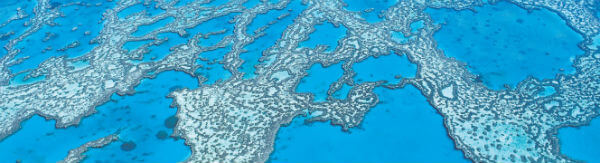
Great Barrier Reef valued at A$56bn as report warns it’s ‘too big to fail’

The Guardian reports: A new report has valued the Great Barrier Reef at A$56bn and warns of vast economic consequences for Australia unless more is done to protect it.

The Deloitte Access Economics report says the world heritage-listed reef underpins 64,000 direct and indirect jobs, and contributes $6.4bn to the national economy each year.

But without ramped-up protection efforts, it warns much of that could be at risk as the reef suffers from repeated mass coral bleaching events, poor water quality and climate change.

“The reef is critical to supporting economic activity and jobs in Australia,” says the report, prepared for the Great Barrier Reef Foundation. “The livelihoods and businesses it supports across Australia far exceeds the numbers supported by many industries we would consider too big to fail.”

Of the 64,000 jobs linked to the reef, 39,000 are direct jobs – making the reef a bigger “employer” than the likes of Telstra, the Qantas Group, National Australia Bank and the oil and gas extraction industry. [Continue reading…]

Facebooktwittermail

FBI has questioned Trump campaign adviser Carter Page at length in Russia probe

The Washington Post reports: FBI agents have repeatedly questioned former Trump campaign adviser Carter Page about his contacts with Russians and his interactions with the Trump campaign, according to people familiar with the investigation.

Over a series of five meetings in March, totaling about 10 hours of questioning, Page repeatedly denied wrongdoing when asked about allegations that he may have acted as a kind of go-between for Russia and the Trump campaign, according to a person familiar with Page’s account.

The interviews with the FBI are the most extensive known questioning of a potential suspect in the probe of possible Russian connections to associates of President Trump. The questioning of Page came more than a month before the Russian investigation was put under the direction of Special Counsel Robert S. Mueller III. [Continue reading…]

Facebooktwittermail

Trump’s bullshit on Russia frustrates even his allies

The New York Times reports: In the span of 72 hours, President Trump described the email hacking that roiled the 2016 campaign as a Democratic “hoax” and as clear aggression by Russia that his predecessor, President Barack Obama, failed to address.

Other times, Mr. Trump has said the hacking might have been done by China.

Or, as he claimed during the first general election debate, the hacking could have been the work of a lone wolf weighing 400 pounds, sitting on his bed at home.

Then there was the time Mr. Trump blamed “some guy in his home in New Jersey.”

Or, as Mr. Trump has also suggested, there might not even have been hacking at all…

On Saturday, Mr. Trump tried again to focus attention on Mr. Obama.

“Since the Obama Administration was told way before the 2016 Election that the Russians were meddling, why no action?” Mr. Trump wrote on Twitter. “Focus on them, not T!”

He followed that up with: “Obama Administration official said they ‘choked’ when it came to acting on Russian meddling of election. They didn’t want to hurt Hillary?”

Government officials, members of Congress from both parties and even some Trump supporters had hoped that, with the campaign behind him, Mr. Trump would finally speak declaratively about the email hacking and recognize the threat Russian cyberattacks present, without asterisks, wisecracks, caveats or obfuscation.

That hope has dissipated. The latest presidential tweets were proof to dismayed members of Mr. Trump’s party that he still refuses to acknowledge a basic fact agreed upon by 17 American intelligence agencies that he now oversees: Russia orchestrated the attacks, and did it to help get him elected. [Continue reading…]

Facebooktwittermail