The Associated Press reports: The Russian province of Dagestan, a flashpoint for Islamic violence in the North Caucasus, is feeding hundreds of fighters to the Islamic State in Syria — and now some are coming back home with experience gained from the battlefield.
The departures mean that the region itself has become markedly less violent recently with fewer bombings and shootings. And the returning fighters have either landed in jail or been kept under close police surveillance. But there are long-term concerns that the presence of radical Muslims trained in IS warfare could lead to greater instability and violence.
“We can’t allow them to use the experience they have just gained in Syria back home,” Russian President Vladimir Putin said recently.
Eduard Urazayev, a former minister in Dagestan’s provincial government, and now a political analyst, said that poverty and unemployment in the region made the IS recruiters’ job easier. “If the high level of corruption and unfavorable socio-economic situation remain,” Urazayev said, “it may further fuel protest sentiments and increase sympathy for the IS.” [Continue reading…]
Category Archives: Russia
After a U.S. shift, Iran has a seat at talks on war in Syria
The New York Times reports: Just a few weeks ago, Ayatollah Ali Khamenei said any new talks with the United States were forbidden. He described the United States as a persistent enemy of the Islamic revolution, and said that despite the nuclear agreement, it needed to be kept at a distance.
But participating in the multination Syria talks does not contradict Mr. Khamenei’s dictums, some Iranian analysts say.
“Our leader has banned the bilateral relations between Iran and America or any negotiation aimed at resuming relations,” said Hamidreza Taraghi, a political analyst in Tehran considered close to the ayatollah. “Case-by-case negotiations or finding solutions for regional problems on a multilateral basis is all right.”
So, while publicly siding with the hard-liners, the Supreme Leader may well be giving more negotiating room to President Hassan Rouhani, who has advocated more open engagements with the rest of the world. There has already been an unspoken cooperation between Iran and the United States in Iraq, where both are fighting the Islamic State.
“We should thank President Rouhani for his efforts in reaching out to the international community, and the nuclear deal,” said Farshad Ghorbanpour, a political analyst close to the government in Tehran. “Now we are seeing the rewards: We are playing an increasing active role in the international arena.”
That role is something that Iran has desperately sought: Diplomatic weight and respect that bolsters its claim that it, not Saudi Arabia, is the most influential power in the region. “It’s very important because it shows that, following the nuclear agreement, Iran is now ready to cooperate on crisis management in the Middle East,” Seyed Hossein Mousavian, a former Iranian diplomat and nuclear negotiator who now teaches at Princeton, said in a telephone interview. “I’m not surprised, because the leader had said that if the deal were done fairly, with face-saving for all parties, Iran would agree to next steps on other issues. This is a big step forward.”
Cliff Kupchan, an Iran specialist and chairman of the Eurasia Group, a Washington political consultancy, said that given Russia’s recent intervention in Syria to support Mr. Assad, it was clear he would remain in charge for a while, which meant Iran would be attending the Vienna talks from a position of strength.
Still, Mr. Kupchan said in an email, “as U.S.-Iran contacts spread to a broader array of issues, it will be harder and harder for Iranian conservatives to quarantine cooperation.” [Continue reading…]
Do Tehran and Moscow still believe Assad’s political survival depends on mass murder?
Frederic C. Hof writes: In Syria consent for the country to be used as a supply and training base for Hezbollah is limited to Assad-Makhluf family and its enablers. Popular consent in Syria is the last thing Tehran wishes to facilitate.
What Iran might be willing to consider, however, is — with the support of Moscow — obliging its client to suspend indefinitely the worst aspects of his mass homicide political survival strategy. Assad will not conduct mass casualty events — barrel bombing, artillery barrages, aircraft strafing, or Scud missile assaults on apartment blocks — if Iran and Russia instruct him not to do so. If so ordered, Assad will direct the lifting of sieges and the unrestricted passage of United Nations humanitarian assistance convoys to people desperately in need of food and medical treatment.
The key question here is whether Tehran and Moscow will persist in believing that mass terror is essential to their client’s political survival. For some four years they have believed so. To the extent that the Supreme Leader and Russian President Vladimir Putin have had reputations worth preserving, they have jeopardized them by facilitating the ability of the Assad regime to conduct war crimes and crimes against humanity with absolute impunity. As they evaluate the Syrian situation now, in October 2015, do they still believe that Assad’s political survival must rest on mass homicide?
This is the question that could conceivably produce a new answer from Tehran. Speaking privately in track two settings, senior non-governmental Iranians have expressed regret over and disgust with Assad regime behavior toward defenseless civilians. Can Tehran reconcile the protection of civilians in Syria with its own national security interests? This — rather than some manner of political grand bargain over Syria — would be worth a serious discussion in Vienna. [Continue reading…]
Aleppo faces ISIS ‘siege nightmare’
NOW reports: Fears have risen in regime-controlled quarters of Aleppo after ISIS cut off the government’s main supply line leading into the city late last week.
Pro-Damascus daily Al-Akhbar published a report Tuesday on the situation in Syria’s second city, saying the mood among residents has worsened after “the great extent of the breach ISIS has achieved” on the key front became clear.
Describing the feelings of regime supporters in the Aleppo, Al-Akhbar reporter Basel Dayoub said that the city’s residents were “remembering the nightmare of the first siege in 2013,” in reference to a rebel siege from August to October of that year.
The period was marked by the hardships suffered by residents of the regime controlled areas of east Aleppo, which saw an increase of prices and shortages of basic staples.
The prospects of another long-siege renewed last Friday when ISIS seized a stretch of the Khanaser-Ithriyah highway southeast of Aleppo—cutting off the main regime controlled route into the city—while rebels staged fierce counterattacks against the Iranian-backed government offensive southwest of Aleppo. [Continue reading…]
Georgia offers clues on the accuracy of Russian airstrikes in Syria
Reuters reports: In the courtyard of an apartment building in the town of Gori in ex-Soviet Georgia is a clue to whether Russia’s air strikes on targets in Syria are as accurate as the Kremlin would like the rest of the world to believe.
Fashioned out of fragments of ordnance is a makeshift shrine to the five residents killed during the Russian-Georgian war in August 2008 when a Russian air force jet, which Georgian defense officials believe was aiming for a nearby tank regiment, missed and hit the apartment building instead.
“So, can we say that their strikes were accurate? I don’t think so,” said Gori resident Avtandil Makharadze as he stood in front of the now-rebuilt apartment block.
Until Russia launched its military operation in Syria last month, the war in Georgia was the last time its air force had conducted air strikes in combat.
There are differences between the two campaigns. Russia’s military has undergone major modernization since the Georgian war. Unlike in Georgia, in Syria there are no anti-aircraft missiles shooting at Russian jets, which allows them to take their time lining up their targets.
But there are similarities too, so the performance of Russian aviation in the Georgia conflict could shed light on the operation in Syria, where making an independent assessment of the Russian strikes on the ground is impossible.
In particular, despite the advent of precision guided weapons in Russia’s arsenal, the majority of the munitions being launched in Syria are still the “dumb bombs” which in Georgia contributed to the off-target strikes. [Continue reading…]
Putin’s mafia statecraft
Brian Whitmore writes: In the past couple years, Russian hackers have launched attacks on a French television network, a German steelmaker, the Polish stock market, the White House, the U.S. House of Representatives, the U.S. State Department, and The New York Times.
And according to press reports citing Western intelligence officials, the perpetrators weren’t rogue cyber-pranksters. They were working for the Kremlin.
Cybercrime, it appears, has become a tool of Russian statecraft. And not just cybercrime.
Vladimir Putin’s regime has become increasingly adept at deploying a whole range of practices that are more common among crime syndicates than permanent members of the UN Security Council.
In some cases, as with the hacking, this involves the Kremlin subcontracting organized crime groups to do things the Russian state cannot do itself with plausible deniability. And in others, it involves the state itself engaging in kidnapping, extortion, blackmail, bribery, and fraud to advance its agenda. [Continue reading…]
Tehran and Moscow: a shaky alliance
Hanin Ghaddar writes: Fundamentally, Iran wants in Syria what is has in Lebanon — weak, ineffective state institutions incapable of making decisions without the approval of their patrons. As in Lebanon, Iran wants to indirectly control Syria’s state institutions and have access to the Golan in the same way it has access to South Lebanon through Hezbollah.
Of course Putin mainly wants to empower himself, but he needs the Syrian institutions to do so. Russia wants to preserve the Syrian state. Putin wants to prop Assad up simply because the state institutions — including the army and the security apparatus — are still linked to his regime. Putin is not investing in Assad per se, but rather in Syria’s institutions. That’s why Russia has only supplied weapons to the Syrian Army and wants all militias united under it.
Unlike Tehran, Moscow is not interested in changing demography or in maintaining the Shiite/Alawite corridor. Moscow does not want to see Assad go and then be implicitly replaced by Soleimani. Assad must go eventually, but only after a stable political solution is secured. That’s why Russia went with Geneva I. [Continue reading…]
Iran invited to participate in international talks on Syria’s future
On Friday, the Wall Street Journal reported: “European Union foreign policy chief Federica Mogherini spoke in favor of including Iran. ‘All relevant actors, regionally and internationally should be involved,’ she said. ‘I hope that Iran can be part of this common effort.’ ”
But US Secretary of State John Kerry said: “For the moment Iran is not at the table. And there will come a time perhaps where we will talk to Iran but we are not at the moment at this point of time.”
That was Friday, now it’s Tuesday.
The Associated Press reports: Iran has been invited to participate for the first time in international talks over Syria’s future, U.S. officials said Tuesday, a shift in strategy for the United States and its allies as they seek to halt the four-year civil war and eventually ease President Bashar Assad out of power.
Iran has yet to reply, the officials said.
The next diplomatic round starts Thursday in Vienna, with Secretary of State John Kerry, Russian Foreign Minister Sergey Lavrov and several top European and Arab diplomats attending.
Washington had held out the possibility of Iran joining the discussions in future, but is only now offering Tehran a seat after days of behind-the-scenes negotiation, particularly with its regional rival Saudi Arabia. Russia extended the invitation. [Continue reading…]
will #Iran go to #Syria talks? 'Not to my knowledge," Iranian official tells me.
— Laura Rozen (@lrozen) October 27, 2015
What Russia’s own videos and maps reveal about who they are bombing in Syria
Bellingcat reports: The Russian Federation launched an air campaign on 30 September 2015, allegedly targeting Islamic State (or ISIS) positions in Syria. The Russian Ministry of Defense (MoD) has been releasing selected videos on its YouTube channel ever since. Bellingcat began geolocating and independently verifying videos published by the Russian MoD after initial reports from the ground indicated that Russian airstrikes have instead destroyed positions held by the Free Syrian Army and other groups rather than ISIS.
Bellingcat has geolocated, verified, and visualised each airstrike published by the Russian MoD on its official YouTube channel as of 25 October. The outcome of our work is unequivocal: the overwhelming majority of Russian airstrikes have targeted positions held by non-ISIS rebel groups posing a more immediate threat to the Syrian regime and its head, Bashar al-Assad. In contrast, ISIS strongholds have rarely been attacked. The methodology and results of the investigation are laid out below.
We noticed that, for many videos, the Russian MoD adds a description in Russian before the video of the strike itself begins. A longer, more in-depth description is also appended to each upload, along with the title of the video. For the verification process, each video was uploaded to Bellingcat’s Checkdesk verification project. We Google-translated the description and pasted the original one in Russian alongside to keep track of the information in an independently managed online space. [Continue reading…]
Iran’s generals are dying in Syria
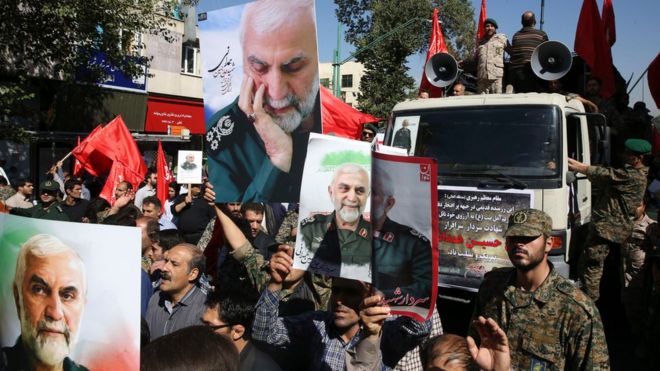
Robin Wright writes: The Islamic Republic described the first men to die as a few young “volunteers” deployed to protect symbols of the faith. The numbers have escalated since then. In June, the Islamic Republic News Agency reported that more than four hundred volunteers from Iran, including Afghan refugees living in the country, had died in Syria so far. Iranian news agencies and social media are now rife with stories about senior officers killed in Syria on the war’s toughest front lines. Last week, Iran’s Fars News Agency reported that the death toll hit eight in just two days. The funerals have become major events, sometimes drawing thousands onto Tehran’s streets to escort the coffins to Zahra’s Paradise.
Iran has increasingly been forced to acknowledge its losses—including at least four generals in the past year—with some reports suggesting that twice that number have been killed since the intervention began. Brigadier General Hossein Hamedani, who was killed on October 8th, was given a state funeral. Iran’s Supreme Leader, Ayatollah Ali Khamenei, personally called on Hamedani’s family to convey his condolences. Khamenei’s official Twitter account, in English, lauded the general for fulfilling his “martyrdom wish.”
Hamedani’s death was a setback for Iran—and possibly for Syria, too. According to Jane’s Defense Weekly, Syria’s regular Army has been halved since the war began, in 2011. Assad has increasingly relied on leaders in Iran to develop strategy, and counted on Hezbollah, Iran’s proxy force in Lebanon, to provide new fighters. Hamedani was the senior Iranian tactician in northern Syria, where the regime is simultaneously fighting Western-backed rebels, the Islamic State, a local Al Qaeda franchise, and smaller militias. Hamedani was a hero of the war with Iraq—the deadliest modern conflict in the Middle East—and his death was the most notable Iranian military loss since that war ended. [Continue reading…]
Who of the great journalists covering Syria has nailed, or will, why so many high-level pro-Assad officers/operatives are dying in Syria?
— Hassan Hassan (@hxhassan) October 26, 2015
Pro-Assad pages confirm the death of Major General Izzadin Ibrahim in Deir Ezzor pic.twitter.com/whLPGYqZxS
— Hassan Hassan (@hxhassan) October 26, 2015
Russian airstrikes in Syria appear to violate laws of war, says Human Rights Watch
Human Rights Watch: At least two air strikes in northern Homs on October 15, 2015, that local residents believed to be Russian, apparently violated the laws of war. The air strikes killed a total of 59 civilians, residents said, including 33 children and a commander of the local armed opposition group. Russia should investigate the attacks.
The deadliest attack hit a house in the village of Ghantou, where the extended Assaf family had taken shelter, killing a reported 46 family members, all civilians, including 32 children and 12 women, first responders and local activists said. The victims were related to a local commander affiliated with the opposition Free Syrian Army (FSA), but witnesses said that he was away from the home at the front lines. The second air strike, on the neighboring town of Ter Maaleh, hit near a bakery, and according to local witnesses, killed at least 13 civilians as well as a local FSA commander who was a Syrian army defector. It is not clear whether he was the intended target, as neither Russia nor Syria have issued statements about the specific air strikes. [Continue reading…]
Taliban and Russian interests may converge in fight against ISIS
The Daily Beast reports: The Taliban are not as lonely as they once were. The pariahs who protected Osama bin Laden and quickly collapsed when the U.S. counter-attacked after September 11, 2001, have been developing contacts with neighboring states and even with Russia, driven out of Afghanistan in 1989.
There’s nothing simple about this picture, and, interestingly, it appears partly tied to Russian efforts to oppose the spread in Afghanistan of groups pledging allegiance to the so-called Islamic State in Syria and Iraq. That same concern has helped to forge links between the Taliban and their longtime enemies in Iran.
And the Russian connection is emerging, ironically, at the same time that Afghanistan’s Uzbek warlord and vice president, Abdul Rashid Dostum, has openly warmed to his onetime allies in Russia and tried to strengthen ties to the former Soviet states on Afghan frontier.
Dostum visited Moscow and Grozny this month and launched an offensive just last week in provinces near the Turkmenistan border. Dostum lumped the Taliban together with Daesh, a common Arabic acronym for the Islamic state, on his enemies list.
“The countries of the Commonwealth of Independent States from Russia to Tajikistan and Turkmenistan, all these states are willing to stand with us against Daesh [one of the acronyms for the so-called Islamic State], against extremism, against the bloodthirsty Taliban,” Dostum declared.
But The Daily Beast has learned that Russia and some of these neighboring states may be playing a double game, or, at the very least keeping their options open if the Taliban manage to retake power. [Continue reading…]
Russian warplanes shatter tenuous truce forcing thousands of Syrians to flee
The New York Times reports: For almost two years, the village in the Syrian countryside north of the city of Homs had been relatively calm, profiting from a tenuous truce between the government and rebel groups that had made it a refuge for thousands of desperate people displaced by the war.
But the peace was shattered earlier this month, when Russian warplanes started attacking the village, Ter Ma’aleh, killing at least a dozen people and sending most of the residents into hurried exile.
The assault on the village was part of a wider escalation of violence across the country that has displaced tens of thousands of people in just weeks and led relief workers to warn that Syria is facing one of its most serious humanitarian crises of the civil war.
The intensity of the fighting, they say, is fueling increased desperation as a growing number of Syrians are fleeing to neighboring countries and, especially, to Europe. More than 9,000 migrants a day crossed into Greece last week, according to the International Organization for Migration, the most since the beginning of the year. [Continue reading…]
Harsh conditions are foiling Russian jets in Syria
USA Today reports: Russian warplanes sent to Syria to back the regime of Bashar Assad are breaking down at a rapid rate that appears to be affecting their ability to strike targets, according to a senior Defense official.
Nearly one-third of Russian attack planes and half of its transport aircraft are grounded at any time as the harsh, desert conditions take a toll on equipment and crews, said the official who was not authorized to speak publicly about sensitive intelligence matters.
The Russians appear to be having difficulty adapting to the dusty conditions, and the number of airstrikes they have conducted seems to have dipped slightly.
“For deployed forces, that’s a hideous rate,” said Richard Aboulafia, an aviation analyst at the Teal Group, an aerospace consulting firm.
Russian President Vladimir Putin deployed warplanes, including Russia’s advanced Fullback ground-attack jet, helicopters and troops to a base near Latakia, Syria, in September. In addition, at least a dozen transport planes have been stationed there.
“They could have bad operating procedures, inadequate supplies of spare parts and support crews,” Aboulafia said. [Continue reading…]
Russia said to redeploy special-ops forces from Ukraine to Syria
The Wall Street Journal reports: Russia has sent a few dozen special-operations troops to Syria in recent weeks, Russian and Western officials say, redeploying the elite units from Ukraine as the Kremlin shifts its focus to supporting Syrian President Bashar al-Assad.
Russia in late September launched a campaign of airstrikes in support of Mr. Assad’s government, and President Vladimir Putin has said Russian troops won’t play a role in ground combat. But Russian military experts and officials say small numbers of special-forces units—whose missions are rarely acknowledged publicly—are also on the ground in Syria.
“The special forces were pulled out of Ukraine and sent to Syria,“ a Russian Ministry of Defense official said, adding that they had been serving in territories in eastern Ukraine held by pro-Russia rebels. The official described them as “akin to a Delta Force,” the U.S. Army’s elite counterterrorism unit.
A senior Western official also said a contingent of elite Russian forces was on the ground in Syria from eastern Ukraine. A U.S. defense official said one of their roles is to provide coordination between Syrian troops and Russian aircraft conducting airstrikes in support of the regime’s ground offensive. [Continue reading…]
Russian intervention has unintended effect of unifying Syrian rebel forces
The Daily Beast reports: As Charles Lister, an analyst of Syria’s multifarious insurgency at the Brookings Institution, calculated, the use of the TOW missile has increased a staggering 850% since the Russians started bombing, a metric that bolstered by press accounts featuring rebels attest to sudden bonanza of the tank-killer. Also reappearing on the battlefield is the RBG-6 multiple grenade launcher, a munition purchased by the Saudis from Croatia and imported into southern Syria via Jordan in 2013. (That supply line was abandoned after the launcher was found in the hands of jihadists not long after its import.)
Evidence of rebel victories is everywhere on social media. Here’s a video of Liwa Suquour al-Jabal destroying an artillery gun with a TOW missile in Khirbat al Naqus, near Latakia. Here’s one of a BMP being wiped out with a TOW near al-Qarassi, Aleppo, a town the rebels appear to have sacked, along with Tel Qurha, which lies just hundreds of meters south of a regime army base. According to the opposition-run Local Coordination Committees, Jaysh al-Fateh seized the village of Mansoura in Hama today after intense combat with pro-regime forces. The FSA participated in that operation, too, because the same anti-tank missile system was put to use in Mansoura.
Mohammed Rasheed, a fighter with Suqur al-Ghab, one of the CIA-backed militias fighting in Hama, told The Daily Beast, “We have managed to liberate two towns; Mea’ar Kabi in the northern [suburb] of Hama and Lahaya. We have been planning for this operation since the start of the Russian invasion. We wanted to reverse the situation and attack them instead of just defending ourselves.” Rasheed said that his brigade destroyed 23 regime tanks and killed 15 Syrian soliders — in the last 24 hours. “What helped us in this operation is that we all got united and fought as one army.” [Continue reading…]
Russia is playing the Western media like a fiddle
It’s easy to bemoan the influence of Twitter on how people digest the news these days. How can anything be reflected upon, contextualized, and rendered meaningful when reduced to 140-character bites?
The problem, however, is not new: It’s as old as print journalism. Just as impoverished as tweets — arguably even more so — are news headlines.
Headlines frame stories and much of the time, the news audience delves no deeper after having, in just a split second, registered the latest version of what’s happening.
What’s happening right now?
“Russia says wants Syria elections, ready to help Free Syrian Army,” says Reuters.
“Russia offers to coordinate with rebels and US in Syria,” says Al Jazeera English.
“Russia offers air cover for anti-Assad rebels, urges polls,” says AFP.
What next? Vladamir Putin wins the Nobel Peace Prize?
If he’s successful in ending the war in Syria, setting the country on a path to democracy, and leading an international coalition that eliminates ISIS, who could begrudge the often-maligned Russian president for winning huge praise for his achievements.
But what’s really happening right now?
Russian war planes are bombing the FSA in Syria even while Foreign Minister Sergei Lavrov is requesting the U.S. to provide intelligence on the locations of those very units.
The issue here is not the provision or withholding of intelligence. All the Russians are trying to do is highlight the nebulous ideological status of many of the Syrian opposition militias in order to buttress Russia and Assad’s narrative that they’re all terrorists.
Russia is promising to provide air cover to the forces it is currently bombing if they stop fighting against the Assad regime and instead start fighting alongside their enemy in a war exclusively against ISIS.
When the Obama administration began its Iraq first/ISIS first strategy, it opened the door to the move that Russia is now making: the argument that ISIS can only be defeated by supporting Assad. Washington has now been forced into a reactive corner where it lamely asserts its desire to eliminate ISIS while refusing to join Russia in its self-declared effort and even when Russia’s dedication to that effort is highly questionable.
Russia is promoting political reform in Syria while strengthening its support for the primary opponent of such reform: Bashar al-Assad.
That contradiction will remain obscured for as long as the Russians continue to control the media narrative. Ironically, their ability to do so derives in large part from the willingness of Western journalists to construct news headlines and reporting around statements from government officials even when such statements have little credibility.
Moreover, these distortions are further compounded by the fact that in much of the news audience, mistrust of Western governments and the Western mainstream media is coupled with a naive willingness to trust those who present themselves as a countervailing force to Western power — a force which, on the contrary, shows no evidence of being any more trustworthy or any less cynical than the much despised West.

How far Russia will go to support one man?
The Daily Beast reports: U.S. intelligence officials have previously assessed that the Assad regime is getting significant backing from Iranian ground forces, and that the support continues to grow, but that it’s not necessarily translating into victories. They think that while some tactical swings along the frontline might favor Assad’s regime in the near term, many provincial capitals occupied by his army remain under threat.
That may help explain Assad’s decision to be seen publicly aligning with Putin, who has supplied essential air cover to forces on the ground. The official characterized Assad’s Moscow visit as a publicity stunt that doesn’t bode well for the dictator’s future. “It only reinforces the notion that Assad has lost control of his country, and is now firmly under Putin’s thumb,” the official said.
“Should the regime’s offensive fail to dislodge opposition elements or suffer major setbacks, the blame will land on Assad’s shoulders,” the official added. “Putin is not one to bet on a losing horse, and Assad’s track record in Syria suggests the regime faces long odds of a military victory. At some point, Putin will have to decide on how far Russia will go to support one man.” [Continue reading…]