Category Archives: Russia

How to make $70 billion look much bigger than $265 billion

The Economist has ingeniously created a way of making Russian defense spending look much greater than European NATO defense spending, even though the latter is almost four times as much as the former:

Facebooktwittermail

What does Russia want?

James Meek writes: There is a dangerous false assumption at the heart of the West’s negotiations at, and reporting of, peace talks in Minsk over the fighting in eastern Ukraine. It is that Russia wants to have direct control over a small area of Ukraine – about 3 per cent of the country; the area, slightly smaller than Kuwait, now under separatist rule – and that Ukrainian forces are fighting to win this area back.

You can’t blame Western negotiators or journalists for thinking this is what is going on, because it’s what the Ukrainians are bound to tell them. That doesn’t mean it is the underlying truth. The evidence so far is that what Russia actually wants is indirect influence over the whole of Ukraine, and for the West to pay for it.

President Petro Poroshenko of Ukraine cannot admit this publicly; he would find it hard to admit it privately. But Ukraine lost the war to keep the far east of the country last summer, in a little reported series of battles on the frontier. Ukrainian border guards, and troops trying to enforce control of the border, came under massive artillery barrages from the Russian side of the border. They couldn’t fire back into Russian territory without inciting a full-scale Russian military assault. Accordingly they were massacred, or they surrendered, or they ran away.

Ever since, a large section of the border has been under Russian-separatist control. As long as Ukraine can’t lob shells into Russia, and Russia is prepared to lob shells into Ukraine, that is how it will stay. [Continue reading…]

Facebooktwittermail

Ukraine ceasefire announced at Minsk summit — what next?

By Stefan Wolff, University of Birmingham

After all night talks in the Belarusian capital Minsk, the outcomes of the four party talks in the so-called Normandy format (Ukraine, Russia, France, and Germany) have neither brought a major breakthrough or a complete disaster. As a deal, it is not a solution, but perhaps a step towards one.

It almost seems to be business as usual – yet another ceasefire deal and commitments to further negotiations on a more durable political settlement – but, by the standards of this crisis, this is not the outcome Ukraine’s people may have hoped for. Not least because the deal, as soon as it was announced, ran into its first set of problems with rebels demanding Ukrainian forces withdraw from the strategic town of Debaltseve before they would agree to the ceasefire.

At the very least, this might mean two more days of heavy fighting before the ceasefire starts on 15 February, at worst it might mean the deal will never be implemented at all.

In the run-up to last might’s summit, the crisis in Ukraine seemed to head towards a major juncture, along with relations between Russia and the West and within the Transatlantic alliance. The weeks before the summit in Minsk has seen intensifying diplomacy, escalating rhetoric, increased fighting on the ground, and a worsening humanitarian situation.

Continue reading

Facebooktwittermail

Signs of desperation in the West’s latest moves to halt the Ukraine crisis

Lucian Kim writes: The European Union, with Germany at its head, sleepwalked into the Ukraine crisis. Shielded by U.S. military might since the end of World War Two, Western Europeans had come to live under the illusion that their irresistible soft power — democratic values and economic prosperity — is alone strong enough to bring the continent together. In their attempt to finalize an association agreement with Ukraine in 2013, EU leaders jostled with Putin for influence, not realizing that what they regarded as a trade deal, he viewed as brazen geopolitical encroachment. When the pro-EU protest on the Maidan unexpectedly succeeded in chasing Kremlin client Viktor Yanukovych from power last February, Putin watched the West crossing a red line it had chosen not to see. Securing Russia’s Black Sea Fleet on Crimea was the first priority. Wreaking havoc on Kiev’s interim government by fomenting an uprising in eastern Ukraine was the second.

Could anybody have anticipated Russia’s actions a year ago? Radoslaw Sikorski, who was Poland’s foreign minister during the Maidan protest, said that at last year’s Munich conference he had asked Russian Foreign Minister Sergei Lavrov if the Kremlin had territorial ambitions in Ukraine. “He flatly denied it,” Sikorski said. Less than a month later, Yanukovych fled Kiev, and Russian troops were fanning out across Crimea.

Lavrov was also in Munich this year. The usually suave Russian foreign minister was visibly nervous as he delivered his speech, rattling off a standard list of slights and transgressions — almost all of them committed by the Bush administration — and blaming the United States for everything. When Lavrov said that Crimea chose the path of self-determination as foreseen under the United Nations Charter, the audience of VIPs burst into laughter.

The Russian position afforded a glimpse into the alternate reality presented day in and day out by the Kremlin propaganda machine. “There are no Russian troops in Ukraine,” Konstantin Kosachyov, the head of the Russian Duma’s foreign affairs committee, said in English. “There is no evidence — just statements, statements, statements.” According to his version of events, Russia is sitting and watching idly as a civil war unfolds across hundreds of miles of undefended border. “I thank Madame Merkel for a very strong position,” Kosachyov said about her rejection of arms for Ukraine.

Even if the West doesn’t believe that it’s engaged in a proxy war with Russia, the Kremlin reading is that it’s already taking place. [Continue reading…]

Facebooktwittermail

Ukraine: draft dodgers face jail as Kiev struggles to find new fighters

The Guardian reports: Ruslan Kotsaba posted a video addressed to the Ukrainian president, Petro Poroshenko, last week in which he said he would rather go to prison for five years for draft-dodging than fight pro-Russia rebels in the country’s east. Now he faces 15 years in jail after being arrested for treason and obstructing the military.

His case is symptomatic of Kiev’s difficulties in mobilising a war-weary society to continue the fight against the rebels, who appear to have an unlimited supply of weapons and training from Russia. As the country nears bankruptcy and the reform programme demanded by the Maidan revolution last year is sidelined by the war effort, the drive to call up new recruits is floundering.

The conflict has cost more than 5,000 lives since it began last spring and Russia shows no signs of toning down its backing for the separatist movement. Poroshenko is due to meet his Russian, French and German counterparts in Minsk on Wednesday, and the financial and emotional burden of months of conflict could mean Ukraine is forced to accept a deal that effectively gives up control of rebel-held territory. [Continue reading…]

Facebooktwittermail

Don’t arm Ukraine

John J. Mearsheimer writes: The Ukraine crisis is almost a year old and Russia is winning. The separatists in eastern Ukraine are gaining ground and Russia’s president, Vladimir V. Putin, shows no signs of backing down in the face of Western economic sanctions.

Unsurprisingly, a growing chorus of voices in the United States is calling for arming Ukraine. A recent report from three leading American think tanks endorses sending Kiev advanced weaponry, and the White House’s nominee for secretary of defense, Ashton B. Carter, said last week to the Senate armed services committee, “I very much incline in that direction.”

They are wrong. Going down that road would be a huge mistake for the United States, NATO and Ukraine itself. Sending weapons to Ukraine will not rescue its army and will instead lead to an escalation in the fighting. Such a step is especially dangerous because Russia has thousands of nuclear weapons and is seeking to defend a vital strategic interest.

There is no question that Ukraine’s military is badly outgunned by the separatists, who have Russian troops and weapons on their side. Because the balance of power decisively favors Moscow, Washington would have to send large amounts of equipment for Ukraine’s army to have a fighting chance.

But the conflict will not end there. Russia would counter-escalate, taking away any temporary benefit Kiev might get from American arms. The authors of the think tank study concede this, noting that “even with enormous support from the West, the Ukrainian Army will not be able to defeat a determined attack by the Russian military.” In short, the United States cannot win an arms race with Russia over Ukraine and thereby ensure Russia’s defeat on the battlefield. [Continue reading…]

Facebooktwittermail

Twitter says government data queries rising

Phys.org: Twitter said Monday it saw a 40 percent jump in government request for user data in late 2014, with sharp rises coming from both Turkey and Russia.

The “transparency report” released by the messaging platform showed the United States remained the largest source of data queries with 1,622 over the last six months of the year, but that notable increases came from Turkey and Russia.

The total number of requests globally was 2,871, up from 2,058 in the first six months of the year.

Turkey — which blocked Twitter and other social media last year for leaking data about government corruption — vaulted to the number two spot with 356 requests, the Twitter report said.

Facebooktwittermail

Arming Ukraine army may escalate conflict, West warned

The Guardian reports: The head of the international organisation monitoring the conflict in Ukraine has said pro-Moscow separatists are constantly being re-armed, but warned that for western states to supply weapons to the Ukrainian army would risk an expansion of the war.

Lamberto Zannier, secretary general of the Organisation for Security and Co-operation in Europe (OCSE), issued the warning at the Munich security conference where the debate over supplying arms to Kiev has pitted eastern European states and US members of Congress against Germany, the UK and other western European countries. The Obama administration says it has not made up its mind.

Zannier said he supported reform and non-lethal support of the Ukrainian army, but saw huge problems in supplying lethal weaponry.

“This carries a risk with it, and the risk is that this will strengthen a narrative we are seeing already appear on the side of the separatists, that they are fighting a war against Nato and against the west,” Zannier told the Guardian in an interview in Munich. [Continue reading…]

Facebooktwittermail

Europeans warn Washington: arming Kiev will backfire

Reuters reports: European defence officials warned on Friday that arming Ukraine in its fight against pro-Russian separatists would only inflame the conflict, but were told by NATO’s top soldier, an American general, that the West should consider using “all tools” if diplomacy with Moscow wasn’t working.

The debate at the Munich Security Conference highlighted an emerging rift between Europe and Washington over how to confront Russian President Vladmir Putin as Moscow-backed rebels make territorial gains in eastern Ukraine.

President Barack Obama is under pressure from some in Congress to provide Kiev with lethal weapons.

German Defence Minister Ursula von der Leyen voiced Europe’s misgivings about this strategy: “Are we sure we would be improving the situation for the people in Ukraine by delivering weapons? Are we really sure that Ukraine can win against the Russian military machine?”

“And would this not be an excuse for Russia to intervene openly in the conflict?” asked the German minister.

Britain also fears that sending weapons could “escalate the conflict”, her British counterpart Michael Fallon told the conference. [Continue reading…]

Facebooktwittermail

Merkel and Hollande’s surprise trip to Moscow

The Guardian reports: The leaders of Germany and France abruptly announced a summit with the Russian president, Vladimir Putin, in Moscow on Friday in response to overtures from the Kremlin, raising hopes of a breakthrough in the year-old Ukraine conflict.

The sudden and unusual decision by the chancellor, Angela Merkel, and the president, François Hollande, to travel to Moscow, with the French leader talking of decisions of war and peace, increased the stakes in the crisis while also raising suspicions that the Kremlin was seeking to split Europe and the US. Putin was said to have made “initiatives” to the European leaders in recent days.

Merkel and Hollande met the Ukrainian president, Petro Poroshenko, in Kiev on Thursday evening but left without making any comment. Ukraine’s foreign minister, Pavlo Klimkin, said on Twitter that the leaders had discussed “steps so that the Minsk agreement can start working”. A ceasefire signed in Minsk in September froze the frontlines at their positions at the time, but never held.

Friday’s visit will be Merkel’s first trip to Russia since the outbreak of violence in eastern Ukraine, which has now cost more than 5,000 lives. The increase in diplomatic efforts came as the US secretary of state, John Kerry, also met Poroshenko and other top officials in Kiev.

At a joint news conference with Ukraine’s prime minister, Arseniy Yatsenyuk, Kerry sounded lukewarm about Merkel and Hollande’s visit. [Continue reading…]

Shaun Walker writes: In Kiev, John Kerry had a clear message for Russia and Vladimir Putin: the Kremlin should respect Ukraine’s territory, negotiate constructively and stop funnelling weapons and troops into the east of the country.

The problem is that it is the same message the US secretary of state and other western politicians have been delivering for more than half a year, to pretty much zero effect.

The issue for western negotiators has been how to force Russia to stop doing something that, even in private, it won’t admit it is doing. Washington is now grappling with whether it should back up its messages to Putin with an “or else” and seriously begin negotiations on supplying arms to Kiev.

In an editorial, The Guardian says: Europe does have leverage, if it chooses to use it. Russia may be a geopolitical giant but its GDP is no bigger than Italy’s. It is dependent on Europe’s financial structures. Yet next to the plunging oil price, the EU sanctions thus far have had a virtually symbolic impact. Cutting Russian banks and companies from the Belgium-based Swift international transaction system would, by contrast, impose a serious jolt. It could be done quickly, but then also rolled rapidly back. It has worked before, against Iran, which entered nuclear negotiations soon after being banned from Swift in 2012. Many businesses would balk at the costs. But these would surely be easier to bear than the enduring damage done by a widening war on the European continent.

Mr Putin regards the EU as a strategic midget. He will respect it only when Russia’s predatory oligarchy is confronted with some red lines. When Mrs Merkel and Mr Hollande head for Moscow, they should put Swift on the table.

Facebooktwittermail

How to start a proxy war with Russia

Michael Kofman writes: The release of a report this week calling for a vast expansion of U.S. military aid to Ukraine, titled “Preserving Ukraine’s Independence, Resisting Russian Aggression,” helped reignite the debate in Washington, D.C. on the provision of lethal weapons and a reassessment of the U.S. role in the conflict. The authors are prominent former diplomats and highly respected members of the national-security establishment, including Michele Flournoy, Strobe Talbott and Steven Pifer, amongst others. As a result, the president’s administration has come under heavy political pressure to reevaluate the existing policy of support for Ukraine. The prominence and experience of the political figures behind this report makes it impossible to ignore. It is a concise piece of argument, demanding the United States supply $1 billion per year in defense articles to Ukraine, ranging from anti-tank missiles to advanced air defense, and a variety of technical enablers for the Ukrainian military.

The proponents of this armaments proposal have treated support for arming Ukraine as a litmus test for supporting Ukraine in its hour of need. But this is a false equivalence. In fact, it is entirely reasonable to support Ukraine fully and simultaneously oppose sending additional weapons into a volatile conflict region. Indeed, the proposed arms shipments would do little to help Ukraine militarily and might actually worsen the situation. Kyiv is in desperate need of financial, technical and political support to achieve vital objectives, which include a fledgling reform agenda and negotiating a durable settlement to hold the country together. This in fact is the position adopted by Chancellor Angela Merkel of Germany and other U.S./NATO allies.

Sending a mix of weapons to Ukraine is unlikely to improve the situation, given the overwhelming force-on-force mismatch the country faces against Russia, but it could add fuel to a fire that is steadily consuming the country’s chances of emerging as a new nation on a European path. Instead, the United States should provide equipment and supplies to sustain Ukraine’s fledgling military, save lives, double down on economic aid and increase efforts aimed at reforming the country. Ukraine needs a genuine army, not weapons. Creating a sustainable professional force in Ukraine is a long-term effort the West must undertake as part of an overall strategy for the country, and perhaps under the framework of a strategic partnership that should emerge from thought and deliberation. Sending weapons in and of itself is not a strategy, either for Ukraine, or for settling the conflict. The United States must focus on achieving a durable political settlement first. This report does not offer recommendations on a path to peace, and no explanation of how weapons shipments could result in a political settlement to the war currently raging in the Donbass.

At its essence, the report is intended to press the reluctant president into changing his course in Ukraine, and to make the United States a more active participant in the conflict. Its core premise is that by giving Ukraine the ability to kill more Russian soldiers, sending weapons would raise the costs of war for Moscow to an unacceptable level, thus forcing Russia to abandon its existing policy and thus deterring further aggression. The weakness in the armaments proposal is that it offers no vision for what a new political settlement to the current conflict might look like, or how to move beyond the failed Minsk ceasefire, but recommends an Afghanistan-like approach to dealing with the Russian invasion. [Continue reading…]

Facebooktwittermail

U.S. military aid to Ukraine dangerous move, experts warn

AFP reports: Washington is once again mulling military support to Ukraine after fierce offensives by Kremlin-backed rebels, but experts fear it will only justify Russian conspiracy theories and drive East and West closer to full-blown war.

The recent rebel attacks across key parts of the frontline in eastern Ukraine may have been timed precisely out of fear the United States could soon get involved.

“One reason the rebels have intensified their offensive now is to make gains before potential US arms arrive,” said Andrew Wilson, author of “Ukraine Crisis: What it means for the West.”

“The US faces a moral dilemma: if it does not act now, the conflict could worsen. But there are big risks to getting involved.”

The White House is once again under pressure to up its involvement in the 10-month-old Ukraine conflict as ceasefire talks collapse and casualties soar.

The UN says 278 people were killed in the 12 days to January 21 alone as Russian-backed rebels sought to capture key transport and communication hubs.

An independent report released Monday by eight former senior American officials said it was time for Washington to provide $3 billion (2.7 billion euros) in military assistance to Ukraine.

“The West needs to bolster deterrence in Ukraine by raising the risks and costs to Russia of any renewed major offensive,” the report said. [Continue reading..]

Simon Tisdall writes: Washington’s threat risks turning what is currently a largely contained, internal insurrection into an international proxy war, pitting the US and Nato against Russia. In prospect now is the killing or maiming of Russians by American anti-tank missiles, a scenario not seen since the cold war-era occupation of Afghanistan by Soviet forces. The impact on wider European security could be deeply destabilising.

Tensions are already running high, not least with the increase in air and sea incidents involving the Russian military, such as last week’s provocative over-flight of the English channel. Nato’s decision to set up permanent military command centres in Poland, Romania, Bulgaria, Lithuania, Latvia and Estonia and its creation of a 5,000-strong rapid response force are characterised by Putin as an attempt by the west to contain Russia.Last week, he ridiculed Ukraine’s army as Nato’s “foreign legion”.

Such an American escalation would probably deepen European divisions over Ukraine. Greece, heavily indebted, and Hungary, which has close economic links to Russia, take a very different line, for example, from that of the UK, which American reports suggest could follow any US lead in supplying weapons.

Uncertainty about Russian intentions has already caused a bad case of the jitters in Finland, Sweden and the Baltic republics. In the Czech Republic, the army chief of staff, General Petr Pavel, was quoted last week as predicting that an escalation in Ukraine would lead to the biggest military manoeuvres since 9/11, with troops being posted to the borders and to guard strategic plants. There are also wider European fears of mass refugee movements and manufactured unrest among expatriate ethnic Russian and Ukrainian minorities.

Judging by past performance, Putin is more likely to up the ante than back down if the US goes ahead.

Facebooktwittermail

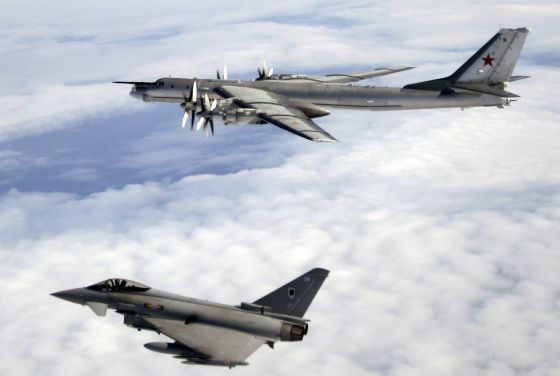
Russian bombers disrupt civil aviation over Britain after Litvinenko murder inquiry opens

bear-typhoon

Reuters reports: Britain summoned the Russian ambassador on Thursday and asked him to explain why two Russian “Bear” long-range bombers had flown over the English Channel the previous day, forcing British authorities to reroute civil aircraft.

A British government source told Reuters the incident, which forced Britain to scramble Typhoon interceptor jets, was viewed as “a significant escalation” and marked a change in strategy since Russian aircraft had previously largely confined themselves to flying close to Scotland.

“It was very dangerous. Civil aircraft flying to the UK had to be rerouted,” the source said. “The Russians were flying with their transponders turned off so could only be seen on military radar. They haven’t flown this far south before.”

The Foreign Office said it had summoned Russian Ambassador Alexander Yakovenko to account for the incident, saying the episode was part of an increasing pattern of “out of area operations” by Russian aircraft.

“The Russian planes caused disruption to civil aviation. That is why we summoned the Russian Ambassador today to account for the incident,” it said in a statement.

Last year, NATO conducted more than 100 interceptions of Russian aircraft, about three times as many as in 2013, amid increased tensions between the West and Moscow over the Ukraine crisis. [Continue reading…]

The Guardian reports: Observers said a possible explanation of the timing ofWednesday’s flypast was the start this week of a public inquiry in London into the 2006 killing of a former Russian intelligence officer, Alexander Litvinenko, by radioactive poisoning.

The UK has charged two former KGB agents with the murder. A lawyer for Litvinenko’s widow has claimed in court that the assassination was ordered by Vladimir Putin.

“This may be timed with the Litvinenko court case as a signal of displeasure,” Ian Kearns, the director of the European Leadership Network, and an associate fellow at the Royal United Services Institute, said. “But it fits with a wider posture of a more assertive Russian demonstration of a growing capability to defend and assert its interests as it sees fit.”

Facebooktwittermail

Litvinenko lawyer accuses Putin of running ‘mafia state’

The Guardian reports: Vladimir Putin is a “common criminal dressed up as a head of state” who presides over a mafia regime and who personally authorised the sensational murder eight years ago of the former Russian spy Alexander Litvinenko, a public inquiry heard on Tuesday.

On the first day of the inquiry at the high court in London, Ben Emmerson QC, acting for Litvinenko’s widow, Marina, said the Russian had been the victim of a “horrifying” political assassination. He said Moscow had decided to silence Litvinenko after he threatened to expose links between Putin and Europe’s largest organised crime group.

Two former KGB agents – Andrei Lugovoi and Dmitry Kovtun – allegedly murdered Litvinenko after meeting him on 1 November 2006 at the Millennium hotel in central London. They slipped radioactive polonium-210 into his green tea. That both men were the killers was beyond any “reasonable doubt”, Emmerson said.

In scathing terms, Emmerson suggested that Litvinenko was the victim of a dysfunctional state in which criminals and politicians had merged. “The trail of polonium traces leads not just from London to Moscow but directly to the door of Vladimir Putin’s office,” he said. “Mr Putin should be unmasked by the inquiry as nothing more than a common criminal dressed up as a head of state.” [Continue reading…]

Facebooktwittermail

New evidence that Alexander Litvinenko was killed in a Russian-backed ‘state execution’

The Telegraph reports: American spies secretly intercepted communications between those involved in the murder of Alexander Litvinenko and provided the key evidence that he was killed in a Russian-backed “state execution”, The Telegraph can disclose.

The National Security Agency (NSA) obtained electronic communications between key individuals in London and Moscow from the time that the former spy was poisoned with radioactive material in central London. The evidence was passed to the British authorities.

A source familiar with the investigation confirmed the existence of American “intelligence material”. They said it would have been “inadmissible” in court, but that the British authorities were “confident that this was a state execution”.

The disclosure comes ahead of the start of the public inquiry into Litvinenko’s death in 2006, which will see hearings, many of which will be held in secret, carried out over a nine-week period in the High Court from Tuesday.

The existence of the American intelligence material offers the first proof that the Russian state was involved in the murder of the dissident and explains why senior British politicians have been so confident in publicly blaming the Kremlin for the murder.

It is revealed as part of a Telegraph investigation which also unearthed an audio recording appearing to capture Litvinenko giving a detailed account of his investigations into links between Vladimir Putin and one of the world’s most dangerous criminals. [Continue reading…]

Facebooktwittermail

U.S. signals policy shift on how to end war in Syria

The New York Times reports: American support for a pair of diplomatic initiatives in Syria underscores the shifting views of how to end the civil war there and the West’s quiet retreat from its demand that the country’s president, Bashar al-Assad, step down immediately.

The Obama administration maintains that a lasting political solution requires Mr. Assad’s exit. But facing military stalemate, well-armed jihadists and the world’s worst humanitarian crisis, the United States is going along with international diplomatic efforts that could lead to more gradual change in Syria.

That shift comes along with other American actions that Mr. Assad’s supporters and opponents take as proof Washington now believes that if Mr. Assad is ousted, there will be nothing to check the spreading chaos and extremism. American planes now bomb the Islamic State group’s militants in Syria, sharing skies with Syrian jets. American officials assure Mr. Assad, through Iraqi intermediaries, that Syria’s military is not their target. The United States still trains and equips Syrian insurgents, but now mainly to fight the Islamic State, not the government.

Now, the United States and other Western countries have publicly welcomed initiatives — one from the United Nations and one from Russia — that postpone any revival of the United States-backed Geneva framework, which called for a wholesale transfer of power to a “transitional governing body.” The last Geneva talks failed a year ago amid vehement disagreement over whether that body could include Mr. Assad.

One of the new concepts is a United Nations proposal to “freeze” the fighting on the ground, first in the strategic crossroads city of Aleppo. The other is an initiative from Russia, Mr. Assad’s most powerful supporter, to try to spur talks between the warring sides in Moscow in late January. Diplomats and others briefed on the plans say one Russian vision is of power-sharing between Mr. Assad’s government and some opposition figures, and perhaps parliamentary elections that would precede any change in the presidency.

But the diplomatic proposals face serious challenges, relying on the leader of a rump state who is propped up by foreign powers and hemmed in by a growing and effective extremist force that wants to build a caliphate. Many of America’s allies in the Syrian opposition reject the plans, and there is little indication that Mr. Assad or his main allies, Russia and Iran, feel any need to compromise. The American-backed Free Syrian Army is on the ropes in northern Syria, once its stronghold, and insurgents disagree among themselves over military and political strategy.

And perhaps most of all, the Islamic State controls half of Syria’s territory, though mostly desert, and it has managed to strengthen its grip even as the United States and its allies try to oust it from neighboring Iraq. [Continue reading…]

Facebooktwittermail

Russia warns media: You’ll be blacklisted for publishing Charlie Hebdo cartoons

Mashable: Russia’s notoriously rigid government media watchdog has warned newspapers and news sites around the country: Should you publish Charlie Hebdo cartoons, prepare to be blacklisted.

The warning was issued via letter to the offices of several media outlets, including editorial department of a local Kamchatka editor, who published the text of it on Facebook.

Facebooktwittermail

U.S. and Russia in danger of returning to era of nuclear rivalry

Julian Borger writes: A widening rift between Moscow and Washington over cruise missiles and increasingly daring patrols by nuclear-capable Russian submarines threatens to end an era of arms control and bring back a dangerous rivalry between the world’s two dominant nuclear arsenals.

Tensions have been taken to a new level by US threats of retaliatory action for Russian development of a new cruise missile. Washington alleges it violates one of the key arms control treaties of the cold war, and has raised the prospect of redeploying its own cruise missiles in Europe after a 23-year absence.

On Boxing Day, in one of the more visible signs of the unease, the US military launched the first of two experimental “blimps” over Washington. The system, known as JLENS, is designed to detect incoming cruise missiles. The North American Aerospace Command (Norad) did not specify the nature of the threat, but the deployment comes nine months after the Norad commander, General Charles Jacoby, admitted the Pentagon faced “some significant challenges” in countering cruise missiles, referring in particular to the threat of Russian attack submarines.

Those submarines, which have been making forays across the Atlantic, routinely carry nuclear-capable cruise missiles. In the light of aggressive rhetoric from Moscow and the expiry of treaty-based restrictions, there is uncertainty over whether those missiles are now carrying nuclear warheads. [Continue reading…]

Facebooktwittermail