Category Archives: Russia

U.S. intelligence officials say Russian hacks ‘prioritized’ Democrats

The Washington Post reports: The CIA assessment that Russia waged a cyber-campaign to help elect Donald Trump is based in part on intelligence suggesting that Moscow’s hacking efforts were disproportionately aimed at targets tied to the Democratic Party and its nominee, Hillary Clinton, U.S. officials said.

U.S. officials said that both parties were repeatedly targeted as part of a months-long cyber-operation linked to Moscow, but that Democratic institutions and operatives came under a more sustained and determined online assault.

U.S. officials said the Republican National Committee’s computer systems were also probed and possibly penetrated by hackers tied to Russian intelligence services, but that it remains unclear how much material — if any — was taken from the RNC.

The lack of a corresponding Republican trove has contributed to the CIA assessment, reported by The Washington Post, that Russia was seeking to elect Trump and not merely to disrupt last month’s presidential election. [Continue reading…]

Facebooktwittermail

Fmr. CIA Acting Dir. Michael Morell on Russian interference: ‘This is the political equivalent of 9/11’

Suzanne Kelly interviewed former CIA Acting Director Michael Morell: Tell me about the significance of these allegations if they are true, what’s the overall significance to national security if Russia was successful in doing something like this?

I think the first point is it’s really interesting, and you said this earlier, this is not a new story. We knew back in October that Russia was meddling in the election. In October, the Obama Administration said publicly that Russia was interfering with the election and that the knowledge and direction of that went to the highest levels of the Russian government. This was, in my mind, the first time in American history that our government has accused another government of meddling in our election. This is huge. What was new in The Washington Post story, if its right—we still don’t know whether its right, and whether the rest of the IC agrees or not—but that the CIA believes the intent of the meddling was to help Mr. Trump and hurt Mrs. Clinton’s chances. That meddling went way beyond just stealing the DNC and Podesta information and giving it to WikiLeaks, that’s what’s new.

But what’s important to me is, it’s less important that they had picked the winner and loser, which I thought all along they had done. What’s most important is that they did indeed meddle. I think the implications of that are just absolutely huge, and I think there are three of them:

The first is, we need to see this for what it is. It is an attack on our very democracy. It’s an attack on who we are as a people. A foreign government messing around in our elections is, I think, an existential threat to our way of life. To me, and this is to me not an overstatement, this is the political equivalent of 9/11. It is huge and the fact that it hasn’t gotten more attention from the Obama Administration, Congress, and the mainstream media, is just shocking to me.

The second is that I agree with a whole bunch of people on the Hill, Democrats and Republicans, Sen. John McCain, that we need a bi-partisan commission to look into exactly what the Russians did and what we can do here at home to make sure that no foreign government can ever do this again to us. That’s why that commission is so important. The commission shouldn’t look into what is an unknowable thing – which is: did they affect the outcome or not – we’ll never know that. We’ll never know what the Russians did, whether it affected a single vote or not. But what we can do is figure out exactly what they did and make changes here at home as to how information is handled, how we protect information, and make sure they never do this again.

The third implication is we need to respond to the Russian attack. We need to deter the Russians and anyone else who is watching this—and you can bet your bottom dollar that the Chinese, the North Koreans, the Iranians are all watching. We need to deter all of those folks from even thinking about doing something like this in the future.

I think that our response needs to have two key pieces to it. One is it’s got to be overt. It needs to be seen. A covert response would significantly limit the deterrence effect. If you can’t see it, its not going to deter the Chinese and North Koreans and Iranians and others, so it’s got to be seen.

The second, is that it’s got to be significant from Putin’s perspective. He has to feel some pain, he has to pay a price here or again, there will be no deterrence, and it has to be seen by the rest of the world as being significant to Mr. Putin so that it can be a deterrant. [Continue reading…]

Stay informed. Click below to sign up for daily email updates from War in Context:

sign up now

Facebooktwittermail

McConnell announces Senate probe of suspected Russian election interference

The Washington Post reports: Senate Majority Leader Mitch McConnell (R-Ky.) on Monday strongly condemned any foreign interference with U.S. elections and announced that the Senate intelligence panel will investigate Russia’s suspected election interference.

“The Russians are not our friends,” he told reporters at a scheduled year-end news conference.

McConnell’s announcement came a day after a group of senators called for a thorough, bipartisan investigation of Russian interference. Some have endorsed the idea of a special select committee to lead an inquiry, but McConnell stopped short of endorsing that, saying that any congressional probe would follow “regular order” through the current committee structure.

“This simply cannot be a partisan issue,” he said, before adding that the Intelligence Committee “is more than capable of conducting a complete review of this matter.”

McConnell declined to address his role in a September briefing for lawmakers, where he reportedly dismissed intelligence assessments suggesting that Russia was trying to sway the presidential election in favor of Donald Trump. Instead, he credited Senate Republicans for standing firm against Russia and blamed President Obama for Russian encroachment around the globe. [Continue reading…]

Facebooktwittermail

Trump’s ideological affinity with Putin

Peter Beinart writes: Through his public statements and presidential appointments, Donald Trump is remaking Republican foreign policy in two fundamental ways. The first concerns Russia. Previous GOP leaders like Mitt Romney and John McCain described Moscow as an adversary. Trump describes it as a partner. The second concerns Islam. Previous GOP leaders — most notably George W. Bush — insisted that the U.S. had no beef with Islam, or with the vast majority of Muslims worldwide. Trump and his top advisors disagree. They often describe Islam itself as a hostile force, and view ordinary Muslims as guilty of jihadist sympathies until proven innocent.

On the surface, these two shifts seem unrelated. But they’re deeply intertwined. Before Trump, Republican leaders generally described the United States as fighting an ideological struggle against the enemies of freedom. Now, Trump and his advisors describe America as fighting a civilizational struggle against the enemies of the West. Seen through that very different lens, Muslims look more nefarious and Vladimir Putin looks more benign. [Continue reading…]

Facebooktwittermail

The Kremlin gloats over Trump’s CIA tantrum

Anna Nemtsova reports: The news that U.S. President-elect Donald Trump called CIA claims about Russia’s involvement in the election process “ridiculous” was cause for celebration in Russia.

“Finally, the U.S. president does not trust CIA!” exclaimed one of Trump’s many Russian fans.

Authorities, who just a few weeks ago were busy training people to hide in bunkers in case the Americans dropped nuclear bombs, now applauded the U.S. president-elect and welcomed his incoming administration’s “a dream team.”

To Moscow officials every step Trump takes, including his harsh criticism of the Central Intelligence Agency, sounds like a victory for President Vladimir Putin.

But wait, was Moscow in fact behind the hackers who attacked the Democratic National Committee and leaked their goodies to Wikileaks, among others (and also attacked the Republican National Committee, but kept that stuff to themselves)?

In Russia, many people are blasé about such charges. This is a country where opposition politicians and journalists are gunned down in the streets. This is a government that has annexed Crimea, and backed rebels in the war in Ukraine. It is also the government, that called the international investigation into the catastrophe of a civilian airliner, MH17, blown out of the sky: “biased.” It’s also the same government that insists it never had ++a state-sponsored doping system for its athletes. Plausible deniability — and even implausible deniability — is its standard operating procedure.

It’s also a country with vast and deep criminal organizations well versed in cyber crimes. [Continue reading…]

Facebooktwittermail

Russian interference in American democracy

In responding to assertions attributed to CIA analysts who say that Russia interfered in the U.S. presidential election in order to help Donald Trump win, the president-elect is following the standard business practice employed by oil companies and the tobacco industry in order to deflect criticism: first come the categorical denials whose purpose is to trample on the questions and belittle the questioners; then comes the cloud of uncertainty whose purpose is to promote a sense of equality in the face of the unknown.

Whereas other practitioners of this strategy often take years to move from stage one to stage two, Trump makes the leap within a few sentences. Having first dismissed the CIA’s claim as ridiculous, Trump then pleaded ignorance.

In order to foster an all-embracing sense of uncertainty, in his interview aired on Fox News yesterday, Trump said: “there’s great confusion. Nobody really knows…. They’re not sure. They’re fighting among themselves. They’re not sure…. if you read the stories, the various stories, they’re disputing. And certain groups don’t necessarily agree. Personally, it could be Russia. It — I don’t really think it is. But who knows? I don’t know either. They don’t know and I don’t know.”

If Trump has actually read the news reports he’d know that there is a consensus in the intelligence community and the FBI that Russia interfered in the election.

What is in dispute is not the fact of the interference but its purpose.

News reporting is currently reducing this dispute to a binary question about whether Russia was trying to install Trump as president, but for those willing to speculate about Russian objectives the analysis needs to be a bit more subtle.

What should not be in dispute is the claim that Russia had a preference for Trump. As the New York Times reports:

American officials cite broad evidence that Mr. Putin and the Russian government favored Mr. Trump over Mrs. Clinton.

After demonstrators marched through Moscow in 2011 chanting “Putin is a thief” and “Russia without Putin,” Mr. Putin publicly accused Mrs. Clinton, then the secretary of state, of instigating the protests. “She set the tone for some actors in our country and gave them a signal,” he said.

More generally, the Russian government has blamed Mrs. Clinton, along with the C.I.A. and other American officials, for encouraging anti-Russian revolts during the 2003 Rose Revolution in Georgia and the 2004 Orange Revolution in Ukraine. What Americans saw as legitimate democracy promotion, Mr. Putin saw as an unwarranted intrusion into Russia’s geographic sphere of interest, as the United States once saw Soviet meddling in Cuba.

By contrast, Mr. Trump and Mr. Putin have had a very public mutual admiration society. In December 2015, the Russian president called Mr. Trump “very colorful” — using a Russian word that Mr. Trump and some news outlets mistranslated as “brilliant” — as well as “talented” and “absolutely the leader in the presidential race.” Mr. Trump called Mr. Putin “a strong leader” and further pleased him by questioning whether the United States should defend NATO members that did not spend enough on their militaries.

Russian television, which is tightly controlled by the government, has generally portrayed Mr. Trump as a strong, friendly potential partner while often airing scathing assessments of Mrs. Clinton.

And yet, there is skepticism within the American government, particularly at the F.B.I., that this evidence adds up to proof that the Russians had the specific objective of getting Mr. Trump elected.

A senior American law enforcement official said the F.B.I. believed that the Russians probably had a combination of goals, including damaging Mrs. Clinton and undermining American democratic institutions. Whether one of those goals was to install Mr. Trump remains unclear to the F.B.I., he said.

The official played down any disagreement between the F.B.I. and the C.I.A., and suggested that the C.I.A.’s conclusions were probably more nuanced than they were being framed in the news media.

There is little reason to doubt that Russia has always had a strong preference for Trump and yet when the DNC hacking was instigated, everyone — including the Russians — must have seen a Trump victory as a long-shot.

So, discussion about Russian intentions needs to take account of the strong likelihood that its goals evolved. As the Washington Post reported in July, “It may be that the Kremlin wishes to disrupt and discredit the U.S. political process without seeking any particular result.”

And yet through a combination of the effect of multiple factors — leaked emails, relentless attacks on Hillary Clinton’s integrity, the lack of a compelling Democratic Party message, and then a decisive last minute assist from the FBI — Donald Trump won the election.

This is the outcome Russia wanted and helped bring about.

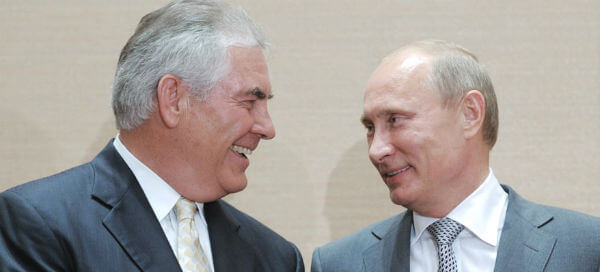
And if there is any remaining doubt that it will be duly rewarded for its efforts, the first serving is about to get dished out this week in the form of Rex Tillerson, chief executive of Exxon Mobil, whose appointment as Secretary of State is already being praised by the Kremlin even before it has been announced.

Stay informed. Click below to sign up for daily email updates from War in Context:

sign up now

Facebooktwittermail

What Donald Trump chooses to ignore

This is part of what Donald Trump said in an interview broadcast on Fox News today:

CHRIS WALLACE, FOX NEWS ANCHOR: According to The Washington Post, the CIA has concluded that Russia intervened in the election to help you win the presidency. Your reaction?

DONALD TRUMP, R-PRESIDENT-ELECT: I think it’s ridiculous. I think it’s just another excuse. I don’t believe it… No, I don’t believe that at all.

WALLACE: You say you don’t know why. Do you think the CIA is trying to overturn the results of the election —

TRUMP: No, I don’t think —

WALLACE: — somehow to weaken you in office?

TRUMP: Well, if you look at the story and you take a look at what they said, there’s great confusion. Nobody really knows.

[…]

WALLACE: You’ve said repeatedly you don’t believe the intelligence community’s analysis that the Russians were involved.

TRUMP: Take a look. They’re not sure. They’re fighting among themselves. They’re not sure.

WALLACE: But the question is, these are the folks you’re going to have to rely on to know what’s going on in the world?

TRUMP: Of course, we’re going to make changes, you know, at the top. I mean, we’re going to have different people coming in because we have our people, they have their people. And I have great respect for them.

But if you read the stories, the various stories, they’re disputing. And certain groups don’t necessarily agree. Personally, it could be Russia. It — I don’t really think it is. But who knows? I don’t know either. They don’t know and I don’t know.

[…]

WALLACE: President Obama just ordered a full review of Russia’s involvement, hacking in the election. And Democrats are now calling for hearings.

Do you think this is part of an effort to undercut you?

TRUMP: Well, it could be. I think President Obama’s been terrific. He’s been very respectful of the process and everything else. So, I saw that.

But — and I want it too. I think it’s great. I think — I don’t want anyone hacking us. And I’m not only talking about countries. I’m talking about anyone, period.

But if you’re going to do that, I think you should not just say Russia, you should say other countries also, and maybe other individuals.

In summary, Donald Trump thinks that the CIA’s claim that Russia intervened to help him win the election is ridiculous. He doesn’t believe it at all.

But he also thinks Russia could have hacked the election and says “I don’t know.”

Tucked inside this contradictory mix of disbelief and doubt is Trump’s overriding conviction: that if he is ever compelled to publicly acknowledge that Russia played an instrumental role in his victory, a fatal blow will have been struck at the legitimacy of his presidency.

No wonder he chooses to get as few intelligence briefings as possible.

Trump is more concerned about avoiding hearing information he doesn’t want to hear than he desires to be apprised of current threats to the national security of the United States.

In an era during which both politicians and the public have become hyperfocused on overstated threats from terrorism, what is actually now in jeopardy is American democracy itself.

Fortified borders and expanded military forces will provide no protection if opponents of democracy are already exerting their influence at the heart of government.

Trump’s insistence that no one really knows whether Russia intervened is a position that will nevertheless resonate in many quarters both because of widespread skepticism about the reliability of the CIA and because of the simple fact that the agency has thus far refrained from making clear exactly how much (or how little) it knows.

Nevertheless, no one should confuse the non-disclosure of evidence with its non-existence.

President Obama’s order that a report be completed before he leaves office, nevertheless suggests the possibility that President Trump will feel compelled to acknowledge the report’s findings.

If he doesn’t, it’s unlikely the report will show up on Wikileaks.

Even so, the more earnestly Trump buries the report’s conclusions, the more reasonably we can assume they must be explosive.

And the more explosive the facts are, the more likely that sooner or later they will become public knowledge.

* * *

Stay informed. Click below to sign up for daily email updates from War in Context:

sign up now

Facebooktwittermail

Rex Tillerson, from a corporate oil sovereign to the State Department

Steve Coll writes: The news that President-elect Donald Trump is expected to nominate Rex Tillerson, the chairman and chief executive of ExxonMobil, as his Secretary of State is astonishing on many levels. As an exercise of public diplomacy, it will certainly confirm the assumption of many people around the world that American power is best understood as a raw, neocolonial exercise in securing resources.

Tillerson figures prominently in “Private Empire: ExxonMobil and American Power,” a book I wrote about the corporation that came out in 2012. He declined my requests to interview him for that project, but I turned up at several public appearances he made and asked him a few questions from the reporters’ gallery. I also studied his public remarks, reviewed accounts of his activities reported in State Department cables obtained by Freedom of Information Act requests or released by WikiLeaks, and conducted interviews with other ExxonMobil executives, retirees, friends, competitors, civil-society activists and business partners from Asia to Africa to the Middle East.

Tillerson’s life has been shaped to a profound extent by two institutions: ExxonMobil and the Boy Scouts of America. He grew up in Texas, where his father was a modestly compensated administrator for the Scouts. Tillerson became an Eagle Scout. An engineering major at the University of Texas, in Austin, Tillerson joined ExxonMobil in 1975. He has never worked anywhere else. Of all the companies that were born out of the breakup of Standard Oil, Exxon is culturally the most direct descendant of John D. Rockefeller’s monopolistic giant, which was organized on principles of ruthless capitalism and Protestant faith. Exxon today is an unusually cloistered corporation that promotes virtually all of its top executives from within. Former executives I interviewed mentioned that as recently as the nineteen-seventies, it was not unusual to start company meetings with a prayer. When Tillerson finally won a competition for the top job, in 2004, he directed substantial time and charitable activity toward the Boy Scouts. In public appearances, he comes across as sophisticated, yet his life is rooted in environments that are fundamentally nostalgic for imagined midcentury virtues and for the days when burning fossil fuels did not threaten to trigger catastrophic climate change. Tillerson once listed his favorite book as “Atlas Shrugged,” Ayn Rand’s 1957 novel that has become a touchstone for libertarians and promoters of unbridled capitalism. Compared to the records of some of the other people around Trump, Tillerson’s is at least one of professional integrity; Exxon is a ruthless and unusually aggressive corporation, but it is also rule-bound, has built up a relatively strong safety record, and has avoided problems such as prosecutions under the Foreign Corrupt Practices Act, even though it operates in many countries that are rife with corruption. [Continue reading…]

Facebooktwittermail

What it really means to be a ‘friend of Putin’

Julia Ioffe writes: In June 2008, ExxonMobil CEO Rex Tillerson attended the St. Petersburg Economic Forum, Russia’s answer to Davos, its way of showing itself to the world as the kind of economic powerhouse that can attract executives like Rex Tillerson to its banquets. It was a key and very shaky moment for Russia. Vladimir Putin was bowing out after his second term as president of Russia — the most the Russian constitution allows in a row, though he would figure out a way around it by 2012 — and his successor, the relatively liberal Dmitri Medvedev, was debuting at the Forum. Tensions were heating up with Russia’s southern neighbor, Georgia, and would soon spill into war. The Russian economy was already getting shaky, and within a few months it would crater, faring the worst out of all the G20 economies, sinking from eight percent GDP growth, to negative eight percent.

Even after eight years of Putin assiduously taking control of the Russian economy and trying to restore some modicum of Soviet geopolitical power, Russia was still a pretty weak player. It had been relegated to last place among the BRICs, that term coined by a Goldman Sachs banker to connote the emerging markets of Brazil, Russia, India, and China. And despite surging commodity prices — oil at the time was around $130 a barrel — Russia wasn’t making a good case for itself in the world. Gazprom, the Russian state gas monopoly, was rattling European nerves by shutting gas supplies on and off in an effort to control an increasingly independent Ukraine, thus leaving much of Central Europe without heat in the winters. It had only been five years since oil tycoon Mikhail Khodorkovsky was thrown in jail for not bowing to Putin’s will, and two years since the Kremlin unceremoniously pushed Royal Dutch Shell out of a lucrative gas project in the far eastern island of Sakhalin. BP was on the obvious verge of meeting the same fate. The following month, BP chief Robert Dudley would flee Russia, complaining of “sustained harassment.”

When Tillerson mounted the stage in St. Petersburg that summer, he chastised the Russian government for the way it was operating. The Kremlin, he said, “must improve the functioning of its judicial system and its judiciary. There is no respect for the rule of law in Russia today.”

It’s hard to imagine Tillerson, now reportedly the frontrunner for Secretary of State under president-elect Donald Trump, saying something similar today, much less from a stage in Russia’s second capital, Vladimir Putin’s birthplace, and at a high-stakes, window-dressing government function. It’s not that Russia has suddenly acquired a taste for the rule of law—if anything, things have only gotten far, far worse, and Russia’s judiciary has become no more independent. And it’s not even because Tillerson is now ubiquitously identified in the press as being personally close to Putin. As the Wall Street Journal puts it, “Among those considered for the post, Mr. Tillerson has perhaps the closest ties to Russian President Vladimir Putin,” adding that, in 2012, Putin personally bestowed Russia’s Order of Friendship on Tillerson.

It’s hard to imagine Tillerson publicly chiding Putin today because he is now so very dependent on that friendship. [Continue reading…]

Facebooktwittermail

Let’s get the facts right on foreign involvement in our elections

Michael McFaul, former U.S. ambassador to Russia from 2012-2014, writes: President-elect Donald Trump won the 2016 presidential election and will be the next president of the United States. As I have written before in these pages, the rules of the game for choosing our presidents need to be changed, but that discussion concerns future elections, not this past one. A win is a win.

That most people acknowledge Trump’s victory should now free us to have a serious discussion about the role of foreign interference in the 2016 presidential election. During the campaign, mentions of foreign meddling quickly became partisan and polarized, blocking any real examination of the facts, let alone a discussion of prescriptions. Even Obama administration officials seemed to tiptoe around these issues, not wanting to appear to use their privileged access to classified information to help the Democratic Party’s candidate, Hillary Clinton. But now the election is over. Before the next one, we need to know the facts — investigate what did and did not occur — so that we can develop procedures, policies and laws to strengthen the integrity of our electoral process before 2020. This is not a partisan plea; it is a national security issue.

We know some facts, and they are disturbing. For instance, we know that Russian actors stole data from people working at the Democratic National Committee. We know that another foreign actor, WikiLeaks, published data stolen from the DNC to adversely affect Clinton. We also know that WikiLeaks and others published data stolen from John Podesta, Clinton’s campaign chairman, in order to try to damage further the Democratic candidate. We also know that WikiLeaks did not publish similar kinds of data from the Trump campaign or the Republican Party. [Continue reading…]

Facebooktwittermail

ISIS retakes UNESCO heritage site Palmyra — so where is Putin’s army now?

Michael Weiss writes: “Our future Russian allies, with all their international legitimacy, are too busy elsewhere in Syria to help much against ISIS.”

So witheringly tweeted former U.S. ambassador Robert Ford on the day that the CIA went public with disclosures about Russian government hacks designed to get Donald Trump elected president; a report emerged that Trump’s imminent appointment for Secretary of State is ExxonMobil CEO Rex W. Tillerson, a personal friend of Vladimir Putin who awarded him Russia’s Order of Friendship in 2012; and news broke that ISIS has recaptured much of the ancient Syrian city of Palmyra, its most successful territorial revanche in two years.

Moscow, as Ford implied, was evidently too busy bombing the rebel-held parts of Eastern Aleppo to prevent one of its major symbolic prizes in the war in Syria from slipping its grasp.

The crossroads of several antique civilizations, Palmyra was sacked by the head-chopping fanatics of the so-called Islamic State in May 2015, just days after they seized the Iraqi provincial capital of Ramadi. After promising not to powder the standing Roman, Persian and Assyrian ruins which have made the city a UNESCO World Heritage Site, ISIS did indeed blow up millennia-old monuments, horrifying historians and archaeologists.

Palmyra’s recapture last March by Syrian government loyalists, backed by heavy Russian airstrikes and Russian-seconded ground mercenaries — including neo-Nazi veterans of the 1990s Balkans wars — was met with cheers from some Western officials, such as then-British MP and now British Foreign Secretary Boris Johnson, as a triumph of culture over barbarism.

Which was exactly the intended propaganda point being made by the Kremlin. [Continue reading…]

Facebooktwittermail

Trump, CIA on collision course over Russia’s role in U.S. election

The Washington Post reports: The simmering distrust between Donald Trump and U.S. intelligence agencies escalated into open antagonism Saturday after the president-elect mocked a CIA report that Russian operatives had intervened in the U.S. presidential election to help him win.

The growing tensions set up a potential showdown between Trump and the nation’s top intelligence officials during what some of those officials describe as the most complex threat environment in decades.

The Washington Post reported Friday that the Central Intelligence Agency had determined that Russia had intervened in the presidential election not just to make mischief but to boost Trump’s chances.

Trump’s reaction will probably deepen an existing rift between Trump and the agencies and raised questions about how the government’s 16 spying agencies will function in his administration on matters such as counterterrorism and cyberwarfare. On Friday, members of Trump’s transition team dismissed the CIA’s assessments about Iraq’s stockpile of weapons of mass destruction.

“Given his proclivity for revenge combined with his notorious thin skin, this threatens to result in a lasting relationship of distrust and ill will between the president and the intelligence community,” said Paul Pillar, former deputy director of the CIA’s Counterterrorism Center.

U.S. intelligence officials described mounting concern and confusion about how to proceed in an administration so openly hostile to their function and role. “I don’t know what the end game is here,” a senior U.S. intelligence official said. “After Jan. 20,” the official said, referring to Inauguration Day, “we’re in uncharted territory.” [Continue reading…]

Stay informed. Click below to sign up for daily email updates from War in Context:

sign up now

Facebooktwittermail

FBI and CIA give differing accounts to lawmakers on Russia’s motives in 2016 hacks

The Washington Post reports: In a secure meeting room under the Capitol last week, lawmakers held in their hands a classified letter written by colleagues in the Senate summing up a secret, new CIA assessment of Russia’s role in the 2016 presidential election.

Sitting before the House Intelligence Committee was a senior FBI counterintelligence official. The question the Republicans and Democrats in attendance wanted answered was whether the bureau concurred with the conclusions the CIA had just shared with senators that Russia “quite” clearly intended to help Republican Donald Trump defeat Democrat Hillary Clinton and clinch the White House.

For the Democrats in the room, the FBI’s response was frustrating — even shocking.

During a similar Senate Intelligence Committee briefing held the previous week, the CIA’s statements, as reflected in the letter the lawmakers now held in their hands, were “direct and bald and unqualified” about Russia’s intentions to help Trump, according to one of the officials who attended the House briefing.

The FBI official’s remarks to the lawmakers on the House Intelligence Committee were, in comparison, “fuzzy” and “ambiguous,” suggesting to those in the room that the bureau and the agency weren’t on the same page, the official said.

The divergent messages from the CIA and the FBI put a spotlight on the difficulty faced by intelligence and law enforcement officials as they try to draw conclusions about the Kremlin’s motives for hacking Democratic Party emails during the 2016 race. Officials are frequently looking at information that is fragmentary. They also face issues assessing the intentions of a country expert at conducting sophisticated “influence” operations that made it hard — if not impossible — to conclusively detect the Kremlin’s elusive fingerprints.

The competing messages, according to officials in attendance, also reflect cultural differences between the FBI and the CIA. The bureau, true to its law enforcement roots, wants facts and tangible evidence to prove something beyond all reasonable doubt. The CIA is more comfortable drawing inferences from behavior. [Continue reading…]

Facebooktwittermail

Rex Tillerson, Exxon chief with close ties to Russia, is expected to be Trump’s pick for secretary of state

The New York Times reports: Rex W. Tillerson, the chief executive of Exxon Mobil, whose extensive deal-making for the energy giant has plunged him into global politics from Yemen to Russia, is expected to be offered the secretary of state post this weekend by President-elect Donald J. Trump, according to two people close to Mr. Trump’s transition team.

Mr. Tillerson, 64, has spent the past 41 years at Exxon, where he began as a production engineer and went on to strike deals around the world for a company that explores, buys and sells oil and gas in some of the globe’s most troubled corners.

Those travels have engendered close ties with a number of world leaders, notably President Vladimir V. Putin of Russia, who has known Mr. Tillerson for more than two decades, and who awarded him the country’s Order of Friendship in 2013. The next year, Washington’s relationship with Moscow was plunged into a deep freeze with Russia’s annexation of Crimea and its shadow war in eastern Ukraine, a problem that Mr. Tillerson would inherit. [Continue reading…]

Steve Horn notes: Exxon, the top U.S. producer of oil and gas and a well-documented funder of climate science denial, actually leases more land in Russia than it does in the U.S.

“Exxon boosted its Russian holdings to 63.7 million acres in 2014 from 11.4 million at the end of 2013, according to data from U.S. regulatory filings,” reported Bloomberg in March 2014. “That dwarfs the 14.6 million acres of rights Exxon holds in the U.S., which until last year was its largest exploration prospect.”

Exxon, though headquartered in Irving, Texas near Dallas, is a sprawling “private empire” with assets spread across the globe. When asked about building more U.S. refineries to protect the U.S. economy and consumers from fuel shortages, former CEO and chairman Lee Raymond put Exxon’s view of itself and its loyalty to the U.S. bluntly.

“I’m not a U.S. company, and I don’t make decisions based on what’s good for the U.S,” Raymond is quoted as saying in the 2012 book Private Empire: ExxonMobil and American Power by Steve Coll. [Continue reading…]

Stay informed. Click below to sign up for daily email updates from War in Context:

sign up now

Facebooktwittermail

Trump, McConnell, Putin, and the triumph of the will to power

Jonathan Chait writes: Of the many things that resulted in Donald Trump’s election, from Hillary Clinton’s own errors to James Comey’s extraordinary insinuations against her in the contest’s final stages, Russian hacking played a meaningful enough role to tilt a razor-tight contest. Russia successfully riled up Bernie Sanders die-hards against the Democratic Party by leaking minor intrigue that fueled their suspicions, aggravating a Clinton liability with young voters that never healed. They also dribbled out enough emails in the succeeding months to keep stories using the word “emails” in the lead of Hillary Clinton news, adding more smoke to the haze of scandal that permeated coverage of her campaign.

We now know with near-certainty that Russia did this with the goal of electing Trump president. During the campaign, this reality was not quite certain enough to be reported as fact. Trump, of course, insisted there was no evidence Russia even had a hand in the attacks, let alone with the goal of helping him. (It “could be somebody sitting on their bed that weighs 400 pounds.”) Elements of the left decried suspicions of Russia’s role as “neo-McCarthyism.” The Nation editorialized, “ liberal-media elites have joined with the Clinton campaign in promoting the narrative of a devious Russian cyber-attack.” Others on the left insisted that the substance of the stolen emails command far more importance than their provenance, which in any case was disputed and unknowable. On October 31, the New York Times reported that the attack was probably “aimed at disrupting the presidential election rather than electing Mr. Trump.”

Friday, the Washington Post reported that the CIA had concluded well before November that Russia specifically sought to elect Trump. The CIA’s analysis is obviously not infallible, but it fits with a wide array of other evidence. Russia had a clear motive: chilly relations with the Democratic administration that had orchestrated sanctions against it, close ties with Donald Trump and several of his advisers, and a series of pro-Russian positions from Trump on such issues as Crimea, NATO, and Vladimir Putin’s human rights abuses. Russia also hacked the Republican National Committee but declined to release any of the contents. The disruption was intentionally one-sided. The CIA’s conclusion merely lends incrementally more confidence to a deduction that was already fairly obvious.

What is more interesting in the Post story is the response of various officials to the revelations. The Obama administration declined to publicize, wary of being seen as intervening on Clinton’s behalf. Instead, it devised a fallback plan. Concerned that Russia might attempt to hack into electronic voting machines, it gathered a bipartisan group of lawmakers to hear the CIA’s report, in the hopes that they would present a united front warning Russia not to disrupt the election. According to the Post, Republican Majority Leader Mitch McConnell “raised doubts about the underlying intelligence and made clear to the administration that he would consider any effort by the White House to challenge the Russians publicly an act of partisan politics.” Other Republicans refused to join the effort for reasons that can only be understood as a desire to protect the Republican ticket from any insinuation, however well-founded, that Russia was helping it.

Even the most cynical observer of McConnell — a cynical man to his bones — would have been shocked at his raw partisanship. Presented with an attack on the sanctity of his own country’s democracy by a hostile foreign power, his overriding concern was party over country. Obama’s fear of seeming partisan held him back from making a unilateral statement without partisan cover. No such fear restrained McConnell. This imbalance in will to power extended to the security agencies. The CIA could have leaked its conclusion before November, but held off. The FBI should have held off on leaking its October surprise, but plunged ahead. [Continue reading…]

Facebooktwittermail

Trump, mocking claim that Russia hacked election, at odds with GOP

The New York Times reports: An extraordinary breach has emerged between President-elect Donald J. Trump and the national security establishment, with Mr. Trump mocking American intelligence assessments that Russia interfered in the election on his behalf, and top Republicans vowing investigations into Kremlin activities.

Mr. Trump, in a statement issued by his transition team on Friday evening, expressed complete disbelief in the intelligence agencies’ assessments.

“These are the same people that said Saddam Hussein had weapons of mass destruction,” Mr. Trump’s team said, adding that the election was over and that it was time to “move on.”

Though Mr. Trump has wasted no time in antagonizing the agencies, he will have to rely on them for the sort of espionage activities and analysis that they spend more than $70 billion a year to perform.

At this point in a transition, a president-elect is usually delving into intelligence he has never before seen and learning about C.I.A. and National Security Agency abilities. But Mr. Trump, who has taken intelligence briefings only sporadically, is questioning not only analytic conclusions, but also their underlying facts. [Continue reading…]

Facebooktwittermail

‘We are dead either way’: Agonizing choices for Syrians in Aleppo

The New York Times reports: He had long been one of the more optimistic anti-government residents of the besieged, rebel-held section of Aleppo, trying to buoy others’ spirits even as loyalist forces closed in. But as the Syrian Army and allied militias took more and more territory in an apparently decisive offensive during the week, Yasser Hmeish, an accountant for the local medical council, grew frantic.

Soldiers seized his neighborhood on Wednesday while he worked at a clinic blocks away. Several of Mr. Hmeish’s neighbors were brought into the clinic wounded, but died before he could ask what had happened to his family.

“I don’t know anything, anything about them,” Mr. Hmeish said in an audio message, in one of scores of exchanges we had with people inside east Aleppo as the offensive unfolded. “We are about to die or be arrested.”

After years of bombing and months under siege, rebels had lost more than three-quarters of their territory in eastern Aleppo by the end of the week, throwing thousands of civilians and fighters into chaos. We followed the events in real time from Beirut, monitoring social media and talking via WhatsApp, Skype, telephone and other media with doctors, fighters, housewives, local council members, antigovernment activists, aid workers and others, including on the government side. All were people we had gotten to know through years of covering Syria’s bloody civil war.

They confided their dilemmas over whether to flee to government-held areas or stay put until the bitter end, a choice that split up many families. They described escalating bombardment and attacks that have killed women and children trying to reach safe ground. They revealed deepening rifts among rebel groups, and between fighters and civilians, over whether and how to surrender. [Continue reading…]

Facebooktwittermail

Russia hacked Republican National Committee but kept data, U.S. concludes

The New York Times reports: American intelligence agencies have concluded with “high confidence” that Russia acted covertly in the latter stages of the presidential campaign to harm Hillary Clinton’s chances and promote Donald J. Trump, according to senior administration officials.

They based that conclusion, in part, on another finding — which they say was also reached with high confidence — that the Russians hacked the Republican National Committee’s computer systems in addition to their attacks on Democratic organizations, but did not release whatever information they gleaned from the Republican networks.

In the months before the election, it was largely documents from Democratic Party systems that were leaked to the public. Intelligence agencies have concluded that the Russians gave the Democrats’ documents to WikiLeaks.

Republicans have a different explanation for why no documents from their networks were ever released. Over the past several months, officials from the Republican committee have consistently said that their networks were not compromised, asserting that only the accounts of individual Republicans were attacked. On Friday, a senior committee official said he had no comment. [Continue reading…]

Facebooktwittermail