Category Archives: Russia

Battle for Aleppo may be the most crucial of the Syrian civil war

The Washington Post reports: A fast-moving cataclysm underway in and around Aleppo has brought together all the major actors in Syria’s civil war for what may be the most crucial battle of the five-year conflict, and it is testing whether U.S.-Russian cooperation to end it is a pipe dream.

North of the city — in which the government holds the western side and U.S.-backed moderate opposition forces have occupied the east since 2012 — the opposition has lost control of its only lifeline for resupply under relentless pummeling by Russian and Syrian aircraft and artillery.

The road to Turkey also provided the only path for humanitarian aid or an escape route for at least a quarter-million civilians trapped inside Aleppo, who the United Nations said this week have been left without food, medical supplies or running water.

So dire is their situation that talks initiated by the Obama administration with Russia this summer about coordinating their Syria counterterrorism efforts have been put on the back burner, superseded by urgent negotiations with Moscow over reopening the road to Turkey, according to U.S. officials. [Continue reading…]

In the video below, Charles Lister discusses the siege of Aleppo and the dynamics within Syrian opposition groups:


 

Facebooktwittermail

Is Putin preparing a new attack on Ukraine?

Anders Åslund writes: Observers have greatly feared that Russia’s President Vladimir Putin would start a small regional war this August. Russia has moved up its State Duma elections to September 18. Although only Putin’s parties are allowed to win, he has a predilection for “small and victorious wars” to mobilize his people.

In 1999, the second war in Chechnya preceded his rise to president. In August 2008, Russia attacked Georgia. In February 2014, Russia annexed Crimea, a move that was greatly popular in Russia. Its war in Syria has been an unmitigated success. For the last two years, Russia’s economy has been in recession, giving Putin all the more reason to mobilize his compatriots around a small war.

August is the best time for Moscow’s military action because Western decision-makers are on holidays. The Berlin Wall was initiated in August 1961, the invasion of Czechoslovakia occurred in August 1968, and the Moscow coup took place in August 1991.

The parallels with the August 2008 Russian-Georgian war are striking. That conflict started with the Olympic games in Beijing. The United States president was a lame duck amid the presidential election campaign. Russia was pursuing a large-scale military exercise called Caucasus 2008 in the Northern Caucasus. The Kremlin blamed Georgia for an implausible attack.

A war in August has seemed quite likely for domestic reasons, but where? In the last week, it has become clear that Ukraine will be the target. Major Russian troop movements with hundreds of tanks and heavy artillery to the Donbas and Crimea were reported during the weekend. They were part of a big Russian military exercise named Caucasus 2016. [Continue reading…]

Facebooktwittermail

Another Trump adviser with deep ties to Russia

Businessman and investor, Howard Lorber, who has various business interests in Russia and has been called one of Donald Trump’s “best friends,” is now one of his economic advisers. Josh Rogin writes: Trump’s visits to Russia began in 1987 and lasted until 2013, when he brought the Miss Universe pageant to Moscow and famously wondered on Twitter about Vladimir Putin, “will he become my best friend?” Trump was also deeply involved in discussions to work on the reconstruction of the Moskva and Rossiya hotels in Moscow’s city center. He has bragged about his ties to Russian businessmen connected to the Kremlin.

“The Russian market is attracted to me,” Trump told Real Estate Weekly in 2013. “I have a great relationship with many Russians, and almost all of the oligarchs were in the room.”

In November 1996, Trump spent three days in Moscow with Lorber and visited Ducat Place, a site being developed by Liggett-Ducat Ltd., a cigarette company that was owned by Lorber’s Vector Group at the time.

“We’re looking at building a super-luxury residential tower … which I think Moscow desperately wants and needs,’ Trump told the Moscow Times at the time.

Lorber’s business partner Ben LeBow was also involved in arranging Trump’s trip to Moscow. He bragged about bringing the Trump Organization to Russia in a 1996 interview with the Moscow Times.

“Donald is the preeminent marketeer and developer in the world,” said LeBow. “We want the best for Moscow — and Donald’s it.”

Trump’s plans to build a Trump Tower in Moscow and reconstruct the Moscow hotels eventually fizzled out. But 15 years later, Trump was still at it. In 2013, while he was organizing the Miss Universe pageant in Moscow, Trump tried to restart the Moscow Trump Tower project. He entered talks with Russian billionaire Araz Agalarov, who happened to own the Crocus City Hall, where the Miss Universe finals were held.

Lorber is only the latest Trump adviser to have long ties to Russia and a financial stake there. Campaign chairman Paul Manafort was a paid adviser to Russia’s client Ukrainian President Viktor Yanukovych for more than a decade. Foreign policy adviser Carter Page is a consultant for Russian state-owned energy firm Gazprom.

Donald Trump Jr. has been a huge proponent of expanding the family business to Russia, making half a dozen trips there on behalf of the Trump Organization during the latest U.S. financial crisis. [Continue reading…]

Facebooktwittermail

Assange promotes conspiracy theory about Wikileaks’ source of DNC emails


Wikileaks’ first gambit in promoting the idea that DNC staffer, Seth Rich, was murdered for political reasons was to announce that it is offering a reward for information that could lead to the conviction of the killer:


In the interview above, Julian Assange is now insinuating that Rich might have been Wikileaks’ source for the “leaked” DNC documents.

Clearly, this is nonsense — but it’s a claim that Assange shamelessly makes because he knows that idiots like Alex Jones will gladly run with it.

Wikileaks has a solid commitment to protect its sources and would have honored that commitment to Rich — had he been a source — when he was alive.

But there’s nothing that Wikileaks can do to protect him now. Indeed, if a Wikileaks source was murdered by those who feared the possibility of him speaking out, Wikileaks would then have a responsibility to speak out in the name of their source.

If Rich was indeed Wikileaks’ source, Assange would not at this time be shiftily alluding to some such possibility — he would instead be publishing evidence that proves this fact.

In that event, Wikileaks would have a solid foundation for demanding that the criminal investigation into Rich’s death include the leadership of the Democratic Party.

Likewise, in a single blow, Wikileaks would have destroyed the credibility of all those now claiming that Russian intelligence was directly or indirectly Wikileaks’ source.

By publishing evidence that Seth Rich — not the Russians — was Wikileaks’ source, Assange would instantly be able to elevate himself from his current role as a fugitive, attention-seeking conspiracy theorist, to a heroic, fearless truth-teller who had unequivocally struck hard at the heart of the American political establishment.

Who knows? He might even then get rewarded by Russia, secretly extracted from London and provided refuge in Moscow.

What seems more likely, however, is that sooner or later he’s going to get bumped unceremoniously onto the streets of London and thereafter land in a U.S. federal court facing charges for something. I’m sure he’ll get an excellent defense, but if convicted, let’s hope that this leads a future president to then show Chelsea Manning the mercy she deserves.

Assange, on the other hand, is increasingly displaying the recklessness of a man who senses his chickens are coming home to roost.

Facebooktwittermail

Putin, Obama and the battle for Aleppo

By Layla Saleh, Qatar University

The battle for Aleppo has the Arab world, Middle East observers and Western policymakers on edge.

In what is likely a turning point in the long Syrian civil war, a coalition of opposition fighters is attempting to break Bashar al-Assad regime’s siege of the country’s commercial capital. Meanwhile, the Syrian government – with Russian support – is bombing rebel strongholds in the city which is still home to 250,000 people, according to the BBC.

Thanks to recent U.S. diplomatic overtures to deepen cooperation with Russia against the Islamic State, or IS, and al-Qaida affiliate Al-Nusra Front, the U.S. could be considered a partner in those airstrikes. The U.S. overtures have been criticized as strategically inconsistent and Putin-pleasing.

As a student of American policy in the Middle East, I’d argue that American efforts are key to the tumultuous trajectory of Syria’s uprising-turned-war. What’s less clear to me is how much U.S. President Barack Obama’s approach prioritizes either the immediate needs of Syrians suffering from war and terrorism or their aspirations for self-liberation from authoritarian rule.

Continue reading

Facebooktwittermail

Russia’s secret mercenaries fighting in Syria


Sky News reports: If Russia is a nation at war, the Kremlin has always been careful to frame its campaign in Syria as an aerial operation.

Other than a limited number of ‘instructors and military advisers’, Russian officials have repeatedly stated that they do not need to put ‘boots on the ground’.

The Russian narrative of low-cost conflict has been seriously challenged however by a group of young Russian men who claim that their country’s involvement in Syria is far more extensive – and more costly – than anyone in President Putin’s administration is prepared to admit.

These individuals told Sky News that they were recruited by a highly secretive private military company called ‘Wagner’ and flown to Syria aboard Russian military transport planes.

For the equivalent of £3,000 a month, they say they were thrown into pitch battles and firefights with rebel factions – including Islamic State.

Two of the group, Alexander and Dmitry, told Sky News they felt lucky to be alive.

“It’s 50-50,” said Alexander (not his real name). “Most people who go there for the money end up dead. Those who fight for ideals, to fight against the Americans, American special-forces, some ideology – they have a better chance of survival.”

“Approximately 500 to 600 people have died there,” claimed Dmitry. “No one will ever find out about them…. that’s the scariest thing. No one will ever know.” [Continue reading…]

Facebooktwittermail

Pity Aleppo as Putin drops his bombs to salvage Russia’s pride

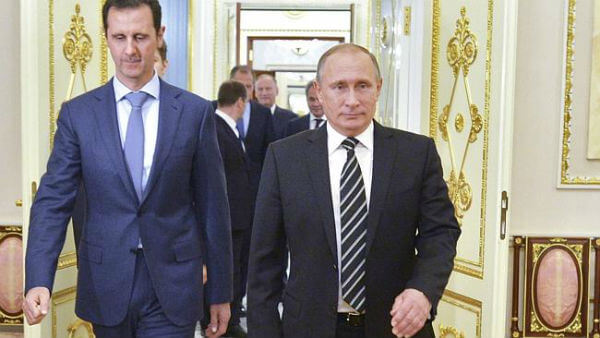
assad-putin

Natalie Nougayrède writes: A few days after Russia launched its military intervention in Syria in September 2015, Barack Obama said it would “get stuck in a quagmire and it won’t work”. Ten months on, that has yet to come to pass. As Russia helps its ally Bashar al-Assad try to retake Aleppo, the last strategic urban stronghold of the Syrian opposition, there aren’t many signs of the Kremlin’s war machine being either hamstrung or stuck. Indeed Russia seems to have registered more victories than setbacks in Syria. Hardly anyone remembers that, just last March, Vladimir Putin had announced he would begin withdrawing his forces. The withdrawal turned out to be as theoretical as Obama’s quagmire.

Most attempts to explain Putin’s military operation in Syria have focused on the following: 1) allergic to popular uprisings, he wants to prevent regime change in Damascus of the sort that happened in 2011 in Tunisia, Egypt and Libya; 2) he wants to secure Russia’s last foothold in the Arab world; 3) he wants to demonstrate Russia will do what it takes to defend an ally; 4) he wishes to divert attention from Ukraine as well as extract western concessions such as the easing of sanctions; 5) he is opportunistic and has capitalised on American unwillingness to get further involved in the Middle East; 6) he believes that by creating chaos, even if there is no clear endgame, Russia shows it can overturn western plans ; 7) it’s all about Russian domestic politics: nationalism and military assertiveness go hand in hand with Putin’s need to safeguard his own power structure.

There is probably truth to all of the above. But as Russia’s bombers hammer Aleppo’s besieged population in what could be the most decisive battle of Syria’s civil war, consider this as another piece to the puzzle of Putin’s mind: Syria is where Russia wants to erase the humiliation of the Soviet Union’s defeat in Afghanistan in the 1980s. [Continue reading…]

Facebooktwittermail

Fears of full-scale war return as casualties mount in Ukraine

RFE/RL reports: Framed by a tiny cutout in the fortified bunker, this particular piece of no-man’s land is tinted a blood-reddish orange by the setting summer sun.

It’s hot as hell, and it’s about to get hotter. When the sun goes down, the guns start blazing. And all that separates the men at their triggers is a grassy patch of land the size of a soccer field that is heavily mined. If you’re a Ukrainian soldier here, you don’t need binoculars to observe the enemy — you just look in his direction.

It starts with a single shot from a Kalashnikov: Ziiip. Then another: Ziiip. And three more: Ziiip. Ziiip. Ziiip. Each shot whizzes dangerously closer. In the time it takes to boil an egg, the situation escalates as the rifles are joined by .50-caliber machine guns, mortars, and rocket-propelled grenades that explode with hollow thuds against the earth or cottages where the soldiers eat and sleep, showering everything with shrapnel. Within an hour, shells from howitzers and tanks — and eventually surface-to-surface Grad missiles, whose name is Russian for “hail” — begin pummeling the scarred steppe.

The “disco,” as the soldiers and the few residents left in this forsaken town call it, is in full effect. The relative calm that dawn brings seems a lifetime away. All are at the mercy of the darkness.

This is eastern Ukraine 28 months after the start of a conflict that once seemed unthinkable, and a year and a half after the signing of a second cease-fire deal, known as Minsk 2, that was supposed to bring lasting peace to this war-torn edge of Europe and reintegrate it with the rest of Ukraine.

But the armistice is unraveling fast as fighting between Ukrainian government forces and Russia-backed separatists has escalated to levels not seen since more furious phases of the conflict in the Donbas — where the separatists hold parts of the Donetsk and Luhansk regions — in 2014 and 2015. Casualties, both civilian and military, are mounting. [Continue reading…]

Facebooktwittermail

New Clinton ad insinuates Trump won’t put America first


The Washington Post reports: Insinuations, accusations and speculations have been a staple of Donald Trump’s presidential campaign. Now Hillary Clinton is using the Republican nominee’s own methods against him.

In a new online advertisement, her campaign makes a few factual statements about Trump’s Russian sympathies, stretches the truth in a couple of ways and then invites readers to draw their own conclusions.

It is exactly the technique that Trump has used repeatedly throughout the campaign to feed conspiracy theories, said Joseph Uscinski, a political scientist at the University of Miami who studies conspiracy theories. The advertisement, which is titled “What Is Donald Trump’s Connection to Vladimir Putin?” and appeared online Friday, insinuates that Trump has some kind of business or political alliance with Russia’s president, Uscinski said.

“We don’t know what’s going on here, and Donald won’t tell us,” the spot concludes. “We’ll let you guess.”

To be sure, a victory for Trump would augur a radical shift in U.S. foreign policy toward Russia. The United States would be much friendlier toward Putin and much more accommodating of his international agenda.

Trump has surrounded himself with people who are sympathetic to Putin. Paul Manafort, the chairman of Trump’s campaign, also advised former Ukranian president Viktor Yanukovych, who was aligned with Putin. Carter Page, one of Trump’s advisers on foreign affairs, has openly praised Putin and criticized Western sanctions on Russian officials.

Trump himself has praised Putin, as well, and has also called for the United States to retreat from its responsibilities in NATO — which would probably increase Putin’s influence in the region.

At this point, however, there is no evidence that anyone in the Trump campaign has a direct connection with the Kremlin, as Clinton’s spot insinuated. [Continue reading…]

Facebooktwittermail

Why Vladimir Putin might want to interfere in the U.S. presidential elections

Fiona Hill writes: Whatever his personal preferences, … Putin cannot reasonably expect to influence the outcome of the US presidential election. The best he can hope for is to reduce the ability of whoever comes into the Oval Office to pursue policies that are detrimental to Putin’s and Russia’s interests.

Right now, Putin wants the US to remove sanctions imposed on Russia after its annexation of Crimea in March 2014. Perhaps even more importantly, Russia has parliamentary elections this September, and presidential elections again in 2018, when Putin is expected to run for a fourth term. The Kremlin does not want a repeat of the protests of 2011-’12, and certainly no pronouncements from the US about whether the elections are free and fair or whether Putin has a genuine popular mandate for his next presidency.

Against this backdrop, the information from the DNC files underscores for the Russian public, and the outside world, that US party politics is just as dirty as in Russia or anywhere else. The US looks a lot less credible as the moral authority on the conduct of elections.

Irrespective of whether Donald Trump or Hillary Clinton is elected, from Moscow’s perspective, at the end of this ruinous political campaign, the new US president will look as wounded as Putin did when he took office again in 2012. A US president who is elected amid controversy and recrimination, reviled by a large segment of the electorate, and mired in domestic crises will be hard-pressed to forge a coherent foreign policy and challenge Russia. [Continue reading…]

Facebooktwittermail

DNC hacking puts Obama in tough spot with Russia

The Hill reports: Pressure is growing on the White House to respond to Russia’s apparent hack of the Democratic National Committee (DNC), placing President Obama in a delicate political position.

Evidence has mounted that the Russian government was behind the theft of tens of thousands of damaging internal emails from the DNC, leading prominent lawmakers from both sides of aisle to call for some form of response.

The ranking members of the House and Senate Intelligence committees and the chairman and ranking member of the Senate Judiciary Committee have all issued calls for Obama to “seek justice” for the alleged attack.

But should Obama publicly point the finger at the Kremlin, it could expose covert intelligence capabilities and damage already touchy discussions over Russia’s behavior in Syria and Ukraine, experts say.

That dynamic reflects one the central challenges the White House faces in responding to cyberattacks. Without any international rules of engagement, officials must weigh a response to each attack individually.

The FBI has opened an investigation into the hack, but because of the risks, experts say, the public is unlikely to ever know the results, even if it is able to prove Russia’s guilt beyond a shadow of a doubt.

Obama has a slate of possible responses at his disposal, but each carries its own set of problems.

“They are really in between a rock and a hard place. Everything they do has a downside,” said Herb Lin, a senior research scholar who studies cyber policy and security at Stanford. [Continue reading…]

Facebooktwittermail

Can we trust Julian Assange and WikiLeaks?

Alex Gibney writes: I’ve had my own run-ins with Mr. Assange. During the making of my 2013 film, “We Steal Secrets: The Story of WikiLeaks,” I spent an agonizing six hours with him, when he was living in an English country house while out on bail. I was struck by how insistently he steered the conversation away from matters of principle to personal slights against him, and his plans for payback. He demanded personal “intel” on others I had interviewed, and dismissed questions about the organization by saying, “I am WikiLeaks” repeatedly. (Later, Mr. Assange and his followers attacked both me and my film.)

Even given that history, I believe that WikiLeaks was fully justified in publishing the D.N.C. emails, which provided proof that members of the D.N.C., in a hotly contested primary, discussed how to undermine the campaign of Bernie Sanders. They are clearly in the public interest.

As for Mr. Assange’s animus against Hillary Clinton — he has written that she “lacks judgment and will push the United States into endless, stupid wars which spread terrorism” — that is evidence of bias, but no more than that. After all, many news outlets are clearly, and sometimes proudly, biased.

We still don’t know who leaked the D.N.C. archive, but given Mr. Assange’s past association with Russia, it wouldn’t surprise me to learn that it was a Russian agent or an intermediary. Mr. Assange insists this is a mere distraction from the issue of D.N.C. interference, but the answer is also in the public interest. We should all be concerned (although hardly surprised) if it is that easy for the Russians to break into the D.N.C. and possibly United States government networks. [Continue reading…]

Facebooktwittermail

For Putin, disinformation is power

Arkady Ostrovsky writes: Fifteen years ago, a few months into his presidency, Vladimir V. Putin told Larry King on CNN that his previous job as a K.G.B. officer had been like that of a journalist. “They have the same purpose of gathering information, synthesizing it and presenting it for the consumption of decision makers,” he said. Since then, he has excelled at using the media to consolidate power inside Russia and, increasingly, to wage an information war against the West.

So the apparent hacking by Russian security services of the Democratic National Committee emails, followed by their publication by WikiLeaks, should come as no great surprise to Americans. It is only the latest example of how Mr. Putin uses information as a weapon. And the Kremlin has cultivated ties with WikiLeaks for years.

It has also used disinformation in its annexation of Crimea and in its war in Ukraine, launched cyberattacks on Finland and the Baltic States, and planted hoax stories in Germany to embarrass Angela Merkel. During the Cold War, the Kremlin interfered in American politics for decades. The K.G.B.’s so-called active measures — subversion, media manipulations, forgery and the financing of some “peace” organizations — lay at the heart of Soviet intelligence.

Then as now, Russia exploited real grievances in the West — discontent with the war in Vietnam and racial tensions in the 1960s; anxiety and fear of Muslim immigrants today. Nevertheless, Mr. Putin’s support of the likes of Donald Trump in America, Brexiters in Britain or the right-wing Marine Le Pen in France does not mean they are his creations. [Continue reading…]

Facebooktwittermail

How Russia dominates your Twitter feed to promote lies (and, Trump, too)

The Daily Beast reports: “Ladies and Gentlemen, We have a situation in #Turkey #Incirlik” the cry went out on Twitter last Saturday night, as news spread of the Turkish forces surrounding the U.S. airbase in Incirlik.

Thousands of armed police had reportedly surrounded the airbase amid swirling rumors of another coup attempt, according to stories tweeted within two minutes of each other on RT.com and Sputnik, the two biggest Russian state-controlled media organizations publishing in English. The stories were instantly picked up by a popular online aggregator of breaking news and prompted hours-long storm of activity from a small, vocal circle of users.

In English, the tweets soon grouped into certain patterns of similar (and sometimes identical) content. The first were panicky expressions of concern about nuclear weapons allegedly stored at Incirlik: [Continue reading…]

Facebooktwittermail

In Aleppo, the West has once again failed to prevent what it vowed to stop

Julian Reichelt writes: Over the past four years, the Aleppo I fell in love with has ceased to exist, its slow and painful four-year-long death now dramatically accelerated by Russian‎ smart bombs and Syrian regime dumb bombs.

If Aleppo were a person, this would be the point where we would pray for a swift end to their suffering. But Aleppo isn’t only one person, it’s a besieged town of 300,000, a disgrace to the conscience of the civilized world. Doctors are working in conditions resembling a slaughterhouse more than a hospital, but still saving lives. Children are burning tires to cloud the skies with smoke and obstruct the vision of Putin’s relentless jets and their soulless pilots. While they — eight-year-old kids — stand up to Putin’s air force and their crimes against humanity, the Western world — once again — has done nothing.

“We had gotten used to hell on earth,” one friend inside the city texted me two days ago. “Now they’re even bombing our hell to pieces.”

In the past days, while bombs were raining on the ruins of Aleppo, I have called, emailed or otherwise contacted every person in politics I know to voice not my concern, as our diplomats would say, but my outrage over what is happening — or, more accurately, what is not happening. [Continue reading…]

Facebooktwittermail

How hackers could destroy election day

Shane Harris writes: Stealing and leaking emails from the Democratic National Committee could be just the start. Hacking the presidential election itself could be next, a bipartisan group of former intelligence and security officials recently warned. Whoever was behind the DNC hack also could target voting machines and the systems for tabulating votes, which are dangerously insecure.

“Election officials at every level of government should take this lesson to heart: our electoral process could be a target for reckless foreign governments and terrorist groups,” wrote 31 members of the Aspen Institute Homeland Security Group, which includes a former director of the Central Intelligence Agency and a former secretary of Homeland Security.

That echoes warnings computer security experts have been sounding for more than a decade: that the system for casting and counting votes in this country is also ripe for mischief. [Continue reading…]

Facebooktwittermail

Syria: UN considers role in Russia’s ‘deeply flawed’ humanitarian corridors plan

The Guardian reports: The United Nations is considering overseeing a Russian proposal to create humanitarian corridors for civilians who wish to leave besieged Aleppo, despite strong opposition from aid organisations.

Confidential documents seen by the Guardian detailing internal UN deliberations on the Kremlin’s proposal, described as “deeply flawed” by humanitarian agencies, reveal the contours of a debate inside an organisation that wants to provide assistance to suffering civilians in Aleppo but fears being seen as an accomplice in an onslaught that has left a quarter of a million civilians under siege.

A UN document outlining its position on the humanitarian corridors proposal says it will only implement the overseeing initiative if the warring sides agree to a ceasefire or pause in fighting. [Continue reading…]

Facebooktwittermail

American trained and armed Syrian rebels find Russian offers of support enticing

Michael Weiss writes: The Russian government is trying to poach Syrian rebels trained and equipped by the United States for the war against ISIS, according to the political leader of a prominent Pentagon-backed brigade in Aleppo — and the rebels are strongly considering Russia’s offer.

In an exclusive interview with The Daily Beast, Mustafa Sejry of the Liwa al-Mu’tasim Brigade said that he met personally with a Moscow representative the Syrian-Turkish border 10 days ago and was offered “unlimited amounts of weaponry and close air support” to fight both ISIS and Jabhat Fatah al-Sham, the rebranded al-Qaeda affiliate in Syria, in exchange for the Mu’tasim Brigade’s transfer of loyalties from Washington to Moscow.

Sejry clearly wants to use the offer to leverage more and better support from the Americans if he can, but that may not be forthcoming. (The Pentagon and U.S. Central Command did not respond to requests for comment from The Daily Beast.) And the Russians, meanwhile, are whispering a lot of sweet nothings in the rebels’ ears. [Continue reading…]

Facebooktwittermail