Category Archives: Russia

Russia wants closer look from above the U.S.

The New York Times reports: Russia asked on Monday to fly surveillance planes equipped with high-powered digital cameras over the United States, fueling a long-simmering debate among Pentagon and intelligence officials over Russia’s intentions to use such flights to spy on American power plants, communications networks and other critical infrastructure.

Russia has for years conducted unarmed observation flights over the United States — as the United States does over Russia — as part of the Open Skies Treaty that was signed in 1992 by both nations and 32 other countries at the end of the Cold War, and entered into force a decade later. Although the treaty and the flights, unfamiliar to most Americans, amount to officially sanctioned spying, their goal has been to foster transparency about military activity and to reduce the risk of war and miscalculation, especially in Europe.

Now some senior American intelligence and military officials say the new digital technology combined with shifting Russian flight plans would violate the spirit of the treaty. Some Republicans also expressed alarm. [Continue reading…]

Facebooktwittermail

Azaz: The border town that is ground zero in Syria’s civil war

Martin Chulov reports: For nearly five years of war, the Syrian border town of Azaz had been little more than a staging point. Opposition fighters used it to receive supplies from the main crossing three miles north, and casualties of the brutal conflict were sent the other way to hospitals inside Turkey.

Nothing changed when Islamic State made Azaz one of its main hubs for six months from mid-2013. The supplies kept coming and the wounded continued to leave, even as the struggle for the north slowly changed hue from homegrown insurrection to a conflict fuelled by many international agendas. The gateway remained just that – until a fortnight ago, when the Kurds of northern Syria moved towards it.

Since then, Azaz has been transformed into ground zero of the war for the north of Syria. Its fate has implications far beyond, with Turkey, especially, now more heavily invested – and exposed – to the region’s shifting dynamics than at any point since its leaders swung behind the Syrian opposition in the summer of 2011.

What becomes of Syria could well be determined in the border areas around Azaz, where a Game of Thrones-like cast of players is vying for supremacy over lands that stretch south to the ancient city of Aleppo, and north beyond the Turkish frontier, over which Ankara now has less control than at any point since the modern state of Turkey was formed. [Continue reading…]

Facebooktwittermail

‘Provisional’ Syria ceasefire plan called into question as bombs kill 120

The Guardian reports: A “provisional agreement” on a ceasefire in Syria has been reached between the US and Russia, the US secretary of state, John Kerry, said on Sunday, but serious doubts remain on whether it will come into force as the country reeled from a series of deadly car bombs in Syria’s two biggest cities that left more than 120 dead.

In Homs, twin car bombs killed at least 57 people and wounded 100 on Sunday, and explosions hit parts of the capital, Damascus, killing a further 62 and wounding 180, according to the UK-based Syrian Observatory for Human Rights. The attacks on both cities were claimed by Islamic State.

Kerry said he had reached an agreement following phone talks with his Russian counterpart, Sergei Lavrov, amid signs that Russia is putting some pressure on the Syrian president, Bashar al-Assad, to comply. There are serious doubts over the strength of the deal, which would need the agreement of Vladimir Putin and Barack Obama, who are expected to speak by phone later this week.

A previous UN-brokered ceasefire, agreed between the interested parties in Munich a fortnight ago, failed to come into force on Friday as expected, with Russia continuing its bombing campaign and the Syrian army moving to encircle Syria’s second city of Homs. [Continue reading…]

Facebooktwittermail

The significance of Aleppo

Syria Deeply spoke with Frederic Hof, a former ambassador and resident senior fellow at the Atlantic Council’s Rafik Hariri Center for the Middle East, Dmitri Trenin, director of the Carnegie Moscow Center, and Hassan Hassan, a Syria expert with the Tahrir Institute for Middle East Policy, about the strategic importance of Aleppo, the likelihood of a “cessation of hostilities” by the end of the week, and the difference in endgames between Damascus and Moscow.

Syria Deeply: Would a siege on Aleppo be a game changer for Russia and the Assad regime?

Frederic Hof: A siege of Aleppo would add about 250,000 people to the 1 million Syrians already besieged, the overwhelming majority by the Assad regime. As over 20 reports by Ban Ki-moon testify, the regime systematically denies access by U.N. humanitarian aid convoys to these areas. So a besieged Aleppo would change an already abysmal game to something even worse. There is no evidence of Moscow seeking an exit from Syria, graceful or otherwise. The nature of the Russian military campaign suggests that President Vladimir Putin wishes to neutralize all alternatives to Assad and ISIS in the hope that Washington will embrace Assad and thus implicitly renounce “regime change.” It is not unthinkable that he could succeed. [Continue reading…]

Facebooktwittermail

Russia guilty of Syria war crimes, says Amnesty

msf-hospital

Sky News reports: Amnesty International has told Sky News that Russia is guilty of some the most “egregious” war crimes it has seen in decades.

The human rights organisation claims Moscow’s warplanes have been deliberately targeting civilians and rescue workers in Syria over the last week.

Tirana Hassan, director of Amnesty’s crisis response programme, said the attacks are ongoing – with strikes documented on schools, hospitals and civilian homes.

She claimed the bombing of civilian targets by Russian and Syrian forces was in itself a war crime, but warned there have been consistent reports of second bombardments which injure and kill humanitarian workers and civilians attempting to evacuate the wounded and the dead. [Continue reading…]

Facebooktwittermail

Russia steps up Syria cyber assault

Financial Times reports: Russia is mounting a far-reaching cyber espionage campaign against Syrian opposition groups and NGOs, as Moscow seeks to influence the flow of information on the country’s humanitarian crisis and obscure the full extent of its military operations there.

Targets include some of the most important human rights organisations and aid groups operating in the country, such as the Syrian Observatory of Human Rights, which reports on military incidents and is frequently cited in western media outlets, the Financial Times has learnt. The operation shares many of the hallmarks of Moscow’s sustained hacking campaign against the Ukrainian government in 2013 and 2014. [Continue reading…]

Facebooktwittermail

In Syria ‘the Americans are like a policeman that passes by the scene of a crime and closes his eyes’

The Telegraph reports: If anywhere can show the consequences of American foreign policy under President Barack Obama, it may be the small town of Marea, north of Aleppo.

In the course of the last five years, it has seen Assad regime tanks roll through from the south, firing shells through its houses.

It has been repeatedly attacked from the east by Islamic State of Iraq and the Levant (Isil). On occasion it has been bombed from the air by the regime and shelled from the ground by Isil on the same day.

Now its rebel defenders are fighting Isil, the regime, Russian bombers, and a new enemy, the Syrian Kurdish militia the YPG, all at once.

America is calling for a ceasefire. But it is not clear whether even if one were declared, it would stop any of those enemies from attacking Marea. [Continue reading…]

Facebooktwittermail

In Libya, Obama chose to lead from behind; in Syria it’s now feed from behind

The New York Times reports: Most of the Russian and American aircraft traversing Syria have been warplanes firing missiles and dropping bombs. But under an international agreement to aid Syrians trapped in the fighting, Russian planes will soon be dropping food in an operation partly financed by the United States.

The United Nations World Food Program will start its first airdrops in Syria in coming days, relief officials said Thursday. The main focus is Deir al-Zour, an eastern Syrian city where more than 200,000 inhabitants are ringed by forces of the Islamic State, which has made land access impossible.

Under the emergency aid agreement, truck convoys began supplying food and medicine to five besieged towns in other parts of Syria on Wednesday. Staffan de Mistura, the United Nations special envoy for the Syrian conflict who helped to negotiate the final arrangements, had hinted that airdrops were an option for areas that are unreachable by land.

The World Food Program will use aircraft provided by a Russian contractor for the drops, which are conducted by parachute from high altitudes, said Bettina Luescher, a spokeswoman for the agency. [Continue reading…]

If the U.S. administration wanted to salvage a few crumbs of credibility among the Syrians who it has otherwise deserted, it could have seized this opportunity in public diplomacy — just as the Russians have.

It’s all very well to say that getting aid to those in need is more important than taking credit, but somehow, I doubt very much that U.S. decision-making at this juncture has been guided by humility. Moreover, Russia’s interest in taking the lead is surely guided by its own desire to do exactly what the Assad regime has in its long-running manipulation of UN aid distribution: support it’s military strategy by steering aid towards its own supporters.

Obama might persist in his passive approach to Syria because he sees himself as the choreographer of America’s departure from the Middle East, but walking away is much easier said than done.

Syria has become a global crisis precisely because so many governments and populations outside the conflict thought it could be ignored or viewed calmly from a comfortable distance.

Meanwhile, many of those who in the past argued most vehemently against Western intervention have since become cheerleaders of Russia’s intervention — erstwhile anti-militarists who turn out to be secret admirers of Vladamir Putin’s muscularity.

Facebooktwittermail

Russia warns Assad not to snub Syria ceasefire plan

Reuters reports: President Bashar al-Assad was out of step with the views of his main ally, Russia, when he said he planned to fight on until he re-established control over all of Syria, Russia’s envoy to the United Nations was quoted as saying on Thursday.

In the first public sign of cracks in the alliance between Moscow and Damascus, the envoy, Vitaly Churkin, said Russia had helped Assad turn the tide of the war so it was now incumbent on him to follow Russia’s line and commit to peace talks.

Churkin said Russia was working towards a peaceful settlement for Syria, and that attempting to take back control over the whole country would be a futile exercise which would allow the conflict to drag on indefinitely.

Asked in an interview with Kommersant newspaper about Assad’s comments that he would keep fighting until all rebels were defeated, Churkin said: “Russia has invested very seriously in this crisis, politically, diplomatically, and now also in the military sense.

“Therefore we of course would like that Bashar al Assad should take account of that.”

“I heard President Assad’s remarks on television… Of course they do not chime with the diplomatic efforts that Russia is undertaking…. The discussions are about a ceasefire, a cessation of hostilities in the foreseeable future. Work is underway on this.” [Continue reading…]

Facebooktwittermail

Saudi foreign minister: ‘I don’t think World War III is going to happen in Syria’

Der Spiegel reports:
SPIEGEL: Is Saudi Arabia in favor of supplying anti-aircraft missiles to the rebels?

Al-Jubeir: Yes. We believe that introducing surface-to-air missiles in Syria is going to change the balance of power on the ground. It will allow the moderate opposition to be able to neutralize the helicopters and aircraft that are dropping chemicals and have been carpet-bombing them, just like surface-to-air missiles in Afghanistan were able to change the balance of power there. This has to be studied very carefully, however, because you don’t want such weapons to fall into the wrong hands.

SPIEGEL: Into the hands of Islamic State.

Al-Jubeir: This is a decision that the international coalition will have to make. This is not Saudi Arabia’s decision.

SPIEGEL: The Russian intervention has had a big impact on the situation in Syria. How would you describe Saudi Arabia’s relationship with Russia at this point?

Al-Jubeir: Other than our disagreement over Syria, I would say our relationship with Russia is very good and we are seeking to broaden and deepen it. Twenty million Russians are Muslims. Like Russia, we have an interest in fighting radicalism and extremism. We both have an interest in stable energy markets. Even the disagreement over Syria is more of a tactical one than a strategic one. We both want a unified Syria that is stable in which all Syrians enjoy equal rights. [Continue reading…]

Facebooktwittermail

Médecins Sans Frontières: Attacks on civilians and hospitals in Syria have become routine

Dr Joanne Liu, International President of Médecins Sans Frontières, writes: Today in Syria, the abnormal is now normal. The unacceptable is accepted.

Relentless, brutal, and targeted attacks on civilians are the dominant feature of this war. In addition to the countless numbers of dead, hundreds of thousands of people are fleeing for their lives. Many of them trapped, and denied the fundamental right to flight.

Deliberate attacks against civilian infrastructure, including hospitals struggling to provide lifesaving assistance, are routine.

Healthcare in Syria is in the crosshair of bombs and missiles. It has collapsed.

Let me be clear: attacks on civilians and hospitals must stop. The normalization of such attacks is intolerable. [Continue reading…]


[Click infographic to enlarge]

Facebooktwittermail

Refugees are becoming Russia’s weapon of choice in Syria

refugee5

Simon Tisdall writes: Excerpts from a report by Turkey’s security services, published on Tuesday in Hurriyet newspaper, highlighted Turkish suspicions that Russia was purposefully attempting to “weaponise” the refugee crisis.

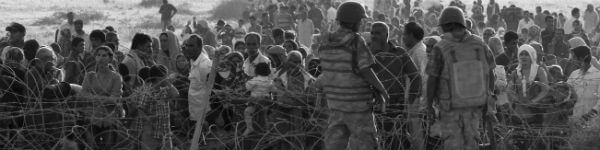
The report warned: “Regime forces and allies are trying to create a new refugee wave by moving towards Azaz [in northern Syria] … There are 10 refugee camps between this town and Turkey’s town of Kilis, approximately along an eight-kilometre line. The residents of these camps will likely flee and seek shelter in Turkey while these camps would be taken by the PYD or Assad forces.”

Security officials told the paper that Russia was employing tactics previously used in the first Chechen war in the north Caucasus in the 1990s, known as the “Grozny model”. This involved forcibly emptying urban residential areas through a campaign of attrition against the local population. Once this was achieved, heavy weapons were deployed to eradicate opposing forces, entailing widespread destruction of homes and infrastructure.

Given Assad’s previous documented use of barrel bombs, chemical weapons, airstrikes and heavy artillery against civilian areas, Russia’s alleged tactics hardly seem new. What appears to be different is the deliberate creation of tactical refugee emergencies to influence outside actors who must deal with the fallout.

Speaking at the weekend, US senator John McCain, a fierce critic of the Obama administration’s policy of non-intervention and a noted hawk, said Russia’s strategy was “to exacerbate the refugee crisis and use it as a weapon to divide the transatlantic alliance and undermine the European project”.

European politicians attending the weekend Munich security conference, prior to Monday’s attacks, echoed McCain’s concerns saying shops, schools and hospitals were being targeted in an attempt to force the local population to capitulate and increase the flow of refugees towards Turkey and Europe. [Continue reading…]

Facebooktwittermail

The Russian quagmire in Syria and other Washington fairy tales

Michael Kofman writes: Assad is not necessarily winning in Syria. The Russian-led coalition, together with Iran, Hezbollah, and what’s left of the Syrian army, is winning. That is a distinction with an important political difference for Assad to play out at the end of this conflict. While Saudi Arabia and Iran have intractable positions on Assad’s fate, Russia seems much more open-minded on alternative futures, though it will not condone regime change by discussing his removal publicly. It is difficult to see how Russian leaders could count on Syria being stable in the long term under his leadership. They’ve made a much larger political and military stake in the country, and Assad does not look like the man to keep it secure in the long term. Some are certain that Russia will never give up Assad, but who has a good track record in predicting events in the Middle East?

The Geneva negotiations are not just a ploy; Russia needs that settlement eventually in any scenario. It is simple battlefield reality. The more territory the Russian-led coalition regains, the more a political settlement is a necessity. If Assad’s forces could not hold the rapidly dwindling piece of Syria they had left in 2015 how can they defend much larger real estate, together with major cities? The answer is they can’t. We can see how the Assad regime might retake Aleppo, but what’s the plan for holding it along with other cities for the next decade or so? Gaining terrain is one thing, keeping it is another. Assad said he plans to retake the whole country — a dictator can dream. Russia started the negotiations precisely to avoid retracing America’s steps in Iraq and Afghanistan, where military victory is day one of the quagmire to come. Certainly Russian leaders remember the Soviet Union’s own fruitless struggle in Afghanistan. Political settlement is the only way for Russia to lock in any gains in Syria.

If this is so, then why have the Geneva talks been suspended through February, while Russia keeps bombing? The short answer is that the Russian-led coalition is not done capturing the territory they feel must be regained, especially the city of Aleppo, and as a result have no intention of giving rebel groups a respite. Russia’s intervention forced them to the table, but they are not weak enough and some of them Moscow does not want to see in Geneva at all. Aleppo is a hulking ruin, but its fall would be a colossal symbolic defeat. It could split the rebel groups Saudi Arabia worked hard to unite in Riyadh. Russia is pressing its advantage, hoping to secure the major cities for the Syria regime, while leaving the ISIL-held eastern part of the country as an “American problem.” [Continue reading…]

Facebooktwittermail

The war of Western failures: Hopes for Syria fall with Aleppo

Der Spiegel reports: Aleppo has been a horrific place for some time now and few thought that it could get much worse. But things can always get worse — that’s the lesson currently being learned by those who have stayed behind in an effort to outlast this brutal conflict. People who have become used to dead bodies in the streets, hunger and living a life that can end at any moment.

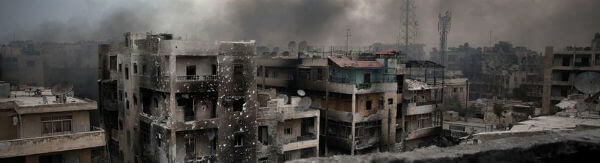
“For the last two weeks, we’ve been living a nightmare that is worse than everything that has come before,” says Hamza, a young doctor in an Aleppo hospital. At the beginning, in 2011, he was treating light wounds, stemming from tear gas or beatings from police batons. When the regime began dropping barrel bombs in 2012, the injuries got worse. But now, with the beginning of the Russian airstrikes, the doctors are facing an emergency. Every two or three hours, warplanes attack the city, aiming at everything that hasn’t yet been destroyed, including apartment buildings, schools and clinics. Often, they use cluster bombs, which have been banned internationally.

They used to get around 10 serious injuries per day, but that number has now risen to 50, says Hamza, adding that most of their time is spent sorting body parts so they can turn them over to family members for burial. Russian missiles, he says, tear everyone apart who is within 35 meters of the impact.

“On one day, we had 22 dead civilians. The day before that, it was 20 injured children. A seven-year-old died and an eight-year-old lost his left leg.” The Russians attacked in the morning, he says, as the children were on their way to school. “We are going to need years of therapy in order to be able to cope with all this.”

There are seven doctors still working in the hospital. “Since the Russians began bombing the city, even more doctors have fled,” Hamza says. There are only about 30 medical professionals left in all of Aleppo, he adds. His hospital too is under fire and Hamza’s voice can be heard trembling over the phone. The regime, he says, has targeted the hospital five times in the past several years, but always missed. “The Russian bombardment, though, is very accurate.” One recent bomb, he says, just barely missed them. [Continue reading…]

Facebooktwittermail

A Syria policy that dare not speak its name

Syria5

Michael Ignatieff writes: Once President Barack Obama had let Bashar al-Assad cross his “red line” and use chemical weapons in 2013, America was left with a policy in Syria that dare not speak its name.

The policy is not what the US wants but, in light of the ceasefire plan agreed last week in Munich between Moscow and Washington, it appears to have become what it reluctantly accepts: to allow Mr Assad and Russian president Vladimir Putin to win by focusing attacks on anti-regime rebels in strongholds such as Aleppo — and then, after a decent interval, to join with them to crush the militants of Isis.

The consequences of this policy are becoming clearer by the day: free Aleppo is dying under continuing Russian bombardment and a civilian uprising that began in 2011 is collapsing for want of help. Mr Assad is re-establishing his tyranny and is certain to take vengeance on surviving insurgents.

This is where risk avoidance has led a conscientious, prudent American president — to a diabolical transaction in which he and his allies regretfully sacrifice the lives of innocent civilians in the name of the mistaken belief that the west’s only overriding strategic interest in Syria is the defeat of Isis.

If this is the actual policy of the US the consequences should be spelt out. Russia and Iran will consolidate control of a rump state in the Middle East but the millions of Syrians who have fled the fighting will never return home and the region will never know peace. [Continue reading…]

Facebooktwittermail

How to lose sight of war crime immorality

msf-hospital

After the U.S. dropped bombs on a hospital run by Doctors Without Borders (Médecins Sans Frontières (MSF) in the Afghan city of Kunduz on October 3, Glenn Greenwald wrote:

Doctors who travel to dangerous war zones to treat injured human beings are regarded as noble and trustworthy. They’re difficult to marginalize and demonize. They give compelling, articulate interviews in English to U.S. media outlets. They are heard, and listened to.

MSF has used this platform, unapologetically and aggressively. Its staff are clearly infuriated by the attack on their hospital and the deaths of their colleagues and patients. From the start, they have signaled an unwillingness to be shunted away with the usual “collateral damage” banalities and, more important, have refused to let the U.S. military and its allies get away with spouting obvious falsehoods.

Greenwald shared MSF’s disgust in response to statements which amounted to justifications for war crimes.

Following the latest airstrikes on MSF hospitals in Syria, Greenwald’s reaction has so far been much more muted. It has yet to go beyond a couple of tweets which rather than being directed at the likely culprit of these war crimes, Russia, focus instead on the hypocrisy of the U.S. government.


Indeed, the U.S. can’t credibly denounce Russia for bombing MSF hospitals in Syria when it has done the same in Afghanistan.

By the same token, however, how can Greenwald credibly denounce American war crimes if he’s going to refrain from denouncing Russia’s?

He can’t be accused of being a hypocritical U.S. official. He doesn’t represent the American government.

Maybe at the moment he’s suspending judgment about who was responsible for the latest airstrikes in Syria — even though MSF says the attack was “deliberate” and says “either the [Syrian] government or Russia” was “clearly” responsible:


That’s a pointless question in this case since as far as Russia is concerned, there is nothing to investigate.

As TASS reports:

Asked for a comment regarding reports a hospital in Syria’s Idlib province had been bombed, as well as claims the Russian air group was responsible, [Russian presidential spokesman Dmitry] Peskov invited everybody to rely “on the root source first and foremost.” “In this particular case the representatives of Syrian authorities are the root source,” he said.

Peskov recalled that Syria’s ambassador to Russia, Riyadh Haddad, said on Tuesday the hospital in Idlib province was destroyed by the Americans, and not the Russian air group.

If Greenwald actually believed Haddad’s claim, I would expect him to be now denouncing U.S. airstrikes on MSF hospitals in Syria, but he isn’t — most likely because he realizes the Syrian ambassador was spouting obvious falsehoods.

Instead, Greenwald’s primary interest is in using these war crimes as an opportunity to take shots at the U.S. government — even though as Physicians for Human Rights (PHR) and others have documented, attacks on medical facilities are neither accidental nor incidental to the conflict: they are an integral feature of the war strategy used by Assad and his allies.

Writing in the New England Journal of Medicine in December, doctors with PHR said:

Since the conflict began in 2011, PHR has documented the killings of 679 medical personnel, 95% of them perpetrated by government forces. Some personnel were killed in bombings of their hospitals or clinics; some were shot dead; at least 157 were executed or tortured to death.

The issue here is that anyone who wants to resolutely challenge American double standards needs, for the sake of credibility, to avoid having their own double standards on war crimes.

As for the notion that Greenwald, as an American, has a duty to challenge his own government rather than Russia’s, he might pause to consider that his tweets and articles probably attract more attention in the Kremlin than they do in the White House.

Facebooktwittermail

Syria’s UN envoy claims MSF hospital was front for French intelligence and got bombed by the U.S.

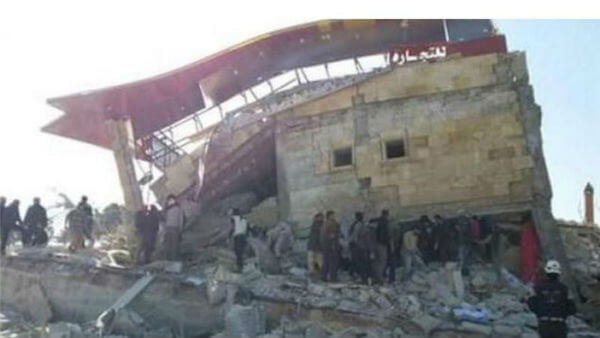
AFP reports: Syria’s U.N. envoy on Tuesday accused the medical aid charity MSF of being a front for French intelligence in Syria and dismissed allegations that Russian air strikes had destroyed one of its hospitals.

“The so-called hospital was installed without any prior consultation with the Syrian government by the so-called French network called MSF which is a branch of the French intelligence operating in Syria,” said Ambassador Bashar Jaafari.

Doctors Without Borders (MSF) said at least 11 people were killed after the hospital in Idlib province was destroyed on Monday morning, but it did not assign blame for the attack.

“They assume the full consequences of the act because they did not consult with the Syrian government,” Jaafari told reporters.

“They did not operate with the Syrian government permission.”

He repeated Syrian claims that the U.S.-led coalition had carried out the air strikes that hit the MSF-backed hospital. [Continue reading…]

Facebooktwittermail

Assad preparing to handover Syria’s energy sector to Russia

The New Arab reports: The regime of Bashar al-Assad is reportedly seeking to rehabilitate and operate oil fields and power plants in areas controlled currently by the rebels and the Islamic State group respectively — areas that the regime forces began recapturing in northern and Western Syria backed by Russian airstrikes.

Measures are already in place by the Syrian regime to hand over the Syrian energy sector to Russian companies, led by a law on partnership between the private sector and foreign companies issued in early 2016.

Last month as well, Russian press reports said Bashar al-Assad, during a recent visit to Moscow, signed an agreement consisting of ten clauses purportedly giving Russia the right to freely operate in Syria, which cannot be revoked except by written agreement.

In the same vein, a recent report published by Russia’s RIA agency said Syria’s ambassador to Moscow, Riad Haddad, had met with the chairman of Russian gas company Gazprom Alexei Miller, and discussed giving Russian energy firms oil and gas concessions in Syria and other forms of cooperation. [Continue reading…]

Facebooktwittermail