Amir Tibon writes: In my conversations with the refugees [at a camp in Serbia] last month, I asked them about some of these lies as if they were well-established truths. Not because I believe them — but rather, because so many people, all over the world, hear and read these lies every day that it’s impossible to ignore them.
It felt dumb, for instance, to ask a family — father, mother, three children aged 12 to 3 — who had just escaped from the burning city of Aleppo, what they thought about “Russia’s bombing campaign against ISIS.” Of course, there is no such thing. Russia isn’t focusing its effort on bombing ISIS, but rather on trying to kill the people I was talking to, who are Syrian civilians. Yet conducting the interview without treating this big lie as if it is simply an alternate explanation of events would be considered “biased reporting.” So, I ask the question and get looks of disbelief, and worse.
Nadia, the mother of this family, told me that “the Russians are the worst thing that happened to us. We survived everything before them, but when they came in to help Bashar, we said — enough. They bomb schools, hospitals, refugee camps, buses carrying people to the border.” What specifically did their involvement mean, I asked her. Her reply: “I would ask myself every morning — how are the Russians going to try to kill my children today?”
Her husband, Yasser, a merchant who owned two stores in the city, disagrees with this analysis — he thinks Shiite militias supported by Iran are an even greater danger than Putin’s air force. “We ran away from the city because we know that after the Russians will finish it, the Iranians will come in. The Iranians are sending people to kill us for Assad.”
These militias, which are entering Syria from neighboring Iraq, have quite a reputation when it comes to killing. “They are just like ISIS, only difference is they are Shi’a and they talk Farsi,” says Yasser. “Tell me — why isn’t anyone bombing them? Why is the entire world only talking about ISIS? The Iranians in Syria burn people alive, burn children and women. Where is the world?” The couple then apologized, explaining they had much more to say, but their youngest daughter started crying, and anyway, they had to leave for the bus. They have six more days on the road ahead of them before reaching Germany.
The biggest lie of them all is that Bashar al-Assad, even more than Vladimir Putin, wants to defeat ISIS. The civil war in Syria, we are told more and more as of late, is actually a choice between Assad and ISIS. Framing the conflict in such terms makes it legitimate and acceptable to cooperate with Assad, a man who is responsible for the deaths of over a quarter of a million people. I tried to ask each and every Syrian I talked to one simple and “neutral” question that has to do with this falsehood. The question was — “Who are you running away from?” The vast majority of people didn’t choose Assad or ISIS — they said they are running away from both.
“The world needs to understand that Assad and ISIS are not enemies — they are partners in destroying our lives,” explained Muhammad, 24, from Aleppo, who stayed in the bombarded city for the last five years because he wanted to complete his university studies before getting out. “It’s like a coin that has two bad sides to it. Doesn’t matter which way you flip it, you’ll end up dead. As long as there is Assad, there will be ISIS. His violence against the Sunni people in Syria is what created ISIS in the first place.”
One man in his 50s, who presented himself in perfect English as a university professor from Aleppo, added: “I’m running away from Da’esh (the Arabic name for ISIS), but there are many different kinds of Da’esh operating in Syria today. There is Da’esh-Da’esh, the people who cut off heads and burn prisoners in cages. There is also Da’esh-Assad, which is actually much worse, and Da’esh-Iran, the Iranian militias who rape and murder women in front of their children’s eyes. They have much more money and capabilities, and they don’t film themselves while doing their atrocities. They are smart enough to hide it from the world. In addition to all these, there is also Da’esh-Putin. I’m coming from Aleppo; I’ve seen the results of his bombings. It’s a massacre. People are killed like cockroaches under a shoe. And then there is Da’esh-the West, which I think is the worst! I mean the civilized world, doing nothing to stop all of this.” [Continue reading…]
Category Archives: Russia
Will Merkel pay for doing the right thing?

Roger Cohen writes: A former German chancellor, Gerhard Schröder, recently called Angela Merkel’s decision to open the door to an unlimited number of refugees a “mistake” and offered this verdict: Merkel had a “heart, but no plan.”
This view of the German leader, who is beloved but now begrudged, is gaining ground as refugees from a ravaged Syria and elsewhere pour in. Local authorities are strained to the limit. Billions of euros have been spent with no end in sight. Many people came in whose identities are unknown; they have to register if they want handouts, but some have not and there are security concerns. Cologne has become a byword for concern over how a large influx of Muslim men will affect the place and security of women in German society.
Three important state elections loom next month. It seems inevitable the far-right Alternative for Germany Party will surge. Merkel will be blamed. Her support has already tumbled. One poll this month showed 46 percent of Germans support her, compared with 75 percent in April last year — and that’s with a strong economy. She could be vulnerable if her Christian Democratic Party turns on her. Europe without Merkel will sink.
So why did this customarily prudent chancellor do it? Because she is a German, and to be German is to carry a special responsibility for those terrorized in their homeland and forced into flight. Because she once lived in a country, East Germany, that shot people who tried to cross its border. Because a united Europe ushered Germany from its darkest hour to prosperity, and she is not about to let the European Union pitch into mayhem on her watch — as it would with more than a million ragged refugees adrift. And, yes, because she has a heart.
Merkel did the right thing. The question now is how she handles the consequences. [Continue reading…]
Russian airstrikes targeted hospitals: ‘The planes returned several times,’ says eyewitness

Syria Direct reports: Reported Russian airstrikes knocked three hospitals in northern Syria out of service on Monday, depriving more than 5,000 patients a month of care ahead of the deadline for a “cessation of hostilities” deal worked out between major powers at last week’s annual Munich Security.
The ceasefire, notably, excludes the Islamic State in addition to Jabhat a-Nusra, one of the lead factions in the Victory Army that controls nearly all of Idlib province.
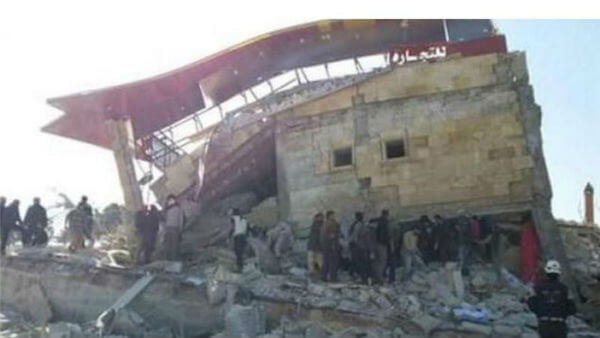
Two hospitals, one belonging to Doctors Without Borders (MSF), were bombed in Idlib province on Monday. A third, a women and children’s hospital in the city of Azaz near the Turkish border, was also hit.
The National Hospital, also in Maarat al-Nuaman, was bombed shortly after the strikes on the MSF facility, Amjed al-Idlibi, a first responder with the Civil Defense who worked to extract the dead and wounded, told Syria Direct Tuesday.
“Both hospitals were hit directly…the planes returned several times to conduct air raids, with roughly 10 minutes between each raid,” said al-Idlibi. He said that the planes were Russian. [Continue reading…]
Meanwhile, Russia’s TASS reports: The Kremlin has dismissed as unacceptable the allegations the Russian air group in Syria has destroyed a hospital in Syria.
“We are strongly against such claims, the more so, since each time those who come up with such charges prove unable to somehow confirm their groundless accusations,” Russian presidential spokesman Dmitry Peskov has said.
Asked for a comment regarding reports a hospital in Syria’s Idlib province had been bombed, as well as claims the Russian air group was responsible, Peskov invited everybody to rely “on the root source first and foremost.” “In this particular case the representatives of Syrian authorities are the root source,” he said.
Peskov recalled that Syria’s ambassador to Russia, Riyadh Haddad, said on Tuesday the hospital in Idlib province was destroyed by the Americans, and not the Russian air group. [Continue reading…]
Note the reasoning of the propagandists: The allegations that the airstrikes on hospitals were carried out by Russia are firstly dismissed as “groundless accusations” and secondly dismissed by repeating a groundless accusation made by Syria’s ambassador to Russia — that these were U.S. airstrikes.
Unfortunately, there exists an uncritical audience all too willing to swallow this kind of shameless lying and tortured reasoning.
‘Unprecedented increase in the number of attacks on healthcare’ in Syria, say aid groups
BuzzFeed reports: Monday marked an “unprecedented” surge in attacks on health facilities in Syria, according to an internal report by affiliates of the World Health Organization that was rushed out to take the toll of the damage.
The report, compiled by the consortium of medical facilities the WHO oversees in the country and provided exclusively to BuzzFeed News, documents a series of what appeared to be targeted bombings of hospitals and other health facilities in Syria. The attacks — which local doctors and international observers alike blamed on Syrian and Russian missiles — killed patients and medical staff at seven different medical sites, the report said, adding that Monday marked “an unprecedented increase in the number of attacks on healthcare in one single day.” [Continue reading…]
Kurds carve out new reality in northern Syria
The Guardian reports: Amid the chaos in northern Syria in recent months, several themes have emerged.
The first is that Islamic State has been spared from intensified Russian airstrikes and advances by pro-regime forces. The second, and potentially more important development, is that one of the war’s least visible players – the Kurds – have done more than anyone else to carve out a new reality.
As Lebanese Hezbollah, militias from Iraq, and Syrian troops – all led by Iran – have inched their way around the top of Aleppo, the Kurdish YPG, supported by Russian air cover, has been making strident moves towards areas they have avoided throughout the conflict.
Over the weekend, the YPG moved towards two Syrian towns between the Turkish border and the almost besieged Aleppo, after earlier seizing an airbase that had been held by the opposition. Throughout the war, the YPG had been viewed warily by the opposition, and given a wide berth by the regime.
Now, though, its moves have sharply expanded a footprint in the north, alarming rebels who have been distracted by other foes, and Turkey, which had vowed never to let the Kurds dominate its border with Syria.
The Kurds are ascendant, and the Turks are enraged. Ankara sees YPG militants, who are affiliated with the Kurdistan Workers’ party (PKK), as vying to own areas they have never before controlled, to establish a foothold from Irfin in Syria’s north-west to the Iraqi border, a frontier dominated for decades by Arabs.
Helping the YPG do that are the same Russian jets that are steadily destroying Turkish-supported rebel groups, whose three-year push to oust Bashar al-Assad increasingly looks lost. [Continue reading…]
Russia uses world war threat to dictate Syria policy, says Turkish PM
Hurriyet Daily News reports: Russia is deliberately using the threat of a possible world war in order to dictate its policy in Syria, according to Turkish Prime Minister Ahmet Davutoğlu.
“Russia is consciously engaging in a perception operation to suggest ‘there could be a world war.’ By keeping this on the agenda, Russia continues to bother the world and dictate its policy,” Davutoğlu said Feb. 15 en route to Kyiv for a one-day visit.
“We should not be tricked with this perception operation,” he added.
Davutoğlu was referring to Russian Prime Minister Dmitry Medvedev’s words in Germany’s Handelsblatt newspaper on Feb. 11 that “world war” was possible if international powers failed to negotiate an end to the conflict in Syria. [Continue reading…]
Turkey to hold back on Syria ground offensive
The New Arab reports: Turkey has said it will only commit forces to a ground operations in Syria if its allies – including the US – back the offensive with troops.
A senior Turkish official told reporters that Ankara has asked its partners to intervene in Syria’s war, but his country will not take any action alone.
“We want a ground operation with our international allies,” the official told reporters in Istanbul on Tuesday.
“There is not going to be a unilateral military operation from Turkey to Syria… [but] without a ground operation it is impossible to stop the fighting in Syria. We are asking the coalition partners that there should be a ground operation.”
It comes as speculation mounts about possible Turkish intervention in Syria’s war to prevent Kurdish forces estabishing a mini-state on its borders and protect Syrian rebel forces from losing further ground. [Continue reading…]
Putin’s reward for doing a deal with OPEC overshadowed by risks
Bloomberg reports: Neither a recession nor a collapse in revenue has yet been enough to convince Russian President Vladimir Putin that it’s time to join with OPEC and cut oil output to boost prices. His reasons may be pragmatic rather than political.
Russia’s Energy Minister Alexander Novak and his Saudi Arabian, Venezuelan and Qatari counterparts agreed to freeze output at January levels on Tuesday. The world’s second-largest crude producer faces numerous obstacles to any deal that would actually cut production, even if Putin decides it’s in the national interest. Reducing the flow of crude might damage Russia’s fields and pipelines, require expensive new storage tanks or simply take too long.
In Siberia, Russia’s main oil province, winter temperatures can go below minus 40 degrees Celsius (minus 40 Fahrenheit). That’s a challenge for anyone thinking of turning off the taps.
The oil and gas that flows from wells always contains water, so once pumping stops, pipes may freeze, Mikhail Pshenitsyn, who has worked for more than 10 years in the Russian oil industry, said by e-mail. The problem goes away in summer, but there’s still the risk of a long-term reduction in output because a halted reservoir can become polluted with salts and residues, he said.
Production from a shut-in well might never be restored in full, Maxim Nechaev, director for Russia at consulting firm IHS Inc., said by phone. [Continue reading…]
A mini world war rages in the fields of Aleppo
The Washington Post reports: Across the olive groves and wheat fields of the northern Syrian province of Aleppo, a battle with global dimensions risks erupting into a wider war.
Russian warplanes are bombing from the sky. Iraqi and Lebanese militias aided by Iranian advisers are advancing on the ground. An assortment of Syrian rebels backed by the United States, Turkey, Saudi Arabia and Qatar are fighting to hold them back. Kurdish forces allied both to Washington and Moscow are taking advantage of the chaos to extend Kurdish territories. The Islamic State has snatched a couple of small villages, while all the focus was on the other groups.
Ahead of a supposed pause in the hostilities negotiated by world powers and due to be implemented later in the week, the conflict seems only to be escalating. Turkey joined in over the weekend, firing artillery across its border at Kurdish positions for a second day Sunday and prompting appeals from the Obama administration to both Turks and Kurds to back down.
Syria’s civil war long ago mutated into a proxy conflict, with competing world powers backing the rival Syrian factions almost since the earliest days of the armed rebellion against President Bashar al-Assad.
But perhaps never before have the dangers — or the complications — of what amounts to a mini world war been so apparent as in the battle underway for control of Aleppo. [Continue reading…]
Russia facilitates ceasefire deals with safe passage for ISIS and Nusra Front fighters
Reuters reports: Pro-government sources say the Russian role has expanded to include facilitating local ceasefires in rebel-held areas around Damascus, with the aim of creating a secure buffer around the capital. Syrian Minister of National Reconciliation Ali Haidar described the process as purely Syrian even if there had at times been Russian help.
“The truth is that since the presence of the Russians on Syrian land, they can play the role of mediator in some areas,” he said at his offices in Damascus. “The Russians make contact (with militants) when they can, of course – in Douma and other areas,” he said, in reference to an area east of Damascus.” Sometimes it is the militants who request mediation by the Russians,” he said. Those wishing to relocate wanted guarantees of safe passage to rebel strongholds, and those wishing to stay wanted to be sure they wouldn’t be killed later on, he said. According to the non-Syrian sources interviewed by Reuters, Russian advisers orchestrated two deals in which hardline Islamist fighters were evacuated from the south toward areas their groups control in the northern and central provinces.
One of the non-Syrian military sources said the Russians worked “in the shadows” to facilitate the ceasefire deals. In some cases the Russians operated as guarantors for the deals.
Dozens of cars left southern towns of Syria in December carrying fighters from Nusra Front with their families to the northern province of Idlib which is under control of an alliance of rebels including Nusra Front. Weeks later a convoy left Hajar al-Aswad and Yarmouk camp areas near Damascus carrying fighters and families from Islamic State to the group’s stronghold of Raqqa.
A second source who was informed of the deals said the fighters were given safe passage. The aim was to empty these areas of hardline Islamists so clearing the way for the government to strike deals with the remaining rebels.
“The Russians want all the battles to be focused in the north, they want the south and Damascus and the coastal line all neutralized. Ultimately they are working toward achieving a wider political solution,” said the source. [Continue reading…]
Obama called Putin and Putin agreed to carry on taking calls from Obama
Following a phone conversation between President Obama and President Putin “to discuss the decisions and agreements made at the February 11 meeting of the International Syria Support Group (ISSG),” the White House said: “The leaders agreed that the United States and Russia will remain in communication on the important work of the ISSG.”
That’s it: they’ll remain in communication.
Obama can stress the importance, emphasize the importance, reiterate the importance, and do as much urging as he wants. To Putin, this is just yada yada yada.
The Washington Post reports: President Obama and Russian President Vladimir Putin have agreed to intensify diplomatic and military cooperation to implement a cease-fire and the delivery of aid in Syria, the Kremlin said early Sunday.
A statement from Putin’s office said that Obama initiated a telephone conversation between the two. The White House, which said the call took place Saturday, did not mention increased U.S.-Russia cooperation but said that Obama stressed the importance “of rapidly implementing humanitarian access to besieged areas.” Obama also urged Putin to cease Russia’s air campaign against “moderate opposition forces” in Syria, according to a White House statement released Sunday.
The call came amid reports that at least one siege had been broken with the first delivery of humanitarian aid to the rebel-held Douma area, east of the Syrian capital of Damascus. Douma had been cut off by government troops since 2013. A United Nations spokesperson said from Geneva, where a task force is organizing aid under an agreement reached Friday in Munich, that the Douma delivery was a previously scheduled shipment by the Syrian Red Crescent. [Continue reading…]
Airstrikes hit hospitals in northern Syria; MSF views Russia or Assad’s forces as responsible

The Guardian reports: Airstrikes have hit hospitals in two locations in northern Syria – marking the latest in a series of attacks on medical facilities and workers in the five-year civil war.
Médecins Sans Frontières said seven people were killed when a facility it supports in Maaret al-Numan, Idlib province, was hit four times in two separate raids. Mego Terzian, MSF’s France president, told Reuters he thought that either Russia or Syrian government forces were responsible. Both have been engaged in an unrelenting aerial bombardment in Idlib.
The hospital, which has 54 staff and 30 beds, is financed by the medical charity, which also supplies medicine and equipment.
“The destruction of the hospital leaves the local population of about 40,000 people without access to medical services in an active zone of conflict,” said Massimiliano Rebaudengo, MSF’s head of mission in Syria.
In separate incident, Syrian opposition activists said a missile struck a children’s hospital in the rebel-held town of Azaz, near the Turkish border, killing 10 and wounding more than 30. The Turkish prime minister, Ahmet Davutoğlu, said a Russian ballistic missile had hit the town. [Continue reading…]
Reuters adds: Residents in both towns blamed Russian strikes, saying the planes deployed were more numerous and the munitions more powerful than the Syrian military typically used. [Continue reading…]
Looking forward to hearing anti-war mvmt on bombing of MSF hospital but as Karam Nachar said, I think I'll be waiting for Godot instead.
— Omar (@omarsyria) February 15, 2016
The Syrian government, with Russia’s help, is driving its own people into exile

Roy Gutman reports: The airstrikes began just after midnight one week ago, as four or more warplanes criss-crossed the skies and unleashed missiles into the small town just northwest of Aleppo. The targets were private residences and apartments on the outskirts of Haritan, and then the town center.
The windows in Salah Hawa’s four-room house had already been shattered by an airstrike nearby last month. The latest blasts blew out the nylon sheets used to cover the gaps.
After two days and nights of attacks — possibly 300 missiles or more — Hawa, a 40-year-old English teacher, and his wife and four children, aged 5 to 16, fled to the nearby countryside in a neighbor’s pickup truck.
During one airstrike, his wife, Hasna, 39, lay down, and for an hour, “she couldn’t stand up out of fear,” Hawa recounted in a Skype conversation from northern Syria. “My children clung to me, crying, and said we are going to die.”
Hawa’s family, multiplied by 10,000, are the face of the latest mass displacement in Syria. They are now living in a village about 30 miles to the west, in Idlib province in a house shared with four other families. Tens of thousands of others displaced by the fighting headed to the closed border with Turkey, where accommodation was even more scarce.
It is the latest evidence of a dramatic shift in the war that began with the Russia air intervention last September 30. Russia claims to be bombing only “terrorists” and has told the Obama administration it is committed to a political settlement. But the real aim of the latest onslaught — which forced the United Nations to suspend peace talks before they even began — could be a lot more menacing.
The airstrikes cleared the way for Lebanon’s Hezbollah militia, Iraqi militias, and Afghan Hazara forces, which are officered by Iran’s Revolutionary Guard Corps and Syrian security forces, to make critical advances on the ground. Now Syrian President Bashar al-Assad is poised to surround Aleppo and besiege some 250,000 civilians living in the rebel-defended eastern sector.
If the military advances continue, Assad soon will also be able to block all military and humanitarian aid now flowing across the border from Turkey. But Assad is also in a position to drive millions of Syrians out of their country into Turkey, which will be hard pressed to stop them from continuing on to Europe. Mass displacement increasingly appears to be the aim of the military operation, and not just a side effect, humanitarian aid officials say.
“The Syrian government is driving its people into exile and the Russians are playing a major part, forcing civilians to Turkey which, caught between this violent exodus and pressure from Europe, risks being destabilized,” said Rae McGrath, head of the Mercy Corps program in Turkey and north Syria. “How can we talk about protecting civilians in the midst of this cynical disregard for the most basic humanitarian principles?” [Continue reading…]
Zachary Laub spoke to Noah Bonsey, senior Syria analyst for the International Crisis Group:
Do these sieges reflect the strategy of the Assad regime?The regime’s military strategy, supported and increasingly embraced by its backers, is based heavily on collective punishment, [which is] especially important given the regime’s manpower disadvantage. This is one of the reasons we see such heavy use of bombing that is not indiscriminate so much as it is discriminately targeting civilian areas and civilian infrastructure. This is also why we see the siege tactics, which in some cases bring rebel[-held] areas to the point of starvation.
As civilians leave areas, regime advances can become easier. These tactics are also applied as a means of raising the price of resistance to the communities as a whole, so that communities pressure the fighters in their area to accept what the regime offers as cease-fire terms, but also, effectively, to surrender.
The Feb. 11 meeting of the International Syria Support Group [ISSG] came as fledgling peace talks in Vienna appeared to be at an impasse. Where do these efforts on a political transition stand?
The political process is based on the premise of U.S.-Russian sponsorship in which the U.S. is the point man rallying the opposition and its backers to a serious negotiating process, and Russia is to do that for the regime side. The reason this current round of the political process is surrounded by such skepticism is that while the U.S. appears enthusiastic—almost desperate—to get some sort of political process moving, Russia appears far less interested in making the process viable at this stage. Russia’s decision to escalate dramatically its aerial attacks on Aleppo—areas with heavy civilian populations—the very day the opposition delegation arrived in Geneva for talks was the latest in a series of indications that Russia is happy to see this political process stall or, potentially, even derail. [Continue reading…]
The Syria ‘ceasefire’ deal is no such thing — it’s cover for the U.S. and Russia
By Scott Lucas, University of Birmingham
Headlines have been declaring a ceasefire in Syria’s conflict. Announced by US secretary of state John Kerry and Russian foreign minister Sergei Lavrov late on February 11, it was greeted as a ray of hope in the floundering efforts to end this seemingly intractable conflict.
What it isn’t, is a ceasefire. The International Syria Support Group (ISSG) – a coalition of 17 nations, among them Russia and the US, the Arab League, the European Union, and the UN – has not in fact used that term, preferring a “cessation of hostilities”. And it isn’t even that: it’s a proposal for a cessation of hostilities, one that will supposedly start soon, but only after a working group has met with representatives of countries supporting the Assad regime and those backing Syria’s opposition.
Nor is it a viable proposal. Instead, it’s best seen as political cover. It covers Kerry, in his remarkably zealous quest to secure the start of a resolution by the end of March, and Russia, in its mission to prop up the Assad regime by bombing the rebels and civilian areas in concert with both Lebanon’s Hezbollah and Iran.
Russia warns of new Cold War as east Ukraine violence surges and the U.S. is outmaneuvered in Syria
The Washington Post reports: Violence in eastern Ukraine is intensifying and Russian-backed rebels have moved heavy weaponry back to the front line, international monitors warned Saturday, as Moscow responded by accusing the West of dragging the world back 50 years.
Russian Prime Minister Dmitry Medvedev described East-West relations as having “fallen into a new Cold War” and said NATO was “hostile and closed” toward Russia, in the latest sign that peace efforts have made scant progress almost two years since Moscow annexed Crimea.
“I sometimes wonder — are we in 2016 or 1962?” Medvedev asked in a speech to the Munich Security Conference on Saturday.
Western governments say they have satellite images, video and other evidence to show that Russia is providing weapons to the Ukrainian rebels and that Moscow has troops engaged in the conflict. Russia denies such accusations. [Continue reading…]
The Observer reports: Moscow is back as a big player in the Middle East, while Washington looks humbled, a shadow of the great power that once dominated events in the region. The cold war is back, as the Russian prime minister, Dmitry Medvedev, said on Saturday – and for now Russia seems to be in the ascendancy.
Critics warned from the day the ceasefire was announced that Moscow had outmaneuvered Washington and was simply using the negotiations and the deal to consolidate gains, a tactic honed by Russian forces in Ukraine.
The US may have lost more than political capital. The ceasefire risks costing them the trust of the few moderate opposition groups left on the ground, who feel abandoned by a country that promised support.
“The people that the Americans had been trying to sponsor are now targets of an enemy that bombs without mercy or discretion, and the Americans don’t have a problem with that?” said one Free Syrian Army member in Aleppo, who declined to be named. “They never deserved our trust.”
Russia, by contrast, has doubled down on Assad. Around the time Lavrov was handing down his grim prognosis for the ceasefire, a missile cruiser left the naval base in Sevastopol in Crimea. It was heading towards the Mediterranean to join the Russian fleet there, a public shoring up of an already strong military presence. Refugees who had recently fled Isis rule said that the failure to challenge Assad and Russia could even put the west’s main goal in Syria – the routing of Isis – at risk. If other opposition groups are driven out, it will shore up the claim of Isis to be champions of the country’s Sunnis. “You will not find anyone in this camp, especially those who have arrived this month, who supports Isis,” said the man, who gave his name only as Jameel. “But most of them accept that at least they tried to protect us, Syrian Sunnis, who the world has abandoned. It is very dangerous to let them fill this role. And I think the world is blind to the immorality of it.” [Continue reading…]
Russia’s scorched earth policy in Syria
Lara Nelson writes: “It’s like Stalingrad. They raze entire areas. Then they send in the militias,” Yamen Ahmad, an FSA commander in Latakia, described. He was in Selma, Latakia province, leading his brigade when the regime took back the area from the opposition in January. “There is no way to resist this scorched earth policy the Russians are deploying with their strikes across Syria.”
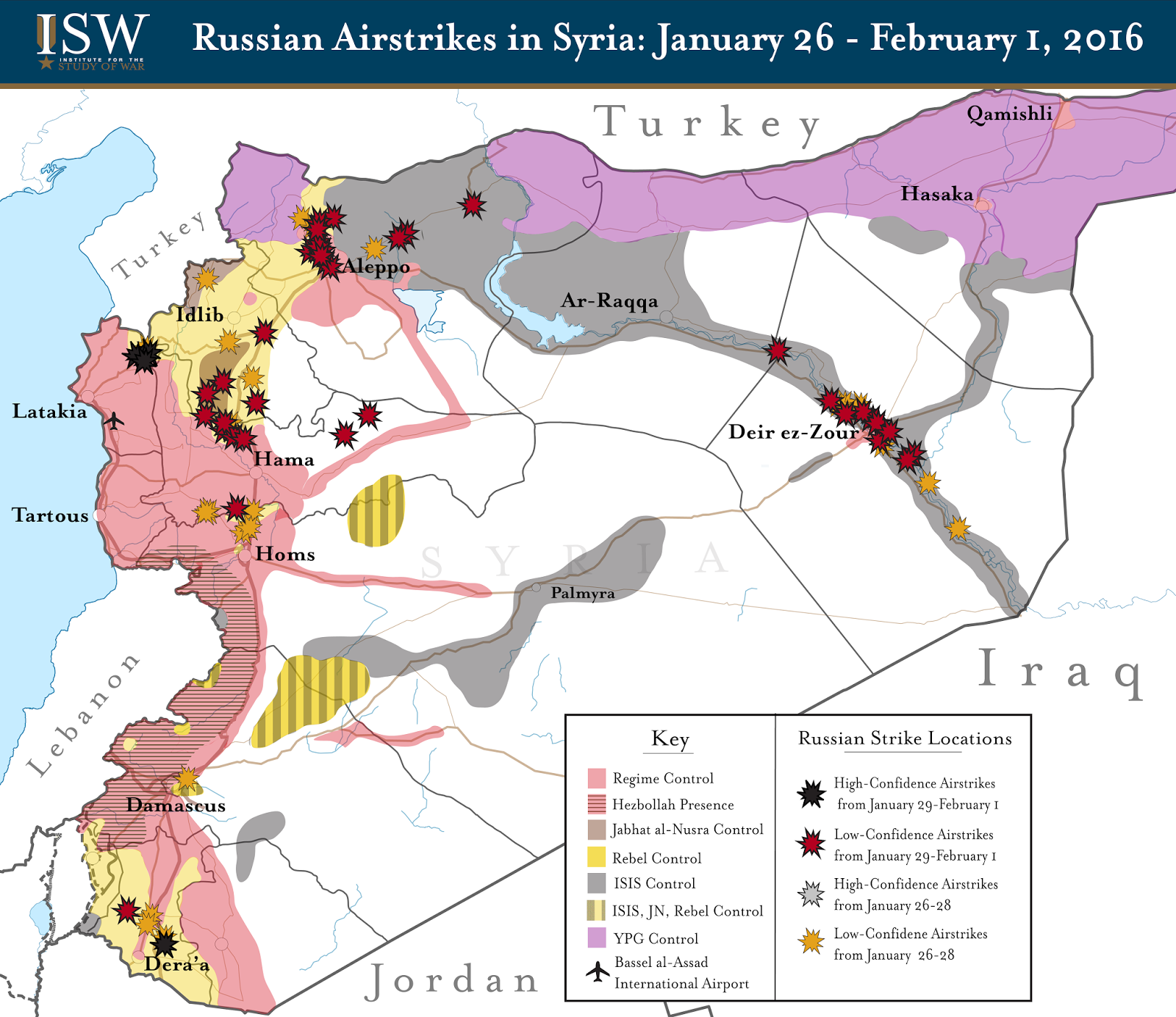
Since Russia began its strikes in Syria on 30 September, the regime has been able to make some gains across the country. Despite declaring that their military goal was strictly to target ISIS in Syria, studies have clearly documented their strikes have the main purpose of supporting the Assad regime’s military operations on the ground against moderate opposition forces, and have done little to seriously combat ISIS.
“Russia is simply acting as the regime’s air force against our moderate forces now,” said spokesman for the FSA’s Southern Front and defected officer Major Issam Al Reis. In Aleppo, the frontline between the regime and ISIS is a de facto safe zone, while they both focus their weaponry on opposition forces. As one media activist on the ground observed in the recent battle for Aleppo: “During the north Aleppo offensive, not a single Russian bomb hit ISIS – not a single ISIS attack hit Assad’s front.” [Continue reading…]
ISIS has been thwarted militarily. But now it could seize chance to advance
Hassan Hassan writes: In January 2014 newly organised rebel factions in northern Syria declared war on Islamic State (Isis), and this culminated in the expulsion of the group from all of the city of Idlib and most of Aleppo. Rebel forces in Raqqa, Deir ez-Zor and Hasaka similarly rose up to root out the increasingly overbearing foreign organisation.
The anti-Isis offensive reportedly cost the rebels about 7,000 fighters. The group’s presence in Syria was seriously threatened, receding to Raqqa and pockets in Aleppo, Deir ez-Zor and Hasaka, until the summer of that year, when Isis swiftly took over Deir ez-Zor and consolidated its presence in eastern Aleppo, southern Hasaka and Raqqa. It was helped by momentum and the advanced weapons it seized after it took over Mosul in mid-June and the Iraqi army there collapsed.
But the advancing hordes of Isis still failed to reclaim control in Idlib or the rest of Aleppo. That remains true today. Local rebel factions have resisted the group’s incessant attempts to return. The rebels’ resilience in those areas is remarkable, especially considering Isis’s control of al-Bab and Manbij west of Aleppo, two significant strongholds for, respectively, Isis’s economic activities and its manpower.
But what Isis failed to achieve with advanced weapons and momentum could be achieved with the changing military landscape in Aleppo and northern Syria at large. [Continue reading…]
The future of Aleppo will show whether Syria can rise from the ashes
Anshel Pfeffer reports: The forces besieging Aleppo will not try to capture it. Tens of thousands of fighters who have hardened by over four years of fighting for their homes are determined to defend their city and now every corner and rooftop of its ancient alleyways. Even a large and advanced army would emerge from such an urban warfare operation with hundreds, perhaps thousands of casualties. The ill-trained Shi’ite militias who have no experience of such warfare and are unacquainted with the city have little chance.
Abu Firas, a former Syrian army colonel and today a commander in the Shami Front, the largest rebel group fighting in Aleppo, says, “we haven’t seen on the battlefield recently any Syrian soldiers fighting for the regime. All the banners and the bodies of fighters we killed are of foreigners from Lebanon, Iraq, Afghanistan and Pakistan. We have no problem fighting them off, our men are well-trained after all these years of fighting. But they have the Russian airstrikes which make all the difference.”
Even if the forces fighting for President Bashar Assad’s regime cut off the last road leading to Aleppo, and close the last remaining kilometers in the ring of siege, the regime does not have sufficient forces to keep the pressure up for long. The rebels will succeed in breaking a way out and bringing in supplies. The local civil organizations have accumulated enough food for around a quarter of million civilians still in the city, which will last months and are meanwhile practicing growing vegetables on rooftops and digging supply tunnels. Instead of the fuel that cannot reach the city to powers it generators, they are working on alternative energy sources from waste.
Other large civilian areas in Syria, such as the rebel-held East Goutah suburb of Damascus, have withheld siege for years now. Aleppo will not fall. It will be bombarded and exhausted and as long as fighters are willing to remain, it won’t be occupied. But life there will become hell. An even worse hell than that which has existed in Syria for the last five years. And for how long can a nation live in hell?
That is, if there is still a Syrian nation.
In opposition circles, there is talk in recent months that the Assad regime has given up on recapturing most of the Syria’s territory and is now focusing on establishing “Suria al-mufida” – useful Syria. They’ve given up long ago on eastern Syria which is occupied by ISIS. The Kurdish enclaves in the north and the Druze area in the south will be allowed to remain autonomous without regime interference (no-one of course is talking any more of regaining the Golan from Israel). The regime is aiming at capturing and “cleansing” the Damascus and Aleppo districts and deepening its control of Latakia on the Mediterranean coast. That is enough to keep the Assad family regime, as a Russian client-state and an Iranian dependancy.
The regime’s main obstacle to achieving that goal is the rebel groups still controlling large areas of “Useful Syria” which continue to demand either democracy or the rule of Islam. The solution to this is carnage, exile and complete submission.
Last week, the international community’s diplomatic attempts at imposing a political solution totally failed, when the talks on Syria’s future ended in Geneva before they began. The official reason was the refusal of the opposition’s representatives to enter negotiations while Russian planes were bombing their homes back in Aleppo. Even if a ceasefire is announced at some stage, what is doubtful right now while the Russians believe they have the advantage, a “political solution” will be far from enough for a country that has lost a third of its population.
Syria has almost ceased to exist. There are enclaves and fiefdoms and an organized crime family which continues to safeguard its interests in Damascus and on the coast and a government in exile in Turkey and millions of refugees. The resilience of the people of Aleppo in face of the siege will be an indication of whether Syria can rise from the ashes. [Continue reading…]