Category Archives: Russia

Syrian government forces open new battle with rebels in northwest

Reuters reports: Syrian government forces launched an attack on Wednesday to capture a rebel-held hill in north-western Syria, a rebel official and the Syrian Observatory for Human Rights reported, an expansion of operations that have continued in that area despite a deal to cease fighting.

Rebels said the assault on Kabani hill in the province of Latakia was supported by Russian air strikes.

Both the government and rebels have accused each other of violating the truce, which came into effect on Saturday. The agreement does not include Islamic State or the Nusra Front, an al Qaeda-linked group that has a wide presence in northwestern Syria. [Continue reading…]

Facebooktwittermail

Mapped: Russian airstrikes in Syria post-cease-fire

The Washington Post reports: Russian airstrikes continued in Syria despite a shaky truce between factions fighting on the ground, according to a report published Monday. Though said to be hitting terrorist factions, some strikes have reportedly struck U.S.-backed opposition groups.

The report, written by the Institute for the Study of War, compiles data based on open-source data including “local Syrian activist networks, Syrian state-run media, and statements by Russian and Western officials.”

According to the report, there was a lull in strikes Saturday — the day the cessation of hostilities was supposed to go into affect — but they began again in earnest Sunday. In the hours leading up to the pause, reports on the ground indicated that there were more than 100 airstrikes in northern Aleppo as Russian and Syrian government forces attempted to consolidate last-minute gains. [Continue reading…]

Facebooktwittermail

Syrian opposition says government wrecking truce deal

Reuters reports: A senior official from Syria’s main opposition group said on Monday that a fragile international attempt to halt nearly five years of fighting was in danger of collapse because of attacks by government forces.

The cessation of hostilities drawn up by Washington and Moscow faced “complete nullification” because Syrian government attacks were violating the agreement, the official of the Saudi-backed opposition High Negotiations Committee (HNC) said.

France said there were reports of attacks on opposition forces in breach of the deal, which came into force on Saturday, and countries backing the Syrian peace process met to try to clarify the situation. [Continue reading…]

Facebooktwittermail

Russia says federal model is possible for Syria in future

Reuters reports: Syria could become a federal state if that model works in the country, Russian Deputy Foreign Minister Sergei Ryabkov told a news briefing on Monday.

A fragile cessation of hostilities, drawn up jointly by the United States and Russia, has led to a dramatic reduction of violence in Syria over the weekend, though rebels are accusing the government of numerous violations including air strikes.

The United Nations’ Syria mediator, Staffan de Mistura, has said he intends to reconvene peace talks between the Syrian government and opposition on March 7, provided the halt in fighting largely holds and allows for greater delivery of humanitarian relief.

“If as a result of talks, consultations and discussions on Syria’s future state order … they come to an opinion that namely this (federal) model will work to serve the task of preserving Syria as a united, secular, independent and sovereign nation, then who will object to this?” Ryabkov said. [Continue reading…]

Facebooktwittermail

Hezbollah is learning Russian

Alexander Corbeil writes: Hezbollah has suffered several setbacks since it began its involvement in the Syrian war — over 1,300 of its fighters have been killed and thousands injured, it has had to cut back on social services it provides to its constituency and had to resort to recruiting teenagers for the fight in Syria. However, the Syrian civil war, especially the recent Russian involvement is also helping enhance the group’s fighting capabilities which is likely to have significant political and security implications in Lebanon and beyond.

Hezbollah has proven to be a forward-thinking and malleable fighting force. In 2012, when the group began to engage more robustly in Syria, it quickly learned that its defensive tactics were not applicable to the fight. Instead of a modern Israeli army, Hezbollah faced an insurgency. These rebel groups applied similar tactics to Hezbollah’s against regime soldiers and further benefited from local knowledge of the terrain in areas crucial to Bashar al-Assad’s survival. For instance, during the capture of Qusayr in 2013 Hezbollah reportedly lost around one-tenth of its fighters, with estimates ranging from 70 to 120 dead and 200 wounded, up to two dozen of whom were killed in a rebel ambush on the first day of that offensive; what Hezbollah leaders thought would be a quick victory instead turned into a drawn-out fight. Fast-forwarding to 2016, Hezbollah has refined its offensive capabilities and—under the cover of a new powerful ally, Russia—continued to help the Syrian regime take back crucial territory with lower casualty rates. [Continue reading…]

Facebooktwittermail

If you hate your own government then the crimes of dictators who it vilifies become easy to excuse

Idrees Ahmad writes: On Sunday, when one of Hollywood’s most politically active and humane figures weighed in to condemn the media for “misleading the public on Syria”, one could only welcome the intervention.

Except, Mark Ruffalo, the Oscar-nominated star of Spotlight, was not indicting the media for failing the people of Syria; he was condemning it for being insufficiently sympathetic to the regime and Russia. He was recommending to his 2.23 million Twitter followers an article by Boston Globe columnist Stephen Kinzer in which he alleges that the “American press is reporting the opposite of what is actually happening”; that it unfairly describes everything Russia and Iran do as “negative and destabilizing”; and it fails to report that in the Assad regime and Russia’s assault on Aleppo, its inhabitants are “finally see[ing] glimmers of hope”. Kinzer’s basis for these claims? A comment “on social media” and the opinion of a “Beirut-based analyst” (in reality a pro-Hizbullah activist who is a contributor to the Russian news outlet RT and the Iranian supreme leader’s personal news site).

To compensate for its fact deficit, Kinzer liberally sprinkles his article with straw men. He claims that journalists are misleading the public by describing Jabhat al-Nusra, as “moderates,” not as “the local al-Qaeda franchise”. As a matter of fact, no one refers to Nusra as “moderates”, and a Nexis search of major newspapers reveals virtually no article that doesn’t refer to it without mentioning its al-Qaeda affiliation.

This article was a sequel to another, published three days after Russia started a series of attacks on MSF-run hospitals, which was boldly titled: “On Syria: Thank you, Russia!” In it Kinzer prescribed that “Russia’s policy should be ours: prevent the fall of Bashar al-Assad’s government, craft a new regime that would include Assad or his supporters, and then work for a cease-fire.” However, to accede to the opposition’s demand for a cease-fire, he insisted, would be to “guarantee continued war”. In a subsequent TV interview, Kinzer lauded the foreign policy wisdom of Donald Trump. (Similar sentiments have also been expressed by his Irish counterpart, Patrick Cockburn of The Independent).

Ruffalo wasn’t the only one promoting this nonsense. Beyond the agoraphobic netherworld of internet conspiracists, it was also warmly received by bestselling authors, Daily Show producers, liberal academics, Pulitzer Prize-winners, and think-tankers.

Why do bien pensant liberals like Ruffalo fall for such dross? Ideological blinkers? Or has dissent become all about aesthetics? It seems at any given moment maintaining an adversarial posture is more important than substantive engagement with an issue. Why bother with details when one can derive them from general principles? And if the reality of an issue contradicts one’s preconceived notions, then reality itself must be brought into question. Shooting the messenger is always a reliable option. But dressed up as criticism of “the mainstream media”, “the establishment”, or “Washington”, even a full-throated defence of fascism acquires the sheen of fearless truth-telling.

There are few things more commonplace than an Oedipal disdain for one’s own government. In this solipsistic worldview, one has no need to understand the dynamics of a foreign crisis; they can be deduced remotely. If you hate your own government then, by virtue of being in its bad books, a Putin or an Assad becomes an ally. [Continue reading…]

Facebooktwittermail

Air strikes hit six towns in Syria’s Aleppo day after truce, monitor

Reuters reports: War planes attacked six towns in Syria’s northern Aleppo province early on Sunday, the Syrian Observatory for Human Rights said, a day after a cessation of hostilities agreement took effect.

Syrian insurgents said the air strikes were carried out by Russian war planes in support of Syria’s government, but the Observatory which monitors the conflict said the identity of the jets was not clear.

“We do not know which planes carried out the strikes and also we are not sure if this is considered a breach to the truce because it is not clear if these towns are included in the truce,” the Observatory’s director Rami Abdulrahman said.

Syria’s state media did not mention the strikes. Russia’s defense ministry declined to comment. [Continue reading…]

Huffington Post asked Joshua Landis: Could this limited ceasefire be a first step towards a future peace deal?

I doubt it. Russia and Syria are committed to reconquering all of Syria. So far Putin doesn’t seem to show any signs of losing interest in Syria or getting stuck in a quagmire.

I think this momentary pause is first and foremost to demonstrate that America is doing something. There’s tremendous pressure on the United States. This is both for humanitarian reasons — as Russia bombs hospitals and a tide of humanity pushes up against the Turkish border — and because [President Barack] Obama needs to do something to smooth the feathers of our traditional allies, like Turkey and Saudi Arabia, who are apoplectic and accuse the U.S. of abandoning them.

I think Obama told the Russians: Give us a ceasefire, even if it’s a limited one for short duration, because I’ve got to take something home. And this is what the Russians have come up with. But obviously Assad is very interested in pressing his advantage right now — he has the rebels on the run. The Syrian regime’s objective is to shut off the rebels’ supply chain to the Turkish border, and the more truces they sign, the longer they have to linger and wait. [Continue reading…]

Track ceasefire violations at Syria Ceasefire Monitor.

Facebooktwittermail

How the White House disregarded mounting evidence of an imminent Russian intervention in Syria

Reuters reports: Last July, Syrian President Bashar al-Assad seemed to be losing his battle against rebel forces. Speaking to supporters in Damascus, he acknowledged his army’s heavy losses.

Western officials said the Syrian leader’s days were numbered and predicted he would soon be forced to the negotiating table.

It did not turn out that way. Secret preparations were already underway for a major deployment of Russian and Iranian forces in support of Assad.

The military intervention, taking many in the West by surprise, would roll back rebel gains. It would also accelerate two shifts in U.S. diplomacy: Washington would welcome Iran to the negotiating table over Syria, and it would no longer insist that Assad step down immediately.

“That involved swallowing some pride, to be honest, in acknowledging that this process would go nowhere unless you got Russia and Iran at the table,” a U.S. official said.

At the heart of the diplomacy shift – which essentially brought Washington closer to Moscow’s position – was a slow-footed realization of the Russian military build-up in Syria and, ultimately, a refusal to intervene militarily.

Russia, Iran and Syria struck their agreement to deploy military forces in June, several weeks before Assad’s July 26 speech, according to a senior official in the Middle East who was familiar with the details.

And Russian sources say large amounts of equipment, and hundreds of troops, were being dispatched over a series of weeks, making it hard to hide the pending operation.

Yet a senior U.S. administration official said it took until mid-September for Western powers to fully recognise Russia’s intentions. One of the final pieces of the puzzle was when Moscow deployed aircraft flown only by the Russian military, eliminating the possibility they were intended for Assad, the official said. [Continue reading…]

Facebooktwittermail

Clear evidence that hospitals and medical workers are deliberate bombing targets in Syria

msf-hospital

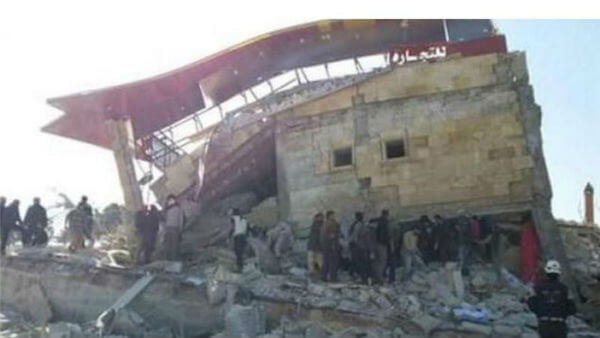
The New York Times reports: The hospital in the northern Syrian town of Maarat al-Noaman was not just grazed, or damaged, by the airstrikes last week. It was destroyed, taking a direct hit that pancaked its three stories into one, entombing and killing 25 people, including nine staff members.

It was struck at around 9:02 a.m., just as day-shift workers and patients were arriving; then again at around 9:05. As rescuers swarmed around, another explosion struck at 9:45, and another at 9:48. That same morning, two airstrikes hit the National Hospital on the other side of town, which was treating nurses injured in the attack on the first facility.

This detailed account, provided by the director of the hospital, which was supported by Doctors Without Borders, is one example of why many Syrian medical workers in insurgent-held areas and human rights groups believe medical facilities are not just being hit by stray bombs or indiscriminate attacks, but have long been deliberately targeted by the Syrian government and its Russian allies. It is a measure of the deep mistrust that gravely challenges prospects for a truce set to begin Saturday.

“I had the feeling they were trying to kill me,” said the director, Dr. Mazen al-Saoud, 55, in a telephone interview from Maarat al-Noaman, his hometown. “Wherever I went, there was bombing.”

According to Doctors Without Borders, there were 94 attacks last year alone on 67 hospitals and clinics the group supports in insurgent-held areas from northern to southern Syria, destroying 12 facilities and killing 23 staff members. In 2016, there have already been 17 attacks on health facilities, including six assisted by the group. [Continue reading…]

Facebooktwittermail

Syrian rebel factions say they will respect two-week truce

The Guardian reports: The main umbrella organisation for Syrian opposition groups backed by the west and Saudi Arabia has said armed groups fighting President Bashar al-Assad will respect a two-week truce beginning at midnight local time (10pm GMT).

The high negotiations committee (HNC) said nearly 100 rebel factions had agreed to the ceasefire, adding that the Syrian government and its allies must not launch attacks on the pretext of fighting terrorism.

The Russian president, Vladimir Putin, welcomed the announcement, saying that though the planned ceasefire was complex, there was no alternative.

Under the terms of the deal, armed groups had to confirm their commitment to the US or Russia no later than midday Damascus time. It was not immediately clear how many factions had refused to join the ceasefire or their military significance.[Continue reading…]

Facebooktwittermail

The carve-up of Syria is already happening under Obama’s Plan A

assad-2

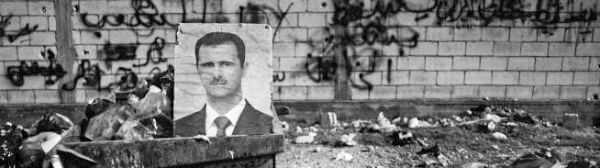
Michael Weiss writes: “Syria,” properly speaking, no longer exists. The nation-state cobbled together a hundred years ago by the great powers, albeit with borders periodically rejiggered since, is FUBAR and will henceforward remain a balkanized set of cantons or fiefs ruled by a panoply of antagonistic sectarian insurgencies, proxies, and terrorist organizations — some elements, including the one residing in the presidential palace in Damascus, adequately meeting the definitions for all three categories. And it really doesn’t matter if every last Sukhoi fighter jet, Scud missile, and barrel bomb gets put away on Saturday, when the truce is set to commence.

I say that because the best-case scenario for Kerry’s last-ditch, now-don’t-hold-me-to-this prescription for ending a modern and globally transformative holocaust is that war actually continues, only against the “right” targets, namely al Qaeda and ISIS. These are the two U.N.-designated terrorist organizations not party to or expected to abide by the ceasefire. Their spoiler potential for provoking others to violate the terms of the agreement is enormous, as both militancies collectively boast an order of battle greater than that of the mobilized Syrian Arab Army.

As Andrew Tabler, a Syria specialist at the Washington Institute for Near East Policy, puts it, the central dilemma is gauging what constitutes success for Kerry’s quixotic program: “Is the bar that fewer people are dying or is the bar that more people are fighting terrorism?”

If the latter, then how do you accomplish that when every security agency of the executive branch believes that Russia is not going to stop bombing the anti-Assad opposition so as long as it can claim it is only hitting terrorists, the Kremlin’s abiding lie since September 30, when it started bombing?

Yes, the Russian Air Force does go after Abu Bakr al-Baghdadi’s minions on occasion, whenever they dare to interdict Russian- and Iranian-abetted regime advances against other rebel groups, as they are currently doing in Aleppo. On the whole, however, Putin’s air war, as the US-led coalition now concludes, has allowed ISIS to acquire terrain where the opposition had previously prevented it from doing so. The best the U.S. has done by way of deterrence is a ceasefire the U.S. thinks is a dud. [Continue reading…]

Facebooktwittermail

The risk in Putin’s skill for projecting menacing ambiguity

Maxim Trudolyubov writes: Mr. Putin’s talent for disruption amounts to a kind of “Midas touch.” It has made him a formidable adversary in Russia’s hybrid war of force and manipulation, where anything can be a target and everything can be a weapon. It has also given him what he has long coveted: Western acknowledgment that Russia is a force to be reckoned with.

“It is much safer to be feared than to be loved” Machiavelli wrote, an observation that the Russian leader and generations of his predecessors have taken to heart. As one high-ranking Russian official told me: “We are not known for being particularly nice or elegant. But that is fine with us as long as our interests are taken seriously.”

And so Moscow is not loved but feared. But snatching land from other nations, scaring your neighbors and destabilizing your business and political rivals are not policies you can maintain forever. They will return to haunt Moscow.

Historically, the Kremlin’s rulers have always considered their country’s first line of defense against what they perceive as Western mischief to lie well beyond Russia’s borders. But Moscow has made people in the West think that its policies are motivated by aggressive revisionism, not defense. Their success is full of ironies.

It may not be true that Mr. Putin is purposefully exacerbating the refugee crisis, or that there is no sound economic logic behind Nord Stream 2. But if you have the reputation of turning everything you touch into a weapon, everything you say and do might be construed as an attack. You become everyone’s enemy. Russia’s leaders have become so adept at their game of projecting menacing ambiguity that it is now impossible for them to persuade anyone that sometimes the Russians might just simply want to do business. [Continue reading…]

Facebooktwittermail

ISIS attacks spike in Syria with help from Russian air cover, report says

The Washington Post reports: The Islamic State has been taking advantage of Russian airstrikes in Syria, using the newfound air cover to maneuver and reposition fighters, according to a report released by IHS Janes’ Terrorism and Insurgency Center on Wednesday.

Despite losing ground in Iraq and being targeted by U.S.-led coalition airstrikes in both Iraq and Syria, the extremist group managed to carry out 935 attacks between Oct. 1 and Dec. 31 2015. Russian warplanes began flying their first sorties in the country during the last week of September. According to the report, the spike in attacks equates to a five percent increase from the prior quarter.

Despite the increase in attacks, the average fatalities per attack–approximately–three remained consistent with the past year. Additionally, the Islamic State’s attacks also “continued to track above the average recorded over the preceding 12 months.” Number of attacks, however, does not equate to the group’s ability to hold territory. The extremist group has lost ground in both northern Syria and Iraq, though it has retained the ability to mount effective counter-attacks and raids in both areas. [Continue reading…]

Facebooktwittermail

John Kerry says partition of Syria could be part of ‘plan B’ if peace talks fail

The Guardian reports: John Kerry, the US secretary of state, has said he will move towards a plan B that could involve a partition of Syria if a planned ceasefire due to start in the next few days does not materialise, or if a genuine shift to a transitional government does not take place in the coming months.

“It may be too late to keep it as a whole Syria if we wait much longer,” he told the US Senate foreign relations committee on Tuesday.

Kerry did not advocate partition as a solution and refused to specify details of a plan B, such as increased military involvement, beyond insisting it would be wrong to assume that Barack Obama would not countenance further action.

He also admitted it was possible Russian-backed forces could capture Aleppo, but pointed out that it has been very hard to retain territory in the five-year civil war. [Continue reading…]

Facebooktwittermail

Russia’s indiscriminate bombing campaign is tilting the balance of the war in Assad’s favor

David Axe reports: Russia has ramped up its air war in Syria — big time. And it’s starting to show. Relentless and indiscriminate, Moscow’s bombing runs have devastated military and civilian strongholds and cleared a path for Syrian regime forces to counterattack against ISIS militants and rebels.

Five months after the first Russian warplanes slipped into Syria to reinforce the embattled regime of President Bashar al-Assad, the Kremlin’s air wing near Latakia — on Syria’s Mediterranean coast in the heart of regime territory — has found its rhythm, launching roughly one air strike every 20 minutes targeting Islamic State militants, U.S.-backed rebels and civilians in rebel-controlled areas.

“From Feb. 10 to 16, aircraft of the Russian aviation group in the Syrian Arab Republic have performed 444 combat sorties engaging 1,593 terrorist objects in the provinces of Deir Ez Zor, Daraa, Homs, Hama, Latakia and Aleppo,” the Russian defense ministry claimed in a statement.

That’s double the rate of air strikes that the much larger U.S.-led coalition has managed to sustain in its own, much older campaign against ISIS in Syria and Iraq. Leave out the coalition airstrikes in Iraq, where there are no Russian forces, and the disparity appears even greater. While lately Russia has launched around 60 air raids every day in Syria, the U.S. and its allies have pulled off just seven, on average, since launching their first attacks in Syria in September 2014. [Continue reading…]

Syria Direct reports: Regime forces are battling to reopen their only supply route into Aleppo city and the surrounding countryside, the Ithriya-Khnaser road, after the Islamic State cut if off entirely on Tuesday, local journalists and a rebel commander tell Syria Direct.

The supply road originates in Hama city, runs approximately 100km northeast to Ithriya in the south Aleppo countryside, and continues 110km northwest through Khnaser and into Aleppo city.

As of Tuesday, Islamic State forces control a 35km section of the road between Ithriya and Khnaser, Mujahid Hreitan, a citizen journalist in the southern Aleppo countryside, told Syria Direct Wednesday.

After capturing regime checkpoints along the Khnaser-Ithriya supply route Monday, the Islamic State took full control of Khnaser town on Tuesday, cementing their control over the stretch of road, reported IS’s semi-official news agency Amaq.

IS’s latest campaign is different from previous attempts to cut off the same regime supply route. The Islamic State has now managed to capture the town of Khnaser in its entirety, whereas in the past “IS would take a couple of small areas [along the road] that the regime quickly recaptured,” Ahmed A-Ruwaished, a citizen journalist in the southern Aleppo countryside, told Syria Direct Wednesday. [Continue reading…]

The National reports: The capture of Sheikh Miskeen by president Bashar Al Assad’s forces last month was their most significant victory in years on Syria’s southern front, but for the rebels, the manner of their defeat was more alarming than the loss itself.

Rebel commanders and fighters described a litany of tactical mistakes, logistical confusion and destructive infighting that contributed to the loss of the town in Deraa province. One commander summed up the performance of the rebel alliance as a “major failure”.

The inability of the rebels and their international backers to come up with an answer to Russian air power was a significant factor in the battle, and is likely to prove critical over the coming weeks and months, as the fight for Syria’s south continues. [Continue reading…]

Facebooktwittermail

Questions remain over Russia’s endgame in Syria, Ukraine and Europe

assad-putin

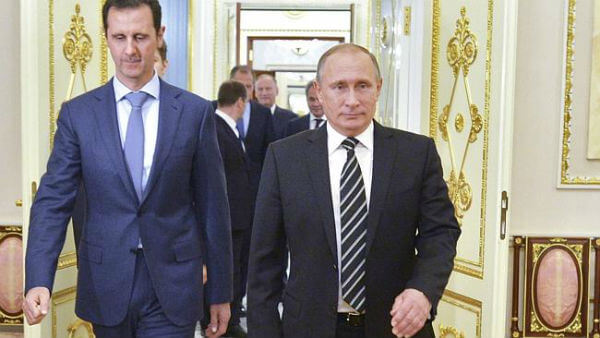
The New York Times reports: The partial truce that Russia and the United States have thrashed out in Syria capped something of a foreign policy trifecta for President Vladimir V. Putin, with the Kremlin strong-arming itself into a pivotal role in the Middle East, Ukraine floundering and the European Union developing cracks like a badly glazed pot.

Beyond what could well be a high point for Mr. Putin, however, lingering questions about Russia’s endgame arise in all three directions.

In Syria, Russia achieved its main goal of shoring up the government of President Bashar al-Assad, long the Kremlin’s foremost Arab ally. Yet its ultimate objectives remain murky, not least navigating a graceful exit from the messy conflict.

In Ukraine, Russia maintains a public commitment to put in place a year-old peace agreement. Renewed fighting in the Russian-backed breakaway regions, however, suggests that Moscow seeks to further destabilize the Kiev government, already wobbly from internal political brawling.

In Europe, Mr. Putin wants to deepen cracks in the European Union, hoping to break the 28-nation consensus behind the economic sanctions imposed on Russia over its annexation of Crimea in 2014. The Kremlin recently cranked up its propaganda machine to malign the German chancellor, Angela Merkel — viewed here as the central figure in the confrontation against Moscow — portraying her as barren and her country as suffering violent indigestion from too many immigrants.

The target audience for these achievements is the Russian populace, partly to distract people from their deepening economic woes.

“On screen we can see that we are so strong, we are so important, we are so great,” Nikolai Petrov, a professor of political science at the Moscow School for Higher Economics, said sarcastically. [Continue reading…]

Facebooktwittermail

The paradox hindering Syrian peace

The Wall Street Journal reports: As world powers struggle to agree on a solution to Syria’s war, a United Nations report points to a paradox it says is hindering peace plans: the same countries pushing for peace are the ones fueling the war.

This ambiguity has radicalized the conflict, raised the political stakes and contributed to civilian suffering, said Paulo Pinheiro, the chairman of the U.N.-backed Independent Syria Commission group in an interview Monday.

“We have said this to the states themselves. We have said it’s better to be fully committed to the political process instead,” said Mr. Pinheiro. “The airspace [above Syria] is overcrowded and it has humanitarian consequences.”

The 31-page report, which laid out a detailed account of a nation at the brink of collapse, is the 11th produced since the commission was formed in 2011 to investigate and document Syria’s war. The report offers a list of recommendations for a lasting peace to Syria’s government, the opposition and the international and regional powers involved directly or through proxy groups. Most of what it has so far recommended has fallen on deaf ears. [Continue reading…]

Facebooktwittermail

Syrian rebels see flaws in U.S.-Russian truce plan

Reuters reports: The United States and Russia announced plans for a “cessation of hostilities” in Syria that would take effect on Saturday but exclude groups such as Islamic State and al Qaeda’s Nusra Front, a loophole Syrian rebels immediately highlighted as a problem.

Monday’s agreement, described by a U.N. spokesman as “a first step towards a more durable ceasefire,” is the fruit of intensive diplomacy between Washington and Moscow, which back opposing sides in the 5-year-old civil war that has killed more than 250,000 people.

Presidents Barack Obama and Vladimir Putin discussed the accord by phone, and the Kremlin leader said it could “radically transform the crisis situation in Syria.” The White House said it could help advance talks on bringing about political change in Syria.

To succeed, the deal will require both countries to persuade their allies on the ground to comply. Fighting and air strikes continued on Monday, according to a British-based monitoring group.

The plan allows the Syrian army and allied forces, as well as Syrian opposition fighters, to respond with “proportionate use of force” in self-defense. It leaves a significant loophole by allowing further attacks, including air strikes, against Islamic State, Nusra and other militant groups.

Bashar al-Zoubi, head of the political office of the Yarmouk Army, part of the rebel Free Syrian Army, said that would provide cover for Syrian President Bashar al-Assad and his Russian allies to keep attacking opposition-held territory where rebel and militant factions are tightly packed.

“Russia and the regime will target the areas of the revolutionaries on the pretext of the Nusra Front’s presence, and you know how mixed those areas are, and if this happens, the truce will collapse,” he said. [Continue reading…]

Facebooktwittermail