Category Archives: Syria

Syrian Kurds say U.S. discussing arms supplies in direct talks

Rudaw reports: US officials have been holding direct talks with leaders of the Democratic Union Party (PYD) about arming its fighters in the war against the Islamic State (ISIS).

PYD spokesman Nawaf Xelil told the Arabic Asharq Al-Awsat daily that arms supplies for the People’s Protection Units (YPG), the group’s military wing, were discussed at a meeting in Paris a week ago. He said that talks between the two sides continued in Duhok on Thursday.

“The subject of arming Syrian Kurds was discussed” the newspaper quoted Xelil as saying.

He added that at the Duhok meeting, a US delegation and PYD leaders had discussed Western and Arab support for the YPG.

“They spoke about sending military support to the Kurds in Kobane,” Xelil told Asharq Al-Awsat. He said the PYD and the US had started their talks two years ago but that Washington had kept the issue under the radar “in order not to upset Turkey.”

US State Department spokesperson Jen Psaki confirmed Thursday that US officials had met with the PYD, but did not say where or what was discussed. [Continue reading…]

The Associated Press reports: Turkish President Recep Tayyip Erdogan says his country would not agree to any U.S. arms transfers to Kurdish fighters battling Islamic militants in Syria.

Turkey views the Kurdish fighters as an extension of the PKK, which has waged a 30-year insurgency in Turkey and is designated a terrorist group.

The state-run Anadolu news agency on Sunday quoted Erdogan as saying the fighters are “equal to the PKK” and that Turkey “would not say ‘yes’ to such a thing.”


Facebooktwittermail

U.S. officials in contact with Syrian Kurds ‘for more than two years’ says PYD spokesman

Asharq Al-Awsat reports: Representatives from the main Syrian wing of the Kurdistan Workers’ Party (PKK) have been in contact with US officials “for more than two years,” an official spokesperson told Asharq Al-Awsat, adding that the talks had been kept secret by Washington to “avoid angering Turkey,” where the PKK is currently banned.

Despite the fact the PKK is also designated as a terrorist organization by the US and EU, Nawaf Khalil, the spokesperson for the PKK affiliate, the Kurdish–Syrian Democratic Union Party (PYD), said this coordination had also included face-to-face meetings, some of which had involved former US ambassador to Syria Robert Ford.

The most recent of such meetings, he said, took place on October 12 in Paris between PYD leader Salih Muslim Muhammad and US State Department Special Envoy for Syria Daniel Rubinstein to “discuss implementing military coordination between the People’s Protection Units [YPG, the armed wing of the PYD] and the joint Arab–international coalition against terrorism,” as well as supplying Kurdish fighters engaged in fighting the Islamic State of Iraq and Syria (ISIS) in the Syrian border town of Kobani with weapons.

Facebooktwittermail

Steven Heydemann on the evolution and sectarianization of the Syrian conflict

Danny Postel, Associate Director of the Center for Middle East Studies at the University of Denver, speaks with Steven Heydemann, Vice President of Applied Research on Conflict at the United States Institute of Peace in Washington. Heydemann is the author of Authoritarianism in Syria: Institutions and Social Conflict, 1946-1970, the editor of War, Institutions and Social Change in the Middle East, and co-editor of Middle East Authoritarianisms: Governance, Contestation, and Regime Resilience in Syria and Iran.

(H/t Pulse)

Facebooktwittermail

The meaning of Kobane

Henri J Barkey writes: The Syrian Kurdish town of Kobani has been under a relentless siege by the Islamic State (IS) for the past few weeks. Surprisingly its defenders have endured, defying the long odds. Whether it falls or survives, Kobani is likely to become for Syrian and Turkish Kurds what Halabja became for Iraqi Kurds in 1988: a defining moment of nationhood and identity.

Halabja helped propel and shape the Kurdish autonomous region of northern Iraq, now called the Kurdistan Regional Government (KRG). In 1988, in the midst of the genocidal Anfal campaign against the Iraqi Kurds, Saddam Hussein used chemical weapons on the sleepy Iraqi Kurdish town near the Iranian border, killing some 5,000, mostly civilians. Unnoticed at the time, Halabja became for much of the world a symbol of the larger campaign of mass extermination against the Kurds, as well as a quintessential example of a crime against humanity.

For the Kurds, it marked yet another time the world stood by and watched silently; theirs was an inconvenient predicament, a sacrifice at the altar of grander strategic purposes. Saddam Hussein enjoyed the support of the West precisely because he was locked in a duel with Iran, then a larger threat.

Fast forward to today: Until the U.S. Air Force began a systematic bombing campaign against IS positions around Kobani, the city had been left largely to fend for itself. Skittish and worried about Turkey’s reaction to support for Syrian Kurds, the Obama Administration initially hesitated but then committed itself to bombing the besieging IS forces after they had penetrated the city’s outer defenses.

Kobani will have two different effects on the region. First and foremost, it will be an important marker in the construction and consolidation of Kurdish nationhood. The exploits of Kobani’s defenders are quickly joining the lore of Kurdish fighting prowess. After all, the Iraqi Kurdish forces, not to mention the Iraqi army, folded in the face of a determined IS onslaught only a couple of months ago. The longer the city resists, the greater will be the reputational impact (although it is already assuming mythic proportions).

There is another, rather unique aspect of the resistance that is adding to its mythic character: the role of women in the fight. The juxtaposition of an Islamic State, which enslaves women or covers them from head to toe, with the Syrian Kurds’ Democratic Union Party (PYD), which has large numbers of women fighting and dying alongside men, is particularly striking. Social and other media outlets have brimmed with stories of the heroism and sacrifice of these women. The fighting in Kobani, and especially the emergence of women fighters, has now entered the Kurdish lore and imagination. [Continue reading…]

Facebooktwittermail

‘Kobane battle far from over’ says defense chief

Facebooktwittermail

U.S.-led coalition jets strike Kobane, ISIS shells hit Turkey

Reuters reports: U.S.-led coalition jets pounded suspected Islamic State targets at least six times in the besieged Syrian town of Kobani on Saturday after the fiercest shelling in days by the insurgents shook the town’s center and hit border areas within Turkey.

Shelling continued after the strikes hit the center of Kobani. Several mortars fell inside Turkey near the border gate, called Mursitpinar, according to witnesses.

Facebooktwittermail

In policy shift, U.S. opens direct talks with Syrian Kurds linked to the PKK

McClatchy reports: The Obama administration acknowledged Thursday that a U.S. official for the first time met with a representative of a Syrian Kurdish political party that’s closely linked to a group on the U.S. terrorist list.

State Department spokeswoman Jen Psaki said a U.S. diplomat met with a counterpart from the main Kurdish political party in Syria – the Democratic Union Party, better known by its Kurdish acronym as the PYD – to discuss the U.S.-led fight against the Islamic State. The PYD’s militia is engaged in fierce battles with the Islamist extremists, especially near the town of Kobani along the border with Turkey.

The direct talks are a sign of the shifting alliances created by the rise of the Islamic State. In Iraq, for example, the U.S. is providing air cover for Iranian-backed Shiite Muslim militias that once targeted American forces. And now in Syria, it appears the United States is willing to work with a group that’s tied to the PKK, or Kurdistan Workers Party, which has waged a guerrilla war for Kurdish rights in Turkey for 30 years and which has been on the U.S. list of foreign terrorist organizations for nearly two decades. Turkey and the European Union also have blacklisted the PKK.

Psaki provided no details of the meeting beyond saying that it took place over the past weekend and outside of the Middle East. Kurdish and other media reports say Charles Rivkin, the undersecretary of state for economic affairs, and PYD leader Salih Muslim met in Paris.

The new face-to-face U.S. channel to the PYD is likely to rankle Turkey, which on Monday bombed PKK locations in Turkey and has battled Kurdish civilians near Kobani protesting the international response to the Islamic State assault on the town. [Continue reading…]

Facebooktwittermail

Lebanon pulled into war with ISIS

The Associated Press reports: With all eyes on the Islamic State group’s onslaught in Iraq and Syria, a less conspicuous but potentially just as explosive front line with the extremists is emerging in Lebanon, where Lebanese soldiers and Shiite Hezbollah guerrillas are increasingly pulled into deadly fighting with the Sunni militants along the country’s border with Syria.

The U.S. has been speeding up delivery of small ammunition to shore up Lebanon’s army, but recent cross-border attacks and beheading of Lebanese soldiers by Islamic State fighters — and the defection of four others to the extremists — has sent shockwaves across this Mediterranean country, eliciting fear of a potential slide into the kind of militant, sectarian violence afflicting both Syria and Iraq, and increasingly prompting minorities to take up arms.

The crisis was slow in coming.

For long, Lebanon managed to miraculously avoid the all-out chaos gripping neighboring countries — despite sporadic street clashes and car bombings, and despite being awash with weapons and taking in an endless stream of refugees from Syria who now constitute a staggering one third of its population of 4.5 million people.

Facebooktwittermail

Let them eat bombs: The cost of ignoring Syria’s humanitarian crisis

Aron Lund writes: Winter is coming, and the humanitarian situation in Syria has never been so dire, with more than 3 million refugees abroad and some 6.5 million internally displaced — nearly half of the country’s population.

According to UN figures, more than 10 million Syrians now need outside aid to survive, nearly half of them stuck in areas under siege or otherwise hard to access. The power infrastructure and agricultural sector are breaking down due to the strains of war and a lack of upkeep. Across Syria, the prices of fuel, food, and everyday goods are skyrocketing due to systemic failures in the power supply structure, war, and bombings. Millions of Syrians are left to face the winter cold in appalling conditions, at a time when wealthy Western and Arab nations spend billions on counterterrorism and renewed rebel training missions.

This is not simply callous neglect. Even if the Syrian conflict were to be viewed solely through a security prism, the international community’s tepid response to this humanitarian crisis is clearly counterproductive. The spiralling poverty, social breakdown, and despair is precisely what has paved the way for extremist sectarian militias, not only inside Syria but also among refugees scattered in countries like Lebanon and Jordan, and there is little hope for a solution for as long as the humanitarian crisis persists.

Yet while funds are readily available for military interventions of last resort — such as “Operation Inherent Resolve,” the U.S.-led coalition striking jihadi targets in Syria and Iraq—the international community remains unwilling to summon up a humanitarian coalition to get Syrians through the winter. [Continue reading…]

Facebooktwittermail

YPG spokesman: ‘If the West wants to defeat ISIS it will have to help us’

Deutsche Welle reports: Redur Xelil is the spokesman of the Kurdish People’s Protection Units, YPG.

DW: What is the current situation like in Kobani?

Redur Xelil: Clashes are still very heavy but we’ve made a significant step forward. Now we are not only resisting the assault but also striking back against enemy positions. However, we still rely on our light weapons against the heavy ones used by the “Islamic State” (IS) forces against us. We need supplies of all sorts as we are not facing just one armed group but the army of a whole state.

But you do have US air cover. What is the degree of coordination between the YPG and Washington?

Airstrikes are important but not enough to get rid of the enemy. Regarding coordination with Washington, it is obvious that we have to give them our exact position so that their bombs don’t fall on us. I cannot give you any further details about it. All I can say is that we’re looking forward to improve cooperation between us.

If airstrikes are not enough, will it be possible to defeat IS without the presence of international troops on the ground?

Mosul – Iraq’s second city – fell in three days while a town like Kobani has already endured a whole month of fighting, and that’s only thanks to our highly motivated fighters who are defending their land. So far, the YPG has proved to be the only armed force that has successfully fought IS. However, we’re not in a position to go beyond our borders, we cannot fight them outside our boundaries unless we coordinate with local Arabs in those areas, as we’ve done on previous occasions. International support is doubtless necessary but I think the different communities in the Middle East could defeat IS if they were properly armed, trained and coordinated. If the West wants to defeat the Islamists it will have to help us. [Continue reading…]

Facebooktwittermail

Kobane key to U.S. strategy against ISIS

The Associated Press reports: The U.S. isn’t sure why IS is fighting so hard for control of Kobani, a city with few resources and far removed from any capital. But like the U.S. with Kobani, a loss to a ragtag group of Kurdish fighters would be a propaganda loss for IS.

Much of the daily fighting in Kobani is caught on camera, where TV crews and photographers on the Turkish side of the border have captivated the world’s attention with searing pictures of refugees, black plumes of smoke from explosions, and the sounds of firefights on the city’s streets. In video after video, refugees just across the border can be seen and heard cheering as U.S. airstrikes pound the extremists.

Last week, in pictures and Tweets, the militants’ supporters declared Kobani as theirs, and changed the city’s name to Ayn al-Islam, or Spring of Islam. The online jeering has quieted considerably after the airstrikes of the last several days.

The Islamic State relies on its global online propaganda machine, run largely by supporters far from the battle, to entice fighters, funding and other aid to the front. If the militants’ victories begin to ebb in such a public forum, U.S. officials believe, so too will their lines of support. That alone makes the battle for Kobani a must-win fight for the U.S. strategy.

And that is not lost on Washington. “What makes Kobani significant is the fact that ISIL wants it,” Kirby said. [Continue reading…]

Facebooktwittermail

Fleeing Kobane: Taking only the things they could carry

Middle East Eye reports: When Islamic State militants began to close in on Kobane, the town erupted into chaos.

Most fled with just the clothes they were wearing, and any money stashed away in the house they could grab quickly.

Taking the time to pack bags was a gamble, especially for families living on the outskirts of the town, who had long heard about the notoriety of the advancing militants that have captured world attention for the particular brand of cruelty they unleash on their opponents.

Yet, even amid the chaos, a few individuals managed to take an object of sentimental value, an item that in their mind could not be left behind and could not be replaced. In disarray and terror, a small piece of comfort was nonetheless carried over the Syrian border to safety.

As mortars rained down on their hometown, and the fighting between the Peoples Protection Unit (YPG) Kurdish forces and Islamic State militants descended from the rural outskirts into the city, Khaled Khalil Bisiki and his family made the decision to flee Kobane.

Two weeks ago in the middle of the night, as they hurryingly packed their lives into the family’s small battered car, Bisiki ran back inside to grab the deeds to his lands in Kobane. His wife, Maram, quickly followed, grabbing precious family photos.

“We left so fast we couldn’t bring anything with us really, it was all so fast, so you just grab the things you think you can bring with you,” Khaled told Middle East Eye.

“When you remember something is important, it becomes so important. I remembered our land deeds, I want to always have proof that this is my family’s place – to never lose that – and my wife grabbed the family photos.” [Continue reading…]

Facebooktwittermail

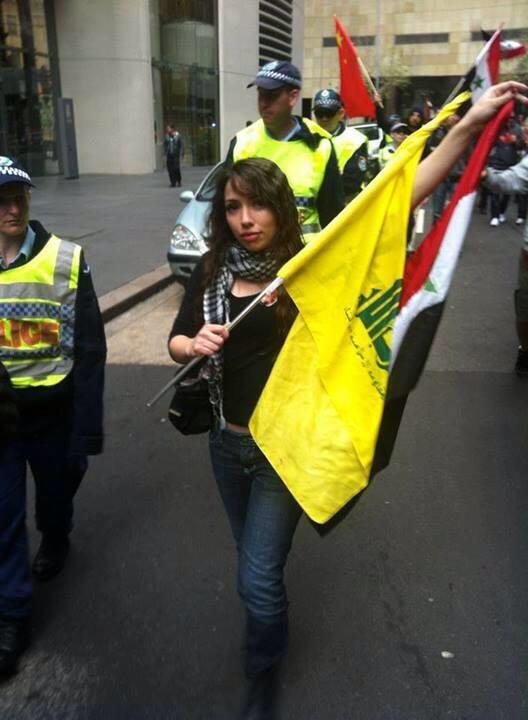
Partisangirl’s false-flag semaphore supporting Assad and her alliance with MIT’s Ted Postol

Ted Postol and Maram Susli

Ted Postol and Maram Susli

Noah Shachtman and Michael Kennedy write: She thinks that Ebola could be an American military bioweapon. She thinks that the Defense Department’s advanced research arm is covertly intervening in the GamerGate debate about feminism and video games. She’s fond of extremist groups like Hezbollah. She believes the Illuminati are leaving secret clues in, among other places, the viral Kony 2012 video. Oh, and she also says she’s in contact with the Syrian Electronic Army, the hacker group tied to the regime of Syrian dictator Bashar al-Assad.

Meet the Damascus regime’s biggest fangirl on social media — at least in English language social media. Her name is Maram Susli. Or Mimi al-Laham. Or Partisangirl. Or Syrian Girl. Or it would appear, or Syrian Sister. She goes by many handles.

As “Partisangirl,” Susli has emerged from the fever swamps of online conspiracy forums and onto social media to become a darling of truthers and state propaganda channels alike. Whenever there’s unpleasant news about the Syrian military or government, Susli (that’s her surname) seems to be there to interpret the false flag semaphore for her rapt audience. The chemical-weapons attack that killed hundreds in the Damascus suburbs? The rebels’ fault. The massacre of more than 100 men, women, and children in Houla? Oh, that was British intelligence. The U.S. bombing campaign against ISIS in Syria? Just an elaborate show, since American is taking it easy on ISIS. And the ghastly videos featuring the murder of Western aid workers? Many of them are fakes.

“There’s an elite and they’re trying to manipulate people’s minds,” Susli told The Daily Beast. “It’s claimed that we’re living in a free democracy but we’re really not. It’s just an illusion. And the more people know that, the more they distrust what they’re hearing.”

The Internet’s always had a well-populated fringe and Susli’s place in its firmament might not otherwise be noteworthy. But with the help of a distinguished MIT professor — whose work has been cited by a Pulitzer Prize-winning journalist — she’s trying to move beyond the chemtrails crowd. Her YouTube videos have racked up hundreds of thousands of views. She’s been interviewed uncritically by Vice. A lapsed graduate student in chemistry at the University of Western Australia, she’s been brought into the academy to become a source of expertise on the chemical-weapons attack that brought America to the brink of war in Syria last year. [Continue reading…]

Facebooktwittermail

ISIS holding thousands of women and children as slaves in Iraq and Syria

Emily Feldman reports: The Islamic State is currently holding thousands of people hostage inside ISIS territory, having taken members of the minority Yazidi sect captive this summer during a brutal campaign across northern Iraq.

While the United Nations has put the number of captives at about 2,500, other estimates are as high as 7,000. And prospects for any rescue are bleak.

Even as the U.S. and its allies bomb ISIS targets in Syria and Iraq, the group has managed to hold on to key cities where it is reviving the practice of slavery.

The latest edition of Dabiq, an ISIS magazine, includes an impassioned argument for the practice as well as an account of how the Yazidi women from the Sinjar region of Iraq were distributed among the fighters.

“The Yazidi women and children were divided according to the Shariah amongst the fighters of the Islamic State who participated in the Sinjar operation…to be divided as khums,” a kind of tax.

“The enslaved Yazidi families are now sold by the Islamic State soldiers.”

The magazine also warns “weak-minded and weak-hearted” ISIS followers who might question or object to the practice of slavery.

“Enslaving the families of the [infidels] and taking their women as concubines is a firmly established aspect of the Shariah,” the article says. “If one were to deny or mock [it], he would be denying or mocking the verses of the Quran.”

The article’s description of how prisoners were dealt with closely mirrors accounts from the few who have escaped or managed to contact their loved-ones by phone.

Women were sold at slave markets, forced to marry and imprisoned in the homes of ISIS fighters across both Iraq and Syria. [Continue reading…]

Facebooktwittermail

After repelling ISIS, PKK fighters are the new heroes of Iraqi Kurdistan

Al Jazeera reports: The body of Zanyar Kawa is making its final journey to Sulaymaniyah, in northeastern Iraq. The slain fighter died 500 miles from his hometown battling the Islamic State of Iraq and the Levant, or ISIL, in Kobane, a Syrian town near the Turkish border.

Though an Iraqi Kurd, Kawa did not die serving the Iraqi Kurdish security forces, known as the peshmerga. Rather, he was killed fighting alongside guerrillas associated with the Kurdistan Workers’ Party, or PKK, which seeks self-determination for Kurds in Turkey and across the region. Both Turkey and the United States consider the PKK a terrorist organization.

Nearly a hundred people have gathered on a grassy plaza in the city’s center to receive Kawa’s body and accompany it home. PKK flags are flying, along with banners of Abdullah Öcalan, the group’s founder. While most in the crowd are Turkish Kurds who live in exile, there are Iraqi Kurds, too.

In the past, the PKK did not count many Iraqi Kurds among its members, nor was the separatist group a critical player in Kurdistan’s internal affairs. But since ISIL fighters swept through northern Iraq this summer, that has changed. Increasingly, Iraqi Kurds are embracing the PKK fighters as heroes, lauding them for recapturing the northern Iraqi town of Makhmour and its surrounding villages and for rescuing thousands of members of the Yazidi ethnic group who were trapped in nearby Sinjar. [Continue reading…]

Facebooktwittermail

Iran’s ‘shadow commander’ Major General Qassem Suleimani steps into the light

The Atlantic reports: On October 16, Iran’s Fars news agency proclaimed the “magnificent role of General Suleimani in the fight against the terrorists of Daesh,” using an alternative acronym for ISIS.

Fars, which is affiliated with the Islamic Revolutionary Guard Corps, boasted that The Guardian had noted the role of Major General Qassem Suleimani, the leader of Iran’s Quds Force — the branch of the Revolutionary Guards responsible for overseas operations — in combating Islamic State militants.

“According to this publication,” Fars enthused, “General Suleimani is playing a key role in the fight against the Islamic State group.”

It is no coincidence that Fars dedicated a whole news article to the fact that an “English newspaper” had commented on Suleimani’s presence in Iraq. Iran has made a concerted effort in recent weeks to show the world that Suleimani — and by extension, the Quds Force — is bolstering Shiite militias against ISIS.

Numerous photographs have circulated on social media and in Iran’s state press showing Suleimani in Iraq and Syria. They are notable largely because until now, Suleimani has been an elusive figure, a subject of great media interest and speculation but also great secrecy. Suleimani’s name has appeared frequently in the Western press, but usually accompanied by the description “shadowy,” as in “shadowy figure,” or even “Shadow Commander.”

Yet this month, the hitherto rarely glimpsed Suleimani has been snapped in Irbil, grinning with Iraqi Kurdish peshmerga fighters; meeting with a top Shiite commander, Mohammad Kazmi, at the Quds Force headquarters in Iraq; and hanging out with Shiite militias while wearing a reversed baseball cap and Palestinian keffiyeh: [Continue reading…]

Facebooktwittermail

ISIS ‘being driven out of Syria’s Kobane’

BBC News reports: The Islamic State (IS) militant group has been driven out of most of the northern Syrian town of Kobane, a Kurdish commander has told the BBC.

Baharin Kandal said IS fighters had retreated from all areas, except for two pockets of resistance in the east.

US-led air strikes have helped push back the militants, with another 14 conducted over the past 24 hours.

Meanwhile, the new UN human rights commissioner has called IS a “potentially genocidal” movement.

Zeid Ra’ad al Hussein described the group as the antithesis of human rights.

Speaking by phone, Kurdish commander Baharin Kandal told the BBC’s Kasra Naji that she hoped the city would be “liberated soon”.

Ms Kandal said her militia group had been receiving arms, supplies and fighters but she refused to say how, reports our correspondent, who is on the Turkish border near Kobane. [Continue reading…]

CBS/AP report: A Syrian Kurdish official called on the international community on Thursday to allow weapons into the border town of Kobani, saying the town is still in danger from the Islamic State of Iraq and Syria (ISIS).

Idriss Nassan, deputy head of Kobani’s foreign relations committee, said ISIS can bring in reinforcements and weapons at any time and endanger the town near Turkey. He said airstrikes by the U.S.-led coalition are “effective” but not enough to defeat the jihadis.

Nassan’s comments came a day after the Pentagon spokesman said Kobani remains under threat of falling to the ISIS fighters. Rear Adm. John Kirby said two weeks of airstrikes have killed hundreds of ISIS fighters, and have stiffened Kobani’s defenders.

Facebooktwittermail