Vice reports: Kurdish and rebel armed groups fighting extremist militants the Islamic State (IS) in Syria have agreed to join forces against their common enemy, the latest in a complex and shifting series of battlefield allegiances.
Units affiliated with the Kurdish People’s Protection Units (YPG), Islamic Front (IF) and US-backed Free Syrian Army (FSA) will form a new coalition named Burkan al-Forat (Euphrates Volcano) after the river which flows through the region in which the agreement was formalized.
The alliance was announced via a video posted on Wednesday in which a man read a statement in front of an armed group including a number of women fighters backed by YPG pennants alongside the three-starred flag of Syrian opposition groups and others. The UK-based Syrian Observatory for Human Rights also reported the news.
The man asked those who had joined IS to desert the group, called for assistance from the international community and finished by saying that the coalition wished to free all areas of Syria under IS control, including Qaraqozaq, Jarabulus, Sirin, Manbaj and Raqqa.
Syrian rebel groups have not always had a smooth relationship with Kurdish militias. The YPG, which is the main force in majority Kurdish parts of the country, has maintained an uneasy truce with President Bashar al-Assad’s forces in the region, leading some rebels to accuse them of colluding with the government, a charge the Kurds deny.
However, it has been instrumental in the fight against IS and has been one of the few forces to mount an effective defense against the jihadis, inflicting heavy losses against them clashes across northern Syria and stymying their efforts to extend control into Kurdish regions. Problematically for the US, the YPG is affiliated with the Kurdistan Worker’s Party (PKK), an organization which is on both America and the EU’s terrorist blacklist. [Continue reading…]
Category Archives: Syria
U.S. and Syrian opposition fighters view each other with mutual distrust
The New York Times reports: American involvement with the rebels so far has largely been through so-called operations rooms in Jordan and Turkey staffed by intelligence officials from the United States and other countries that have provided arms to limited numbers of vetted rebels. So far, the support provided has included light arms, ammunition and antitank missiles, which have helped the groups destroy government armor but have not resulted in major rebel advances or helped control the spread of ISIS.
“The United States can probably work with them to some extent, but they haven’t been hugely effective so far, which is why the Islamic State is there in the first place,” said Mr. Lund, the Syria analyst.
The support so far has been limited, leaving many rebels feeling that the aid is prolonging the war, not helping them win. And the fluidity of battlefield alliances in Syria means that even mainline rebels often end up fighting alongside the Nusra Front, whose suicide bombers are relied on by other groups to soften up government targets.
“Even the groups that the U.S. has trained tend to show up in the same trenches as the Nusra Front eventually, because they need them and they are fighting the same battles,” Mr. Lund said.
The operations rooms — known as the Military Operations Command — also have had their influence sapped by the spread of extremists.
Ahmed Naimeh, the top Syrian official in the operations room in Jordan, was captured by rebels during a visit to Syria this year, ironically while trying to unify local rebel groups. He has not been heard from since, and many suspect that the Nusra Front killed him.
An operations room in Turkey has provided support to a number of moderate groups in northern Syria, shifting the balance of power away from the Islamists, according to a report published this week by the International Crisis Group. But this, in addition to a decline in direct support from Persian Gulf states, has not strengthened the rebels, instead causing “a weakening of overall rebel capacity to halt regime gains in Aleppo and hold ISIS at bay to the east,” the report said. [Continue reading…]
McClatchy reports: In an effort to map out the ideological spectrum of Syria’s various rebel groups, Turkish and American officials used a color-coded scheme: green for trusted friends, red for clear-cut enemies and yellow for those in the middle.
That middle section turned into a point of contention when it became clear that the Turks were willing to work with groups that were anathema to the United States, including al Qaida’s Nusra Front and the hard-line Ahrar al Sham. Turkish officials seemed to be gambling that they could build a moderate rebel force by nudging groups in the middle toward the green, friendly category.
“We said, ‘Yes, sure, OK, but a number of the groups that you’re working with, which you consider open to persuasion, we consider beyond the pale. And we will not work with them, and we’d rather you not work with them and we think they need to be blocked from transiting your borders,’ ” Francis Ricciardone, the U.S. ambassador to Turkey until last month, recalled Thursday in a media call arranged by the Atlantic Council foreign policy institute, where he’s now the director of the Middle East program.
“We ultimately had no choice but to agree to disagree,” Ricciardone said.
U.S. officials haven’t publicly acknowledged previously knowing that Turkey was providing assistance to Nusra, which the State Department designated a foreign terrorist organization in December 2012. Turkey’s Foreign Ministry didn’t respond to a request for comment.
Now the schism with Turkey, never resolved, is resurfacing in a more public way with President Barack Obama’s pledge to build a “moderate” Syrian rebel force as he wades deeper into the Middle East’s turmoil. When the United States and Muslim partners such as Turkey or Saudi Arabia clash over the very definition of “moderate,” who gets to decide the makeup of a coalition-backed rebel force? And no matter what it’s called, is Obama ready to accept the risk of backing a movement that’s widely viewed as too small, too weak and too untrustworthy to win? [Continue reading…]
The difficulty the U.S. faces in identifying which Syrian groups are fit to view as partners, is a product primarily of the ideological straightjacket inside which Washington operates.
U.S. officials who are obsessed by their own fear of being accused of unwittingly or intentionally offering support to extremists, are asking the wrong questions.
The exact political complexion of each group is of far less consequence than their proclivity to commit war crimes, level of corruption, and commitment to create an inclusive Syria. Whether a particular group can be dubbed “moderate” gives relatively little indication of how they would rank on those counts.
The fact that officials bemoan a paucity of reliable partners among the opposition groups says as much about the Obama administration’s willful neglect of the conflict as it says about the opposition.
Confronting ISIS
Hassan Hassan writes: The Syrian opposition is in a rare position of power, at least internationally. In his September 10 address, President Barack Obama extended the war against the Islamic State, also known as ISIS, into Syria. He said that the United States will lead a coalition to “degrade and ultimately destroy” ISIS. There is a wide recognition that the opposition will be key in the fight against the radical group. But the opposition does not have a strategy to seize this opportunity. And at this critical juncture Syrian rebels have even alienated some of their allies.
Until Obama’s speech, the opposition was suspicious that U.S. strikes in Syria would be carried out in collaboration with the Assad regime, despite repeated statements from Western capitals to the contrary. On Wednesday, the Syrian Muslim Brotherhood rejected the international coalition against ISIS “unless the first bullet is directed at [Bashar] al-Assad’s head.” Even though the opposition’s National Coalition welcomed the American move against ISIS, the political opposition is still waiting for an invitation to play a role, rather than proactively presenting a vision for a way out for the Syrian crisis.
Away from politics, however, a fairly different situation exists among opposition fighters. Significant rebel coalitions have already been formed to help in the fight against ISIS, and preparations for the zero hour seem to be in full swing. On September 10, seven groups affiliated with the Kurdish People’s Protection Units (YPG), Free Syrian Army, and the Islamic Front, among them Kurdish and Arab fighters, announced a small yet symbolically significant coalition to fight ISIS in eastern Syria. On Monday, five sizable fighting groups in Idlib announced a merger, named al-Faylaq al-Khamis (The Fifth Legion), saying they would adhere to strict military discipline and use the Syrian revolutionary flag, which indicates a rejection of Islamist ideology. The Syrian Revolutionary Front, which was key to the expulsion of ISIS from much of the north earlier this year, also announced that it would send “convoys after convoys” to areas under ISIS control to defeat the jihadi group.
But even though rebels on the ground are willing and prepared to fight ISIS, the political opposition has a critical role to play. The areas tightly controlled by ISIS will require an assiduous effort to organize groups that could fill any vacuum left by ISIS as a result of the potential airstrikes. ISIS has made it much harder for armed groups from these areas, particularly Deir ez-Zor and Raqqa, to regroup and make a comeback or for local forces to stage an insurrection against the jihadi group. Rebel groups from outside these areas will also find it quite difficult to navigate, much less be welcomed in, these territories. [Continue reading…]
Will the U.S. launch airstrikes in Syria?
The New York Times reports: The prospect of the first American attacks on Syrian soil during three years of brutal civil war electrified Syrians on Thursday, prompting intense debate over whether airstrikes on the extremist Islamic State in Iraq and Syria would help or harm President Bashar al-Assad, his armed Syrian opponents and war-weary civilians.
Raqqa, the northeastern city that ISIS has ruled for more than a year, was abuzz with the news. Civilians fled areas near ISIS headquarters. Anti-ISIS insurgents pronounced themselves energized by the prospect of new American aid and said Turkish officials had recently contacted them, promising new arms to fight the foreign-led Sunni group.
But even among fervent opponents of ISIS — including Syrian insurgents, some of whom stand to gain aid to battle the group — there was ambivalence over President Obama’s declaration that he would “not hesitate” to strike ISIS in Syria.
Many warned that if weakening ISIS strengthened Mr. Assad, allowing him to continue attacking opposition-held civilian areas with impunity, and was not accompanied by political enfranchisement of the Sunni majority in Syria, the strikes could backfire, driving more Sunnis to support or tolerate ISIS. Others worried that Syrian civilians could be killed in the attacks. [Continue reading…]
In his national address last night, President Obama said:
I have made it clear that we will hunt down terrorists who threaten our country, wherever they are. That means I will not hesitate to take action against ISIL in Syria as well as Iraq. This is a core principle of my presidency: If you threaten America, you will find no safe haven.
In terms of military strategy, it’s well understood that ISIS will not be weakened, let alone destroyed, if it is pushed back in Iraq while consolidating its strength in Syria. But when Obama says he will not hesitate to strike ISIS in Syria, he is not tying that choice to the campaign in Iraq. Instead, he appears to be making it conditional on his assessment of the threat that ISIS poses to the United States.
He also said, “we have not yet detected specific plotting against our homeland,” and warned that ISIS fighters “could try to return to their home countries and carry out deadly attacks.”
So, Obama appears not to see ISIS as posing an imminent threat to the U.S. and for as long as that remains the case, I’m doubtful that he will order airstrikes in Syria.
If the White House lawyers insist that an imminent threat is the required trigger, then identifying an imminent threat could simply be a matter of political convenience. But I really doubt that Obama is itching to launch such an attack, so I don’t think he’s actively looking for a pretext.
At the same time, if as many have argued, ISIS is trying to bait the U.S., then an adequate bait would involve nothing more than making a few phone calls (which can predictably be intercepted by the NSA) in which plotters discuss plans for attacking America.
As things stand right now, I believe that neither ISIS nor Obama are ready to see U.S. airstrikes on Raqqa.
Foreign Policy notes:
[T]here are good reasons American policymakers haven’t yet rushed to bomb Syria. “There’s a good risk of losses to the U.S. Air Force if we go into Syria without consent,” says Poss. “Syrian air defenses are among the best in the world because they have to go up against one of the best air forces in the world, the Israelis, almost daily.” Israel has managed to outwit its neighbor’s ground-to-air missile defenses a few times thanks to tactical surprise. But a concerted U.S. air campaign against IS in Syria would require multiple sorties every day. Syria’s foreign minister has already warned that the United States will need President Bashar al-Assad’s permission to carry out operations against the terrorist group — something few in Washington have the appetite for requesting. Even so, there’s a risk that bombing in Syria could open an unwanted front in the war.
An explosion that could change the Syrian war
The Washington Post: On Tuesday, a single event happened that could change the course of the the Syrian war. At least a dozen commanders of Ahrar al-Sham, including leader Hassan Aboud, were wiped out in an instance by what has been described as a suicide bomb during a high-level meeting in Ram Hamdan in Syria’s Idlib province.
Less than 24 hours after the explosion, the group announced new leaders, but relatively little is known about them. In a video, its new leadership announced that the group will continue on the same course as before.
Analysts have their doubts, however, on whether that will be true – or even if Ahrar al-Sham can survive at all. “This will be a turning point of sorts,” Syrian journalist and analyst Hassan Hassan tweeted shortly after the news spread.
Could one explosion really change the Syrian war?
Formed in 2011 by former Islamist prisoners – including a number of al-Qaeda alumni – Ahrar al-Sham pushed a Salafist agenda and called for a Sunni Islamist state, but steered clear of calls for a global jihad and focused on the Syrian state. Over the course of the Syrian civil war, the group (whose name means “The Free Men of Syria”) gained a reputation as one of the strongest and best organized forces among the rebel groups. [Continue reading…]
Countering ISIS will be hard in Iraq and harder in Syria, officials say
The Washington Post reports: President Obama’s strategy to beat back Islamic State militants spread across Iraq and Syria will depend on far more than U.S. bombs and missiles hitting their intended targets.
In Iraq, dissolved elements of the army will have to regroup and fight with conviction. Political leaders will have to reach compromises on the allocation of power and money in ways that have eluded them for years. Disenfranchised Sunni tribesmen will have to muster the will to join the government’s battle. European and Arab allies will have to hang together, Washington will have to tolerate the resurgence of Iranian-backed Shiite militias it once fought, and U.S. commanders will have to orchestrate an air war without ground-level guidance from American combat forces.
“Harder than anything we’ve tried to do thus far in Iraq or Afghanistan” is how one U.S. general involved in war planning described the challenges ahead on one side of the border that splits the so-called Islamic State.
But defeating the group in neighboring Syria will be even more difficult, according to U.S. military and diplomatic officials. The strategy imagines weakening the Islamic State without indirectly strengthening the ruthless government led by Bashar al-Assad or a rival network of al-Qaeda affiliated rebels — while simultaneously trying to build up a moderate Syrian opposition.
All that “makes Iraq seem easy,” the general said, speaking on the condition of anonymity to share views on policy. “This is the most complex problem we’ve faced since 9/11. We don’t have a precedent for this.” [Continue reading…]
Turkey refuses U.S. permission for combat missions against ISIS
AFP reports: Turkey will refuse to allow a U.S.-led coalition to attack jihadists in neighboring Iraq and Syria from its air bases, nor will it take part in combat operations against militants, a government official told Agence France Presse Thursday.
“Turkey will not be involved in any armed operation but will entirely concentrate on humanitarian operations,” the official said on condition of anonymity.
The decision echoes the country’s refusal to allow the U.S. to station 60,000 troops in Turkey in 2003 to invade Iraq from the north, which triggered a crisis between the two allies.
Ankara then also refused Washington permission to use its air bases to attack Saddam Hussein’s regime.
Turkey has come under fire by some critics for indirectly encouraging the formation of the Islamic State because of its support of Islamist opponents of Syrian President Bashar Al-Assad, and its loose control of its borders.
But Ankara vehemently denies its strategy has backfired. [Continue reading…]
Is ISIS a terminal disease?
President Obama might have been slow to come up with a strategy for defeating ISIS but he seems to have been much more resolute in his choice of metaphor for describing the enemy.
After James Foley was murdered, Obama said, “there has to be a common effort to extract this cancer so it does not spread.” A few days later he said: “Rooting out a cancer like [ISIS] won’t be easy and it won’t be quick.” Again, last night he said: “it will take time to eradicate a cancer like ISIL.”
I can see several reasons why Obama finds this cancer metaphor appealing.
Firstly, it avoids the language of George Bush fighting a war of good against evil — a war whose only acceptable conclusion is victory.
Secondly, it implies that there is likely to only be qualified success since cancer has a tendency to reappear.
Thirdly, it implies that “treatment” is likely to be prolonged or perhaps continue indefinitely, just as there is no certain cure for cancer.
Obama’s political goal appears to be to secure support for an open-ended relatively low-key military operation that will be of such little concern to most Americans that it can continue for years without any real accountability.
Even though Obama insists that ISIS must be destroyed, nearly everything he has said indicates his goal is containment.
Here’s most of his speech with a few observations of my own thrown in: Continue reading
Obama promises a long and limited war on ISIS
Tony Karon writes: President Barack Obama used the broadest of brushstrokes on Wednesday night to describe his “comprehensive strategy to degrade and ultimately destroy” the Islamic State insurgency, providing few details and skirting discussion of key dilemmas facing any such plan.
The United States will lead a “broad coalition,” Obama said, but its war plan “will not involve American combat troops fighting on foreign soil.” Instead, the campaign would rely on U.S. air power and support for “partner forces on the ground” to put the Islamic State (IS) to flight. The U.S. would supply intelligence, weapons and logistics and training. But it would be up to those forces to drive out the IS.
It was telling that the example he cited as the model for confronting the IS was the approach “we have successfully pursued in Yemen and Somalia for years.” That comparison underscores the message that “ultimately” is the operative word in Obama’s promise to “ultimately destroy” the IS. In both Yemen and Somalia, America’s enemy remains very much intact and active, and the U.S. approach has thus far succeeded in managing and containing the threat, but not in destroying it.
If anything, the challenge of confronting the Islamic State movement in Iraq and Syria is more complex. That’s because the IS is a symptom of the current state of play in regional power struggles that have raged with unprecedented intensity over the past decade; it is not their cause. Yet it is on the warring regional proxy powers that the U.S. must now rely to roll back the IS.
The insurgency’s impressive recent success “is due only in small part to IS itself,” wrote International Crisis Group analyst Peter Harling last week.
“The way has been paved for it by its enemies, who make an impressive roll-call of major players in the region,” he added. [Continue reading…]
America’s island mentality
“Traveling in Europe made me understand that America has an island mentality: No one exists except us. There’s a whole other world out there, but most Americans – all they know is America” — will.i.am
A recent Pew poll asked Americans about what they perceive as “global threats facing the U.S.” the threat from ISIS being among them. The news is that 67% of Americans view ISIS as a major threat to the U.S. — a threat only exceeded by the threat from “Islamic extremist groups like Al Qaeda.”
I guess that after more than a decade of indoctrination in which we have been led to regard Al Qaeda as the purest distillation of evil ever known, it will take some time for the average American to accept the idea that there could actually be anything worse than Al Qaeda.
Even so, the fact that most Americans now perceive ISIS as a major threat doesn’t really reveal a whole lot more than the fact that most Americans watch television.
What I find more interesting than the numbers is the premise behind the pollster’s question: that something could be a global threat and yet not necessarily be a threat to America.
This is a reflection of the prevailing mentality among Americans: that America and the world are in some sense separable.
America can be engaged with or disengaged from the rest of the world because, supposedly, if we are so inclined, the rest of the world can be shut out while America tends to its own affairs.
Is it any wonder that a nation that has such difficulty in seeing itself as part of and as inseparable from the world, also has difficulty viewing climate change — the greatest challenge facing our planet — as a threat?
The Pew poll found that 52% of Americans view the spread of infectious diseases as a threat to the U.S., lower, for instance, than the perceived threat from North Korea’s nuclear program.
No doubt for most people being questioned, when it comes to infectious diseases the issue of the Ebola outbreak in West Africa will have been uppermost in their minds.
President Obama’s announcement on Sunday about a U.S. response to the crisis again reflects America’s island mentality. This is how he framed the urgency of the issue:
“If we don’t make that effort now, and this spreads not just through Africa but other parts of the world, there’s the prospect then that the virus mutates. It becomes more easily transmittable. And then it could be a serious danger to the United States.”
He also said, “We have to make this a national security priority.”
For the United States, the Ebola outbreak is less of a humanitarian issue than it is a threat to America’s security.
It’s as though if health workers in Africa could guarantee that the disease was contained and there was no risk of it spreading overseas, then the U.S. would have no reason to be concerned.
America sees itself as a generous country, in part because Americans have a staggering level of ignorance about how much foreign aid the U.S. grants.
Americans on average believe that 28% of the federal budget — more than is spent on defense — is spent on foreign aid when in reality it is just 1%! When informed about actual spending, the majority of Americans say that 1% is about right or too much — only 28% say that 1% of the budget is too little.
What these numbers imply is that most Americans perceive the world as a drain on this nation’s resources. Having been led from birth to believe that this is the greatest nation on earth, how could the rest of the world be perceived otherwise?
When Obama lays out his strategy for dealing with ISIS this evening, it goes without saying that one of the central pillars of his argument will be that this organization poses a threat to America’s national security. To present ISIS in any other way would risk implying that the threat which ISIS poses across the Middle East constitutes a sufficiently urgent threat that even if it was to advance no further, this should nevertheless concern Americans. Such an argument would likely elicit a shrug — we don’t live in the Middle East so why should we care?
The idea that we might care because we all live on the same planet, breath the same air, and inhabit the same world, has little traction in the hearts and minds of Americans who see the world as somewhere else.
The idea that those whose lives are not in danger have a responsibility to pay attention to the needs of those in peril, is a humanitarian impulse which in an era of unquestioned realism, is always a lower priority than the national interest.
Returning to the question about global threats, rather than ask Americans a conceptually mangled question about threats to the U.S., it might have been more interesting to try and gauge awareness about actual global threats, which is to say, threats that are global in scale.
These would be — at least by my reckoning:
- the excessive production of greenhouse gases by human activity resulting in climate change
- the Holocene extinction — the mass extinction of species and loss of biodiversity that has resulted from human activity
- population displacement which now exceeds 50 million people, the largest number since World War II
- industrialized agriculture involving the use of toxic pesticides and genetically modified crops which poisons the food chain, degrades ecosystems, resulting in the loss of topsoil thereby undermining the basis for agriculture
- nuclear weapons both in existing arsenals and through proliferation
- infectious diseases including antibiotic resistant superbugs
- chronic illness caused by unhealthy lifestyles, poor nutrition, and profit driven pharmaceutical protocols promoted by the disease-maintenance industry
- racism and other forms of intolerance which undermine the growth of political pluralism
- the endangered ethnosphere in which the accumulated knowledge of indigenous peoples, their languages and cultures is rapidly being lost
- homogenized global culture in which human aspirations are manipulated in the service of commerce
- technological dependence through which intelligence is being displaced from minds into devices
- inequality stemming from inadequate political representation and excessive corporate power
- ignorance resulting in the proliferation of all the above threats.
Compared with these issues, I don’t believe that ISIS constitutes a global threat, yet it nevertheless poses an urgent threat calling for a global response — a response that should not be artificially separated from the need to envision a post-war Syria.

Obama ready to strike at ISIS in Syria, he tells policy experts
The Washington Post reports: President Obama is prepared to use U.S. military airstrikes in Syria as part of an expanded campaign to defeat the Islamic State and does not believe he needs formal congressional approval to take that action, according to people who have spoken with the president in recent days.
Obama discussed his plans at a dinner with a bipartisan group of foreign policy experts this week at the White House and made clear his belief that he has the authority to attack the militant Islamist group on both sides of the Iraq-Syria border to protect U.S national security, multiple people who participated in the discussion said. The move to attack in Syria would represent a remarkable escalation in strategy for Obama, who has sought during his presidency to reduce the U.S. military engagement in the Middle East.
Administration officials have been working in recent days to enlist the support of the nation’s political establishment to help sell their strategy to the American public, which Obama will address in a prime-time speech Wednesday night. The president met with the top four congressional leaders Tuesday, while his aides held briefings on Capitol Hill. [Continue reading…]
Assad faces growing Alawite discontent
The Washington Post reports: Syrian President Bashar al-Assad’s hold on power is looking less certain than his recent assertions of victory suggest, as America snubs his appeals for a partnership, Islamic State militants inflict defeats on his troops and his own Alawite constituency shows signs of growing discontent.
Far from looking invincible, the man who blamed terrorists for the rebellion against him instead is at risk of being cast as the leader under whose watch they flourished and who now can’t do anything to check — much in the way Iraqi leader Nouri al-Maliki was held to account for the fall of the city of Mosul.
The shift does not appear to have registered with Assad, who remains confident, his supporters say, that the United States and its allies will soon be forced to seek his partnership in an international coalition against terrorism.
President Obama is expected to spell out his own strategy for confronting the Islamic State in a speech Wednesday that will prioritize Iraq, seemingly deferring yet again any effort to confront the mess that Syria’s war has become and leaving Assad in place for the foreseeable future.
Neither the Islamic State militants concentrated in the north and east of Syria nor the more moderate, Western-backed rebels pose any immediate military threat to Assad’s grip on power. Iran and Russia show no signs of wavering in their support for his regime.
Yet there is also a growing recognition in Washington and allied capitals that the breathtaking militant gains require a broader approach to the underlying grievances that fueled their ascent, U.S. officials and diplomats say, refocusing attention on Assad’s role in the brutal suppression of the Sunni-dominated revolt against his rule.
In the weeks since Assad’s triumphant claim that he had prevailed over his foes after his victory in tightly controlled elections, his boasts seem more shaky and his approach may be about to backfire.
A string of humiliating defeats inflicted on the Syrian army in the northeastern province of Raqqah last month suggested that Assad, like many in the region and beyond, had underestimated the gathering strength of the former al-Qaeda affiliate. The Syrian government refrained from confronting the Islamic State throughout its year-long rise to power, which conveniently sustained the narrative that extremism was the only alternative, according to Syrians who speak regularly to members of the regime. [Continue reading…]
International response to Syria failing on ‘every front’ says Oxfam
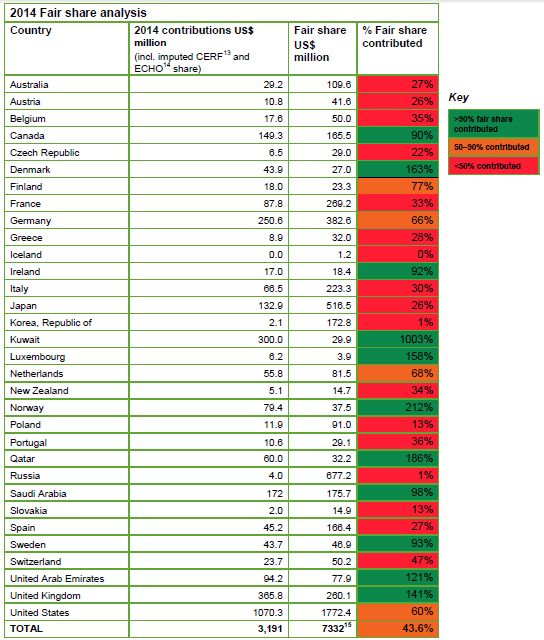
Oxfam: The international response to Syria is failing on three fronts – insufficient aid, meager resettlement offers and continued arms transfers – Oxfam warns in a report published today.
Oxfam is calling on the UN to impose an arms embargo on all warring parties in Syria and is urging governments to provide their fair share of aid, and offer a haven to greater numbers of refugees fleeing violence.
The report, A Fairer Deal for Syrians, details how the $7.7 billion humanitarian appeals are less than half funded, while a continued supply of arms is fuelling widespread violations and undermining peace efforts. Rich countries are offering a safe haven to a paltry number of refugees from Syria while neighboring countries are struggling to support more than 3 million people who have fled the conflict.
Russia, a major arms exporter to Syria, has committed only one percent of its fair share of aid. France and the USA have provided just 33 percent and 60 percent of their fair share respectively and are continuing to supply arms, undermining efforts to stop the conflict. Many Gulf countries are giving more than their fair share but need to do more to stop arms flowing. Other generous donors include the UK and Denmark. [Continue reading…]

Obama expects ISIS to still be in power when he leaves the White House
Rami Khouri: [C]ombining American militarism with Arab dictatorships is probably the stupidest recipe that anybody could possibly come up with to try to fight jihadi movements like al-Qaeda and Islamic State and others, because it was that combination of Arab autocracy and American militarism that actually nurtured and let these movements expand. There has to be a more intelligent, more realistic process that allows the people in the Middle East to roll back these threats. And these people need to be fought; I’m not saying you sit around and do nothing. You have to fight these people and eradicate them…
What do we do about this Islamic State? These guys are taking more territory. They’re enforcing their rule by force, by terrorizing people. And very few people are happily accepting them. They don’t — you know, ordinary people don’t have a choice. If the Islamic State comes in with their guns and chops people’s heads off or crucifies a couple of people, everybody else stays [inaudible]. And this should be a telltale sign that these groups only can operate in zones of chaos. And the United States and others, the British, have helped create these zones of chaos in the last 20 years in Afghanistan and in Iraq, most recently. So, there’s really a lot of shared responsibility for this terrible situation we’re in, but the bottom line is we need to figure out how to fight the two real problems, which Obama keeps repeating as his strategy, the two real problems of autocratic, nondemocratic, abusive, corrupt, pretty inefficient and mediocre Arab government systems, Arab regimes, across the board. And the other one is the repeated use of American, British, Israeli, other military power in the region to try to enforce an order that the West and the Israelis and others feel is suitable for them. Those two problems are two of the root causes of all of these issues that we’re seeing, and the Islamic State is simply a symptom of years and years of this, of these kinds of problems of bad governance.
The driving force behind President Obama’s formulation of a strategy for dealing with ISIS appears to have been the mere fact that he inadvertently revealed he lacked such a strategy.
In other words, the strategy he is about to unveil on Wednesday is not really a strategy for dealing with ISIS; it’s a strategy for dealing with the fact that he looked inept when he said he didn’t have a strategy.
Having been forced by embarrassment to quickly formulate this strategy, it appears to have been stitched together as an effort to deflect earlier criticisms. For instance, in Libya the administration was embarrassed by Obama’s reluctance to lead. This time, the New York Times reports, “the Obama administration is no longer ‘leading from behind,’ but plans to play the central role in building a coalition to counter ISIS.”
Still, by framing this as an operation likely to last longer than his administration, the president wants to insulate himself from the risk of personal failure, while most likely he passes on the most difficult phase to his successor:
The final, toughest and most politically controversial phase of the operation — destroying the terrorist army in its sanctuary inside Syria — might not be completed until the next administration.
What do we do about ISIS?
This isn’t a debate about the pros and cons of military action. As Khouri says: “You have to fight these people and eradicate them.”
If Obama invests less time on message management and more on genuine strategic thinking, then he might see that the coalition he’s trying to build should place at its core the people who have the ability and desire to fight ISIS: Syrians, Iraqis, and Kurds who should not be used as proxy forces following the commands of the Pentagon, but fighters fighting their own war with U.S. and allied support.
French jihadist, alleged ISIS torturer, ‘looking for a destiny of his own’
Nicolas Henin, a French journalist who was released in April after being held hostage in Syria by ISIS, has identified Mehdi Nemmouche, who is also French, as one of his captors. Henin says that over a period of several months he was repeatedly tortured and beaten by Nemmouche.
In July, Nemmouche was charged with murder following the killing of four people at the Jewish Museum of Belgium, in Brussels, on May 24.
The case of Nemmouche raises concerns in at least two ways: firstly, because he is viewed as a fear come true by those who warn of the risk posed to the West by European passport holders returning from the war in Syria who, having been trained by ISIS, may bring their jihad home. Secondly, his violence is being linked to the rise of antisemitism across Europe, particularly in France.
Henin’s perspective on Nemmouche is interesting because unlike terrorism experts who maintain much more distance from their subjects, the French journalist got to know this individual in a much more intimate way: as his torturer.
It would be easy to conclude that the nature of this relationship would make it impossible for Henin to be objective. Maybe so. But I think it’s just as likely that a victim of torture would feel driven to try and understand the mind of his persecutor — especially when they were in the unusual situation of sharing the same first language.
For this reason, I find Henin’s brief psychological profile of Nemmouche particularly interesting.
Henin observed that Nemmouche “came to Syria not because he wanted to fight for a specific cause but because he was looking for a destiny of his own.”
The term “radicalization” appears in the media a lot these days and it conjures up images of empty vessels — young men susceptible to being radicalized.
While that might accurately describe the hapless path that leads some into jihad, there are others — and who’s to say which are more numerous — for whom jihad simply becomes the vehicle for a destiny they were already pursuing.
My hunch is that it is the latter kind of jihadist for whom ISIS has the greatest appeal — that they are pursuing destinies of their own for which they have been provided an ideological vehicle which legitimizes and articulates their visceral drives.
France has about 70,000 prisoners, 60-70% of whom are Muslim. However prevalent the radicalization of Muslim prisoners has become, only a small minority become jihadists. Given that only 5-10% of the French population is Muslim, France’s larger concern should be that so many Muslims are being thrown in jail.
The French journalist Marc Weitzmann recounts how one prisoner describes the system.
Karim Mokhtari, who was sentenced to 10 years in the mid-1990s after he tried to rob a drug trafficker and accidentally killed him with a shotgun, reveals in his book Redemption how easy it is to be approached by Islamists there. “In prison,” he told me, “there are two things you catch as soon as you get there. One is how lonely you are, and the other is how lonely you don’t want to be. So you look in the courtyard and you ask yourself, to which group do I belong? There are the junkies, there are the dealers, there are the rapists, and so forth. And there are the religious. Cleaner than the rest, they also seem to suffer less, they take care of each other. I watched them for a week, then the improvised Imam came to me to ask if I were a Muslim and I said no, not yet, and he introduced me to someone freshly converted — a European — who taught me the first rudiments of Arabic, the first prayers and rituals. And it went on from there.”
After the conversion rate started to turn the group into a force of some sort, the administration decided out of precaution to dismantle the religious group: The imam was transferred. He came to Mokhtari’s cell, as Mokhtari told me: “ ‘Listen’ he said, ‘I’m being transferred and I must leave. But you, your mission as a Muslim is to kill. Kill miscreants anywhere you find them. You need to keep in touch for that even when you’re out so do it. And if you need military training, we have places for that too.’ ”
“That’s when I realized what I was going into,” Mokhtari said. He was the son of a violent mixed marriage, and his French mother got divorced and remarried to a racist Frenchman who lived on welfare and off robbery. … Mokhtari started to get regularly beaten by the man, who also woke him up at 4.a.m. on Saturday nights to take him along with him on his robberies of villas and apartments while Karim kept watch. But despite an incomparably more violent background than Nemmouche endured, Karim Mokhtari never turned to terrorism.
In the following film, Mokhtari describes his own redemption.
Destiny is a dangerous and intoxicating idea. It empowers the individual by allowing him to shed doubt.
Where there is no internal struggle, conviction easily translates into action. Those pursuing their destiny, swiftly move forward, while those unsure of their destiny, are more inclined to waver, aware of their capacity to make mistakes. Destiny is dangerous both subjectively and objectively.
If we believe some individuals are destined to become to become terrorists, we’re also likely to view them as irredeemable.
After Syria and Iraq, ISIS makes inroads in South Asia
Reuters reports: Islamic State pamphlets and flags have appeared in parts of Pakistan and India, alongside signs that the ultra-radical group is inspiring militants even in the strongholds of the Taliban and al Qaeda.
A splinter group of Pakistan’s Taliban insurgents, Jamat-ul Ahrar, has already declared its support for the well-funded and ruthless Islamic State fighters, who have captured large swathes of territory in Iraq and Syria in a drive to set up a self-declared caliphate.
“IS (Islamic State) is an Islamic Jihadi organization working for the implementation of the Islamic system and creation of the Caliphate,” Jamat-ul Ahrar’s leader and a prominent Taliban figure, Ehsanullah Ehsan, told Reuters by telephone. “We respect them. If they ask us for help, we will look into it and decide.”
Islamist militants of various hues already hold sway across restive and impoverished areas of South Asia, but Islamic State, with its rapid capture of territory, beheadings and mass executions, is starting to draw a measure of support among younger fighters in the region.
Al Qaeda’s ageing leaders, mostly holed up in the lawless region along the Pakistan-Afghanistan border, are increasingly seen as stale, tired and ineffectual on hardcore jihadi social media forums and Twitter accounts that incubate potential militant recruits. [Continue reading…]
Map of reported massacres by ISIS in Syria and Iraq
(More details at the Washington Post.)
As ISIS advances in Syria, Israel tightens its grip on the Golan Heights
The Economist: IS’s advance is prompting the 20,000 Druze who inhabit the Golan Heights, alongside a similar number of Israelis, to shift their allegiance. For decades under Israeli occupation they professed their loyalty to Syria. But now, as adherents of an esoteric offshoot of Islam that IS and Jabhat al-Nusra excoriate, they are quietly loosening their ties to Syria. They have stopped exporting their apples there—and their brides. Druze applications for Israeli citizenship have risen sharply, says the Israeli-appointed mayor of Majdal Shams, the biggest of the four Druze towns. Many Druze now look to Israel (and particularly to its Israeli Druze soldiers stationed on the heights) to protect their secular world, where women walk and drive their cars unveiled.
This raises the hopes of those in Israel’s hawkish government who want to extend the annexation of the Golan Heights indefinitely. Whereas a more dovish Israeli government in 1999 came close to a land-for-peace deal with Syria, few Israelis nowadays contemplate such a thing. Indeed, Israel’s current leaders often remind their voters how vulnerable Israel would have been to the threat of jihadists if its border with Syria had been realigned along the shore of Lake Galilee, as was mooted.
An army division, newly equipped with drones, and a new iron fence, are meant to secure the border. The nearby vineyards look set to provide Israel with excellent, if expensive, wine for some years to come.