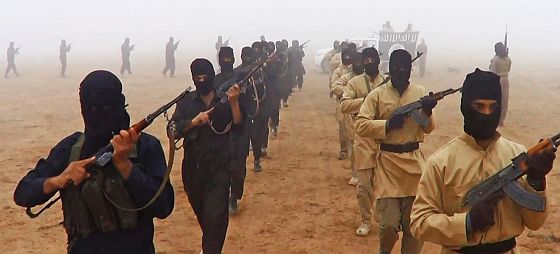
Amil Khan writes: Abdel Majed Abdel Bary, the rapper suspected of murdering American journalist James Foley somewhere between Syria and Iraq, is the product of a British youth culture that has managed to merge two seemingly contradictory lifestyles: gangsta rap and jihad. Like Douglas McAuthur McCain — an American hip-hop fan who was recently killed fighting for the Islamic State — Abdel Bary represents a new and very scary evolution in modern jihadi history.
U.S. Secretary of Defense Chuck Hagel recently described the Islamic State as a threat “beyond anything we’ve ever seen.” Yet we are only just beginning to grasp what is different about this group. One reason is that it includes men in its ranks whom you might expect to see in a nightclub rather than fighting in the desert for an organization that would, traditionally, whip you for listening to music.
As a result of this cultural elasticity, the Islamic State has succeeded in attracting supporters outside its natural recruiting pool. Both McCain and another Westerner, Denis Mamadou Cuspert, a German citizen who died fighting with the Islamic State — and had a previous life as rapper Deso Dogg with three albums to his name — became converts as part of this broader appeal.
I first began to look into this hybrid phenomenon in 2008 when I was a journalist researching a subculture that had fused the extremism and violence of gangsta rap with that of al Qaeda — or at least a version of it. During a months-long investigation for British television station Channel 4, I met dozens of young men across London who tended to have three things in common: a history of criminal activity, an ambition to be a gangsta rapper and a fixation with the terrorist group begun by Osama bin Laden. [Continue reading…]
Category Archives: Syria
British hostage David Haines held by ISIS ‘helped thousands of people’
The Telegraph reports: The wife of the British hostage David Haines has described him as “everything to us” in her first comments since terrorists threatened to behead him.
Mr Haines, 44, is a father of two described by his wife as a “fantastic man and father”.
He made his home in Croatia after spending five years helping local people, including Muslim families, rebuild their homes after the Balkans war, and the town of Petrinja, where he helped put up 800 houses, was “in shock” over his seemingly hopeless plight.
Mr Haines, who was born on Humberside but raised in Scotland, has a 17-year-old daughter by his first wife Louise and a four-year-old daughter by his second wife Dragana, who is Croatian.
Speaking at the family’s home near Zagreb, Dragana Haines, 44, said: “He’s everything to us. He’s our life. He’s a fantastic man and father.
“Nobody can understand how we are feeling. My daughter keeps asking about him every day. She hasn’t seen her father for a year and a half. She has gone through so much. She sees me crying all the time.
“My daughter was on a play date and I had to bring her home when I got the news.
“I just can’t digest it right now. We just don’t want to do anything to endanger his life.”
Mr Haines and his wife, whom he met when she worked as his translator, were due to celebrate their fourth wedding anniversary in November, having married in Croatia in 2010, when Mr Haines wore a kilt.
He was known as the “Crazy Scotsman” by locals whom he helped during several spells working for aid agencies in parts of Croatia torn apart by civil war.
When he worked for the German aid agency Arbeiter-Samariter-Bund from 1999 to 2004 Mr Haines’s landlady in the Croatian town of Petrinja was Nena Skoric, 67, to whom he affectionately referred as “Mama”.
Sitting at her kitchen table, surrounded by photographs and memories of Mr Haines, Mrs Skoric said: “To me, it was like God had sent David to this place.
“It didn’t matter to him whether people were Croats, Serbs or Muslims, as long as they needed help.
“Many of the people from all sides had destroyed each other’s houses during the war. There were many families who had lost everything.
“But they all loved David. For years after he left they would come here and ask how he was. He was such a good man and he was like one of my family.
“I don’t know what is wrong with the kidnappers. Don’t they know he was helping Muslims? They don’t seem to care about that.”
Mr Haines helped “thousands” of local people as he led efforts to build new homes and schools for refugees returning to their shattered villages, and became so frustrated at the lack of available funds that he would donate a large slice of his salary to pay for materials and other essentials. [Continue reading…]
Disillusioned British jihadists seek amnesty
The Times reports: Dozens of British jihadists have become so disillusioned with fighting in Syria that they have contacted Britain begging to come home.
One jihadist, claiming to represent 30 Britons, approached an intermediary to complain of growing despondency among the men in his group. They had gone to fight against President Bashar al-Assad’s regime but were instead engaged primarily in fierce combat with rival rebel groups, he said.
The man contacted researchers from the International Centre for Study of Radicalisation and Political Violence at King’s College London in the past two weeks. He effectively sought amnesty, saying the group feared long prison terms but would be willing to enrol on a deradicalisation program and submit to surveillance.
The militants are from a group affiliated with Islamic State. More than 500 British citizens are believed to have travelled to the region since 2011. Most have joined Islamic State.
The British man told researchers: “We came to fight the regime and instead we are involved in gang warfare. It’s not what we came for, but if we go back we will go to jail.
“Right now we are being forced to fight — what option do we have?”
Shiraz Maher, who runs a research unit at ICSR that is in intermittent contact with about 50 British jihadists, said the man regretted being involved in the conflict. [Continue reading…]
As NATO allies unite against ISIS, it’s time for the U.S. to talk to the PKK
The Washington Post reports: The Obama administration accelerated efforts Friday to build an international coalition to combat the Islamic State, winning pledges of support from nine allies but leaving questions about the extent of possible expanded military force.
The United States has waged a series of airstrikes seeking to slow the advance of the Islamic State in northern Iraq and bolster the defenses of Western-allied fighters in the Iraq’s nearby Kurdish region.
But Washington is now eager to broaden the military and diplomatic pressures on the group, which has drawn international condemnation for sending non-Muslim minorities fleeing in fear and waging bloodshed such as mass killings and the beheadings of two American journalists.
The 10-nation alliance, forged at a NATO summit in Wales, could raise worries about deepening Western military engagement in the region nearly three years after the withdrawal of U.S. combat forces from Iraq.
Secretary of State John F. Kerry and Defense Secretary Chuck Hagel used the NATO forum to hold meetings with foreign and defense ministers from nine countries: Britain, France, Germany, Canada, Australia, Turkey, Italy, Poland and Denmark.
The leaders described themselves as the core of an emerging coalition to counter the Islamic State, although they downplayed the prospect of imminent joint military action. They also left unsaid whether they were planning to attack Islamic State’s strongholds in Syria or limit their mission to Iraq. [Continue reading…]
The New York Times adds this tough-talk from Kerry: “There is no containment policy for ISIL,” Secretary of State John Kerry said at the beginning of the meeting, using an alternate acronym for ISIS. “They’re an ambitious, avowed, genocidal, territorial-grabbing, caliphate-desiring quasi state with an irregular army, and leaving them in some capacity intact anywhere would leave a cancer in place that will ultimately come back to haunt us.”
So even though the text of the statement issued by the State Department makes no mention of attacking ISIS in Syria, that’s part of the plan — right?
It’s widely recognized that the most effective force fighting against ISIS is the YPG (People’s Protection Units), the branch of the PKK (Kurdistan Workers’ Party) based in Rojava, Syrian Kurdistan.
When the U.S. claimed success in rescuing thousands of Yazidis trapped on Mount Sinjar, it was YPG fighters on the ground who played the crucial role in creating a safe corridor.
In building its international coalition to fight ISIS, the U.S. will naturally want the support of as many allies as possible, yet what could be the most productive alliance of all — with the PKK — will remain hamstrung unless Washington grows up and ditches its childish anti-terrorism fundamentalism and quickly de-lists the PKK as a so-called terrorist organization.
Not only is this particular designation unwarranted — as Henri Barkey points out, the U.S. should be willing to talk to the PKK when the PKK’s chief adversary, Turkey, is already doing so — but the whole idea of designating organizations and individuals as terrorists is itself an insult to the rule of law. Such labeling functions as a political tool used without much more subtlety than the Catholic church’s practice of branding heretics at the time of the inquisition. Democracy, however, only allows for the designation of illegal actions — not illegal opinions or affiliations.
The necessity of fighting ISIS has arisen not because it promotes a diabolical ideology; it derives from the fact that the members of ISIS are engaging in genocide, ethnic cleansing, war crimes, and crimes against humanity.
Is the PKK becoming a new Middle East power?

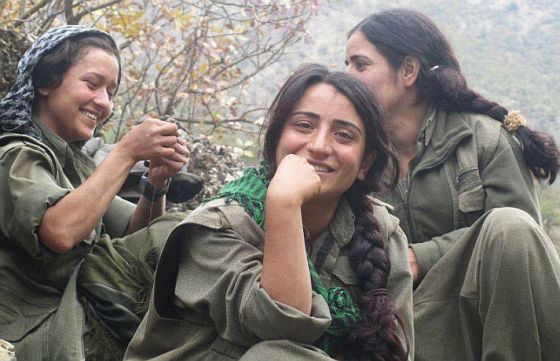
30% of the PKK’s fighters are women.
The Turkish columnist, Kadri Gursel, writes: [T]he PYD [the Democratic Union Party, the PKK’s Syrian branch] has been able to hold on to these three regions [Ras al-Ain, Kobani and Afrin, in northern Syria] and resist the jihadists for more than two years. Hence, long before IS’ capture of Mosul, the PKK already deserved to be recognized as the Middle East’s only fighting force to defy and resist IS for the struggle it has waged in Rojava [Syrian Kurdistan].
The Kurdish forces in Syria have surprised the world not only with their resolve against the jihadists but also with their female fighters. Against a barbarian mindset that enslaves and sells women as concubines, the PYD has displayed a secular mindset embracing gender equality, which has enormously contributed to its international image.
In Iraq, on the other hand, the PKK has put aside disagreements with the Kurdistan Democratic Party (KDP) to form a national military alliance against the jihadist threat to Iraqi Kurdistan.
That the Western public is already discussing the prospect of the PKK’s removal from the lists of terrorist organizations is a clear indication of how much the PKK’s struggle against the jihadists has contributed to its international standing.
Lauren Bohn reports: Standing in a parched field far from any roads in Turkey’s southeastern mountains, a teary-eyed Sokrun Gunduz clutched photographs of her two absent sons.
Mazlum, 15, is in a Turkish prison under suspicion of collaborating with the Kurdistan Workers Party (PKK), a group branded a terrorist organization by Turkey, the European Union and the United States.
Agit, 22, is in northern Iraq battling the jihadist Islamic State in Iraq and Syria (ISIS) with the same group. The young man is one of thousands of PKK soldiers who have joined the war against ISIS in Kurdish areas of Syria and Iraq, and who have become vital to the international community’s battle against the powerful Islamist insurgency.
“The Kurdish fight has spread,” the 43-year-old grocer said at a recent rally marking the anniversary of the PKK’s armed struggle against Turkey. The group has battled the Turkish state for cultural and political rights and Kurdish self-rule for 30 years in a conflict that has claimed more than 30,000 lives.
“We must protect our Kurdish brothers and sisters,” she said amid a crowd of thousands of PKK fighters and supporters celebrating the 30th anniversary of the group’s struggle. “In doing so, we will finally get our own Kurdish state.”
Many of Turkey’s Kurds – a disenfranchised minority that makes up a fifth of the country’s population – feel revitalized by the PKK’s role in Syria and Iraq, and hope their successes on the battlefield will produce political victories such as greater autonomy, more rights and perhaps even an independent state.
“In a way, we have to thank the Islamic State. They’ve united us, reviving the great Kurdish cause,” said Seyid Narin, a municipal mayor in Diyarbakir, long the center of the Kurdish resistance and separatist movement in southeast Turkey. Ten months ago he lost a son who was fighting in Syria — a second one is now in northern Iraq with the PKK.
“Our struggle is reborn,” he said.
This struggle poses a potential threat to Turkey’s ruling Justice and Development Party (AK Party) which has spearheaded efforts to restart peace talks with the terror group and now tolerates its military role in Turkey.
“Both the (ruling party) and PKK know that ISIS must be stopped … if anything, this fight will bring the AK party and Kurds closer together,” said Bedirhan Akyol, a Kurdish Justice and Development official in Diyarbakir. “The PKK is becoming stronger through this fight, but that won’t have a bad effect on peace talks.”
But Akyol’s positive spin belies a deep unease in Turkey about the PKK’s role fighting ISIS in Syria and its place in society at large. That the long reviled organization has been cast as the hero in the war against homicidal Islamist fighters has prompted alarm and anger in some circles.
The ruling party and the PKK are essentially creating laws that would result in the break- up of Turkey, said Oktay Vural, a leading Turkish opposition politician.
“The terrorists failed to divide Turkey for 30 years, but the country is now being brought to the brink of partition in the name of [Recep Tayyip] Erdogan’s political future,” he wrote in an editorial, referring to the country’s powerful prime minister and president elect.
Even some who do not consider talks with the PKK treasonous, like Vural does, worry that Turkey already has enough on its plate with the regional threat posed by ISIS and a teeming Syrian refugee population, before dealing with the legitimization of a group long branded as terrorists. [Continue reading…]
Should U.S. remove the PKK from its terrorist list?
Syria may have hidden chemical arms, U.S. says
The New York Times reports: The United States expressed concern on Thursday that Syria’s government might be harboring undeclared chemical weapons, hidden from the internationally led operation to purge them over the past year, and that Islamist militant extremists now ensconced in that country could possibly seize control of them.
The assertions by Samantha Power, the United States ambassador to the United Nations and current president of the Security Council, were made after the Council received a private briefing on the Syria chemical weapons disarmament effort from Sigrid Kaag, the United Nations official appointed last year to coordinate it. Under Ms. Kaag, 96 percent of Syria’s declared chemical weapons stockpile, including all of the most lethal materials, have been destroyed.
But Ms. Kaag told reporters after the briefing that Syria had yet to address what she described as “some discrepancies or questions” about whether it had accounted for all of the chemical weapons in its arsenal. She also said Syria had yet to destroy seven hangars and five tunnels used for mixing and storing the weapons — which is required under the chemical weapons treaty that Syria has signed. The Organization for the Prohibition of Chemical Weapons, the Hague-based group that collaborated with the United Nations in overseeing the Syrian chemical disarmament, is now responsible for ensuring that Syria honors its promise. [Continue reading…]
Israeli Arabs reported to have joined ISIS
Israel Hayom reports: Shin Bet security service officials believe that at least 10 Israeli Arabs have joined the Islamic State terrorist group and are currently fighting with the organization in Iraq and Syria, officials briefed Israeli leaders recently. The information has been discussed at length behind closed doors.
The Shin Bet assessment rests on the fact that since the outbreak of the civil war in Syria in March 2011, dozens of Israeli Arabs have joined various rebel groups currently fighting the Syrian army. The Shin Bet’s intelligence suggests that since the beginning of the civil war at least 25 individuals — Israeli Arabs known to hold radical views — have left Israel to join the “jihad” or holy war.
Meanwhile Thursday, 18 foreign fighters from the Islamic State, including an American jihadist, were killed in a Syrian air raid on a town near the militant group’s main stronghold city of Raqqa in eastern Syria, the Syrian Observatory for Human Rights reported.
The Syrian human rights group, which has tracked violence on all sides of the three-year-old conflict, said reliable sources reported that top Islamic State leaders who happened to be in the municipal building of Gharbiya at the time of the raid were among the foreign fighters killed. [Continue reading…]
ISIS gains in Syria alarm some Assad allies
Reuters reports: A mounting death toll in President Bashar al-Assad’s armed forces is causing alarm among some government loyalists who are worried about Islamic State’s territorial gains and are turning their anger on the authorities in Damascus.
The execution of scores of Syrian soldiers taken captive by Islamic State at an air base in Raqqa province has triggered unusually harsh social media criticism of the Damascus government by people who have taken its side in the civil war.
Some, including one of Assad’s cousins, have called for the resignation of the defense minister, blaming him for the loss of the Tabqa air base that represented the government’s last foothold in a province otherwise controlled by Islamic State.
With the flow of information from Syria greatly restricted, it is not possible to gauge how widely such sentiment is felt. And it is not the first time the Syrian government has faced criticism from its supporters during the three-year conflict.
But it points to a potential pressure point for Assad, who draws support from minority groups including his own Alawite community for whom Islamic State is an existential threat.
“I demand the resignation of the minister of defense, the chief of staff, the air force commander, the minister of information, and whoever is responsible for the fall of the Tabqa military airport,” Duraid al-Assad, the cousin of Bashar al-Assad, wrote on his Facebook page.
Duraid is a son of Rifat al-Assad, who left Syria after being accused of attempting a coup in the 1980s against the late president Hafez al-Assad. Contacted by Reuters via his Facebook page, Duraid said he currently lives in Syria.
His status was endorsed more than a thousand times. Dozens of people wrote comments expressing their agreement. [Continue reading…]
How #ISIS wants to exploit anti-interventionist sentiment in the West

#ISIS kills thousands of Syrians, not worthy of news, #ISIS kills an American, the world goes beserk
— Danny Makki (@Dannymakkisyria) September 2, 2014
Like any organization that takes messaging seriously, ISIS has to study its audience while crafting its messages.
In its “second message to America,” the blunt warning from the militant group boiled down to this:
… just as your missiles continue to strike our people, our knife will continue to strike the necks of your people… We take this opportunity to warn those governments that enter this evil alliance of America against the Islamic State to back off and leave our people alone.
Beheading Americans — first James Foley and now Steven Sotloff — might seem like a counterproductive way of influencing American public opinion, but ISIS isn’t interested in gaining American sympathy. It just wants the U.S. to back off.
After several months in which it has enjoyed success after success during its often unopposed advance across Iraq, U.S. airstrikes have thrown an unwelcome obstacle in the progress of this would-be Islamic state.
ISIS’s victories have been its biggest recruiting asset and the promise of life in the new caliphate is much more appealing than the prospect of getting bombed by Americans.
ISIS had four American prisoners and now it has just two. Despite its flagrant disregard for the value of human life, there should be no doubt that ISIS applies a brutal but careful calculus in deciding when to sacrifice an American life, given that it has power over so few.
The killing of Foley and Sotloff seems much less like “an announcement of global jihad” than an indication that ISIS feels threatened.
No one inside or outside ISIS can have had any illusions that President Obama — his expressed determination to protect American lives notwithstanding — would base his decisions solely on the need to protect the lives of four American captives. For that reason, neither the death of Foley two weeks ago nor that of Sotloff now, could be expected to manipulate U.S. policy.
Even so, ISIS is surely well aware that America as a country has lost most of its appetite for war and “back off” is a demand that harmonizes with the anti-interventionist sentiment to which everyone in Washington is well attuned.
Even the most gung-ho hawks nowadays always feel obliged to qualify their war-making recommendations with an obligatory promise: no boots on the ground. The Pentagon and the American public collude with each other in sustaining the deceit that military action only becomes war after American soldiers start getting killed. Thus, no boots on the ground supposedly means no war.
Post 9/11, post the war in Iraq and as we approach the end of America’s longest war — the one in Afghanistan that is generally recognized as having accomplished nothing — Americans express less a sense of defeat than an easy resignation that “the problem” is really the nature of the Middle East. “The solution” thus appears patently obvious: have nothing to do with the region.
Yes, ISIS is a monster and we helped create it, but it doesn’t operate in the U.S. And even if we did try to defeat it, we’d more likely make the problem worse and turn the U.S. into a direct target for ISIS attacks.
For many Americans, there’s clearly something comforting in this perspective, but it leaves me wondering: what happened to everyone’s sense of humanity?
We each have many layers of identity, but doesn’t the sense of being human matter more than all the others? Or does being human matter less than being American?
Some commentators argue that the alarm calls about ISIS are being driven by Empire’s insatiable lust for war — suggesting that ISIS is in some sense a manufactured threat.
That’s a view that easily finds traction on the internet, but each time I hear this I have the same reaction: who would have the audacity to make this argument directly to this Yazidi girl?
#Iraq, Becoming an almost iconic picture, #Yazidi girl with an #AK47 to protect her family against #ISIS. pic.twitter.com/CScIaBXAvM
— Danny Makki (@Dannymakkisyria) August 18, 2014
Here is a child who has to carry a gun to defend herself and her family from ISIS because there is no one else she can rely on. She has been let down by humanity.
Perversely, we now inhabit a world in which the concept of humanity seems to have gradually fallen out of circulation even among people who would have once dubbed themselves humanists.
Supposedly, the only arbiter which can be applied to determine whether the threat posed by ISIS concerns Americans is ISIS’s ability or intention to kill Americans or harm American interests.
In an interview Obama gave in January he said:
[H]ow we think about terrorism has to be defined and specific enough that it doesn’t lead us to think that any horrible actions that take place around the world that are motivated in part by an extremist Islamic ideology is a direct threat to us or something that we have to wade into.
In other words, America should only concern itself with terrorism if and when it poses a threat to America.
It’s easy to understand what has led Obama to this conclusion — it’s part of his measured effort to wind down the war on terrorism.
Yet Obama lacks the political courage, moral conviction, or imagination to propose a new paradigm through which Americans can view the world.
The terrorism paradigm has become so entrenched in the American zeitgeist that this president has done little more than make minor modifications. Indeed, he had done so while expanding the national security state.
Ironically, the failure of the terrorism paradigm is becoming particularly evident in the debate about how the U.S. should respond to ISIS.
As war-weary Americans view the Middle East, it’s worth remembering what happened in South-East Asia after the U.S. withdrew from Vietnam. Within two years the Khmer Rouge in neighboring Cambodia had embarked on the worst genocide since the Holocaust.
Kenneth M. Quinn who later served as U.S. ambassador to Cambodia wrote:
[T]he explanation for the terror and violence that swept Cambodia during the 1970s is that a small group of alienated intellectuals, enraged by their perception of a totally corrupt society and imbued with a Maoist plan to create a pure socialist order in the shortest possible time, recruited extremely young, poor, and envious cadres, instructed them in harsh and brutal methods learned from Stalinist mentors, and used them to destroy physically the cultural underpinnings of the Khmer civilization and to impose a new society through purges, executions, and violence.
As the writer Sean Thomas has noted, the parallels between ISIS and the Khmer Rouge are striking.
In many ways Isis are the Khmer Rouge with prayer mats. Both wear, or wore, black, as if to emphasise their nihilism. Both expanded – even exploded – from stupid wars engendered by the West. Both ruthlessly murdered any rival factions, ensuring that they became the sole standard-bearer for fellow travellers.
The parallels go on. The Khmer Rouge used hallucinatory violence as a technique and leitmotif – ripping foetuses from living women, smashing babies against trees – as do Isis, beheading anyone they fancy and tweeting the result, burying women and kids alive. Just as Isis are fiercely, fundamentally religious – slaughtering the infidels, the heathens, the Christians, the Shia, or even tribes of Sunnis who don’t cut the jihadi mustard, so the Khmer Rouge were fiercely, fundamentally atheist – promising to tear down every temple, and throw every single monk into the sea. Which they did.
The two forces are likewise similar in their aims and accomplishments. The Khmer Rouge managed to kill 2 million Cambodians (a third of the nation’s population), Isis will aim to kill many more than that, and they may well succeed, if they manage to get hold of chemical weapons, dirty bombs, nukes, and/or the lost souls of lonely young men in London, Paris, Moscow, and Detroit. As the KR despised and feared anyone outside their core, Isis believe we – by which I mean everyone on the entire planet who does not submit to their ideals, or convert to their deviant form of Islam – are at once a threat and an abomination, worthy of nothing but death, or grotesque servitude.
There is plenty of evidence that ISIS has committed genocide, war crimes, ethnic cleansing and crimes against humanity — as has the Syrian government. These are crimes that should concern all humanity however far removed some of us might be from the carnage.
If we reassure ourselves that these horrors are occurring somewhere else but not here, we are in a methodical and dispassionate way allowing our own humanity to slowly dissipate. As we gradually become less humane we slowly succumb to a pervasive indifference. If we might once imagined we could feel safe by standing apart from the rest of the world, in the end we will feel nothing.

In Raqqa’s training camps, ISIS teaches children how to behead
Omar Abdullah reports: This summer, in his hometown of Raqqa, 13-year-old Mohammad was forced to attend a children’s training camp established by the Islamic State of Iraq and Syria (ISIS). When his father opposed his son’s conscription, ISIS fighters threatened to kill him. Mohammad left for camp, which his father describes as a form of “brainwashing the children.” After his return, his mother says she was surprised to find in his bag a blond, blue-eyed doll – along with a large knife given to her son by his ISIS supervisors. When she confronted Mohammad, he told her that the camp manager had distributed the dolls and asked that the children decapitate them using the knife, and that they were asked to cover the dolls’ faces when they performed the decapitation. It was his homework: practice beheading a toy likeness of a blond, white Westerner.
Mohammad’s father says the other camp parents corroborated his son’s story – their children had all been given dolls and knives, too. In Raqqa, ISIS’s Syrian stronghold, residents say children are slowly being forced into lives under the Sunni militant group’s notoriously brutal interpretation of Sharia law.
Those living in the eastern city say ISIS has instituted rules banning traditional children’s games and forcibly conscripting children to ISIS. They say ISIS is recruiting children under 15 to special ISIS camps established to introduce minors to the foundations of their brand of Islam.
Some of the male children are then transferred to an adult military camp, where they are trained to use arms and fight. Sources familiar with activity inside the camp say in order to teach the children how to use knives, ISIS has distributed dolls with blond hair and blue eyes, like many Europeans and Americans, dressed in orange prison uniforms like those worn by prisoners in Guantanamo. The children are given large knives and told to decapitate the dolls.
Mohammed said that older kids were asked to show the rest of the group how to decapitate dolls. Anyone who failed to perform the task was punished. [Continue reading…]
How Obama’s half-hearted support for Syria’s rebels has empowered ISIS
McClatchy reports: North of Aleppo, the U.S.-backed Free Syrian Army is battling the Islamic State terror group over a vital supply route.
In Washington, the Obama administration is groping for a strategy to deal with a force that Defense Secretary Chuck Hagel says is “beyond anything we have ever seen.”
But in this south Turkish city, in the office of the chief of staff of the rebel force, not much is astir, and the atmosphere is funereal.
This should be the hour of coordination and brainstorming between the U.S.., its allies in Europe and the Middle East and the leadership of the appointed western-backed fighters. But according to Gen. Abdul-Ilah al Bashir, the FSA’s embittered chief of staff, they just aren’t talking.
Since December, when Islamist fighters overran the arms warehouses of the moderate rebel group. the covert U.S. program has been working directly with individual commanders, leaving the leadership structure here high and dry. Some 12 to 14 commanders receive military and non-lethal aid this way in northern Syria and some 60 smaller groups are recipients in southern Syria, al Bashir said. They report to the CIA.
“The leadership of the FSA is American,” says the veteran officer, who defected from the Syrian army two years ago and won respect for leading rebel forces in southern Syria. “The Americans are completely marginalizing the military staff. Not even non-lethal aid comes through this office.”
U.S. officials acknowledge the dysfunction, but blame al Bashir for keeping too low a profile among commanders and for not fully staffing his office. They say his title is a “business card.” Yet the failure to establish a good working relationship also reflects an ambivalence within the U.S. government that goes straight to the top.
President Barack Obama received the opposition leadership in May, and renewed his commitment to the removal of Syrian President Bashar Assad. But in an interview last month, he disparaged the fighters as “doctors, farmers, pharmacists, and so forth” and said it was a “fantasy” that they could overthrow Assad.
The issue of who hands out the weapons and funds provided by the FSA’s international backers isn’t just a turf battle between the Syrian opposition military leadership and the CIA, which runs the covert supply and training program.
According to al Bashir, the lack of communication and the CIA’s “tactical” approach to Syria prevented a timely response when the Islamic State, using weapons looted from Iraqi bases, rampaged through eastern Syria in July and seized almost the entire region bordering Iraq. One commander told McClatchy that 2,000 rebel troops were killed, along with hundreds of civilians in the fighting. Another 750 members of the Shueitat tribe were executed last month after a tribal revolt against the extremists, al Bashir said.
He said that if military aid had been distributed through the institution of the rebel Supreme Military Council, which stays in touch with all fighting fronts in the country, “the situation would be different. Terrorism and Daash” — a pejorative for the Islamic State — “would not have spread as they have today. “
“So I put the responsibility on the Americans for the spread of terrorism now on a larger scale than before,” he said. “And now the Americans are trying to combat terrorism and forget the regime at a time the regime itself is the source of this terrorism.” [Continue reading…]
‘ISIS tore our families apart. Now we’re fighting back’. Meet the Kurdish women’s resistance army

Sofia Barbarani reports: A shot rings out across an oval of dusty land, next to a man-made lake.
There, crouched in front of a light support weapon, is a young Iraqi woman, her hair in a long plait tied with a silver butterfly clip, hanging over her shoulder. Two Syrian Kurdish soldiers instruct her on how to aim and shoot, while a row of women dressed in camouflage sit beind her on a mound of sand, looking on. And awaiting their turn.
Welcome to this remote corner of Syria’s Kurdish region, between the city of Derik and the Tigris River, where a group of 11 Yazidi women are being trained to form a resistance army.
They are among more than 1,000 men and women who have joined the Sinjar Resistance Units here and are being prepared to fight by the People’s Protection Units (YPG) and Women’s Protection Units (YPJ); the female armed-wing of Syria’s Kurdish Supreme Committee.
In early August approximately 200,000 of Iraq’s estimated 600,000 Yazidis – a minority religious community – fled their hometowns in Sinjar province when the Islamic State gave them an ultimatum: convert to Islam or die.
While most found refuge in the Kurdistan Region, more than 15,000 fled to the Sinjar mountain range, where they were escorted by the protection units through a man-made ‘safety corridor’ into Syria. They have been sheltering here ever since.
Video footage from the area has shown refugees, including many children, living in unbearably hot conditions, with little food and water and reliant on aid.
But there is another side to the Yazidi experience. For, in driving these people from their homes, the extremist organisation IS – known for its barbaric treatment of women and girls – has unknowingly created an army of women, prepared to fight.
“For myself and for my people I will go to Sinjar to either die or live there freely,” 26-year-old Hend Hasen Ahmed tells me.
“We are being trained to use snipers, Kalashnikovs, rocket propelled grenades and hand grenades,” she explains. [Continue reading…]
Israel wary of Islamist militants on its borders
Reuters reports: Israel’s frontier with Syria, where militants have kidnapped 45 U.N. peacekeepers, has become a magnet for Islamist activity and Israel itself is now a target, the defense minister and security analysts said on Tuesday.
The Nusra Front, an al-Qaeda-linked group fighting Syrian President Bashar al-Assad, has established a major presence in the region, analysts said, and is poised to carry out attacks across the barren borderlands where Syria, Israel and Jordan converge.
Iran meanwhile is seeking to expand its influence in the region via its support for Assad and the Lebanese militant group Hezbollah, all of which are allied against the Sunni insurgency confronting Assad, Israeli Defense Minister Moshe Yaalon said.
“Iran’s fingerprints can be seen in Syria, including in the Golan Heights, in attempts to use terror squads against us,” Yaalon told an economic conference as he set out the combined threat from Islamist groups in Syria.
In their latest assault, Nusra Front fighters seized 45 Fijians serving as U.N. monitors in the demilitarized zone on the Golan Heights between Israel and Syria. It is demanding to be removed from global terrorism lists in exchange for their release.
“We now have Jabhat al-Nusra, which is basically al Qaeda, on the border with Israel, and Israel is a legitimate target for Muslim militants all over,” said Aviv Oreg, a retired Israeli intelligence officer and a specialist on al Qaeda.
Oreg said it was only “a matter of time” before the Islamist groups now engaged in fighting in Syria turn more of their attention towards Israel.
“I cannot tell you exactly when, but it’s very risky. It only needs one suicide bomber to cross the fence and attack an Israeli military patrol or a tractor full of farmers going to work in the fields…”
But while Israel may be growing alarmed, it is not clear that the Jewish state is a strategic priority for Nusra or other radical Sunni Muslim groups.
Their focus since 2011 has been the overthrow of Assad, a campaign that has bogged down from infighting in their ranks and Shi’ite Muslim Hezbollah’s intervention on the side of Assad.
If Israel is attacked in any serious way, the retaliation would likely be intense, setting back the insurgency and opening the way for Assad’s forces to further reclaim the initiative. [Continue reading…]
The existential threat posed by ISIS to the Middle East and beyond
Gareth Stansfield writes: ISIS have exposed a great strategic illusion/miscalculation by Western powers. This is to say that the West is clinging to a traditional, statist response to a cross-border terrorist/insurgent threat from a non-state actor. This is actually a choice of the West not to recognise the expanding threat not because ‘we’ cannot see it, but because political leaders are scared to acknowledge it – scared by the still-fresh memories of the public backlash following the invasion of Iraq in 2003, and scared by the prospect of engaging in the no-win world of Middle East politics. But the situation now is different to then. ISIS is a terrorist organisation (and a spectacularly effective one) and remains border-less. But it has also acquired a substantial chunk of territory (a development which is convincing – insofar as it substantiates the idea of the caliphate – to impressionable recruits). So we have supremely violent, ideologically rampant terrorism fused with a new, border-less version of something like a modern state. This is a new development and one that seems to be studiously, and perilously, ignored.
It is not possible to defeat ISIS by attacking their forward-placed troops on the Great Zab river as they look east towards Erbil: the ‘state’ itself would have to be targeted at its points of concentration – Mosul, Fallujah, Raqqa, Hassekeh – if the challenge of ISIS is to be met. If one were to be privy to ISIS strategy meetings around Ibrahim al-Baghdadi and his policy team in Raqqa, (and, unlike everyone else, they have articulated their vision, they do seem to have a strategy, and they certainly have policies) one would probably see a plan that sees ISIS grow in the Middle East through a combination of pushing the message of their success and thus seeing recruitment grow and neighbouring states undermined. It would be combined with an aggressive policy of territorial expansion, with Lebanon and Jordan both being prime targets. Indeed, the black flag of ISIS has already been raised in these countries.
ISIS therefore do not play by the rules of the game that still underpin much of the West’s responses to such challenges. They are making a new rule book – one that combines the most modern approaches of strategic planning, media messaging, psychological warfare, and counter-insurgency (consider how they have shut down opposition among their close partners/potential threats and implemented their own version of identifying those who could be ‘reconciled’, and those who are ‘irreconcilables’ – a technique perfected by the US in Iraq in 2007-8), with the most brutal, inhuman techniques of control imaginable. Their methods then see the organisation grow either because some followers are genuinely impressed by what is seem to be a strong organisation for once being able to stand up for them, or because some are simply too fearful of the consequences of not being in the biggest and nastiest gang around.
As their plan has unfolded, ISIS have brought two thresholds forward – one is their own advance and the reformation of realities on the ground on the Middle East; the second is the reaction of Western populations and the pressure they could bring to bear on their governments to take actions to roll back ISIS.
The question to ask now is simply which threshold will be passed first? Will ISIS succeed and strengthen the so-called Caliphate so it can no longer be dismissed as the fantasy of a self-proclaimed leader on a remarkably lucky streak, or will the international community recognise the threat of ISIS as being an actor with real agency and with aspirations that are absolutely antagonistic not only to Western interests, but to allies in the Middle East, and stop them? Neither prospect is palatable, but then neither, it seems, is muddling through and banally hoping for the best.
Arm moderates to fight ISIS in Syria, not just in Iraq
Alistair Harris writes: The growth of ISIS is a product of four factors. The first is the enabling environment of the Syrian conflict, and the Syrian government’s cynical manipulation of extremists, enabling the latter to fight the regime’s enemies. The Al-Assad regime may intermittently be bombing ISIS now, much as the US are doing in Iraq, but that is simply an attempt to salvage its claim that the regime has been ‘fighting terrorists’ since the outbreak of the popular uprising against its excesses.
The second is the regime’s use of Hizbollah and other Iranian-backed militias to attack its predominantly Sunni Syrian opponents, thus stoking sectarianism that has been exploited by ISIS.
The third is the legacy of Nouri al-Maliki’s sectarian politics, which drove disaffected and marginalised Sunni, tribal and ex-Baathist groups to make common cause with ISIS in Iraq.
The fourth is the vacuum created by the conflict in Syria and the lack of sustained international support, including militarily, to the Syrian opposition. ISIS in Syria was driven from many areas it controlled in Syria in January as a result of popular rejection and armed opposition activity.
The regime played no part in this roll back, and the failure to consolidate rebel gains against ISIS during the offensive allowed it to maintain a crucial foothold in northeastern Syria. Re-minted as ‘Islamic State’ and burnished with resources seized in Iraq, ISIS expanded its zone of control from its Syrian base in Raqqa to neighbouring Dayr aw-Zawr and beyond, with ISIS fighters even spilling over to Lebanon. As the Head of the Aleppo Provincial Council, Abdul-Rahman Dedem stated this week, forced to fight on two fronts against the regime and IS, the opposition forces in Aleppo may soon be encircled and then defeated. Some within the international community have suggested that we make common cause with the Syrian regime against IS. This is the dichotomy that Al-Assad has sought to posit from the outset; that the choice is between beheadings, crucifixions, the slaughter of minorities and the imposition of Manichean ISIS rule, and the regime as a bastion of security and a buffer against the worst excesses of the extremists. The majority of Syrians, however, reject this Faustian bargain, instead seeking peace, opportunity and a better future for themselves, their families and their country.
Contain ISIS by Supporting the Syrian OppositionAs the Syrian conflict has ground on, the international community has lacked a coherent, realistic strategy. There now needs to be an acceptance that the Syrian opposition can not defeat either ISIS or the Syrian regime without external military support. This may not and should not involve direct military intervention, but must involve an expansion of military assistance, principally with two aims. The first is to contain ISIS by supporting Syrian rebels willing to take the fight to ISIS. The opposition is already the principal target for ISIS, and is fighting (and losing) as its forces suffer at the hands of better armed ISIS fighters. The ironies are profound here. The international community baulked at providing weapons to the opposition for fear they might fall into the hands of extremists, only for ISIS to rise uncontested and seize US-supplied weapons in Iraq. The opposition has lamented that whilst they must contend with insufficient numbers of Soviet-era Kalashnikovs, ISIS enjoys access to US weaponry, courtesy of the Iraqi Army. The second objective of external military support is to create a military balance in Syria which will bring the regime to the negotiating table and hasten the end of this conflict. [Continue reading…]
The impatient jihadist
With ISIS being infamous for its brutality, one might assume that anyone joining such an extreme organization would first have to go through the ill-defined process called “radicalization.” Not so.
The story of a young Bahraini man, appearing in the latest issue of CTC Sentinel, is perhaps more representative of the path leading to violent jihad than we might imagine.
Having received a short pep talk in an ISIS office in Syria, this man signs up and then gets instruction on the cause he’s about to fight for and for which he’s ready to sacrifice his life (and the lives of others).
The jihadists grabbing the headlines these days are commonly described as living out a kind of medieval fantasy. I’m not so sure. I wonder whether on the contrary their behavior is symptomatic of a thoroughly modern affliction: the death of the interior life.
When the means through which an individual understands their identity is wholly defined by outward forms and the perceptions of others, they lose their capacity for self knowledge. An inner vacuity then has to be filled by something from outside. Most people can be satisfied with a steady supply of pleasurable distractions, whereas for others their discontent is strong enough to drive them to take up a cause.
In both cases they are running away from themselves. Some run away to Syria.
Abu Thar al-Bahrini, from Bahrain, began his story by discussing how he was “not religiously committed” in high school, although he knew that this was “wrong.” After he graduated high school with high grades, his family assumed he would go to medical school. Al-Bahrini, however, had different ideas, as he thought that this was his chance to “repent” and the best way to do that was by joining a Shari`a school in Saudi Arabia. He changed his mind, however, after deciding that the path of studying Shari`a was too long, so he made a decision to join jihad in Syria instead. At the start, al-Bahrini mentioned that he did not “differentiate between the Free Syrian Army (FSA), Jabhat al-Nusra (JN) or ISIL.” His main concern was finding a coordinator to show him the way to Syria, and collecting enough money to cover the expenses of his trip. He started to post photos of the FSA, JN and ISIL on his Instagram account, and during that time he was able to meet with a coordinator in Bahrain who linked recruits with the FSA. At this point, al-Bahrini had only 50 Bahraini dinar (about $130), and the coordinator told him that he needed at least 200 dinar (about $520) to cover his expenses. Al-Bahrini was able to convince only one of his friends to appeal to a wealthy individual on his behalf, and the affluent man agreed to cover all his expenses. For some unidentified reason, the agreement between the coordinator and al-Bahrini fell apart, so he decided to travel to Turkey alone.
“I didn’t know the route to take, didn’t have any recommendation letter, and didn’t know anything about my journey,” al-Bahrini said. “All what I knew is that I should fly to Istanbul airport, from there fly to one of the villages near the [Turkish-Syrian] borders, and then a car would take me from there to enter Syria.”
He flew to Istanbul as planned, purchased a ticket to a “bordering city,” and while he was waiting for the plane he saw “a man with a beard reading the Qur’an, and I knew that he was going to Syria.” Without hesitation, al-Bahrini approached the man, and said to him confidently: “you are going to Syria and I’m going with you.” After a short discussion, al-Bahrini convinced the man to help him. “The man was in touch with coordinators from the Free Syrian Army,” who were supposed to smuggle him into Syria to join JN. They went to a house used by the FSA as a clinic in Turkey, and on the second day a “brother from ISIL came to that house to visit his friends,” al-Bahrini explained. “We told him that we are going to join JN in Idlib, and he offered to take us to JN after we enter Syria.”
Two days after they entered Syria, the same person from ISIL came to them, explained the tensions between the two groups, and suggested they join ISIL instead of JN. They found the explanation complicated, as they knew little about the mujahidin, Usama bin Ladin or any basic jihadist issues, so he took them to one of ISIL’s headquarters so they could learn more about jihad in general and ISIL in particular. After a short interview with the group’s amir of that area, al-Bahrini was sent to a training camp and took military courses and a Shari`a class where he learned “the correct creed.”
Al-Bahrini’s parents were religiously committed, but in his opinion they “were not following the correct creed” because they believed that “jihad now is selective duty and not an individual duty.” Therefore, al-Bahrini decided not to inform them about his intentions to travel to Syria. Once he arrived at the Istanbul airport, al-Bahrini posted a scanned copy of his “ticket and passport on his Instagram account to inform his family about his real intentions to migrate to Syria.” Despite his family’s best efforts, they could not convince him to return to Bahrain. Al-Bahrini concluded his story by acknowledging that his mother and brother, who was a soldier in the Bahrain army, later visited him and were both convinced to join ISIL’s ranks in Syria.
Al-Bahrini appeared in the recently released ISIL video Salil al-Sawarim 4 (Sound of the Swords Clashing 4), in which he delivered a short and powerful speech followed by him ripping up his Bahraini passport and promising to “return to Bahrain not with this useless passport, but marching with ISIL army to liberate all Muslim lands.”
ISIS’s carefully crafted multimedia message
The New York Times reports: ISIS propaganda … has strikingly few calls for attacks on the West, even though its most notorious video, among Americans, released 12 days ago, showed the beheading of the American journalist James Foley, threatened another American hostage, and said that American attacks on ISIS “would result in the bloodshed” of Americans. This diverged from nearly all of ISIS’s varied output, which promotes its paramount goal: to secure and expand the Islamic state. Experts say that could change overnight, but for now it sharply distinguishes ISIS from Al Qaeda, which has long made attacks on the West its top priority.
And while ISIS may be built on bloodshed, it seems intent on demonstrating the bureaucratic acumen of the state that it claims to be building. Its two annual reports so far are replete with a sort of jihadist-style bookkeeping, tracking statistics on everything from “cities taken over” and “knife murders” committed by ISIS forces to “checkpoints set up” and even “apostates repented.”
ISIS media frames its campaign in epochal terms, mounting a frontal assault on the national divisions and boundaries in the Middle East drawn by Western powers after World War I. These “Crusader partitions” and their modern Arab leaders, ISIS argues in its English-language magazine, were a divide-and-conquer strategy intended to prevent Muslims from unifying “under one imam carrying the banner of truth.”
That sense of historical grievance is an old theme for Al Qaeda and more moderate Islamist groups. The difference is that by capturing expansive territory and heavy weaponry, and flush with wealth from kidnappings, oil piracy, bank robbery and extortion, ISIS claims to have taken a major first step toward righting what it sees as this ancient wrong, creating a unified Muslim state that will subsume existing nations. [Continue reading…]

Abu Thar al-Bahrini, from Bahrain, began his story by discussing how he was “not religiously committed” in high school, although he knew that this was “wrong.” After he graduated high school with high grades, his family assumed he would go to medical school. Al-Bahrini, however, had different ideas, as he thought that this was his chance to “repent” and the best way to do that was by joining a Shari`a school in Saudi Arabia. He changed his mind, however, after deciding that the path of studying Shari`a was too long, so he made a decision to join jihad in Syria instead. At the start, al-Bahrini mentioned that he did not “differentiate between the Free Syrian Army (FSA), Jabhat al-Nusra (JN) or ISIL.” His main concern was finding a coordinator to show him the way to Syria, and collecting enough money to cover the expenses of his trip. He started to post photos of the FSA, JN and ISIL on his Instagram account, and during that time he was able to meet with a coordinator in Bahrain who linked recruits with the FSA. At this point, al-Bahrini had only 50 Bahraini dinar (about $130), and the coordinator told him that he needed at least 200 dinar (about $520) to cover his expenses. Al-Bahrini was able to convince only one of his friends to appeal to a wealthy individual on his behalf, and the affluent man agreed to cover all his expenses. For some unidentified reason, the agreement between the coordinator and al-Bahrini fell apart, so he decided to travel to Turkey alone.