Category Archives: Syria

Alternative Left perspectives on Syria

Danny Postel writes: The responses of most leftists to the Syrian uprising and subsequent war (it’s often forgotten that it started as an uprising — indeed a nonviolent and nonsectarian one) have been deeply disappointing. Disappointing to many Syrian activists, and to many of us on the Left who support the Syrian struggle for dignity and justice, which is now a struggle against both Assad’s killing machine and the jihadi counter-revolutionary forces.

The Left’s responses fall into three main categories:

  1. explicit support for the Assad regime
  2. monochrome opposition to Western intervention, end of discussion (with either implicit or explicit neutrality on the conflict itself)
  3. general silence caused by deep confusion

The first camp, while relatively small, represents a truly hideous, morally obscene and, I would argue, deeply reactionary position – siding with a mass murderer and war criminal who presides over a quasi-fascist police state. [Continue reading…]

Facebooktwittermail

800 dead from hunger, illness inside besieged Aleppo prison

Dania Akkad reports: At least 800 prisoners, trapped in a Syrian jail for more than a year as army officers inside and surrounding rebels battle, have died as a result of starvation and illness, according to a former prisoner, a current prisoner and an organization documenting the prison’s conditions.

An estimated 2,400 prisoners – including women and children – remain in the Central Aleppo Prison in which guards intentionally withhold food and medicine, according to the prisoners and a spokesman for the Damascus-based Violations Documentation Center.

“Death surrounds us,” Mohammed, a current prisoner who says he bought a phone from a guard and asked only to be identified by his first name, told the MEE. “And fear, and hunger, and cold, and illness and darkness and our unknown fate.”

Though independently unverifiable, Mohammed’s claims are supported by a Violations Documentation Center report on the prison scheduled to be released this week and a UN official who asked to remain anonymous. [Continue reading…]

Facebooktwittermail

Evaporated in Syria, the most dangerous place in the world for journalists

James Harkin writes: On May 23, 2012, a 30-year-old Georgetown University law student and former Marine captain, adapting to his newly reduced circumstances as a freelance journalist, crawled under a fence from southern Turkey into northern Syria. Austin Tice had not yet published a single article, but it didn’t matter. Since mass demonstrations had spilled over into a full-scale armed insurgency against the regime of President Bashar al-Assad six months before, Syria was the story that everyone wanted—all the more so because, with the Syrian government keeping a tight lid on visas, hardly any journalists were in the country. Just about the only way inside was to smuggle yourself under the protection of armed rebels, which suited Tice just fine. As a soldier, he already had tours in Afghanistan and Iraq under his belt. Now his ambition was to go back to the region with a fresh pair of eyes and launch a new career as a journalist.

His guide was a bespectacled Syrian-American in his early 50s named Mahmoud—wiry and stubborn, a bit like an older, shorter, Syrian version of Tice himself. After I met him, Mahmoud would show me training videos he had made, one revealing a pro-regime militiaman lying dead at his feet. Tice and Mahmoud bonded quickly, as people do in war zones; Tice would poke fun at Arab procrastination and Mahmoud would call him “White Boy.” Until a few months before, Mahmoud had been leasing out heavy equipment in Atlanta; now he was a soldier in the new Free Syrian Army and on his way to becoming a brigade commander. Things were changing fast, and it was possible to believe that before long the rebels would be in Damascus, and Syria’s creaking Ba’thist regime would be history. Within two days, Tice and Mahmoud had made it to a rebel base in the province of Hama, where Mahmoud had contacts. “Writing like a maniac,” Tice wrote on Twitter, “taking photos, working like crazy.”

Tice turned out to be a gifted journalist. Laid out in scattershot bursts on Flickr and Twitter, mixing descriptions of field maneuvers with the Free Syrian Army and references to country pop, Tice’s information trail made for a thrilling, hard-charging alternative to the flak-jacketed puppetry of much war-zone reporting. He bantered about soccer with rebels in the central Syrian province of Homs, drew on his military background to analyze the weapons and strategy of both sides, and ribbed The New York Times and the rest of the international media for their inability to put a journalist on the ground. (“Srsly guys if any of y’all wanna come down here, I would love some company,” he wrote on Twitter.) Tice’s headstrong, impudent side wasn’t to everyone’s taste—on at least one occasion his rebel hosts had to put him under house arrest for his own safety—but he had the merit of being funny. “Tonight made a good-faith effort to explain gay rights to a fun and well-meaning group of Syrian guys,” he wrote at one point. “Yeah, not the time, not the place.”

In Homs, Mahmoud left to go back north, after which Tice was passed from tiny battalion to tiny battalion, making friends quickly and trusting those he met with his life. By July he had made it to Yabroud, a city north of Damascus, and was writing for The Washington Post. It was around this time, too, that he composed a kind of mission statement as a defense of what he was trying to achieve. [Continue reading…]

Facebooktwittermail

Latakia: In Assad’s coastal heartland, Syria’s war creeps closer

Reuters reports: For three years, residents of Syria’s Mediterranean provinces have watched from their coastal sanctuary as civil war raging further inland tore the country apart, killing tens of thousands of people and devastating historic cities.

But a three-week-old offensive by rebel fighters in the north of Latakia province, a bastion of President Bashar al-Assad’s Alawite minority, has brought the battle ever closer and shattered that sense of relative security.

Rebels are now fighting in the hills overlooking the sea, bringing the country’s main port of Latakia within their range – rocket-fire killed eight people in one barrage on the city a month ago – and Syria’s coast feels under real threat.

“They can erase us, even those of us who support them,” said a young Alawite woman as she drank coffee with her fiance in a Latakia cafe, 50 km (30 miles) south of where have rebels seized their first toehold on Syria’s coast, by the Turkish border.

While many Alawites, roughly 10 percent of Syria’s 23 million people, have actively supported Assad, others sympathized with the popular revolt against him in 2011 but now fear reprisals from his mainly Sunni Muslim enemies.

Memories of a rebel offensive in August, when scores of Alawite villagers near Latakia were killed by radical Sunni Islamists and foreign jihadists, heighten tensions in the bustling streets of the city of 400,000. [Continue reading…]

Facebooktwittermail

Climate change-fueled droughts are about to make Syria even more hellish

Brian Merchant writes: In a 2011 study, scientists at the National Oceanographic and Atmospheric Administration determined that climate change was at least partly responsible for the more frequent droughts withering the Mediterranean region. Both veteran foreign policy analysts and climate experts have blamed a particularly debilitating spate of those droughts for setting the stage for the violent conflict that would unfold in Syria. Climate change, it can be said, warmed Syria up for war.

“The magnitude and frequency of the drying that has occurred is too great to be explained by natural variability alone,” Martin Hoerling, Ph.D. of NOAA’s Earth System Research Laboratory, said in October of the same year that unrest broke out in the Middle East. Now, the drought is on the verge of returning en force, and it could exacerbate the already considerable suffering of the refugees, victims, and citizens caught in the crossfire of the interminable conflict.

“A drought could put the lives of millions more people at risk,” Elisabeth Byrs, a spokeswoman for the UN’s World Food Programme (WFP), said at a Tuesday briefing on a new report that outlines the incoming threat. [Continue reading…]

Facebooktwittermail

Seymour Hersh as Dorian Gray

The following piece by Louis Proyect is the sixth article I’ve posted in response to Seymour Hersh’s “The Red Line and the Rat Line” which appeared in the London Review of Books on Sunday.

How can one article merit this amount of attention and criticism?

In terms of its substance, it does not. Had such a thinly-sourced report been written by anyone else, the LRB wouldn’t have touched it — it would more likely have appeared somewhere like Mint Press or Alex Jones’ Infowars.

But whenever the byline “Seymour Hersh” appears in the media, shock-waves ripple across the planet. His latest blockbuster always commands that governments respond. Within hours official statements get circulated to the press.

It’s an unfortunate effect because this reaction to Hersh lends his reporting more gravity than its most recent examples deserve. Moreover, the fact that he can prompt such swift responses reenforces the perception that this is a man who through telling the truth, has the power to shake the establishment. Thus, there seems all the more reason to treat his “revelations” as authoritative.

However, for me (and a few others) the reason Hersh’s work demands attention at this time, is because it reveals a malaise on the Left.

A fear of “Islamic terrorists” or “jihadists” which a decade ago served as the fuel powering the neoconservative enterprise, has since then percolated across the political spectrum and turned into a widely accepted means to delegitimize the Syrian revolution.

It is now not uncommon to hear people suggest that after Bashar al-Assad has killed tens of thousands of his own people and turned cities to rubble, for him to remain in power would be the lesser of two evils.

It’s either Assad or the wild men who eat human hearts for breakfast, many on the Right and the Left now believe.

Islamophobia which used to reside on the Right has now acquired a veneer of cosmopolitan “realism.”

This is why the attention I’m giving to Hersh is not all about the veteran investigative reporter. He merely highlights a much wider corruption of thought.

Louis Proyect’s choice of metaphor is both provocative and appropriate.

Proyect writes: Like his last article for the London Review of Books, Seymour Hersh’s latest continues to demonstrate that he is no longer a trenchant and truthful investigative reporter. Instead the portrait of a decaying and sloppy propagandist is taking shape, just as damning as the one that caught up with Dorian Gray. While Gray recoiled in horror from what he saw, it is likely that Hersh will persist in his ways since so many of his fans are also committed to demonizing the Syrian rebels and rallying around the “axis of good” in Syria, Iran and Russia. With this 77 year old reporter so badly in need of correction, it is almost tragic that none will be made.

To start with, he likens Barack Obama to George W. Bush as if the rhetoric about “red lines” were to be taken seriously. Hersh believes that he was held back by “military leaders who thought that going to war was both unjustified and potentially disastrous.” I often wonder if people like Hersh bother to read the NY Times or — worse — read it and choose to ignore it.

In fact there was zero interest in a large-scale intervention in Syria in either civilian or military quarters. All this is documented in a NY Times article from October 22nd 2013, written when the alarums over a looming war with Syria were at their loudest, that stated “from the beginning, Mr. Obama made it clear to his aides that he did not envision an American military intervention, even as public calls mounted that year for a no-fly zone to protect Syrian civilians from bombings.” The article stressed the role of White House Chief of Staff Dennis McDonough, who had frequently clashed with the hawkish Samantha Power. In contrast to Power and others with a more overtly “humanitarian intervention” perspective, McDonough “who had perhaps the closest ties to Mr. Obama, remained skeptical. He questioned how much it was in America’s interest to tamp down the violence in Syria.” In other words, the White House policy was and is allowing the Baathists and the rebels to exhaust each other in an endless war, just as was White House policy during the Iran-Iraq conflict.

These pacifist military leaders, Hersh assures us, were suffering sleepless nights over Turkey’s bellicose role in the region.

‘We knew there were some in the Turkish government,’ a former senior US intelligence official, who has access to current intelligence, told me, ‘who believed they could get Assad’s nuts in a vice by dabbling with a sarin attack inside Syria — and forcing Obama to make good on his red line threat.’

With all these unnamed military leaders and spooks at his beck and call, who are we to question Hersh’s analysis? I don’t know, maybe it’s just me, but I don’t put much store in unnamed inside-the-beltway sources after putting up with Judith Miller’s “reporting” in the NY Times back in 2003:

Having concluded that international inspectors are unlikely to find tangible and irrefutable evidence that Iraq is hiding weapons of mass destruction, the Bush administration is preparing its own assessment that will rely heavily on evidence from Iraqi defectors, according to senior administration officials.

I understand that most people on the left are willing to take Hersh’s word at face value but I suppose that is to be expected when they are also partial to RT.com and Iran’s PressTV. Like the Obama voter who takes Rachel Maddow by the loving spoonful, these “radicals” find their bliss in media outlets that do not pass the smell test. [Continue reading…]

Facebooktwittermail

Where is Hersh’s secret Turkish chemical weapons factory?

Dan Kaszeta writes: [O]f all Hersh’s claims, his biggest evidentiary pitfall is in the Turkish Sarin hypothesis. Somehow, Hersh would have us all believe that there is a large factory somewhere in Turkey, a member of NATO and signatory to the OPCW. A factory of the necessary size to make tons of short-shelf life binary Sarin would be huge, at least similar in scale to the UK’s pilot plant that once stood in Nancekuke, Cornwall. It would have many employees, a supply chain of controlled and prohibited chemicals, and a waste stream that would be noticed. Where is this factory? Let us have an OPCW challenge inspection.

More importantly, would Turkey risk the international opprobrium to produce a weapon that, after all, has only limited actual tactical use? Somehow, this Sarin was produced, using a secret hexamine acid reduction process hitherto unknown to the world, and only mastered by Syria’s chemical weapons program. It was put into rockets that are exact copies of Syrian ones, down to the paint and bolts. The Sarin-filled rockets were smuggled via the “rat line” into Syria to Damascus, without a single one being caught. And quickly, I should add, due to the short shelf life of binary Sarin. Then they were supposed to be fired onto rebel areas from government positions without the Syrian regime knowing about it? It defies belief.

Finally, we get to the biggest deficit of all. Seymour Hersh seems unencumbered by the fact that the Assad regime confessed to having a chemical weapons research, development, and production program. Which is the more likely scenario? The Turkish-produced Sarin tale, which relies on a very dubious “inside source” in Washington and no accompanying physical evidence? Or the idea that the Assad regime, using a chemical warfare agent made according to a formula they confessed to, used rockets in their own inventory to attack from their own positions against rebel-held territory? History will tell us, eventually. But one of these tales is sounding more probable than the other.

Facebooktwittermail

Was Hersh duped by a forged document?

Jeffrey Lewis writes: Well, there are plenty of reasons to doubt Sy Hersh’s recent reporting implying that the chemical weapons attack on Ghouta was some sort of Turko-Saudi-Al Nusra false front attack — I am rolling my eyes as I write it — and not a single one to buy any of it. Dan Kaszeta has explained all the technical problems with the scenario, while Aaron Stein provided a lot of the missing context here at ACW for things asserted about Turkey and Turkish foreign policy.

I don’t have much to add, the but the erstwhile Washingtonian in me noticed this passage:

“Asked about the DIA paper, a spokesperson for the director of national intelligence said: ‘No such paper was ever requested or produced by intelligence community analysts.’”

Normally, the response is to “no comment” specific reporting on intelligence matters. Does that mean it is a forgery? Because I love forgeries.

Well, I hate forgeries — but I find them fascinating. I find it hard to explain why, other than to say I am interested in public policy as a discipline that studies national security decisions. Understanding who made what decision and why requires working with historical materials. The notion that some of these materials might be forgeries — or that perhaps decisions were made on the basis of forgeries — has always struck me as interesting. Perhaps that is also because, as someone who prefers Cold War history to other eras, the role of intelligence agencies in controlling information as part of a broader ideological struggle has always seemed like a central part of the Cold War story that seldom finds its way on to center stage.

There are always incentives to feed bum information into the analytic process. This is sometimes called the ”paper mill” problem. [Continue reading…]

Facebooktwittermail

Assad: ‘The project of political Islam has failed’

AFP reports: The “project of political Islam has failed,” Syria’s President Bashar al-Assad said on Monday, calling for the separation of religion from politics, state television said.

Assad’s regime has been battling an uprising that has come to be dominated by Islamists, ranging from moderates to radicals, who want to see Syria run as an Islamic state.

“The project of political Islam has failed, and there should be no mixing between political and religious work,” he said in comments on the 67th anniversary of the founding of his Baath party.

These are the observations of a man whose life has been saved by the Islamic Republic of Iran and Hezbollah. If Assad really opposes the mixing of political and religious work, how could two of the region’s preeminent proponents and practitioners of political Islam still be his chief allies?

Facebooktwittermail

U.N. has to cut Syria food rations for lack of donor funds

Reuters reports: The United Nations has been forced to cut the size of food parcels for those left hungry by Syria’s civil war by a fifth because of a shortage of funds from donors, a senior official said on Monday.

Nevertheless, the United Nations’ World Food Programme managed to get food to a record 4.1 million people inside Syria last month, WFP deputy executive director Amir Abdulla told a news conference, just short of its target of 4.2 million.

As the humanitarian crisis within Syria intensifies, its neighbors are also groaning under the strain of an exodus of refugees that now totals around 3 million, U.N. High Commissioner for Refugees Antonio Guterres said.

“We know that this tragedy, together with the tragedy of the people displaced inside the country, 6.5 million, now shows that almost half of the Syrian population is displaced.”

Donor countries pledged $2.3 billion for aid agencies helping Syria at a conference in Kuwait in January, but only $1.1 billion has been received so far, including $250 million handed over by Kuwait on Monday, U.N. officials said. [Continue reading…]

Facebooktwittermail

Long a survivor in Syria, a Dutch priest is slain

The New York Times reports: The Rev. Frans van der Lugt, a Dutch Jesuit priest who became a symbol of suffering and compassion in the war-ravaged Old City district of Homs, Syria, was shot to death Monday morning by a lone gunman, according to members of his order. The killing came amid growing disputes between Syrian insurgents blockaded in the Old City — those who want to accept an amnesty from the government in exchange for laying down their arms, and those who do not.

After Syrian government forces isolated and laid siege to the rebel-held Old City for more than a year, a truce in January allowed the evacuation of 1,500 people, both civilians and fighters. But Father Frans, as he was known, insisted on remaining in the monastery where he had lived for decades, offering refuge to Muslim and Christian families alike and sharing their deprivation and trauma.

The killer’s identity and motives were not known, but the attack carried a heavy symbolic importance. Though he was European, Father Frans, 72, had come to be considered part of Syrian society and was well known in and around Homs, including among local insurgents in the Old City. He survived there long after foreign fighters from the Islamic extremist group Nusra Front moved in and raised new fears for the few Christians who remained.

But now, something had changed, and he could no longer be protected. Fingers quickly pointed in all directions.

“The death of the priest is a scandal for the rebels,” said Mahmoud Taha, an antigovernment activist in Talbiseh, a village near Homs where the Jesuits run a center for the elderly. Mr. Taha speculated that the local Homs fighters had become radicalized. “They no longer accept anyone but those who are like them,” he said.

The Syrian exile opposition coalition said in a statement that Father Frans was protected by rebels, including a guard from the Free Syrian Army who was shot in the chest in the attack.

Amir Bader, an antigovernment activist in the Old City, said most of the fighters did not regard the priest as an enemy.

“Maybe some fanatic shot him,” Mr. Bader said, “or some regime associate did it, so the regime will show all the Christians: ‘Look what will happen to any of you if you support the revolution like Father Frans.’ ” [Continue reading…]

Facebooktwittermail

Does Seymour Hersh understand how hexamine fits into Syrian sarin?

On Democracy Now! today, Amy Goodman provided Seymour Hersh with an opportunity to summarize the contents of his article which appeared at the London Review of Books yesterday.

The only juncture in the interview where Goodman challenged Hersh on the substance of his claims, came when she cited a post written by Scott Lucas which appeared at EA Worldview yesterday. In that post, Lucas reiterated a point he had made last December in response to Hersh’s first article on the chemical attack, referring to one of the many reasons that the scale of the attack was an indication that only the regime had such capabilities:

Reports on the day and subsequently indicated that 7-12 sites were attacked with chemical agents at the same time. In other words, whoever was responsible for the attacks launched multiple surface-to-surface rockets with chemical payloads against opposition-held towns in East Ghouta and one town in West Ghouta, near Damascus.

In part of his response to this challenge, Hersh said:

You have a UN report, you have this independent report, saying [the missiles used in the chemical attack] went no more than one or two kilometres and so I don’t know why we are talking about multiple launched rockets. These were homemade weapons and it seems very clear to most observers, as I say even to the UN team that did the final report — the UN because of whatever rules they have, wasn’t able to say that, who fired what, they could just say, they could just describe the weapons and never make a judgement, but I can tell you, I quote somebody from inside that investigation unit who was very clear that the weapons [that] were fired were homemade and were not Syrian army. This was asked and answered.

Hersh has a habit of making stronger claims in interviews than he is willing to make in writing.

Although on Democracy Now! he said “I quote somebody from inside that investigation unit” in the article itself he merely quotes a “person with knowledge of the UN’s activities.”

If this person was actually inside the investigation unit, why didn’t Hersh put that in print?

In the interview, Hersh says this person “was very clear that the weapons [that] were fired were homemade and were not Syrian army,” yet quoting this individual he wrote: “Investigators interviewed the people who were there, including the doctors who treated the victims. It was clear that the rebels used the gas.”

Note: Hersh’s source refers to “investigators,” not “our investigation” — a suggestion that the source was not in fact inside the investigation — and the source makes no direct reference to the construction method of the weapons.

In tune with the interests of his audience, Hersh prefers to tell political stories. Technicalities serve as nothing more than stage props and for this reason, it should come as no surprise that his televised engagements are generally solo performances, which is to say, he doesn’t get interviewed alongside experts who could quickly expose the weakness of his arguments.

For instance, a pillar of the argument that Hersh is making about the chemical attacks in Ghouta was that the weapons and the sarin they contained were homemade.
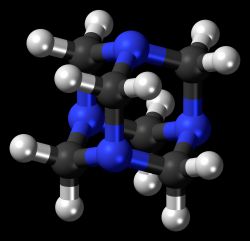
hexamineNow if Amy Goodman had wanted to pose a really tough question to Hersh she could have asked: How do you explain the presence of hexamine found on the remains of the missiles used in the chemical attacks?

That’s not the kind of question Hersh is likely to have thrown at him by Goodman or any other interviewer since neither he nor the interviewer would be likely to understand its significance.

Still, when the subject is chemical weapons and the media is able to see whether Hersh’s claims can withstand expert analysis, then that is exactly how his reporting should be tested.

It’s safe to assume that Hersh will never divulge the identity of any of his sources and so their credibility cannot be separated from his credibility. But Hersh’s assertion that the weapons and warheads used in the attack were homemade and that they lacked the identifying characteristics of Syrian army weapons, is a substantive claim that has to be supported by evidence.

The only physical evidence Hersh cites is sarin collected by Russian military intelligence operatives and passed on to British military intelligence at Porton Down.

This is worthless. For Hersh to attest to the reliability of this evidence by citing his own source’s claim that “the Russian who delivered the sample to the UK was ‘a good source – someone with access, knowledge and a record of being trustworthy’” is a joke.

Russia is an ally of Syria. The whole point of having UN weapons inspectors gathering evidence is that they are international and independent.

Dan Kaszeta, a former US Army and US Secret Service specialist on chemical, biological, and radiological defense, last year laid out the reasons why neither al Nusra nor any other non-state actor would have the capabilities to produce sarin in the quantity used in the Ghouta attacks.

Having presented the technical reasons why rebel-produced sarin was highly implausible, Kaszeta went on to make an important discovery about a unique feature of the sarin produced by the Assad regime — something that has never been observed before: the use of hexamine.

Sarin used in chemical weapons contains hydrogen flouride — “one of the most corrosive chemicals in existence.” Although hexamine has a diverse array of applications, Kaszeta suspected that Syria was using it as the acid reducer in sarin to mitigate the corrosive effects of hydrogen flouride. That suspicion was confirmed by the UN/OPCW inspection mission.

Ake Sellstrom, the head of the mission, was interviewed by CBRNe World magazine in February and asked:

CBRNe World: Why was hexamine on the list of chemical scheduled to be destroyed – it has many other battlefield uses as well as Sarin? Did you request to put it on the list or had the Syrian’s claimed that they were using it?

Sellstrom: It is in their formula, it is their acid scavenger.

To summarize:

  • The Syrian government has never claimed that it lost control of any of its CW arsenal.
  • It has acknowledged that hexamine was part of its formula for producing sarin.
  • Nobody else has previously used hexamine as a sarin additive.
  • Hexamine was found in the field samples collected by CW inspectors in Ghouta after the attacks.
  • Syria included 80 tons of hexamine in its declared inventory for CW destruction.

Add these facts together and there can be little doubt that, as Dan Kaszeta says, “the Assad regime did the wicked deed.”

Then again, who wants to hear about hexamine when instead they can listen to Seymour Hersh spinning tales about false flags?

Facebooktwittermail

Seymour Hersh’s Volcano problem

Eliot Higgins writes: Yesterday, the London Review of Books published a second piece by Seymour Hersh on the August 21st Sarin attack. In an earlier piece published in December 2013, Hersh had approached the attacks from two angles, that the White House had used dodgy intelligence in the build up to intervention in Syria, and that the evidence suggested the munition used were improvised, and therefore it was likely the opposition was responsible. While the first point is certainly worth exploring, especially in light of information gathered about the attacks since August 21st, the second point was extremely flawed, with there being clear evidence of the government using the type of munitions linked to August 21st going back to late 2012, which I detailed in my piece Sy Hersh’s Chemical Misfire.

In his latest piece on August 21st, Seymour Hersh presents a narrative where the Turkish intelligence services aided the Syrian opposition in carrying out a false flag attack on August 21st, using one “former intelligence” source in particular. EA Worldview has already put together an excellent response highlighting some of the major flaws in Hersh’s piece, in particular the use of one source for most of his accusations, and I’d like to focus on one particular aspect of the attacks that Hersh appears to be ignorant of, or has chosen to ignore.

In the aftermath of the Sarin attack on Eastern Ghouta on August 21st, the remains of munitions that were practically unknown where recorded at several impact sites (shown below)

After months of research it has been possible to gather a significant amount of information about these rockets. [Continue reading…]

Facebooktwittermail

Seymour Hersh’s alternate reality

The Pulitzer Prize winning veteran investigative journalist Seymour Hersh was once a regular contributor to the New Yorker. He also wrote for the Washington Post. No more.

Last December he had to turn to the London Review of Books to publish, “Whose sarin?” and his latest piece on Syria appears at LRB today.


A truth-teller shunned by the American mainstream media!

I have little doubt Hersh revels in the image — it plays so well among those who revere him.

But just pause for a minute to think about this: Is Hersh’s reporting so radical, such a threat to the political establishment, that he couldn’t get published by Rolling Stone, or Vanity Fair, or the Boston Review, or Mother Jones, or any of the dozens of new long-form online publications that don’t seem lacking in boldness or creativity?

I doubt it. On the contrary, I think the image of a journalist-in-exile is simply Hersh’s latest vanity.

But if it turns out that there really is no publication this side of the Atlantic that will touch his work, maybe that would say less about a decline in the standards of American journalism and a lot more about the demise of Hersh’s credibility.

When it comes to Hersh’s reporting on Syria, one story that really deserves deeper investigation is whether he has become a stooge for Michael Maloof, a former senior security-policy analyst at the Pentagon who helped gather the bogus intelligence that lay the foundations for the war in Iraq. The fact that both of them have been spinning such similar yarns in recent months seems like more than a coincidence

The most inexcusable feature of Hersh’s reporting is that he effectively functions as his own source. In other words, for readers smitten by his reputation, what he reports is treated as fact for no other reason than the fact that he reported it.

Each time he comes out with a new piece, it’s like Moses coming down from the mountaintop. No one dare ask whether he really heard the voice of God, because no one questions Moses.

For his latest piece, Hersh’s primary source is a “former intelligence official.”

I can picture the two leaning against a bar somewhere in DC as the old hack furiously takes notes. What makes this former official’s word unimpeachable, we’ll never know — suffice to know is that just as Hersh unquestioningly believes his source, we are supposed to believe Hersh, without corroborating sources, without any hard evidence.

Just by chance, a few days ago, Bashar Ja’afari, Syria’s ambassador to the U.N., sent a letter to the Security Council on March 27, saying:

The competent Syrian authorities intercepted a wireless communication between two terrorists in the Jawbar area of Damascus governorate. In that communication, one of the terrorists said that another terrorist named Abu Nadir was covertly distributing gas masks. The authorities also intercepted another communication between the two other terrorists, one of whom is named Abu Jihad. In that communication, Abu Jihad indicates that toxic gas will be used and asked those who are working with him to supply protective masks.

This information … confirms that armed terrorist groups are preparing to use toxic gas in Jawbar quarter and other areas, in order to accuse the Syrian government of having committed such an act of terrorism.

“Terrorists” talking about gas masks who knows when and this “confirms” another gas attack is on the way.

The false flag industry remains as busy as ever — or so the Syrian government’s interlocutors would have you believe.

Those who find Hersh persuasive will probably find the ambassador’s warnings equally persuasive, but in each case it’s not that either is presenting a compelling case. On the contrary, they merely know how to feed their target audience exactly what it wants to hear.

Facebooktwittermail

Misinformation maligns Syrian uprising

Borzou Daragahi writes: Earlier this week the famous-for-being-famous celebrity Kim Kardashian regurgitated Syrian regime disinformation about a rebel massacre of Armenians in the town of Kasab in the country’s northeast on her Twitter feed after it was captured by rebels.

The Tweet – Please let’s not let history repeat itself!!!!!! Let’s get this trending!!!! #SaveKessab #ArmenianGenocide – went viral, further damaging the reputation of Syria’s opposition, a ragtag rebellion struggling to make inroads against Bashar al-Assad, a dictator who continues to massacre hundreds of people daily in bombing raids and inside his dark dungeons. Unlike in Kasab, these murders have been meticulously documented by independent human rights groups and the UN.

Perhaps no other cause in recent history has been more unjustly, and perhaps fatally, maligned than the Syrian uprising. Still haunted by the Iraq war debacle and the failures of the Libyan uprising, many in the west have unwittingly become Mr Assad’s dupes, spreading mischaracterisation after mischaracterisation about the rebellion. [Continue reading…]

@al_7aleem debunks “The #SaveKessab hoax propaganda pandemic”: On Sunday 23rd March, rebels in Syria launched offensive (of which AlNusra, an AlQaeda affiliated group, was but one of many participants) into Latakia province via Idlib and East Latakia (AlAnfal offensive). Among the towns and villages seized from Assad regime troops in the advance, was Kessab and its Turkey border crossing. Three days later the world was hit by the largest viral social media disinformation campaign in history.

A cacophony of hoax images, misused videos, and Syrian State TV reports (including the 80 killed 12 beheaded story, which was then taken and cited by tens of smaller outlets giving the illusion of a large source basin) spread through social media like wildfire. Once again, Assad is pulling the minorities propaganda card.

A “#SaveKessab” trend riled up a global community of expat Armenians, Twitter teenagers, and Keeping Up With The Kardashians viewers; to arms (i.e. iPhone fingers). Catchy propaganda posters with gory images coupled with lent voices from a certain famous celebrity pair of siblings fed fuel to the Twitter fire. Hoax images are mostly being posted first to Instagram with the ArmenianUnity and SaveKessab instagram pages being so far the most notorious for posting misused and hoax images.

The result thousands of wannabe politically-enlightened good-will “activists” (Who have never heard of Kessab in their lives, don’t know where it is, and utterly blissfully ignorant of the Syrian conflict) ravenously retweeting, tweeting and hashtagging the ongoing “Mass murder and genocide of Armenians in Kessab by the Turkish military and AlQaeda, a continuation of the 1915 genocide” – because as per the rules of Twitter, enough retweets can stop a non-existent genocide from happening. Welcome to the internet. [Continue reading…]

@al_7aleem goes on to document how images that have been used in the #SaveKessab campaign have come sources as wildly unconnected to Syria as “Inner Depravity by Remy Couture” — a video made by “a master of special effects horror” which can be found on YouTube and whose content is so twisted that it landed the director on trial in Canada for “moral corruption through propagation of obscene material.”

Facebooktwittermail

Is Syria becoming Iran’s Vietnam?

Syria

Deborah Amos reports: [I]n Iran, discussions about Syria are surprisingly frank, complex and demonstrate growing divisions over how to handle a costly war that has no end in sight.

At Tehran University, students of international relations study the Syria-Iran alliance, one of the most enduring in the region. Yet there are now more questions about Iran’s recent role in the Syrian bloodshed.

“What is happening in Syria, it’s related to us; it is an obvious catastrophe,” says one student in a discussion on campus. He didn’t give his name because discussing Syria is sensitive.

Iran is reportedly spending billions to prop up Syrian President Bashar Assad. Saudi Arabia backs the rebels. The student believes Syrian civilians are paying the price. Innocent children are dying, he says, his voice rising. “But nothing is being declared as a solution,” he says, “because of the balance of power.”

Another student, Masa, 23, says she follows the news of the Syrian uprising on Iranian television. When it comes to insurgents, she says, “For me, I think they are just people, but Iran TV wants to show them as terrorists. Our media is not neutral.”

Iranian student activists launched a website and a Facebook page in Farsi and English last month to promote news from Syria for Iranians.

“The Iranian regime is supporting a dictator hated by most Syrians,” reads the founding statement on the site, “and is wasting economic resources desperately needed by Iranians at home.”

The regional rivalry between Saudi Arabia and Iran is now at the core of the Syrian conflict, says New York University academic Mohamad Bazzi, who is writing about the war. The Iranians have put money and manpower behind the Assad regime, he says.

“The Iranians are helping the regime survive day to day,” he adds.

But Iran’s investment has come with unexpected costs. The war has destabilized Iraq and Lebanon, where Tehran has allies and interests; and Tehran’s image has been tarnished in the Arab world. [Continue reading…]

Facebooktwittermail

Syria: Does the ‘Southern Front’ really exist?

Aron Lund writes: In mid-February, opposition websites circulated a statement signed by 49 different rebel factions in southern Syria. Banding together as the “Southern Front,” they declared themselves to be “the moderate voice and the strong arm of the Syrian people.”

It was no ordinary rebel statement. Most armed factions have adopted Islamist and often Sunni-sectarian rhetoric, but the Southern Front’s communiqué was different: it made little reference to religion and was couched in nationalist and democratic language, reminiscent of the revolutionary slogans of early 2011:

We are the farmers, the teachers, and the workers that you see every day. Many of us were among the soldiers who defected from a corrupt regime that had turned its weapons around to fight its own countrymen. We represent many classes but our goal is one: to topple the Assad regime and give Syria a chance at a better future. There is no room for sectarianism and extremism in our society, and they will find no room in Syria’s future. The Syrian people deserve the freedom to express their opinions and to work toward a better future. We are striving to create in Syria a government that represents the people and works for their interest. We are the Southern Front.

According to the statement, these 49 signatory factions (some sources put the number at 56 factions) add up to some 30,000 fighters and are spread across the southern border governorates of Quneitra, Daraa, and Sweida, as well as in and around Damascus. Certainly, the numbers are likely to be exaggerated, but the list of signatories did actually include some influential southern groups.

For example, Bashar al-Zoubi’s Yarmouk Brigade has often been mentioned as one of the most powerful groups in the Daraa region. A former travel agent turned rebel commander, Zoubi claimed in August 2013 to control some 4,000–5,000 fighters. He was appointed by the opposition Free Syrian Army’s Supreme Military Council as head of the local front and has long been viewed as a key conduit for foreign support.

Another example is the Syria Revolutionaries’ Front. This group was created only in December 2013, after an injection of Saudi money. Most commanders are in northwest Syria, like its best-known leader, Jamal Maarouf. But the Syria Revolutionaries’ Front does have member factions in the south, after absorbing units from a now-defunct alliance known as Ahfad al-Rasoul. Among these groups, we find Captain Qais Qatana’s Omari Brigades, which was one of the original Free Syrian Army units from 2011.

So, have powerful southern Syrian rebel groups joined in a non-Islamist, democratic alliance? For many Syrians, that must sound too good to be true—and it probably was just that. [Continue reading…]

Facebooktwittermail

UN brands polio outbreak in Syria and Iraq ‘most challenging in history’

n13-iconThe Guardian reports: A UN agency has described the eruption of polio in Syria as perhaps “the most challenging outbreak in the history of polio eradication” after the number of cases in the war-ravaged country reached 38 and the first case was confirmed in neighbouring Iraq.

According to the World Health organisation (WHO), the Iraqi case – found in a six-month-old unvaccinated child in Baghdad – is related to the outbreak in Syria, fuelling fears that the virus is spreading around the Middle East.

“The current polio outbreak in Syria – now with one confirmed case in Iraq – is arguably the most challenging outbreak in the history of polio eradication,” said a spokesman for the UN relief and works agency for Palestine refugees (UNRWA).

“Seriously damaged health infrastructure, poor health access and utilisation because of insecurity inside Syria, and massive movements of vulnerable and at-risk populations in and out of Syria – all make controlling the outbreak and rendering health protection to Palestine refugees in Syria and across the region very challenging.” [Continue reading…]

Facebooktwittermail