Category Archives: Syria

Obama may allow air defense help for Syria rebels

n13-iconThe Associated Press reports: The Obama administration is considering allowing shipments of new air defense systems to Syrian rebels, a U.S. official said Friday.

President Barack Obama’s possible shift would likely be welcomed by Saudi Arabia, which has been pressing the White House to allow the man-portable air-defense systems, known as “manpads,” into Syria. Obama arrived in Saudi Arabia on Friday evening for meetings with King Abdullah.

Allowing manpads to be delivered to Syrian rebels would mark a shift in strategy for the U.S., which until this point has limited its lethal assistance to small weapons and ammunition, as well as humanitarian aid. The U.S. has been grappling for ways to boost the rebels, who have lost ground in recent months, allowing Syrian President Bashar Assad to regain a tighter grip on the war-torn nation.

The actual manpad shipments could come from the Saudis, who have so far held off sending in the equipment because of U.S. opposition. [Continue reading…]

Facebooktwittermail

Turkey YouTube ban: Full transcript of leaked Syria ‘war’ conversation between Erdogan officials

n13-iconInternational Business Times reports: Turkish Prime Minister Recep Tayyip Erdogan’s ban of YouTube occurred after a leaked conversation between Head of Turkish Intelligence Hakan Fidan and Turkish Foreign Minister Ahmet Davutoğlu that he wanted removed from the video-sharing website.

The leaked call details Erdogan’s thoughts that an attack on Syria “must be seen as an opportunity for us [Turkey]”.

In the conversation, intelligence chief Fidan says that he will send four men from Syria to attack Turkey to “make up a cause of war”.

Deputy Chief of Staff Lt. Gen. Yaşar Güler replies that Fidan’s projected actions are “a direct cause of war…what you’re going to do is a direct cause of war”.

Turkey’s foreign ministry said the leaked recording of top officials discussing the Syria operation was “partially manipulated” and is a “wretched attack” on national security.

In the leaked video, Fidan is discussing with Davutoğlu, Güler and other officials a possible operation within Syria to secure the tomb of Suleyman Shah, grandfather of the founder of the Ottoman empire.

Full transcript (translated by @castizbey): [Continue reading…]

Reuters adds: Turkey threatened two weeks ago to retaliate for any attack on the tomb following clashes between militants of the Islamic State of Iraq and the Levant (ISIL), an al Qaeda breakaway group, and rival rebel groups in the area, east of Aleppo near the Turkish border.

“An operation against ISIL has international legitimacy. We will define it as al Qaeda. There are no issues on the al Qaeda framework. When it comes to the Suleyman Shah tomb, it’s about the protection of national soil,” a voice presented as that of foreign ministry undersecretary Feridun Sinirlioglu says.

When the discussion turns to the need to justify such an operation, the voice purportedly of Fidan says: “Now look, my commander, if there is to be justification, the justification is, I send four men to the other side. I get them to fire eight missiles into empty land. That’s not a problem. Justification can be created.”

The foreign ministry said it was natural for state officials to discuss defending Turkish territory.

“In the meeting it was confirmed that Turkey would take necessary steps decisively to protect the security of our personnel at the Suleyman Shah tomb and Turkey’s will to defend it in the face of an attack was reiterated,” the statement said.

Facebooktwittermail

How Assad created a haven for al Qaeda in Syria

Peter Neumann lays out the history of Bashar al-Assad’s nurturing and manipulation of jihadists in Syria, as a consequence of which for most of 2003 the bulk of foreign fighters joining the insurgency in Iraq were Syrians.

The most significant, long-term consequence of Assad’s policy arose from the opening up of Syria to international jihadist networks. Before he turned his country into a transit point for foreign fighters, Syrian jihadists had been largely homegrown. If international links existed, they were to neighbouring countries. Al-Qaida had always had prominent Syrians as members – the strategist Abu Musab al-Suri, for example, or Abu Dahdah, who was sentenced to a lengthy prison term in Spain – but they had fled the country in the early 1980s, and there is no evidence that they directed jihadist activities inside Syria, sought to organise them, or even showed any interest in doing so. The terrorism experts were not entirely wrong, therefore, in believing that – for some time at least – Syria was outside al-Qaida’s orbit.

This changed in 2003 when Assad allowed the jihadists in his country to link up with Zarqawi and become part of a foreign fighter pipeline stretching from Lebanon to Iraq, with way points, safehouses and facilitators dotted across the country. With the active help of Assad’s intelligence services, Syria was opened to the influx – and influence – of experienced and well-connected jihadists from Libya, Saudi Arabia, Algeria, Tunisia, Yemen and Morocco, who brought with them their contact books, money and skills. Within a few years, the country ceased to be a black spot on the global jihadist map: by the late 2000s it was familiar terrain to foreign jihadists, while jihadists from Syria had become valued members of al-Qaida in Iraq, where they gained combat experience and acquired the international contacts and expertise needed to turn Syria into the next battlefront.

When the current conflict broke out, it was hardly surprising that jihadist structures first emerged in the eastern parts of the country, where the entry points into Iraq were located, and in places like Homs and Idlib, which were close to Lebanon; or that it was jihadists – not the Muslim Brothers – who could offer the most dedicated and experienced fighters with the skills, resources, discipline and organisation to hit back at the government. They were also the ones who found it easiest to prevail on international networks of wealthy sympathisers, especially in the Gulf, to supply weapons and funding. The clearest example is the Islamic State of Iraq and Greater Syria (ISIS), a viciously sectarian player in the current conflict, descended from Zarqawi’s al-Qaida in Iraq, which draws on the same networks and supply lines that enabled the transfer of fighters from Syria to Iraq – except that now, of course, the traffic flows in both directions.

Given the history and genesis of groups like ISIS, many Syrian opposition figures now claim that the jihadist groups in Syria are puppets of Assad, and that they continue to be used and manipulated by Syrian intelligence in its efforts to discredit the revolution, divide the opposition and deter the West from intervening on their behalf. Indeed, there can be little doubt that many of the older and more senior figures in groups like ISIS will have records with Syrian intelligence, and that some are likely to be collaborating with the regime. Nor is there any question that the Syrian government, which is fighting large numbers of secular defectors from its own forces, has an interest in portraying the opposition as crazy fanatics, or that some of its actions – such as releasing more Islamists from Sednaya prison, or sparing ISIS-controlled areas from attack – have been designed to strengthen the jihadists vis-à-vis their rivals. There still is no solid evidence, however, that the jihadists as a whole are controlled by the regime, despite repeated announcements by opposition figures that such evidence would be forthcoming. No one doubts that jihadist groups in Syria draw on external support and international networks, including foreign fighters from across the Middle East and even Europe. But the reason they were able to mobilise them – and mobilise them quickly – is that Assad’s government had helped to set them up.

Facebooktwittermail

Doubts surface on Gaza destination of rockets seized by Israel

n13-iconReuters reports: Some U.S. intelligence analysts and Middle East security officials believe that a rocket shipment seized by the Israeli navy in the Red Sea this month was destined for the Egyptian Sinai and not for the Gaza Strip, as Israel says.

A U.S. official and two non-Israeli regional sources said Israel appeared to be insisting on the Gaza destination in order to spare the military-backed interim Egyptian administration embarrassment as it struggles to impose order in the Sinai.

Israel has little compunction about drawing scrutiny to the rocket arsenals of Gaza’s governing Hamas Islamists and other armed Palestinian factions, with whom it has regularly clashed.

“Were the Israelis to say the rockets were going to Sinai, then they would also have had to say who in Sinai was going to receive the rockets,” one source told Reuters, adding that such a statement would draw attention to the insurgents resisting Egypt’s security sweeps in northern Sinai. [Continue reading…]

Facebooktwittermail

Is a real revolution possible in the Arab world?

f13-iconLouis Proyect writes: At first blush, the term “Arab Winter” makes sense given the restoration of military rule in Egypt, Syria’s descent into sectarian chaos, and Libya’s coming apart at the seams. Can a case be made for guarded optimism, however? If so, then there is probably nobody more qualified to make it than Gilbert Achcar, the preeminent Marxist scholar of the region whose 2013 study The People Want attempts to get beneath surface impressions, especially those based on changing seasons. If Marxism seems deeply troubled as a political movement and lacks a sizable contingent in the Middle East and North Africa (MENA), it still has a use as an analytical tool. Owing much to its Hegelian roots, the dialectical method at the heart of Marxism is ideally suited to resolving contradictions. And no other region in the world is more riven with contradictions than MENA, arguably the source of its failure as of yet to deliver on the promises of 2011.

In a September 4, 2013 article for Guernica titled “What is a Revolution”, Tariq Ali adopted a rather frosty tone in sizing up the undelivered promises of the region, described mostly as a failure to qualify as a genuine revolution. He wrote that only “a transfer of power from one social class (or even a layer) to another that leads to fundamental change” could qualify as a revolution. Now, of course, there was a time in which Tariq Ali would have been more generous with movements that were so lacking, including many of the national liberation movements he embraced as a young radical. Using his yardstick, Vietnam had no revolution when it drove out the American imperialists. Just look at the millionaires in Vietnam today, profiting off of sweatshops. But that is no argument for not protesting against B-52 bombing raids and Operation Phoenix. If Ali was referring to the classical socialist revolution that have been far and few between since 1917, rarer in some ways than the Ivory-Billed Woodpecker that was supposedly last spotted in Arkansas back in 2005, he certainly had a point even if it did not do justice to the social realities of Egypt, Syria, or Libya.

Perhaps another term might be more useful when trying to understand the process that began in 2011—one that Achcar argues was already in progress for some years due to unresolved social, political and economic contradictions. In his introduction he makes the case for recognizing the struggle as a thawra, the Arab term for revolt, a word that might be more useful since it is both less restrictive than Ali’s parameters as well as leaving open the possibility that what we are seeing is a protracted and long-term revolutionary process. Considering Ho Chi Minh’s long struggle to break colonial control over his nation, this gives you some sense of the historic mission facing revolutionaries in the region.

Departing from the “game of nations” framework that is used by most commentators on MENA as a way of reducing everything to a battle between the US and an “anti-imperialist” bloc led by Vladimir Putin, Achcar’s analysis is grounded in the class relations that exist within nations like Egypt, Libya, Syria et al. Based on the statistics he amasses in chapter one (“Fettered Development”), one can only wonder why it took so long for revolts to break out. [Continue reading…]

Facebooktwittermail

Syrian army says has control of western Homs province

n13-iconReuters reports: Standing at the gate of a Crusader castle captured from insurgents less than 24 hours before, a Syrian army officer declared on Friday that forces loyal to President Bashar al-Assad were now in control of the western half of Homs province.

The securing of the area follows three months of gains by government forces against opposition groups and serves two aims – cutting rebel supply routes from Lebanon, which borders Homs, and securing a highway that connects the capital to the coast.

Controlling this road is especially important for Assad as it is used to transport chemical weapon agents to be shipped out and destroyed under an international agreement.

Syrian authorities, battling a three-year-long insurgency against Assad, blame security problems for being months behind schedule, citing attempted attacks on convoys carrying chemical agents last month.

Multiple army checkpoints punctuate the 160 km (100 mile) drive from Damascus to the Crac des Chevaliers fortress – a UNESCO World Heritage site – but no sign of opposition forces.

The Syrian army convoy and journalists passed by several towns in the Qalamoun mountain range that were also recently captured by the army.

Syrian soldiers raised the national flag on the battlements of Crac des Chevaliers on Thursday after a three-month siege. Its fall followed the army’s retaking on Sunday of Yabroud – one of the last rebel-held towns along the Damascus-Homs highway. [Continue reading…]

Facebooktwittermail

Syrian Electronic Army ‘leak’ of Microsoft billing promotes its own agenda

e13-iconIs Bashar al-Assad a defender of human rights? Does the Syrian Electronic Army respect free speech? No and no. But do either have an interest in exploiting the widespread fears of government surveillance? You bet!

If the leaking of Microsoft documents revealing the charges it makes for complying with FBI requests, serves the public interest (which it probably does), no one should conclude on that basis that the Syrian Electronic Army having facilitated this leak, had any interests in mind other than its own and the government it supports.

Daily Dot reports: Microsoft often charges the FBI’s most secretive division hundreds of thousands of dollars a month to legally view customer information, according to documents allegedly hacked by the Syrian Electronic Army.

The SEA, a hacker group loyal to Syrian President Bashar al-Assad, is best known for hijacking Western media companies’ social media accounts. (These companies include the Associated Press, CNN, NPR, and even the Daily Dot.) The SEA agreed to let the Daily Dot analyze the documents with experts before the group published them in full.

The documents consist of what appear to be invoices and emails between Microsoft’s Global Criminal Compliance team and the FBI’s Digital Intercept Technology Unit (DITU), and purport to show exactly how much money Microsoft charges DITU, in terms of compliance costs, when DITU provides warrants and court orders for customers’ data.

In December 2012, for instance, Microsoft emailed DITU a PDF invoice for $145,100, broken down to $100 per request for information, the documents appear to show. In August 2013, Microsoft allegedly emailed a similar invoice, this time for $352,200, at a rate of $200 per request. The latest invoice provided, from November 2013, is for $281,000.

None of the technologists or lawyers consulted for this story thought that Microsoft would be in the wrong to charge the FBI for compliance, especially considering it’s well within the company’s legal right to charge “reasonable expenses.” Instead, they said, the documents are more of an indication of just how frequently the government wants information on customers. Some of the DITU invoices show hundreds of requests per month.

For ACLU Principal Technologist Christopher Soghoian, the documents reiterated his stance that charging a small fee is a positive, in part because it creates more of a record of government tracking. In 2010, Soghoian actually chided Microsoft for not charging the Drug Enforcement Agency for turning over user records when instructed to by courts, noting that companies like Google and Yahoo did.

Nate Cardozo, a staff attorney for the Electronic Frontier Foundation, agreed, and told the Daily Dot the government should be transparent about how much it pays. [Continue reading…]

Facebooktwittermail

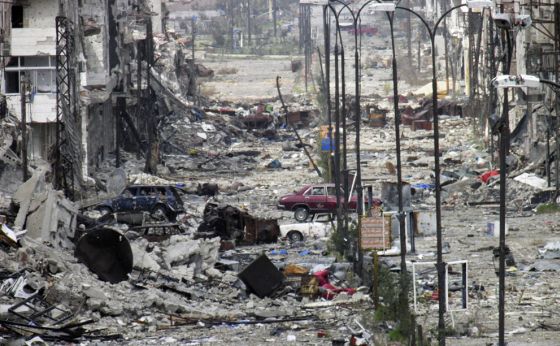
Syria: A country in ruins after three years of war

homs

Click the photo above to see 36 more grim reminders of the devastation caused, above all, by the Assad regime’s unwillingness to accede to the legitimate demands of the Syrian people for freedom and democracy.

From the outset of what was initially a peaceful uprising, Assad made it clear that had no reservations about using violence to crush political dissent, and yet for many Western observers who had just been cheering on an ostensibly peaceful revolution in Egypt, Syria’s revolution became unpalatable as soon as the opposition picked up weapons.

Yet remember these words: “Where choice is set between cowardice and violence, I would advise violence. I prefer to use arms in defense of honor rather than remain the vile witness of dishonor.”

That was the choice most Syrians faced: to either cower in response to ruthless authoritarian rule, or to fight back.

And who offered this advice to use arms? Mahatma Gandhi.

The cost of fighting has been higher than any country should ever bear, but the power to choose a different course has rested in Bashar al Assad’s hands from day one. This catastrophe did not have to happen.

Facebooktwittermail

Nearly half of Syria’s chemical arms supply removed

n13-iconThe New York Times reports: Nearly half of Syria’s chemical stockpile for weapons use has now been removed from the war-ravaged country, the organization helping to oversee the elimination of the deadly arsenal reported on Wednesday.

The organization said in a statement that two shipments, including some of the most lethal chemicals from the stockpile, were delivered on March 14 and 17 to the Syrian port of Latakia, where they were transferred to cargo ships, making a total of 10 exported shipments so far.

“The latest movements increased the portion of chemicals that have now been removed from Syria for destruction outside the country to more than 45 percent,” said the statement, issued by the Organization for the Prohibition of Chemical Weapons, the Hague-based group that is collaborating with the United Nations to ensure the arsenal’s destruction.

The statement was the first progress report on the Syrian government’s commitment to getting rid of the chemicals since the Syrians proposed a revised timetable for exporting them early this month. The timetable’s revision, which calls for the job to be finished by the end of April instead of Feb. 6 as originally planned, came after Syria missed deadlines in the destruction effort and was widely criticized internationally.

The statement also appeared to suggest that Russia and the United States were continuing to cooperate in pressuring Syria to comply with its pledges on chemical weapons, despite the crisis in Ukraine, which has deeply chilled relations between Moscow and Washington. [Continue reading…]

Facebooktwittermail

Hamas’ ‘unfortunate’ disagreement on Syria is on the road to being resolved

n13-icon“I salute all people of the Arab Spring, or Islamic winter, and I salute the heroic people of Syria who are striving for freedom, democracy and reform,” head of the Hamas government in Gaza, Ismail Haniya, told worshippers at a mosque in Cairo on February 24, 2012.

Two days later Abu Marzouk, Hamas’ deputy political leader, told the Associated Press: “Our position on Syria is that we are not with the regime in its security solution, and we respect the will of the people.”

In an interview with Britain’s Channel 4 News in May 2013, the leader of Hamas, Khaled Meshaal, said: “After the start of the crisis I said to all Syrian political, security and military leaders in very clear words, the demands of your people for freedom, democracy and reform are legitimate. The military approach is wrong. It makes the crisis worse.”

Ali Hashem, a columnist for Al-Monitor, now writes that Hamas appears ready to patch up its differences with the Assad regime, and Meshaal will soon be visiting Syria’s closest ally, Iran.

A senior Hamas official who met with Al-Monitor in Tehran last week confirmed that the visit is indeed on the agenda. He asserted, “Our relationship with Iran is back as it was, and maybe better. Enemies who are betting on the end of the resistance bloc should know that this bloc is getting bigger and stronger, from North Africa to Tehran.”

Osama Hamdan, Hamas’ international relations officer, explained that the “unfortunate” disagreement on Syria is on the road to being resolved and that positive options are on the table with respect to his organization’s relations with Damascus. Hamdan added that ties with Hezbollah are good and that he continues to carry out his work from his office in Beirut’s southern suburbs, a Hezbollah stronghold.

Facebooktwittermail

Fueled by Syrian war, hostilities surge in Lebanon

a13-iconThe Associated Press reports: Sunni Muslim demonstrators used burning tires to close key roads across Lebanon Tuesday to protest a blockade of their brethren by Shiite gunmen, officials said, as the country struggles to keep a lid on simmering sectarian tensions enflamed by the civil war in neighboring Syria.

In one of the most ominous signs, an AP reporter saw protesters marching among cars stopped at a Beirut roadblock and warning drivers with Shiite emblems on their vehicles that Sunnis would not be cowed by the powerful Shiite militant Hezbollah group. There was no violence, and all of the cars eventually moved on unscathed.

Lebanon, which is still haunted by its own 15-year civil war that ended in 1990, has been deeply polarized by the current conflict in Syria. Lebanese Sunnis largely support the predominantly Sunni opposition in Syria, while Shiites have backed President Bashar Assad’s government.

That dynamic has sent sectarian hatreds soaring in Lebanon, particularly since the country’s most powerful political and military force, Hezbollah, dispatched its fighters last year to Syria to bolster Assad’s forces. Many Sunnis also resent Hezbollah’s unmatched political and military position in Lebanon. [Continue reading…]

Facebooktwittermail

Three years of strife and cruelty put Syria in free fall

f13-iconThe New York Times reports: Day after day, the Syrian civil war has ground down a cultural and political center of the Middle East, turning it into a stage for disaster and cruelty on a nearly incomprehensible scale. Families are brutalized by their government and by jihadists claiming to be their saviors as nearly half of Syrians — many of them children — have been driven from their homes.

At the start of the fourth year since Syrians rose up in a peaceful movement that turned to arms after violent repression, a snapshot of the country presents the harsh truth that Syria’s descent is only accelerating, with nothing to check it.

The government bombards neighborhoods with explosive barrels, missiles, heavy artillery and, the United States says, chemical weapons, then it sends in its allies in Hezbollah and other militias to wage street warfare. It jails and tortures peaceful activists, and uses starvation as a weapon, blockading opposition areas where trapped children shrivel and die.

The opposition is now functionally dominated by foreign-led jihadists who commit their own abuses in the name of their extremist ideology, just last week shooting a 7-year-old boy for what they claimed was apostasy. And some of those fighters, too, have targeted civilians and used siege tactics.

It is not as if the world has no evidence of Syria’s ordeal, which has killed an estimated 150,000 people. Syrians have issued a sustained, collective cry for help from what is now probably history’s most-documented manmade disaster. They capture appalling suffering on video and beam the images out to the world: skeletal infants, body parts pulled from the rubble of homes, faces stretched by despair, over and over.

Despite that, to the bitterness of Syrians, the world’s diplomatic attention is drifting. Even as Syria’s epic suffering is remaking the human geography of the Middle East and beyond, initiatives to ease the crisis have sputtered and failed to offer effective help. Already tenuous hopes for an internationally brokered peace settlement have further faded as Russian-American relations worsen.

António Guterres, the head of the United Nations refugee agency, said that is in part because there is no obvious path to a coherent global response. Given the world’s growing unpredictability, and competing priorities, “crises are multiplying and more and more difficult to solve,” he said. “Afghanistan is not finished. Somalia is not finished. It’s overwhelming.”

All the while, Syria is falling apart.

Last weekend, another vital center of opposition life — the city of Yabrud, near the Lebanese border — fell to pro-government forces. As each such haven has been shattered, like Homs and Qusayr, it has become a watchword for civilian suffering, and more are displaced.

The country is threatened with de facto partition among the government, Kurdish militias and a patchwork of insurgent groups, some seeking to impose extremist Islamist rule. Criminal gangs profit from chaos, and pro-government militias increasingly threaten to slip from state control. A regional proxy war between Saudi Arabia and Iran further polarizes the conflict and fuels its sectarian dimension.

Adding to the urgency is the growing scale of regional destabilization. With nine million Syrians driven from their homes, according to the United Nations, 2.5 million of them into nearby countries, the Syrian displacement dwarfs the exodus from British-mandate Palestine during the war over Israel’s founding in 1948, a flight of 750,000 people that fuels conflict and hardship to this day. [Continue reading…]

Facebooktwittermail

Don’t put Syria aside, Brahimi says amid Ukraine crisis

n13-iconBloomberg reports: More than 350,000 people will have died in Syria’s civil war by next year if peace talks don’t restart, United Nations mediator Lakhdar Brahimi said in an effort to keep an international spotlight on the conflict.

“I told the Security Council that Syria cannot be placed on a back burner,” Brahimi told the UN General Assembly yesterday, according to a transcript. “A crisis of this magnitude needs the full attention of this organization.”

With the Security Council set to take up a resolution today on Russia’s move into Ukraine, Brahimi sought to underscore the continuing human and economic costs of Syria’s civil war, which entered its fourth year this week with more than 130,000 people killed. He said more than 300 Syrians flee their homes every hour. [Continue reading…]

Facebooktwittermail

Syria and the Arab affliction of family rule

o13-iconRami G Khouri writes: Perplexity and despair seem to be the two sentiments that most often define people’s attitudes to the mayhem in Syria.

The fighting by an expanding range of Syrians, backed by a regional and global web of supporters, has reached barbaric proportions in some cases, with civilians largely paying the price.

Refugee and displaced persons flows continue to grow and now account for some 6 million people. While efforts to find a diplomatic breakthrough continue and most interventions by outside forces are focused on providing humanitarian aid to the millions of Syrians in need, a wider web of Arab, Middle Eastern and global actors pump in money and guns to keep the Syrian war going.

Nobody knows what to do and more and more voices are calling for external military intervention to protect civilians or even to topple Bashar Assad’s regime. The impact of the war on neighboring countries is reaching unsustainable levels, especially Jordan and Lebanon. To their credit, the neighbors have kept their borders open to fleeing Syrians, even though these host countries are finding it more and more difficult to absorb any more refugees due to the pressure on their own social infrastructure, such as housing, water, education, and medical care. The host countries have received financial assistance either directly or through the United Nations and other international organizations, but it is well below what is needed.

Perhaps one reason why Arab host countries such as Lebanon, Jordan and Iraq keep their borders open is that these countries have all experienced the pain of conflicts that sent many of their own citizens fleeing for shelter in neighboring lands. So we should keep in mind that what is happening in Syria, terrible as it is, should not be seen as an aberration in modern Arab history, but rather represents perhaps the culminating chaos of that history. Syria once referred to itself as “the throbbing heart of Arabism.” That might be an appropriate description in retrospect, because the country’s destruction and implosion today very much mirror those deviant tendencies that have defined the configuration and behavior of so many Arab countries.

Some time in the 1970s, the majority of Arab states left behind their nationalist development aspirations and instead settled into a pattern of conduct that has culminated in the ghastly situation in Syria. The single most debilitating reality of modern Arab history has been the tendency of Arab countries to be ruled by single families that rely on vast security networks to maintain their rule. Single family rule is bad enough; military-security-police states are equally bad. Put them together and you get the core weakness of the modern Arab state system that has seen country after country suffer the scourge of internal war, mass suffering and significant refugee flows. [Continue reading…]

Facebooktwittermail

On third anniversary of Syrian rebellion, Assad is steadily winning the war

a13-iconThe Washington Post reports: Three years into the revolt against his rule, Syrian President Bashar al-Assad is in a stronger position than ever before to quell the rebellion against his rule by Syrians who rose up to challenge his hold on power, first with peaceful protests and later with arms.

Aided by the steadfast support of his allies and the deepening disarray of his foes, Assad is pressing ahead with plans to be reelected to a third seven-year term this summer while sustaining intense military pressure intended to crush his opponents.

The strategy is not new, but in recent months it has started to yield tangible progress in the form of slow but steady gains on several key fronts on the battlefield that call into question long-held perceptions of a stalemate.

Most notably, the government has pushed the rebels back or squeezed them into isolated pockets in large swathes of the territory surrounding Damascus, diminishing prospects that the opposition will soon be in a position to seriously threaten the capital or topple the regime.

For those who joined the effort to unseat Assad three years ago, flush with the fervor of the Arab Spring protests sweeping the region, the realization that the rebellion is faltering is “deeply depressing,” said Abu Emad, a student activist who has watched as the government has steadily crushed the armed rebellion in his hometown of Homs, once regarded as the epicenter of the revolt. [Continue reading…]

Facebooktwittermail

Yarmouk and a contagion of doubt

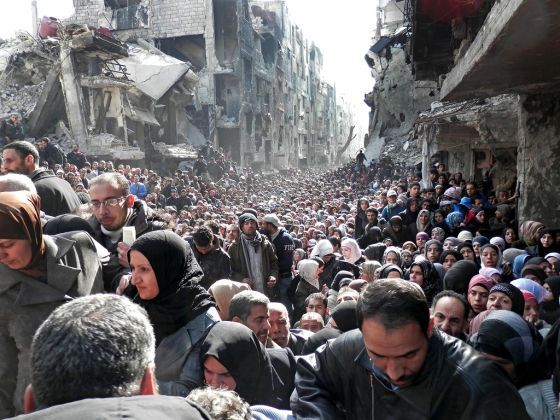
U.N. Denies That Syria Image Was Faked” and “U.N. Denies Altering Image of Palestinian Refugees in Damascus” — both headlines appeared in the New York Times on Tuesday and referred to doubts that have been expressed about the authenticity of what has become an iconic representation of suffering in Syria.

Yarmouk

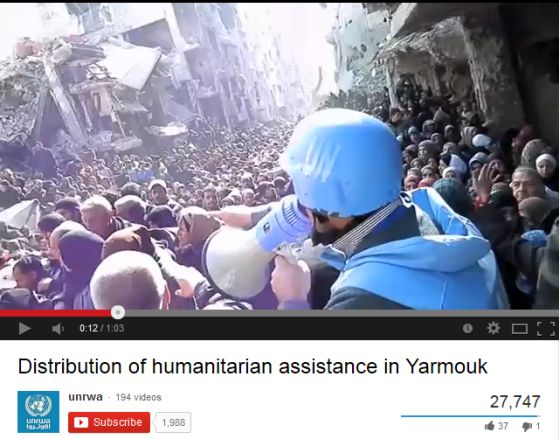
As the following screenshot taken from a video that the United Nations Relief and Works Agency (UNRWA) posted on YouTube and filmed at the same time as the photo above makes clear, the photograph’s authenticity is beyond doubt.

unrwa-yarmouk

Paradoxically, the fact that UN officials were put in a position where they needed to refute accusations that the photograph had been faked, and the New York Times’ own headlines, will quite likely have had the opposite of the intended effect. Where doubts may have previously been few, they are now just as likely to continue growing.

We live in an age of doubt and the internet is its engine — the very notion that something can be “beyond doubt” has itself become an object of doubt.

As someone who from a very early age was taught to question — I was lucky enough to have parents and teachers who recognized that questioning is a vital instrument of intelligence — the proliferation of doubt might to my eye look like a positive development. It might seem like a sign that people are less susceptible to manipulation by the political and corporate forces which shape popular thought. But I see little evidence that this is indeed the case.

On the contrary, the doubt that spreads so easily has less to do with critical intelligence and much more to do with suspicion and fear. The “fake” meme is much more contagious than any sober analysis.

Doubt and cynicism are held onto because they offer psychic armor for shielding ourselves from the dark forces controlling the world. The price, however, for those who employ this form of protection, is that it tends to render them immobile.

Yet clearly, the image of Yarmouk’s starving residents that got retweeted more than eight million times was not being passed around primarily by those who had doubts about what the photograph depicted.

As Chris Gunness, the spokesman for UNRWA said: “I saw that image and said, ‘This has the wow factor.’”

It is an image that resonates and does so for multiple reasons. Strange as it may sound, this is not only a news image but also a work of art.

In accordance with the principle of the “golden ratio” (or divine proportion), it is a perfectly balanced composition. It is a photograph that could just as easily be a painting.

More than simply capturing a moment of one day for one particular group of people, it seems to represent something timeless about the vulnerability of all people throughout history in times of war.

Within the skeletal remains of a city shattered by human brutality, we see that reinforced concrete is easier to destroy than the will to live.

Hope and desperation come together.

Facebooktwittermail