Category Archives: Syria

‘America only talks about the Islamiyeen as if everyone else in Syria doesn’t count’

Reem Salahi writes: Traveling into “liberated” (i.e. rebel-controlled) Syria, I was initially struck by the appearance of normality. Olive groves bloomed, kids played on the street and food and drink stands peppered the roadways. Absent were the pictures and statutes of Bashar and his father Hafez al-Assad that I had come to expect from my many trips to Syria. Also missing were the regime flags and any other sign of Baathist rule.

The deeper we went into Syria, though, the more abnormal things became. Tinted and unlicensed SUVs with the insignia of a Free Syrian Army (FSA) or Islamist brigade were readily prevalent. Men with guns strapped to their backs wearing military fatigues and long beards rode on motorcycles. Demolished factories and bombed stores were more frequent sights than open and functioning stores. And FSA checkpoints secured the entry and exit points of most towns. As we drove deeper into Idlib Province, I found myself thinking of Dorothy’s line in the Wizard of Oz: “Toto, I’ve a feeling we’re not in Kansas anymore.”

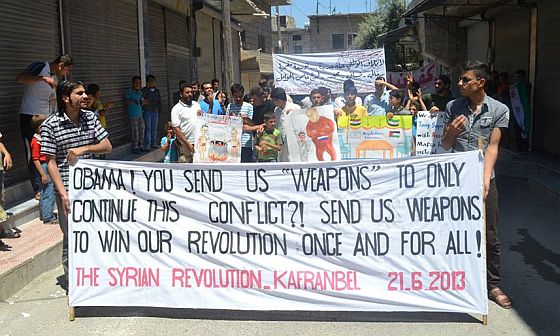
Entering Kafranbel — a small yet internationally-known town due to its witty posters and weekly protests — I was awestruck by the painted walls with messages of “rEVOLution”.

The media center was abuzz with foreign journalists and local activists as they prepared their posters for the Friday protest. The English and Arabic posters as well as the drawings depicting Barack Obama and Vladimir Putin were calculated to speak to local and global audiences. The activists spent hours strategizing how best to express their dissatisfaction with the U.S.’s failure to provide anti-aircraft missiles and heavy weaponry that could strike down government planes that terrorized the “liberated” areas.

Yet in the subsequent days, I experienced the more honest banality of life. Despite not having a physical presence in the “liberated” areas, the government still controlled the utilities and cut the electricity for 20 or more hours a day as both a carrot (a reminder that it remained in power) and a stick. There was no phone service and Internet was rare; jobs were even rarer. At times, it seemed that the only activity was in the sky from helicopters transporting soldiers or dumping loads of explosives on “liberated” towns or in the hospitals that assumed the consequent casualties.

As we lazily sat around during the long hot summer days drinking one cup of sweetened tea after another and doing little else, I was surprised to hear Syrians state they had “no time.” I soon understood that it was not the physical demand for time but the lack of mental clarity for solutions to the intractable conflict that had left Syrian towns with no formal governance and little resources; their residents, without exception, were left psychologically scarred and emotionally taxed. As one young man expressed to me: “everyone wants to train me in transitional justice and documenting human rights abuses but no one has offered to train me on how to overthrow the Regime. It’s been over two years and I still don’t know how to do the very thing that got me involved in this Revolution in the first place.” [Continue reading…]
Facebooktwittermail

Syrian refugees long to return home

Robin Yassin-Kassab visited Atmeh, a Syrian refugee camp close to the Turkish border which currently houses 22,000 refugees: Some tents are fire-resistant; some are plastic; some are concoctions of canvas and blankets. Some have been distributed by the United Nations’ refugee agency, some by Turkish and expatriate Syrian charities. Some tents are pitched among the silvery olive trees, but the area closer to the barbed wire, where tents are set unshaded on the baked and stony earth, is much grimmer. There are toilets (unpleasant and not nearly enough of them), rough shower blocks, and daily deliveries of clean water. But there are also streams of green liquid filth, which the children fall into as they play. Many children have something that sounds like a bad smoker’s cough but is most probably tuberculosis — a disease, like typhoid and leishmaniasis, once defeated in Syria but now resurgent.

A “main street” in Atmeh features stalls set up in tents that sell cigarettes, soda, and sandwiches for those who can afford them; there are also barbers in tents and of course a tented mosque. A “ready meal” breakfast is sent in by the Turks each morning, and a simple lunch — lentil soup, for instance — is prepared in communal kitchens and distributed in buckets around the camp. There is no dinner.

Most impressively, a civil society infrastructure has been established — something that was effectively forbidden in Assad’s Syria. Atmeh has its own Coordination Committee — an extension of the committees that sprang up across Syrian cities and villages from the revolution’s first days in order to provide services the state wouldn’t and to organize protests and media work. Over half the assembled members and speakers at the meeting I attended were women, a fact which illustrates both the expanded social role of women in the revolution and the disproportionate numbers of women (and children) in the camp, because so many men are dead, imprisoned, or fighting.

One of the committee’s duties is to help set up schools for the camp’s children. I saw three schools: the Revolution House, which was a single-room concrete shack; the Ghurabaa (“Strangers”) School, run by Salafi Islamists and disapproved of by many because it entirely ignores the old Syrian curriculum in favor of a purely “Islamic” education; and the Return School, which serves 500 children, cramming 40 at a time in stifling tent classrooms.

The Return School was where I gave my storytelling workshop as part of the Maram and Karam foundations’ Camp Zeitouna project, which included workshops in calligraphy, art, dental care, and soccer skills. We were assisted by some of the school’s 20 unsalaried teachers and inspired by the laughing, shouting children. Some of these children have had only one month of schooling in the last two years. Some are physically scarred and emotionally traumatized. They responded well to the workshops and of course to the soccer field and playground constructed by Maram. They responded best of all, simply, to attention.

One of the trip’s highlights was sitting in the dust on the new soccer grounds and being sung to by a group of boys and girls — a surreal mix of revolutionary nationalist, jihadi, and romantic songs. One of the low points was meeting Manar, a woman whose two children died in a tent fire caused by a fallen candle. Another woman said she’d prefer to be dead than living in such conditions. American teenagers say such things in English, and it means nothing much. In Arabic it means a great deal.

Tamador, a volunteer psychologist, does her rounds. She advises a woman whose husband has abandoned her for another wife, but still turns up to take her money. She hears about a man who sexually abuses his son’s wife. Pre-existing social problems have been immeasurably exacerbated by war trauma, unemployment, entrapment, and the forced proximity of the extended family.

Muhammad Ojjeh, our soccer coach and professional photographer, went down on one knee with his long lens to shoot a picture of a child. The child screamed in terror, turned, and ran. His mother shouted after him, “It’s a camera, stupid, not a gun.”

A woman welcomed us to her tent shamefacedly. “We’ve become Bedouins,” she apologized. Deprived for so long of influence on the public space, Syrians of all classes take inordinate pride in their carefully ordered homes. Now this, too, is denied them.

An angry man reacted badly to the playground under construction. “What’s the use of this?” he complained. “We don’t want to stay here. The insects are eating us! We want to return to our homes. We need weapons. We need help.” [Continue reading…]

Facebooktwittermail

U.S. still hasn’t armed Syrian rebels

The Wall Street Journal reports: In June, the White House authorized the Central Intelligence Agency to help arm moderate fighters battling the Assad regime, a signal to Syrian rebels that the cavalry was coming. Three months later, they are still waiting.

The delay, in part, reflects a broader U.S. approach rarely discussed publicly but that underpins its decision-making, according to former and current U.S. officials: The Obama administration doesn’t want to tip the balance in favor of the opposition for fear the outcome may be even worse for U.S. interests than the current stalemate.

U.S. officials attribute the delay in providing small arms and munitions from the CIA weapons program to the difficulty of establishing secure delivery “pipelines” to prevent weapons from falling into the wrong hands, in particular Jihadi militants also battling the Assad regime.

Allied rebel commanders in Syria and congressional proponents of a more aggressive military response instead blame a White House that wants to be seen as responsive to allies’ needs but fundamentally doesn’t want to get pulled any deeper into the country’s grinding conflict.

The administration’s view can also be seen in White House planning for limited airstrikes—now awaiting congressional review—to punish Syrian President Bashar al-Assad for his alleged use of chemical weapons.

Pentagon planners were instructed not to offer strike options that could help drive Mr. Assad from power: “The big concern is the wrong groups in the opposition would be able to take advantage of it,” a senior military officer said. [Continue reading…]

Facebooktwittermail

For Syria’s sake, end Iran’s isolation

Shirley Williams writes: President Obama’s decision to consult Congress before taking any military action against the Syrian government offers a brief opportunity for diplomatic efforts to construct a political settlement. That decision has been welcomed by many in the Middle East, among them the new president of Iran, Hassan Rouhani.

It is astonishing that, apart from by the Conservative MP Rory Stewart, Iran was hardly mentioned in the debates in parliament last week – given that it has a vital role in the region and is the key to a negotiated outcome. It is the most important ally that Syria has, as a recent report by the Rand corporation points out. With a population of 75 million, and with oil and natural resources, it is the most important Shia Muslim state in the world.

Iran is also a country that has suffered more cruelly than any other from chemical weapons. During the Iran-Iraq war in the 1980s, Iran lost tens of thousands of young men, many to the obscene effects of chemical weapons used by Iraq, which was never condemned by the west.

Iran has repeatedly condemned the use of chemical weapons, most recently in a statement by President Rouhani about the attack on the eastern Ghouta district of Damascus. He was careful not to associate the attack with a particular perpetrator, but the president’s detestation of chemical weapons was plain.

In the UN, Iran has been active in advocating the chemical weapons convention. President Rouhani has been bold in calling for negotiations with the western allies, and in committing himself to a foreign policy of “reason and moderation”. His foreign minister, Mohammad Javad Zarif, has stressed the need for consultation and co-operation on Syria. In a country anxious about its own security, in a region where it feels threatened, it takes courage to speak in these terms. Iran’s political leaders are constrained by divided public opinion and by the views of its military elite, the Revolutionary Guard, which has close links with Syria. Iran’s president needs a constructive response from the west. [Continue reading…]

Facebooktwittermail

One third of Syrian population displaced by war

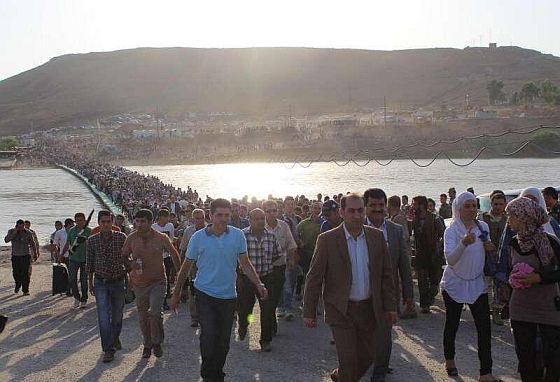
UNHCR photo shows mass exodus of Syria refugees fleeing to Iraq, August, 2013.

For Americans to grasp the magnitude of the crisis in Syria, it’s worth drawing some comparisons and imagining what this would look like here.

Imagine this: Every single person in California, Texas, New York, and Florida has fled their home. Nearly everyone who once lived in California is now a refugee in Mexico and has little more than a sheet of canvas to protect themselves from the sun. The rest of the world sees on their TV screens the misery of America and everyone agrees its awful but then carries on living their life as though nothing was happening.

RTÉ reports: The United Nations has said that nearly seven million Syrians have been displaced by the civil war, which is almost one third of the population.

UNHCR envoy to Syria Tarik Kurdi said five million people had been displaced internally.

Another two million had sought refuge in the neighbouring countries of Lebanon, Jordan, Turkey and Iraq.

More refugees are expected to leave the country in advance of an anticipated airstrike by the US military following what it said was a chemical weapons attack the US blames on President Bashar al-Assad’s forces.

Lebanon has around one million people, either refugees who have formally registered, or others who have moved into employment, or who have enough resources of their own not to declare themselves refugees.

The influx is putting a strain on Lebanon’s meagre resources, according to the International Crisis Group.

Facebooktwittermail

Syrian refugee: ‘Obama lied to us’

The Guardian reports: Across the camp, five miles inside Jordan, Syrian refugees gathered in small groups to listen to Barack Obama. Some watched on al-Jazeera TV, others tuned in to the radio, many followed on Twitter or online news sites. Expectations were high.

“We thought, when he began to speak, the strikes on Bashar al-Assad’s regime were going to start immediately,” said one refugee, Abu Assam. “Then he said ‘but’.” In Arabic “but” is “wa lakin“, but in both languages the implication is the same. “It was when he said that word that everything came crashing down.” He added: “Obama lied to us.”

A member of the Free Syrian Army, who walks on crutches after an accident inside Zataari, Abu Assam said he immediately decided to cross the border back to Syria to rejoin the fighters on the other side, despite his injury. “I can fire a weapon on a pick-up truck,” he said.

The Zaatari refugee camp is home to about 120,000 Syrians who have fled the war next door, the sound of which, on still nights, can be heard from across the border. The mood on Sunday was uniformly bleak. The news of the chemical attack in Damascus was devastating for those in the camp, said a UN official. Residents asked for no visits from journalists or dignitaries for three days. After that period of grief, amid all the tough talk by western leaders, refugees believed that something would be done to punish the Syrian regime. [Continue reading…]

Facebooktwittermail

British ministers face questions over licensing of chemical exports to Syria

The Guardian reports: Ministers are to face further questions over the decision to allow the export of substances used to make chemical weapons to Syria, months after the country descended into civil war.

In a letter to the business secretary, Vince Cable, to be sent on Monday, a member of the House of Commons’ committee on arms export controls will demand to know who was allowed to sell the chemicals and what other licences for the export of dangerous materials to Syria have been granted.

Labour MP Thomas Docherty will also ask which civil servants knew that the potassium fluoride and sodium fluoride they allowed British firms to sell could be used to make nerve agents and when they found out.

Docherty criticised the government after it emerged that British firms were granted the licences in January 2012, about 10 months after the start of the bloody conflict. In a draft of the letter, seen by the Guardian, he wrote that he was “horrified” by the news. And he asked if civil servants consulted colleagues in the Foreign and Commonwealth Office or Ministry of Defence to determine what the chemicals could be used for.

Cable admitted that licences were granted to sell the chemicals for use in the manufacture of “aluminium showers, windows, etc”. But he admitted that they “could also be used as precursor chemicals in the manufacture of chemical weapons”. He refused to publish additional details, citing “commercial sensitivity”. [Continue reading…]

Facebooktwittermail

Obama ‘has the right’ to strike Syria regardless of Congress vote, says Kerry

The Guardian reports: The Obama administration indicated on Sunday that it would launch strikes against Syria even in the face of rejection by the US Congress, less than a day after vowing to put an attack to a congressional vote.

President Obama “has the right to do this no matter what Congress does”, said secretary of state John Kerry, one of the leading advocates of a military assault on dictator Bashar al-Assad for allegedly using chemical weapons on 12 neighborhoods outside Damascus on 21 August.

Kerry said the Obama administration’s clear preference was to win a vote in Congress that could occur as early as next week, after Congress returns from its summer recess on 9 September. In an effort to bolster the case that he first laid out on Friday, Kerry said the administration had evidence, independent of UN weapons inspectors, that Sarin gas had been used in the August attacks.

“We are stronger as a nation when we act together,” Kerry told CNN, defending a decision to seek congressional authorization that has stunned Washington and foreign capitals alike. He said he could “hear the complaints” about presidential abuse had Obama not gone to Congress.

But, Kerry said, “America intends to act.” [Continue reading…]

Facebooktwittermail

‘Assad comes out of this mess victorious’

The Washington Post reports: Syrians opposed to President Bashar al-Assad expressed anger on Saturday that President Obama had apparently decided against an imminent strike in Syria, saying that failure to act after the threats that have been made would embolden Assad’s government.

After Obama announced that he would seek congressional approval for any attack on Syria, deferring any possible military action for at least 10 days, rebel fighters predicted that Assad loyalists would seek to use the delay to escalate attacks on rebel strongholds.

“Assad has been given the green light by the international community,” said Musab Abu Qatada of the Damascus Military Council, speaking from a rebel-held area west of the capital. “The message he got from the international community is that he can kill his people with conventional means, just not with chemical weapons.”

After a day of widespread panic in the capital of Damascus that saw residents throng bakeries and grocery stores in anticipation of American strikes, others who said they had hoped U.S. intervention would dent Assad’s hold on power also said they were dismayed.

“I feel betrayed,” said a 24-year-old woman who spoke on the condition of being identified by only her first name, Sarah, because she fears retaliation.

“Assad comes out of this mess victorious. He is winning so far, and his confidence in himself and his regime will grow,” she said, speaking by telephone from the capital. [Continue reading…]

Reuters reports: Syria hailed an “historic American retreat” on Sunday after President Barack Obama delayed an imminent military strike by deciding to consult Congress.

As Obama stepped back from the brink, France said it could not act alone in punishing President Bashar al-Assad over a chemical weapons attack, making it the last remaining top Western ally to hesitate about bombing Syria.

“Obama announced yesterday, directly or through implication, the beginning of the historic American retreat,” Syria’s official al-Thawra newspaper said in a front-page editorial.

The U.S. president said on Saturday he would seek congressional consent before taking military action against Damascus for the August 21 attack which he blames on Assad’s forces – a decision likely to delay any strike for at least nine days.

Syria’s deputy foreign minister Faisal Mekdad denounced any armed Western move against his government. “A decision to wage war on Syria is a criminal decision and an incorrect decision. We are confident that we will be victorious,” he told reporters outside a hotel in Damascus. [Continue reading…]

Facebooktwittermail

Syrian rebels feel let down by delay on U.S. strikes

The Los Angeles Times reports: Syrian rebel commanders preparing for possible U.S. missile strikes against the government said Saturday that they were concerned President Obama’s decision to seek congressional approval would mean one more broken promise of help.

Obama’s announcement came late in the day in the Middle East, and there was no immediate reaction from authorities in Damascus, the Syrian capital. The government labeled as lies U.S. accusations that Syria killed more than 1,400 people, including 426 children, in an Aug. 21 chemical attack on the outskirts of Damascus.

The delay appeared to be at least a minor victory for Syrian President Bashar Assad.

Rebel commanders say the limited campaign Obama has described in recent days is insufficient, and delaying it further will only allow the Syrian government to protect its military assets.

“They are all playing us,” said 1st Lt. Muhammad Sheikh, who leads a rebel militia in Rastan in Homs province, referring to the international community. “The Syrian people were very hopeful.”

Musab Abu Qatada, spokesman for the Damascus military council of the Free Syrian Army rebel group, said the lengthy debate in the West had allowed the government to move weapons and soldiers into schools, empty residential buildings and underground garages.

An entire regiment and intelligence unit has been moved into university dorms and more than a dozen schools throughout the capital, he said. [Continue reading…]

Facebooktwittermail

Sarin gas used in Syria attack, Kerry says

The Washington Post reports: Secretary of State John F. Kerry said Sunday that fresh laboratory tests show that Sarin nerve gas was used in an Aug. 21 attack in Syria that killed more than 1,400 people, the first time that U.S. officials have pinpointed what kind of chemical weapon was used.

In an interview with NBC’s “Meet the Press,” Kerry said blood and hair samples from emergency workers in east Damascus had tested positive for Sarin, a highly toxic nerve agent. He said that U.S. officials learned of the lab results in the past 24 hours, citing the evidence as yet another reason for Congress to pass President Obama’s request to authorize the use of military force against the government of Syrian President Bashar al-Assad.

“So this case is building and this case will build,” Kerry said, according to a transcript of his remarks provided by NBC. “I don’t believe that my former colleagues in the United States Senate and the House will turn their backs on all of our interests, on the credibility of our country, on the norm with respect to the enforcement of the prohibition against the use of chemical weapons.”

In an unclassified intelligence assessment released Thursday, U.S. officials had said they believed that the Syrian government had used “a nerve agent” in the Aug. 21 attack in the Damascus suburbs. But the intelligence report did not specify what kind, and questions have remained about precisely what chemical weapons may have been involved and who ordered their use. Syria is believed to have multiple nerve agents and poison gases in its chemical weapons stockpile.

The new disclosure from Kerry came a day after Obama put on hold a plan to attack Syria for its alleged use of chemical weapons, arguing that the United States had a moral responsibility to respond forcefully but would not do so until Congress has a chance to vote on the use of military force. [Continue reading…]

Facebooktwittermail

Britain sold Syria raw materials for chemical weapons, months after war began

The Sunday Mail reports: Britain allowed firms to sell chemicals to Syria capable of being used to make nerve gas, the Sunday Mail can reveal today.

Export licences for potassium fluoride and sodium fluoride were granted months after the bloody civil war in the Middle East began.

The chemical is capable of being used to make weapons such as sarin, thought to be the nerve gas used in the attack on a rebel-held Damascus suburb which killed nearly 1500 people, including 426 children, 10 days ago.

President Bashar Assad’s forces have been blamed for the attack, leading to calls for an armed response from the West.

British MPs voted against joining America in a strike. But last night, President Barack Obama said he will seek the approval of Congress to take military action.

The chemical export licences were granted by Business Secretary Vince Cable’s Department for Business, Innovation and Skills last January – 10 months after the Syrian uprising began.

They were only revoked six months later, when the European Union imposed tough sanctions on Assad’s regime. [Continue reading…]

Facebooktwittermail

UK will offer only diplomatic support on Syria

The Guardian reports: Britain has definitively ruled out any involvement in military strikes against Syria even if further, more serious chemical weapons attacks take place, William Hague and George Osborne have said.

In his first major interview since the government’s defeat in the Commons on Thursday night, Hague, the foreign secretary, said parliament had spoken and Britain would only offer diplomatic support to its allies.

He said he could only envisage a change if Labour became “less partisan”. His remarks were echoed by Osborne, the chancellor, who told BBC1’s Andrew Marr Show that Ed Miliband looked less like a future prime minister after helping to defeat the government.

In an interview with the Murnaghan Show on Sky News, Hague said: “Parliament has spoken. I don’t think it is realistic to think that we can go back to parliament every week with the same question having received no for an answer. [Continue reading…]

Facebooktwittermail

Hezbollah’s expanding role in Syria

The National reports: In response to a blast that claimed the lives of 22 in the middle of the Hizbollah-controlled area of southern Beirut, Hizbollah secretary general, Hassan Nasrallah, delivered a fiery speech, rife with threats. The bombing was clearly intended to send a message to Hizbollah that Mr Nasrallah could not leave unaddressed.

Mr Nasrallah has vowed to avenge attacks against his followers. As expected, he blamed the Dahiyeh blast on Takfiris, a term usually applied to Sunni Islamists who cast other Muslims as apostates, but commonly used by Hizbollah to describe all of Syria’s rebels.

One of the most significant points Mr Nasrallah made was: “If we have 1,000 fighters in Syria, they will become 2,000, and if we have 5,000 fighters in Syria, they will become 10,000.” Disregarding the numbers, this statement does have some validity, since the group and its Iranian-backed Shia militias have been increasing their presence in Syria. If anything, the bombing’s real accomplishment has been to give Hizbollah a further excuse for expanding its presence.

It should not be forgotten that when Mr Nasrallah publicly admitted his party’s involvement in Syria, he proclaimed that defeating “US and Israeli-backed Takfiris” in that country is one the organisation’s primary goals. During his May 25 speech, Mr Nasrallah clearly stated: “We today consider ourselves defending Lebanon, Palestine and Syria … As I used to promise you victory always, I promise you victory again.” It should come as little surprise that if the group is pushing for absolute victory in Syria, it would require further deployments to that country.

Since June, there has been gradual increase in Hizbollah and Shia militia presence in Syria. Following Hizbollah’s large-scale intervention in Syria during the battles in Qusayr, battles that some in the group celebrated as a “victory” akin to “defeating” Israel in 2006, Hizbollah tended to downplay announcements of its activities there. Compared to May, when the group had public funeral after funeral and public acknowledgement of their activities in Qusayr, the current silence has had the added bonus of deflecting western attention from Hizbollah’s activities.

In Hizbollah’s media, the familiar anti-Syrian rebel and pro-Assad tone has continued. Nevertheless, the group’s rather extensive combat and support actions in Damascus and Homs were downplayed. Instead, armed engagements by Mr Al Assad’s army were covered by Hizbollah’s media. Hizbollah’s support for Mr Al Assad’s forces received little to no mention. For the western press, which utilises limited assets devoted to tracking Hizbollah’s moves, the silence and message-reorientation implied decreased or hazier levels of Hizbollah’s involvement. [Continue reading…]

Facebooktwittermail

International Crisis Group issues statement on Syria

International Crisis Group: Assuming the U.S. Congress authorises them, Washington (together with some allies) soon will launch military strikes against Syrian regime targets. If so, it will have taken such action for reasons largely divorced from the interests of the Syrian people. The administration has cited the need to punish, deter and prevent use of chemical weapons – a defensible goal, though Syrians have suffered from far deadlier mass atrocities during the course of the conflict without this prompting much collective action in their defence. The administration also refers to the need, given President Obama’s asserted “redline” against use of chemical weapons, to protect Washington’s credibility – again an understandable objective though unlikely to resonate much with Syrians. Quite apart from talk of outrage, deterrence and restoring U.S. credibility, the priority must be the welfare of the Syrian people. Whether or not military strikes are ordered, this only can be achieved through imposition of a sustained ceasefire and widely accepted political transition.

To precisely gauge in advance the impact of a U.S. military attack, regardless of its scope and of efforts to carefully calibrate it, by definition is a fool’s errand. In a conflict that has settled into a deadly if familiar pattern – and in a region close to boiling point – it inevitably will introduce a powerful element of uncertainty. Consequences almost certainly will be unpredictable. [Continue reading…]

Facebooktwittermail

Obama’s missiles of impunity

Rami G Khouri writes: It is quite stunning to experience for the sixth time in a decade a global debate about whether Western powers should use their military superiority to attack Arab countries in order to get those Arab countries to conform to “international norms.” After the experiences of Iraq, Libya, Afghanistan, Mali, and the global use of drones to attack suspected Al-Qaeda militants, we are now witnessing heartfelt debates across the world about the wisdom, efficacy and legitimacy of an American-led attack against Syrian targets.It is heartening to see the best aspects of Western democracy in practice, in the British parliament’s rejection of Prime Minister David Cameron’s request to join the U.S. attack on Syria, and in the skepticism that many American congressmen and women express about the validity of the administration’s case for the attack. Not surprisingly, President Barack Obama’s administration is making the case that it does not need congressional approval for an attack, and seems determined to go ahead with it, with or without Western partners or Congressional support.

So in the coming days we are likely to see a few dozen American missiles smashing into selected Syrian targets, accompanied by passionate arguments for and against this action. Since we have witnessed this scenario several times in the past decade, and are likely to encounter it again in the years ahead (Iran? Sudan? Afghanistan and Pakistan again?), this might be a good moment to step back a bit from the din and haze of battle and focus for a moment on the core issues at hand that matter to all sides.

I see those issues very clearly as two sides of the same coin: What do we do about the criminal use of armaments by a government against its own people, especially when such action breaks prevailing global norms and conventions? And what do we do about the criminal use of armaments by a government against other countries – even ones whose governments kill their own people – in the absence of legitimate international support for such action?

Our prevailing global media- and entertainment-based society does not like to discuss such issues in a symmetrical manner that juxtaposes the criminal actions of the Syrian president against the criminal actions of the American president. Yet we must do so if we wish to reduce the recurring incidents of Western attacks against Arab or other regimes in the global South that kill their own people with impunity.

The cautious Barack Obama has now shifted into a common policy mode for American presidents who are confronted with the need to respond to a complex foreign policy issue somewhere far away and largely alien to them. This is the policy that, in political science terms, should best be called the “kicking ass policy.” It uses the United States’ massive advantages in military technology and force projection to unleash powerful missiles against virtually defenseless targets in places like Iraq, Afghanistan, Pakistan, Sudan and Yemen, and now perhaps Syria. It aims to teach those people over there a lesson they will never forget, and push them to comply with norms of civilized behavior, but it also almost always happens without Washington fully calculating or understanding the consequences of such a policy. [Continue reading…]

Facebooktwittermail

Experts fear U.S. plan to strike Syria overlooks risks

The New York Times reports: Supporters of the president’s proposal contend that a limited punitive strike can be carried out without inflaming an already volatile situation. But a number of diplomats and other experts say it fails to adequately plan for a range of unintended consequences, from a surge in anti-Americanism that could bolster Syria’s president, Bashar al-Assad, to a wider regional conflict that could drag in other countries, including Israel and Turkey.

“Our biggest problem is ignorance; we’re pretty ignorant about Syria,” said Ryan C. Crocker, a former ambassador to Syria and Lebanon, who has served in Iraq and Afghanistan and is dean of the Bush School of Government and Public Service, Texas A&M University.

The American strike could hit President Assad’s military without fundamentally changing the dynamic in a stalemated civil war that has already left more than 100,000 people dead. At the same time, few expect that a barrage of cruise missiles would prompt either side to work in earnest for a political settlement. Given that, the skeptics say it may not be worth the risks.

“I don’t see any advantage,” said a Western official who closely observes Syria.

In outlining its tentative plans, the Obama administration has left many questions unanswered. Diplomats familiar with Mr. Assad say there is no way to know how he would respond, and they question what the United States would do if he chose to order a chemical strike or other major retaliation against civilians.

That would leave the United States to choose between a loss of credibility and a more expansive — and unpopular — conflict, they said. “So he continues on in defiance — maybe he even launches another chemical attack to put a stick in our eye — and then what?” Mr. Crocker said. “Because once you start down this road, it’s pretty hard to get off it and maintain political credibility.” [Continue reading…]

Facebooktwittermail