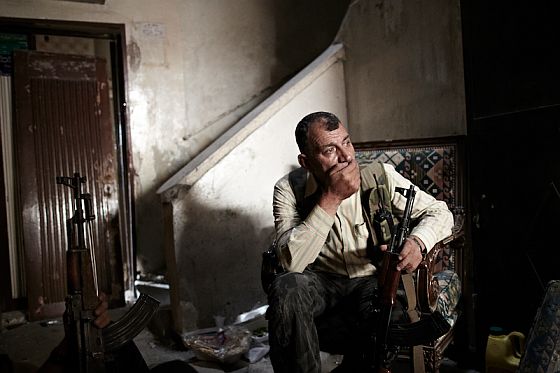
Lauren Wolfe writes: One day in the fall of 2012, Syrian government troops brought a young Free Syrian Army soldier’s fiancée, sisters, mother, and female neighbors to the Syrian prison in which he was being held. One by one, he said, they were raped in front of him.
The 18-year-old had been an FSA soldier for less than a month when he was picked up. Crying uncontrollably as he recounted his torture while in detention to a psychiatrist named Yassar Kanawati, he said he suffers from a spinal injury inflicted by his captors. The other men detained with him were all raped, he told the doctor. When Kanawati asked if he, too, was raped, he went silent.
Although most coverage of the Syrian civil war tends to focus on the fighting between the two sides, this war, like most, has a more insidious dimension: rape has been reportedly used widely as a tool of control, intimidation, and humiliation throughout the conflict. And its effects, while not always fatal, are creating a nation of traumatized survivors — everyone from the direct victims of the attacks to their children, who may have witnessed or been otherwise affected by what has been perpetrated on their relatives. [Continue reading…]
Category Archives: Syria
War without end: the price of inaction in Syria
Christoph Reuter writes: Western leaders — and German ones, in particular — have come up with countless reasons for not providing military support to Syrian rebels. But this just plays into the hands of Assad, who has nothing to win, but plenty to destroy.
Take a moment to imagine it the other way around: A Syrian dictator with a full beard — an Islamist harboring al-Qaida sympathies — has the Christian population of his country shot, starved and bombed, lets fanatical militias massacre non-believers and burns the country down to ashes. Were that the case, an alliance of Western nations would step up to intervene faster than you could say “Mali.”
Yet the people of Syria have been trying to rid themselves of a dictator for two years now. They spent months getting shot at while participating in peaceful demonstrations before they starting putting up violent resistance, and now they are facing a regime that intends to annihilate them. But it would seem that they’re simply out of luck.
The reason isn’t hard to see: Most of these rebels are Sunnis or, more broadly, Muslims. Many of them also have beards and shout “Allahu akbar” (as do the much smaller numbers of Ismailis, Druzes and Christians who fight alongside them). Sunnis also live in the areas that are being bombed almost daily when visibility is good.
Muslims rising up against their rulers to demand justice simply doesn’t fit into our worldview. Over the past decades, this view has been fed on news of the Taliban, of radical Islamist clerics preaching messages of hate, of “honor” killings, of battles over a Danish cartoon and of the events of 9/11. Held responsible for the sum total of all we have heard over the years, Syria’s Muslims are finding that the world views their struggle with suspicion and as just another attempt to establish a Muslim theocracy.
If they were Tibetans, you could bet things would be different. But, as is, Bashar Assad’s air force has been allowed to bomb with impunity. Scud missiles level entire city blocks, while Syria gradually empties out. Over 70,000 people have died in the conflict, and more than 1 million have fled the country. [Continue reading…]
How Eric Harroun, the American fighter in Syria, was duped by the FBI
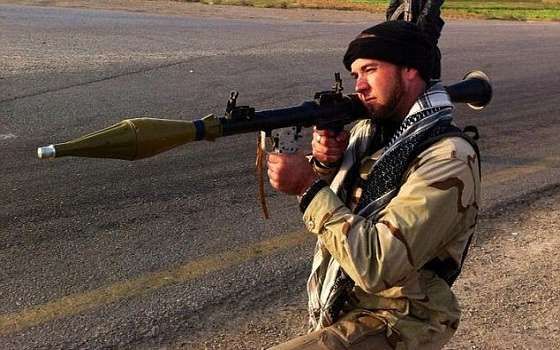
Robert Young Pelton writes: On April 8, Eric Harroun will appear with his public defender in an Alexandria, Virginia, court to answer charges that he conspired to use a weapon of mass destruction outside the United States. While such legal wording may suggest that he was looking to get his hands on a chemical or nuclear weapon, Harroun’s alleged crime is actually much more mundane: He stands accused of using a rocket-propelled grenade launcher while fighting with rebels who aim to topple Syrian President Bashar al-Assad’s regime.
If this story sounds familiar, it should: The 30-year old Harroun has joined a small but controversial club: young Americans who decided to fight in foreign jihads. And I’ve met a lot of them. In 1999, I traveled with the red-haired, blue-eyed Irish-American Aukai Collins on his journey to fight against the invading Russians in Chechnya. In December 2001, I met John Walker Lindh, an American who joined up with the Taliban, who insisted that he was fighting a pre-9/11 war against brutal warlords, not a jihad against the United States. But even when these freelance soldiers join the same side that the U.S. government is supporting, they also often run afoul of the U.S. legal system — and Harroun is now the latest to face punishment for his adventure overseas.
On March 11, I contacted Harroun via Facebook to interview him for my new magazine, Dangerous. He replied “R U A Zionist?” Three days later, I finally reached Harroun on Skype. He had left Syria, and was staying in the upscale Istanbul neighborhood of Taksim. He said he had visited the American consulate in Istanbul.
Harroun had just finished an interview with an editor from the Times of Israel. He explained that the interview was combative, including numerous insults and even shouting matches with the Israeli reporters. When the article was published on Fox News, it highlighted Harroun’s statement that he had fought alongside the Syrian rebel group Jabhat al-Nusra, which the State Department has labeled an alias for al Qaeda in Iraq.
The article rattled Harroun. He decided to check in with the American consulate, with the aim of telling U.S. officials exactly what transpired while he was in Syria. He was surprised to see a print out of the Fox News story sitting on the desk of the FBI agent when he walked in for what turned out to be a four-hour interview.
Harroun told me that he insisted to the FBI and CIA that he joined the “Amr ibn al-‘As Brigade.” According to the Institute for the Study of War, a Washington think tank, the brigade is a faction of the rebel Free Syria Army formed under the command of Col. Abdul-Jabar Mohammed Egeydi.
But the consulate also had evidence that Harroun had been in contact with Jabhat al-Nusra. A video shot by Harroun and uploaded to Youtube on Jan. 26 showed him in a truck loaded with his jihadist friends, driving toward a recently downed Syrian military helicopter.
When I reached Harroun, he described his association with Jabhat al-Nusra as accidental. “I was separated from my unit in the fighting. I found these guys,” he said. “I didn’t even know they were al-Nusra until later. I said, ‘I need a ride back to my commander.’ It took 25 days to get them to give me a ride.”
“When they would go out and fight, I’d go along with them. What was I supposed to do?” he asked. “We are all fighting for the same thing. We’re trying to kill the same people. It’s not like I chose to fight with al-Nusra.” [Continue reading…]
The internationalization of the war in Syria
View Internationalization of Syria’s Civil War in a larger map
Foreign Policy: Last week, on March 25, unnamed foreign and U. S. government officials revealed to the Associated Press that the United States has been secretly training Syrian rebels in Jordan, and the New York Times reported that U.S. intelligence services facilitated large arms purchases for rebel forces by Saudi Arabia. It marked a milestone in the militarization of Syria’s bloody civil war: Barely a week before, Secretary of State John Kerry told reporters, “[T]he United States does not stand in the way of other countries that have made a decision to provide arms, whether it’s France or Britain or others.”
The disclosures are a departure from public U.S. policy on Syria, which has attempted to regulate the distribution of arms through a “security coordination committee” without getting embroiled in the conflict. But the U.S. training program and role in procuring arms for rebels are just the latest instances of the internationalization of Syria’s civil war.
In this map, we’ve tried to track some of the international incidents and influences of the Syrian civil war. It is not comprehensive, and suggestions are welcome. It shows an uprising that increasingly travels like an electric current across filaments of ethnic and sectarian identity, regardless of borders. As the power vacuum grows, so will the opportunities for foreign countries to interject themselves further into the conflict. [Continue reading…]
6,000 people killed in Syria in March
BBC News reports: More than 6,000 people died in Syria in March, the deadliest month since protests against the government began two years ago, activists say.
The Syrian Observatory for Human Rights (SOHR), a UK-based activist group, said it recorded 6,005 deaths last month.
It said victims included at least 291 women, 298 children, 1,486 rebel fighters and army defectors, and 1,464 government troops.
The other casualties were unidentified civilians and fighters, it added.
The anti-government group, which monitors human rights violations on both sides of the conflict via a network of contacts across Syria, said the total toll was much higher than the 62,554 deaths it has documented.
“We estimate it is actually around 120,000 people,” Rami Abdelrahman, the head of the group, told Reuters news agency.
Portrait of an activist: Razan Ghazzawi, the Syrian blogger turned exile
Time reports: On July 18 Razan Ghazzawi, a Syrian blogger and media activist, was in the city of Douma, 45 minutes outside the capital, when she received a call: Free Syrian Army (FSA) fighters, dug-in in the central Damascus neighborhood of Midan, needed someone who could set up a remote Internet connection. So she and two other activists went in a taxi, circumnavigating military checkpoints, to join the fighters.
Days earlier, Syria’s armed opposition launched an unprecedented assault on the government, which they dubbed Damascus Volcano and Syrian Earthquake. The operation peaked with a bombing at the national-security headquarters in the capital, which killed four top officials, including President Bashar Assad’s brother-in-law. The regime was already striking back, sending helicopter gunships, tanks and snipers after roaming bands of lightly armed rebels.
“I went down there with a taxi driver who we trusted but I don’t know why and how,” Ghazzawi says. “FSA revolutionaries secured our entrance, and I was welcomed as a media expert. I explained I’m not. I’m just a blogger with a laptop and 3G,” she says, referring to her wireless Internet link.
Ghazzawi, 32, is a short, trim woman with large brown eyes. At the time of the Damascus battle, she was the only widely known antiregime blogger writing in English under her real name from inside Syria. She had already been detained by the government twice for her activism since the Syrian uprising began, once for two weeks after being held at the Jordanian border and a second time for 22 days after a raid on the office of her employer, the Syrian Center for Media and Freedom of Expression. She left Syria for Sweden in October 2012.
While the majority of news reports from Syria consisted of information stitched together by journalists outside the country and attributed to unnamed “activists,” Ghazzawi was a verified source reporting live from the firing zone, and doing so at great personal risk. “I was the one who uploaded the videos. I was the one who was giving all the information to certain media figures,” she recalled, speaking recently at New York University. [Continue reading…]
New website: Syria Video
Syria Comment Announces a new web service: Syria Video, which can be found at http://syriavideo.net
Syria Video is a web application that maps and aggregates Syrian war videos by tracking a large number of YouTube channels. The channels have been identified as reliable and tied to specific towns or regions of Syria. Syria Video collects all new videos released on these channels and attempts to identify their location in Syria and then displays them in chronological order. Since going online in early January, Syria Video has collected over 40,000 videos from 42 Syrian cities and 10 governates. Syria Video is an automated system, and thus, gathers videos in an unbiased manner.
Syria Video is our first attempt to bring order to the online Syrian war-sphere and has the potential to provide valuable insight to the conflict.
The Syrian government has tried to exploit the fog of war to gain advantage over its opponents by barring foreign journalists, restricting what Syrian journalists can report, and attacking its own citizen journalists.
Opposition activists have struggled to counter this blackout by posting a growing stream of YouTube videos. They are intended to keep the international community abreast of the revolution’s progress, to produce sympathy for their cause, raise money, and advertise their exploits and victories.
The footprint of the Syrian conflict on the web has been tremendous. The daily barrage of videos, tweets and Facebook posts coming out of Syria, has the potential to provide great insight into events occurring in any given area across the country. The lack of clarity that we face in following these events is not so much due to the lack of information, but to the overwhelming amount of it.
Video: Divisions in Syria’s opposition
Going nowhere in Aleppo

Matthieu Aikins reports: Syria’s largest city sits in a valley down from a hill with an old citadel. Over the centuries, the massive stone fortress has hosted Romans, Mongols and Ottomans; these days, it’s home to the soldiers of President Bashar al-Assad. The rebels occupy the eastern portion of the old city, a maze of alleyways and courtyards down below. It’s an ideal terrain for urban guerrilla: Tanks cannot enter the narrow passages, and the thick stone walls act as shields against artillery and air strikes.
On Monday, in the northern side of the old city, I watched a group that calls itself Ahrar as Suria (The Freemen of Syria) try to take over a building occupied by government soldiers; the rebels used a slingshot one meter tall to lob homemade grenades across enemy lines. By late afternoon, they had made little progress. They seemed content to throw grenades and fire off their weapons around corners instead of pressing a more serious and risky assault. How long had they been in this position? “Three months,” said a rebel who went by the name of Abu Zakaria. [Continue reading…]
U.S. Army veteran Eric Harroun — arrested for picking up an RPG in Syria?

Eric Harroun, a former US Army soldier from Phoenix, was arrested shortly after landing at Dulles International Airport on Wednesday. He has been charged with conspiring to use a rocket propelled grenade outside the United States and could face life in prison. He had been fighting alongside members of Jabhat al-Nusra in Syria which has been designated as a terrorist organization by the State Department and is referred to as an offshoot of Al Qaeda in Iraq. What the group’s actual connections to Al Qaeda might be is open to question.
In an interview that Harroun made voluntarily with the FBI in Istanbul earlier this month:
he equated Zionism with Nazism and Fascism. He further claimed that he hated al-Qaeda, that he did not know any al-Qaeda members, and that he would fight against any regime if it imposed Sharia law in Syria because he opposed all forms of oppression.
In a later interview also held at the U.S. consulate in Istanbul, he acknowledged that he had been fighting with al-Nusra for about 25 days and had engaged in seven to ten battles with the group.
Harroun was not charged with joining a terrorist organization. Neither is there any evidence that Jabhat al-Nusra is engaged in or plans hostilities towards the U.S..
As Joshua Keating noted in 2011, U.S. citizens are not necessarily breaking the law if they serve in a foreign army:
If you hold a U.S. passport, you’ll note that it advises that you “may lose your U.S. citizenship” by “serving in the armed forces of a foreign state.” The word may is critical. In the 1967 case Afroyim v. Rusk, the Supreme Court ruled that under the 14th amendment, U.S. citizens cannot be involuntarily stripped of their citizenship. (That case involved a dual U.S.-Israeli citizen who had his U.S. citizenship revoked after voting in an Israeli election, but the precedent applies to military service as well.) Since then, the government has had to prove that an individual joined a foreign army with the intention of relinquishing his or her U.S. citizenship. The army in question must be engaged in hostilities against the United States or the individual must serve as an officer.
An interview with Harroun was published at Foreign Policy last week.

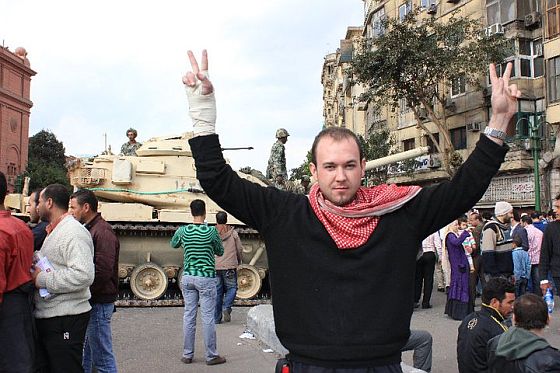
Eric Harroun, apparently in Egypt.
No, Islamists will not dominate in Syria
Rami G Khouri writes: The fast pace of developments in and around Syria in the past week has pushed the country more quickly toward the end of Bashar Assad’s regime, a situation many of us thought was imminent last autumn. He did not fall then for reasons that are evident today. The first is that Assad’s strategy from the start of the uprising against his rule two years ago this month turned out to be that he would, first, bludgeon into submission civilians who demonstrated against him (as his father had done in Hama 30 years earlier). And when that failed he would cede territory to them, but continue to hit their areas hard using air power and missiles. The Syrian government that ruled nationally has disappeared, to be replaced by fortified military bases tightly controlled by Assad loyalists, cousins and desperado fellow Alawites who are prepared to destroy Syria to save themselves.
The second is that this is a losing strategy, because the regime’s circling of its wagons in a few areas makes it more vulnerable than ever to the continued successes of Islamist rebels and the enhanced strengthening of the secular rebels (thanks to aid and training from Arab and foreign powers). As both prongs of the armed opposition advance on the regime’s isolated strongholds, and rockets fall in the center of Damascus, Assad’s constricted bases will panic, and ultimately collapse.
Third is the evident turmoil within the Syrian opposition coalition, coupled with this week’s bomb attack against the head of the Free Syrian Army. Unable to close ranks and work methodically to replace Assad, the weak Syrian opposition continues to flounder, despite considerable domestic and international support. It is worth remembering and repeating: A credible national opposition movement cannot be created and funded by Arab Gulf and Western powers. Rather, it must emanate solely from the legitimacy bestowed by those millions of brave Syrians who continue to fight on the ground inside their country.
Fourth, the opposition’s weaknesses underlie the major developments that now shape the situation: The anti-Assad uprising has turned into an armed conflict; Islamist opposition groups (including many non-Syrian nationals) have earned leading positions in the uprising, due mainly to their military successes; and regional and foreign actors such as Saudi Arabia, Qatar, Turkey, the United States, Jordan and others are increasingly assisting all the armed opposition groups. Consequently, Syria has become the latest front in a regional struggle for control of Arab governments between secular nationalists and pan-Islamists. The Islamists seem to be doing well now, for the reasons mentioned above, but I suspect the secular nationalists will triumph in the end. [Continue reading…]
In Syria, the rebels have begun to fight among themselves
Rania Abouzeid reports: The day started like a regular Sunday for Mohammad al-Daher, better known as Abu Azzam, the commander of the rebel Farouq Brigades in the vast swath of eastern Syria called the Jazira, a region that stretches from the Turkish border to the Iraqi frontier and encompasses the three provinces of Raqqa, Hasaka and Deir ez-Zor. He had a series of meetings in the morning in a number of locations in the bustling town of Tal Abyad on Syria’s border with Turkey as well as in the partially destroyed former police station that is the Farouq’s headquarters. And he was going to visit his mother.
By late afternoon, however, the burly 34-year-old Raqqa native would be lying in a hospital bed — wounded by members of the ultraconservative Islamist group Jabhat al-Nusra (which the U.S considers a terrorist organization with links to al-Qaeda). Abu Azzam’s targeting has blown open a sharp rift and long-brewing conflict between the more secular nationwide Farouq brigades and the Jabhat. The two groups are among the most effective, best organized and most well-known of the many military outfits aligned against Syrian President Bashar Assad — and the fight between them is just beginning.
Farouq has the upper hand in Tal Abyad, which lies opposite the Turkish city of Akcakale. It snatched the border crossing from Assad’s forces on Sept. 19, much to the chagrin of a number of other rebel groups — both secular units under the loose banner of the Free Syrian Army (FSA), as well as Islamist groups operating independently. It’s not the only border post controlled by the Farouq. The gateway to Idlib province, Bab al-Hawa, near the Turkish city of Reyhanli, is also in their hands. The Jabhat, on the other hand, were at the forefront of taking Raqqa city, farther to the south, the first provincial capital to fall to any rebel force.
By mid-afternoon, Abu Azzam stopped in to see his mother, Em Mohammad, in her modest first-floor apartment a short walk from the Farouq base. The young man stooped to kiss her right hand, he put his forehead to it before kissing her cheeks and embracing her warmly. “Finally, I see you!” she told him, gently scolding her son as he sat beside her. “You know the last time I saw him he was like this,” Em Mohammad said, picking up Abu Azzam’s two cell phones, holding one to each ear and pretending to issue orders into them, interspersing the talk of weapons and requests for battle updates with “Hi, mother, how are you, how is your health?” The half a dozen men in the room all laughed. “I’m sorry,” Abu Azzam told his mother, “but what can I do?”
Turkish coffee was served in delicate, thin-handled china cups. On this day Abu Azzam wasn’t in his unit’s military uniform. He was dressed in indigo jeans, a dark green crew-neck sweater, a black leather jacket and navy boat shoes. He has a Salafi-style black beard (without a mustache) that he frequently tugs at and a smile so broad and disarming that it seems like it takes up his whole face.
He reached for his pack of Winston Silver cigarettes before turning to his mother, a feisty, friendly woman in a long black dress and powder blue headscarf whom he bore a striking resemblance to. “Just so you don’t hear it elsewhere, they planted an [improvised explosive] device in my car yesterday,” he told her. Em Mohammad put her hand up to her mouth. She had lost Abu Hussein, the second of her three sons, on Feb. 20 in the battles for Raqqa province. He was also a member of the Farouq, a father of two little girls, and now her eldest son was telling her he had been targeted. “May God protect you,” she told him.
“Nobody dies before his time,” Abu Azzam said, repeating a common Arabic phrase. In a chilling premonition of what would happen just a few hours later, he said: “I know that I am going to be killed either by the regime or by the Jabhat. There is no difference, they are both dirty.” [Continue reading…]
Obama’s Syria policy in shambles as Assad opposition squabbles
McClatchy reports: The Obama administration’s Syria policy was unraveling Monday after weekend developments left the Syrian Opposition Coalition and its military command in turmoil, with the status of its leader uncertain and its newly selected prime minister rejected by the group’s military wing.
State Department officials said they still planned to work with the coalition, to which the United States has pledged $60 million, but analysts said the developments were one more sign that the Obama administration and its European allies had no workable Syria policy.
The opposition coalition, already in its second incarnation, has proved to be as beset by factionalism as its predecessor, the Syrian National Council, exacerbated this time by the meddling of foreign donors, analysts said. But, the analysts added, the United States has no other entity to back in a war that pits the regime of President Bashar Assad against a jihadist-dominated rebel movement.
“This is it. The U.S. can’t reboot it a third time. If they can’t make this work, they’ve got nothing,” said Joshua Landis, the director of the Center for Middle East Studies at the University of Oklahoma and the author of the blog Syria Comment. [Continue reading…]
Aleppo: a city abandoned by the world
Channel 4 News: Twelve-year-old Mohamed Asaf’s days are filled treating Aleppo’s war wounded. He starts work at 8am and usually gets to bed by 11pm.
When filmmaker Marcel Mettelsiefen meets him in the city’s Dar al-Shifa clinic, Mohamed is battling to save a young girl’s life.
After months bearing witness to the human tragedy of Syria’s civil war, he has become desensitised to the horrors: “With time it has become easy: blood has become like water to me,” he says.
In an interview, Mettelsiefen describes the logic of the Assad regime which targets civilians while avoiding striking the al-Nusra Front’s command in Aleppo. The desired effect is to radicalize the population, swell al-Nusra’s ranks and thereby heighten Western fears about the fall of the regime. In effect, al-Nusra has become Assad’s insurance against intervention.
Obama’s foggy red line on use of chemical weapons in Syria
The Washington Post reports: The suspicious attack that killed 26 people in northern Syria last week exposed the difficulty of determining whether the Syrian regime has resorted to using chemical weapons as well as the lingering uncertainty over how President Obama would respond if what he has called a “red line” is crossed.
Current and former U.S. officials acknowledged that confirming a small-scale chemical weapons attack poses technical challenges that have been compounded by limitations on the ability of U.S. spy agencies to gather reliable intelligence, let alone air or soil samples, inside Syria.
The two factors are why U.S. intelligence analysts are still working to determine whether the attack near Aleppo last Tuesday involved the use of chemical compounds. The Syrian government and rebels have accused each other of unleashing chemical weapons.
The course Obama intends to take if confronted with proof of a chemical attack is equally unclear. The Pentagon has prepared calibrated options, ranging from airstrikes to sending troops to seize weapons sites. But officials said they haven’t taken the advance steps necessary to carry out such orders because planning has been hobbled by concerns about the political backlash to a potential U.S. intervention as well as struggles to coordinate with regional allies.
“If we had to go in tomorrow, I’d say we aren’t ready,” said an Obama administration official involved in preparations for securing Syria’s chemical weapons. “One thing we want to avoid is having one group securing the sites and another group bombing them.”
The level of uncertainty surrounding U.S. contingency planning two years into a conflict that has killed more than 70,000 people contrasts with the clarity of Obama’s repeated admonitions to the government of President Bashar al-Assad. [Continue reading…]
Rebel Free Syrian Army founder loses leg in Syria blast
Reuters reports: Colonel Riad al-Asaad, founder of the rebel Free Syrian Army (FSA), lost a leg in an explosion in Syria overnight and is in Turkey for treatment, a Turkish official said on Monday.
Asaad, who established the FSA in 2011 to fight for the overthrow of President Bashar al-Assad, was one of the first senior officers to defect from the Syrian military.
The Turkish official, who asked not to be identified, said Asaad’s wounds were not life-threatening.
Syrian opposition sources said Asaad had been hit by a car bomb in the city of al-Mayadin, south of Deir al-Zor in eastern Syria. These accounts could not immediately be confirmed.
Video: Syria — governing in a war zone
Obama’s effort to prolong the war in Syria
“I am very concerned about Syria becoming an enclave for extremism because extremists thrive in chaos, they thrive in failed states, they thrive in power vacuums,” President Obama said at a news conference in Amman, Jordan, this week.
Given that this administration has designated the al Nusra Front as a terrorist organization, is now linking it to al Qaeda’s leadership in Pakistan, and that the widely accepted consensus is that among the opponents of the Assad regime, this ranks as the most powerful group, isn’t the eventuality that Obama fears, the state of affairs that already exists?
Maybe not. Maybe in Obama’s mind the current conditions in Syria represent what amounts to a tolerable balance of power. The rebels don’t have the strength to topple Assad and Assad retains control over his chemical weapons. For the U.S., Syria’s river of blood has not reached flood stage.
Even when it would be possible to make an argument that since the U.S. has such limited influence over the outcome it should not be involved in Syria militarily in any way whatsoever, Obama opts for limited involvement for what would appear to be political reasons: he can thereby deflect criticism from those who say the U.S. must do something — even if in the end all the U.S. is doing is prolonging the war.
The Wall Street Journal reports: The Central Intelligence Agency is expanding its role in the campaign against the Syrian regime by feeding intelligence to select rebel fighters to use against government forces, current and former U.S. officials said.
The move is part of a U.S. effort to stem the rise of Islamist extremists in Syria by aiding secular forces, U.S. officials said, amid fears that the fall of President Bashar al-Assad would enable al Qaeda to flourish in Syria.
The expanded CIA role bolsters an effort by Western intelligence agencies to support the Syrian opposition with training in areas including weapons use, urban combat and countering spying by the regime.
The move comes as the al Nusra Front, the main al Qaeda-linked group operating in Syria, is deepening its ties to the terrorist organization’s central leadership in Pakistan, according to U.S. counterterrorism officials.
The provision of actionable intelligence to small rebel units which have been vetted by the CIA represents an increase in U.S. involvement in the two-year-old conflict, the officials said. The CIA would neither confirm nor deny any role in providing training or intelligence to the Syrian rebels.
The new aid to rebels doesn’t change the U.S. decision to not take direct military action. President Barack Obama last year rejected a CIA-backed proposal to provide arms to secular units fighting Mr. Assad, and on Friday he reiterated his argument that doing so could worsen the bloodshed.
He also warned that Mr. Assad’s fall could empower extremists. “I am very concerned about Syria becoming an enclave for extremism because extremists thrive in chaos, they thrive in failed states, they thrive in power vacuums,” Mr. Obama said at a news conference in Amman, Jordan.
The new CIA effort reflects a change in the administration’s approach that aims to strengthen secular rebel fighters in hope of influencing which groups dominate in post-Assad Syria, U.S., European and Arab officials said.
The CIA has sent officers to Turkey to help vet rebels that receive arms shipments from Gulf allies, but administration officials say the results have been mixed, citing concerns about weapons going to Islamists. In Iraq, the CIA has been directed by the White House to work with elite counterterrorism units to help the Iraqis counter the flow of al Qaeda-linked fighters across the border with Syria.
The West favors fighters aligned with the Free Syrian Army, which supports the Syrian Opposition Coalition political group.
Syrian opposition commanders said the CIA has been working with British, French and Jordanian intelligence services to train rebels on the use of various kinds of weapons. A senior Western official said the intelligence agencies are providing the rebels with urban combat training as well as teaching them how to properly use antitank weapons against Syrian bunkers.
The agencies are also teaching counterintelligence tactics to help prevent pro-Assad agents from infiltrating the opposition, the official said.
Among other U.S. activities on the margins of the conflict, the Pentagon is helping train Jordanian forces to counter the threat posed by Syria’s chemical weapons, but isn’t working directly with rebels, defense officials say.
The extent of the CIA effort to provide intelligence to Syrian rebels remains cloaked in secrecy. The U.S. has an array of intelligence capabilities in the region, mainly on the periphery of the conflict.
The U.S. uses satellites and other surveillance systems to collect intelligence on Syrian troop and aircraft movements as well as weapons depots. Officials say powerful radar arrays in Turkey are likewise used to track Syrian ballistic missiles and can pinpoint launch sites.
The U.S. also relies on Israeli and Jordanian spy agencies, which have extensive spy networks inside Syria, U.S. and European officials said.
The current level of intelligence sharing is limited in scope because the CIA doesn’t know whether it can fully trust fighters with the most sensitive types of information, several U.S. and European officials said. The CIA, for example, isn’t sharing information on where U.S. and Israeli intelligence agencies believe the Syrian government keeps its chemical weapons, officials said.
Rebel leaders and some U.S. lawmakers say more robust U.S. support is needed to turn the tide in the civil war. These officials say the CIA’s current role comes as too little, too late to make a decisive difference in the war.