Category Archives: Syria

Defensive jihad in Syria

Aymenn Jawad Al-Tamimi asks: How do the jihadist rebels generally conceive of jihad in the Syrian civil war?

One useful way to look into this question is to examine the Qur’anic verses pertaining to warfare cited in propaganda statements. In this context, one recurring verse is 22:39, which runs as follows: ‘Permission [to fight] has been granted to those who are being fought, because they have been wronged. And verily is God able to grant them victory.’

For example, at the start of the final rebel offensive on Raqqah at the beginning of this month that successfully took the city out of the hands of Assad’s forces, a video emerged on Youtube entitled ‘Statement from Jabhat al-Nusrah [JAN] on the beginning of the battle to liberate Raqqah.’ In this video, one can see three fighters from JAN – the al-Qa’ida-aligned jihadist group. The speaker begins the statement with citation of 22:39.

In a similar vein, at the end of last year, a battalion calling itself ‘The Free Men of the Euphrates Battalion’ invoked 22:39 at the opening of the announcement of its formation. In January of this year, a claimed police defector in Hama highlighted 22:39 in announcing his defection to Ahrar al-Sham, which has since merged with numerous other battalions to form a broad jihadist umbrella group that played a key role in the capture of Raqqah.

To be sure, 22:39 is also cited beyond jihadist circles, for it was notably invoked by the prominent Islamic scholar Mohammed Ali al-Sabouni — head of the Association of Syrian Scholars and a member of the Syrian National Coalition (opposition coalition-in-exile) — as a justification for taking up arms against the Assad regime.

Coming back to JAN (on whom I focus since it is considered the most hardline jihadist group), another Qur’anic quotation cited in their propaganda is 9:39, which states: ‘Fight the polytheists altogether just as they fight you altogether.’ This verse appeared at the beginning of a video released through the group’s official channel, called ‘The White Minaret.’

JAN’s channel also released a video that begins with quotation from 4:75, which speaks of the need to fight in the cause of God for the oppressed who cry out for aid: a theme emphasized in the same video.

One could go on, but the point is that by citing all these verses, even JAN places an emphasis on what might be termed ‘defensive jihad’: that is, fighting in self-defense and in defense of one’s fellow Muslim brethren in the face of a regime seen as waging war on Islam.

Indeed, the doctrine contrasts with ‘offensive jihad’, which is a concept that normally relies on a verse of the Qur’an quite different from the ones cited above: namely, 9:29. Modern al-Qa’ida theorists use this verse to argue that Muslims must conquer the world for Islam. Osama bin Laden himself made this aggressive approach clear in an essay stating that non-Muslims had three choices: conversion, subjugation, or death. [Continue reading…]


Facebooktwittermail

The Free Syrian Army does exist and is growing stronger by the day

Koert Debeuf writes: When I read the piece of Aron Lund, ‘the FSA doesn’t exist’, I was utterly surprised. Of course the FSA does exist. And it is changing rapidly.Over the last few months, the FSA has transformed itself from a loose structure into a functioning organization. In fact, what Lund describes is an era of the FSA that no longer exists. It ignores the developments of the last several months and the present reality on the ground.

Last month, I visited Northern Syria three times with the Free Syrian 
Army (FSA). I spoke to many generals who had defected from the Syrian Army, to commanders on
 the ground,to people in the headquarters of the FSA and
 to military-civilian organizers of humanitarian aid of all parts of
 Syria. I also spent many hours with Dr. Brigadier General Salim 
Idriss, Chief of Staff of the FSA; I was in the middle of a battle 
at Quweris airport, then one of the main front lines.

Many points Lund is making, were correct three months ago. But not now. Col. Riaad Assad for example is completely out of the picture, whatever he himself might say. Another example is Qasem Saadeddin. He did indeed try to create some unity in Homs and had difficulties in doing so. But that too is history. Today he is a Commander of one of the five fronts under the umbrella of the FSA and he is working very closely with Chief of Staff Salim Idriss. It is also not true that Idriss would not use the ‘brand’ FSA. One example is the fact that he recently started his own twitter and Facebook account as well as one for the headquarters, using @FSAHQ. [Continue reading…]

Beneath Debeuf’s post is a response by Lund.

Facebooktwittermail

Syrian exile opposition pick U.S. citizen to lead interim government

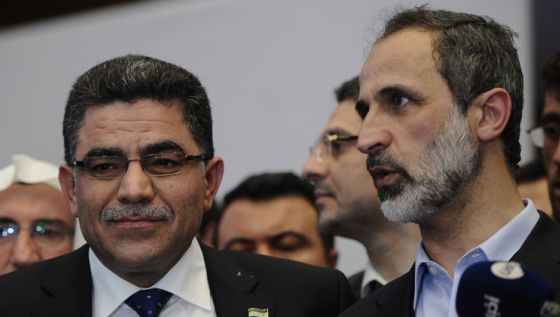
Ghassan Hitto (left) alongside Moaz al-Khatib, president of the Syrian National Coalition.

The Associated Press reports: Syria’s rebel coalition has elected as its prime minister Ghassan Hitto, a little-known American-educated IT manager and Islamic activist who will head an interim government to administer the areas seized by opposition forces from the regime troops of President Bashar Assad.

Hitto received 35 votes out of 48 ballots cast by the opposition Syrian National Coalition’s 63 active members during a meeting in Istanbul. The results were read aloud by coalition member Hisham Marwa to applause from a few dozen of his colleagues who had waited until after 1am to hear the results.

“I miss my wife and children and I look forward to seeing them soon,” said Hitto, who has lived in the United States for decades and recently moved from Texas to Turkey to help co-ordinate aid to rebel-held areas.

When asked what his interim government’s first priority would be, Hitto said he planned to give a speech later on Tuesday outlining his plans.

Hitto did not receive a resounding mandate from the coalition, of which he is not a member. Of the group’s 63 active members only 48 voted. Four cast blank ballots and Hitto received 35 of the remaining votes.

Hitto was born in Damascus, the Syrian capital, in 1963, according to his official resumé provided by the coalition. Little known in Syria, Hitto has lived in the United States for more than two decades, most recently in Texas. He has academic degrees from Purdue University in Indiana and Indiana Wesleyan University.

He worked for a number of different technology companies and helped run a Muslim private school called the Brighter Horizons Academy. He is also a founding member of the Muslim Legal Fund of America, which was founded to give legal aid to Muslims following the 9/11 terrorist attacks. He is married with four children.

Coalition members hope the new government will unite the rebels fighting Assad’s forces on the ground and provide services to Syrians living in rebel-held areas, many of which have been battered by the country’s civil war and suffer acute shortages of food, electricity and medical services.

But the new government faces huge challenges, starting with its ability to gain recognition from rebel factions on the ground.

Facebooktwittermail

The Free Syrian Army doesn’t exist

Aron Lund writes: Is the FSA losing influence in Syria? How many people are in the FSA? Is the FSA receiving enough guns from the West, or too many? Will the FSA participate in elections after the fall of Bahar el-Assad? What is the ideology of the FSA? What’s the FSA’s view of Israel? Is Jabhat el-Nosra now bigger than the FSA? What does the FSA think about the Kurds? Who is the leader of the FSA? How much control does the central command of the FSA really have over their fighters?

All these and similar questions keep popping up in news articles and op-ed chinstrokers in the Western media, and in much of the Arabic media too.

They all deal with important issues, but they disregard an important fact: the FSA doesn’t really exist.

The FSA was created by Col. Riad el-Asaad and a few other Syrian military defectors in July 2011, in what may or may not have been a Turkish intelligence operation. To be clear, there’s no doubting the sincerity of the first batch of fighters, or suggest that they would have acted otherwise without foreign support. But these original FSA commanders were confined to the closely guarded Apaydın camp in Turkey, and kept separate from civilian Syrian refugees. Turkish authorities are known to have screened visitors and journalists before deciding whether they could talk to the officers. While this is not in itself evidence of a Turkish intelligence connection, it does suggest that this original FSA faction could not, how shall we say, operate with full autonomy from its political environment.

From summer onwards, new rebel factions started popping up in hundreds of little villages and city neighborhoods inside Syria, as an ever-growing number of local demonstrators were provoked into self-defense. The most important recruiting tool for this nascent insurgency was not the FSA and its trickle of videotaped communiqués on YouTube. Rather, it was Bashar el-Assad’s decision to send his army on a psychotic rampage through the Syrian Sunni Arab countryside. As the corpses piled up, more and more civilians started looking for guns and ammo, and the rebel movement took off with a vengeance.

While the new groups almost invariably grew out of a local context, and organized entirely on their own, most of them also declared themselves to be part of the FSA. They adopted its logotype, and would often publicly pledge allegiance to Col. Riad el-Asaad. As a branding operation, the FSA was a extraordinary success – but in most cases, the new ”FSA brigades” had no connection whatsoever to their purported supreme commander in Turkey. In reality, what was emerging was a sprawling leaderless resistance of local fighters who shared only some common goals and an assemblage of FSA-inspired symbols. [Continue reading…]

Facebooktwittermail

Aleppo’s river of death


The Guardian reports: It is already one of the defining images of the Syrian civil war: a line of bodies at neatly spaced intervals lying on a river bed in the heart of Syria’s second city Aleppo. All 110 victims have been shot in the head, their hands bound with plastic ties behind their back. Their brutal execution only became apparent when the winter high waters of the Queiq river, which courses through the no man’s land between the opposition-held east of the city and the regime-held west, subsided in January.

It’s a picture that raises so many questions: who were these men? How did they die? Why? What does their story tell us about the wretched disintegration of Syria? A Guardian investigation has established a grisly narrative behind the worst – and most visible – massacre to have taken place here. All the men were from neighbourhoods in the eastern rebel-held part of Aleppo. Most were men of working age. Many disappeared at regime checkpoints. They may not be the last to be found. Locals have since dropped a grate from a bridge, directly over an eddy in the river. Corpses were still arriving 10 days after the original discovery on January 29, washed downstream by currents flushed by winter rains. [Continue reading…]

Facebooktwittermail

Jabhat al-Nusra and Hezbollah in first confrontation

Al Monitor reports: While the Iraq-Syria border was witnessing the first armed confrontation pitting Sunni jihadists against Iraqi and Syrian soldiers, leaving scores of people dead, a wide stretch of border between Lebanon and Syria was the scene of direct and unprecedented contact between Shiite Hezbollah militants and Sunni jihadists belonging to Jabhat al-Nusra. This new and serious development is likely to have serious repercussions in the coming weeks. There are several theories about how this situation came to pass.

One week prior, amid sporadic clashes on both sides of the northeastern border of Lebanon and Syria, regular Syrian army forces had redeployed in al-Nabk, near ​​the Lebanese border. Official Lebanese sources confirmed the event. On first glance, the redeployment would appear to be unremarkable given the movement of Syrian army units since the beginning of the civil war almost two years ago, but upon closer inspection, the seriousness of the maneuver becomes apparent.

The al-Nabk area stretches more than 45 kilometers along the border region. It starts to the west at the Jabal Akrum area of Akkar, north of Lebanon, and extends to ​​Arsal, in the Bekaa to the east, along a strip of rugged mountainous land where the Lebanese state — including administrative authorities as well as security forces — has not had a presence for decades. What is more important about this strip from which the Syrian army withdrew is that it is now almost completely controlled by the jihadists of Jabhat al-Nusra, the Syrian offshoot of al-Qaeda and rebel fighting force. In addition, the adjacent Lebanese territory is inhabited by an overwhelmingly Shiite population, which points to Hezbollah having a dominant presence there.

Thus, after nearly two years of recurring tensions and sporadic clashes between conflicting and volatile components on both sides of the border, Shiite Hezbollah and Sunni Jabhat al-Nusra today stand face to face along a significant length of the Lebanese-Syrian border in the absence of a restrictive or deterrent force in the form of the Lebanese or Syrian state. Remarkably, this development resulted from a sudden redeployment by the Syrian army.

The army still has an effective presence west of al-Nabk, whose inhabitants are, demographically speaking, predominantly Sunni, rather than Shiite, Lebanese. It responds almost daily to incidents of infiltration by fundamentalist Sunni insurgents from Lebanon. The situation is similar further to the east in the central Bekaa, where the regular Syrian army is still deployed in the face of a Sunni Lebanese demographic, no more than 30 kilometers from the center Damascus. In short, the Syrian army remains deployed in areas adjacent to Sunni regions, but has strategically withdrawn from Lebanese Shiite villages, paving the way for Jabhat al-Nusra to fill the vacuum, putting it in direct conflict with Hezbollah members. [Continue reading…]

Facebooktwittermail

Aleppo at war: Everyday life in the death zone

Kurt Pelda reports: In Aleppo, every footstep is a crunch. The streets are strewn with rubble and broken glass from destroyed buildings and shattered windows. It’s a sound that distinguishes a walk around this war-torn Syrian town from any other city in the world.

Abu Jamal is a young fighter from Brigade North Storm, a unit of the Syrian resistance. His comrades just call him “the sniper” because he spends his days creeping over rubble and broken glass from one building to the next in search of a firing position.

Abu Jamal is stationed in Bustan al-Basha, a district devastated by bombs and shells. Hardly any civilians live here anymore. A few fighters invite him to take tea with them in front of an office building that used to house a bank. I too sit on a stool on the sidewalk. Abu Jamal warns me. “That’s not a good place to sit,” he says, pointing to a big window on the first floor. “The shockwave of explosions can burst the window pane. The falling bits of glass could kill you.” Sure enough, when we pass the same spot the next day, the window is broken, its glass strewn across the sidewalk and the street.

There are rusting bits of metal everywhere. The shrapnel comes from exploding artillery shells and aerial bombs whose sole purpose is to kill. The explosions send them hurtling through the air. They tear people to pieces and slice gaping holes in skulls. The shrapnel doesn’t distinguish between fighters and civilians, men and women, old people and children. After impact with the ground, the pieces, often twisted into bizarre shapes, are red hot. You can burn your fingers on them — Aleppo’s children have learned that lesson.

If you want to survive in this city gone mad you watch out for flying metal and rubble. If an aerial bomb explodes in the area, people stay under shelter for at least 10 seconds afterwards — that’s how long it takes for the debris hurled into the air from the crater to come raining down, often over a distance of hundreds of meters, with deadly force. [Continue reading…]

Facebooktwittermail

UN peacekeepers abducted by Syrian rebels safe and sound, videos suggest

The Associated Press reports: Several UN peacekeepers from the Philippines who were abducted by Syrian rebels said in videos posted online on Thursday that they were safe and sound, even as activists reported clashes and shelling in the area where UN troops were being held.

Opposition fighters detained 21 Filipino peacekeepers near the village of Jamlah in the Golan Heights on Wednesday. The abduction marked the first time since UN troops began patrolling an Israeli-Syrian armistice line in the Golan Heights nearly 40 years ago that they had encountered trouble, said Timor Goksel, a Beirut-based former UN official in the region.

One of the videos posted online shows three men dressed in camouflage and blue bulletproof vests marked “UN” and “Philippines”.

“We, the UN personnel here, are safe, and the Free Syrian Army are treating us good,” one of them says in English. “We cannot go home because the government of Assad do not stop the bombing. To our family, we hope to see you soon and we are OK here.”

The second video shows six peacekeepers sitting in a room. An officer, who identifies himself as a captain, says that as their convoy came under shelling on Wednesday, “we stopped and civilian people helped us for our safety and distributed us in different places to keep us safe”.

A spokesman for the Martyrs of Yarmouk Brigades, who are holding the peacekeepers, told Associated Press via Skype that all the 21 peacekeepers were ‘fine and in good health”.

“We consider them guests,” he added.

Facebooktwittermail

Those who put their own interests first while they watch Syria burn

A Syrian-American using the pseudonym, Amal Hanano, writes: Over a kebab dinner in the Turkish city of Iskenderun, Syrian physician and cleric Mahmoud al-Husseini explained why he has not yet visited the Atmeh refugee camp in northern Syria, just 55 miles south from where he now lived. “I’m too famous, I don’t want to go to be photographed,” he explained.

It sounded like a cop-out. Husseini is the former head of Aleppo’s religious endowment, and although he left the country in the summer of 2011, he still boasts wide influence inside Syria. But this influence remained untapped. He says that he considers those who visit the camps to be “revolution celebrities,” merely looking for the next photo op with a poor Syrian refugee child. So he avoids getting involved altogether.

Like many Syrians, Husseini has strong yet contradictory opinions on the disaster unfolding across the border. He believes that the Syrian opposition in exile is controlled by foreign agendas and paid off with “political money,” and was convinced that the crisis could end with a single threatening “phone call from President Obama.” Yet, he also holds that it’s not time yet to counter the growing sectarianism within the ranks of the opposition fighters, because “the killing had to stop first.”

And his plan to solve the bloody crisis? Forming yet another Syrian opposition group. He claims his exclusive group, the “Building Civilization Movement,” is made up of 100 of the most important Syrian political and social figures in the country. He could only give one name, however, out of those elusive hundred. What was their plan? And why would he not announce the names? His answer: “They will be burned.” (Figuratively, of course.)

It’s a common response in Syria these days. Uncertain about how this bloody, two-year revolt will play out, many Syrians have essentially decided not to decide on their stance toward the conflict. When asked to give their reason, they repeat the same sentence: “I don’t want my cards to be burned.” Many prominent Syrians are sitting on the fence, waiting for the right moment to get involved — but only when it is clear their personal interests will be protected.

The “don’t burn your cards” saying became a joke between our group of Syrian journalists, writers, and activists as we moved back and forth across the Syrian-Turkish border area in January to meet with rebel fighters, refugees, and politicians. If you do “fill-in-the-blank,” we would laugh, then you will burn your cards. This action could be almost anything — take a picture with a refugee child, announce your true political beliefs, go into Syria, don’t go into Syria. [Continue reading…]

Facebooktwittermail

Syria’s refugee tide passes one-million mark, half are children

Reuters reports: A 19-year-old mother of two registered on Wednesday as the millionth refugee to flee Syria, part of an accelerating exodus that is piling pressure on neighbouring host countries.

Wearing a green headscarf and holding her young daughter, Bushra smiled nervously as she waited at Lebanon’s main registration centre in the northern city of Tripoli, which processes 800 Syrians a day.

“The situation is very bad for us. We can’t find work,” she said. “I live with 20 people in one room. We can’t find any other house as it is too expensive. We want to return to Syria. We wish for the crisis to be resolved.”

Syrians started trickling out of the country nearly two years ago when President Bashar al-Assad’s forces shot at pro-democracy protests inspired by Arab revolts elsewhere.

The uprising has since turned into an increasingly sectarian struggle between armed rebels and government soldiers and militias. An estimated 70,000 people have been killed.

Around half the refugees are children, most of them aged under 11, and the numbers leaving are mounting every week, the United Nations refugee agency said in statement. [Continue reading…]

Facebooktwittermail

Profile of the leader of Jabhat al-Nusra

Al-Amir Gazi al-Haj

GlobalPost reports: On Dec. 10, the Obama administration officially deemed al-Nusra a terrorist organization, describing it as an extension of Al Qaeda in Iraq. The move criminalized any private support for the group. Members of al-Nusra have since dodged any questions about its Al Qaeda links in the foreign media. Al-Haj followed suit.

“Why are the US upset about Al Qaeda?” he asked. “Didn’t Hilary Clinton say they are fighting an organization they created?”

“If the US intend to make justice and peace in the world, then we are with them. If Al Qaeda does, then we are with them. We are on the side of justice and peace, whoever brings it.”

Among other opposition leaders, the general belief is that al-Nusra does not have direct links to Al Qaeda, but that much of their ideology stems from the same core beliefs. One of the few outside groups to have worked alongside al-Nusra is Suqur al-Sham, a coalition of moderate Islamists.

“Some of their thinking is similar to Al Qaeda in Iraq. But I do not believe they are financed by Al Qaeda,” said Ayachi Abdel Rahman, a Suqur al-Sham brigade leader who himself stands accused of terrorism. “They have shown a willingness to conform. They have slowly changed their tactics to appease fellow opposition groups and the Syrian population.”

Read the full story: From IT to rebel commander: The story of Ayachi Abdel Rahman

But Abdel Rahman said the two groups have had their disagreements over the killing of prisoners. He recalled a joint mission against a government checkpoint in Idlib where al-Nusra members captured and slit the throats of five government soldiers, throwing their bodies on the roadside. They told Abdel Rahman they wanted to instill fear in their enemy.

While the majority of opposition groups, by policy, send captives to face the centralized Free Syrian Army tribunal, YouTube videos show al-Nusra carrying out executions by gunfire and beheading.

Al-Nusra recently signed agreements in most areas, including Jabal al-Zawiya, to abide by the decisions of the Free Syrian Army courts, including the trial of prisoners of war. But al-Haj said there are situations were prisoners are executed without trial.

“There are some who we are sure have killed many,” he said. “By Islamic law it is an eye for an eye. These executions are by the same law as the courts. The intention of Jabhat al-Nursa is not to kill, but to uphold the law.”

Al-Haj said he was surprised when the United States designated al-Nusra a terrorist organization.

“If Jabhat al-Nusra are terrorists, why don’t we take a look at how many women have been raped by us, how many mosques have been destroyed by us, how many children killed. Now compare our record to Bashar’s list,” he said. “Then you will see who is the terrorist.”

Entering the room to serve a lunchtime feast, Al-Haj’s mother-in-law joined the conversation.

“The people are a witness to Jabhat al-Nusra,” she said. “They love Jabhat al-Nusra. What makes them terrorists? Because they don’t rape or steal? Because they protect and help the people? How is this terrorism?”

When his wife and young son entered the room, al-Haj beamed a joyous smile. He hugged the boy, who ran giggling into his arms, before warmly inviting his guests to enjoy the meal.

Following the terrorist designation in December, protests broke out across Syria in support of al-Nusra. Signs declared, “We are all Jabhat al-Nusra” and “There is no terrorism in Syria except that of Assad.”

Facebooktwittermail

U.S. policy on Syria is self-defeating

Rami G Khouri writes: Every time I visit the United States, I find without fail that the public’s awareness of the Middle East reflects a pattern that has two dimensions. The majority, which does not follow events in the region, invariably expresses those images that it absorbs from simplistic media coverage of events, usually with phrases like, “Are they ever going to solve the problems over there?” or, “Are things any quieter now over there?” to which the easiest reply is, “Oh, not really, but we hope for the best.”Those Americans who do follow events in the Middle East, however, tend to focus on only one issue at a time, perhaps because it is easier to see it in terms of single issues isolated in time and political context, rather than view the complexities and nuances of our region as they really are: interconnected, fluid and mostly negotiable, among a range of situations and actors such as Egypt, Iran, Saudi Arabia, Turkey, the March 14 and March 8 alliances in Lebanon, the warring sides in Syria, and Iraq’s fragile condition in the run-up to President Barack Obama’s visit to the Middle East this month.

At the start of my current trip in the U.S. the single question that preoccupies Middle East-watchers there is what to do about Syria, and whether or not the United States should provide military assistance to the opposition groups fighting to topple the regime of President Bashar Assad. The issue is topical given the current trip to the Middle East of Secretary of State John Kerrey, who has met with the head of the main political opposition group in Syria, the Syrian National Coalition. Kerry also announced $60 million in nonlethal aid to help the opposition improve services for citizens in liberated areas.

The big question people ask is whether the U.S. should provide military aid to help the Syrian rebels improve their chances of defeating the Assad family regime. The hesitancy of the Obama administration to do this (beyond the military training that is widely assumed to be under way in Jordan) is a classic example of why American foreign policy in the Middle East is so erratic, often leading to the growth of groups that feed off anti-American sentiments.

The U.S. is reluctant to offer direct military aid to the rebels because it fears weapons might fall into the hands of groups the United States does not like, especially Islamist groups such as the Nusra Front or smaller groups with alleged affinities to Al-Qaeda that have grown rapidly in the past year and now spearhead military advances in parts of Syria. Presumably, that is because the U.S. does not want to arm Islamist or other unfriendly groups who might agitate against the U.S. or its allies, such as Israel, Saudi Arabia or Jordan.

That sounds like a reasonable policy, but in reality it is a total failure. In fact it brings about precisely that outcome that Washington says it wishes to avoid – the rise to prominence, or even dominance, of those Islamist groups the U.S. dislikes. So as the U.S. speaks boldly about bringing down the Assad regime, but does little on the critical military front to help bring this about, Islamist and other rebel groups whom the U.S. dislikes have received plenty of arms and made sustained gains militarily. They have therefore won the confidence of ordinary people across the land, enhancing the likelihood that these groups will dominate the post-Assad system of power.

Vali Nasr says: “It is not going too far to say that American foreign policy has become completely subservient to tactical domestic political considerations.”

So how does this apply to Obama’s thinking on Syria?

I imagine it runs something like this: Who knows how long the war in Syria will drag on? Maybe the death toll will pass 200,000. But here’s the thing we must be sure will never happen: We cannot run the risk that an American-supplied surface-to-air missile might be used to bring down an Israeli aircraft. That would be unthinkable — the rest, that’s just regrettable. After all, no one in Washington has to worry about the Free Syria Lobby.

Facebooktwittermail

U.S. Syria strategy aims to salvage reputation

Shashank Joshi writes: This week, new US Secretary of State John Kerry promised $60m (£40m) to the Syrian National Coalition, the political umbrella group for opponents of President Bashar al-Assad’s beleaguered regime. But there is a certain irony to the fact that, while the cash was pledged to “non-lethal” assistance, US policy is increasingly being forced to accommodate itself to the armed, very much lethal side of Syria’s rebellion.

Last summer, after former UN Secretary General Kofi Annan gave up on his peace plan for Syria, things looked hopeless. President Barack Obama’s top national security officials all fell in line behind a plan to arm selected Syrian rebels.

But, according to reports in the Wall Street Journal, the president vetoed the proposal: He was concerned at whether the weapons would make their way to extremists, make much difference, or provoke Russia into a response.

Although the US had given its support earlier in the year to a Saudi Arabia, Qatari and Turkish effort to funnel arms to Syria, it changed its mind after seeing that jihadists were getting many of the weapons. The flow thinned out.

But fast forward to the beginning of this year, and the picture looks different. Syria-watchers, like the bloggers Eliot Higgins and James Miller, began noticing an influx of arms from the former Yugoslavia to southern Syria – most previous arms having come in from the north, via Turkey.

Piecing together various news reports, it seems that Croatian arms are being purchased by Saudi money, collected by Jordanian aircraft, and smuggled to groups who are almost certainly being vetted by the United States.

Why the shift in policy? First, the timing would indicate that the White House was waiting for last year’s presidential elections to conclude.

Second, the rebels’ performance in the north of Syria, strong as it has been over the last six months, wasn’t having a decisive effect.

The aim of going through Jordan is to open up a new front in the south, and put more pressure on Damascus itself. [Continue reading…]

Facebooktwittermail

Rebel cooperation in Syrian town shows challenge of isolating Islamists

McClatchy reports: Sophisticated new weapons now in the hands of rebels in north-central Syria underscore how difficult it will be, once more lethal aid begins to arrive, to keep those weapons from Islamist extremists who’ve become key to rebel military advances throughout the country.

Rebels who belong to the Victory Brigade – a group whose alliance with the Hama provincial military council makes it acceptable to U.S. officials who are deciding where aid should go – were giddy as they showed off their new weapons this week. They included Russian-made RPG-27s – shoulder-fired rocket-propelled grenades capable of piercing the armor on the Syrian military’s most advanced tanks – and RG6 grenade launchers, another Russian-designed weapon, this one capable of spewing projectiles that explode on contact.

But the brigade doesn’t fight alone, and a video that another rebel group, the Islamist Ahrar al Sham, posted to YouTube this month showed fighters using the same kinds of weapons in an assault that was coordinated with the Victory Brigade.

“Of course they share their weapons with us,” said Ali Ankir, a spokesman for Ahrar al Sham. “We fight together.”

Indeed, Victory closely coordinated its offensive in December to seize the town of Kfar Nbouda from forces loyal to President Bashar Assad not just with Sham, but also with fighters from the Nusra Front, which the State Department has designated a terrorist organization aligned with al Qaida in Iraq. Nusra and Sham share the goal of establishing an Islamist state in a post-Assad Syria, and unlike Victory they don’t recognize the authority of the Hama military council. [Continue reading…]

Facebooktwittermail