Category Archives: Syria

Syrian opposition strikes unity deal

Reuters reports: Syrian opposition leaders struck a hard-won deal on Sunday under intense international pressure to form a broad, new coalition to prepare for the fall of President Bashar al-Assad.

Delegates, who had struggled for days in the Qatari capital Doha to find the unity their Western and Arab backers have long urged, said the new body would ensure a voice for religious and ethnic minorities and for the rebels fighting on the ground, who have complained of being overlooked by exiled dissident groups.

Some details remain outstanding, including who will head the new Syrian National Coalition for Opposition and Revolutionary Forces and the final assent of some leaders not present in Doha.

Diplomats and officials from the United States and Qatar, the tiny Gulf emirate whose oil and gas wealth has helped fund the 20-month-old uprising, have particularly been pressing the Syrian National Council (SNC), whose leaders mostly live abroad, to drop fierce objections to joining a wider body.

“An initial deal has been signed. A final formulation has been agreed and signed,” Ali Sadreddine al-Bayanouni, a delegate for the Islamist group the Muslim Brotherhood, told reporters.

“The evening session will be for electing the president of the body and his deputy,” he added. The meeting was due to resume around 6 p.m. (1500 GMT).

Delegates said there would be specific representation for women and ethnic Kurds as well as for Christians and Alawites, the religious minority to which Assad belongs and from which he has drawn much of the leadership of his security forces.

It was not entirely clear whether full agreement had been reached, however. [Continue reading…]

Facebooktwittermail

Israel fires warning shot within Syria

The following Haaretz report doesn’t make clear exactly where the latest Syrian mortar fell or the position of the IDF when it fired warning shots, but it’s reasonable to assume that both locations were in the Israeli-occupied Golan Heights which legally remains part of Syria.

The Israel Defense Forces fired a warning shot at Syria on Sunday, after an errant mortar shell landed in Israeli territory. This was the first time Israel has directed weaponry at its northern neighbor since the Yom Kippur War in 1973.

The errant shell marked the fourth time in just over a week that the infighting from Syria has spilled into Israel.

An Israeli security source said the military fired in the direction of a Syrian army mortar crew that had launched a shell which overshot the Golan disengagement fence on Sunday, exploding near a northern Israeli community without causing casualties.

In a statement, the Israeli military said soldiers had “fired warning shots towards Syrian areas”.

“The IDF has filed a complaint through the UN forces operating in the area, stating that fire emanating from Syria into Israel will not be tolerated and shall be responded to with severity,” the statement said.

Defense Minister Ehud Barak earlier Sunday warned that Israel would respond should stray Syrian ordnance continue to strike the Golan Heights, highlighting international concerns that the civil war in Syria could ignite a wider regional conflict.

Facebooktwittermail

Northern Syria awash with advanced weapons

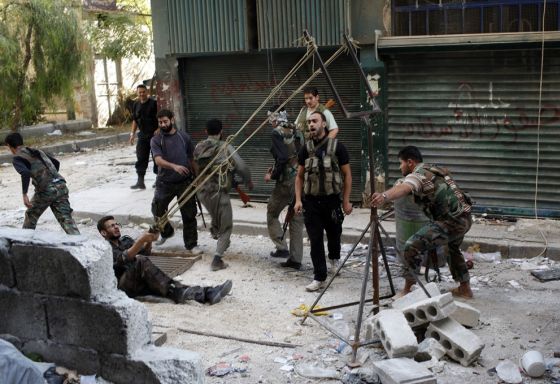
Members of the Free Syrian Army use a catapult to launch a homemade bomb during clashes with pro-government soldiers in the city of Aleppo, on October 15, 2012 - Reuters

“Northern Syria is awash with advanced antitank and antiaircraft weapons. The situation has changed very quickly,” said a Syrian involved in coordinating weapons procurement with regional states, the Wall Street Journal reported on October 17.

Facebooktwittermail

Syrian National Council picks a Christian to be its new leader

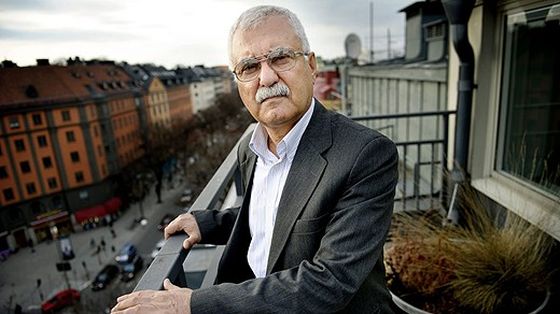
George Sabra, newly-elected president of the Syrian National Council.

McClatchy reports: Syria’s biggest political opposition bloc Friday elected a Christian, George Sabra, as president, a move Sabra said showed that the Muslim-majority nation will not allow its national uprising to descend into sectarian war.

Sabra, a geography teacher who once wrote for the Arabic version of “Sesame Street,” immediately demanded that the international community provide arms to the rebels so that they can protect Syrian civilians from regime attack.

Western nations, he told reporters after the vote by the Syrian National Council, should “support our right to survival.” He added, “To protect ourselves, we need weapons.”

Tens of thousands of Syrians have died in the uprising, which began as peaceful demonstrations against the government of President Bashar Assad. But it has become a bloody civil war pitting the Syrian army and air force against rebels who despite a lack of heavy weapons have seized large swaths of Syrian countryside and have fought loyalist forces to a standstill in Aleppo, the country’s largest city.

Sabra seemed stunned by his sudden elevation to the council’s top post. “It is an unbelievable moment in my life,” he told reporters. “I promise to become a representative for all the Syrian people.”

It was uncertain whether Sabra’s selection would rehabilitate the Syrian National Council in the eyes of the United States. Last week, Secretary of State Hillary Clinton announced that the U.S. no longer would recognize the council as the primary anti-Assad organization, saying too many of its members had lived in exile for decades and that a new opposition group should include more representation from people fighting inside Syria.

Sabra may help fit that requirement. A longtime member of Syria’s communist party, which renamed itself the Syrian Democratic People’s Party in 2005, Sabra went into exile only in October after serving two months in prison for inciting dissent. Previously, he had served eight years in prison during the regime of Bashar Assad’s father, Hafez Assad.

Sabra credited his election to the intervention of a conservative Islamist from Homs, a Sunni Muslim city that has been the scene of brutal fighting between rebels and pro-Assad forces for most of this year.

Until the Islamist, Wasal al Shamali, who was here representing the Supreme Council for Revolutionary Commands, a collection of rebel-held cities in Syria, spoke on Sabra’s behalf, Sabra wasn’t even a member of the group’s top governing committee, the general secretariat. The Syrian National Council has been criticized because its 41-member secretariat includes no women or Alawites, the religious offshoot of Shiite Islam to which Assad belongs.

Shamali, however, said that Sabra should have his place on the general secretariat.

“I didn’t even know his name,” Sabra told McClatchy. “He was in tears.”

Added Sabra: “After that, who can talk about sectarianism when a Muslim sacrifices his place for a Christian?”

The group later elected Sabra its president, 28-13, over Hisham Marwah, an Islamic legal scholar.

Sabra said his selection should signal to the international community: “Look at Syria. There is no sectarianism inside Syria. All the people here, Muslims, voted for Christians.”

He said the Syria that he and others are fighting for “doesn’t have minorities and majorities. We have citizenship. And as I am a citizen, my colleagues elected me.” [Continue reading…]

Facebooktwittermail

Syria opposition seen uniting after U.S., Qatari push

Reuters reports: Syria’s fractious opposition, under pressure from the United States and Qatar to unite, looked likely on Friday to agree to form an inclusive new opposition body that would serve as a unity government if Bashar al-Assad falls.

Qatar, which has bankrolled the opposition to Assad and played a leading role in Arab diplomacy against him, is hosting an opposition meeting, with senior U.S. diplomats hovering on the sidelines, prodding the opposition to make a deal.

Rebel advances on the ground and increasing economic and social disintegration within Syria have added to the pressure on the opposition to form a body that can rule after Assad.

A source inside meetings that lasted into the early hours of Friday morning said members of the Syrian National Council (SNC), a group made up mainly of exiled politicians, had shifted views and were coming to accept the need to form a wider body.

“We will not leave today without an agreement,” the source said. “The body will be the sole legitimate representative of the Syrian people. Once they get international recognition, there will be a fund for military support.”

The new body would mirror the Transitional National Council that united the opposition to Muammar Gaddafi in Libya last year and then took power after he was ousted, the source suggested.

“They will create a ‘temporary government’, which could take control of embassies around the world and take Syria’s seat at the U.N., because the regime would have lost its legitimacy.”

An outline agreement could see the SNC and other opposition figures agree on a 60-member political assembly, or congress, as well as a military and a judicial council.

The SNC, which has previously been the main opposition group on the international stage, may have around a third of the seats in the new body but would otherwise lose much of its influence.

Though it was not yet clear whether the groups meeting in Doha will name members to the new body or broach the thorny issue of its leadership, its creation would mark an advance long sought by the United States and Qatar.

Meanwhile, Reuters also reports: Thousands of Syrians fled their country on Friday in one of the biggest refugee exoduses of the 20 month war after rebels seized a border town.

Syria’s fractious opposition was meeting in Qatar, under increasing pressure from the United States and Qatar to unite and form a credible body capable of ruling the country effectively if President Bashar al-Assad falls.

The United Nations said 11,000 refugees had fled in 24 hours, most to Turkey. The exodus is testing the patience of Ankara, the most militarily capable of Syria’s neighbors and a strong opponent of Assad. Ankara has long said a full-blown refugee emergency would demand robust intervention.

Facebooktwittermail

Obama re-election signals new phase in Syria war

The Associated Press reports: Within hours of President Barack Obama’s re-election the deadlocked Syrian conflict moved into a new phase Wednesday, with Britain’s prime minister urging the U.S. to join him in working directly with Syrian rebels and Turkey saying Washington has discussed protecting a safe zone inside Syria with Patriot missiles.

The changes would mark a profound shift in Western efforts to oust Syrian President Bashar Assad, and indicate that leaders have been waiting for the result of the U.S. presidential election before embarking on a new strategy to end the civil war that has killed more than 36,000 people.

British Prime Minister David Cameron, visiting a camp for Syrian refugees in Jordan, said the U.S., Britain and other allies should do more to “shape the opposition” into a coherent force and open channels of communication directly with rebel military commanders. Previously, Britain and the U.S. have acknowledged contacts only with exile groups and political opposition figures inside Syria.

Meanwhile, a Turkish official said Turkey and allies, including the United States, have discussed the possibility of using Patriot missiles to protect a safe zone inside Syria.

The foreign ministry official, who spoke on condition of anonymity because of ministry prohibitions on contacts with the news media, said planning for the safe zone had been put on hold pending the U.S. election. He said any missile deployment might happen under a “NATO umbrella,” though NATO has insisted it will not intervene without a clear United Nations mandate.

“There is an opportunity for Britain, for America, for Saudi Arabia, Jordan and like-minded allies to come together and try to help shape the opposition, outside Syria and inside Syria,” Cameron said. “And try to help them achieve their goal, which is our goal of a Syria without Assad.”

In London, British Foreign Secretary William Hague said talks with rebel military leaders would not involve advice on military tactics or support for their operations. Hague also insisted that Britain would not consider offering weapons to Assad’s opponents. [Continue reading…]

The Los Angeles Times reports: They are this ancient city’s bedraggled warriors: plowmen and laborers, mechanics and carpenters who came from the countryside this summer to “liberate” this formerly freewheeling town attuned to the rhythms of commerce.

Now they’re stuck here.

Bogged down by a relentless urban combat they’re ill-equipped to fight, the rebels daily endure both government bombardment and thinly veiled hostility from the resentful residents of a mercantile hub turned dystopia.

These rebels who entered Aleppo from semirural, tradition-bound suburbs and agricultural areas found no spontaneous outpouring of support, no waves of sleeper cells yearning to join the revolution. Many shopkeepers in the historic Old City seem to avoid eye contact with the scruffy legions strutting along the cobblestoned streets of this former Silk Road terminus.

A reporter escorted by rebels on a recent visit couldn’t escape the sensation of accompanying an occupying force.

The widely divergent backgrounds of fighters and Aleppo residents underscore a continuing tension that probably contributed to the stalling of the rebel advance.

It has been more than three months since the rebel brigades slipped into mostly sympathetic, largely working-class Sunni Muslim districts along the city’s northern, eastern and southern edges. But the advance mostly halted at the borders of more mixed and prosperous areas where the government still enjoys support.

Today, Aleppo remains divided along a roughly four-mile front line separating government and rebel-controlled zones.

Neither side has been able to push forward much in what appears to be an enduring stalemate, even as casualties mount and the destruction proceeds inexorably, creating vistas of pancaked apartment blocks and rubble-strewn lots in one of the world’s oldest continuously occupied cities.

Some rebel commanders openly regret the decision made in mid-July to attack the city directly. Filled with false confidence after chasing government troops from nearby districts, rebels eschewed a more classic guerrilla strategy of gradual advance via strikes on police stations, military posts and other security targets.

“We gave the regime an excuse to attack civilians,” laments Ahmed Obeid, who heads the Amr ibn al-As Division, one of perhaps 10 major rebel groupings fighting here. “We are not military men. We have made mistakes.” [Continue reading…]

Facebooktwittermail

How civil wars evolve

Peter Dizikes writes: When the Taliban took control of Kabul, Afghanistan, in late 1996, they soon launched a sustained military offensive to the north, an area they did not control. The following May, however, Abdul Malik Pahlawan, an Uzbek leader of the so-called Northern Alliance, which had been defending the region, struck a power-sharing agreement with the Taliban — who marched right into Mazar-i-Sharif, a key northern city.

All of two days later, Malik changed his mind, recognizing that his group would not have as much power as he had hoped. Quickly joining forces with two other ethnic groups in the area, Malik and his Uzbek followers repelled the Taliban in a bloody battle, eventually regaining control of the northern provinces.

This episode contains a larger lesson: Contrary to the common perception, political alliances during civil wars are not formed along immutable religious, ethnic or linguistic lines, according to the research of MIT political scientist Fotini Christia. As she explains in a new book, “Alliance Formation in Civil Wars,” published this month by Cambridge University Press, such alliances are often created for balance-of-power reasons, and stretch across religious or ethnic boundaries. Moreover, factions can develop within homogenous groups — leading seemingly solid allies, representing the same identity groups, to oppose each other.

“We see a civil war as black-and-white, a two-sided conflict between a government and rebels,” Christia says. “But usually it is a more dynamic situation.” In these more fluid circumstances, she adds, “Two groups can be friends one day and bitter enemies the next.”

The practical upshot of Christia’s findings is that many civil wars, though often described as manifestations of ancient sectarian conflicts, are often fought between factions whose leaders are more pragmatic — possibly suggesting that these wars can be resolved if the right incentives are in place.

“We have to be a lot more nuanced in the way we understand the dynamics of civil wars,” Christia says. “The process of alliance formation and alliance breakdown can take on a life of its own as a conflict unfolds.” Or, as she writes in the book, “policy makers should not be looking to race, language or religion to predict or preclude civil wars’ allies.” [Continue reading…]

Facebooktwittermail

Bashar al-Assad wants war not peace reveals Syria’s former prime minister Riyad Hijab

The Daily Telegraph reports: The most senior politician to defect from the Bashar al-Assad’s regime has revealed that the President repeatedly rejected calls by his own government for a political compromise, in favour of all-out war.

In his first full interview with a Western newspaper since he fled to Jordan in August, Riyad Hijab, the former prime minister, told The Daily Telegraph that he and other senior regime figures pleaded with Mr Assad to negotiate with the Syrian opposition.

One week before his defection, Mr Hijab, the vice-president, the parliamentary speaker and the deputy head of the Baath party together held a private meeting with Mr Assad.

“We told Bashar he needed to find a political solution to the crisis,” he said. “We said, ‘These are our people that we are killing.’

“We suggested that we work with Friends of Syria group, but he categorically refused to stop the operations or to negotiate.”

Mr Hijab referred to the war waged against the Muslim Brotherhood by Mr Assad’s father, Hafez, which led to the deaths of up to 10,000 people in an assault on the city of Hama.

“Bashar really thinks that he can settle this militarily,” he said.

“He is trying to replicate his father’s fight in the 1980s.” Mr Hijab was speaking as key anti-regime figures gathered in the Qatari capital Doha to replace the fractured opposition Syrian National Council with a new government-in-exile. Once formed, the new Council would seek to gain formal international recognition, and, crucially, better weapons.

Mr Hijab said he rejected an offer to be part of the US-backed proposal, promising to be a “soldier in this revolution without taking a political position”.

He said the lack of serious action by the West had consolidated President Assad’s confidence.

“Bashar used to be scared of the international community – he was really worried that they would impose a no-fly zone over Syria,” he said. “But then he tested the waters, and pushed and pushed and nothing happened. Now he can run air strikes and drop cluster bombs on his own population.” [Continue reading…]

Facebooktwittermail

Alawite FSA supporter whose father backs Assad tells of a Syrian family ripped apart

The National reports: Loubna Mrie is one of the few who belong to the minority Alawite sect of Syria’s president, Bashar Al Assad, and oppose his rule.

The 21-year-old activist, from a village near Latakia, said the country’s conflict has torn her family apart. She fled to Turkey in August after hearing security forces knew about her role in smuggling bullets to the opposition Free Syrian Army (FSA). En route, she was recorded talking to an FSA rebel in a video that was uploaded to YouTube. Within days, her mother was kidnapped from her home and has not been heard from since.

Ms Mrie blames her father, Jaodat Kamel Mrie, for the abduction.

“He is ready to do anything to show his loyalty to the government and Bashar Assad,” she said in an interview last week.

At the beginning of the uprising, her father, 69, a wealthy businessman, became a member of the dreaded shabiha, armed Alawite groups accused of acting as government sponsored militiamen.

Ms Mrie said he felt his financial success was due to privileges granted by the regime. He began arming unemployed Alawi men, paying them to carry out attacks, and training them.

“I am sure he is responsible for what happened to my mother,” she said.

Her decision to work against the regime came from a fierce independence her mother had instilled in her, she said. Her parents had divorced when she was in fifth grade and growing up she only saw her father a few times a week. Because so many people in Latakia, where she attended university, were pro-regime, she left for Damascus and begin assisting the FSA. [Continue reading…]

Facebooktwittermail

Syrian opposition meeting in Qatar to broaden, unify ranks

Reuters reports: Syria’s splintered opposition factions prepared to begin talks in Qatar on Sunday on a common front to gain international respect and recognition and, crucially, better weapons for their quest to oust President Bashar al-Assad.

It was the first concerted attempt to meld opposition groups based abroad and align them with rebels fighting in Syria, to help end a 19-month-old conflict that has killed over 32,000 lives, devastated swathes of the major Arab country and threatens to widen into a regional sectarian conflagration.

Divisions between Islamists and secularists as well as between those inside Syria and opposition figures based abroad have thwarted prior attempts to forge a united opposition.

Four days of talks in the Qatari capital Doha are expected with the goal of expanding and broadening the Syrian National Council (SNC), the largest of the overseas-based opposition groups, from some 200 members to 400, SNC politicians said.

SNC leaders hope this will pave the way for a separate meeting in Doha on Thursday of the wider opposition movement, aiming to form a united coalition.

“The four coming days for the Syrian National Council… will see for the first time the election of the leading committees and a new president for the council,” veteran opposition figure George Sabra told Reuters ahead of the talks.

The broadened council will include more representatives from other political and revolutionary groups, he said.

The United States called last week for an overhaul of the opposition’s leadership, saying it was time to move beyond the SNC and bring in those “in the front lines fighting and dying”.

Secretary of State Hillary Clinton said the meeting in Qatar would be an opportunity to establish a credible opposition.

Internal divisions, including a lack of cooperation between leaders abroad and fighters in Syria, as well as the rising profile of Islamist militants in rebel ranks, have put off Western states otherwise keen to see Assad fall.

Influential opposition figure Riad Seif has proposed a structure melding the rebel Free Syrian Army, regional military councils and other insurgent units alongside local civilian bodies and prominent opposition figures. [Continue reading…]

Facebooktwittermail

American amateurism on display in Syria

Rami G Khouri writes: A famous American coloring shampoo advertisement years ago used the effective slogan, referring to whether or not the woman in the ad dyed her hair, “Does she or doesn’t she?” The same question can be asked today about Hilary Clinton’s attitude to the Syrian opposition and the uprising to overthrow President Bashar Assad’s regime. Does she or doesn’t she truly support the uprising? To judge by her comments a few days ago that the U.S. will no longer view the Syrian National Council as the leading opposition group and instead wants to help shape a new coalition of groups to finish the job of removing Assad from power, the truth is that we really do not know the answer to that question. Now the U.S. is working with Qatar and the Arab League to hold a gathering in Doha this week to shape a new coalition of opposition groups that more credibly represents “those who are on the front lines, fighting and dying today to obtain their freedom … the Syrian National Council can no longer be viewed as the visible leader of the opposition … the opposition must include people from inside Syria and others who have a legitimate voice that needs to be heard.”

The irony of this is that the points Clinton makes are very sensible. The Syrian opposition must be led by credible people on the ground who have legitimacy and impact on the ground. The problem with her statement is that it creates a political reality that is a lose-lose situation for all concerned, because it hinders both the U.S.’s own standing in the region and the efficacy of the opposition groups it says it supports.

The U.S. seems to deal with the Syrian opposition like a consumer shopping for a car or a dress – it shops around the available markets because it is not sure of what it wants to buy, looks favorably upon one item it likes at first, and then changes its mind as it looks around to find the product that best matches its specifications. The U.S. seems to support freedom, dignity and democracy around the world in a very American-specific manner, not as a consistent or principled policy.

Three specific problems emerge from this new American attitude to the Syrian opposition. The first is about the United States itself. The U.S. appears increasingly unsure about how it wants to respond to the Syrian uprising, and having changed its mind this week it will be seen by most people as an unreliable partner that can change its mind again and again. If it wants, correctly, to support opposition groups on the ground, why did it not do this from the start? It could have engaged with the SNC and assisted other groups inside Syria through the available entry points into Syria. Or, it could simply quietly provide more assistance to other groups than the SNC, without making a public spectacle of its erratic behavior. [Continue reading…]

Facebooktwittermail

The Syrian revolution becomes more Islamist

By Robin Yassin-Kassab, Pulse, November 2, 2012

Like ‘armed gangs’, armed Islamists are one of the Syrian regime’s self-fulfilling prophecies. Most grassroots organisers and fighters are secularists or moderate Islamists, but the numbers, organisational power and ideological fervor of more extreme and sectarian Islamists are steadily rising. So why is the revolution taking on an increasingly Islamist hue? Here are some points in order of importance.

First, the brute fact of extreme violence. As the saying goes, “there are no atheists in foxholes.” Not only is faith intensified by death and the threat of death, and by the pain and humiliation of torture, but tribal and sectarian identities are reinforced. We want to feel like we when in death’s presence, not like I, because I is small and easily erased. So in Syria at the moment many Sunnis are identifying more strongly as Sunnis, Alawis as Alawis, Kurds as Kurds, and so on. This is very sad and it immeasurably complicates the future task of building a civil state for all, but it is inevitable in the circumstances. The violence was started by the regime, and the regime is still by far the greatest perpetrator of violence, including aerial bombardment of villages and cities, and now the liberal use of child-killing cluster bombs.

Second, beyond patriotic feelings for Palestine and Iraq and an unarticulated sense that their government was corrupt, two years ago most men in the armed resistance were apolitical. Finding themselves having to fight, and suddenly entered onto the political stage, they search for an ideology within which to frame their exciting and terrifying new experience. At present, the most immediately available and simplest ideology on offer is Salafism. As well as for their stark message, Salafists are winning recruits because of their organisational and warfaring skills honed in Iraq and elsewhere, and because of their access to private funds from the Gulf. If this were the sixties, the revolutionaries growing beards would have had Che Guevara in mind (and if much of the ‘left’ in the world were not writing off the revolution as a NATO/Saudi/Zionist conspiracy, the left might have more traction). At present, Salafism is in the air. It’s unfortunate, but it’s the historical moment. And why were all these young men apolitical before the revolution? Why hadn’t they learned more of debate and compromise? Simply put: because politics was banned in Asad’s Syria.

Third, the perception that Alawis (and to varying extents other minorities too) are siding with the regime as it destroys the country and slaughters the masses has produced a Sunni backlash. To a large extent the perception is correct. The regime’s crucial officers, its most loyal troops, and most of the shabeeha in Homs, Hama and Latakkia are Alawis. It’s true that some prominent Alawis have joined the revolution, that Alawis were targetted by Asad’s sectarian propaganda from the start, and that Alawis have good historical reasons to fear the rule of the majority, but all this is academic to some of the men in the firing line. The situation has been made much worse by the lining up of supposedly ‘Shia’ forces in defence of the criminal regime. Iran, Iraq and Hizbullah each have their own (horribly mistaken) strategic reasons for opposing the revolution, but a fighter with no time for geostrategic analysis sees only a Shia alliance opposing his life and freedom. By their words and actions, Iran and its clients have confirmed the discourse of anti-Shia propagandists. Many Syrians who now chant threats against Hassan Nasrallah previously loved the man, and scorned those who muttered about his heresy or Iranian loyalties. Like racism, sectarian hatred is not something inherent in a society or in an individual’s heart. It is generated by propaganda and political reality. (Please someone tell this to Joshua Landis). So we have to worry about the Sunni backlash, but we also have to blame the propaganda and bad politics which catalysed the backlash.

Next, in the ears of many Syrians the phrase ‘Islamic government’ doesn’t signify ‘amputations’ or ‘women in burkas.’ Many Syrians hear the phrase as ‘just government’ or ‘clean government.’ Leftist and rightist Islamophobes made a fuss of the news that certain liberated areas of Syria have set up sharia courts, but this development isn’t necessarily as scary as it sounds. Family law was already run according to sharia in Asad’s Syria. In places where the state has collapsed, where corrupt officials have fled or been arrested, it is logical that local fighters and organisers would recruit respected clerics to practise a law which everyone understands. In rural Syria in particular sharia is more trusted than civil law, because the experience of civil law in Asad’s Syria has been an experience of grotesque corruption.

Then the regime went out of its way to kill or detain secularist or anti-sectarian activists. Secularist activists are in some ways the greatest threat to the regime, because their existence contradicts the regime’s sectarian propaganda. There are tens of thousands of disappeared, and amongst them many civil society organisers. We don’t know how many are still alive, but if and when these people leave prison their ideas will be reinjected into the revolutionary debate.

Finally, some units of the resistance that have recently grown beards and thrown a more Islamic twist on their videos are really only pretending. They are wearing Islamic clothing in the hope of attracting weapons and money from the Gulf. They are doing so out of necessity. This is what the regime’s violence has reduced the country to.

Is the increase in radical Islamism a problem? Of course it is. There is no reason to think that post-Asad Syria, once united and fed (for these will be the first tasks), will accept an undemocratic Islamism, but in the perhaps very long gap between here and there, radical Islamism poses a great threat. It makes it much more difficult to start building a civil state for all. It scares minority communities. It scares the West (which, anyway, is doing almost nothing to help). It means that at some point there will have to be a showdown between the majority of fighters who want a Syrian democracy and the small minority who want an emirate on the path to a global ‘caliphate’.

Should we refuse to support the resistance for fear of its Islamism? Absolutely not. The factors generating scary forms of Islamism are factors introduced by the criminal regime. The situation will continue to deteriorate until the regime is made inoperative.

(This article was originally posted at Pulse and appears here with the author’s permission.)

Facebooktwittermail

Syrian rebels arm Palestinians against Assad

Reuters reports: Syrian rebels said on Wednesday they had begun arming sympathetic Palestinians to fight a pro-Assad faction in a Palestinian enclave in Damascus – a move which could fuel spiraling intra-Palestinian violence.

Two rebel commanders told Reuters they expected their Palestinian allies to fight the Popular Front for the Liberation of Palestine General Command (PFLP-GC) which dominates the Yarmouk enclave – a one-time refugee camp turned sprawl of apartment blocks which is run by the Palestinians themselves.

“We’ve been arming Palestinians who are willing to fight…We have formed the Liwa al-Asifah (the Storm Brigade)which is made up of Palestinian fighters only,” a rebel commander from the Suqour al-Golan (Golan Falcons) brigade said.

“Its task is to be in charge of the Yarmouk camp. We all support it and back it,” he told Reuters.

Earlier, AFP reported: Fierce clashes broke out before dawn Tuesday in a major Palestinian refugee camp south of Syria’s capital, pitting rebels against troops backed by pro-regime Palestinian fighters, activists and a watchdog said.

The fresh violence came after the feast of Eid al-Adha came to a close on Monday, with 560 people, including 235 civilians, reported killed during a failed ceasefire attempt over the four-day Muslim holiday.

“Clashes broke out overnight in al-Hajar al-Aswad district between rebels and the army, spreading into the adjacent Yarmuk Palestinian camp. The Popular Front for the Liberation of Palestine-General Command joined on the side of the army,” the director of the Syrian Observatory for Human Rights watchdog, Rami Abdul Rahman, told AFP.

Meanwhile, Reuters reports: After a week of clashes between anti-government rebels and Kurdish militants in Syria’s Aleppo province, the two sides are observing a tenuous truce.

It is a war within a war which neither side wants.

“We want to fight the regime and instead we are fighting a new front that we don’t need or have time for,” said a fighter of the rebel Free Syria Army, warming himself over a fire on a on a mountain overlooking olive groves and stone villages.

“We should be in Aleppo fighting, instead we are camping.”

The situation exemplifies the tangle of alliances, loyalties and rivalries – local and international – complicating the uprising against Syrian President Bashar al-Assad.

The FSA counts on the backing of Turkey, which gives it sanctuary over its border and is in the forefront of the diplomatic campaign against Assad.

The Syrian Kurdish militants are allied to the PKK (Kurdistan Workers Party), which is locked in a long struggle against the Turkish army to carve out an autonomous Kurdish region in southeast Turkey.

The Syrian Kurds have maintained their own unaligned militias and administer Kurdish areas in Aleppo province – scene of heavy fighting in the civil war. They are believed to be cutting deals with both the government and the opposition in order to maintain their autonomy.

The side conflict risks weakening the mostly-Arab rebels fighting Assad’s better-armed forces.

Dozens of rebels and Kurdish fighters of the separatist Democratic Union Party (PYD) were killed in the past week in clashes that began in Aleppo city and have now spread to the countryside, just a few kilometers away from Turkey.

On the mountain dividing rebel-held areas from Kurdish towns to the northwest of Aleppo city, heavy clashes raged for days.

“We are not against all Kurdish groups, but these PKK-linked groups are helping the regime by attacking us, we had no choice but to act,” says Mohammed Hamadeh, head of a rebel unit on the mountain.

The Associated Press reports: China on Thursday called for a phased-in cease-fire and negotiations on a gradual political transition to end the ongoing bloodshed in Syria.

A four-point proposal issued by the Foreign Ministry stopped short of calling for the ouster of President Bashar Assad and omitted mention of any measures to compel compliance. Alongside Russia, China has steadfastly blocked any outside intervention that could force Assad from power, much to the consternation of the U.S. and other countries seeking a swift end to the 19-month-old conflict, which has killed more than 35,000 people.

The proposal called on the international community to support the work of the U.N.-Arab League envoy to Syria, Lakhdar Brahimi, and other mediation efforts. Assistance should be provided to refugees, but humanitarian work should not be politicized or militarized, it said.

The ministry’s proposal was an elaboration of remarks made Wednesday by Foreign Minister Yang Jiechi to Brahimi during a meeting in Beijing, and echoed China’s position since the start of the conflict, ministry spokesman Hong Lei told reporters at a regularly scheduled news conference.

Facebooktwittermail

Pro-Assad page claims Syria and Iran engineered Hurricane Sandy

The Washington Post reports: Among the many global reactions to Hurricane Sandy’s impact on the U.S. East Coast, this one might be the most amusing. Syrian Army News, a pro-regime Facebook page, announced that anti-Western “resistance” forces working under President Bashar al-Assad and under the Iranian government secretly engineered the natural disaster using “highly advanced technology.” It describes the hurricane as a punishment for threatening Assad’s Syria.

Here’s the English translation:

Sources confirm that hurricane Sandy, now buffeting the U.S., was carried out by highly advanced technology developed by the heroic Iranian regime, in coordination with our resistant regime. These sources have also confirmed that experts from Syria have contributed in carrying out this work. This is the consequence of attacking Assad’s Syria and threatening its security.

Meanwhile, the New York Times reports: Iranian rescuers and aid workers are on standby to fly to New York City to provide assistance to those affected by Hurricane Sandy, the head of Iran’s Red Crescent Organization said on Wednesday.

“We are ready to help the flood-stricken people of America,” Mahmud Mozaffar, who leads the organization, told the semiofficial Fars News Agency.

His men stand ready to board planes and fly to the United States to help out, assuming the American government accepts Iran’s offer, he said.

“If American authorities agree, we can send our rescuers with equipment and tools to American cities in the shortest period of time,” Mr. Mozaffar said.

Dealing regularly with floods and earthquakes, Iran’s Red Crescent Organization is experienced in providing immediate assistance following disasters.

Facebooktwittermail

Residents of Syria’s capital stare into the abyss

John Pedro Schwartz writes: If you go to Damascus and ask a taxi driver to take you to the suburb of Harasta, you will not find it. Nor will you find Jobar. You will not find al-Hajar al-Aswad, either. Nor Qaddam. You will find half of Douma, three quarters of Daraya. Zamalka you will not find.

What you will find in place of these villages in the Damascus countryside, which the Syrian army reclaimed from the rebels in August and September, is the rubble of war. Rows of four- and five- and six-story buildings razed to their foundations. Symmetrical heaps of broken masonry, neatly setting off the original real estate lots — and then whole oceans of stone, with jagged waves. Electricity poles shattered at the trunk like felled trees, their tangle of wires branching in the dirt. Cars flattened as at the junk yard. Buses riddled with bullets. Apartment buildings with their fronts sheared off, so that you get an axial view of the floors, furniture and tenants gone missing.

The Damascus outskirts are not entirely unpeopled, however. I’m in the cab with Khalid, driving from Douma, the half-destroyed district northeast of the capital city, south along the smooth, deserted Hafez al-Assad highway. “Jobar,” Khalid points left across the highway to hulks of buildings heavily shelled yet erect amid the ruins. “We cannot go in. If we go in, they will kill us.”

“Who?”

“Both sides, the jaysh al-suri and the jaysh al-hur,” the Syrian government army and the Free Syrian Army (FSA), a collection of anti-government fighters and army defectors. “They are in there” — I peer down the narrow, empty streets as we drive slowly past — “but they fight at night.”

Night-fighting goes on among the alleyways and rooftops and oblique angles of Zamalka and Ain Terma, too. But not in Jaramana, a town southeast of Damascus that appears entirely unscathed, where people fill the streets and merchants hawk their wares. Even the drabness remains undisturbed. The only sign that something is rotten is the garbage that remains uncollected by the curbs. “Why no damages?” I ask.

“They support Assad.”

“Why do they support Assad and their neighbors don’t?”

Bee-khafuu,” They are scared. That they are mostly Christian and Druze might also have something to do with it. The Assads are Alawites, a Shiite Muslim offshoot, and the minorities have largely stuck together, fearful of a takeover by the Sunni majority.

Returning north, we see a white-haired man trudging across the grassless median. He tells us he is going home. Where is home? “Zamalka.” How are you? “Mneeh,” fine. How is everything? “Kil shee mneeh,” everything is fine. Are they any problems? “Maa fee mashakil,” there are no problems. We say our goodbyes.

Kil shee mneeh,” Khalid repeats, as we drive off. He points to one of Zamalka’s leveled buildings, lifts his hands, palms to the ground, and brings them down. “Bee-khaf,” He is afraid.

He has good reason to be afraid. Within minutes, we see a security officer leading a man in handcuffs across the highway. The officer turns to us with the snarl of a carnivore who has caught his prey. The detained has the look of one upon whom the reason why his wrists are hurting is slowly dawning. “Harasta,” Khalid points to the ghost town — once the scene of thousands-strong protests — on the right. “Jaysh,” he looks out the window at the army quarters on our left. A giant billboard image of President Bashar al-Assad looms over the sandbagged gate.

Passing a row of flattened structures, Khalid says, “kanabil foraghieh.” He sucks in and brings his palms together. “Suction bombs?” He nods his head. It is difficult to verify the claim, and I know of no reports that make the allegation. But implosive or explosive, the weapons — including aerial and artillery fire — have done their job well.

Khalid is young, short, dark, bearded, Sunni, illiterate, and fearless. “B-khaaf aleik,” I am afraid for you, he tells me.

Do you support Assad? “No.” Why not? “He killed 10 of my friends.” Do you know the rebels? “They are my friends.” Before the war started, did you like Assad? “Yes. Very much.” Why did you change? “He killed my friends.” Why don’t you join the rebels? “Maa bhebb el asliha,” I don’t like weapons. What kind of government do you want? “Muslim.” [Continue reading…]

Facebooktwittermail