



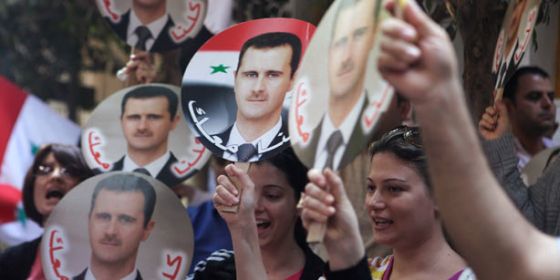
Al Ayyam reports: Pro-Assad rallies. The epitome of a civilized rally. The balloons, the flags, the dancing everyone happy and singing their praises to a supreme leader, denouncing violence and sectarianism. It’s a utopia of free speech and unwavering support. It is the example the Assad regime points to for proof of their success at ruling the country. It is a far cry from the tear gas, bullets and indeed heavy artillery that rain down on protests in other parts of the country. Proof, the government says, that these other protests are not peaceful at all, that they are, in fact, armed gangs paid for and financed from a number of external forces.
Activists have long claimed pro-Assad rallies are fabricated, that if one were to look closer the crowds are made up of the secret police or moukhabarat and a few die-hard loyalists. That these are planned in advance, funded by the regime no less and are not, as the government claims, spontaneous showcases of love and adoration.
It seems the devil truly is in the detail. The hacktivist syndicate Anyonymous recently dumped emails from MOPA, the Ministry of Presidential Affairs, President Assad’s personal office. Emails uncovered sent to Presidential aid Akram Issa, detail billings and accounts and efforts made in advance to create these spontaneous rallies in support of the President.
The email in question marked SPAM in the subject header, states Governors involved offered their verbal commitment to pay the supplier of these protests yet have not paid up their dues as per the Minister’s request. Attachments in the email detail itemized descriptions of the outstanding balance, which reach a total of 1.1 Million SYP in October 2011 (before the inflation of the SYP) at the time equaling $20,000.
The rally in Lattakia province alone cost the administration 315,000 SYP the bare minimum, the supplier writes, to make the rally seem like an acceptable turnout.
An attachment titled “Details of the Flag Raising Rally in Lattakia” [PDF] includes 45,000 SYP ($800) spent on 60 kg of confetti to be thrown in the air the moment the Syrian flag is raised. One hundred sweaters for the flag raising crew in the colors of the flag totaling 2,500 SYP ($580) and sound system rental for the rally at 500,000 SYP ($9000).
In another attachment titled “Detailed billings to the personal account of Monhal Zeitoun” [PDF] costs for rallies held in Damascus, Sweida and Hasakeh province are itemized. The supplier writes under the header for Damascus “Campaign: Our martyrs, your blood runs in our veins” and details expenditures of 150,000 SYP ($2,600) to cover sound and broadcast of the event including another 49,000 SYP ($875) for printed t-shirts. A miscellaneous amount of 57,000 SYP includes costs for ironing clothes, supply of water, taxi cabs and a refrigerator and its transport.
At a time when cities and towns were surrounded by regime tanks and protesters died on the streets by army bullets, when heating oil in Homs was scarce and when international opinion towards the regime came into question the President’s office was gearing up for a fanfare of pomp and circumstance in an effort almost too bureaucratic to believe to prove their support is indeed a spontaneous act of love sheltered in the heart of every Syrian.

Sharmine Narwani shares an email she received from a former US diplomat with service experience in Syria who has asked to remain unnamed. The email appears to have been written a week ago.
I have serious problems with all the talk about military intervention in Syria. Everyone, especially the media, seems to be relying solely on anti-regime activists for their information. How do we know 260 people were killed by the regime in Homs yesterday? That number seems based solely on claims by anti-regime figures and I seriously doubt its accuracy.
I served over three years in Damascus at the US Embassy and I know how difficult it is to sort fact from rumor in that closed political society. We were constantly trying to verify rumors that we had heard about assassinations, regime arrests, etc., and that included the Agency, which was just as much in the dark as everyone else. Today, we have a skeleton embassy which I am sure is under constant surveillance and with very few personnel to go out and report on what is happening. When I was in Damascus over two years ago, I was less than impressed with the Embassy’s sources and with its understanding of the dynamics of what was going on Syria. And the same is true when I talk to officials at the State Department.
The media, and to an extent the Administration, have personalized the conflict in Syria as being about Bashar Assad and his family. They have consistently underestimated the sectarian nature of the conflict there. It is not just Bashar Assad and his family that are hanging onto power at all costs, it is the entire Alawi system of control of the country, including the military, the security services and the Baath Party. I believe that Alawites firmly think that if they lose power, the Sunnis will slaughter them, That was one reason Hafez and his brother Rifaat were so ruthless in Hama thirty years ago. And everyone in the West conveniently forgets the campaign of assassinations and suicide bombings carried out in the three or four years before Hama by the Muslim Brotherhood throughout the country. I personally witnessed the aftermath of such bombings in which several hundred people were killed. While the State Department, the CIA and other organs of government may have short historical memories, the people in Syria do not.
There have been few good analyses of the conflict in Syria. With the exception of the journalist Nir Rosen and the International Crisis Group, most reporting has been superficial and biased in favor of opponents of the regime. This is no basis on which to base policy, especially if officials in Washington are contemplating some form of military intervention. We would be opening a Pandora’s box of sectarian conflict that could easily spread to Lebanon, Israel, Kurdish areas of Iraq and elsewhere.
One irony of the current situation compared to thirty years ago is Iraq’s role. Then, we had reasonably good information that Saddam Hussein was supporting the Brotherhood with arms, explosives and facilitating the smuggling of both across the Syrian-Iraqi border. Today, the Maliki government in Baghdad appears to be supporting the Assad regime. And thirty years ago, we also had information that the Brotherhood leadership was given sanctuary in Jordan by King Hussein and in Saudi Arabia.
I don’t think we know how to play in this arena, just as we don’t understand how to play in the Afghanistan-Pakistan arena. US military intervention, whether under the guise of NATO or some other umbrella, could have serious unforeseen consequences for the US, Europe and the region. Officials in Washington should have the law of unforeseen consequences hammered into their heads every morning.
In a revised version of an op-ed that appeared earlier in the New York Times, Nicholas Noe writes: With Syria rapidly descending into civil war and UN action blocked by recent Russian and Chinese vetoes, opponents of the murderous Bashar al-Assad regime face a critical turning point in their almost one-year long struggle to unseat him.
Unfortunately, though, in western capitals, among supportive regional states and within the Syrian opposition itself, practically the only approach to the crisis being seriously discussed revolves around one question: how best to ratchet up the pressure in order to bring about a “controlled collapse” of the whole structure.
In this often simplistic approach, the underlying logic invariably rests on two core ideas. First, Iran and Lebanon’s Hezbollah will not come to the aid of their staunch ally in the event of an impending fall. Second, any violence committed by a dying, isolated Assad regime could be reasonably contained.
Both projections are, however, unlikely. The fall of Assad would deliver a huge, strategic blow to both Iran and its “junior partner”, Hezbollah. It simply does not follow, then, that these actors will simply bite their tongues and absorb the disaster for their mutual position in the Middle East.
As key leaders in Tehran and Beirut have made publicly and privately clear, Assad anchors their tripartite “Resistance Axis”. As a result, both countries have only increased their support of Assad personally – even as his regime acts with more violence and irrationality.
But what if this dominant view were correct and Iran and Hezbollah do not see it in their interests to act? Even in that case, things would be unlikely to turn out as the west would like. A collapse will probably not replicate the eastern Europe experience of the late 1980s or Hosni Mubarak’s fall in Egypt. This is largely because Assad and his supporters control formidable military capabilities, which include, unlike in Iraq or Libya, chemical weapons and ballistic missile systems. Together with the sectarian support that the Alawite Assad regime will likely retain over time against an increasingly mobilised and violent Sunni majority, as well as any continuing military and elite support, the regime is fairly well positioned to prolong what many in the west have confidently projected as an “inevitable” demise wreaked by history.
This slow denouement will mean an extremely violent civil war that will burn for quite some time, with vast humanitarian consequences and multiple unintended effects. [Continue reading…]
McClatchy reports: The Iraqi branch of al Qaida, seeking to exploit the bloody turmoil in Syria to reassert its potency, carried out two recent bombings in the Syrian capital, Damascus, and likely was behind suicide bombings Friday that killed at least 28 people in the largest city, Aleppo, U.S. officials told McClatchy.
The officials cited U.S. intelligence reports on the incidents, which appear to verify Syrian President Bashar Assad’s charges of al Qaida involvement in the 11-month uprising against his rule. The Syrian opposition has claimed that Assad’s regime, which has responded with massive force against the uprising, staged the bombings to discredit the pro-democracy movement calling for his ouster.
The international terrorist network’s presence in Syria also raises the possibility that Islamic extremists will try to hijack the uprising, which would seriously complicate efforts by the United States and its European and Arab partners to force Assad’s regime from power. On Friday, President Barack Obama repeated his call for Assad to step down, accusing his forces of “outrageous bloodshed.”
The U.S. intelligence reports indicate that the bombings came on the orders of Ayman al Zawahiri, the Egyptian extremist who assumed leadership of al Qaida’s Pakistan-based central command after the May 2011 death of Osama bin Laden. They suggest that Zawahiri still wields considerable influence over the network’s affiliates despite the losses the Pakistan-based core group has suffered from missile-firing CIA drones and other intensified U.S. counterterrorism operations.
U.S. officials said that al Qaida in Iraq, or AQI, began pushing to become involved in Syria as Assad’s security forces and gangs of loyalist thugs launched a vicious crackdown on opposition demonstrations, igniting large-scale bloodshed. Growing numbers of lightly armed army deserters and civilians have joined an armed insurrection, and perhaps thousands of people have been killed.
Zawahiri finally authorized AQI to begin operations in Syria, the officials said, in what’s believed to be the first time that the branch has operated outside of Iraq.
“This was Zawahiri basically taking the shackles off,” said a U.S. official with access to the intelligence reports. Like others interviewed for this story, he spoke on condition of anonymity because the issue involves classified information.
U.S. officials believe that the Sunni Muslim AQI was looking to expand beyond Iraq, where it has been stepping up attacks on majority Shiites. In Syria, Assad heads a regime dominated by Alawites, a minority Shiite Muslim sect that has ruthlessly ruled the Sunni Muslim-majority country since Assad’s father seized power in a 1963 coup.
While the extent of AQI’s presence in Syria is unknown, U.S. officials believe that it’s too small to have a decisive effect on the conflict. Although al Qaida and its affiliates may have sought to play roles in other Arab Spring uprisings, this appeared to be the first time that the network had successfully done so.
“This has less to do with the targets and more to do with the opportunity,” the U.S. official said.
To explain al Qaeda’s entry into the conflict in Syria as “opportunism” is really to offer no explanation — unless one believes al Qaeda’s ranks are filled with young men simply looking for an opportunity to blow themselves up.
Neither should a recognition of al Qaeda’s involvement draw the simplistic retort (but no doubt it will) that this is a confirmation of Bashir’s claim that his government is facing a challenge from terrorists.
Assuming that the intelligence being reported here is accurate, then it would seem more likely that AQI’s activity in Syria has more to do with its ambitions in Iraq than in lending support to the cause of Sunni majority rule in Syria.
In Iraq, Nouri al-Maliki is showing no restraint in his effort to wipe out AQI. This week, 14 people were executed on a single day — most of them AQI members according to government officials.
AQI’s emergence in Syria may simply be a way of declaring its continued existence. And it may also hope to consolidate its foothold in its last remaining safe haven by compounding the instability on which it thrives.
Amal Hanano writes: Another early morning in Baba Amr, another late night here. My plan is to write a simple post from a few reports on the day’s events in Homs, the fifth consecutive day of shelling in Baba Amr. Keeping an eye on Skype and Twitter and my ears tuned in to Omar Shakir’s livestream broadcast, I begin, intending to finish quickly with the goal of sleeping earlier than the last four nights. Omar’s livestream is calm. The quiet moments before dawn are punctuated by chirping birds and soon after by the crowing rooster of Baba Amr, whose crows have now been heard across the world. I hear a booming noise in the distance every now and then. They have become part of Baba Amr’s everyday soundtrack, as normal as the calls of the rooster.
People tweet that it seems more peaceful, that the sounds of shelling are less intense. Then I notice Omar’s latest tweets, in Arabic with no hashtags, just cries of pure desperation. I sense this is Omar the person speaking not the citizen journalist. I know something was terribly wrong. A few moments later, we find out what it was. A different livestream camera had been targeted with a missile. People watched as the screen turned gray with smoke then black. The feed is dead. So are the five people who were manning the camera, including two women. I realize that Omar had been tweeting about witnessing the explosion of his friends, “A street strewn with limbs. People have become limbs. We have no one but you, God.”
Five dead quickly become twenty-nine and another fifty-five wounded. My fresh reports from an hour ago are now obsolete. Baba Amr is under attack. Again.
As I read Omar’s tweets and watch his videos, Jaafar, an activist in Daraa, messages me on Skype, “I need you to connect me to someone from the media to speak to a doctor in Homs.” I tweet, many kind people retweet, and we wait. He sends me another message, “I want television coverage not an article.” I wasn’t about to start arguing or tell him that beggars can’t be choosers. But truth is, no one is contacting me. So I call him and tell him I want to speak to the people in Baba Amr myself. He says reluctantly, “For an article?” “Yes, Jaafar,” I say, holding my tongue, “For an article.” He says, “Okay.” Moments later we’re on the call.
I speak to Yousef (whose name has been changed for his protection), an activist in Baba Amr who was assisting the doctor. The doctor was at another makeshift field hospital taking care of the wounded. Yousef recounts this morning’s events.
“The shelling started at 5 a.m. There are four families buried under the rubble of their homes. The rockets tear through one side of a house and penetrate through the walls into the next. At night, the shelling is less frequent but the snipers are everywhere, targeting every moving object. If people leave their homes to get food or anything, the snipers are ready. Almost fifty percent of the homes in Baba Amr are destroyed. Four days before the shelling, Baba Amr was cut off from the rest of the city. Cut off from bread and food. There is no food. When the Red Crescent entered, the army took all their supplies before letting them in. And they didn’t allow them to take any wounded out. What did we get out of the Red Crescent without supplies?” As we speak I can hear the pounding explosions in the background. Planes are circling over Baba Amr, launching missiles into buildings filled with people.
Journalists are responding now. I connect each one to Jaafar. He’s like a media traffic controller, efficient and precise. I listen to him typing while he talks, ordering activists to be ready to speak, in English and Arabic. Each time I send him a name of someone who is interested in an interview, he messages me within one second, “television or newspaper?” He says, “I want people to listen to the explosions, to see with their eyes, not just read about it. Reading about it is not good enough.” I smile to myself and respond dutifully: newspaper, newspaper, radio. The radio interview makes him happier, and for some reason that makes me as well.
I listened in to the calls with the journalists. I could tell Yousef was getting frustrated. When they ask for the number of dead, Yousef repeats, “Twenty-nine. No, not in the last twenty-four hours, the last four hours.” Later, a reporter asks, “What is the condition of the hospital?” He answers, “There are no hospitals. We’ve made our homes into hospitals. We are treating our wounded in the mosque.” She asks again, “Where is the hospital?” He replies in a clipped tone, “It’s not a hospital. It’s a mosque.”

Muhammad Idrees Ahmad writes: This is an English translation, courtesy of Wadiqratiya, of a joint statement by Palestinian intellectuals offering their solidarity to the Syrian people and applying for for membership to the newly established Syrian Writers Union.
It is our honor, as Palestinian writers and signatories to this statement, to request as a group to be inducted into the Syrian Writers Union, which has been recently established by the free Syrian writers and intellectuals who stand with the people as they climb the ladder of freedom which has been smeared with blood by the hand of the tyrant. The establishment of the Syrian Writers Union constitutes an essential pillar of the Syrian revolution and places the true intellectual in his or her rightful place beside the people as an effective partner in building a new Syria free of dynastic authoritarianism–a diverse, democratic, civil system based on the rights of the citizen, one that embraces the rights of expression and creation, a system incapable of falsifying the free Syrian intellectual’s will through hollow structures that arrogate the potentials of culture, usurp the role of the intellectual and falsify his or her will, always a device in the hand of the tyrant and his apparatuses.
Now more than ever, Syria needs a mature voice that speaks from its very heart, a voice which strengthens national unity and derives strength from the diversity and richness of Syrian society […] [which will serve as] the basis for building a democracy.
We have recently heard a representative of the Syrian regime at the UN Security Council use the Palestinian cause and its painful and honorable course as cover for its terrifying crimes in Syria. We say to the Syrian regime and its representatives: not in our name, not in Palestine’s name, will these crimes be committed in our beloved Syria, oh killers. Do not make our just cause a mask for your inhumane crimes against our Syrian brothers and sisters. It is the Syrian people who have historically adopted our cause, and sacrificed martyrs for its sake, not your regime, of which we have painful memories. We will never forget its role in the massacre of Tel Az-Zaatar in 1976, nor in the terrible assault on the Nahr al Bared camp near Tripoli in 1983, nor the siege of the camps in Beirut in 1985, nor any of the other acts which have bitterly weakened Palestinian national unity. Do not use Palestine’s name, for it is no longer your winning card.
A unified, free and democratic Syria is what Palestine needs, and this is the Syria that is being born today from the womb of a bloody revolution ignited by a great people. We are confident that Palestine’s name will remain in the heart of this courageous, revolutionary people and of its cultural elite.
Mourid Barghouti (poet and writer)
Taher Riyad (poet)
Ghassan Zaqtan (poet)
Zuhair Abu Shayib (poet)
Azmi Bishara (intellectual)
Mahmoud Ar-Rimawi (writer)
Ma’an al-Biyari (writer and journalist)
Youssef Abu Laouz (poet)
Najwan Darwish (poet)
Rub’i al-Madhoun (novelist)
Adel Bishtawi (writer, novelist and researcher)
Antoine Shalhat (writer and critic)
Fakhri Salih (critic)
Hussein Shaweesh (writer)
Huzama Habayeb (writer and novelist)
Nasr Jamil Shaath (poet)
Ahmed Abu Matar (academic critic, researcher and activist)
Mohammad Khalil (writer)
Youssef Abdel Aziz (poet)
Moussa Barhouma (writer)
Issa Ash-Shu’aibi (writer)
Moussa Hawamdeh (poet)
Na’il Balaawi (poet)
Khalil Qandeel (writer)
Ghazi at-Theeba (poet)
Wissam Joubran (poet and musician)
Omar Shabana (poet)
Qusai al-Labadi (poet)
Ali al-Aamari(poet)
Jihad Hudeib (poet)
Ziad Khaddash (writer)
Nasr Rabah (poet)
Bassem Al Nabrees (poet and writer)
Raji Bathish (writer)
Shaher Khadra (poet)
Raed Wahish (poet)
Asma Azaiza (poet)
Mahmoud Abu Hashhash (poet)
Khodr Mahjaz (novelist, poet, researcher, academic critic)
Bassel Abu Hamda (writer)
Ibrahim Jaber Ibrahim (writer)
Abdullah Abu Bakr (poet)
Osama al-Rantisi (writer)
Issam As-Saadi (poet)
Khalid Juma (poet)
Naim al-Khatib (writer)
Akram Abu Samra (poet)
Hanin Juma Takrouri (writer)
Najwa Chamoun (poet)
Mohamad As-Salimi (poet)
Hani As-Salimi (novelist)
Bilal Salameh (poet)
Osama Abu Awad (writer)
Jaber Sha’at (poet)
Youssef al-Qadra (poet)
Nesma al-Aklouk (writer)
Othman Hussein (poet)
Rizk al-Biyari (poet)
Yasser al-Wiqaad (poet)
Subhi Hamdan (writer)
Imad Mohsen (writer)
Leila Violet (poet)
Tayseer Muheisen (writer, critic, and political activist)
Fayez As-Sirsawi (visual artist and poet)
Rajab Abu Sirriyeh (writer)
Fuad Hamada (academic critic, researcher, and political activist)
Mai Nayif (academic critic, researcher, and gender activist)
Yusri Al-Ghul (writer and critic)
Hussein Abu An-Najja (writer and academic researcher)
Nasr Aliwa (novelist and critic)
Abdel Karim Aliyan (writer and education researcher)
Walaa Tamraz (researcher and political writer)
Omar Sha’aban (writer and researcher)
Hassan Mai (writer and academic critic)
Ma’an Samara (poet and journalist)
Mohamad Hassouna (academic and critic)
Aoun Abu Safia (novelist)
Atif Hamada (poet and academic critic)
Ghiath al-Madhoun (poet)
Rajaa Ghanem (poet)
Tariq al-Karmi (poet)
Ahmed al-Ashqar (poet)
Ali Abu Khitab (poet and writer)
Dunia al-Amal Ismail (poet)
Isra Kalash (writer)
Moussa Abu Karash (poet and writer)
Abdel Fitah Shihada (poet and novelist)
Yasser Abu Jalala (poet and visual artist)
Khalil Hassouna (poet and novelist)
Muheeb al-Barghouti (poet)
Abdel Nasr Aamer (poet, visual artist)
Nidal al-Hamarna (writer)
Ashraf Amro (writer)
Asma Nasr Abu Ayyesh (writer and journalist)
Maya Abu al-Hiyaat (writer)
Zeinat Abu Shaweesh (writer)
Suzanne Salameh (poet)The original Arabic text can be found here. I’ve taken a few small liberties for the sake of clarity and flow in English, but tried to remain as faithful to the text as possible. I have also taken the liberty of adding “his or her,” which is generally not used in Arabic for stylistic reasons but I feel is in the spirit of the statement since the signatories include women.
Marc Lynch enumerates some of the pitfalls in the proposals for providing Western military support for Syria’s opposition: First, who exactly would be armed? The perennial, deep problem of the Syrian opposition is that it remains fragmented, disorganized, and highly localized. This has not changed. The “Free Syrian Army” remains something of a fiction, a convenient mailbox for a diverse, unorganized collection of local fighting groups. Those groups have been trying to coordinate more effectively, no doubt, but they remain deeply divided. For all their protestations of solidarity, the Syrian National Council and the FSA show few signs of working well together, while repeated splits and conflicts have emerged in the media within the FSA. So to whom would these weapons be provided, exactly? I expect that what will happen is that foreign powers will rush to arm their own allies and proxies (or are already doing so); which ones are the United States meant to choose? While claims about the role of Salafi jihadists in the armed opposition are likely exaggerated, the reality is that we know very little about the identities, aspirations, or networks of the people who would be armed.
Second, how would the provision of weapons affect the Syrian opposition? Access to Western guns and equipment will be a valuable resource that will strengthen the political position of those who gain control of the distribution networks. Competition for those assets does not seem likely to encourage the unification of the fragmented opposition, and it could easily exacerbate their divisions. What’s more, fighting groups will rise in political power, while those who have advocated nonviolence or who advance political strategies will be marginalized. Fighting groups’ political aspirations will likely increase along with their military power. The combination of militarization and more ambitious goals will make any political solution that much less likely. And it could increase the fears of Syrian fence-sitters who have stayed with Assad out of fear for their future.
Third, what will the weapons be intended to achieve? I can see at least three answers. Perhaps they’ll be meant to be purely defensive, to stop the regime’s onslaught and protect civilians. But this relatively passive goal does not seem a likely stable endpoint once the weapons start flooding in. A second possibility is that they’ll be meant to give the rebels the power to defeat the regime on the battlefield and overthrow it. But that does not seem realistic, since it would require far more fire power than would likely be on offer to reverse the immense imbalance in favor of regime forces. A third possibility is that they’ll be meant to even the balance of power sufficiently to force Assad to the bargaining table once he realizes that he can’t win. But the violence of the escalating civil war will make such talks very difficult politically. The provision of arms probably won’t be intended to create a protracted, militarized stalemate — but that does seem the most likely outcome. Is that the goal we hope to achieve?
From Israel, Zvi Bar’el writes: “At the end of last week we received a reminder about the environment we’re living in. We heard Iran’s ruler talk about Israel’s destruction, we saw the Syrian army massacring its own people. Some leaders have no compunctions about harming their people or their neighbors,” said Prime Minister Benjamin Netanyahu at the start of the cabinet meeting. True, it’s a lousy environment. Only one sentence is needed to complete the picture: “And there are governments that don’t mind continuing to occupy other nations for nearly 50 years.”
It isn’t just the environment that’s bad. It’s also that “the international community” – mainly Western countries – can’t claim a monopoly on international morality. A veto by just one of the UN Security Council’s five permanent members is enough for a murderous leader to continue killing his country’s citizens, and for those citizens to realize that the “international community” is nothing more than a noisy microphone.
In a single moment, Russia became the bad guy in the Syrian story. An evil empire. But what was rejected in the resolution? Nothing concrete that could stop the slaughter, no intention to impose sanctions, not even a hint at military intervention. What have the United States and the Europeans done to help Syria’s people? And what do they plan to do? Just what they’ve been doing so far.
It’s hard to swallow the Russian and Chinese veto of the resolution that merely intended to demand a stop to the violence. Even Vice Prime Minister Silvan Shalom was disappointed by the veto and Knesset members were appalled by Russia’s behavior.
It’s interesting that the Russian-Chinese veto is rousing such profound anger and loathing in a country that permanently relies on an American veto.
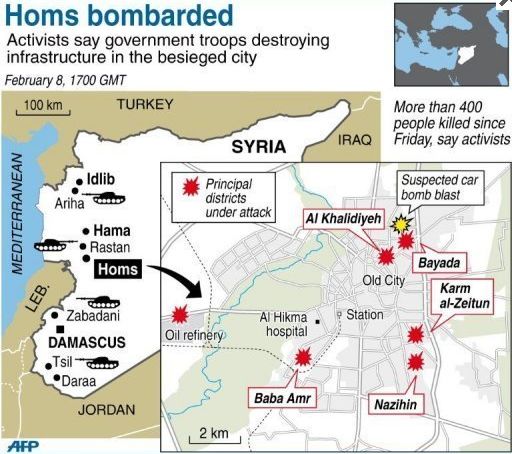
Reuters reports: Syrian forces bombarded opposition-held neighborhoods of the city of Homs with rocket and mortar fire on Thursday, activists said, as divided world powers struggled to find a way to end the violence.
The United Nations chief condemned the ferocity of the government assault on Homs, heart of a revolt against President Bashar al-Assad that broke out nearly a year ago and is getting bloodier by the day.
“I fear that the appalling brutality we are witnessing in Homs, with heavy weapons firing into civilian neighborhoods, is a grim harbinger of things to come,” U.N. Secretary General Ban Ki-moon told reporters after briefing the Security Council.
Activists and residents report hundreds of people killed over the last week as Assad’s forces try stamp out opposition in Homs, and as dawn broke on Thursday, rocket and mortar fire rained down again on Baba Amro, Khalidiya and other districts. Armored reinforcements also poured into the eastern city.
Concern was growing over the plight of civilians and the United States said it was considering ways to get food and medicine to them – a move that would deepen international involvement in a conflict which has wide geopolitical dimensions and has caused division between foreign powers.
Turkish Foreign Minister Ahmet Davutoglu said before flying to Washington for talks on Syria that Turkey, which once saw Assad as an ally but now wants him out, could no longer stand by and watch. Turkey wanted to host an international meeting to agree ways to end the killing and provide aid, he said.
“It is not enough being an observer,” he told Reuters, though Russia and China have warned against “interference.”
Amnesty International today urged Russia and other countries with influence over Syria to make an urgent appeal to try to stop the military assault on Homs.
The organization said more than 200 people have been killed since Friday from shelling and sniper fire.
While Russian Foreign Minister Sergei Lavrov was meeting Tuesday with President Bashar al-Assad in Damascus, Syrian security forces’ unrelenting bombardment of Homs continued and has since intensified. Amnesty International called on Russia to make it clear to the Syrian government, both publicly and in private, that the military assault on Homs must end immediately.
The organization also called on the Arab League to continue its diplomatic efforts on Syria.
“The situation in Homs is critical, and is turning into a major humanitarian crisis. Russia has blocked international efforts to stop the massive human rights violations in Syria, stating that they have a better plan for resolving the crisis,” said Salil Shetty, Amnesty International’s Secretary-General.
“Russia, and other countries with influence over Syria, must use whatever means they have to restrain the Syrian military in Homs and ensure it stops using heavy weaponry in residential areas.”
“The Syrian government seems to think that Saturday’s Security Council veto has given it the green light to crush resistance in Homs by any means – Russia needs to make clear, with a loud voice, that this is not the case.”
Since Friday residential areas in Homs – including al-Khaldieh, Bab ‘Amr, Bab al-Seba’ and al-Insha’aat – have been subjected to shelling by government forces and there have been heavy exchanges of fire with anti-government fighters in these areas.
The Syrian army has deployed tanks in certain areas. Armed groups in the city are reported to be using Kalashnikovs and RPGs in response.
Amnesty International has received the names of 246 people reported to have been killed in Homs, including at least 17 children. While some of those killed were armed men fighting against the government forces, the majority were reported to have been unarmed.
Hundreds more are reported to have been injured. Most people are being treated in makeshift field hospitals or at their homes.
Tony Karon writes: The reason that there’s no plausible end-game in Syria anytime soon — and that thousands more Syrians may be fated to die before the conflict is ended — is that the Assad regime is fighting a very different war to the one envisaged by many of its opponents. For Arab and Western powers, and many Syrians, President Bashar Assad is a doomed despot desperately holding on by force to the power he can never hope to exercise by democratic consent. But for Assad — and more importantly, for the minority Allawite community on which his regime is based — this is an existential struggle against an implacable sectarian foe. A majority of Syrians may be fighting for their rights and dignity; for the ruling minority it’s a battle to avoid the fate that befell Iraq’s Sunnis after the fall of their brutal benefactor, Saddam Hussein.
There’s no way of establishing its veracity, but one anecdote from the tormented city of Homs speaks volumes about how Syria’s power struggle is likely to play out: As regime forces continue to exact an horrific toll in their bombardment of Bab Amr and other opposition-controlled Sunni neighborhoods, residents in adjacent Allawite communities allege that the rebels are retaliating for regime attacks by firing mortars into Allawite neighborhoods. The Allawites of Homs, so the tale goes, are livid that the regime hasn’t more forcefully crushed the uprising, accusing President Assad of being too fearful of foreign intervention to smash the rebel forces with the ruthlessness his father would have mustered.
The story could be true, or it could simply be propaganda fare aimed at whipping up Allawite fears — either way, though, it resonates with the deep fear of sectarian retribution among the minority sect that constitutes the key pillar of the regime’s support. Whatever their views of Assad, many Allawites — a community in which, by some estimates, every family has at least one member in the security forces, and which dominates the key structure of power — are willing to fight to preserve the system of minority rule over which he has presided, first and foremost out of fear of the alternative.
At least two thirds of Syria’s population are Sunni Arabs, yet the country is ruled by an authoritarian regime dominated by Allawites — a syncretic offshoot of Shi’ism that comprises some 12% of the population. But the Assad regime presents itself as the guarantor of the interests not only of Allawites, but also Syria’s Christians (10%), Kurds (10%) and smaller communities of Druze, Yazidis, Ismailis and Circassians — against the specter of a vengeful sectarian Sunni Muslim Brotherhood. No surprise, then, that the regime has, through its own violent strategy, encouraged the rebellion against Assad’s rule onto the path of sectarian civil war. Call it Assad’s Milosevic option, in which the despot narrows the political alternatives, and forces minority groups to either support his regime or stay on the sidelines for fear of the alternative.
Those readers here who have been dismayed by the negative image of the Assad regime in the Western media may want to study the talking points that Bashir has been getting.
Hundreds of emails from Syrian President Bashar Assad’s office were leaked on Monday after an attack by the hacker group Anonymous. One of the email files, which Haaretz has obtained, was a document preparing Assad for his December 2011 interview with ABC’s Barbara Walters.
The attack took place overnight Sunday and the target was the mail server of the Syrian Ministry of Presidential Affairs. Some 78 inboxes of Assad’s aides and advisers were hacked and the password that some used was “12345”. Among those whose email was exposed were the Minister of Presidential Affairs Mansour Fadlallah Azzam and Assad’s media adviser, Bouthaina Shaaban.
Assad’s TV interview with Walters was memorable for his repeated denials that Syrian citizens were being killed. “We don’t kill our people … no government in the world kills its people, unless it’s led by a crazy person,” Assad told Walters.
About 10 days before the interview, Sheherazad Jaafari – a press attache at the Syrian mission to the United Nations – sent a long email to former Al Jazeera journalist Luna Chebel, who now works in Assad’s bureau. She also sent the email to an aide of Shaaban’s. Jaafari, who was involved in arranging the interview with Walters, also happens to be the daughter of the Syrian ambassador to the UN, Dr. Bashar Jaafari.
Click here to read the leaked documents, part one
Click here to read the leaked documents, part twoJaafari Jr. wrote: “The major points and dimensions that have been mentioned a lot in the American media are: The idea of violence has been one of the major subjects brought up in every article. They use the phrases ‘The Syrian government is killing its own people,’ ‘Tanks have been used in many cities,’ ‘Airplanes have been used to suppress the peaceful demonstrations,’ and ‘Security forces are criminals and bloody.'”
She advised: “It is hugely important and worth mentioning that ‘mistakes’ have been done in the beginning of the crises because we did not have a well-organized ‘police force.’ American psyche can be easily manipulated when they hear that there are ‘mistakes’ done and now we are ‘fixing it.’ It’s worth mentioning also what is happening now in Wall Street and the way the demonstrations are been suppressed by policemen, police dogs and beatings.”
Jaafari also recommended that Assad say: “Syria doesn’t have a policy to torture people, unlike the USA, where there are courses and schools that specialize in teaching policemen and officers how to torture.” She advised using Abu Ghraib in Iraq or execution via electric chair as more examples.
She added that that mentioning the talkbacks on articles in the American media are a useful tool, saying that “the Americans are asking their government to stop interfering in other countries’ business and sovereignty and to start taking care of American internal issues.”
“It is worth mentioning that when Obama asked H.E. to step down he himself have had a 70% decrease of his popularity in the States,” Jaafari wrote.
“It would be worth mentioning how your personality has been attacked and praised in the last decade according to the media. At one point H.E. was viewed as a hero and in other times H.E. was the ‘bad guy’. Americans love these kinds of things get convinced by it.”
Jaafari also stressed that Facebook and YouTube are important to “the American mindset” and advised to mention that “the fact that Facebook and YouTube are open now – especially during the crisis – is important.”
She also recommended mentioning that, “in the first month the international media was allowed in Syria. Both Al Jazeera and Al Arabiya’s offices were open but when they started to manipulate what is happening and ‘make up facts’, the Syrian government became more cautious about who will enter the country.”
Seumas Milne writes: There is no limit, it seems, to the blood price Arabs have to pay for their “spring”. After the carnage in Egypt, Yemen, Bahrain and Libya, Syria’s 11-month-old uprising grows ever more gruesome. Four days of bombardment of rebel-controlled districts in the Syrian city of Homs have yielded horrific images and reports from the embattled Bab al-Amr opposition stronghold: of mosques full of corpses, streets strewn with body parts, residential areas reduced to rubble.
Television footage broadcast in the Arab world is still more graphic, and the impact convulsive. Whatever the arguments about the number of dead on either side, the scale of human suffering is unmistakable – and comes after almost a year of continuous bloodletting, torture and sectarian revenge attacks.
So when Russia and China vetoed Saturday’s western-sponsored UN resolution condemning Bashar al-Assad’s regime, requiring his troops to return to barracks and backing an Arab League plan for him to be replaced, US and British leaders and their allies, echoed by the western media, felt able to denounce it as a “disgusting” and “shameful” act of betrayal of Syrians.
But that assumes externally imposed regime change, which is what the resolution entailed, would either work, have legitimacy or actually stop the killing. By decreeing a “political process” with a predetermined outcome, the withdrawal of the Syrian army from the streets with no parallel demand on armed rebel groups, and full implementation within 21 days – with a provision for “further measures” in the event of “non-compliance” – it also paved the way for foreign military intervention.
