Category Archives: Syria

Syria tries to placate Sunnis and Kurds

The New York Times reports:

The government of President Bashar al-Assad of Syria offered several unusual gestures on Wednesday intended to earn it good will among Sunnis and Kurds.

The government announced that Syria’s first and only casino, which had enraged Islamists when it opened on New Year’s Eve, would be closed. It also said that schoolteachers who had been dismissed last year for wearing the niqab, a type of face veil, would be allowed back to work.

These concessions and others were made public as activists were calling for renewed demonstrations to be held on Thursday, which is the 64th anniversary of the formation of the Baath Party, which has been in power since 1963. Protests demanding expanded political rights and a multiparty democracy have spread to cities across Syria over the last three weeks, posing a highly unusual challenge to Mr. Assad.

Ayman Abdel Nour, a Syrian writer and activist who was a childhood friend of Mr. Assad’s, said that about 1,200 women would be affected by the niqab decision, which was the most immediately significant result of a meeting Tuesday between Mr. Assad and a popular Islamist leader, Said Ramadan al-Bouti.

Other concessions offered at the meeting, Mr. Abdel Nour said, included permission to create an Islamist satellite channel and to form an Islamist political party. The party, he said, would be similar to the AKP in Turkey.

“It will be a moderate Islamist party loyal to the regime,” Mr. Abdel Nour said. “This is a very important deal. The regime is trying to weaken the demonstrators.”

Mr. Assad also promised to give citizenship to stateless people within Syria, and to make a national holiday of the Kurdish New Year’s festival Nayrouz, Mr. Abdel Nour said. An estimated 200,000 Kurds living in Syria are stateless, international human rights groups said.

“If the Islamists and the Kurds enter the demonstrations, the regime will lose control,” Mr. Abdel Nour said. “The president is trying to delay the big explosion.”

Facebooktwittermail

Intifada update

As quiet returns, Syrians ponder the future
Syria experienced its first day of political calm in over two weeks on April 3. The tsunami of protest and youth awakening that swept over Syria as part of the earthquake that hit the Arab world over two months ago has profoundly shaken Syrians. So accustomed to being the “island of stability” in the Middle East, Syrians are now wondering how long the Assad regime can last.

The Baathist regime has presided over Syria for 48 years; Bashar al-Assad has been president for 11 since inheriting power from his father. Although badly bruised and shaken, both remain in firm control. Western accounts of the protest movement in Syria have been exaggerated. At no time was the regime in peril. No officials resigned or left the country as has happened in Libya. Unlike the Tunisian and Egyptian armies, the Syrian army remained loyal to the president, and the protest movement that grew large in the Syrian countryside failed to take root in the cities. The number of demonstrators that turned out in Damascus, Aleppo, and Hama, three of Syria’s four largest cities, counted in the hundreds and not the thousands.

Damascus was the only one of these three cities to have demonstrations. There were four in all. The two most significant protests occurred early in the process on March 16 and 17. Dozens of young demonstrators marched through the al-Hamidiyeh and Hariqa souqs on March 16 shouting, “God, Syria, Freedom — is enough,” a chant that became the standard slogan of the movement that spread to other parts of Syria in the following two weeks. The day after, scores of human rights activists and the relatives of political prisoners demonstrated in front of the Interior Ministry. After Deraa flared up, the citizens of Damascus fell quiet rather than jumped on the bandwagon.

Aleppo, a hotbed of Muslim Brotherhood support in the 1970s, was completely unaffected by the anti-government movement. Instead, Aleppines turned out in sizable numbers to support the government.

Hama was also unaffected. It was the city that the Muslim Brotherhood was able to take over in 1982 before having its old districts destroyed brutally by the regime. A friend from Hama was asked, “Why isn’t Hama rising against the regime and taking revenge?” He answered: “Syrians demonstrate for their own reasons. Don’t ever think anyone in Daraa will shed a tear for Hama or the other way around.” He said there is no great Syrian revolution — “just locals having internal issues.” (Joshua Landis)

Will Saleh’s resignation bring democratic reform to Yemen?
As the political battle for Yemen’s future unfolds, the country’s most immediate challenge is to avert a bloody civil war. Yet if Yemenis avoid this outcome by peacefully transitioning power, Yemeni President Ali Abdullah Saleh’s replacements will immediately face a daunting economic crisis, festering regional tensions, and an unstable security environment. Moreover, as Saleh negotiates with elites in the capital, powerful tribal and religious interest groups may drown out the youth and civil society protesters demanding far-reaching democratic reform.

Those currently aligned against Saleh represent a diverse group of unlikely allies. Youth and civil society activists originally initiated the anti-regime protests and stand at their symbolic core. But over time and for various reasons — including genuine support for democratic change, opposition to Saleh’s heavy-handed response to the protests, and political opportunism — established opposition parties, Huthis rebels, some southern separatists, religious leaders, prominent tribal sheikhs, businessmen, and army commanders have joined the protests. Although youth and civil society activists welcome assistance in ousting Saleh, they are legitimately skeptical of the role that some of these forces may play in the future. (April Longley Alley)

Salafists’ wrath turns violent in Egypt
The hostility between Sufis and Salafists, long suppressed in the minds and hearts of both parties, has revealed its fangs for all to see. The shrines built to commemorate and worship saints in the Sufi tradition is a very physical embodiment of the clash in ideology and faith of the two groups. For Sufis these are sacred sites at which to pray and worship through celebration, for Salafists they are an abomination against Islam and the teaching of the Prophet.

This fractious relationship has recently taken a violent turn with the destruction of shrines by Salafists across Egypt, attracting attention to the diverging paths of faith as the attacks spread. The latest act was the burning of the tomb of Sidi Izz El-Din in Qalioubiya, which sparked the crisis and confrontation between the two groups. (Ahram Online)

Facebooktwittermail

Intifada update

AFP reports:

Yemeni security forces shot dead 17 anti-regime demonstrators and wounded scores more on Monday, on the second day of lethal clashes in Taez, south of the capital, medics said.

“The death toll has gone up to 17, in addition to dozens wounded,” said Sadeq al-Shujaa, head of a makeshift field hospital at a square in central Taez, updating an earlier casualty toll.

The bloodshed came as demonstrators staged a march on the governorate headquarters in the city about 200 kilometres (125 miles) from the capital to demand the ouster of Yemen’s embattled President Ali Abdullah Saleh.

The New York Times reports:

The United States, which long supported Yemen’s president, even in the face of recent widespread protests, has now quietly shifted positions and has concluded that he is unlikely to bring about the required reforms and must be eased out of office, according to American and Yemeni officials.

The Obama administration had maintained its support of President Ali Abdullah Saleh in private and refrained from directly criticizing him in public, even as his supporters fired on peaceful demonstrators, because he was considered a critical ally in fighting the Yemeni branch of Al Qaeda. This position has fueled criticism of the United States in some quarters for hypocrisy for rushing to oust a repressive autocrat in Libya but not in strategic allies like Yemen and Bahrain.

That position began to shift in the past week, administration officials said. While American officials have not publicly pressed Mr. Saleh to go, they have told allies that they now view his hold on office as untenable, and they believe he should leave.

A Yemeni official said that the American position changed when the negotiations with Mr. Saleh on the terms of his potential departure began a little over a week ago.

“The Americans have been pushing for transfer of power since the beginning” of those negotiations, the official said, but have not said so publicly because “they still were involved in the negotiations.”

Those negotiations now center on a proposal for Mr. Saleh to hand over power to a provisional government led by his vice president until new elections are held. That principle “is not in dispute,” the Yemeni official said, only the timing and mechanism for how he would depart.

The Yemen Observer adds: “Yemen’s opposition coalition Joint Meeting Parties (JMP) has presented a five-point plan on Saturday that outlines the details of how President Ali Abdullah Saleh should hand over power.”

Lamis Andoni writes:

Bashar al-Assad, the Syrian president, insists on believing that his support for the ”resistance against Israel” distinguishes his regime from others in the region and, therefore, makes it immune to the revolutions that have brought down pro-Western presidents in Tunisia and Egypt.

His support for Hamas and Hezbollah may make the Syrian president more popular among Arabs, but he is engaged in dangerous delusions if he thinks this makes the killings of peaceful Syrian protesters less reprehensible.

The eruption of Arab revolutions has been a reaction to decades of repression and the skewed distribution of wealth; two problems that have plagued anti- and pro-Western Arab governments alike.

And Syria is one of the most repressive states in the region; hundreds, if not thousands, of people have disappeared into its infamous prisons. Some reappear after years, some after decades, many never resurface at all.

Syrians have not been the only victims. Other Arabs – Lebanese who were abducted during the decades of Syrian control over its neighbour, Jordanian members of the ruling Baath party who disagreed with its leadership and members of different Palestinian factions – have also been victimised.

Syrian critics of the regime are often arrested and charged – without due process – with serving external – often American and Israeli – agendas to undermine the country”s “steadfastness and confrontational policies”.

But these acts have never been adequately condemned by Arab political parties and civil society, which have supported Syria”s position on Israel while turning a blind eye to its repressive policies.

The National reports:

From euphoria to stalemate: this is the epitaph of Bahrain’s recent experience in what some are calling the “Arab spring” of revolutionary movements.

What started out slowly in mid-February drawing a few hundred protesters gradually swelled beyond expectations into what looked like a semi-permanent presence of thousands of protesters who could, at a moment’s notice, be galvanised for marches anywhere in the capital, Manama.

Its base camp at the Pearl Roundabout had a stage, big TV screens, and tents for those who stayed overnight and for the 30-plus political factions and parties spreading their views among the crowds.

It was an exhilarating experience for many Bahrainis, angry about corruption and what they said was the government’s resistance to political reform.

“We saw it as something incredible,” said one woman who became a regular visitor to Pearl Roundabout. “This gave us hope. We felt like, as Barack Obama, said, ‘Yes, we can’.”

Today, the protest movement is in tatters, many of its leaders and activists imprisoned and its followers, most of them Shiite, subject to harsh emergency laws. Where Tunisia and Egypt saw change, Bahrain saw more of the same.

The clampdown continued yesterday, as Bahraini authorities banned Al Wasat, the country’s main opposition newspaper, and blocked its website.

The state-run Bahrain News Agency accused the paper of “unethical” coverage of the unrest.

Several days of interviews with Bahraini Sunni and Shiite political figures, human rights activists and journalists underscore that the tense impasse is due to mistakes on all sides, but principally, in most analyses, to the ascendancy of hardliners in both the government and the protest movement.

Facebooktwittermail

Assad sticks to the Mubarak survival plan

Israelis are quietly confident that Bashar al-Assad can survive the unrest in Syria but fear what might follow if he falls. Assad himself seems confident he can use the same tactics as Mubarak, but with the opposite outcome.

The Guardian reports from Damascus:

The Syrian president, Bashar al-Assad, has blamed foreign conspirators and satellite television channels for two weeks of widespread unrest that has challenged his regime, but in a highly anticipated speech he offered none of the reforms that protesters had hoped for.

The address to the Syrian parliament, which was seen as the most critical of his 11 years as president, left observers bemused and is unlikely to placate protesters who have taken to the streets across the country demanding democratic freedoms and more accountability from the government.

Assad said “conspirators” were pushing an “Israeli agenda”, but offered no further details. “There is chaos in the country under the pretext of reform,” he said.

He said changes to governance in Syria could be considered, but only after the country became more stable and economic conditions improved. However, he offered no timeframe for change, or specific details about what his government would offer.

“We tell those asking for reform that we were late in implementing it but we will start now. Priorities are stability and improving economic conditions,” he said.

Assad had been widely expected to revoke a four-decade-old emergency law, which was put in place by his father and used by security forces to crush dissent ever since. He was also thought to be preparing to lift restraints on the media, which are largely government-controlled.

On Wednesday morning the al-Watan newspaper, which is close to the regime, predicted Assad would “reassure all Syrians and draw clear features for the coming phase”.

Nicholas Blanford reports:

Looking relaxed and smiling and chuckling frequently, Assad delivered his hour-long address to the Syrian parliament in a customary conversational tone. His statements were interrupted every few minutes by parliamentarians standing up and offering individual messages of support and loyalty. He entered and exited to a standing ovation, and was frequently interrupted with coordinated applause.

“Only God, Syria, and Bashar!” chanted the parliamentarians.

“I am talking to you at an exceptional time. It is a test that happened to be repeated due to conspiracies against the country,” said Assad, who became president in 2000 on the death of his father, Hafez al-Assad. “God willing, we will overcome [this conspiracy].”

He acknowledged that reforms have been slow in coming, but he blamed the delay on traumatic distractions over the past decade, including the 2000-2005 Palestinian intifada, the September 2001 attacks, the invasions of Afghanistan and Iraq, and the Hezbollah-Israel war of 2006.

“We know we haven’t addressed many of the people’s aspirations,” he said, adding that not all those that have taken to the streets since March 15 were “conspirators.”

He said that Syria was heading toward “another phase” and admitted that proceeding without reforms “destroys the country.” He said that there would be new measures to combat corruption and “enhance national unity” and that the new government would announce them later. The previous government of Prime Minister Najib Ottari resigned Tuesday, and a new premier is yet to be named.

Patrick Seale writes:

By all accounts, the debate about how to deal with the growing protests has led to increasingly violent confrontations inside the regime between would-be reformers and hard-liners. The outcome of this internal contest remains uncertain.

What is certain, however, is that what happens in Syria is of great concern to the whole region. Together with its two principal allies, the Islamic Republic of Iran and the Lebanese Shiite resistance movement Hezbollah, Syria is viewed with great hostility by Israel and with wary suspicion by the United States. The Tehran-Damascus-Hezbollah axis — of which Syria is the linchpin — has long been seen by many leaders in the region as the lone bulwark against Israeli and American hegemony. With backing from Washington, Israel has sought to smash Hezbollah (notably through its 2006 invasion of Lebanon) and detach Syria from Iran, a country Israel views as its most dangerous regional rival. Neither objective has so far been realized. But now that Syria has been weakened by internal problems, the viability of the entire axis is in danger — which could encourage dangerous risk-taking behavior by its allies as they seek to counter perceived gains by the United States and Israel.

If the Syrian regime were to be severely weakened by popular dissent, if only for a short while, Iran’s influence in Arab affairs would almost certainly be reduced — in both Lebanon and the Palestinian territories. In Lebanon, it would appear that Hezbollah has already been thrown on the defensive. Although it remains the most powerful single movement, both politically and on account of its armed militia, its local enemies sense a turning of the tide in their favor. This might explain a violent speech delivered earlier this month by the Sunni Muslim leader and former prime minister Saad Hariri, in which he blatantly played the sectarian card.

Cheered by his jubilant supporters, he charged that Hezbollah’s weapons were not so much a threat to Israel as to Lebanon’s own freedom, independence, and sovereignty — at the hand of a foreign power, namely Iran. The Syrian uprisings may have already deepened the sectarian divide in Lebanon, raising once more the specter of civil war and making more difficult the task of forming a new government, a job President Michel Suleiman has entrusted to the Tripoli notable, Najib Mikati. If Syria were overrun with internal strife, Hezbollah would be deprived of a valuable ally — no doubt to Israel’s great satisfaction.

Meanwhile, Turkey is deeply concerned by the Syrian disturbances: Damascus has been the cornerstone of Ankara’s ambitious Arab policy. Turkey-Syria relations have flourished in recent years as Turkey-Israel relations have grown cold. Prime Minister Recep Tayyip Erdogan and his foreign minister, Ahmet Davutoglu, have actively sought to mediate local conflicts and bring much-needed stability to the region by forging close economic links. One of their bold projects is the creation of an economic bloc comprising Turkey, Syria, Lebanon, and Jordan — already something of a reality by the removal of visa requirements as well as by an injection of Turkish investment and technological know-how. A power struggle in Syria could set back this project; and regime change in Damascus would likely put a serious dent in further Turkish initiatives.

The Los Angeles Times reports:

As popular unrest threatens to topple another Arab neighbor, Israel finds itself again quietly rooting for the survival of an autocratic yet predictable regime, rather than face an untested new government in its place.

Syrian President Bashar Assad’s race to tamp down public unrest is stirring anxiety in Israel that is even higher than its hand-wringing over Egypt’s recent regime change. Unlike Israel and Egypt, Israel and Syria have no peace agreement, and Syria, with a large arsenal of sophisticated weapons, is one of Israel’s strongest enemies.

Though Israel has frequently criticized Assad for cozying up to Iran, arming Lebanon’s Hezbollah movement and sheltering leaders of the Palestinian militant group Hamas, many in Israel think their country might be better off if Assad keeps the reins of power.

“You want to work with the devil you know,” said Moshe Maoz, a former government advisor and Syria expert at Hebrew University’s Harry S. Truman Institute for the Advancement of Peace.

Several Israeli government and military officials declined to speak in depth about Assad, fearing any comments could backfire given the strong anti-Israel sentiments in the Arab world. That’s what happened when some Israeli officials attempted to bolster Egyptian President Hosni Mubarak before he resigned Feb. 11.

“Officially it’s better to avoid any reaction and watch the situation,” said Maj. Gen. Amos Gilad, the Defense Ministry’s policy director. He predicted Assad’s regime would survive the unrest.

David W. Lesch notes:

When I met with him during the Syrian presidential referendum in May 2007, he voiced an almost cathartic relief that the people really liked him. Indeed, the outpouring of support for Mr. Assad would have been impressive if he had not been the only one running, and if half of it wasn’t staged. As is typical for authoritarian leaders, he had begun to equate his well-being with that of his country, and the sycophants around him reinforced the notion. It was obvious that he was president for life.

Facebooktwittermail

Syrian revolution

The New York Times reports:

President Bashar al-Assad accepted the resignation of his cabinet on Tuesday as thousands of government supporters took to the streets of the capital in an effort to counter a rising tide of pro-democracy protests in several cities, news agencies reported.

The cabinet resignation, announced on state television, appeared to be a concession to protesters and came as the political crisis in Syria deepened on Monday, with the armed forces in the restive southern city of Dara’a firing live ammunition in the air to disperse hundreds of pro-democracy demonstrators.

The unrest in Syria poses a serious challenge to President Assad and his Baath Party. Mr. Assad was expected to announce as early as Tuesday the repeal of the country’s emergency law, in place since 1963, which effectively allows security forces to detain citizens without charges. Whether the repeal — or the cabinet resignations — would quell the protests remains unclear; other laws restrict freedoms and give immunity to the secret police.

Joshua Landis writes:

Ammar Abdulhamid has emerged as the “unofficial spokesman” and most visible face of the Syrian revolutionary movement.

One of the great weaknesses of the protest movement sweeping Syria has been the absence of any recognizable leadership. Syrians have been asking, “Shoo al-Badiil? – What is the alternative [to Bashar al-Assad]?” Today, one of the faces behind the extraordinary revolutionary movement sweeping the Middle East and driving the social media protest movement has emerged in an extended profile by Eli Lake in the Washington Times.

The Syrian regime has stated that the protest movement centered in Deraa is driven by Islamists, an accusation that scares the moderate middle of Syrian society. No one in Syria wants to see a return to the dark days of the early 1980s, when the Muslim Brotherhood led an insurgency movement in Syria that nearly dragged the country into civil war and ended with the regime’s brutal suppression of an Islamist uprising centered in the city of Hama. Thousands were killed.

Ammar Abdulhamid is no Islamist. He did flirt with Islam and the notion of going to Afghanistan during a difficult period of introspection after dropping out of University of Wisconsin-Stevens Point, but pulled away from the lures of fundamentalism. “It gave my life structure, but it enslaved the hell out of me,” he told the Washington Post’s Nora Boustany. Eventually he abandoned Islam for atheism and ultimately became an “agnostic.”

James Denselow writes:

The modern Syrian republic is a chimera whose mothballed constitution hides the true face of an authoritarian monarchy that legislates through powers granted through a vicious and all consuming emergency law. While Syria appeared initially immune to the revolutionary shockwaves spreading through the region, unrest in Deraa and a cack-handed government response of rotten carrots and bloody sticks has simply served to rally a momentum that has spread across the country.

Before he inherited control of Syria Bashar al-Assad trained as an eye surgeon and he should really have seen these protests coming. His response, communicated so far only through underlings, has been to promise the raising of living standards and the abolition of the 1963 Emergency Law, only in Syria could a state of emergency lead to discussion of abolishing the emergency law.

Unsurprisingly in a country where it is estimated that there is a member of the intelligence service for every 153 citizens, the silent majority are hedging their bets, unsure whether the regime will be willing to resort to the levels of repression that characterized the clampdowns in the 1980s.

The International Crisis Group says:

The regime faces three inter-related challenges. First is a diffuse but deep sense of fatigue within society at large, combined with a new unwillingness to tolerate what Syrians had long grown accustomed to — namely the arrogance of power in its many forms, including brutal suppression of any dissent, the official media’s crude propaganda and vague promises of future reform. As a result of events elsewhere in the region, a new awareness and audacity have materialised over the past several weeks in myriad forms of rebelliousness, large and small, throughout the country.

Secondly, at the heart of virtually any locality in the nation is a long list of specific grievances. These typically involve a combination: rising cost of living, failing state services, unemployment, corruption and a legacy of abuse by security services. In a number of places, religious fundamentalism, sectarianism or Kurdish nationalism also form an integral part of the mix. In others, the depletion of water resources and devastation of the agriculture sector add to the tensions.

The third challenge relates to the regime’s many genuine enemies, all of whom undoubtedly will seek to seize this rare opportunity to precipitate its demise. Authorities have ascribed much of the strife to the exiled opposition, home-grown jihadi elements, local “aliens” (notably residents of Palestinian and Kurdish descent) and hostile foreign parties (notably U.S., Israeli, Lebanese and Saudi).

As a result, the regime claims to be fighting critical threats to national unity, such as foreign interference, ethnic secessionism and sectarian retribution. It also stresses the illegitimacy of exiled Syrians they accuse of stirring unrest — some of whom, in fairness, are suspected of crimes no less deserving of investigation than those of the officials they seek to replace.

The Economist reports:

The situation in Syria is becoming increasingly messy. This weekend the unrest shaking the southern city of Deraa spread to Latakia, a port in the north. The sunny metropolis, dotted with palm trees, is the heartland of president Bashar Assad’s Alawite sect. Most of its inhabitants, however, are Sunni mixed in with a few are Christians. Security forces in other parts of the country have been shooting at civilians for the past ten days. Protesters in Latakia say people there have been shot at and attacked by gunmen and thugs. A journalist allowed into the city on Sunday night reported rampaging by armed hardmen.

For once, this seems to tally with the government’s account of the protests; it released a statement saying that gangs were responsible for the violence. But this may be misleading. Some say they have been sent onto the streets by the government or the ruling family itself. Quite who these gangs are, and who they are loyal to, no one is sure. But at least some of the troublemakers are believed to belong to the Shabiha, a notorious group of Alawite ruffians and smugglers, most of whom are members of the extended Assad family. Residents of Latakia barely dare to whisper the name. Many Syrians believe the Shabiha have been told to stir up trouble. Almost all, including many Alawites, dislike them. But their attacks are stirring up deep-seated Syrian fears of sectarian strife, and the government is playing on this.

This has sparked further questions about who is co-ordinating the regime’s violent response to the protests. Many do not believe it is the president. Mr Assad has cracked down on the Shabiha before. In the 1990s, while being groomed for power, he pulled many of them into line, curbing their tendency to tramp around the city extorting money. Instead, many believe they currently answer to Mr Assad’s younger brother, Maher, head of the 4th division, part of the Syrian elite forces. But while rumours of internecine splits are rife in Damascus, there is a strong feeling that Bashar remains the best chance of the regime’s survival. Elite, metropolitan and foreign-educated, regime insiders may not see him as tough, but he has the most public appeal.

Bloomberg reports:

Secretary of State Hillary Clinton said the U.S. won’t enter into the internal conflict in Syria the way it has in Libya, where the international effort to protect civilians from Muammar Qaddafi is progressing.

“No,” Clinton said when asked on the CBS program “Face the Nation” if the U.S. would intervene in Syria’s unrest. Syrian President Bashar Al-Assad’s security forces clashed with protesters in several cities over the weekend after his promises of freedoms and pay increases failed to prevent dissent from spreading across the country.

Clinton said the elements that led to intervention in Libya — international condemnation, an Arab League call for action, a United Nations Security Council resolution — are “not going to happen” with Syria, in part because members of the U.S. Congress from both parties say they believe Assad is “a reformer.”

Facebooktwittermail

Syria’s Day of Dignity

The Guardian reports:

Demonstrations in the Syrian capital, Damascus, and elsewhere were met with force as security forces struggled to contain unrest that had begun in the southern city of Deraa a week ago.

Thousands once again joined funeral processions in Deraa on Friday, chanting: “Deraa people are hungry, we want freedom.”

Hundreds took to the streets in the cities of Homs, Hama, Tel and Latakia and in towns surrounding Deraa, with smaller protests in the major cities of Damascus and Aleppo, which are more firmly under the watch of security forces. Troops reportedly opened fire in some cases.

Protests in the capital are rare and not tolerated by the Ba’athist regime. A witness told the Guardian that efforts at protests in Damascus were broken up by plain-clothed agents using batons.

By nightfall, a counter-demonstration had been mounted near the historic Umayyad mosque in the heart of the capital. Brief clashes were reported between anti-regime demonstrators and loyalists. A large rally then began in support of President Bashar al-Assad. Hundreds drove around the capital beeping horns and waving flags, whilst posters of the president were put up in the city.

The violence in Syria came after the government had pledged on Thursday to look into reforms. But activists using the Syrian Revolution Facebook page had called for a day of solidarity with Deraa, where according to unofficial reports at least 44 have been killed in the past week.

In the past, many young Syrians had been willing to overlook corruption, a lack of freedom and the slow pace of reforms in return for what they have seen as dignified leadership brought about by Assad’s anti-Western foreign policy. He has also had a youthful appeal. Both appear to now be wearing thin.

“Regimes become really weak when their image turns to brutality. The killings in Deraa have done that,” said Ziad Malki, an activist living in exile in Switzerland. “The Syrian people want more now.”

Others agreed that a turning point had been reached. “Syrians [normally] never come out to protests. This shows how the killings, the worthless reforms announced yesterday and the government propaganda is insulting and is only making us angrier,” said a 32-year-old man.

Demonstration in Damascus:

Demonstration in Hama:

Joshua Landis writes:

The Baathist regime that has ruled Syria for 48 years is on the ropes. Even President Bashar al-Assad himself seems to have been shocked by the level of violence used by Syria’s security forces to suppress demonstrations that began a week ago, and on Thursday afternoon his office announced unprecedented concessions to popular demands. But the question of whether those concessions assuage protesters’ concerns or prove to be too little too late may be answered in the escalation of clashes that followed Friday prayers, with a number of demonstrators reportedly killed when security forces again opened fire.

The protests began a week ago in the dusty agricultural town of Dara’a, near the border with Jordan, over the arrests of high school students for scrawling antigovernment graffiti. Those demonstrations quickly spun out of control, with thousands joining in, inspired by the wave of revolutions that have rocked the Arab world, to demand political freedoms and an end to emergency rule and corruption. The government responded brutally, killing over 30 demonstrators and wounding many more, according to activists. Gruesome videos of the crackdown, disseminated via the Internet in recent days, have enraged Syrians from one end of the country to the other.

On Thursday, the regime began to try a different tack, with Assad’s spokeswoman Buthaina Shaaban offering the President’s condolences to the people of Dara’a and acknowledging their “legitimate” demands, even as she insisted that reports of the scale of protests and the number of casualties had been exaggerated. Oddly, the President has himself not appeared on TV since Syria’s political troubles began, apparently hoping to protect himself from criticism. But Shaaban insisted that Assad was completely against the use of live fire in suppressing the demonstrations. She emphasized that she had been present in the room when the President ordered the security agencies to refrain from shooting at protesters — “not one bullet.”

But the only promised concessions that can be taken to the bank are pay rises for state employees of up to 30%, and the release of all activists arrested in the past weeks. Other reforms, which the regime undertook to study, are job creation, press freedom, permitting the formation of opposition parties and lifting emergency law. Should they be implemented, those changes would be nothing short of revolutionary. But many activists have already dismissed Assad’s offer as a stalling tactic to make it through the next few days of funerals and demonstration. The opposition had called for Syrians to assemble in large numbers in mosques for a day of “dignity” and demonstrations.

In order to mount a serious challenge to the regime’s iron grip on power, opposition activists will have to move their protest actions beyond Dara’a and its surrounding villages, and extend it to the major cities. Their attempt to do so presents the country with a choice of great consequence: they must decide if Syria is more like Egypt and Tunisia, where the people achieved sufficient unity to peacefully oust their rulers, or whether Syria is more like Iraq and Lebanon, which slipped into civil war and endless factionalism.

Facebooktwittermail

The Syrian uprising

The Guardian reports from Damascus:

Syria’s government pledged to consider protesters’ “legitimate demands” after thousands took to the streets for the funerals of nine people killed by the military.

Rights activists described Wednesday’s shootings in the southern city of Daraa as a massacre, claiming that more than 100 people may have been killed when troops fired on a mosque in the early hours and throughout the day.

With protests called for after Friday prayers, Buthaina Shaaban, adviser to President Bashar al-Assad, announced that the government would consider ending Syria’s emergency law and revise legislation for political parties and the media. Similar reform pledges have been announced in the past, and are unlikely to satisfy protesters.

In Deraa, funeral-goers chanted “God, Syria, Freedom” and “The blood of martyrs is not spilt in vain!”, Reuters news agency reported. Some reports said that up to 20,000 people attended, but this could not be verified. The city has been cordoned off .

Deraa’s hospital reported receiving 37 bodies from Wednesday’s violence. YouTube videos apparently showed bloody scenes at the mosque.

Electricity and communications in the city were cut before the attack, which sources said was by a unit of forces headed by the president’s brother, Maher al-Assad.

“This is a crime against humanity because forces opened fire on unarmed civilians without any warning,” said Radwan Ziadeh, head of the Damascus Centre for Human Rights and a visiting scholar at Harvard University.

Michael Young writes:

A key indicator of the uprising’s momentum will be whether the situation escalates after Friday prayers this week. The Assads are taking no chances. The brutality in Dara is a testament to the family’s sense of vulnerability. The minority Alawite-led regime controls all levers of power and intimidation in Syria, including elite military units and the intelligence services. Reports have suggested that troops whose principal role is regime protection were swiftly dispatched to the south. According to Syrian dissident Ammar Abdulhamid, this included Republican Guard detachments, and rumor has it that Assad’s younger brother, Maher, has been directing operations.

Haytham Manna, the spokesman for the Arab Committee for Human Rights, appeared to agree that internal security companies, not the army, were leading the repression. He told the BBC Arabic service that “security branches, military and civilian, wearing civilian clothes, they are the ones engaging in [attacks against the Omari mosque].”

The fear is that the situation may take on a sectarian coloring, with Sunnis, some 74 percent of the population, turning against Alawites, who represent roughly 8 to 12 percent. This is simplistic. The Assads will defend Alawite domination as an existential necessity, but Sunnis thrive in many sectors, especially the economy. Assad is married to a Sunni. Syria is characterized by complex, sometimes crisscrossing, political, regional, tribal, ethnic, and class bonds that transcend a narrow sectarian reading of events. That’s why a breakdown of authority could bring about a situation even more volatile and vicious than in Libya.

Jim Muir writes:

The Syrian leadership seems for the moment to have drawn back from the kind of draconian repression that it meted out to crush a revolt by the Muslim Brotherhood in Hama in 1982.

It seems to be following the Egyptian and Tunisian examples rather than the Libyan model, though clearly with the hope that placatory measures may be in time to head off a national upheaval.

In theory, the political reforms promised would – if implemented swiftly and seriously – meet most of the demands of reformists and activists.

The Baath party would no longer enjoy an official monopoly of power, the press would be free, citizens’ rights would be respected, and the corrupt would be punished.

It is hard to imagine.

For it to happen, powerful vested interests would have to be overridden.

Some diehards within the regime may not admit the necessity for radical self-reform until it is too late – if it is not already.

Facebooktwittermail

Syrians have broken the fear barrier

Some observers of the Libyan uprising, particularly those who now most vehemently oppose intervention, insist that Libya is a special case, really a civil war rather than a revolution — the implication being that if Gaddafi were to crush his opponents, then the wider Arab revolution would not suffer a major setback.

Activists involved in the uprising that has now started in Syria indicate that, on the contrary, the fate of Libya has very much been in their minds. Fearing that a Gaddafi victory in Libya would make it more difficult to plead their case for revolution to the Syrian people, activists launched demonstrations this month, instead of allowing several more weeks for organization, as they had earlier intended.

David Hirst writes:

In whichever countries it has already broken out – from Yemen, whose President Saleh is suffering new, perhaps even terminal reverses, to Libya, where Colonel Gaddafi defies the military “crusaders” from the west – the Arab democratic revolution pursues its seemingly inexorable, if chequered, course. But is it yet another country’s turn now? Of all Arab regimes, none more resembles those of former presidents Mubarak and Ben Ali than President Assad and the ruling Ba’athists of Syria; and, after their fall, his 51-year-old “republican monarchy” looked the next most logically in line of candidates to succumb to the Arab uprising.

Yet Assad himself begged to differ. “We are not Egyptians or Tunisians,” he said; Syria might have “more difficult circumstances than most of the Arab countries” but it was “stable”. And outwardly it did remain an island of calm, even as pro-democracy turbulence rocked other Arab countries from the Atlantic to the Gulf. But last week things suddenly changed. A series of small-scale and isolated but audacious protests developed into much larger ones after Friday prayers in a string of Syrian cities.

One, in the southern city of Dera’a, was particularly serious. It had been triggered by the arrest of 15 schoolchildren accused of scrawling anti-government graffiti on city walls, among them that trademark slogan – “the people want the overthrow of the regime” – of the uprisings elsewhere. It was a peaceful gathering but the security services opened fire, killing three. The next day a much larger, angrier crowd – estimated to number as many as 20,000 – turned out for the burial of the previous days’ victims.

Bloomberg reports:

Syrian troops are forcing people to stay at home in the southern city of Daraa after six people were killed in renewed anti-government protests that have swept across the country, Amnesty International said.

“People are being asked through loudspeakers to remain at home or they will be shot,” Neil Sammonds, a researcher on Syria for the rights group, said today by telephone from London. Snipers are enforcing the orders and all the city’s entrances are being watched, he said. “The town is besieged.”

Seven people were also wounded when security forces opened fire earlier today during the funeral of two of those killed during the night in Daraa, according to an Agence France-Presse photographer who visited one of the local hospitals. President Bashar al-Assad sacked Faisal Kalthum, the governor of Daraa, state television reported today.

The rallies in Syria mark the latest extension of the political turmoil that has engulfed the region this year.

Ammar Abdulhamid, a Syrian dissident and democracy activist now living in exile in Washington, DC, writes:

What a difference six weeks make. Back in early February I was asked whether Syria would be next on the growing list of countries to witness a popular revolution. My answer, which came in the form of an article published on Comment is free, was, in essence, “not yet”.

The “day of anger” that exiled opposition figures called for on 5 February fizzled out largely because the networks that were being built on the grounds at the time were not ready to take up such a call. Activists needed time to ensure that they had networks of supporters all over the country and that clear communication strategies and methods were agreed, both within these networks and between them and their supporters in the country and across the world.

Formulating the right messages meant to address the concerns of certain segments within Syrian society, as well as those of the international community, especially with regards to the potential role Islamists would play in a future democratic Syria, was also something that required more time.

These points were being debated online through emails and on various Facebook groups; the main thrust of the debate was not whether a revolution could take place but when. Myself and others were on the side of waiting until mid-summer at least, to give in-country activists more time to organise their networks, while others worked on messaging.

Others were less patient, with some fearing a Gaddafi victory in Libya could make it more difficult to plead our case for revolution to the Syrian people; they pushed for a quicker move. Obviously, seeing that Syria has been caught in the midst of a revolutionary upheaval since the Ides of March, it was this latter side that won the debate.

Maher Arar, an engineer with dual Canadian and Syrian citizenship who was a victim of the Bush administration’s rendition program in 2002, writes:

At the time of his ascent to power in 2000, still only, the young president [Bashar al-Assad] promised major reforms were coming.

Popularly elected by 97% of all votes, Syrians of all stripes thought they finally had a glimpse of hope after the 30-year, iron-fist rule of his father.

Assad pledged he would fight corruption, would guarantee his people more freedom of expression, and would adopt a more liberal market policy. He may have partially succeeded on the latter point but it became clear a few years into his rule that he miserably failed on the first two, leading some Syrians to speculate that the new president was simply a puppet in the hands of his father’s old camp.

Furthermore, Syria’s human rights situation steadily deteriorated under the new ruler, especially after the unofficial alliance with the Unites States to fight al-Qaida, a historically common enemy. For instance, it became clear around 2001 that Syria was a preferred rendition destination for terror suspects. The cases of Hydar Zammar, Ahmed El-Maati, Abdullah El-Malki and my own are only a few examples . Bob Baer, a former CIA official, stated at the time: “If you want a serious interrogation, you send a prisoner to Jordan. If you want them to be tortured, you send them to Syria,” something to which I can personally attest.

Facebooktwittermail

Syria deploys troops after protests

Al Jazeera reports:

Syrian troops have been deployed in the southern city of Daraa a day after an anti-government protester was killed when forces reportedly fired on a demonstration.

News agencies, citing residents, said that thousands of Syrians marched on Monday in the town following the funeral of Raed Akrad, the killed protester.

A resident told the AFP news agency that “mass of demonstrators started to march from the cemetery towards al-Omari mosque after the burial”.

“Just God, Syria and Freedom,” and “Revolution, revolution” demonstrators chanted, the resident said.

Another witness said security forces had been deployed to block protests, but people had gathered regardless.

However Rula Amin, Al Jazeera’s correspondent in Daraa, said the situation on Monday was “very tense but it is quiet”.

“There are a lot of security, the army as well as police, there are a lot of checkpoints. But we didn’t see any protests, people told us there was a funeral this morning but it ended with no clashes,” she said.

Protesters have been demonstrating in Syria since last week, calling for an end to corruption and 48 years of emergency law. They have also been protesting against the killing of five civilians in a similar demonstration three days ago.

Al Jazeera reports:

Crowds have set fire to the courthouse and other buildings on a third straight day of demonstrations in the southern Syrian city of Daraa.

Residents said one person was killed and scores injured when security forces used live rounds against protesters. Witnesses said dozens were also taken to be treated for tear gas inhalation at the main Omari mosque.

Thousands took to the streets on Sunday, calling for an end to corruption and 48 years of emergency law and to protest the killing of five civilians in a similar demonstration two days earlier.

The headquarters of the ruling Baath party was set ablaze as well as two phone company branches. One of the firms, Syriatel, is owned by President Bashar al-Assad’s cousin Rami Makhlouf, who is under specific US sanctions for what Washington regards as public corruption.

“They burned the symbols of oppression and corruption,” an activist said. “The banks nearby were not touched.”

Second day of Syrian Protests in Dar’aa

Protests in Banyas – Tartous

Facebooktwittermail

Intifada update

The revolution reaches Damascus
Until this week, it appeared that Syria might be immune from the turmoil that has gripped the Middle East. But trouble may now be starting to brew.

On March 18, popular demonstrations escalated into the most serious anti-government action during Syrian President Bashar al-Assad’s decade-long rule. Security forces opened fire on a demonstration in the southern city of Deraa, killing at least two protesters. The unrest also does not appear to be contained to any one geographical region: Protests were also reported in the northwestern city of Banias, the western city of Homs, the eastern city of Deir al-Zur, and the capital of Damascus.

The demonstrations began on March 15, when a small group of people gathered in Souq al-Hamidiyeh, Damascus’s historic covered market, to turn the ruling Baath Party’s slogans against it. “God, Syria, freedom — that’s enough,” they chanted. The phrase is a play on words on the Baathist mantra: “God, Syria, Bashar — that’s enough.” The next day, around 100 activists and relatives of political prisoners gathered in front of the Interior Ministry in Damascus’s Marjeh Square to demand the release of Syria’s jailed dissidents.

The protests may be small fry by regional standards, but in Syria — repressively ruled under a state of emergency since the Baath Party came to power in 1963 — they are unprecedented. An atmosphere of fear and secrecy makes the extent of discontent hard to ascertain. Sources outside the country said demonstrations took place in six of Syria’s 14 provinces on Tuesday. Those claims were hard to verify, but the government is clearly rattled: It has beefed up the presence of its security forces, a ragtag-looking bunch in leather jackets, across the country and especially in the northeast, home to a large and often restless Kurdish population, and Aleppo. (Foreign Policy)

Demography and Bahrain’s unrest
The introduction of GCC troops into Bahrain has been labeled a foreign “occupation” by the opposition, while the government has hailed it as brotherly support from its neighbors. In fact, this “native-foreigner” issue has a long history in the country and serious political implications not only in Bahrain but also throughout the Gulf.

The Bahraini monarchy has long relied on foreigners not only as military and police forces, but also to shift the political balance in the island kingdom. The opposition in Bahrain, drawing primarily but not exclusively on support from the country’s majority of Shi’i Muslims, has accused the government of fast-tracking the citizenship of carefully selected foreigners in order to change the demographic makeup of the country. The “politically naturalized,” as they are called, are Sunni Muslims mainly from Bedouin tribes in Saudi Arabia, Syria, Yemen, Jordan, and Baluchistan. They are seen as having close ethnic and cultural links to the local rulers. Estimates of their numbers range from 50,000 to 200,000, constituting between one-tenth and one-third of the total number of citizens.

The politically naturalized are mainly employed in the security and defense forces, increasing the perception that they have been brought in to contain the local population. The graphic videos surfacing of the recent attacks by security forces against protestors show actions that involved some foreign or politically naturalized individuals.

This systematic use of foreign forces is a tradition that goes back decades. It was first used in the region by the British in the nineteenth century, when divisions composed of individuals from Baluchistan and the Indian sub-continent were brought in to help establish control over the Trucial coast. It limits the risk of identification with locals and of defection. Fears about loyalty are less of an issue, as long as the right material incentives are provided. (Carnegie Endowment for International Peace)

Bahrain clashes: ‘Riot police showed no mercy
CBS Radio News reporter Toula Vlahou was covering clashes between protesters and riot police outside Manama, Bahrain.

Riot police were firing tear gas and advancing toward the protesters. Vlahou and her BBC driver, a local Bahraini who was taking pictures – decided to leave the area. The riot police confronted them while they were in the car. The driver backed up and the riot police opened fire on the car.

“We were attacked by a wall of riot police,” Vlahou said. “We thought they were going to fire tear gas at us. But they fired pellets at us.”

“I had to fall to the ground in the driver’s seat as the driver was driving to get out of there,” Vlahou added.

The riot police began chasing them and continued shooting at the car. A helicopter was hovering above them for the entire time.

Vlahou said her driver believes that a helicopter above saw him filming, and “chased us and actually pursued us because they say him filming the scene.” The neighborhood people were watching from their houses as Vlahou and the driver were being fired upon. One neighbor waved at them to come into the house. The local family ushered them into a prayer room in the back of the house where they remained there an hour. (CBS News)

Yemen unrest: ‘Dozens killed’ as gunmen target rally
Unidentified gunmen firing on an anti-government rally in the Yemeni capital Sanaa have killed at least 39 people and injured 200, doctors told the BBC.

The gunmen fired from rooftops overlooking the central square in what the opposition called a massacre.

President Ali Abdullah Saleh later declared a national state of emergency.

He said he regretted Friday’s casualties but denied security forces had been behind the shooting, as the opposition demanded his resignation.

“There is no longer any possibility of mutual understanding with this regime and he has no choice but to surrender authority to the people,” Yassin Noman, rotating president of Yemen’s umbrella opposition group, was quoted by Reuters news agency as saying. (BBC)

A terrible day for Yemen
The situation in Yemen is looking increasingly insoluble. The problem is not merely how to get rid of Salih but what will happen after he goes. The longer he clings on, the more difficult it will be to achieve a peaceful transition – and it may even be too late for that already. (Brian Whitaker)

Facebooktwittermail

Intifada update

Death toll hits 19 in Libya’s “Day of Rage”
The death toll in clashes between protesters and security forces in the Libyan cities of Benghazi and al-Baida on Thursday rose to 19 as Muammar Gaddafi ‘s regime sought to overshadow an opposition “Day of Anger” with its own rally in the capital Tripoli.

Meanwhile, violent clashes rocked the Libyan city of Zenten southwest of Tripoli on Thursday during which a police post and an office of the local revolutionary committee were torched, Quryna newspaper said on its website.

Separately, lawyers demonstrated in front of a courthouse in Benghazi — Libya’s second city after Tripoli — to demand a constitution for the country.

The Al-Youm and Al-Manarawebsites, monitored in Nicosia, earlier reported at least four people were killed in the city of Al-Baida, 200 kilometres (120 miles) east of Benghazi, on Wednesday.

Sites monitored in Cyprus and a Libyan human rights group based abroad reported earlier that the anti-Kadhafi protests in Al-Baida had cost as many as 13 lives. (Al Arabiya)

Libyans in US allege coercion
In an apparent effort to control the public narrative in the wake of rare protests that have spread throughout Libya, the country’s government is threatening to withdraw scholarship funding from citizens studying in the US unless they attend pro-government rallies in Washington this weekend, Al Jazeera has learned.

Several Libyans studying in the US said they and their peers have received phone calls this week from a man employed by the Libyan embassy instructing them to join rallies in the capital on Friday and Saturday. (Al Jazeera)

Libya cracks down on protesters after violent clashes in Benghazi
Hundreds of anti-government protesters clashed with police and government supporters in Libya’s second city yesterday as unrest spread across the Arab world.

Reports from the city of Benghazi said 38 people were injured in rioting after a human rights lawyer was arrested on Tuesday. Film footage captured screams and the sounds of gunfire as crowds scattered. Water cannon and teargas were used against an estimated 6,000 people. Some protesters armed with stones and petrol bombs had set fire to vehicles and fought with police in the city’s Shajara Square.

Opposition supporters accused the authorities of deliberately provoking trouble to spoil plans for a nationwide “day of rage” that had been called for. (The Guardian)

Syrians protest police beating in Damascus

Facebooktwittermail

After the collapse of the Lebanese government — what next?

Lebanon’s government collapsed on Wednesday while Prime Minister Saad Hariri was in Washington. It wasn’t until today that he returned to Beirut.

Robert Fisk writes:

There are many who believe that Lebanon will now descend into a civil war, similar to the fratricidal conflict which it endured from 1976 to 1980. I doubt it. A new generation of Lebanese, educated abroad – in Paris, in London, in America – have returned to their country and, I suspect, will not tolerate the bloodshed of their fathers and grandfathers.

In theory, Lebanon no longer has a government, and the elections which were fairly held and which gave Saad Hariri his cabinet are no more. President Michel Suleiman will begin formal talks on Monday to try to create a new government.

But what does Hezbollah want? Is it so fearful of the Hague tribunal that it needs to destroy this country? The problem with Lebanon is perfectly simple, even if the Western powers prefer to ignore it. It is a confessional state. It was created by the French, the French mandate after the First World War. The problem is that to become a modern state it must de-confessionalise. But Lebanon cannot do so. Its identity is sectarianism and that is its tragedy. And it has, President Sarkozy please note, a French beginning point.

The Shias of Lebanon, of which Hezbollah is the leading party, are perhaps 40 per cent of the population. The Christians are a minority. If Lebanon has a future, it will be in due course be a Shia Muslim country. We may not like this; the West may not like this. But that is the truth. Yet Hezbollah does not want to run Lebanon. Over and over again, it has said it does not want an Islamic republic. And most Lebanese accept this.

But Hezbollah has made many mistakes. Its leader, Hassan Nasrallah, talks on television as if he is the President. He would like another war with Israel, ending in the “divine victory” which he claims his last war, in 2006, ended in. I fear the Israelis would like another war too. The Lebanese would prefer not to have one. But they are being pushed further and further into another war which Lebanon’s supposed Western friends seem to want. The Americans and the British would like to hurt Iran. And that is why they would like Hezbollah to be blamed for Mr Hariri’s murder – and for the downfall of the Lebanese government.

Nicholas Noe sees the greatest threat of war emanating from Israel, which having downgraded the threat from Iran, sees Hezbollah as its most immediate military threat. If such a war is to be averted, Washington will need more courage and imagination than have thus far been in evidence.

The Obama administration seems to believe that in order to stave off the logic of approaching war, it should try to manoeuvre Hezbollah into a tough position, thereby restraining it from pushing at the military red line. According to this thinking, to have accepted a Saudi-Syrian sponsored agreement regarding the Hariri tribunal actually would have only emboldened Hezbollah.

This approach is clearly less triumphal than during the heady Bush years (reflecting the changed balance of power in the Middle East as well as a less violence-focused mindset) but the overall direction is similar: throw whatever short-term pressure tools you have against the problem, rhetorically back up your narrow set of “friends” and hope for a miracle, since productive negotiations are essentially unrealistic – this time less because of “evil” opponents than an immovable Israeli ally.

The problem, however, is that Hezbollah will not be substantially boxed in by an indictment from the tribunal, since its domestic enemies are so militarily weak. Moreover, the party is apparently betting that an Israeli “pre-emptive” strike would overwhelm any domestic opposition, especially given Israel’s long history of obtusely, and sometimes wantonly attacking Lebanon as a whole.

Finally, the scent of domestic turmoil and indigenous opposition to Hezbollah is likely to entice Israel further into believing that the time is ripe for a strike against it.

All of which means the Obama administration really only has one good option. The current political breakdown in Lebanon will not be solved without bold steps towards peace that will involve concessions, especially, and perhaps most importantly, via the Syrian track.

Facebooktwittermail

Israel’s central role in ‘the new Cold War’

Even if Britain has yet to enact promised changes to the law in order to protect Israeli war criminals from facing the risk of arrest while visiting the UK, it would appear that some form of understanding is already in place so that Tamir Pardo, the new head of Mossad, will be able to visit in January.

An outline of some of the key issues on Pardo’s agenda when he meets Britain’s intelligence chiefs reveals the depth of Mossad’s operations across the Middle East. It also reveals that Israel sees itself having a pivotal role in what Pardo is branding “the new Cold War” between Russia and the West.

The Daily Telegraph reports:

[Pardo] is expected to brief officials on Mossad’s plans to provide Britain and Nato with increased intelligence over Iran’s nuclear weapons programme. Mossad has a network of undercover agents in the country.

He also intends to increase Mossad’s role in Yemen and to spearhead the hunt for al-Qaeda’s new chief of military operations, Saif al-Adel, who Mossad believe is based in Somalia.

At the same time he wants to expand Mossad’s watch over the SVR, Russia’s foreign intelligence service, which is an increasing presence in Syria and Turkey – and is using both countries as launch pads from which to enter Europe. In his first briefing to senior staff after he took up his new post, Mr Pardo said Mossad had a key role to play in helping the West win what he called “the new Cold War”.

With Mossad conducting operations in Iran, Yemen and Somalia, Israel sees itself as an indispensable partner with the United States in the enduring global conflict through which each nation now defines its identity and upon which each has become economically dependent. No two nations on the planet are more threatened by the possibility of peace.

Facebooktwittermail

Drums of war: Israel and the “axis of resistance”

In a new report, the International Crisis Group warns that the situation in the Levant, four years after the last war between Israel and Hezbollah, is exceptionally quiet and uniquely dangerous.

Of all the explanations why calm has prevailed in the Israeli-Lebanese arena since the end of the 2006 war, the principal one also should be cause for greatest concern: fear among the parties that the next confrontation would be far more devastating and broader in scope. None of the most directly relevant actors — Israel, Hizbollah, Syria and Iran — relishes this prospect, so all, for now, are intent on keeping their powder dry. But the political roots of the crisis remain unaddressed, the underlying dynamics are still explosive, and miscalculations cannot be ruled out. The only truly effective approach is one that would seek to resume — and conclude — meaningful Israeli-Syrian and Israeli-Lebanese peace talks. There is no other answer to the Hizbollah dilemma and, for now, few better ways to affect Tehran’s calculations. Short of such an initiative, deeper political involvement by the international community is needed to enhance communications between the parties, defuse tensions and avoid costly missteps.

Four years after the last war, the situation in the Levant is paradoxical. It is exceptionally quiet and uniquely dangerous, both for the same reason. The build-up in military forces and threats of an all-out war that would spare neither civilians nor civilian infrastructure, together with the worrisome prospect of its regionalisation, are effectively deterring all sides. Today, none of the parties can soberly contemplate the prospect of a conflict that would be uncontrolled, unprecedented and unscripted.

Should hostilities break out, Israel will want to hit hard and fast to avoid duplicating the 2006 scenario. It will be less likely than in the past to distinguish between Hizbollah and a Lebanese government of which the Shiite movement is an integral part and more likely to take aim at Syria — both because it is the more vulnerable target and because it is Hizbollah’s principal supplier of military and logistical support. Meanwhile, as tensions have risen, the so-called “axis of resistance” — Iran, Syria, Hamas and Hizbollah — has been busy intensifying security ties. Involvement by one in the event of attack against another no longer can be dismissed as idle speculation.

Reporting from Beirut, Borzou Daragahi adds:

a clandestine intelligence war between the Jewish state and the Iranian-backed militant group continues unabated, officials and security experts say.

Now, a strengthening Lebanese government is helping Hezbollah bust alleged spy cells, sometimes using tools and tradecraft acquired from Western nations eager to build up Lebanon’s security forces as a counterweight to the Shiite group, which since a 2008 power-sharing agreement has been a member of the governing coalition.

Although security officials here say they’re using newfound tools to ferret out spies watching Hezbollah, just like they would against anyone attempting to infiltrate the country, Western observers express concern.

“There are deep Israeli worries that anything the West gives the Lebanese armed forces and the Internal Security Forces could be used against them,” said Mara Karlin, a former Lebanon specialist at the U.S. Defense Department, now a researcher at the Johns Hopkins School of Advanced International Studies.

The United States and its Western allies play a delicate balancing game in Lebanon. Since 2006, Washington has given nearly $500 million in military aid to Lebanese security forces and has allocated $100 million for 2011, making Lebanon the second-largest recipient of American military aid per capita after Israel.

U.S. Assistant Secretary of Defense Alexander Vershbow met officials in Lebanon on Monday, emphasizing that continuing U.S. aid and training would allow the army to “prevent militias and other nongovernment organizations” from undermining the government.

Patrick Seale describes an initiative by Saudi Arabia’s King Abdullah:

King Abdallah bin Abdulaziz’s four-nation tour this week must be seen as a bold attempt to defuse a dangerous regional situation and assert the autonomy of Arab decision-making free from external interference.

According to Arab and Western diplomatic sources, the Saudi monarch’s visits to Egypt, Syria, Lebanon and Jordan have had several ambitious aims: to head off the threat of renewed civil war in Lebanon; to consolidate Syrian-Lebanese relations; to encourage Fatah-Hamas reconciliation at a decisive moment in Palestinian fortunes; and to signal to Washington the Arabs’ disillusion with President Barack Obama’s Middle East policy, still grossly biased towards Israel.

The volatile Lebanese situation seems to have been the immediate trigger for the King’s wide-ranging diplomatic initiative. Hezbollah and its local opponents, notably diehard Christians and hard-line Sunni members of Prime Minister Saad Hariri’s Forward Movement, have engaged in a war of words — which seemed in imminent danger of degenerating into violence. At issue were their different attitudes towards the UN Special Tribunal for Lebanon (STL).

According to some alarmist reports, the STL is preparing to indict a number of Hezbollah members for the murder of former Prime Minister Rafik Hariri on 14 February 2005. Pointing to the recent uncovering of several Israeli spy rings in Lebanon — notably in the sensitive communications sector — Hassan Nasrallah, Hezbollah’s secretary-general, denounced the STL as an Israeli plot and vowed pugnaciously never to surrender any of his members to its jurisdiction. Hezbollah’s opponents, on the other hand, claim that unless the STL brings Rafik Hariri’s murderers to justice — whoever they may be — there can be no internal peace.

The issue extends far beyond Lebanon because Hezbollah clearly sees the reports as a sinister bid to blacken the resistance movement, spark internal fighting, and provide Israel with an opportunity to attack Lebanon, as it did in 2006, in a further attempt to destroy Hezbollah.

A tripartite summit in Beirut of King Abdallah, Syria’s President Bashar al-Asad and Lebanon’s President Michel Suleiman — together with numerous side meetings — has somewhat reduced tensions and calmed fears of war. Among the implicit consequences of these contacts are Saudi Arabia’s recognition of the legitimacy of Syria’s involvement in Lebanon, as well as a warning to Israel that any further aggression would face a united Arab front.

Facebooktwittermail

The shifting sands of state power in the Middle East

In The Washington Quarterly, Alastair Crooke writes:

In his commendably candid interview with Time in January 2010, President Barack Obama noted that managing politics in the Israeli–Palestinian conflict “is just really hard.” The president, however, might well have been speaking about the Middle East as a whole. It is not just the Israeli-Palestinian track that has been difficult, so too have the Iranian and Syrian tracks, where engagement has not taken traction. Iran, Iraq, Israel, Lebanon, Syria—nothing has been exactly easy for US policymakers this past year. To be fair to the president, he has taken office at a time when the whole region is journeying into a new era. In a sense, the president is facing the consequences of three key events that took place in the region more than 20 years ago.

That the dynamics for change arising from this triumvirate of events should have culminated at the outset of Obama’s term is unfortunate. But the reality is that the strategic balance within the Middle East was already tipping. Change on several planes—at conventional state politics, economics, and within Islam—were already underway. The consequence of this is that the United States’ old allies in the ‘‘southern tier’’—namely Egypt and Saudi Arabia—are likely to wield less influence in the future. The ‘‘northern tier’’—which includes Turkey along with Iran, Qatar, Syria, and possibly Iraq and Lebanon—represents the nascent “axis of influence” for the coming regional era, barring war.

The prospective bitter struggle—already begun—over the future of the region, and over the shaping of Islam closely interconnected to the balance of power, will not see a region that becomes any “easier” for the United States to deal with. The question is whether or not the United States can accommodate some of the unfolding changes. As it remains obsessed with dissections of Israeli politics and bilateral relations, can it even recognize the broader regional changes? Will it adjust to them, or will the United States seek to inoculate itself by clinging to nation-state structures from the 1920s?

Download the complete article in PDF format here.

Facebooktwittermail

Syria’s new alliances

At Foreign Policy, Helena Cobban writes:

From 2003 to 2008, when the Bush White House was working hard to encircle and isolate Syria, with a definite view to overthrowing the Asad regime, Damascus’s strengthening tie to NATO member Turkey provided what regime insiders have described as “almost literally, a lifeline for us.”

Today, Syria’s relationship with Turkey has matured even further. At the official level, Syria now has a “no-visa” open border with Turkey, and just last week Turkey’s large, state-backed company Turk Telekom announced a massive deal to install a 2,500-kilometer, state-of the-art fiber-optic network in Syria, Jordan, and Saudi Arabia that will link those three countries through Turkey to European networks.

At the popular level, Syrians have really appreciated the opportunity to travel freely throughout Turkey, and to trade with it. (Along the way, they even somehow forgot their country’s longtime claim to the lovely seaside province of Alexandretta, which is now Turkey’s province of Hatay.) Many Syrian citizens see their ties to Turkey as providing a valuable counterbalance to their government’s much older ties to Iran. They see Turkey as providing a much more attractive example than Iran for how a traditional Middle Eastern country can successfully modernize.

The Turkish government’s growing activism on the Palestinian cause, and in particular on Gaza, has been more recent icing on the Syrian-Turkish cake.

Facebooktwittermail

Syria’s Bashar al-Assad warns of Middle East war

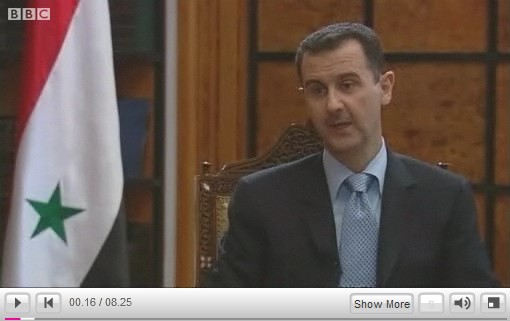
The BBC’s Middle East editor, Jeremy Bowen interviewed Syrian President Bashar al-Assad who says Israel’s raid on the Gaza aid flotilla has increased the risk of war in the Middle East.

A few days before the Israeli attack on the Mavi Marmara, Charlie Rose did a full length interview with the Syrian president which is well worth watching. He’s a serious and articulate strategic thinker.

Assad gets far less attention in the US media than he deserves. To some extent this may result from his reserved manner and the perception that he rules in the shadow of his father, the late Hafez al-Assad, but to a larger extent I see it as standard-fare Washington contempt for Syria itself. Perennially branded a rogue state, a relatively minor oil producer, Syria is a country that interests America no more than can be measured by its willingness (or unwillingness) to bow to American pressure.

But Assad belongs to and is articulating the vision of a new generation of regional leaders who recognize that the fate of the Middle East rests firmly in the hands of those who refuse to define themselves on the basis of their relationship with the United States.

Facebooktwittermail