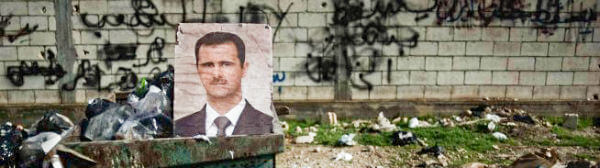
The Washington Post reports: Russian bombers flying from an Iranian air base struck rebel targets across Syria on Tuesday, Russian and Iranian officials said, dramatically underscoring the two countries’ growing military ties and highlighting Russia’s ambitions for greater influence in a turbulent Middle East.
The long-range Tu-22 bombers took off from a base near Hamadan in western Iran and launched raids in the Syrian provinces of Aleppo, Deir al-Zour and Idlib, the Russian Defense Ministry said in a statement. The ministry said the bombers were accompanied by Russian fighter jets based in Syria.
Both countries are staunch allies of Syrian President Bashar al-Assad, but the flights marked the first time Russia has launched strikes from Iranian territory.
Iran has long banned foreign militaries from establishing bases on its soil. But the raids appeared to signal a budding alliance that would expand Russia’s military footprint in the region. [Continue reading…]
Category Archives: Syria
The never-told-before story of the meeting that led to the creation of ISIS
Harald Doornbos and Jenan Moussa write: Abu Ahmad never hesitated in his embrace of the Syrian uprising. Born in a northern Syrian city to a conservative and religious Sunni Arab family, he was a student when the revolt began in March 2011, and joined the protests against President Bashar al-Assad from day one.
“With excitement in our hearts we saw [the uprising in] Egypt happening, followed by the revolution in Libya,” he said. “We hoped the wind of change would not pass our country.”
When the uprising became a full-fledged civil war by mid-2012, Abu Ahmad decided to take up arms and fight. He joined a jihadi-leaning rebel group, whose members were mostly Syrians but also included some foreign fighters from Europe and Central Asia. The composition of the brigades was in flux then — every couple of months, Abu Ahmad’s group would either change its name or unite with other jihadi rebels. But then the groups began to consolidate: In Spring 2013, Abu Ahmad chose to side with the Islamic State of Iraq and the Levant when it officially expanded into Syria, as tensions escalated between the jihadi group and the Nusra Front. The group would go on to proclaim itself a worldwide caliphate in June 2014, assuming the name “Islamic State” to reflect its global ambitions. To this day, Abu Ahmad is a serving member in the organization, with unique insight into the group’s behavior and its history.
Over the course of our more than 15 meetings with Abu Ahmad, we questioned him intensively about his knowledge of the jihadi group and his bona fides as one of the “soldiers of the caliphate.” Over a period of 10 months, we spent more than 100 hours with him. He patiently answered our questions on everything from how he ended up with the Islamic State, how the organization is organized, and the identity of the European foreign fighters within the group. Our interviews would go on for six hours a day, in week-long stretches.
Abu Ahmad took a great personal risk in talking to us. Because he is still with the Islamic State, we had to deliberately obscure some details about his life to protect his identity.
Abu Ahmad agreed to speak to us, he explained, for several reasons. Although he is still with the Islamic State, he doesn’t agree with everything the outfit does. He is attracted to the organization because he views it as the strongest Sunni group in the region. However, he is disappointed that it “has become too extreme,” blaming it for doing such things as crucifying, burning, and drowning its opponents and those who violate its rules.
For example, Abu Ahmad objected to a punishment that the Islamic State implemented in the northern Syrian city of al-Bab, where it put a cage in the middle of the city center, known as Freedom Square, to punish Syrian civilians guilty of minor crimes, such as selling cigarettes. The group, Abu Ahmad said, imprisoned Syrians in the cage for three days at a time, hanging a sign around their neck stating the crime that they had committed.
“Now the square is known as the Punishment Square,” he said. “I think this kind of harsh punishment is bad for us. It is making ISIS more feared than liked by Sunnis, which is not good at all.”
In the past, Abu Ahmad said, he had hoped the Islamic State would become “jihadi unifiers,” capable of bringing Sunni jihadis together under one banner. He admired the foreign fighters whom he knew, mainly young men from Belgium and the Netherlands who had traveled to Syria to fight jihad. They had all lived in rich and peaceful countries, and while tens of thousands of Syrians had paid large sums of money to be smuggled to Europe to escape the war, these jihadis voluntarily traveled in the exact opposite direction.
“These foreigners left their families, their houses, their lands and traveled all the way to help us here in Syria,” Abu Ahmad said. “So to support us they are truly sacrificing everything they have.”
But Abu Ahmad would soon sour on aspects of the jihadi group. First, the Islamic State has not brought jihadis together; on the contrary, tensions have risen with other groups, and he worried that “the rise of ISIS led to the breakup with the Nusra Front and the weakening of unified jihadi forces in Syria.”
Secondly, while some of the foreign fighters were men who led truly religious lives in Europe, he discovered another group that he took to thinking of as the “crazies.” These were mostly young Belgian and Dutch criminals of Moroccan descent, unemployed and from broken homes, who lived marginal lives in marginal suburbs of marginal cities. Most of these crazies had no idea about religion, and hardly any of them ever read the Quran. To them, fighting in Syria was either an adventure or a way to repent for their “sinful lives” in Europe’s bars and discos. [Continue reading…]
Aid worker in Aleppo says joint U.S.-Russian airstrikes would be ‘diabolical’
The Intercept reports: A British aid worker based in rebel-held East Aleppo says that reported plans by the United States and Russia to conduct joint airstrikes against the city are “ludicrous and diabolical,” and, if carried out, would have a disastrous impact on civilians living there.
Tauqir Sharif, 29, speaking to The Intercept from a hospital in Aleppo, says that Russian and Syrian government airstrikes on the city are creating nightmarish conditions for ordinary people. The addition of American forces to the mix would compound the misery of civilians, while giving the impression that the United States was openly siding with the Assad government.
Last week an alliance of Syrian rebels and Islamist groups broke the longstanding government siege on the eastern half of the city. Sharif says that since then, the frequency and intensity of airstrikes has increased. “There has been an almost constant bombardment from strikes because the regime is very, very angry that a corridor has been opened into the city from the south,” Sharif says. “The siege in some ways is still in place because it is very difficult to bring aid in due to constant airstrikes on vehicles driving the routes to the city.” [Continue reading…]
Russia uses Iran as base to bomb Syrian militants for first time
Reuters reports: Russia used Iran as a base from which to launch air strikes against Syrian militants for the first time on Tuesday, widening its air campaign in Syria and deepening its involvement in the Middle East.
In a move underscoring Moscow’s increasingly close ties with Tehran, long-range Russian Tupolev-22M3 bombers and Sukhoi-34 fighter bombers used Iran’s Hamadan air base to strike a range of targets in Syria.
It was the first time Russia has used the territory of another nation, apart from Syria itself, to launch such strikes since the Kremlin launched a bombing campaign to support Syrian President Bashar al-Assad in September last year.
It was also thought to be the first time that Iran has allowed a foreign power to use its territory for military operations since the 1979 Islamic revolution. [Continue reading…]
China seeks closer military ties with Syria
Reuters reports: China wants to have closer military ties with Syria, state media on Tuesday cited a senior Chinese officer as saying during a rare visit to the war-torn Middle Eastern country.
While relying on the region for oil supplies, China tends to leave Middle Eastern diplomacy to the other permanent members of the U.N. Security Council, namely the United States, Britain, France and Russia.
But China has been trying to get more involved, including sending envoys to help push for a diplomatic resolution to the violence there and hosting Syrian government and opposition figures.
Guan Youfei, director of the Office for International Military Cooperation of China’s Central Military Commission, met Syrian Defence Minister Fahad Jassim al-Freij in Damascus, China’s Xinhua state news agency said. [Continue reading…]
The tale of two victories against Syria’s worst killers
Hassan Hassan writes: On two consecutive Fridays this month, Aleppo was the site of major victories against the Assad regime and ISIL in Syria. In southwestern Aleppo, anti-government forces broke a month-long siege enforced by the regime. In eastern Aleppo, a coalition of Arab and Kurdish forces drove out ISIL from one of its critical strongholds, Manbij.
The two developments are a blow to the country’s worst killers, and thus should be commended. The win in southwestern Aleppo saved about 300,000 civilians from a crippling siege and a slow death, while the defeat of ISIL in Manbij will further weaken the group and deprive it a crucial planning and recruitment hub.
Notwithstanding the benefits of defeating regime forces in southern Aleppo, the liberation of Manbij is in many ways a far greater victory for Syria.
The battle for breaking the siege was framed as a victory for Al Qaeda’s newly-rebranded Jabhat Fateh Al Sham (JFS), formerly Jabhat Al Nusra. A week after the JFS-led forces stormed the Artillery Academy, one of the regime’s key bastions near the city of Aleppo, a tug-of-war erupted on social media after JFS members lashed out at attempts by some rebels to take credit for the accomplishment. [Continue reading…]
The Democratic Party’s silence on Syria

Kim Ghattas writes: Syria cannot be made to fit a clear pattern of injustice, with an occupier and an occupied, like with Israel and the Palestinians, or an oppressed and an oppressor, like with South Africa’s apartheid. Any meaningful U.S. action in Syria would require more military force, a no-no for the left. And rather inconveniently, Assad belongs to the so-called axis of resistance against Israel that includes Hezbollah — and for which the American left has a tendency to voice support with little questioning, because it has the luxury of geographical distance from the consequences of life under its rule.
American political scientist and Israel critic Norman Finkelstein exemplified that attitude when he visited Lebanon in 2008 to show his support for Hezbollah, which he lauded for its courage and discipline in its 2006 war with Israel. A local interviewer pointed out that the widespread support Hezbollah enjoyed among Lebanese after it forced Israel to withdraw from southern Lebanon in 2000 had dissipated in the wake of the costly 2006 war that had wrecked much of the country’s infrastructure — a war which many Lebanese blamed on Hezbollah. “I am not telling you what to do with your lives, and if you’d rather live crawling on your feet, I could respect that,” Finkelstein replied, evoking Spanish Civil War heroine Dolores Ibárruri, who said “It is better to die on your feet than to live on your knees.”
When the interviewer pressed that support for Hezbollah should be a choice left to the Lebanese who have to live with the consequences of the group’s actions, Finkelstein’s answer was again that it was always better to resist and die with honor, adding dismissively that he doesn’t live in Lebanon, so the internal political divisions were irrelevant to him.
Such thinking is prevalent on the left when it comes to Syria, and its adherents are unwilling to vocalize any criticism of Assad’s use of force, lest it indicate support for removing him from power. Mouaz Moustafa, the executive director of the Syrian Emergency Task Force, which supports the opposition, told me Assad’s positions on the Palestinian cause means that “a large segment of the left has completely ignored Syria, and turned a blind eye to what is going on, or even subscribed to conspiracy theories” that the war was manufactured by the West to weaken Assad.
“They believe that U.S. power and military can never be used for good, and somehow they believe Russia provides a balance in the world, but they don’t realize that the Russians are much more brutal,” he said, a pertinent point as President Vladimir Putin’s influence or interference in this election cycle has become a point of debate.
Mustafa said he believed that Sanders’s silence reflected a lack of understanding of both Syria’s geopolitical complexities and the horror of a war where the overwhelming majority of civilian victims have been killed by government forces. “He should go to the Syrian border in Turkey. He should see for himself what is happening and then see if that shifts his position in the right direction,” Mustafa said. “This is our ‘never again’ moment. He needs to clarify his stance, not just keep repeating: We can’t depose dictators, we can’t use force, we can’t have no-fly zones.”
But if the left opposes military action, what about humanitarian action? Even if the United States does not impose a no-fly zone, it could still ramp up funding for overwhelmed and underfunded U.N. agencies and refugee organizations.
This is where [running mate Tim] Kaine’s views are closer to Clinton’s than even some of her own advisors, and those of President Barack Obama himself. As chairman of the Senate Foreign Relations subcommittee on the Middle East, he traveled to the region often, speaking passionately about the refugee crisis — including in March 2014, when he said that he refused to accept that “there’s nothing more we can do to end the suffering.” He spearheaded an effort to pass a Senate resolution to press the administration to beef up its humanitarian assistance.
There are two key components to Kaine’s thinking on Syria: First, he believes that the United States should push for a humanitarian zone to deliver aid. In November, he said the zone would be “principally a tool for delivering humanitarian aid pursuant to the U.N. Security Council resolution that even Russia voted for. I think, done correctly, it could also accelerate a path to a negotiated end to the Syrian Civil War.” In other words, this creates space to push back against Assad.
Secondly, Kaine believes the challenge of the Islamic State and the issue of Assad are connected, and Washington’s single-minded focus on the jihadi group means its Syria strategy is nonexistent or a mess. “These are two problems that are connected, and you can’t have a strategy that’s just about one,” he told NPR in October. [Continue reading…]
Watching my beloved Aleppo rip itself apart
Lina Sergie Attar writes: In June 2011, the last time I was in Aleppo, I visited my grandmother’s home every day. I obsessively photographed the apartment where my father grew up and where I spent much of my youth. I snapped shots of her wooden doors and balcony, our family’s antiques arranged in the glass vitrine, her organized kitchen cabinets and my grandfather’s proud portrait in the dining room. I took only a few sentimental pieces with me when I left to go back to my home in America. I wish I had taken everything.
My grandmother’s apartment is on a tiny street tucked between parallel one-way boulevards, one traveling southeast toward the heart of old Aleppo, and the other running northwest to the city’s expansive outlying neighborhoods. This diverse part of the city, in the west, has largely avoided the destruction of the war swirling around it — so far.
Aleppo, where I spent my adolescent years, where I went to college and became an adult before returning to the United States, where I was born, has been split in two since 2012. The west side is in the clutches of the government, and the east is held by rebel forces. Over the last four years, brutal territorial battles tore through the city, dividing neighborhoods that had been interwoven for centuries. Some two million people (including thousands of displaced Syrians) live in relative safety in the west, while over 250,000 live in the east, which has been subjected to years of indiscriminate aerial bombardment by the government’s barrel bombs and, since last year, Russian airstrikes.
Aleppo is the last major city where the rebels control significant territory, and President Bashar al-Assad thinks that capturing it could bring him close to so-called victory. In July, his forces tightened the noose around eastern Aleppo to wage yet another brutal “kneel or starve” campaign. Supplies of food and medicine were choked off; hundreds of civilians died.
At the beginning of August, the power struggle on the ground shifted unexpectedly. Activists set thousands of tires alight, creating huge clouds of black smoke, a weak attempt at a homemade no-fly zone to hide the east side from Russian airplanes. The rebel groups forged a fragile coalition and joined forces with the Levant Conquest Front, an Islamist group that recently was called the Nusra Front and was previously Al Qaeda’s affiliate in Syria. Together, they battled Mr. Assad’s troops and their Hezbollah militia allies. On Aug. 6, they broke the siege. Trucks from nearby Idlib brought the trapped civilians fresh food for the first time in weeks. Meanwhile, Russian jets struck nearby towns with incendiary bombs in retaliation. The bodies of fighters piled up in trucks like dead cattle.
As the battle unfolded, analysts on social media discussed events in real time with a zeal that comes only with detachment. Some said this battle would (again) tip the scales of the war. Others claimed that the rebels’ victory meant the bloody end was (again) near.
A favorite tool of the dispassionate Syria analyst is a map: red and green blobs showing a shifting front line, which streets are held by rebels and which by the government. These wretched maps rudely superimpose their lines over the landmarks of my life: On the east are the people I grew to love through the revolution, men, women and children who defied all odds and stood chanting in the face of one of the most ruthless regimes in history. On the west are my streets, my school, my university, my home.
I study these maps and calculate how far my home sits from the moving front line. As my neighborhood shifts sides from west to east, from red to green, will it be the next target of Mr. Assad’s barrel bombs? Or will it be left to the mercy of the rebels, who promised not to loot or destroy private property or kill civilians? Why should my home be spared when millions of others’ weren’t? This is what it feels like to watch your city rip itself apart: a constant oscillation between guilt and relief, fear and pride. [Continue reading…]
Syrian doctors write letter to President Obama, urging him to act in Aleppo
ABC News reports: Some of the last doctors remaining in the besieged Syrian city of Aleppo have written a letter to President Obama, urging him to intervene to break the siege of the city and stop bombardments of hospitals. Their plea comes as fighting continues despite Russia’s announcement of a partial ceasefire.
“We have seen no effort on behalf of the United States to lift the siege or even use its influence to push the parties to protect civilians,” the doctors wrote in the letter obtained by ABC News. “Continued U.S. inaction to protect the civilians of Syria means that our plight is being willfully tolerated by those in the international corridors of power. The burden of responsibility for the crimes of the Syrian government and its Russian ally must therefore be shared by those, including the United States, who allow them to continue.”
The doctors said that last month alone Syria saw 42 attacks on medical facilities and that a medical facility in Syria is attacked every 17 hours. Two weeks ago, four newborn babies gasping for air suffocated to death after a blast cut the oxygen supply to their incubators, according to the doctors.
“At this rate, our medical services in Aleppo could be completely destroyed in a month, leaving 300,000 people to die,” the doctors wrote.
They explained that what pained them most was being forced to choose who will live and who will die.
“Young children are sometimes brought into our emergency rooms so badly injured that we have to prioritize those with better chances, or simply don’t have the equipment to help them,” they wrote. “We do not need tears or sympathy or even prayers, we need your action. Prove that you are the friend of Syrians, not the friend of our killers.” [Continue reading…]
The 75,000 Syrian refugees trapped on Jordan’s border
Jason Cone writes: For millions of Syrian civilians trapped for five years by a relentless war, mere lifesaving aid, let alone refuge, is out of reach. But for the 75,000 displaced people caught on Jordan’s desert frontier with Syria, salvation is only yards away. Unlike many of their fellow citizens, they can be saved. So why have they been effectively abandoned?
They are assembled in a kind of buffer zone on an inhospitable strip of land, much of it within Jordanian territory, just north of the official Jordanian border. But that border is closed, which prevents aid from reaching these desperate refugees and at the same time prevents them from seeking safety. If they move, they risk being pushed back into Syria or perishing in the harsh desert. Both options are morally intolerable and completely avoidable.
The refugees have amassed in makeshift camps in an area known as the berm, so named for its distinctive raised barrier of sand, which marks a mileslong no man’s land between Syria and Jordan. Military bases, checkpoints and patrols dot the area, along with various Syrian armed groups, some of whom mix among the refugees.
Since the start of Syria’s war in 2011, the area around the berm has served as an entry point to safety in Jordan from the unremitting violence in Syria. But on June 21, Jordan closed its northern border after a car bombing that day at a nearby Jordanian military base.
For the last seven weeks, relief agencies based in Jordan have not been able to get to the berm. Adequate food, water and medical supplies are not reaching the refugees, just as summer temperatures soar. Rodents roam the sprawling settlement, which lacks proper latrines and shelter. Dust storms regularly rip apart makeshift tents.
With the border closed, a critical lifeline has been cut, threatening death by starvation, illness, heat stroke or unattended medical complications. While some water is provided by a rudimentary pipeline, it’s unclear how many refugees have access to it. And it’s not known if an ad hoc delivery of food last week, dropped by crane over the berm, reached all those in need.
What is clear is that no medical aid is getting through. Just this week, Doctors Without Borders teams in Jordan received reports from United Nations personnel that pregnant women at the berm had died in labor.
According to the United Nations, four out of five of the refugees at the berm are women or children. Even before the border closing, medical assessments conducted by Doctors Without Borders revealed alarming medical needs. Children suffered from diarrhea and malnutrition. Hundreds of pregnant women lacked adequate obstetric care. Many people were afflicted with respiratory illnesses and skin infections because of the harsh living conditions. [Continue reading…]
Aid and attention dwindling, refugee crisis intensifies in Greece
The New York Times reports: As her young children played near heaps of garbage, picking through burned corn cobs and crushed plastic bottles to fashion new toys, Shiraz Madran, a 28-year-old mother of four, turned with tear-rimmed eyes to survey the desolate encampment that has become her home.
This year, her family fled Syria, only to get stuck at Greece’s northern border with Macedonia in Idomeni, a town that had been the gateway to northern Europe for more than one million migrants from the Middle East and Africa seeking a haven from conflict. After Europe sealed the border in February to curb the unceasing stream, the Greek authorities relocated many of those massed in Idomeni to a camp on this wind-beaten agricultural plain in northern Greece, with promises to process their asylum bids quickly.
But weeks have turned into months, and Mrs. Madran’s life has spiraled into a despondent daily routine of scrounging for food for her dust-covered children and begging the authorities for any news about their asylum application. “No one tells us anything — we have no idea what our future is going to be,” she said.
“If we knew it would be like this, we would not have left Syria,” she continued. “We die a thousand deaths here every day.” [Continue reading…]
Manbij liberated: Syrian town freed from ISIS control
Fractured lands: How the Arab world came apart
The following New York Times Magazine feature story is more than a long-read — at 42,000 words it’s more like a short book. Scott Anderson writes: Before driving into northern Iraq, Dr. Azar Mirkhan changed from his Western clothes into the traditional dress of a Kurdish pesh merga warrior: a tightfitting short woolen jacket over his shirt, baggy pantaloons and a wide cummerbund. He also thought to bring along certain accessories. These included a combat knife, tucked neatly into the waist of his cummerbund, as well as sniper binoculars and a loaded .45 semiautomatic. Should matters turn particularly ticklish, an M-4 assault rifle lay within easy reach on the back seat, with extra clips in the foot well. The doctor shrugged. “It’s a bad neighborhood.”
Our destination that day in May 2015 was the place of Azar’s greatest sorrow, one that haunted him still. The previous year, ISIS gunmen had cut a murderous swath through northern Iraq, brushing away an Iraqi Army vastly greater in size, and then turning their attention to the Kurds. Azar had divined precisely where the ISIS killers were about to strike, knew that tens of thousands of civilians stood helpless in their path, but had been unable to get anyone to heed his warnings. In desperation, he had loaded up his car with guns and raced to the scene, only to come to a spot in the road where he saw he was just hours too late. “It was obvious,” Azar said, “so obvious. But no one wanted to listen.” On that day, we were returning to the place where the fabled Kurdish warriors of northern Iraq had been outmaneuvered and put to flight, where Dr. Azar Mirkhan had failed to avert a colossal tragedy — and where, for many more months to come, he would continue to battle ISIS.
Azar is a practicing urologist, but even without the firepower and warrior get-up, the 41-year-old would exude the aura of a hunter. He walks with a curious loping gait that produces little sound, and in conversation has a tendency to tuck his chin and stare from beneath heavy-lidded eyes, rather as if he were sighting down a gun. With his prominent nose and jet black pompadour, he bears a passing resemblance to a young Johnny Cash.
The weaponry also complemented the doctor’s personal philosophy, as expressed in a scene from one of his favorite movies, “The Good, the Bad and the Ugly,” when a bathing Eli Wallach is caught off guard by a man seeking to kill him. Rather than immediately shoot Wallach, the would-be assassin goes into a triumphant soliloquy, allowing Wallach to kill him first.
“When you have to shoot, shoot; don’t talk,” Azar quoted from the movie. “That is us Kurds now. This is not the time to talk, but to shoot.”
Azar is one of six people whose lives are chronicled in these pages. The six are from different regions, different cities, different tribes, different families, but they share, along with millions of other people in and from the Middle East, an experience of profound unraveling. Their lives have been forever altered by upheavals that began in 2003 with the American invasion of Iraq, and then accelerated with the series of revolutions and insurrections that have collectively become known in the West as the Arab Spring. They continue today with the depredations of ISIS, with terrorist attacks and with failing states.
For each of these six people, the upheavals were crystallized by a specific, singular event. For Azar Mirkhan, it came on the road to Sinjar, when he saw that his worst fears had come true. For Laila Soueif in Egypt, it came when a young man separated from a sprinting mass of protesters to embrace her, and she thought she knew the revolution would succeed. For Majdi el-Mangoush in Libya, it came as he walked across a deadly no-man’s-land and, overwhelmed by a sudden euphoria, felt free for the first time in his life. For Khulood al-Zaidi in Iraq, it came when, with just a few menacing words from a former friend, she finally understood that everything she had worked for was gone. For Majd Ibrahim in Syria, it came when, watching an interrogator search his cellphone for the identity of his “controller,” he knew his own execution was drawing nearer by the moment. For Wakaz Hassan in Iraq, a young man with no apparent interest in politics or religion, it came on the day ISIS gunmen showed up in his village and offered him a choice.
As disparate as those moments were, for each of these six people they represented a crossing over, passage to a place from which there will never be a return. Such changes, of course — multiplied by millions of lives — are also transforming their homelands, the greater Middle East and, by inevitable extension, the entire world.
History never flows in a predictable way. It is always a result of seemingly random currents and incidents, the significance of which can be determined — or, more often, disputed — only in hindsight. But even accounting for history’s capricious nature, the event credited with setting off the Arab Spring could hardly have been more improbable: the suicide by immolation of a poor Tunisian fruit-and-vegetable seller in protest over government harassment. By the time Mohamed Bouazizi succumbed to his injuries on Jan. 4, 2011, the protesters who initially took to Tunisia’s streets calling for economic reform were demanding the resignation of Zine el-Abidine Ben Ali, the nation’s strongman president for 23 years. In subsequent days, those demonstrations grew in size and intensity — and then they jumped Tunisia’s border. By the end of January, anti-government protests had erupted in Algeria, Egypt, Oman and Jordan. That was only the beginning. By November, just 10 months after Bouazizi’s death, four longstanding Middle Eastern dictatorships had been toppled, a half-dozen other suddenly embattled governments had undergone shake-ups or had promised reforms, and anti-government demonstrations — some peaceful, others violent — had spread in an arc across the Arab world from Mauritania to Bahrain.
As a writer with long experience in the Middle East, I initially welcomed the convulsions of the Arab Spring — indeed, I believed they were long overdue. In the early 1970s, I traveled through the region as a young boy with my father, a journey that sparked both my fascination with Islam and my love of the desert. The Middle East was also the site of my first foray into journalism when, in the summer of 1983, I hopped on a plane to the embattled city Beirut in hopes of finding work as a stringer. Over the subsequent years, I embedded with a platoon of Israeli commandos conducting raids in the West Bank; dined with Janjaweed raiders in Darfur; interviewed the families of suicide bombers. Ultimately, I took a five-year hiatus from magazine journalism to write a book on the historical origins of the modern Middle East. [Continue reading…]

Chemical weapons attacks in Syria may normalise war crimes, experts warn
The Guardian reports: A woman and two children have been killed and dozens injured in an alleged chlorine gas attack in Aleppo, doctors have said, as experts warned that the frequent use of chemical weapons in Syria risks normalising war crimes.
There have been dozens of attacks with chlorine gas since Syria officially agreed to give up its weapons stockpile following a 2013 sarin gas assault on a Damascus suburb, rights groups and doctors on the ground said.
The latest reports came as Russia offered to halt fighting for three hours a day to allow aid into besieged parts of the city, but the UN countered by saying it needed at least 48 hours a week to take convoys through heavily bombed and mined roads into eastern Aleppo.
There are still 1.5 million people living in Aleppo, the city that was Syria’s largest before the civil war and is now at the heart of the brutal battle for its future. About 300,000 civilians in rebel-held areas are at grave risk from water shortages and disease as fighting has intensified, said the UN envoy to Syria, Staffan de Mistura.
Asked about the chemical attack on the Aleppo district of Zubdiya, he said there was a lot of evidence that it took place, and it would constitute a war crime if chlorine gas was used, but he added that it was not his remit to verify the attack. “If it did take place, it is a war crime and as such it would require everyone … to address it immediately,” he added.
Last week, doctors in the neighbouring province of Idlib said they had treated more than two dozen patients following a suspected chlorine attack on the town of Saraqeb. [Continue reading…]
Battle for Aleppo may be the most crucial of the Syrian civil war
The Washington Post reports: A fast-moving cataclysm underway in and around Aleppo has brought together all the major actors in Syria’s civil war for what may be the most crucial battle of the five-year conflict, and it is testing whether U.S.-Russian cooperation to end it is a pipe dream.
North of the city — in which the government holds the western side and U.S.-backed moderate opposition forces have occupied the east since 2012 — the opposition has lost control of its only lifeline for resupply under relentless pummeling by Russian and Syrian aircraft and artillery.
The road to Turkey also provided the only path for humanitarian aid or an escape route for at least a quarter-million civilians trapped inside Aleppo, who the United Nations said this week have been left without food, medical supplies or running water.
So dire is their situation that talks initiated by the Obama administration with Russia this summer about coordinating their Syria counterterrorism efforts have been put on the back burner, superseded by urgent negotiations with Moscow over reopening the road to Turkey, according to U.S. officials. [Continue reading…]
In the video below, Charles Lister discusses the siege of Aleppo and the dynamics within Syrian opposition groups:
Obama’s worst mistake
Nicholas Kristof writes: A crazed gunman’s attack on an Orlando club in June, killing 49 people, resulted in blanket news coverage and national trauma.
Now imagine that such a massacre unfolds more than five times a day, seven days a week, unceasingly for five years, totaling perhaps 470,000 deaths. That is Syria. Yet even as the Syrian and Russian governments commit war crimes, bombing hospitals and starving civilians, President Obama and the world seem to shrug.
I admire Obama for expanding health care and averting a nuclear crisis with Iran, but allowing Syria’s civil war and suffering to drag on unchallenged has been his worst mistake, casting a shadow over his legacy. It is also a stain on all of us, analogous to the indifference toward Jewish refugees in the 1930s, to the eyes averted from Bosnia and Rwanda in the 1990s, to Darfur in the 2000s. [Continue reading…]
45,000 ISIS fighters killed in past two years, says U.S. general
AFP reports: About 45,000 militants have been killed in Iraq and Syria since the US-led operation to defeat the ISIS group began two years ago, a top general said Wednesday.
“We estimate that over the past 11 months, we’ve killed about 25,000 enemy fighters. When you add that to the 20,000 estimated killed (previously), that’s 45,000 enemy (fighters) taken off the battlefield,” said Lieutenant General Sean MacFarland, who commands the US-led coalition campaign against ISIS.
MacFarland said estimates for the overall remaining strength of ISIS vary from about 15,000 to 30,000 but said the jihadists are having increasing difficulties replenishing their ranks. [Continue reading…]
Putin, Obama and the battle for Aleppo
By Layla Saleh, Qatar University
The battle for Aleppo has the Arab world, Middle East observers and Western policymakers on edge.
In what is likely a turning point in the long Syrian civil war, a coalition of opposition fighters is attempting to break Bashar al-Assad regime’s siege of the country’s commercial capital. Meanwhile, the Syrian government – with Russian support – is bombing rebel strongholds in the city which is still home to 250,000 people, according to the BBC.
Thanks to recent U.S. diplomatic overtures to deepen cooperation with Russia against the Islamic State, or IS, and al-Qaida affiliate Al-Nusra Front, the U.S. could be considered a partner in those airstrikes. The U.S. overtures have been criticized as strategically inconsistent and Putin-pleasing.
As a student of American policy in the Middle East, I’d argue that American efforts are key to the tumultuous trajectory of Syria’s uprising-turned-war. What’s less clear to me is how much U.S. President Barack Obama’s approach prioritizes either the immediate needs of Syrians suffering from war and terrorism or their aspirations for self-liberation from authoritarian rule.