Category Archives: Syria

Russia’s secret mercenaries fighting in Syria


Sky News reports: If Russia is a nation at war, the Kremlin has always been careful to frame its campaign in Syria as an aerial operation.

Other than a limited number of ‘instructors and military advisers’, Russian officials have repeatedly stated that they do not need to put ‘boots on the ground’.

The Russian narrative of low-cost conflict has been seriously challenged however by a group of young Russian men who claim that their country’s involvement in Syria is far more extensive – and more costly – than anyone in President Putin’s administration is prepared to admit.

These individuals told Sky News that they were recruited by a highly secretive private military company called ‘Wagner’ and flown to Syria aboard Russian military transport planes.

For the equivalent of £3,000 a month, they say they were thrown into pitch battles and firefights with rebel factions – including Islamic State.

Two of the group, Alexander and Dmitry, told Sky News they felt lucky to be alive.

“It’s 50-50,” said Alexander (not his real name). “Most people who go there for the money end up dead. Those who fight for ideals, to fight against the Americans, American special-forces, some ideology – they have a better chance of survival.”

“Approximately 500 to 600 people have died there,” claimed Dmitry. “No one will ever find out about them…. that’s the scariest thing. No one will ever know.” [Continue reading…]


Facebooktwittermail

Pity Aleppo as Putin drops his bombs to salvage Russia’s pride

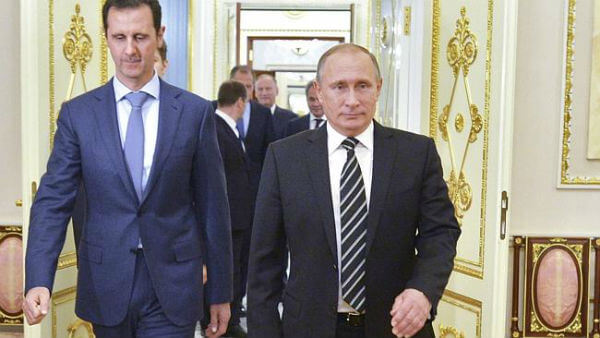
assad-putin

Natalie Nougayrède writes: A few days after Russia launched its military intervention in Syria in September 2015, Barack Obama said it would “get stuck in a quagmire and it won’t work”. Ten months on, that has yet to come to pass. As Russia helps its ally Bashar al-Assad try to retake Aleppo, the last strategic urban stronghold of the Syrian opposition, there aren’t many signs of the Kremlin’s war machine being either hamstrung or stuck. Indeed Russia seems to have registered more victories than setbacks in Syria. Hardly anyone remembers that, just last March, Vladimir Putin had announced he would begin withdrawing his forces. The withdrawal turned out to be as theoretical as Obama’s quagmire.

Most attempts to explain Putin’s military operation in Syria have focused on the following: 1) allergic to popular uprisings, he wants to prevent regime change in Damascus of the sort that happened in 2011 in Tunisia, Egypt and Libya; 2) he wants to secure Russia’s last foothold in the Arab world; 3) he wants to demonstrate Russia will do what it takes to defend an ally; 4) he wishes to divert attention from Ukraine as well as extract western concessions such as the easing of sanctions; 5) he is opportunistic and has capitalised on American unwillingness to get further involved in the Middle East; 6) he believes that by creating chaos, even if there is no clear endgame, Russia shows it can overturn western plans ; 7) it’s all about Russian domestic politics: nationalism and military assertiveness go hand in hand with Putin’s need to safeguard his own power structure.

There is probably truth to all of the above. But as Russia’s bombers hammer Aleppo’s besieged population in what could be the most decisive battle of Syria’s civil war, consider this as another piece to the puzzle of Putin’s mind: Syria is where Russia wants to erase the humiliation of the Soviet Union’s defeat in Afghanistan in the 1980s. [Continue reading…]

Facebooktwittermail

Radicalisation in Bosnia: Old wounds reopened by an emerging problem

By Louis Monroy Santander, University of Birmingham

Bosnia experienced a difficult reconstruction process after its 1992–1995 war. Now its ongoing political and economic crisis is making it harder to respond to a growing global problem – radicalisation.

According to recent reports, Bosnians have been travelling to Syria to fight for radical Islamist groups in increasing numbers since 2012. They now constitute one of the largest European foreign fighter contingents as a proportion of national population. Figures from 2015 suggest there are more than 300 Bosnians in Syria.

There have also been a number of low-level incidents of terrorist violence in Bosnia. In April 2015, for example, a 24-year-old man from an area near the town of Zvornik drove into a police station and opened fire. He killed one officer and injured two others before being shot dead.

This has prompted heated debates about how to handle the problem without feeding into the tensions that pervade in Bosnian politics. Of particular concern is the possibility that decisions about security will be coloured by ethno-politics.

Continue reading

Facebooktwittermail

Former ISIS members open up to German investigators

Der Spiegel reports: Prior to his field trip into the realm of the murderous IS band, Nils D. had been a good-for-nothing. He would sleep until mid-day, then surf the Internet and meet up with his buddies in a café, where they took drugs, drank booze and played cards. They didn’t have any hobbies and they lacked any enthusiasm. The company that had provided him with vocational training fired him because he wasn’t attending the vocational school courses that were part of the program. Afterward, the most he found were temporary jobs. “I was a pothead,” Nils D. says. “I didn’t feel like doing anything.”

This continued for years. Then D. discovered Islam through his cousin Philip B. and became a Salafist. He was still serving a sentence for grand theft when his cousin and the other guys went to Syria to fight. Then, during the autumn of 2013, D. also traveled to the “caliphate.”

During his trial in the dock of the Higher Regional Court in Düsseldorf, Nils D. said “he wanted to see things for himself.” He then quickly became part of the murderous system. In Manbij, he joined a special IS unit. The force’s task was to capture suspected traitors, spies or deserters. D. is believed to have taken part in up to 15 missions.

He also knew what happened to the men he had helped to capture. The former pothead from Dinslaken knew about the wooden crates they would be placed in. There were large ones in which they could stand, sandwiched. And there were small ones in which the prisoners could only crouch — sometimes for days at a time.

Nils D. sported a typical Islamist beard. Whenever he went out, it was always dressed in black and with his face covered. He attended five executions as a spectator. “I had goosebumps all over,” D. would later tell investigators with the State Office of Criminal Investigation in Düsseldorf. “But after a while it bounces off you.” [Continue reading…]

Facebooktwittermail

Battles rage across Aleppo as Assad regime fights to quell rebels

The Guardian reports: Rebels in Syria’s second largest city were on Monday coming under intense aerial bombardment from forces loyal to the Syrian president, Bashar al-Assad, less than two days after they fought through regime lines to break the siege of rebel-held east Aleppo.

Activists say intense airstrikes have continued unabated after rebels seized Ramouseh, a district in south-west Aleppo, allowing them to open a corridor into the besieged areas.

“We are in our trenches but there are insane airstrikes of unprecedented ferociousness,” a commander in the rebel coalition told Reuters. “The regime is using cluster and vacuum bombs.”

Over the weekend, rebels in a coalition known as Jaish al-Fatah launched a lightning advance that sealed the conquest of Ramouseh, a key district through which supplies flow to government forces in west Aleppo. The advance followed a rare show of unity among the opposition, which began a campaign a week ago involving thousands of fighters working to break the siege. [Continue reading…]

Facebooktwittermail

British special forces operating inside Syria


BBC News reports: The BBC has obtained exclusive pictures showing for the first time British special forces operating on the ground in Syria.

It is the vehicles that first stand out. The open air, Thalab long range patrol vehicles are built for harsh terrain and are favoured by special forces.

In this case it is British special forces, seen for the first time on the ground, inside Syria, in photographs obtained by the BBC.

The pictures, which date from June, follow an attack by the so-called Islamic State (IS) on the moderate rebel New Syrian Army base of Al Tanaf on the Syria-Iraq border. The British soldiers appear to be securing the base’s perimeter.

According to eyewitnesses, they were there in a defensive role. But they are carrying an arsenal of equipment including sniper rifles, heavy machine guns and anti-tank missiles. [Continue reading…]

Facebooktwittermail

U.S. military intelligence contractors being hired to operate in Syria

The Daily Beast reports: Every day at 5 p.m., the Pentagon releases a list of that day’s contracts worth more than $7 million. On July 27, buried in the daily email was an eye-catching detail: Military contractors would be working inside Syria alongside the roughly 300 U.S. troops already deployed there.

This appears to be the first time the Pentagon has publicly acknowledged that private contractors are also playing a role in the fight against the so-called Islamic State inside Syria, and it’s one more signal that the U.S. military is deepening its involvement in the fate of the country.

The contract announcement said Six3 Intelligence Solutions — a private intelligence company recently acquired by CACI International — won a $10 million no-bid Army contract to provide “intelligence analysis services.” According to the Pentagon, the work will be completed over the next year in Germany, Italy and, most notably, Syria. [Continue reading…]

Facebooktwittermail

Syria’s civil war: Rebels push to take all of Aleppo

Al Jazeera reports: A Syrian rebel alliance has announced the start of a battle to recapture the whole of Aleppo, a day after it broke a government siege on the rebel-held half of the city.

The Army of Conquest, a coalition of rebel groups including Jabhat Fatah al-Sham (formerly the al-Nusra Front), said in a statement on Sunday that it would “double the number of fighters for this next battle”.

“We announce the start of a new phase to liberate all of Aleppo,” the group said. “We will not rest until we raise the flag of the conquest over Aleppo’s citadel.”

Footage obtained by Al Jazeera showed rebel fighters at government checkpoints on Saturday after breaking the month-long siege on the rebel-held eastern neighbourhoods of the city in a major setback for the forces of President Bashar al-Assad. [Continue reading…]

Facebooktwittermail

Syria’s rebels unite to break Assad’s siege of Aleppo

The Guardian reports: A Syrian military academy in the heart of Aleppo made for a bold, even reckless target for opposition forces trying to break a devastating siege, but the rebels gambled on a double advantage: surprise and suicide bombers.

Soon the rebels were sharing pictures of abandoned artillery and a smashed portrait of President Bashar al-Assad on Twitter, flaunted as triumphant proof that the army was routed and opposition forces were within a few hundred metres of their besieged comrades.

Hours later, the people of east Aleppo were dancing in the street, as rebels and activists confirmed that the month-long siege of the area had been broken. The fate of the opposition-held city was back in play. “Morale is very high now,” said activist and poet Mahmoud Rashwani, who had been living largely underground to avoid airstrikes, eking out his supplies of canned food.

The victory is a fragile one. The area is still a conflict zone and it may be some time before a secure corridor for food and medical supplies can be set up, and the regime has called in reinforcements.

“We expect revenge bombing by the regime, including, possibly, chemical weapons,” said Zaher Sahloul, a Syrian-American doctor who coordinates medical aid in the city.

Still, for the rebels, it has been a remarkable triumph against the odds. After months of retreat under pressure from government forces and Russian airstrikes, they have not only broken the siege, but overrun a key base the regime had used to enforce it and apparently taken possession of a large cache of weapons and artillery. [Continue reading…]

Middle East Eye reports: Fighting on the southern edges of Aleppo continued into Sunday morning, hours after rebels said they had broken a three-week government siege of the Syrian city.

Rebels spearheading the push to seize control of Syria’s most populous city released a statement on Sunday morning confirming that the fight was ongoing and pledging to protect civilians.

“Anyone who heads to rebel-held areas will be safe, and we will continue to protect the lives of all Syrians, no matter what your affiliation or background,” the branch of the Free Syrian Army active in Aleppo said.

The alliance of rebels said late on Saturday that they had opened a new route into Aleppo’s eastern neighbourhoods, home to some 250,000 people.

But the road, which passes through southern edges of the city, remains too dangerous for civilians to use, the Syrian Observatory for Human Rights said on Sunday. [Continue reading…]

Facebooktwittermail

Middle East bishops say U.S. has ‘moral responsibility’ to help Christians

Crux reports: Catholic leaders in the Middle East say that the United Sates has the “moral responsibility” to help stop the savagery against Christians in the region, and to provide assistance to help them stay in the region, because it was the U.S. that unleashed the chaos in the first place.

“They were the ones who invaded [Iraq] in 2003 and changed the whole region, and they had the moral responsibility to fix the situation before leaving the country,” said the Chaldean Catholic Archbishop of Erbil, Iraq, Bashar Matti Warda.

Jean-Clément Jeanbart, Greek Melkite Archbishop of Aleppo, the “martyred city” of Syria, said that the U.S. has a two-fold responsibility. On the one hand, he asked the U.S. government to ensure that the aid being sent to the region is also distributed among Christians, which, he said, means entrusting a portion of it to the churches.

As the system is set up, he said, all the aid goes to the refugee camps. Yet Christians see their lives at risk there, so they generally choose to seek shelter at churches and convents instead.

“If the help went to the churches, it wouldn’t mean that they’re giving special rights to Christians, but that they’re actually helping everyone,”Jeanbart said at a press conference held on Wednesday during the Knights of Columbus’s 134th Supreme Convention, which took place in Toronto, Canada.

The many Christian churches in the region – in Syria, there are six different Catholic rites alone – fund schools, hospitals, and provide shelter to all refugees, without distinguishing between Muslims, Yazidis or Christians, he said. [Continue reading…]

Facebooktwittermail

In Aleppo, the West has once again failed to prevent what it vowed to stop

Julian Reichelt writes: Over the past four years, the Aleppo I fell in love with has ceased to exist, its slow and painful four-year-long death now dramatically accelerated by Russian‎ smart bombs and Syrian regime dumb bombs.

If Aleppo were a person, this would be the point where we would pray for a swift end to their suffering. But Aleppo isn’t only one person, it’s a besieged town of 300,000, a disgrace to the conscience of the civilized world. Doctors are working in conditions resembling a slaughterhouse more than a hospital, but still saving lives. Children are burning tires to cloud the skies with smoke and obstruct the vision of Putin’s relentless jets and their soulless pilots. While they — eight-year-old kids — stand up to Putin’s air force and their crimes against humanity, the Western world — once again — has done nothing.

“We had gotten used to hell on earth,” one friend inside the city texted me two days ago. “Now they’re even bombing our hell to pieces.”

In the past days, while bombs were raining on the ruins of Aleppo, I have called, emailed or otherwise contacted every person in politics I know to voice not my concern, as our diplomats would say, but my outrage over what is happening — or, more accurately, what is not happening. [Continue reading…]

Facebooktwittermail

Syria: UN considers role in Russia’s ‘deeply flawed’ humanitarian corridors plan

The Guardian reports: The United Nations is considering overseeing a Russian proposal to create humanitarian corridors for civilians who wish to leave besieged Aleppo, despite strong opposition from aid organisations.

Confidential documents seen by the Guardian detailing internal UN deliberations on the Kremlin’s proposal, described as “deeply flawed” by humanitarian agencies, reveal the contours of a debate inside an organisation that wants to provide assistance to suffering civilians in Aleppo but fears being seen as an accomplice in an onslaught that has left a quarter of a million civilians under siege.

A UN document outlining its position on the humanitarian corridors proposal says it will only implement the overseeing initiative if the warring sides agree to a ceasefire or pause in fighting. [Continue reading…]

Facebooktwittermail

American trained and armed Syrian rebels find Russian offers of support enticing

Michael Weiss writes: The Russian government is trying to poach Syrian rebels trained and equipped by the United States for the war against ISIS, according to the political leader of a prominent Pentagon-backed brigade in Aleppo — and the rebels are strongly considering Russia’s offer.

In an exclusive interview with The Daily Beast, Mustafa Sejry of the Liwa al-Mu’tasim Brigade said that he met personally with a Moscow representative the Syrian-Turkish border 10 days ago and was offered “unlimited amounts of weaponry and close air support” to fight both ISIS and Jabhat Fatah al-Sham, the rebranded al-Qaeda affiliate in Syria, in exchange for the Mu’tasim Brigade’s transfer of loyalties from Washington to Moscow.

Sejry clearly wants to use the offer to leverage more and better support from the Americans if he can, but that may not be forthcoming. (The Pentagon and U.S. Central Command did not respond to requests for comment from The Daily Beast.) And the Russians, meanwhile, are whispering a lot of sweet nothings in the rebels’ ears. [Continue reading…]

Facebooktwittermail

Battle for Aleppo a pivotal moment for besieged residents

The Associated Press reports: The 28-year-old Syrian attorney turned down a scholarship to study economics in Germany in order to remain in his native Aleppo after rebels took it over in 2012, promising a new administration and life free of the rule of President Bashar Assad.

Four years later, besieged in the ruins of Syria’s largest city and once its commercial heart, Mohammed Khandakani’s dream is in serious jeopardy after Syrian troops, aided by Russian air power, closed the lifeline of the rebel-held area after weeks of fighting.

The siege and inaction by world and regional powers that claim to support the rebels collided to deprive him of “brief feelings of independence and freedom,” Khandakani said in a telephone interview from inside Aleppo, which has been largely cut off from the international media. A resident of the Maadi neighborhood, close to the city’s old quarter, he now fears for his two children, wife, mother and other relatives.

Khandakani, who volunteers with the city’s medical council and documents casualties of war, is among tens of thousands of Syrians trapped in the rebel-controlled part of Aleppo, struggling to survive the crippling encirclement of their once-thriving city. Bread and medicine are being rationed, and as fuel runs out, many are relying on bicycles to run errands past skeletons of buildings and rubble that litter the city’s narrow alleys and streets.

For those who remain amid the government siege that began July 17, the battle for Aleppo is a pivotal point in the Syrian civil war. [Continue reading…]

Facebooktwittermail

Aleppo conditions worsen under siege

The Wall Street Journal reports: The Syrian regime and its Russian allies are heavily bombarding hospitals, markets, utilities and aid warehouses in the besieged, rebel-controlled half of Aleppo, according to opposition officials and aid workers who said it was a concerted effort to force rebels and residents to surrender quickly.

The regime succeeded last month in encircling and cutting off the rebel-held eastern side of Aleppo after more than two years of attempts. The bombardment of infrastructure since has led to deteriorating humanitarian conditions for an estimated 300,000 people under siege, the officials and aid workers said.

Food supplies in the city are expected to last for only a few more weeks, according to the United Nations and aid agencies.

“What is happening is to break the will of the opposition,” said Muhammad al-Zein, an administrator with the medical council overseeing hospitals in the rebel-held part of Aleppo. “The warplanes are not striking the headquarters of [rebel] factions. They are targeting the infrastructure in order to create a feeling of defeat and surrender.”

Russian warplanes don’t strike civilian targets, said Lt. Gen. Sergei Rutskoi, a top general overseeing Russian operations in Syria. He said seven channels had been opened up around Aleppo to allow people to flee, and added that Russian soldiers have delivered food products and medical supplies.

Opposition officials and local aid workers said no humanitarian corridors have been opened to allow civilians to leave the rebel-held portion of Aleppo. On Sunday, in an attempt to break the siege, rebel factions launched an offensive against regime forces along the southern edge of the city, and some people burned tires that filled the sky with black smoke in an attempt to prevent regime and Russian aircraft from bombing the rebels. [Continue reading…]

Facebooktwittermail

A record 65.3 million people were displaced last year: What does that number actually mean?

By Jeffrey H. Cohen, The Ohio State University and Ibrahim Sirkeci, Regent’s University London

We continue to witness violent attacks – bombings and murders in France, Germany, Turkey, Afghanistan and Iraq; fighting in South Sudan and the continued civil war in Syria. These conflicts have renewed interest in the global refugee crisis and the movements of displaced persons around the globe.

The United Nations Human Rights Council announced in June that 65.3 million people were forcibly displaced from their homes in 2015. This is a record number and is equal in population to the U.K. or France.

People who have been forced to leave their homes, their nations and occupation against their will are often referred to as “displaced.” And 65.3 million is a lot of displaced people. They are found across the globe in response to crises that range from the social to the environmental, and include Syrian refugees fleeing civil war, Central American children crossing international borders to reach family and security in the U.S., Colombians moving internally to avoid warfare and violence and Filipinos who are forced to relocate in response to changing climates and environmental disasters.

The UNHRC’s report identifies important global patterns that we must acknowledge. But, the overwhelming size of the displaced population reported confounds a complex issue and creates new fears. The numbers overwhelm and make it difficult to define potential solutions.

Continue reading

Facebooktwittermail

As Obama dithers, Syrian rebels in Aleppo brace for Putin’s onslaught

Roy Gutman reports: When Russia dropped its bombshell announcement of a plan to bring “stabilization” and “assistance” to rebel-held Aleppo by emptying it of its inhabitants and its defenders, the U.S., the UN, and any number of countries working to end the war in Syria were taken aback.

Gen. Sergei Shoigu, the Russian defense minister, announced that President Vladimir Putin had issued a decree ordering a “large scale humanitarian operation” in Aleppo, which has been under siege for three weeks.

But there was no advance consultation on the decision to set up four corridors — three for civilians and one for armed combatants — to leave the city. Western diplomats said it amounted to imposing a military solution on Syria’s biggest metropolis as well as a violation of international law.

A top official of the Syrian opposition said he’s convinced Russia’s intent is use the methods it deployed to destroy Grozny. The capital of the Chechen Republic was the scene of bloody combat in 1994-95, and then again in 1999-2000, early in Putin’s first presidency. At that point leaflets were dropped offering people safe passage out of the city, and after a brief pause the real devastation began. In 2003, the United Nations reportedly called Grozny “the most destroyed city on earth.” The war was over, and on Putin’s terms. [Continue reading…]

Facebooktwittermail

The forces besieging Aleppo are counting on our indifference

Natalie Nougayrède writes: As Europe reels from terrorist attacks, Aleppo, once Syria’s second city, is suffering its own nightmare. The connection between these two developments is more than coincidence. As bombs, guns and knives were being wielded in France and Germany, a massive military operation was under way to besiege, and perhaps empty or starve, the eastern districts of Aleppo that since 2012 have been controlled by the anti-Assad rebellion.

When responding to the latest terror in Europe, few if any western officials draw parallels with the plight of Aleppo. That is understandable. Public opinion is naturally more focused on the domestic fallout from traumatic events. When security fears take over and political passions are aroused, it is hard to look beyond what lies in your immediate vicinity. Yet Aleppo will have consequences for Europe and for its citizens, and there is little cause to think they will be positive.

This is why: Islamic State cannot be defeated just through military action in Iraq and Syria, or police operations in Europe. It can be defeated only if the attraction that the militant group exerts on young, confused Sunni Muslims, in the Middle East and elsewhere, is somehow neutralised. The massacres carried out by the Assad regime in Syria over the past five years, and the failure of the international community to put an end to them – or even to hold his power accountable – have provided no small reason for the radicalisation now making Europe bleed.

The summer of 2015 went down in history as a time when the chaos of the Middle East suddenly became a vivid reality for Europeans because of the refugee crisis. The summer of 2016 may go down as the tipping point when all hope of a negotiated settlement in Syria’s civil war, one that would deprive Isis of much of its ability to recruit and sow terror, entirely faded. [Continue reading…]

Facebooktwittermail