Category Archives: Syria

As rich nations turn their backs on those in need

refugee5

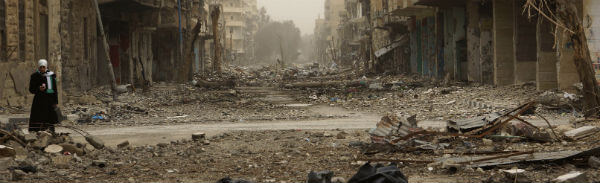
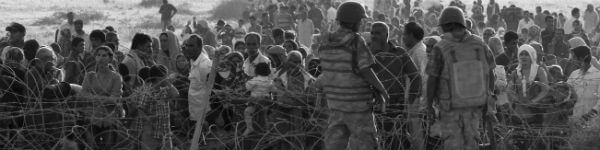
In an editorial, the New York Times says: The world is witnessing the largest exodus of refugees in generations, spawned by armed conflicts in the Middle East, North Africa and South Asia. But “witnessing” is perhaps the wrong word. Many world leaders, including those who run most of the richest countries, are choosing to look the other way. They are more interested in barricading their nations from the fallout of conflict than in investing in peacekeeping and stability.

This willful neglect was on display last week at the inaugural World Humanitarian Summit, convened to face the needs of the world’s most vulnerable people. Most heads of state from the richest nations — including the United States — didn’t bother to show up, drawing a rebuke from the United Nations secretary general, Ban Ki-moon.

“It’s disappointing that some world leaders could not be here, especially from the G-7 countries,” he said at a news conference on Tuesday. “We have reached a level of human suffering without parallel since the founding of the United Nations” 70 years ago. [Continue reading…]

Contrast Ki-moon’s words with the happy talk from Barack Obama two weeks ago when he gave the commencement address at Rutgers:

by almost every measure, America is better, and the world is better, than it was 50 years ago, or 30 years ago, or even eight years ago.

This assessment has I believe less to do with the dry statistical arguments made by the likes of Steven Pinker, than it has with the group-think inside the Obama administration.

The easiest way to counter criticism on Syria, with the refugee crisis, and elsewhere, is by insisting we did all that we could.

This self-administered anesthetic is designed to suppress remorse, guilt and a keen sense on personal responsibility.

Obama’s faith in inexorable progress derives from his refusal to “look backwards” — a conviction not unlike that of a hit-and-run driver who keeps his eyes firmly on the road ahead.

Likewise, the notion that the United States can extricate itself from its Middle East entanglements by simply walking away, is really no different from the attitude of a deadbeat father who thinks he can leave his past behind.

Our need to understand the past derives from our need to understand the present — it has nothing to do with (as Obama claims) a fear of the future.

The simplistic approach favored inside the White House reduces everything to a choice over which Obama had no control: the decision to invade Iraq.

Those who make that the beginning of history, have very often thereafter indulged in the conceit that by having personally opposed that misadventure, they can thereby shed any sense of collective responsibility for what followed — as though the neocons’ war never actually became America’s war.

What is ostensibly geographically circumscribed by a neat divide between domestic and foreign is really a separation between those things we claim as our own and those we don’t.

The convenient reflex to which most people are susceptible is simply to disown whatever becomes problematic.

We turn our backs on refugees because we prefer to believe that they are not our problem.

Facebooktwittermail

The Morning They Came For Us by Janine di Giovanni – heroic dispatches from Syria

Robin Yassin-Kassab writes: Reading this book by the war correspondent Janine di Giovanni is at once necessary, difficult and elating. Her reporting from the Syrian revolution and war is clear-eyed and engaged in the best sense – engaged in the human realm rather than the abstractly political.

Giovanni’s account is deeply personal. She was once obsessed with Bosnian crimes; in the introduction, she says that Syria may similarly “engulf her”. She finds herself unable to trim her baby son’s nails for thinking of an Iraqi who’d had his ripped out. Later, accepting a cigarette pack from a student of human rights, she notes the old cigarette burns on his arms.

Her Syrian visits fell between March and December 2012. During the first, she describes an uneasy silence in central Damascus even as the suburbs burned. Class in this society is a more significant divider than religion, and the bi-national elite are in denial, spinning conspiracy theories and attending pool parties. In these “last days of a spoilt empire that was about to implode”, Giovanni delineates the two different kinds of regime “believer” – true devotees, and those simply scared of the alternatives. A few hundred frustrated UN monitors are confined to their hotel, and war is “descending with stunning velocity”.

The book continues by recounting the ramifications for Syrian civilians of Assad’s various scorched earth strategies. An estimated 200,000 people disappeared into the regime gulag. Most have experienced torture. “I struggle to remember a place where torture has been so widespread and systematic,” a Human Rights Watch official tells Giovanni, who sets about uncovering some of the individual stories, by means of interviews and recollections of beatings, burnings and cuttings, perpetrated to the torturer’s usual refrain: “You want freedom? Is this the freedom you want?” [Continue reading…]

Facebooktwittermail

The last remaining Pentagon-trained rebel group in Syria is now in jeopardy

The Washington Post reports: Throughout the fiasco of the Pentagon’s $500 million effort to train and equip a force of Syrian rebels to take on the Islamic State, one small group endured.

The New Syrian Army completed the U.S. training course in Jordan, infiltrated into Syria and then, in March, without fanfare or publicity, seized a pinprick of territory from the militants at the remote Tanaf border crossing with Iraq in the far southeast corner of the Syrian province of Homs.

There they have remained, holding their ground without deserting, defecting or getting kidnapped, unlike many of the other similarly trained rebels whose mishaps prompted the temporary suspension of the program last year.

Even this modest success is now in jeopardy, however, following an Islamic State suicide attack this month. An armored vehicle barreled into the rebels’ base shortly before dawn on May 7, killing a number of them, said Lt. Col. Mohammed Tallaa, a Syrian officer who defected and is the group’s commander. [Continue reading…]

Facebooktwittermail

In Syria, a slow-motion genocide while diplomats chatter

Janine di Giovanni writes: The International Syria Support Group, consisting of 20 countries and organizations, met in Vienna earlier this month to once again attempt to decide the fate of the Syrian people. Predictably, the diplomats left the Austrian capital with little more than promises for a “cessation of hostilities.”

“The challenge we face now is to transform these possibilities into the reality of an agreement,” U.S. Secretary of State John F. Kerry declared, referring to a “basic framework” for a united, non-sectarian Syria.

Those words mean nothing to the fighters on the ground, who continue to push for more territory. In Aleppo, missiles fall and helicopters whir in the sky. In Daraya, a suburb of Damascus that has been besieged by Syrian government forces since 2012, 8,000 inhabitants are starving.

The Syria Campaign, an independent advocacy group, estimates that a Syrian dies every 51 minutes. On the day the diplomats gathered in Vienna, 28 civilians were killed, 94 rockets were launched and 40 barrel bombs dropped. There is a disconnect, to say the least, between the “peace process” and what is actually happening in real time. [Continue reading…]

Facebooktwittermail

Assad’s allies in the West

Shawn Carrié writes: If there’s one thing everyone can agree on about Syria, it’s that nobody can agree on anything.

After five years of constantly evolving strife, the world still looks on in occasional waves of horror, pity, outrage and apathy – before returning to the stoic conclusion that the conflict is just too complicated to understand.

The laws of war, human rights and geopolitics have gone out the window. With them, regrettably, the rules of responsible journalism seem to have gone, too.

At one time, open-source activists and “Facebook revolutionaries” made the Arab Spring history’s most documented tectonic societal shift. Today, Syria’s war is a dangerously polarised nebula of partisans, as much in the media as on the battlegrounds.

Few non-aligned journalists remain to report unbiased and trustworthy news. Without credible information, it’s hard to understand anything that happens in Syria, contributing to a political and public consensus of apathy. What’s left is a news landscape driven less by actual events than by a narrow set of available perspectives.

“The Syrian conflict involves a public relations war with a level of sophistication we’ve never seen before,” American writer Patrick Henningsen said in an report published by Russia Today. Ironically, it’s an accurate assessment of a reality which Russia had a primary role in fostering.

In areas where Russian intervention hasn’t decisively turned the tide militarily in favour of Syrian President Bashar al-Assad, the allies’ powerful public relations machine has been working to pick up the slack.

The alliance with Putin has availed Assad of the full gauntlet of Moscow’s superior state-controlled media apparatus. The result: a highly efficient and centralised narrative spread throughout the international press. For every report, a favourable counter-narrative filters down from the regime megaphone to a wide network of smaller websites and blogs. [Continue reading…]

Facebooktwittermail

ISIS advance traps 165,000 Syrians at closed Turkish border

Gerry Simpson, at Human Rights Watch, writes: There are two walls on the Turkey-Syria border.

One is manned by Turkish border guards enforcing Turkey’s 15 month-old border closure who, according to witnesses, have at times shot at and assaulted Syrian asylum seekers as they try to reach safety in Turkey – abuses strongly denied by the Turkish government.

The other is a wall of silence by the rest of the world, including the United Nations, which has chosen to turn a blind eye to Turkey’s breach of international law which prohibits forcing people back to places, including by rejecting them at the border, where their lives or freedom would be threatened.

Both walls are trapping 165,000 displaced Syrians now scattered in overcrowded informal settlements and fields just south of Turkey’s Öncupınar/Bab al-Salameh border crossing and in and around the nearby Syrian town of Azaz. [Continue reading…]

Facebooktwittermail

ISIS, losing territory in Syria, signals strategic shift

Taylor Luck reports: With the territory of the Islamic State cut by a third and Kurdish militias launching an offensive into its proclaimed capital of Raqqa, the group appears to be preparing its followers for a new, drawn-out phase of warfare.

In a rare recorded audio message released May 21, IS spokesman Abu Mohammed al-Adnani conceded that the group has lost territory to the US-backed international coalition and its allies, and vowed that IS will still strike the West even if it is “driven into the desert.”

He called on IS supporters across the world to carry out attacks during the month of Ramadan, which starts in early June.

“We will make this month, inshallah, a month of calamities for the infidels everywhere,” said Mr. Adnani, also known as Taha Subhi Falaha. “This call specifically goes out to the supporters of the Islamic Caliphate in Europe and America.”

The announcement signals a shift away from the traditional military campaign that enabled IS to rapidly capture large swaths of territory across Syria and Iraq and establish the so-called “Islamic Caliphate,” a jihadist’s utopia where its ultra-extremist interpretation of Islam is enforced in all aspects of life. [Continue reading…]

Facebooktwittermail

U.S. military special forces pictured aiding Kurdish fighters in Syria

The Guardian reports: Elite US military forces have been photographed for the first time in Syria as they join largely Kurdish forces on an advance toward, Raqqa, the Islamic State terror group’s capital.

A photographer with Agence France-Presse captured US special operations forces with Kurdish forces known as the YPG, part of the US-mentored Syrian Democratic Forces, in a rural village less than 40 miles from Raqqa. Some US troops wear the insignia of the YPG in an apparent show of support.

Peter Cook, the Pentagon press secretary, resisted commenting on the photographs and would only describe the US special operations forces’ mission in generic terms.

“Our special operations forces in the past have, yes, worn insignias and other identifying marks with their partner forces,” Cook told reporters on Thursday. [Continue reading…]

BBC News reports: Turkey has hit out at the US over images said to show US special forces in Syria wearing insignia of Kurdish militia, during joint operations against so-called Islamic State (IS).

Turkish Foreign Minister Mevlut Cavusoglu called the US “two-faced” and said the practice was “unacceptable”.

The images appear to show a US special forces soldier wearing the patch of the YPJ – a Kurdish militia group.

A Pentagon spokesman said troops often blended in with partners for safety. [Continue reading…]

Facebooktwittermail

‘Waiting for the world’: An interview with one of Aleppo’s last doctors

Christoph Reuter reports: For almost four years now, eastern Aleppo has been the target of bombing by the Syrian air force, with Russia joining the bombardment as of last September. The cease-fire announced in February only briefly changed the situation. Beginning in April, the Syrian army again increased its targeting of civilians.

The most tragic bombing occurred close to three weeks ago, when the regime’s warplanes fired rockets and destroyed the al-Quds hospital, which is supported by Doctors without Borders. More than 50 people died, including Muhammad Waseem Moaz, one of the last remaining pediatricians in the city.
Prior to the war, thousands of doctors worked in the city, which was once home to a million people. In the eastern part of Aleppo, only around 30 doctors remain today. Osama Abo El Ezz, a 30-year-old surgeon, is one of the few still holding out.

At the beginning of the telephone interview with SPIEGEL, the doctor said that our discussion might be repeatedly broken off if he had to perform an emergency operation or if jets approached the hospital.

SPIEGEL: Did the April 27 attack on the al-Quds hospital have an impact on you and your work?

Ezz: Absolutely, even if they aren’t bombing us, we still run to the cellar every time jets appear over the city. They are able to target much more precisely than they could before when they dropped their untargeted barrel bombs. They were savagely powerful, but they hit their target less often. Today they do hit their targets. And they obviously want to hit and kill the last doctors and nurses in eastern Aleppo. [Continue reading…]

Facebooktwittermail

Behind the barricades of Turkey’s hidden war against the Kurds

The New York Times reports: On the morning of Oct. 29, 2014, a long convoy of armored vehicles and trucks rolled northward in the shadow of Iraq’s Zagros Mountains and crossed a bridge over the Khabur River, which marks the border with Turkey. As the convoy rumbled past the border gate, the road for miles ahead was lined with thousands of ecstatic Kurds, who clapped, cheered and waved the Kurdish flag. Many had tears in their eyes. Some even kissed the tanks and trucks as they passed. The soldiers, Iraqi Kurds, were on their way through Turkey to help defend Kobani, a Syrian border city, against ISIS. Their route that day traced an arc from northern Iraq through southeastern Turkey and onward into northern Syria: the historical heartland of the Kurdish people. For the bystanders who cheered them on under a hazy autumn sky, the date was deliciously symbolic. It was Turkey’s Republic Day. What had long been a grim annual reminder of Turkish rule over the Kurds was transformed into rapture, as they watched Kurdish soldiers parade through three countries where they have long dreamed of founding their own republic.

Some who stood on the roadside that day have told me it changed their lives. The battle against the Islamic State had made the downtrodden Kurds into heroes. In the weeks and months that followed, the Kurds watched in amazement as fighters aligned with the Kurdistan Workers’ Party, or P.K.K. — long branded a terrorist group by Turkey and the United States — became the central protagonists in the defense of Kobani. The P.K.K.’s Syrian affiliate worked closely with the American military, identifying ISIS targets for airstrikes.

By the time ISIS withdrew from Kobani in January 2015, the Kurdish militants had paid a heavy price in blood. But they gained admirers all over the world. The Pentagon, impressed by their skill at guerrilla warfare, saw an essential new ally against ISIS. There was renewed talk in Europe of removing the P.K.K. from terrorism lists, often in news articles accompanied by images of beautiful female Kurdish soldiers in combat gear. For many Turkish Kurds, the lesson was unmistakable: Their time had come. I met a 27-year-old P.K.K. activist in Turkey, who asked not to be named, fearing reprisals from the government, and who first went to Kobani in 2012, when the Kurds began carving out a state for themselves in Syria called Rojava. “I remember talking to P.K.K. fighters, and I thought, They’re crazy to think they can do this,” she said. “Now I look back and think, If they can do it there, we can do it here.”

Nineteen months after that convoy passed, the feelings it inspired have helped to start a renewed war between Turkey and its Kurdish rebels. Turkish tanks are now blasting the ancient cities of the Kurdish southeast, where young P.K.K.-supported rebels have built barricades and declared “liberated zones.” More than a thousand people have been killed and as many as 350,000 displaced, according to figures from the International Crisis Group. The fighting, which intensified last fall, has spread to Ankara, the Turkish capital, where two suicide bombings by Kurdish militants in February and March killed 66 people. Another sharp escalation came in mid-May, when P.K.K. supporters released a video online seeming to show one of the group’s fighters bringing down a Turkish attack helicopter with a shoulder-fired missile, a weapon to which the Kurds have rarely had access. Yet much of the violence has been hidden from public view by state censorship and military “curfews” — a government word that scarcely conveys the reality of tanks encircling a Kurdish town and drilling it with shellfire for weeks or months on end.

The conflict has revived and in some ways exceeded the worst days of the P.K.K.’s war with the Turkish state in the 1990s. The fighting then was brutal, but it was mostly confined to remote mountains and villages. Now it is devastating cities as well and threatening to cripple an economy already burdened by ISIS bombings and waves of refugees from Syria. In Diyarbakir, the capital of a largely Kurdish province, artillery and bombs have destroyed much of the historic district, which contains Unesco world heritage sites. Churches, mosques and khans that have stood for centuries lie in ruins. Tourism has collapsed. Images of shattered houses and dead children are stirring outrage in other countries where Kurds live: Iraq, Syria and Iran. [Continue reading…]

Facebooktwittermail

What the world owes to the Syrian people

Syria1

Elizabeth Shakman Hurd writes: The suffering of Syrians comes to those of us outside the country in words and images. Violent scenes and anguished accounts pervade the international media. Reporters tell us who is fighting, and commentators ask why. How should the United States and others respond? What should be done about ISIS? About refugees? There are days when it seems we have reached a saturation point. No more talking, please — no more words.

But that impulse, however understandable, is mistaken. In their new book Burning Country: Syrians in Revolution and War, journalist Robin Yassin-Kassab and human rights activist Leila Al-Shami provide a bracing and timely reminder that no matter how long the war rages or how unreachable a political settlement may appear, the world owes it to the Syrian people — especially the peaceful revolutionaries — to listen to their stories and support their cause. Burning Country is a portrait of the opposition, a movement of protest against Bashar al-Assad’s brutal regime, which has been nearly forgotten amid the humanitarian strife, factionalism, and power politics surrounding and driving the conflict.

The regime’s extraordinary cruelty is well known, thanks to reporting such as Janine de Giovanni’s The Morning They Came For Us: Dispatches from Syria (2016), the latest in a long line of works detailing Assad’s bloody response to the revolution for democratic reform, economic opportunity, and an end to corruption and institutionalized violence. This revolution has its own lesser-known backstory, though, which Yassin-Kassab and al-Shami helpfully emphasize. Contrary to popular perception, 2011 was not the beginning. Calls for change emerged with the political openings accompanying the Damascus Spring movement in the early 2000s and the 2005 Damascus Declaration for Democratic National Change. Prominent civil and political figures of all backgrounds — secular and religious, Arab and Kurdish; the opposition, Muslim Brotherhood, Communist Labor Party — signed on. When I visited Damascus in 2009, the potential for democratic reform was palpable, if unspoken. Within limits, one could discuss and even debate issues such as women’s rights and Syria’s role in the region. My sense was that many Syrians, though mindful of the dangers, wanted change.

To appreciate the tenacity of the Syrian revolutionaries in the face of the regime’s violence, it is important for those outside the country to understand this history: the Syrian uprising was not a spur-of-the-moment reaction to the Arab Spring. It percolated just beneath the surface — and just beyond the headlines — for at least a decade before March 2011, when anti-regime graffiti drawn by schoolboys in the southern city of Daraa provoked Assad’s violent crackdown. It is also critical to recognize the depth of many Syrians’ disillusionment with a regime that has imprisoned, abused, and violated them. One evening during my 2009 visit, I had dinner with two weary but warm Syrian Kurds who had spent the prime of their lives in prison. I asked what outsiders could do to help people in their situation. “Tell our stories,” they replied. This is exactly what Yassin-Kassab and al-Shami do. [Continue reading…]

Facebooktwittermail

The Morning They Came for Us reports on the hell of Syria

Syria5

Michiko Kakutani writes: The title of Janine di Giovanni’s devastating new book, “The Morning They Came for Us,” refers to those terrible moments in ordinary Syrians’ lives when the war in their country becomes personal. Those moments when there is a knock on the door and the police or intelligence services take a family member away. Those moments when a government-delivered barrel bomb falls on your home, your school, your hospital, and daily life is forever ruptured.

“The water stops, taps run dry, banks go, and a sniper kills your brother,” she writes. Garbage is everywhere because there are no longer any functioning city services, and entire neighborhoods are turned into fields of rubble. Victorian diseases like polio, typhoid and cholera resurface. Children wear rubber sandals in the winter cold because they do not have shoes. People are forced to do without “toothpaste, money, vitamins, birth-control pills, X-rays, chemotherapy, insulin, painkillers.”

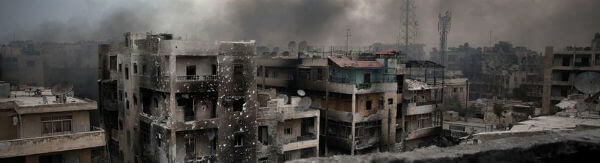
In the five years since the Assad regime cracked down on peaceful antigovernment protests and the conflict escalated into full-blown civil war, more than 250,000 Syrians have been killed and some 12 million people — more than half the country’s prewar population — have been displaced, including five million who have fled to neighboring countries and to Europe in what the United Nations calls the largest refugee crisis since World War II. [Continue reading…]

Facebooktwittermail

U.S.-backed offensive in Syria targets ISIS’s capital

The Washington Post reports: A Kurdish-led force backed by U.S. airstrikes launched an offensive on Tuesday to seize territory around the northern Syrian city of Raqqa, the first ground attack to directly challenge the Islamic State’s control of its self-proclaimed capital.

Although the operation appears to have relatively limited goals, it will serve as an early test of a coalition being forged with U.S. help between local Arab fighters and the Kurdish People’s Protection Units, or YPG, to take on the militant group in its most symbolically significant stronghold.

A few thousand Kurdish and Arab fighters — grouped under the umbrella of the U.S.-backed Syrian Democratic Forces (SDF) and backed by U.S.-led coalition airstrikes — began moving south from the existing front line about 30 miles north of Raqqa, according to a statement from the SDF and the U.S. military.

The operation aims to secure control of a stretch of territory in the mostly desert terrain north of Raqqa, said Col. Steve Warren, a spokesman for the U.S. military, speaking by telephone from Baghdad. [Continue reading…]

Facebooktwittermail

My son the ISIS executioner

BuzzFeed reports: When El Shafee Elsheikh was a little boy, after his father had left, his mother would find him at the workbench by the summerhouse at the bottom of the garden in White City, west London, tinkering endlessly with engine motors, bicycle parts, and old computers. Elsheikh was slight and elfin-featured, with wide almond eyes and pointed ears under a cloud of dark curls. He cut a sombre figure, intently turning the parts over in his small hands, finding out what made things work, how to fix them when they got broken. On warm nights, his mother says, he liked to sleep alone down here, in the makeshift old wooden summerhouse with a sheet drawn over the door.

Years later, in 2011, when Elsheikh had a grown into a striking young man in his early twenties, his mother found him here skulking with his CD player, listening to a torrent of hate. The words streaming out of his headphones, when she snatched them from him, were those of the notorious al-Qaeda-affiliated west London preacher Hani al-Sibai. By now Elsheikh had qualified as a mechanical engineer and was earning his living fixing cars and fairground rides. He was quiet, studious, and devoted to his family, and he made his mother proud. But on that day in the garden, she says, she feared for the first time that she was losing him to an ideology she did not understand.

Now, five years on, Maha Elgizouli stands down here by the summerhouse, struggling to conceive of how the son she still calls her “little one” turned into one of the world’s most wanted terrorists. Elsheikh has just been identified by BuzzFeed News and the Washington Post as a member of the notorious ISIS execution cell of four British guards known as the “Beatles” and responsible for beheading 27 hostages and torturing captives with electric shocks, waterboarding, and mock executions. He is the fourth and final member of the terror cell to be named, following the unmasking of the group’s knife-wielding executioner “Jihadi John” as Mohammed Emwazi, and the two other guards as fellow west Londoners Alexanda Kotey and Aine Davis. [Continue reading…]

Facebooktwittermail

Syria’s doctors on the frontline

Borzou Daragahi reports: Just a few more days, the pediatrician assured his friend, and he would come back. Doctor Hatem, as he is known in the tight-knit community of Syria war physicians, had an important exam to take in Istanbul, a half-hearted attempt at career development in the midst of the chaos that had engulfed his homeland. Hatem asked his fellow pediatrician and friend, Muhammad Waseem Moaz, to delay his own long-planned break a little while longer so he could sit for the test.

“You stay, and I will change places with you later,” he promised his friend.

The last couple weeks of April had been a particularly stressful stretch of the war. A shaky cessation of hostilities between pro- and anti-Syrian regime forces was crumbling in Aleppo, Syria’s commercial capital and largest city. Casualties were mounting again as helicopters and planes pounded the city with barrel bombs. One day a missile landed in the city, barely missing the Children’s Hospital, where Hatem is the senior doctor.

Then there was the daily battle to stock up on essential supplies. Transit routes to opposition-held territory in eastern Aleppo had closed as rebels lost control to fighters from the regime of Bashar al-Assad, to ISIS, or to Kurdish militias. Only the dangerous Castello Road leading to the northwest, through Idlib province, remained open. Doctors had stocked up on six months of supplies, but the regime appeared to be targeting their warehouses. “We used to get supplies through Kilis, but now everything is affected by the siege,” Hatem said. [Continue reading…]

Facebooktwittermail

Not just Russia: The Iranian surge in Syria

Aron Lund writes: When the Russian Air Force intervened in Syria on September 30, 2015, it changed the tide of battle. After a year of painful defeats in places such as Idlib, Jisr al-Shughour, Palmyra, and the Hawran region, Syrian President Bashar al-Assad’s government managed to regain its balance. By the end of the year, Assad’s forces were again moving forward in the northern Latakia region, east of Aleppo, and on several other fronts. In February 2016, his army cut a key rebel supply route between Aleppo and the Turkish border, and, in late March, Assad’s Russian-backed troops retook Palmyra from the self-proclaimed Islamic State. They are now moving on the Ghouta enclave east of Damascus, exploiting weeks of disastrous infighting among the local rebels.

Assad’s advances have slowed down recently, partly due to a brittle cessation of hostilities agreement monitored by the United States and Russia. The government even lost some ground in the Aleppo, Latakia, and eastern Homs regions. More significantly, the Syrian economy is in disastrous shape, and this might undermine Assad’s military progress. But there is no question that Assad’s position has greatly improved due to the Russian intervention, or that Moscow’s influence over the conduct of the war in Syria has grown significantly.

That is the conventional narrative, at least. However, it is missing something.

What happened in autumn 2015 was not just that Russia began operating in Syrian airspace. The reason the Russian intervention was so successful was that it was also accompanied by Iranian intervention on the ground. Let’s take a closer look at how that happened. [Continue reading…]

Facebooktwittermail

ISIS ‘destroys Syria airbase’ used by Russia

BBC News reports: A strategically significant Syrian airbase, used by Russia, appears to have been almost completely destroyed – according to new satellite imagery exclusively seen by the BBC.

The Tiyas facility – near the recently re-captured city of Palmyra in Syria – was repeatedly hit – with the so-called Islamic State presumed to be behind the attack. [Continue reading…]

Facebooktwittermail

In Syria, rebuilding bombed hospitals is an act of resistance

Charles Davis writes: The horror of the conflict in Syria, which began in March 2011, can be measured with statistics: over 400,000 people dead; half the population displaced; the life expectancy of a newborn child dropping from 76 years in 2011 to under 56 years in 2016. But the grotesque absurdity of this revolution turned civil war is perhaps best captured by the fact that today Syrians are forced to crowdsource money online to rebuild and fortify bombed hospitals.

“Now, thanks to this war, we are 10,000 years back and we dig hospitals in the mountains and in the ground,” Zaidoun al-Zoabi, head of the Union of Syrian Medical Relief Organizations (UOSSM), told me. “In our worst dreams — in our worst nightmares — we never thought we would have to fortify hospitals,” he said. “It’s not humane. It’s impossible to comprehend.”

Zoabi, a 42-year-old father of three daughters, spoke to me from Berlin, where he fled two years ago. Originally from Daraa, where the initially peaceful uprising against the government of Bashar al-Assad began, he fled when he “couldn’t stand anymore the brutality of the regime. Two times in jail was enough for me.” Now, like 4.8 million other Syrians, he witnesses the brutality from abroad.

Today, Syria lacks many things, including the democracy Zoabi and thousands of others were arrested and tortured for demanding, but there is no shortage of atrocities. [Continue reading…]

Interview with Dr. Zaher Sahloul, founder of the American Relief Coalition for Syria, senior advisor to and former president of the Syrian American Medical Society (SAMS), Associate Clinical Professor of Medicine at the University of Illinois at Chicago (UIC) and a practicing physician in pulmonary and critical care medicine (recorded on April 26, 2016 in the Center for Middle East Studies at the University of Denver).

Facebooktwittermail