Annie Sparrow writes: Syria, the world’s largest humanitarian crisis, is also the most expensive. OCHA, shorthand for the Office for the Coordination of Humanitarian Affairs, is the UN agency tasked with managing such crises, along with determining the global humanitarian budget, more than $20 billion in 2016, and allocating funds received from donor governments. OCHA’s forecast for 2016 is $3.2 billion for Syria alone, where it estimates that 13.5 million people are in need of humanitarian aid. Another $4.8 billion is solicited for the regional cost of putting up some four million refugees in Jordan, Lebanon, and Turkey.
Yet five years into the Syrian crisis, long-festering concerns over OCHA’s lack of neutrality are growing. Characteristic of many agencies of the United Nations, OCHA places a premium on maintaining good relations with the Syrian government, a position fueled by its desire to stay in Damascus. With no end to the conflict in sight, though, it is worth asking whether OCHA’s bottom line is harming the agency’s efforts to alleviate the catastrophic consequences of Damascus’ anti-civilian strategy. Indeed, the 2016 UN plan for Syria provides a real-time illustration of what happens when a UN agency loses sight of humanitarian principles and prioritizes relations with a government intent on violating them.
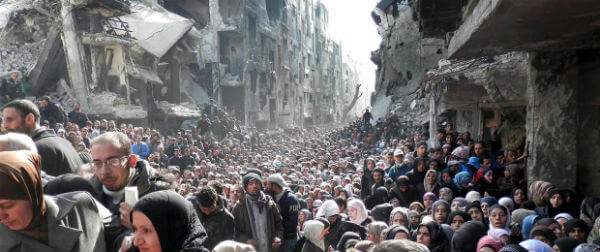
The UN plan must be understood in the context of Syria’s incredibly complicated humanitarian situation. The most recent estimates place 800,000 civilians under siege, denied access to safe water, food, health care, fuel, and warmth. Of these, more than 600,000 civilians are besieged by the government. An additional 200,000 civilians are held by the self-proclaimed Islamic State (also known as ISIS) in the city of Deir ez-Zor. OCHA relies on permission from the government to gain access to these people, but the government rarely grants it. Madaya, for example, is less than an hour’s drive from Damascus, yet between July 1, 2015, and January 12, 2016, OCHA could arrange only a single convoy, which contained expired food aid. The last convoy to Duma, where 175,000 civilians have been under siege since November 2012, was on July 2, 2015. Duma is barely ten miles from the Four Seasons in Damascus, where Yacoub El Hillo, OCHA’s resident/humanitarian coordinator, is based. [Continue reading…]
Category Archives: Syria
Residents in Syria’s Aleppo fear blockade as regime advances
AFP reports: Shop shelves are bare and prices have doubled in Syria’s Aleppo as the threat of a blockade looms after advancing regime forces cut off the second city’s main supply route last week.
“What will happen when food runs out? We’ll die of hunger,” said Abu Mohammed, who has seven children.
“Everybody here fears a blockade. We can feel it unavoidably coming,” said the 42-year-old salesman from the southeastern Fardoss neighbourhood.
Some 300,000 people are at risk of being placed under siege in Aleppo, a city that has been divided since 2012, with government forces controlling the west and rebels the east. [Continue reading…]
Inside the Syrian provincial capital where 200,000 face starvation
The Daily Beast reports: Deir Ezzor, a once relatively prosperous city of more than 300,000 people, is modern-day Syria in a microcosm. When anti-government protests broke out in 2011, the government sent in tanks. When rebels occupied the city, the ideals of those who protested state repression were betrayed by the arbitrary arrests and Islamist repression of al-Qaeda’s Syrian affiliate, Jabhat al-Nusra. Now, half the city is occupied by the Islamic State, which for more than a year has been besieging and starving the other half controlled by the Syrian government led by Bashar al-Assad — with the complicity, current and former residents say, of the government itself.
What’s left today of government-controlled Deir Ezzor is a poor and tired population. Some of those people are stubborn, or proud: having survived nearly five years of a war that has killed more than 250,000 of their fellow Syrians, they refuse to abandon their homes. Most, however — the vast majority — are there not because they choose to be, but because they have no choice. Many are refugees from other areas of Deir Ezzor province or from the city’s other half, taken over by the Islamic State in July 2014, on the other side of the Euphrates River. [Continue reading…]
Turkish president threatens to send millions of Syrian refugees to EU
AFP reports: Turkish President Recep Tayyip Erdoğan has threatened to send the millions of refugees in Turkey to EU member states, as Nato agreed to deploy ships to the Aegean Sea to ease the migrant crisis.
In a speech in Ankara on Thursday, Erdoğan stepped up his denunciations of western policy in the refugee crisis, confirming he had threatened EU leaders at a summit meeting in November that Turkey could say “goodbye” to the refugees.
But in a separate move, Nato agreed to send a naval group “without delay” to the Aegean to crack down on the people smugglers who have helped hundreds of thousands of migrants cross to EU territory in the last year.
Alarm is growing in EU capitals that thousands of refugees are still crossing the Aegean daily from Turkey after over a million made the perilous journey last year.
But Turkey, already home to some 3 million refugees, is also under EU and UN pressure to take in tens of thousands of Syrian refugees fleeing regime advances in the Aleppo region.
Erdoğan sought to turn the tables on the EU by saying Turkey had every right to send the refugees out of the country if it so wished. [Continue reading…]
Putin is a bigger threat to Europe’s existence than ISIS
George Soros writes: Putin is a gifted tactician, but not a strategic thinker. There is no reason to believe he intervened in Syria in order to aggravate the European refugee crisis. Indeed, his intervention was a strategic blunder because it embroiled him in a conflict with Turkey’s president, Recep Tayyip Erdoğan, which has hurt the interests of both.
But once Putin saw the opportunity to hasten the EU’s disintegration, he seized it. He has obfuscated his actions by talking of cooperating against a common enemy, Isis. He has followed a similar approach in Ukraine, signing the Minsk agreement but failing to carry out its provisions.
It is hard to understand why US and EU leaders take Putin at his word rather than judging him by his behaviour. The only explanation I can find is that democratic politicians seek to reassure their publics by painting a more favourable picture than reality justifies. The fact is that Putin’s Russia and the EU are engaged in a race against time: the question is which one will collapse first.
The Putin regime faces bankruptcy in 2017, when a large part of its foreign debt matures, and political turmoil may erupt sooner than that. The president’s popularity, which remains high, rests on a social compact requiring the government to deliver financial stability and a slowly but steadily rising standard of living. Western sanctions, coupled with the sharp decline in the price of oil, will force the regime to fail on both counts. [Continue reading…]
Aleppo airlift: Maybe the U.S. has not run out of options in Syria

After I posed the question, can the U.S. take action to protect Aleppo? a reader reasonably asked: What would a productive engagement look like? Indeed.
For several years, the off-the-shelf answer to this question has included imposing a no-fly zone. The frequency with which this option has been proposed — and then ignored or dismissed — has undermined its credibility. Even so, it’s worth remembering that the northern no-fly zone enforced following the First Gulf War in 1991 provided the basis for the development of enduring Kurdish self-rule in what has since become the most stable part of Iraq. American actions in the Middle East are not always destined to make things fall apart.
The U.S. and its allies could have imposed a no-fly zone in Syria. But President Obama delayed long enough for that option to get knocked off the table by Vladimir Putin.
The latest high-profile proponents of a no-fly zone, Michael Ignatieff and Leon Wieseltier, seem to be engaged in an exercise in wishful thinking.
I don’t doubt that their outrage over American inaction is heartfelt. Even so, they gloss over the fact that since Russia now controls Syrian airspace, there isn’t the faintest chance the Obama administration would be willing to try and impose a no-fly zone because — as officials keep on saying — the U.S. isn’t going to risk starting World War Three.
Does that mean, therefore, that U.S. Syria policy now rests in the hands of John Kerry and his efforts to breath life into a political track — an approach that has little more vitality than the Middle East peace process? If that’s true, then the conventional wisdom is probably right: nothing can be done.
Dualistic thinking is always convenient. Debate gets simplified if we only have to weigh up two options. Other options are easy to marginalize, not necessarily because they are unworthy of consideration but because the debate risks becoming open-ended if too much gets brought to the table. Thus the current debate has largely been reduced to military action versus diplomacy and with the former ruled out, Kerry ends up as the embodiment of U.S. Syria policy. Unfortunately for him, diplomatic successes are much harder to accrue than frequent flier miles — especially when the U.S. has no bargaining power.
The Russians now say that they intend to carry on bombing Syria through the rest of this month while proposing a truce in March. Translated into plain English, that means they will continue bombing until their current military objectives have been accomplished.
Russia’s UN Ambassador Vitaly Churkin says that their airstrikes are being conducted in a “transparent manner” and says Russia’s critics are politically exploiting humanitarian issues.
“They rather crudely use humanitarian matters in order to play, we believe, a destructive role as far as the political process is concerned,” he says.
So this is Russia’s position: It claims it’s military actions are constructive while it accuses the proponents of diplomacy of undermining the political process.
No one should be in any doubt: for Assad and his powerful allies, Geneva is now just a sideshow — a useful distraction and an occasional stage for diplomatic games.
With no military options and no effective diplomacy, it’s easy to see why so many have concluded that nothing can be done.
But there’s never nothing…
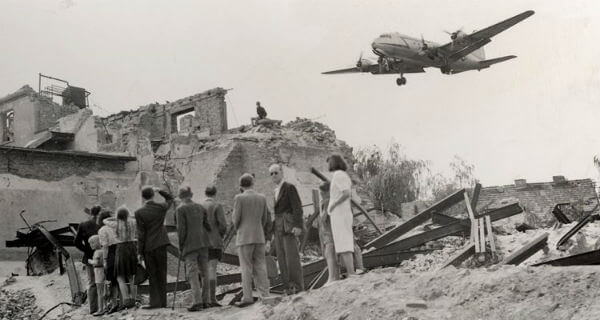
In 1948, having as many as one million soldiers based in Germany, the Soviet Union tightened a blockade around Berlin. At that time, the U.S. had 31,000 combat troops in West Germany. It seemed very reasonable to conclude that there was nothing the West could do to prevent the whole of Berlin coming under the control of the Soviets. The only way of preventing that outcome was to break the blockade and launch an airlift, unprecedented in scale.
The airlift began on June 24 and was anticipated to run for three weeks. The Communist press in East Berlin mocked the project, describing it as “the futile attempts of the Americans to save face and to maintain their untenable position in Berlin.”
Over the following weeks and months, the U.S., Britain, and France, succeeding in delivering up to 6,000 tons of supplies every day, as a result of which on May 12, 1949, the Soviets lifted the blockade. The operation continued through the end of September in order to amass a sufficient stockpile of supplies in the event that the airlift needed to be restarted.
In the course of the airlift’s operation, 2,326,406 tons of supplies were carried on 278,228 flights. And this was at a time that Europe was still weighed down by the economically crippling effects of World War Two.
The cost of the Berlin airlift was equivalent to less than the United States gives to Israel each year in military aid.
In August 2014, President Obama was persuaded to intervene in Iraq to provide humanitarian assistance to 40,000 Yazidis, trapped in the Sinjar Mountains, under threat from ISIS. The operation continued for a few days and the Yazidis were led to safety by Kurdish fighters from the PKK and YPG. This wasn’t reminiscent of 1948, but it was an emergency response.
At times of crisis the U.S. has often shown its willingness and capacity to make constructive interventions. (Acknowledging that fact doesn’t require we ignore America’s destructive impact on the world.)
What the U.S. did in Berlin and the Sinjar Mountains does not offer a template for humanitarian operations in Syria, although it might suggest new ways to consider the application of military resources to serve humanitarian goals.
Obama might be unwilling to risk direct conflict between American and Russian fighter jets patrolling the same skies, but when the U.S. started sending cargo planes into Berlin, in was on the assumption that the Soviets would not risk a war by attacking non-combatant aircraft. The same principle could apply to Syria. Whatever Churkin claims, delivering food, clothing, and medicine to those in need is a legitimate humanitarian endeavor.
UN Resolution 2165 was passed with Russia’s support to “ensure that humanitarian assistance, including medical and surgical supplies, reaches people in need throughout Syria through the most direct routes,” but the UN’s ability to make good on that promise is currently being obstructed by both Russia and the Assad regime.
Moreover, the UN has increasingly come under fire from Syrians who see humanitarian aid being used to support the Assad regime. “For many of us in Syria, the UN has turned from a symbol of hope into a symbol of complicity,” besieged Syrians wrote in a letter to Stephen O’Brien, the UN Undersecretary for Humanitarian Affairs.
There are cities across Syria under siege with populations facing starvation. If the U.S. was to start humanitarian airlift operations whose scope might initially be quite limited, it would send several important messages:
- Assad’s policy of siege warfare will not continue unchallenged
- The West has not turned its back on those Syrians now facing starvation
- Russia is not being given a free hand in shaping Syria’s future
This isn’t a political solution for the war in Syria and the logistical challenges would be huge, but facing emergencies has more to do with the willingness to act than it has with being able to construct the perfect plan.
Discovering what is possible often requires ignoring the many ways in which one risks failing. If the Berlin airlift had been proposed on the assumption that it would need to continue for 15 months, it would most likely have been dismissed as impossible and never undertaken.

Can the U.S. take action to protect Aleppo?

Michael Ignatieff and Leon Wieseltier write: Aleppo is an emergency, requiring emergency measures. Are we no longer capable of emergency action? It is also an opportunity, perhaps the last one, to save Syria. Aleppo is the new Sarajevo, the new Srebrenica, and its fate should be to the Syrian conflict what the fate of Sarajevo and Srebrenica were to the Bosnian conflict: the occasion for the United States to bestir itself, and for the West to say with one voice, “Enough.” It was after Srebrenica and Sarajevo — and after the air campaign with which the West finally responded to the atrocities — that the United States undertook the statecraft that led to the Dayton accords and ended the war in Bosnia.
The conventional wisdom is that nothing can be done in Syria, but the conventional wisdom is wrong. There is a path toward ending the horror in Aleppo — a perfectly realistic path that would honor our highest ideals, a way to recover our moral standing as well as our strategic position. Operating under a NATO umbrella, the United States could use its naval and air assets in the region to establish a no-fly zone from Aleppo to the Turkish border and make clear that it would prevent the continued bombardment of civilians and refugees by any party, including the Russians. [Continue reading…]
Any military strategy that’s designed “to recover our moral standing” is dubious — and not simply because there are those who doubt that the U.S. possessed much the moral standing in the first place.
The effectiveness of a military strategy can’t be assessed on the basis of the worthiness of its non-military goals.
The authors in their sweeping assertion that they are offering “a perfectly realistic path,” dodge the awkward details on how this would work.
Are they assuming that once the boundaries of this no-fly zone had been defined, Russian and Syrian aircraft would then obediently comply?
Or do they assume that as soon as a few jets had been shot down the intended lesson would have swiftly been learned?
Turkey already shot down a Russian jet on the edge of this arena. What lessons, if any, have been drawn from that incident and are they now being applied to this future scenario?
“If the Russians and Syrians sought to prevent humanitarian protection and resupply of the city, they would face the military consequences,” we are told by the armchair generals.
“Military consequences” is a phrase of political bluster — especially when coming from two writers who profess no military expertise. If pressed to spell out what these military consequences might be, I expect Ignatieff and Wieseltier would defer to the actual generals.
My point here is not to dismiss the idea that at this late hour there might be a constructive military intervention in Syria, but simply to say that such an argument needs more detail and substance and fewer passionate declarations. It needs to credibly show how this would work rather than simply why it should be undertaken.
Currently, Obama administration officials are cynically curtailing all discussion about their military options by claiming that they only have two choices: start World War III or do essentially nothing (beyond repeating their mantra that their is no military solution in Syria).
“What do you want me to do, go to war with Russia?” John Kerry is reported to have asked a Syrian NGO representative in London last week.
The choice is false but it is gladly being picked up by ideological anti-interventionists who are attracted by the rhetorical utility of this device when offered to those who have little interest in questioning its validity.
To those who insist on framing this crisis in terms of World War III, I would ask two questions: What makes you think it hasn’t already begun? And why do you think its defining attribute necessarily involves a clash between the U.S. and Russia?
A world war involves global instability and a contagion of violent conflict. There are active conflicts in Pakistan, Afghanistan, Yemen, Iraq, Syria, Turkey, Egypt, and Libya. There is unrest in Saudi Arabia, Bahrain, Palestine, Israel, and elsewhere.
As the EU struggles to handle the refugee crisis, European unity is being fractured, placing its future in jeopardy.
If through the power of inattention, Americans could indeed successfully insulate themselves from the effects of global strife, then perhaps this could endure as a land of blissful ignorance.
Instead, what is more predictable is that the more disengaged the U.S. becomes, the less influence it will have and the fewer options it can consider.
No one will benefit from America’s self-imposed paralysis.
Since the war began, 177 hospitals have been destroyed in Syria
AFP reports: An airstrike hit a hospital in southern Syria that is supported by Médecins Sans Frontières, killing three people and wounding six, the medical charity has said.
“The strike on Tafas field hospital, some 12 km (seven miles) from the Jordanian border, took place on the night of 5 February,” MSF said in a statement on Tuesday, adding that a nurse was among the casualties. “It caused partial damage to the hospital building, and put its heavily used ambulance service out of action.
“The hospital is the latest medical facility to be hit in a series of airstrikes in southern Syria, which have been escalating over the past two months.”
In addition to the Syrian government, Russia and a US-led coalition targeting the Islamic State group are also carrying out raids in the war-torn country.
A Syrian aid group in January said 177 hospitals had been destroyed and nearly 700 health workers killed since the outbreak of the country’s civil war in March 2011.
It is not the first time MSF-supported facilities in Syria have been hit.
“Since the start of this year alone, 13 health facilities in Syria have been hit, confirming that hospitals and clinics are no longer places where patients can recover in safety,” the charity said. [Continue reading…]
The cheap, brutally effective medieval tactic shaping the Syrian civil war

Annia Ciezadlo writes: On Feb. 3, the United Nations suspended talks between the regime of Syrian President Bashar al-Assad and representatives of the Syrian opposition. The Geneva talks, which were aimed at ending the five-year-old civil war, had bogged down in distrust and regional politics before they even got underway.
The UN mediator, Staffan de Mistura, hinted that the initial round of discussions collapsed because the Syrian regime refused to lift the sieges that are slowly starving hundreds of thousands of people across the country. Assad’s regime has been using starvation as a weapon — technically a war crime, when used against civilians — for the past four years.
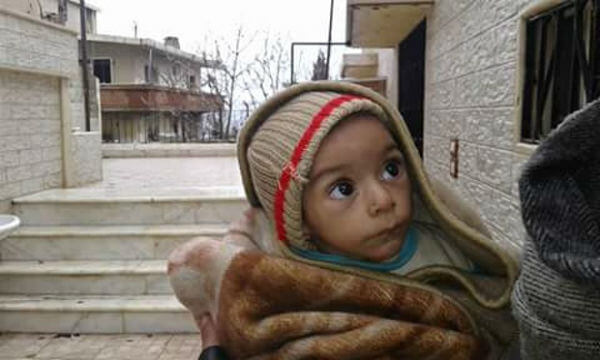
As the war has progressed, various rebel factions, like Islamic State and Nusra Front, have also adopted the strategy. But the vast majority of the people under siege in Syria are being starved by their own government. Today, up to a million people are being slowly and deliberately starved to death in the heart of the Fertile Crescent, many of them a stone’s throw away from grain silos full of wheat. [Continue reading…]
France’s Fabius accuses U.S. of ‘ambiguous’ Syria policy
Reuters reports: French Foreign Minister Laurent Fabius on Wednesday questioned the commitment of the United States to resolving the crisis in Syria, saying its “ambiguous” policy was contributing to the problem.
“There are ambiguities, including among the actors of the coalition … I’m not going to repeat what I’ve said before about the main pilot of the coalition,” Fabius told reporters, in a clear reference to the United States.
“But we don’t have the feeling that there is a very strong commitment that is there.” [Continue reading…]
Syrian opposition see Obama’s support having been worthless
The New York Times reports: The United States and its allies have spent many millions of dollars backing Syrian opposition fighters they deem relatively moderate and secular, and civilian groups whose work on small businesses and local councils they billed as the cornerstone of Syria’s future.
But the very Syrians who benefited — and risked their lives in the process — now say that investment is in danger of going down the drain, and they see little urgency from Washington, diplomatic or military, to save it.
“What are you going to do, other than statements?” Zakaria Malahifji, the political chief of one of the largest rebel groups given weapons and salaries by the C.I.A. and its counterparts in several European and Arab states, demanded in a recent message to contacts at the French Embassy.
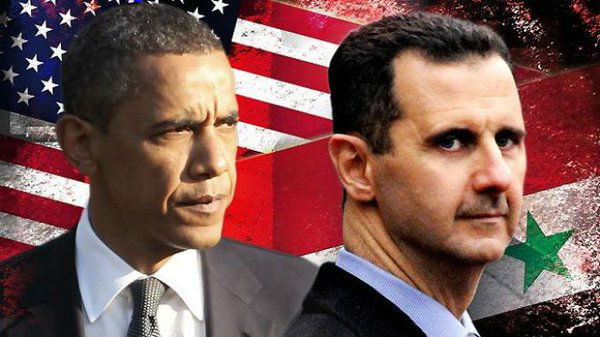
In nearly five years of war and insurrection, many Syrians have been repeatedly disillusioned by what they saw as a mismatch between tough American rhetoric against the Syrian government and comparatively modest efforts to aid some of its opponents. President Obama said President Bashar al-Assad must go, and drew a red line over the use of chemical weapons, but backed off on both, diminishing anti-government Syrians’ trust.
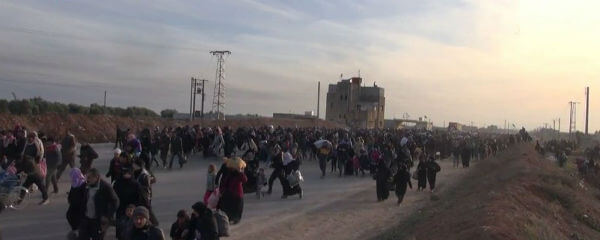
But the confusion and despair has reached a new level over the last week, as forces backing Mr. Assad have pushed farther north into Aleppo Province, sending tens of thousands of new refugees to the Turkish border. With insurgent groups losing troops and territory, their villages shattered by Russian warplanes, civilians and fighters have in recent days used phrases like “no hope,” “it’s finished” and “it’s over.”
“Bye-bye, revolution,” Abu al-Haytham, a spokesman for Thuwwar al-Sham, another rebel group supported through the C.I.A. program, said in a text message on Friday from Tal Rifaat, a town in northern Aleppo that is increasingly threatened by the government advance.
American-backed insurgents have long been used to the American stance in recent years, that the United States did not want them to actually win the war — lest a sudden toppling of Mr. Assad lead to Islamist rule — but wanted to prevent them from losing for long enough to pressure the government to negotiate for a political solution.
Now they fear that the United States and its allies may actually let them lose. [Continue reading…]
Why are Russian engineers working at an ISIS-controlled gas plant in Syria?
Foreign Policy reports: The Syrian government originally awarded the contract to construct the Tuweinan facility [the largest such facility in Syria, located 60 miles southwest of Raqqa] to Stroytransgaz in 2007. The construction utilized a Syrian subcontractor, Hesco, which was owned by Russian-Syrian dual national George Haswani. Last November, the Treasury Department sanctioned Haswani for allegedly brokering oil sales between the Islamic State and the Assad regime, charges he denies.
The partnership between Hesco and Stroytransgaz goes far beyond this one deal. The companies have worked in joint projects in Sudan, Algeria, Iraq, and the UAE since 2000, according to Haswani’s son-in-law, Yusef Arbash, who runs Hesco’s Moscow office.
Construction continued slowly until a coalition of Syrian rebel groups seized the facility in a joint operation with the al Qaeda-affiliated al-Nusra Front in January 2013. Abu Khalid, a member of the Qwais al-Qarani brigade, which was a part of the rebel coalition, said that when they entered the area, Russian engineers and advisors had already fled, leaving Syrian employees behind. “We decided to protect this plant; we thought it is belonging to Syrian people since it was owned by the Syrian state,” he said.
The Islamic State has been in control of the facility since early 2014. A senior Turkish official said that after its seizure, Stroytransgaz, through its subcontractor Hesco, continued the facility’s construction with the Islamic State’s permission. He also claimed that Russian engineers have been working at the facility to complete the project.
Syrian state-run newspaper Tishreen published a report appearing to corroborate this claim. In January 2014, after the facility was captured by the Islamic State, the paper cited Syrian government sources, saying that Stroytransgaz had completed 80 percent of the project and expected to hand over the facility to the regime during the second half of the year. The article didn’t mention that the facility was under the control of the Islamic State. [Continue reading…]
Exodus and betrayal: How a Syrian Nakba was created

David Hearst writes: US Secretary of State John Kerry came close to revealing his true thoughts when he was accosted by two Syrian aid workers at a reception in London after the collapse of the Geneva talks last week.
The Syrians accused him of doing nothing to protect civilians from the onslaught they are facing in Aleppo. Kerry replied: “Don’t blame me – go and blame your opposition,” laying the fault for the government’s offensive on the opposition walking out of the talks.
Kerry got flustered in the encounter: “What do you want me to do? Go to war with Russia? Is that what you want?” the aid worker said Kerry told her. Kerry then anticipated three months of bombing during which time “the opposition will be decimated”.
Kerry’s off-mic encounter deviated significantly from the official line which was that Russia and Iran had offered Washington a ceasefire. Kerry’s remarks differed also from the State Department mantra that the brutality of Assad against the Syrian people had helped foster the growth of the Islamic State group. Apparently now, Syrians who resisted Assad’s brutality were responsible for the barrel bombs being dropped on them.
After multiple avowals that Assad’s army was on the point of collapse and the ill-fated CIA training programmes, Syrian rebels are being sold down the river by the country that urged them to rise up five years ago.
The Deraa protests started peacefully. To that everyone attests. Four factors turned those protests into an armed uprising: the brutality of the regime’s response, Assad’s decision to release Jihadis from Sednaya Prison, an act which “Islamised” the opposition, the Libyan intervention, and the intervention of foreign powers – Iran and Saudi Arabia.
The scenes today on the Turkish border are a direct consequence of Obama’s “intervention-lite” in Syria – a drip feed of weapons – but only 16 bullets per fighter per month. The Free Syrian Army has reportedly stopped receiving weapons for four months. In Libya, Obama boasted he was leading from behind. In Syria he is now wringing his hands from behind. [Continue reading…]
U.S. credibility is plummeting among Syrians and across the region
Josh Rogin writes: In the eyes of the Syrian opposition, Russia and Iran are making a mockery of the peace process, and Kerry’s reluctance to acknowledge this is putting them in deadly harm. It also creates more problems for America’s regional allies, aids the Islamic State and dims the prospects for future peace talks. “The failures of the negotiations end up lowering the credibility of the moderate opposition in front of the Syrian people,” said [Riyad] Hijab. [Hijab is leader of the High Negotiating Committee that represented the Syrian opposition at last week’s meetings in Geneva.] “United States credibility is plummeting within the population of Syria but also in the region as a whole.”
This week, it is Syrians near Aleppo who are paying the price. Regime forces, with Russian support, are advancing toward the Turkish border, threatening to cut off opposition groups and civilians from their source of aid. At least 35,000 people have joined the flood of refugees since the collapse of the talks, ahead of what many anticipate will be another in a long line of starvation sieges the regime is perpetrating on cities. Hijab said there are now 18 cities under siege, three more than when the talks began.
Moscow wants the peace talks to fail, Hijab said. He accused the Russian air force of using illegal cluster bombs indiscriminately against civilians. (Human rights groups support those claims.) “The situation has taken a horrible turn, specifically in terms of the scorched earth policy of the Russian aircraft and the way that they are bombing, literally destroying everything,” he said. “The other side has been moving to ensure the failure of any negotiation through horrendous bombardment.”
Hajib said the Obama administration is still pressuring the opposition to return to talks despite the ongoing offensive, but the opposition is insisting that Russia adhere by the UN resolutions first. In a press conference with reporters last week, Kerry said of the Syrian-Russian attacks on civilians, “It’s not going to stop just by whining about it.” He called on rebel leaders to return to the negotiating table. [Continue reading…]
While listening to U.S. State Department spokesmen John Kirby at yesterday’s press briefing, one might not have accused him of whining, but instead adopting President Obama’s standard position: a baseless confidence that whoever can make the most reasonable argument will win the day — as though politics conforms to the rules of a debating society.
Kerry and Obama must be very perplexed about how unreasonable it is that Russia regards bombing as more useful than diplomacy. But what is actually very unreasonable is the notion that anyone would be fooled by Washington’s toothless efforts at peacemaking.
UN fears for hundreds of thousands if Syria troops encircle Aleppo
Reuters reports: Hundreds of thousands of civilians could be cut off from food if Syrian government forces encircle rebel-held parts of Aleppo, the United Nations said on Tuesday, warning of a massive new flight of refugees from a Russian-backed assault.
Syrian government forces, backed by Russian air strikes and Iranian and Lebanese Hezbollah fighters, have launched a major offensive in the countryside around Aleppo, which has been divided between government and rebel control for years.
The assault to surround Aleppo, once Syria’s biggest city with 2 million people, amounts to one of the most important shifts of momentum in the five year civil war that has killed 250,000 people and already driven 11 million from their homes. [Continue reading…]
In Madaya residents still face starvation as the only clinic loses its only doctor

Vice News reports: After three years under siege, mass starvation, and relentless airstrikes, the people of Madaya didn’t think it could get much worse. Then their only doctor disappeared in the middle of the night.
In the besieged Syrian town, which made international headlines in January when photos of its starving residents spread around the world, the only medical care facility, slightly euphemistically called the field hospital, is now run by two dentists, an agricultural engineer and a vet. Sources told VICE News that an anaesthesiology nurse known as Doctor Khaled, who ran the clinic until mid-January, had to pay a smuggler thousands of dollars to get out of the town when he heard a hit man had been hired to kill him for talking to the media.
The tiny clinic lies in one room of a basement, moved there after staff were driven out of the main hospital by shelling. Inside there’s an operating table, a stand for IV drips and some basic medication — mainly boxes of glucose solution. For the 90 patients who seek treatment there every day, mostly for malnutrition or influenza, there are few options for treatment. [Continue reading…]
Syria: Assad regime kills so many detainees it amounts to ‘extermination’ of civilian population, UN says
The Independent reports: The Assad regime is killing so many detainees in Syria that it now amounts to the crime against humanity of “extermination”, a UN report has found.
In a document published by the UN’s High Commissioner for Human Rights, investigators found the Syrian government responsible for “massive and systematised violence”.
The crimes against humanity committed by the Assad regime, according to the UN, far outnumber those of Isis militants and other jihadist groups. [Continue reading…]
Turkey’s Erdogan reported to have threatened to flood Europe with migrants
Reuters reports: Turkish President Tayyip Erdogan threatened in November to flood Europe with migrants if European Union leaders did not offer him a better deal to help manage the Middle East refugee crisis, a Greek news website said on Monday.
Publishing what it said were minutes of a tense meeting last November, the euro2day.gr financial news website revealed deep mutual irritation and distrust in talks between Erdogan and the EU’s two top officials, Jean-Claude Juncker and Donald Tusk.
The EU officials were trying to enlist Ankara’s help in stemming an influx of Syrian refugees and migrants into Europe. Over a million arrived last year, most crossing the narrow sea gap between Turkey and islands belonging to EU member Greece.
Tusk’s European Council and Juncker’s European Commission declined to confirm or deny the authenticity of the document, and Erdogan’s office in Ankara had no immediate comment.
The account of the meeting, in English, was produced in facsimile on the website. It does not state when or where the meeting took place, but it appears to have been on Nov. 16 in Antalya, Turkey, where the three met after a G20 summit there. [Continue reading…]